


Best GraphQL API Management Platforms: Detailed Comparison
This blog dives deep into the best GraphQL API management platforms, offering a detailed comparison to help you navigate this critical decision and ensure your GraphQL initiatives are built for long-term success.

TL;DR
1. GraphQL APIs offer unmatched flexibility but require specialized management platforms to handle their unique challenges like query complexity and deep data access.
2. Key features to look for include schema management, advanced caching, robust security (rate limiting, authorization), developer portals, and analytics.
3. Top platforms like Apollo GraphOS, Kong Gateway, Tyk, Gravitee.io, and DigitalAPI each offer distinct strengths, from GraphQL-native tooling to broad multi-protocol support.
4. Choosing the right platform depends on your existing infrastructure (multi-gateway vs. single), team's GraphQL expertise, scalability needs, and specific security and governance requirements.
5. DigitalAPI stands out with its unified multi-gateway approach, AI-ready architecture, and comprehensive lifecycle management, offering a robust solution for diverse enterprise environments.
Explore how DigitalAPI can unify your GraphQL and REST API management. Book a Demo!
As digital experiences grow more sophisticated, the underlying data architecture often dictates success. REST APIs, long the workhorse of backend communication, are increasingly complemented by GraphQL, a query language that offers unparalleled flexibility and efficiency for modern applications. This shift, however, introduces unique complexities in managing, securing, and scaling APIs. While GraphQL promises streamlined data fetching and reduced over-fetching, realizing its full potential demands robust API management strategies tailored to its unique paradigm.
This blog dives deep into the best GraphQL API management platforms, offering a detailed comparison to help you navigate this critical decision and ensure your GraphQL initiatives are built for long-term success.
Understanding GraphQL API Management
GraphQL, unlike REST, isn't about fixed endpoints returning predefined data structures. Instead, clients define exactly what data they need, leading to highly efficient data fetching and reducing over-fetching or under-fetching issues. This dynamic nature, while powerful, presents a different set of challenges for API management.
GraphQL API management focuses on addressing these unique characteristics to ensure security, performance, governance, and a seamless developer experience. It goes beyond basic API gateway functions to deeply understand and control GraphQL operations.
Key differences that necessitate specialized management include:
- Single Endpoint: Most GraphQL APIs operate over a single HTTP endpoint, requiring granular control over queries rather than paths.
- Query Complexity: Clients can request deeply nested data, which can lead to complex and resource-intensive queries, making traditional rate limiting insufficient.
- Schema-driven: The GraphQL schema is the contract, and managing its evolution, versioning, and discoverability is paramount.
- Introspection: While useful for discovery, introspection can also expose sensitive schema details if not properly managed.
Why GraphQL API Management Platforms Are Essential
Adopting GraphQL without a robust management strategy can quickly lead to security vulnerabilities, performance bottlenecks, and governance nightmares. Dedicated GraphQL API management platforms provide the necessary tools to harness its power safely and efficiently.
Enhanced Security
GraphQL's flexibility is a double-edged sword. Malicious or overly complex queries can lead to denial-of-service (DoS) attacks or data over-exposure. Platforms offer:
- Query Depth Limiting: Prevents excessively deep queries that can exhaust server resources.
- Query Complexity Analysis: Assigns a "cost" to each field and limits total query complexity to prevent resource hogging.
- Persisted Queries: Allows only pre-registered, known-good queries to be executed, significantly reducing attack surface.
- Access Control: Fine-grained authorization at the field and type level, ensuring users only access permitted data. You can learn more about API access management and API authentication.
Improved Performance and Scalability
Managing query performance is crucial for GraphQL. Platforms provide:
- Advanced Caching: Intelligently caches query results, even for dynamic queries, reducing database load.
- Batching and Deduping: Optimizes data fetching by combining multiple requests into a single backend call.
- Rate Limiting: Beyond simple request counts, GraphQL-aware rate limiting can consider query complexity or field access.
Robust Governance and Lifecycle Management
A structured approach to managing your GraphQL schema and its evolution is vital for team collaboration and API consistency. Platforms enable:
- Schema Registry: A centralized hub for managing, versioning, and sharing GraphQL schemas.
- Schema Versioning: Tools to handle schema changes gracefully, minimizing breaking changes. See our guide on API versioning.
- Automated Documentation: Generates up-to-date documentation directly from the schema, improving developer experience.
- Policy Enforcement: Ensures that all GraphQL APIs adhere to organizational API management policies and standards.
Enhanced Developer Experience
A well-managed GraphQL API simplifies consumption for internal and external developers alike.
- Developer Portals: Self-service portals offer interactive documentation, sandboxes, and analytics. Read about API developer portals.
- Testing Tools: Integration with tools for API sandbox testing and contract testing.
- Monitoring and Analytics: Provides insights into query usage, performance, and errors. Explore API monitoring tools.
Monetization and Analytics
For businesses leveraging APIs as products, management platforms offer tools for tracking usage and billing.
- Usage Tracking: Detailed insights into who is consuming which fields and types.
- Billing Models: Support for various API monetization models based on query complexity or data volume.
Key Features to Look for in a GraphQL API Management Platform
When evaluating GraphQL API management platforms, consider the following essential features:
- Schema Registry & Management: A central repository for GraphQL schemas, enabling versioning, change tracking, and discovery. This is foundational for any GraphQL strategy.
- Query Depth & Complexity Limiting: Essential security features to prevent DoS attacks and resource exhaustion from overly complex queries.
- Persisted Queries: Support for running only pre-approved, hashed queries, enhancing security and potentially performance.
- Field-level Authorization & Access Control: Granular control over which users or roles can access specific fields and types within your GraphQL schema.
- Caching: Intelligent caching mechanisms that can handle the dynamic nature of GraphQL queries.
- Rate Limiting & Throttling: Advanced rate limiting that can factor in query complexity, not just request count.
- API Gateway Functionality: Core API gateway features like routing, load balancing, authentication (API keys, OAuth), and policy enforcement.
- Developer Portal: A self-service portal with interactive documentation, sandboxes, and client generation.
- Monitoring & Analytics: Detailed insights into API usage, performance metrics, errors, and GraphQL-specific metrics like field usage. Learn more about API observability.
- Federation Support: Tools to build a unified GraphQL supergraph from multiple underlying GraphQL services, crucial for microservices architectures.
- Hybrid/Multi-Cloud Deployment: Flexibility to deploy across various cloud environments and on-premises infrastructure.
- Extensibility & Customization: Ability to extend functionality with plugins, custom policies, or integrations with existing systems.
Detailed Comparison of Top GraphQL API Management Platforms
Let's dive into a comparison of some of the leading platforms that offer robust GraphQL API management capabilities. We'll examine their core strengths, GraphQL-specific features, and ideal use cases.
1. DigitalAPI
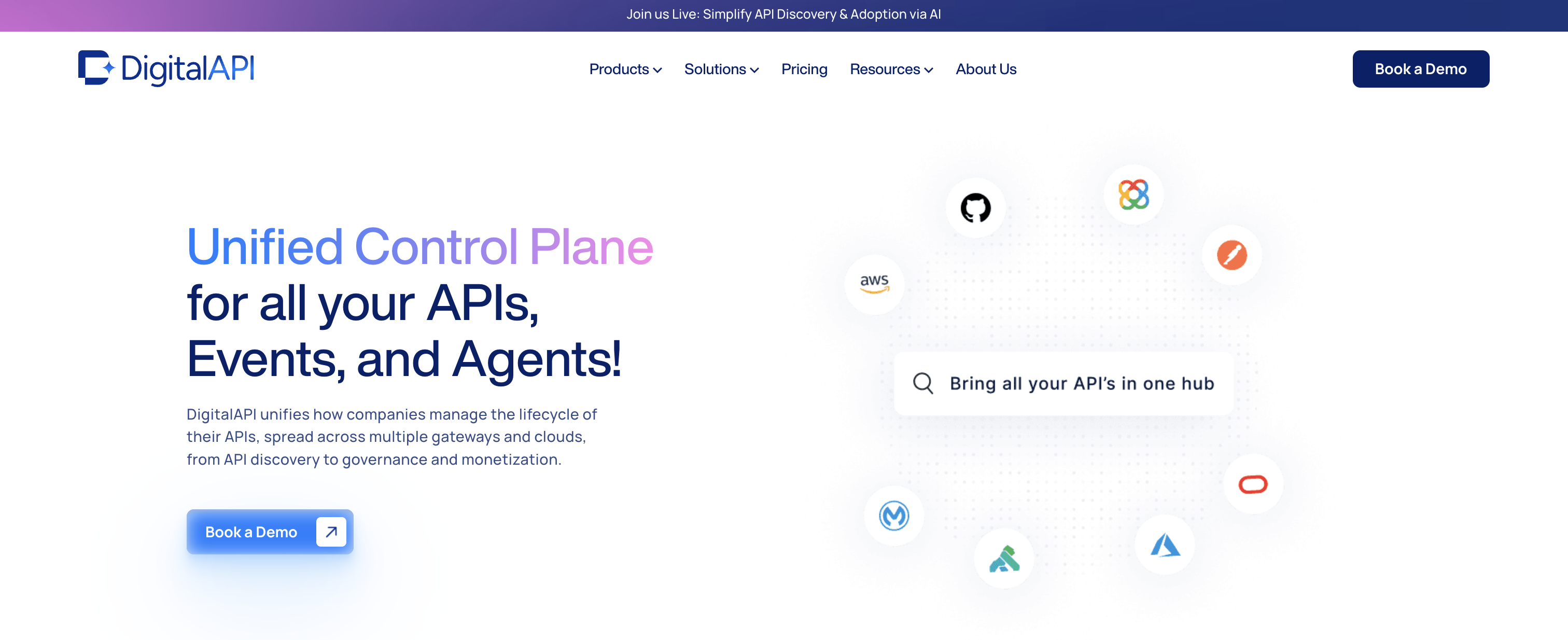
DigitalAPI is designed as a comprehensive API management platform that brings a unified approach to managing heterogeneous API landscapes, including GraphQL. It aims to solve the challenges of API sprawl across multiple gateways and clouds by centralizing discovery, governance, and developer experience. Its focus on AI-readiness and unified management makes it a strong contender for enterprises with diverse API estates.
Key GraphQL-Specific Features:
- Unified Cataloging: Automatically discovers and catalogs GraphQL APIs alongside REST, gRPC, and SOAP from various gateways (Apigee, Kong, AWS, Azure, MuleSoft) and source repositories.
- Automated Documentation: Generates interactive documentation for GraphQL schemas, ensuring it's always up-to-date and accessible via a developer portal.
- Governance & Policy Enforcement: Applies consistent API governance rules, security policies, and lifecycle management across all API types, including GraphQL, ensuring compliance and quality.
- AI-Ready Architecture: Structures GraphQL schemas and metadata in a machine-readable format, preparing them for consumption by AI agents and automated workflows.
- Developer Experience: Offers a customizable developer portal with search, filtering, and API cards that unify GraphQL alongside other APIs for easy discovery and consumption.
Pros:
- Excellent for multi-gateway, multi-cloud environments, reducing operational complexity.
- Strong focus on enterprise governance and API lifecycle management across a diverse API portfolio.
- AI-ready features future-proof API strategies.
- Centralized developer experience for all API types.
Cons:
- May require some integration effort with existing non-standard GraphQL implementations.
- As a comprehensive platform, it might be more extensive than what a purely GraphQL-native small startup needs.
Ideal Use Cases:
- Large enterprises with sprawling API estates (REST, GraphQL, etc.) across multiple gateways and cloud providers.
- Organizations looking to standardize API design, governance, and documentation across diverse teams.
- Companies preparing their APIs for future AI-driven automation and intelligent agent consumption.
2. Apollo GraphOS
Apollo GraphOS (formerly Apollo Platform) is a comprehensive, GraphQL-native platform built by the creators of Apollo Client and Server. It focuses on helping organizations build, manage, and scale a "supergraph" – a unified GraphQL layer composed of multiple underlying services. Apollo is particularly strong in GraphQL federation and provides tools tailored specifically for the GraphQL ecosystem.
Key GraphQL-Specific Features:
- Apollo Studio & Schema Registry: Centralized hub for schema management, version control, and collaboration, offering a powerful UI for introspection and testing.
- Apollo Federation: Enables building a distributed GraphQL architecture by composing multiple GraphQL services into a single supergraph.
- Query Tracing & Analytics: Deep insights into GraphQL query performance, field-level usage, and error rates, crucial for optimization.
- Caching: Offers robust caching capabilities, including response caching and per-field caching.
- Schema Checks: Automatically analyzes schema changes for breaking changes before deployment.
Pros:
- Industry leader in GraphQL tooling and ecosystem.
- Exceptional support for GraphQL federation, ideal for microservices.
- Robust schema management and governance.
- Deep analytics and performance monitoring tailored for GraphQL.
Cons:
- Primarily focused on GraphQL, so if you have a significant REST API estate, you'll need another solution for those APIs.
- Can be more opinionated, requiring adherence to the Apollo ecosystem.
Ideal Use Cases:
- Organizations building large, distributed GraphQL APIs using a microservices architecture.
- Companies committed to a GraphQL-first strategy and leveraging federation.
- Teams needing deep performance insights and schema governance for their GraphQL services.
3. Kong Gateway
Kong Gateway is a popular open-source and enterprise-grade API gateway that supports a wide range of protocols, including GraphQL. Known for its performance, extensibility via plugins, and flexibility, Kong can be deployed anywhere and acts as a central control plane for all API traffic.
Key GraphQL-Specific Features:
- GraphQL Proxy Plugin: Kong can act as a proxy for GraphQL endpoints, allowing you to apply policies and plugins to GraphQL traffic.
- Introspection Disable: Ability to disable GraphQL introspection for production environments to enhance security.
- Query Depth & Complexity Limiting (via plugins): While not native, plugins can be used to enforce query depth and complexity limits.
- Authentication & Authorization: Leverages Kong's extensive suite of authentication and authorization plugins (OAuth, JWT, API Keys) for GraphQL endpoints.
- Rate Limiting: Standard rate limiting can be applied to GraphQL requests.
Pros:
- Highly performant and scalable, suitable for high-traffic environments.
- Extensive plugin ecosystem for various functionalities, including security and transformation.
- Supports multiple protocols (REST, GraphQL, gRPC), making it a versatile API gateway for microservices.
- Open-source version offers flexibility and community support.
Cons:
- GraphQL-specific features often rely on plugins, which might require more configuration than a native GraphQL platform.
- Lacks an integrated schema registry and deep GraphQL analytics out-of-the-box, typically requiring integration with other tools.
- Compared to dedicated GraphQL solutions like Apollo, its GraphQL features are less opinionated and more infrastructural. You can read more in this Apigee vs. Kong comparison.
Ideal Use Cases:
- Organizations already using Kong for REST APIs and want to extend management to GraphQL.
- Teams needing a highly performant and extensible gateway for mixed API workloads.
- Environments where GraphQL is one of several API styles and deep, GraphQL-native features are secondary to broad API management.
4. Tyk API Gateway
Tyk is an open-source API management platform that offers a full suite of features, including an API gateway, analytics, developer portal, and dashboard. It provides robust support for GraphQL, allowing organizations to secure, manage, and monitor their GraphQL endpoints effectively. Tyk is known for its flexibility and ability to integrate into various infrastructure setups.
Key GraphQL-Specific Features:
- GraphQL Policy Engine: Tyk allows you to apply policies directly to GraphQL queries, enabling advanced features like field-level access control, introspection disabling, and query complexity limiting.
- Universal Data Graph: Tyk can aggregate multiple upstream REST, SOAP, or other data sources into a single GraphQL endpoint, providing a unified access layer.
- Schema Stitching & Federation: Offers capabilities to combine multiple GraphQL services.
- Developer Portal: Generates interactive documentation for GraphQL APIs within its integrated developer portal.
- Advanced Analytics: Provides detailed analytics on GraphQL queries, including performance and usage.
Pros:
- Comprehensive API management solution with gateway, portal, and analytics.
- Strong focus on security policies for GraphQL queries.
- Flexible deployment options (cloud, on-premise, hybrid).
- Open-source foundation with enterprise extensions. You can compare it with Tyk vs. Kong or Tyk vs. Apigee vs. Gravitee.
Cons:
- While powerful, the setup and configuration of advanced GraphQL policies might have a learning curve.
- Community support for the open-source version may vary compared to enterprise offerings.
Ideal Use Cases:
- Organizations seeking an all-in-one open-source API management solution with strong GraphQL capabilities.
- Teams that require fine-grained control over GraphQL query policies and field-level access.
- Companies looking to expose existing data sources as a unified GraphQL API.
5. Gravitee.io
Gravitee.io is another open-source API management platform that offers a powerful and flexible solution for managing all types of APIs, including GraphQL. It provides an API gateway, a management API, a developer portal, and an access management component, all designed for scalability and extensibility. Gravitee's focus is on enabling businesses to control their API landscape effectively.
Key GraphQL-Specific Features:
- GraphQL Policy Support: Gravitee's policy engine allows you to apply various policies directly to GraphQL flows, such as rate limiting, security, and transformation.
- Query Plan Analysis: Offers insights into GraphQL query execution plans for performance optimization.
- Schema Validation: Ensures incoming GraphQL queries adhere to your defined schema.
- Field Filtering & Transformation: Policies to filter fields or transform data within GraphQL responses.
- Developer Portal Integration: GraphQL APIs are fully supported within the developer portal for discovery and interactive documentation. You can see a comparison in Apigee vs. Gravitee.
Pros:
- Comprehensive open-source API management suite.
- Strong policy engine with GraphQL-specific features.
- Modular architecture that is highly extensible.
- Integrated access management solution.
Cons:
- While powerful, the breadth of features might mean a steeper learning curve for new users.
- Its GraphQL federation capabilities might not be as mature or feature-rich as Apollo GraphOS.
Ideal Use Cases:
- Enterprises looking for a full-featured, open-source alternative for API management including GraphQL.
- Organizations needing robust policy enforcement and security for their GraphQL APIs.
- Companies that value a highly extensible and customizable API management platform.
Choosing the Right Platform for Your Needs
Selecting the best GraphQL API management platform requires careful consideration of your specific requirements. Here are key factors to guide your decision:
Your API Landscape: Monolith vs. Microservices vs. Hybrid
- GraphQL-First Microservices: If you're building a new supergraph from distributed services, Apollo GraphOS with its federation capabilities is a strong choice.
- Mixed API Estate (REST, GraphQL, etc.) across Multiple Gateways: Platforms like DigitalAPI, Kong, Tyk, and Gravitee are better suited, offering unified management across protocols and infrastructure.
- Existing REST Gateway Users: If you already have a significant investment in Kong, Tyk, or Gravitee for REST, extending it to GraphQL can be efficient.
Scalability and Performance Requirements
- For extremely high-traffic GraphQL APIs, platforms with proven performance and advanced caching (Apollo, Kong) are crucial.
- Consider how the platform handles API orchestration and data source optimization.
Security and Governance Needs
- Prioritize platforms with robust query depth/complexity limiting, persisted queries, and field-level authorization for high-security environments.
- If API governance across different teams and environments is critical, look for strong schema management and policy enforcement (DigitalAPI, Apollo).
- Ensure the platform aligns with your overall API security strategy.
Developer Experience
- A self-service developer portal with interactive documentation, code examples, and sandboxes is vital for adoption.
- Look for tools that simplify API discovery and API onboarding.
Cost and Licensing
- Evaluate open-source options (Kong, Tyk, Gravitee) vs. commercial offerings (Apollo, DigitalAPI) based on budget, support needs, and internal expertise.
- Consider the total cost of ownership, including hosting, maintenance, and potential integrations. Review options like API management cost.
AI Readiness and Future-Proofing
- If preparing for AI agents and automated API consumption is on your roadmap, platforms with structured, machine-readable API catalogs and AI-ready features (like DigitalAPI) will be a significant advantage.
Conclusion
GraphQL APIs are transforming how applications interact with data, offering unparalleled flexibility and efficiency. However, realizing these benefits at scale demands a dedicated approach to API management. From securing complex queries and optimizing performance to enforcing governance and empowering developers, a robust GraphQL API management platform comparison is critical. Whether you opt for a GraphQL-native specialist like Apollo GraphOS, a versatile gateway like Kong or Tyk, a feature-rich open-source solution like Gravitee.io, or a unified enterprise platform like DigitalAPI, the right choice will accelerate your GraphQL journey and ensure your APIs are secure, performant, and future-ready.
By carefully evaluating the platforms against your organization's unique needs, you can select a solution that not only meets today's demands but also positions you for success in the evolving API landscape.
Dhayalan Subramanian is Associate Director, Product Growth at DigitalAPI, where he leads go-to-market and product growth for the company’s multi-gateway API management platform. His work focuses on helping large enterprises and mid-market cloud companies consolidate APIs across AWS, Azure, Apigee, Kong, MuleSoft, and other gateways into a single control plane for governance, discovery, monetization, and agent consumption.
Dhayalan brings 14+ years of experience across product strategy, enterprise architecture, and engineering leadership. Earlier in his career, he held senior roles at Encora (as Associate Architect and Technical Manager), Mindtree (Technology Lead), Tech Mahindra (Technical Lead), and Primus Analytics, where he designed integration frameworks and delivered enterprise-grade digital platforms for global customers.
At DigitalAPI, he works directly with platform, integration, and developer experience leaders at Fortune 500 organizations to operationalize unified API catalogs, developer portals, and MCP-ready APIs. He writes regularly on API developer experience, API governance, and AI agent architectures.

One email a fortnight. Worth opening.
A short digest of what we're writing, what we're learning from customers, and the handful of links you'd actually want from us. No tracking pixels.

.avif)