






How to Discover APIs Across Your Organization: A Practical Enterprise Guide
Learn how to discover APIs across your organization, reduce shadow APIs, and build a centralized API inventory with automated API discovery practices.


TL;DR
Many organizations struggle to discover APIs across teams and environments. APIs are often undocumented or scattered across systems, creating shadow APIs, duplication, and governance challenges.
DigitalAPI automatically discovers APIs across repositories, gateways, and runtime environments while building a centralized API catalog.
Book a demo to see how DigitalAPI simplifies API discovery across your organization.
Organizations discover APIs effectively by combining automated API scanning, centralized API catalogs, and governance workflows that identify APIs across code repositories, gateways, and runtime traffic. This process is known as API discovery, and it helps organizations build a complete inventory of APIs across teams, environments, and stages of the lifecycle.
In large organizations, APIs are often created by different teams without a centralized system to track them. Over time, this leads to undocumented APIs, duplicate services, and shadow APIs that operate outside governance processes.
Without a structured discovery approach, teams struggle to find reusable APIs, security teams lose visibility into exposed endpoints, and architects cannot maintain an accurate API inventory. A systematic API discovery strategy helps organizations identify existing APIs, improve reuse, and maintain visibility across the entire API ecosystem.
Why Is API Discovery Difficult in Large Organizations?
API discovery becomes difficult in large organizations because APIs are created across multiple teams, tools, and environments without a centralized system to track them. As the number of services grows, visibility decreases, and APIs become scattered across the organization. Some key reasons include:
- Decentralized development teams: Different teams build and deploy APIs independently. Without a shared catalog or governance process, many APIs are never registered in a central system.
- Lack of a centralized API inventory: Organizations often rely on spreadsheets, outdated documentation, or internal portals. These methods fail to maintain a real-time inventory of APIs.
- Outdated or missing documentation: APIs evolve frequently, but documentation does not always get updated. As a result, developers cannot easily identify which APIs exist or how they are used.
- APIs deployed across multiple environments: APIs may exist in API gateways, microservices, containers, serverless environments, or internal services. This distributed architecture makes discovery harder.
- Shadow APIs created outside governance processes: Teams sometimes deploy APIs without registering them with the platform or security teams. These “shadow APIs” remain invisible until issues arise.
- Duplicate APIs built by different teams: When developers cannot discover existing APIs, they often build new ones that perform similar functions, increasing maintenance and operational complexity.
- Limited visibility into runtime traffic: Some APIs are only visible through network traffic or gateway logs. Without automated discovery tools, these APIs remain hidden from governance systems.
- Rapid growth of APIs in modern architectures: Microservices and cloud-native development increase the number of APIs dramatically, making manual discovery processes impractical.
What Risks Do Undiscovered or Shadow APIs Create?
Undiscovered or shadow APIs introduce security, governance, and operational risks because they operate outside an organization’s visibility and control. When APIs are not properly tracked, documented, or governed, teams cannot enforce standards, monitor usage, or manage lifecycle changes effectively.
1. Security Vulnerabilities and Unmonitored Endpoints
Shadow APIs often bypass security reviews and monitoring systems. Without proper authentication, authorization, or rate limiting, these APIs can expose sensitive data and create entry points for attackers.
2. Data Exposure and Compliance Risks
Undocumented APIs may access or transmit sensitive data without proper controls. This increases the risk of violating compliance requirements such as data protection regulations and internal security policies.
3. Duplicate APIs and Inefficient Development
When developers cannot discover existing APIs, they may build new APIs that perform the same function. Duplicate APIs increase maintenance overhead, create inconsistencies, and slow down development across teams.
4. Lack of Governance and Standardization
Shadow APIs operate outside defined governance frameworks. This makes it difficult to enforce API standards, versioning practices, and lifecycle management policies across the organization.
5. Operational Complexity and Poor Visibility
Without a centralized API inventory, teams lack visibility into which APIs exist, where they are deployed, and how they are used. This makes troubleshooting, monitoring, and dependency management significantly harder.
What Are the Most Common Ways Organizations Discover APIs Today?
Organizations typically discover APIs using a mix of manual processes, platform tools, and automated discovery techniques. However, many enterprises still rely on fragmented methods that only provide partial visibility into their API landscape.
Here are the most common approaches organizations use today.
1. Manual Documentation and Internal API Portals
Many organizations rely on internal documentation portals, developer portals, or spreadsheets to track APIs. Teams manually register APIs and maintain descriptions, endpoints, and ownership information.
This method works for small environments, but becomes unreliable as the number of APIs grows because documentation is often outdated or incomplete.
2. API Gateway and Traffic Log Analysis
Organizations analyze API gateway logs, network traffic, and service mesh telemetry to identify APIs that are actively receiving requests. This method helps detect APIs that may not be formally documented.
However, traffic-based discovery only identifies APIs that are currently being used and may miss dormant or internal APIs.
3. Code Repository Scanning
Some organizations scan source code repositories such as Git-based systems to identify API specifications, endpoint definitions, or API framework patterns.
This approach helps discover APIs during development but may miss APIs deployed outside standardized development pipelines.
4. API Management and Integration Platforms
API management platforms and integration tools often include features to register or catalog APIs created through those platforms. This helps maintain a structured inventory for APIs built within those ecosystems.
The limitation is that APIs built outside those platforms may remain undiscovered.
5. Automated API Discovery Platforms
Modern enterprises increasingly use automated API discovery solutions that continuously scan infrastructure, traffic, documentation, and code repositories to identify APIs across the organization.
These platforms create a centralized API inventory, making it easier for teams to discover APIs, enforce governance policies, and improve API reuse across teams.
Why Do Manual API Discovery Methods Fail at Scale?
Manual API discovery approaches rely on documentation updates, spreadsheets, and team communication. These methods quickly break down as organizations scale their API ecosystem and multiple teams deploy APIs independently. Some of the key reasons include:
- Documentation quickly becomes outdated: APIs evolve frequently, but teams do not always update documentation or internal portals. This creates gaps between documented APIs and what actually exists in production.
- Teams forget or skip API registration processes: Developers often prioritize delivery speed over governance tasks. As a result, APIs may be deployed without being added to internal catalogs or documentation systems.
- APIs are distributed across multiple platforms: APIs may exist in gateways, microservices, serverless functions, containers, and internal services. Manually tracking APIs across these environments is extremely difficult.
- Manual inventories cannot keep up with API growth: In microservices architectures, organizations may manage hundreds or thousands of APIs. Maintaining a manual inventory at that scale is impractical.
- Limited visibility into runtime APIs: Some APIs only become visible through runtime traffic or integrations between services. Manual discovery processes cannot detect these hidden endpoints.
- High risk of shadow APIs emerging: When manual processes fail to capture newly created APIs, shadow APIs emerge outside governance frameworks, increasing security and compliance risks.
How Can You Streamline API Discovery and Governance with DigitalAPI?
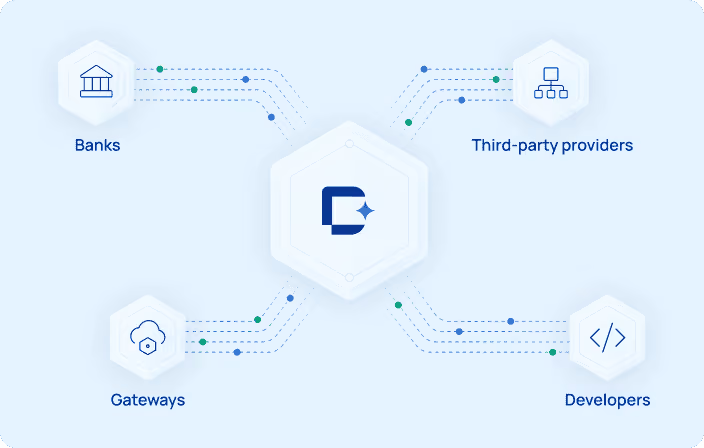
Enterprises need a structured way to continuously discover, catalog, and govern APIs across teams and environments. A platform-driven approach helps organizations move beyond manual discovery and maintain a centralized, continuously updated API inventory. DigitalAPI enables this by combining automated discovery, API cataloging, and governance workflows in one platform.
1. Automatically Discover APIs Across Your Organization
DigitalAPI continuously discovers APIs across different environments such as API gateways, repositories, and runtime traffic. This automated discovery helps organizations identify undocumented or previously unknown APIs, reducing the risk of shadow APIs and incomplete inventories.
2. Build a Centralized API Inventory and Catalog
Once APIs are discovered, DigitalAPI consolidates them into a centralized API catalog. This catalog provides visibility into available APIs, their owners, documentation, and usage context. Developers and architects can easily search and discover APIs that already exist before creating new ones.
3. Improve API Reuse Across Teams
A centralized catalog allows teams to identify reusable APIs instead of building duplicate services. By making APIs easier to discover, DigitalAPI helps organizations improve development efficiency and reduce redundant API creation across teams.
4. Enable Governance and Lifecycle Visibility
DigitalAPI helps platform teams enforce governance policies across the API lifecycle. Organizations can track API ownership, lifecycle stages, and compliance with internal standards, ensuring APIs follow consistent design and documentation practices.
5. Gain Organization-Wide Visibility into APIs
With automated discovery and centralized cataloging, DigitalAPI provides enterprise-wide visibility into the API ecosystem. This helps security, platform, and architecture teams understand where APIs exist, how they are used, and how they evolve across the organization.
Teams looking to simplify API discovery and governance can explore how DigitalAPI enables continuous API discovery and centralized API visibility across the enterprise. Book a Demo.
FAQs
1. What is API discovery?
API discovery is the process of identifying and cataloging APIs across an organization to create a complete API inventory. It helps teams understand what APIs exist, who owns them, and how they can be used or reused. Organizations typically perform API discovery by analyzing sources such as code repositories, API gateways, runtime traffic, and documentation systems to maintain visibility across their API ecosystem.
2. How do companies find undocumented APIs?
Companies find undocumented APIs by analyzing infrastructure systems where APIs are deployed or used. Common methods include reviewing API gateway logs, monitoring network traffic, scanning code repositories, and inspecting microservices environments for exposed endpoints. Many organizations also use automated API discovery platforms that continuously scan systems to detect APIs that were deployed without proper documentation.
3. What are shadow APIs?
Shadow APIs are APIs that exist within an organization but are not formally documented, registered, or governed by platform or security teams. They are often created when teams deploy APIs independently without adding them to a centralized API catalog. Because shadow APIs operate outside governance processes, they can introduce security vulnerabilities, compliance risks, and visibility gaps across the organization.
4. What tools help with API discovery?
Organizations use several types of tools to discover APIs and maintain an accurate API inventory. These tools include API gateways that log traffic, API management platforms that register APIs, code scanning tools that detect endpoint definitions, and network monitoring systems that identify active APIs. Modern API discovery platforms combine these capabilities to continuously detect APIs across development and runtime environments.
5. Why is API discovery important for governance?
API discovery is important for governance because organizations cannot manage or secure APIs they cannot see. A complete API inventory helps teams track API ownership, enforce design and security standards, monitor lifecycle stages, and ensure compliance with internal policies. By maintaining visibility into all APIs across the organization, teams can reduce duplicate APIs, detect shadow APIs, and apply governance consistently.
Bharath Kumar is the Founder and CEO of DigitalAPI, the multi-gateway API management platform helping organizations unify API discovery, governance, monetization, and AI agent enablement across Apigee, AWS, Azure, Kong, and MuleSoft.
Bharath founded DigitalAPI in 2015 after several years as a Solutions Architect at Apigee, the platform now part of Google Cloud and widely regarded as the foundational product of the modern API management category. At Apigee, he worked across pre-sales, product evangelism, and customer architecture, designing API programs for Fortune 100 customers. Earlier in his career, he held engineering roles at IBM, GalaxE Solutions, and Infinite Computer Solutions.
Under his leadership, DigitalAPI has grown into a globally recognized API management platform and caters to multiple Fortune 500 customers. His perspective on APIs, AI, and developer experience has been featured in Forbes, and he is a recurring speaker at Apidays and other API industry events.


One email a fortnight. Worth opening.
A short digest of what we're writing, what we're learning from customers, and the handful of links you'd actually want from us. No tracking pixels.

.avif)