



Apigee vs Gravitee: Enterprise standard vs. event-native challenger
For most API architects and CTOs, the final decision on API infrastructure inevitably comes down to a clash of philosophies that will define their future roadmap.

TL;DR
Philosophy: Apigee manages APIs as secure request-response proxies for strict governance; Gravitee mediates continuous event streams natively for real-time reactivity.
Best Use: Leverage Apigee for high-value monetization and deep Google Cloud ecosystems; choose Gravitee for Kafka integration and protocol-agnostic architectures.
Infrastructure: Apigee utilizes a centralized SaaS-managed control plane on GCP; Gravitee offers a decentralized foundation that runs anywhere without vendor lock-in.
AI Readiness: DigitalAPI.ai future-proofs your estate by automatically converting existing APIs into standards-compliant MCP servers for autonomous agents and LLM tools.
Unified Control: Unify fragmented Apigee and Gravitee clusters into a single governable ecosystem with consistent security guardrails across multiple cloud providers.
Future-proof your API estate and make it AI-ready with DigitalAPI.ai. [Book a Demo!]
For most API architects and CTOs, the final decision on API infrastructure inevitably comes down to a clash of philosophies that will define their future roadmap. This is not just a comparison of features on a checklist; it is a fundamental choice about how your organization handles data in motion across its entire digital estate. One path leads to a centralized, rigorously governed fortress, while the other opens the door to a reactive, decentralized mesh of real-time events.
A wrong choice here does not just mean swapping software later; it means fundamentally rethinking your traffic architecture and potentially rewriting years of integration logic. This guide dissects the trade-offs to help you make the right call, ensuring your platform choice aligns perfectly with your long-term business goals and technical requirements.
What is Apigee?
Apigee is Google Cloud’s enterprise API management platform, acting as a centralized "control tower" for digital assets. It excels in full lifecycle management, strict governance, and monetization, making it the heavyweight standard for organizations deeply embedded in the Google ecosystem.
What is Gravitee?
Gravitee is an event-native platform that bridges synchronous REST APIs and asynchronous streams. Its "Protocol Mediation" ingests data from Kafka or MQTT and exposes it securely via WebSockets or SSE, enabling legacy systems to interact with modern event-driven architectures without complex middleware.
The core conflict: static vs. streaming
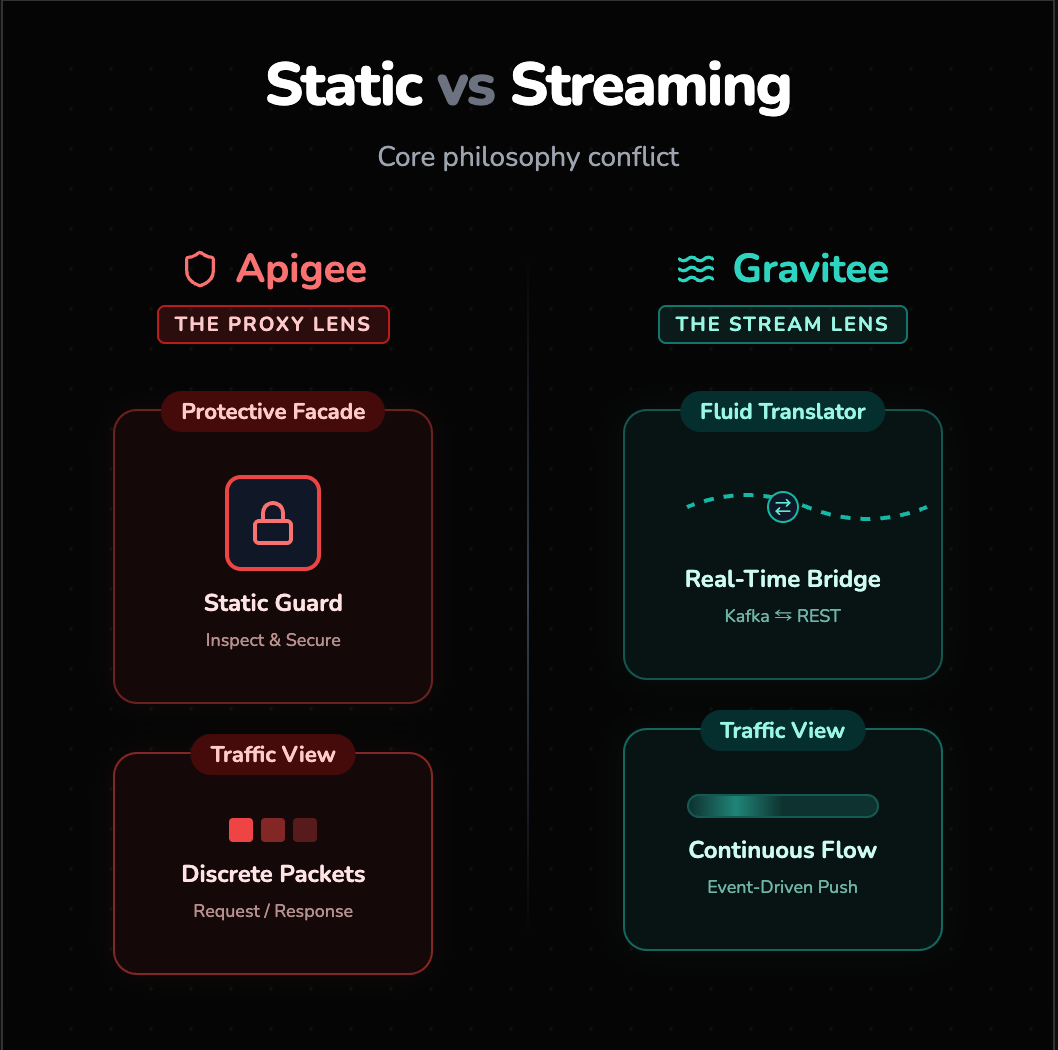
The divergence between these two platforms represents a broader shift in the industry, reflecting a fundamental difference in how organizations value and manage their data flow. The core conflict lies in how they view data traffic: is it a series of discrete, request-response transactions to be managed, or is it a continuous, fluid stream of events to be orchestrated?
Apigee: The Proxy Lens
Apigee views the world primarily through the lens of the "Proxy," where the gateway serves as a protective, intelligent facade sitting in front of your backend services to manage traffic.
- Protective Facade: It sits in front of backend services as a guard, ensuring that no unauthorized or malicious traffic ever reaches your critical internal infrastructure.
- Static Focus: It excels at synchronous request-response patterns, which are the backbone of traditional web and mobile applications, providing reliability and predictability.
- Unrivaled Use Case: Perfect for wrapping legacy SOAP services in secure REST interfaces for billing, effectively modernizing older systems without requiring a complete rewrite.
- Traffic View: Treats traffic as discrete transaction packets to be inspected, secured, and counted, which is ideal for monetization models based on API call volume.
Gravitee: The Stream Lens
Gravitee views the world through the lens of the "Stream," acknowledging that modern digital experiences are built on real-time data that flows continuously rather than in discrete bursts.
- Modern Reality: Acknowledges that modern architectures are increasingly event-driven, requiring a platform that can handle the complexity of asynchronous communication patterns natively.
- Stream Handling: Thrives on high-velocity streams like inventory updates from Kafka, ensuring that data is processed and delivered with minimal latency to downstream consumers.
- Translator Role: Acts as a translator, bridging gaps between different protocols in real-time, allowing disparate systems to communicate seamlessly without custom integration code.
- Real-Time Push: Ideal for pushing updates to mobile apps via WebSockets, creating engaging, dynamic user experiences that traditional polling mechanisms simply cannot match.
Apigee vs. Gravitee: technical comparison
1. Architecture: SaaS-first vs. event-native
The architectural foundation of these tools dictates their performance profile and deployment flexibility, influencing everything from latency to operational overhead and compliance posture. Choosing the right architecture is critical because it determines how well the solution will integrate with your existing infrastructure and how easily it can scale to meet future demands.
Apigee: Centralized & Managed
Apigee utilizes a centralized, full-stack architecture that is designed to provide a unified control plane for managing APIs across the entire enterprise, ensuring consistency and compliance.
- Managed Plane: The management plane is fully managed by Google Cloud, which offloads the operational burden of maintaining the management infrastructure to Google's engineering teams.
- Peered Runtime: The runtime is a managed instance peered with your network, providing a secure, dedicated environment for processing your API traffic within Google's cloud.
- Distinct Layer: Creates a separation between consumers and backend services, enforcing a clear boundary that simplifies security policies but can introduce additional network hops.
- Trade-off: Offers consistent enforcement and simplified operations but introduces architectural weight and potential latency for high-performance internal microservices communication.
Gravitee: Reactive & Flexible
Gravitee abandons the traditional proxy model in favor of a reactive architecture built on Java and the Vert.x toolkit, which allows for non-blocking I/O and high concurrency.
- Non-Blocking Engine: Handles massive concurrency and asynchronous data streams efficiently, making it well-suited for high-throughput scenarios where traditional thread-based servers might struggle.
- Run Anywhere: Deploy as a centralized gateway, sidecar, or fully air-gapped in a private data center, giving you complete control over where your data is processed and stored.
- No Cloud Lock-in: Unlike Apigee, it does not rely heavily on the Google Cloud ecosystem, allowing you to deploy it on AWS, Azure, or your own bare-metal servers without penalty.
- Data Residency: Ideal for industries with strict data residency requirements, as you can ensure that all data processing happens within your own controlled environment, completely offline if necessary.
2. Event capabilities: proxy vs. mediation
This is the most significant technical differentiator between the two platforms, determining whether you can truly build a modern, event-driven architecture or if you are stuck tunneling legacy protocols. It highlights the difference between simply moving bytes around and actually understanding the content of the data streams you are managing.
Apigee: The Secure Pipe
Apigee treats event streams primarily as TCP traffic, providing a secure tunnel for data to pass through but lacking deep insight into the nature of the events themselves.
- TCP Tunneling: Acts as a secure TCP tunnel for Kafka traffic, ensuring that the connection is encrypted and authenticated, but without inspecting the message content.
- Opaque Content: Treats the content as opaque; it ensures the pipe is secure and not leaking, but it doesn't read, validate, or transform the individual messages passing through.
- Configuration: Transforming specific Kafka message payloads requires significant custom work, often involving external compute services like Cloud Functions to handle the logic.
Gravitee: The Protocol Mediator
Gravitee elevates the event to be a first-class citizen through "Protocol Mediation," enabling it to interact with, transform, and govern event streams just as easily as it does REST API calls.
- Bridge Between Protocols: Ingests data from clients via REST and pushes to Kafka or MQTT, effectively allowing synchronous clients to interact with asynchronous backend systems seamlessly.
- Payload Understanding: Understands the message payload, allowing for intelligent routing, content-based filtering, and dynamic transformation of data before it reaches the consumer.
- Message-Level Policies: Applies policies like filtering or rate limiting based on "messages per second," providing granular control over the flow of events that goes far beyond simple connection limits.
3. Security & identity: external vs. integrated
Security philosophies differ sharply between these two contenders regarding where identity logic should live, impacting the complexity of your security stack and your total cost of ownership. The choice here depends on whether you prefer a best-of-breed approach with separate components or a unified, all-in-one platform.
Apigee: Best of Breed
Apigee typically relies on external identity providers, adhering to the philosophy that identity management is a specialized function that should be handled by dedicated, purpose-built systems.
- External Reliance: Assumes usage of dedicated IDPs like Okta, Azure AD, or PingIdentity, integrating with them via standard protocols to offload user authentication and management.
- Enforcement Focus: Excels at enforcing rules set by providers (validating JWTs, OIDC flows), acting as a policy enforcement point that relies on the IDP as the source of truth.
- User Management: Generally does not manage the users itself, meaning you will need to maintain and pay for a separate identity provider to handle user directories and logins.
Gravitee: Battery Included
Gravitee takes an all-in-one approach by bundling Gravitee Access Management (AM), providing a fully integrated identity solution that works seamlessly with the API gateway right out of the box.
- Cohesive Stack: API Gateway and Identity Management work in concert, allowing for complex security flows that tightly couple API access rights with user identity and context.
- Primary IDP: Can act as your primary IDP for defining security domains and managing users, creating a centralized hub for both API security and user authentication.
- Cost-Effective: Offers significant value for organizations, avoiding high licensing fees for separate IDPs, as you get robust identity management capabilities included with the platform.
4. Developer experience: XML vs. policy studio
The speed at which teams can configure and deploy APIs often depends on the interface they use, making developer experience a crucial factor in platform adoption and overall agility. A clumsy or overly complex interface can slow down development cycles and frustrate engineering teams, while a modern UI can accelerate delivery.
Apigee: Powerful but Verbose
Apigee is powerful but carries the legacy of its XML-based configuration, which provides immense flexibility and control but can be daunting and time-consuming for developers to master.
- XML Bundles: Defining complex policies often involves editing XML bundles, requiring developers to work with verbose configuration files that can be prone to syntax errors.
- Granular Control: Offers deep control over every aspect of the API proxy, allowing for highly customized behaviors, but this power comes at the cost of complexity.
- Learning Curve: Mastering the specific policy configuration language can be steep, often requiring specialized training or dedicated Apigee experts to manage the platform effectively.
Gravitee: Visual & Unified
Gravitee offers a more modern, visual approach via its "Policy Studio," designed to simplify the configuration process and make API management accessible to a broader range of developers.
- Drag-and-Drop: Visually drag policies onto API flows, allowing developers to intuitively design complex request and response pipelines without writing extensive code.
- Unified Catalog: Document and publish OpenAPI (REST) and AsyncAPI (Event) specs side-by-side, creating a single source of truth for all your API documentation.
- Cohesive Portal: View REST endpoints next to WebSocket subscriptions in one place, providing a consistent consumption experience for developers regardless of the protocol.
5. Monetization and governance
When it comes to the business side of APIs, Apigee remains the heavyweight champion, offering a sophisticated suite of tools designed specifically for turning APIs into revenue-generating products. For organizations where APIs are a direct line of business, the depth of these features is often the deciding factor.
Apigee: The Business Platform
Apigee shines in its comprehensive breadth as a business platform, treating APIs not just as technical interfaces but as digital products with their own lifecycles, pricing models, and revenue streams.
- Mint Module: The industry benchmark for complex billing, offering granular control over pricing tiers, revenue sharing models, and developer payout mechanisms.
- Sophisticated Plans: Supports rate plans, revenue sharing, and billing integration out of the box, allowing you to launch complex monetization strategies without building custom billing engines.
- Financial Infrastructure: Ideal for telecom or banking ecosystems driven by API revenue, where accurate metering, invoicing, and partner settlements are critical business requirements.
Gravitee: Technical Governance
Gravitee offers monetization capabilities, but they are generally lighter, focusing more on the technical aspects of controlling access and usage rather than complex financial operations.
- Lighter Features: Supports basic plans and subscriptions, which are sufficient for many use cases but may lack the depth required for complex enterprise billing scenarios.
- Custom Integration: Complex B2B billing often requires more custom work than Apigee, potentially needing integration with third-party billing providers like Stripe to handle advanced logic.
- Focus: Prioritizes technical governance and usage tracking over financial sub-ledger capabilities, making it a better fit for internal chargebacks or simpler public API products.
6. Cost structure: call volume vs. node
The pricing models of these platforms reflect their target customers and can have a massive impact on the long-term cost of ownership, especially as your API traffic scales up. Understanding these models is essential to avoid unexpected costs and ensuring that the platform remains affordable as you grow.
Apigee: Volume-Based
Apigee is generally associated with a high-cost, enterprise pricing model that scales with the volume of API calls, which can become expensive for high-traffic applications.
- Call Volume: Pricing based on call volume and environment units, meaning your costs increase directly in proportion to the success and usage of your APIs.
- Success Penalty: Costs can escalate quickly as traffic spikes, potentially punishing you for launching a successful product if the revenue doesn't scale linearly with traffic.
- OpEx Heavy: Suited for organizations where the API directly generates revenue that can offset the operational expenses, or for large enterprises with substantial IT budgets.
Gravitee: Node-Based
Gravitee typically employs a node-based or developer-seat pricing model, which decouples cost from traffic volume and offers more predictability for budgeting.
- Predictability: Offers more predictable costs for high-traffic applications, as you know exactly how much you will pay based on the number of gateway nodes you deploy.
- Infrastructure Based: You pay for what you consume in infrastructure, not per call, allowing you to process unlimited traffic as long as your hardware can handle it.
- Streaming Friendly: Significantly more cost-effective for high-volume streaming use cases where message counts can be astronomical and per-message pricing would be prohibitive.
Strategic decision framework

When to choose Apigee
Apigee is the right choice if your organization fits the profile of a traditional enterprise seeking rigid control and financial returns, where the primary goal is to monetize and govern external-facing APIs securely. It is the gold standard for organizations that need a proven, reliable platform to manage a mature API strategy.
- Google Cloud investment: If your infrastructure is already heavily centered on Google Cloud Platform (GCP), Apigee offers deep, native integration that feels seamless, allowing you to leverage other GCP services like BigQuery and Cloud Armor effortlessly.
- Complex monetization: If your primary goal is to sell data to partners and you require bank-grade billing, invoicing, and revenue share logic out of the box, Apigee’s monetization engine is superior and will save you months of custom development time.
- Strict governance: If you are in a highly regulated industry like banking or healthcare where centralized auditability and a "Sheriff" style governance model are non-negotiable, Apigee’s policy enforcement tools are proven to meet the most stringent compliance requirements.
When to choose Gravitee
Gravitee is the strategic choice if your organization is pivoting toward modern, reactive architectures, where the ability to handle real-time data and diverse protocols is more important than traditional monetization features. It is the ideal platform for innovators building the next generation of event-driven applications.
- Event-driven architecture: If you are building systems that rely on Kafka, MQTT, or other streaming protocols and need to expose them securely to the web, Gravitee’s native mediation capabilities are essential for bridging the gap between internal streams and external clients.
- Integrated identity: If you need a full-stack solution that includes a robust Identity Provider (AM) alongside your gateway to manage users and MFA without buying a separate tool, Gravitee offers unmatched value and simplifies your security architecture.
- Self-hosted requirements: If you require a fully air-gapped environment or need to run your gateway in a private data center without dependencies on a public cloud control plane, Gravitee’s flexible deployment model is the answer, giving you total sovereignty over your data.
Understanding model context protocol (MCP)
The next frontier in API management isn't just about managing traffic for humans or applications, but for AI. This is where the Model Context Protocol (MCP) becomes critical, serving as the standardized language that allows AI agents to understand and interact with your digital assets. As AI becomes more autonomous, the ability to expose your APIs in a format they can easily consume will be a key competitive advantage.
MCP is an open standard that lets AI models connect to external data and tools safely. Think of it as a universal USB port for AI agents. It eliminates the need to build custom "glue code" every time you want to connect an LLM, like Claude or GPT-4, to your internal APIs. By adopting MCP, you future-proof your API strategy, ensuring that your data and services are ready to be leveraged by the next wave of intelligent applications.
Converting APIs to MCP servers
DigitalAPI.ai bridges this gap by automatically making your API estate AI-ready. With our platform, you can instantly convert your existing APIs, whether they are managed by Apigee or Gravitee, into MCP Servers. This transformation is automated and seamless, requiring no changes to your underlying API implementation, yet instantly unlocking the value of your data for AI consumers.
This means your APIs become instantly consumable by AI agents. You do not need to rewrite your APIs or build custom plugins for every AI model. DigitalAPI handles the translation, governance, and security layer, ensuring that when an AI agent accesses your data, it does so within the strict guardrails you have defined. This capability transforms your static API catalog into a dynamic toolset for your organization's AI initiatives, accelerating your adoption of generative AI technologies.
Unifying governance with DigitalAPI.ai
We have analyzed the strengths of the industry giants. For most large organizations, the optimal strategy isn't choosing a single winner. It is a hybrid approach. You may leverage Apigee for your established external partner ecosystem while utilizing Gravitee for internal microservices. This is the new reality where you use the best tool for the specific job. This multi-gateway environment creates a critical challenge known as Silos. Running these powerful engines separately leads to operational fragmentation. It forces security gaps and "swivel-chair" management where teams must constantly switch between disparate dashboards to piece together a complete picture of the landscape.

Rather than forcing a costly "rip and replace" consolidation, DigitalAPI.ai acts as the unified control plane that sits above your infrastructure. We embrace the hybrid reality by abstracting away the underlying complexity. This ensures there are no silos and creates a single, governable ecosystem. This unified approach allows you to:
- Centralize governance: Define security policies once and enforce them globally across all your gateways to prevent configuration drift, ensuring that every API, regardless of where it is hosted, adheres to your organization's security standards.
- Universal visibility: Gain a single view of all your APIs (REST, SOAP, GraphQL, and Events) regardless of which gateway is powering them, enabling you to monitor performance, track usage, and troubleshoot issues from one central dashboard.
- Eliminate vendor lock-in: Move workloads between Apigee and Gravitee as your needs evolve, without being tied to a single vendor's proprietary management tools, giving you the flexibility to choose the best execution engine for each specific use case.
Ready to unify your API strategy?
Whether you choose the enterprise robustness of Apigee or the event-native agility of Gravitee, you shouldn't have to manage them in isolation. DigitalAPI.ai gives you the power to govern, secure, and monetize your entire API estate from one single pane of glass.
Book a Demo today to see how you can unify your gateways and make your APIs AI-ready.
Frequently Asked Questions
1. Can Apigee handle Kafka?
Apigee can route traffic to Kafka via TCP tunneling, treating it as an opaque stream. However, it does not natively understand or mediate the message payloads as Gravitee does. It acts as a pipe, not a translator.
2. Is Gravitee purely for events?
No. Gravitee is a full-lifecycle API management platform that handles traditional REST API traffic alongside event streams. It is designed to manage both synchronous and asynchronous protocols in a single platform.
3. How hard is the migration?
The process of migrating logic between platforms can be complex due to differences in policy configuration. However, using a unified control plane like DigitalAPI.ai can abstract this complexity, allowing you to manage policies centrally without rewriting underlying gateway code.
4. Which is better for on-premise?
Gravitee is generally better suited for on-premise deployments. It offers a true "Run Anywhere" model where the control plane and data plane can be fully self-managed and air-gapped. Apigee’s modern architecture relies on a SaaS-managed control plane hosted on Google Cloud.
5. Does Gravitee replace Okta?
It can. Gravitee includes an Access Management (AM) module that functions as a full Identity Provider, capable of handling user management, MFA, and registration. While Okta is a dedicated enterprise IDP, Gravitee AM is a powerful alternative for those wanting an integrated solution.
Dhayalan Subramanian is Associate Director, Product Growth at DigitalAPI, where he leads go-to-market and product growth for the company’s multi-gateway API management platform. His work focuses on helping large enterprises and mid-market cloud companies consolidate APIs across AWS, Azure, Apigee, Kong, MuleSoft, and other gateways into a single control plane for governance, discovery, monetization, and agent consumption.
Dhayalan brings 14+ years of experience across product strategy, enterprise architecture, and engineering leadership. Earlier in his career, he held senior roles at Encora (as Associate Architect and Technical Manager), Mindtree (Technology Lead), Tech Mahindra (Technical Lead), and Primus Analytics, where he designed integration frameworks and delivered enterprise-grade digital platforms for global customers.
At DigitalAPI, he works directly with platform, integration, and developer experience leaders at Fortune 500 organizations to operationalize unified API catalogs, developer portals, and MCP-ready APIs. He writes regularly on API developer experience, API governance, and AI agent architectures.
One email a fortnight. Worth opening.
A short digest of what we're writing, what we're learning from customers, and the handful of links you'd actually want from us. No tracking pixels.

.avif)