




API Discovery
API Discovery and Catalog
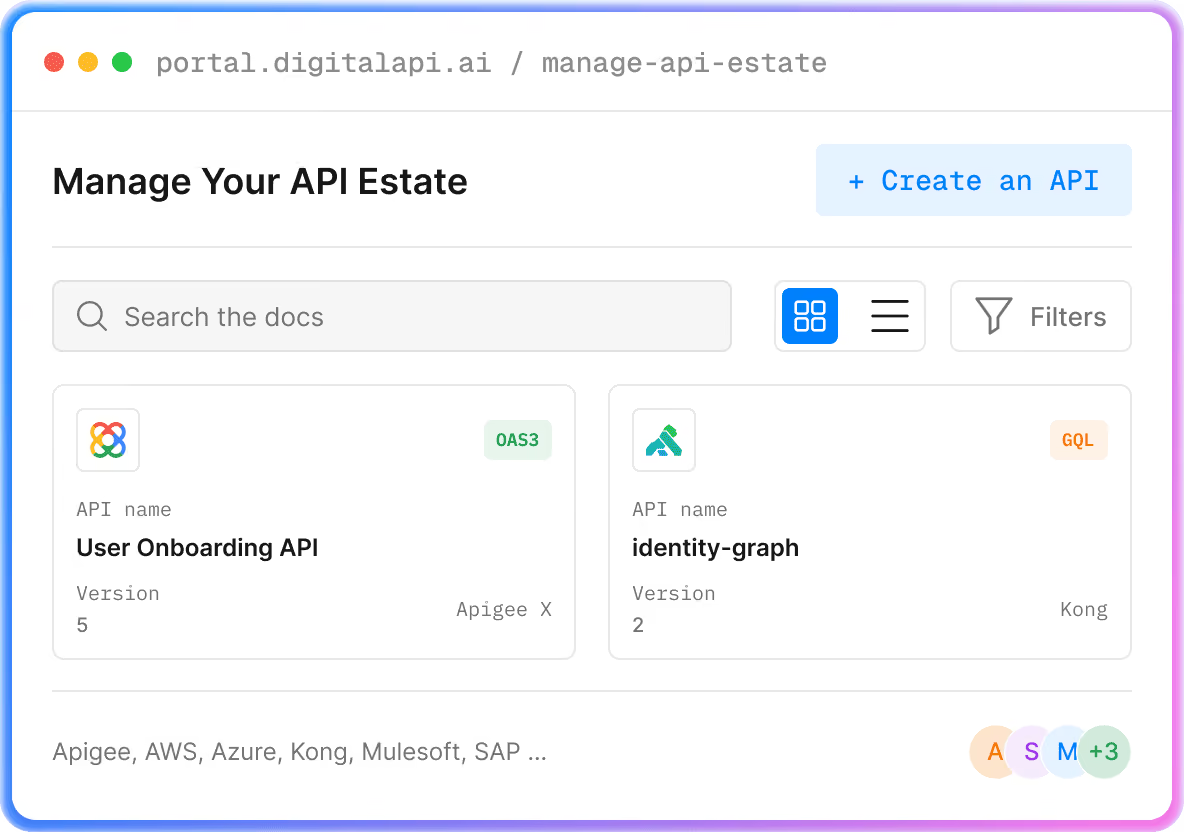
Bring every API, event, SDK, and Postman collection scattered across Apigee, Kong, AWS, and Azure into one searchable catalog. DigitalAPI gives you a single, authoritative source of truth, so teams find and reuse APIs instead of rebuilding them, and nothing stays hidden.
ISO 27001 certified
Recognized by Gartner







Definition
What is API discovery?
API discovery is the process of automatically finding and cataloging every API across an organization, including documented, undocumented, and shadow APIs spread over multiple gateways, clouds, and repositories. It turns a scattered, hard-to-track estate into one searchable catalog so teams can see, govern, and reuse what they already have.
An API catalog (or API inventory) is the continuously updated source of truth that discovery produces: every API, event, and SDK with its owner, version, gateway, and metadata, in one place.
Discovery
The act of finding APIs, including ones nobody registered, across every gateway, cloud, and repo.
Catalog / inventory
The continuously updated source of truth discovery keeps current. DigitalAPI does both, so your catalog never drifts.
How it works
How does API discovery work with DigitalAPI?
You go from a scattered estate to one authoritative, searchable catalog in four steps, across every gateway, cloud, and repo, with no manual tracking.
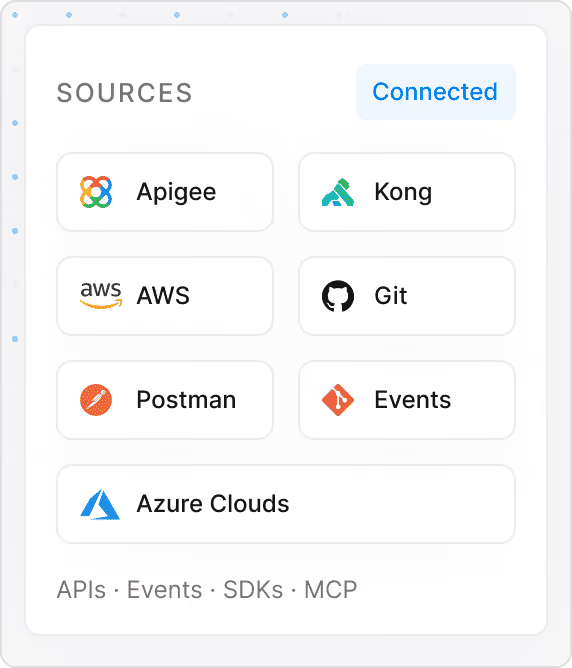
Connect every source
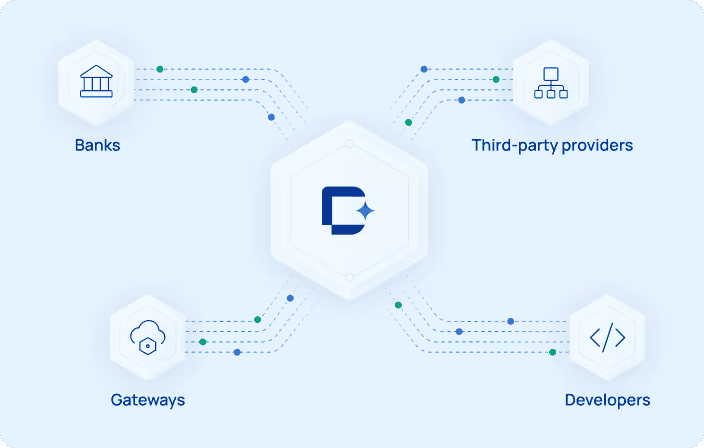
Link gateways, clouds, Git repos, Postman collections, event brokers, and MCP servers natively, with read-only credentials. Nothing gets left behind.
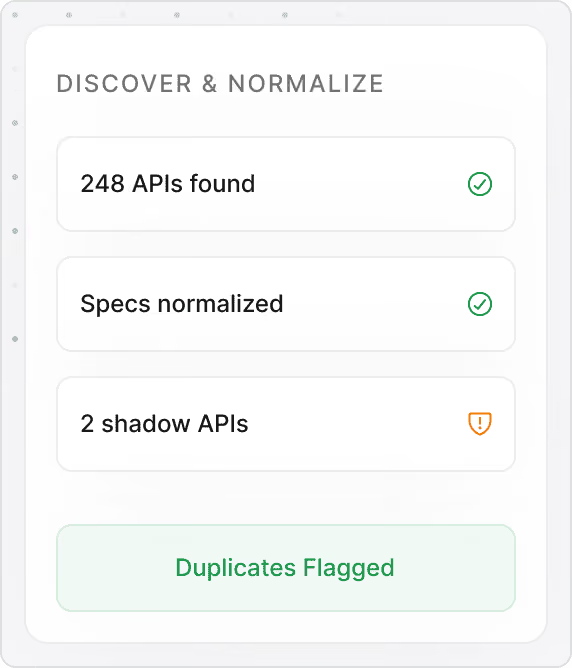
Discover, normalize, de-duplicate
DigitalAPI finds every API, normalizes OpenAPI definitions into one format, surfaces shadow APIs, and flags duplicates so the catalog stays clean.
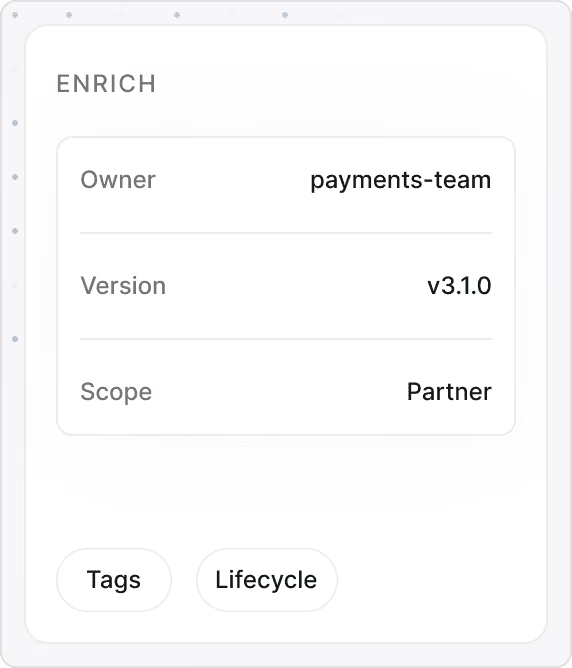
Enrich with metadata and ownership
Every API gets an owner, version, scope, and tags, with full lifecycle from design to deprecation, so the catalog is trustworthy, not just complete.
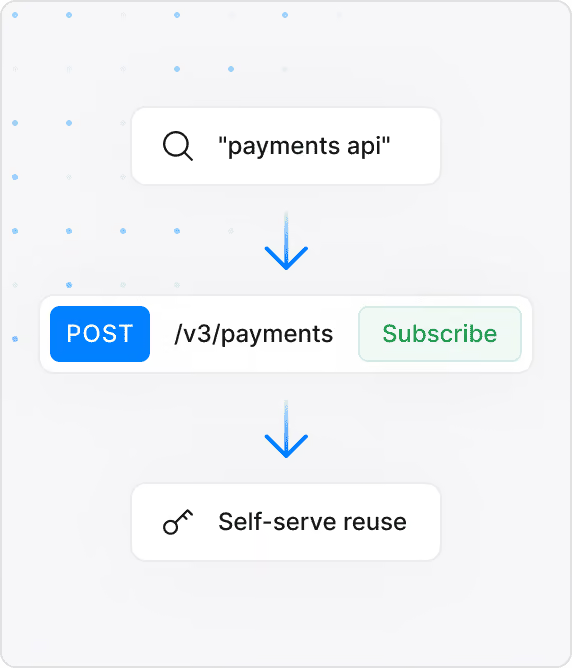
Publish one searchable catalog
Developers search across every gateway in one portal, find the right API, and subscribe in seconds, so they reuse what exists instead of rebuilding it.
What a catalog needs
What does great API discovery cover?
A catalog is only useful if it is complete, current, and searchable. DigitalAPI covers all of it, across every gateway and cloud, so the source of truth never drifts from reality.

Multi-source aggregation
Pull from every gateway, cloud, repo, Postman, and event broker into one catalog.

OpenAPI normalization
Normalize specs from different sources into one consistent, comparable format.

De-duplication
Spot and flag duplicate APIs so teams reuse instead of rebuilding.

Metadata & ownership
Owner, version, scope, and tags on every API, so the catalog is trustworthy.

Search & filtering
AI-powered search and filters to find the right API across all gateways fast.

Shadow & zombie detection
Surface undocumented and deprecated APIs hiding in your estate.

Events and SDKs,
not just REST
Catalog async events, GraphQL, and SDKs alongside REST APIs.

Continuous sync
Re-discover on every change so the catalog never drifts from production.
Why DigitalAPI
Why choose DigitalAPI for API discovery?
Every gateway only shows its own APIs, and security scanners find endpoints without making them reusable. DigitalAPI unifies your entire estate into one authoritative catalog teams can actually search, govern, and reuse.
.svg)
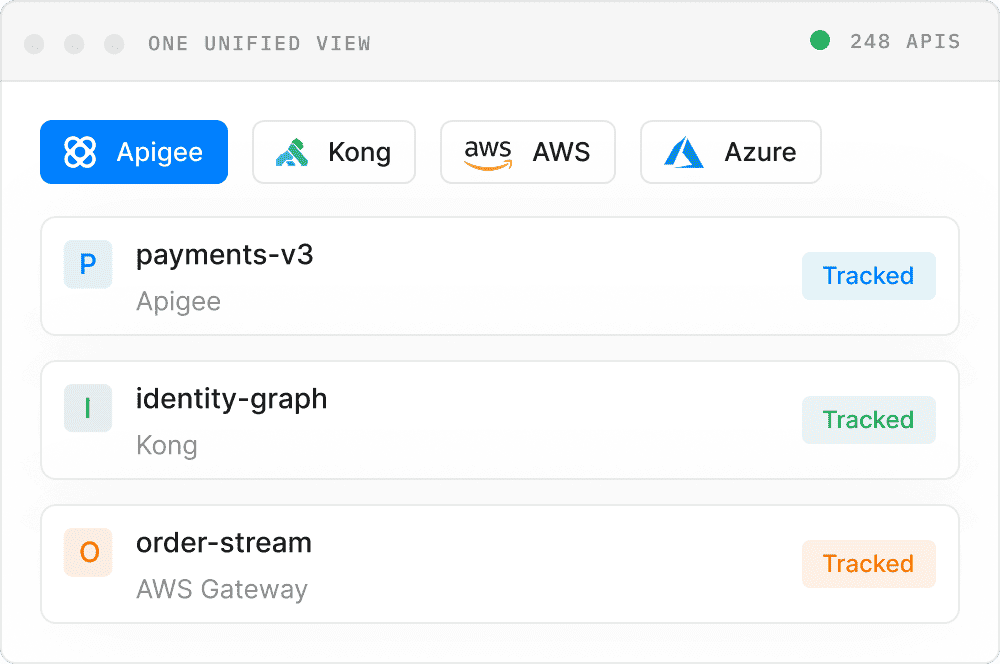
Complete visibility across gateways
No more blind spots. Track, manage, and secure every API across Apigee, Kong, AWS, and more from one clean, unified view.
See the catalog →
.svg)
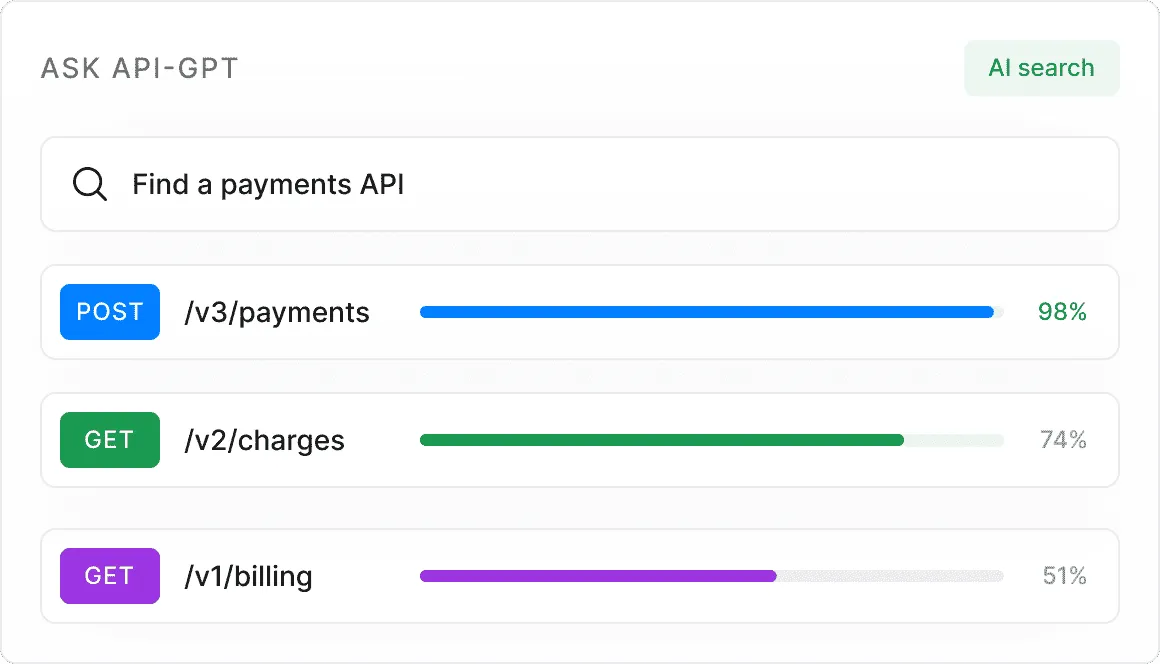
AI-powered smart search and filtering
API-GPT and advanced filters help teams instantly find, compare, and subscribe to the right APIs across every gateway, by intent, not guesswork.
Try API-GPT →
.svg)
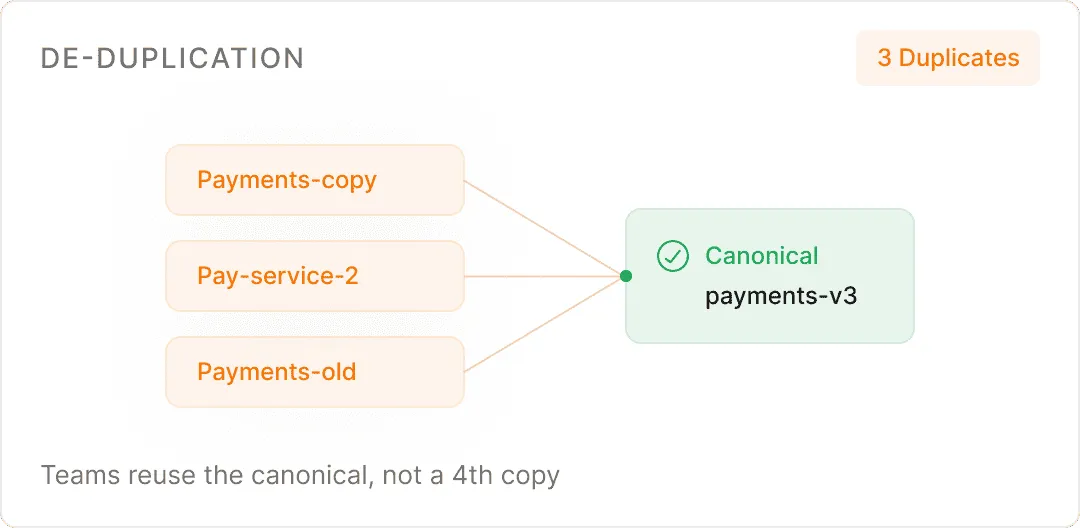
Consistent governance and de-duplication
Flag duplicate APIs so teams reuse the canonical one instead of rebuilding, and set policies once so security, compliance, and access rules stay consistent across every gateway.
See governance & de-dup →
.svg)
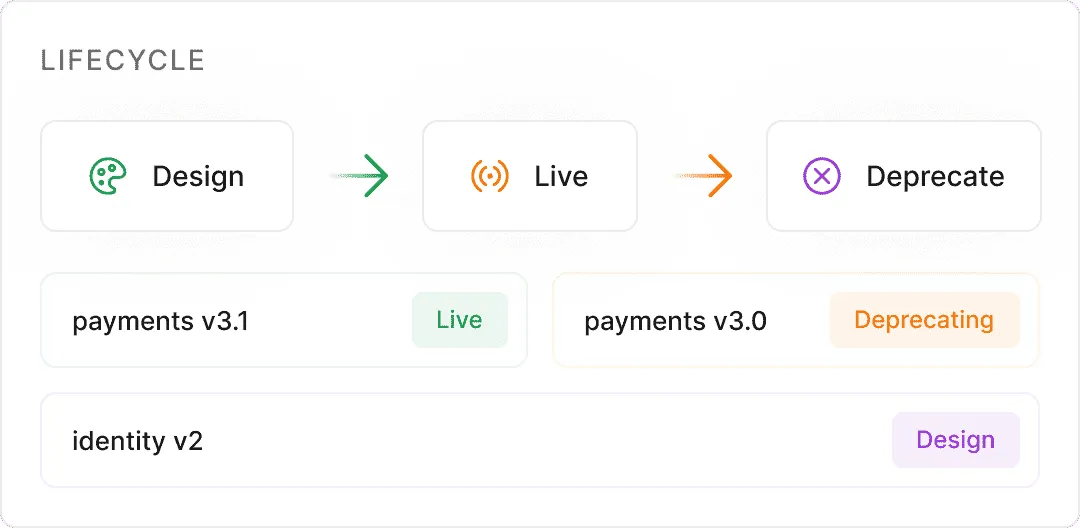
Complete lifecycle management
Track every API from design to deprecation with version controland automated governance, so the catalog reflects reality at every stage.
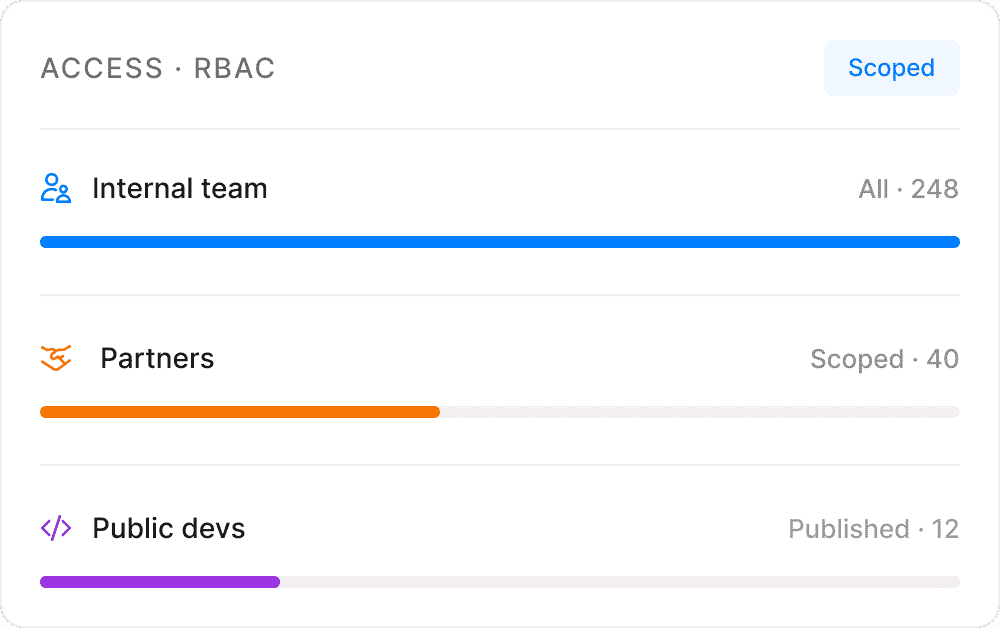
RBAC for internal and external APIs
Granular RBAC ensures the right teams discover the right APIs, with secure, role-based access for both internal and external consumers.
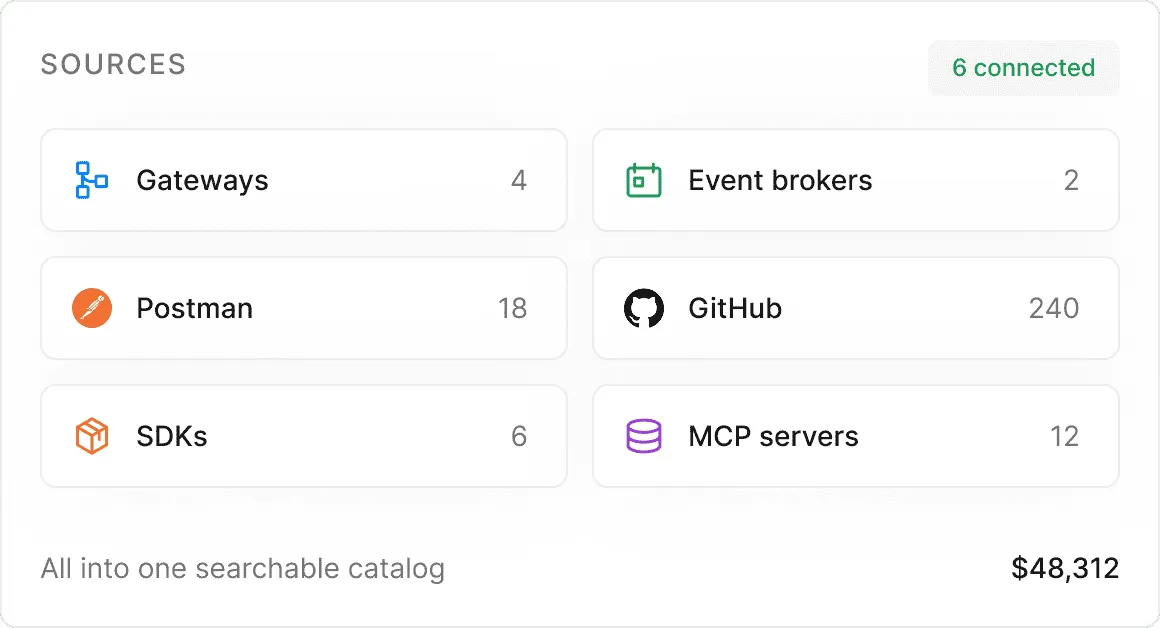
Endless integration possibilities
Catalog API gateways, event brokers, Postman collections, GitHub repos, and MCP servers natively, into a single searchable interface.
How we compare
How does DigitalAPI compare to other API discovery approaches?
Discovery tools mostly fall into two camps: single-gateway catalogs (Apigee, Kong, MuleSoft Exchange) that only see their own estate, and spec registries that need manual upkeep. DigitalAPI federates every gateway, cloud, and repo into one catalog teams can search and reuse.
Capability
%20(1).svg)
Single-gateway catalog
Spec registry
Multi-gateway & multi-cloud aggregation
Federated
Own estate
Manual
OpenAPI normalization
Partial
De-duplication & sprawl control
Manual
Events & SDKs, not just REST
APIs only
APIs only
Search, subscribe & reuse
Built in
Own portal
Browse only
Ownership, metadata & lifecycle
Partial
Shadow & zombie detection
Across estate
Own estate
MCP servers cataloged
Native
Emerging
Multi-gateway & multi-cloud aggregation
Federated
Single-gateway catalog
Own estate
Spec registry
Manual
OpenAPI normalization
Single-gateway catalog
Partial
Spec registry
De-duplication & sprawl control
Single-gateway catalog
Spec registry
Manual
Events & SDKs, not just REST
Single-gateway catalog
APIs only
Spec registry
APIs only
Search, subscribe & reuse
Built in
Single-gateway catalog
Own portal
Spec registry
Browse only
Ownership, metadata & lifecycle
Single-gateway catalog
Partial
Spec registry
Shadow & zombie detection
Across estate
Single-gateway catalog
Own estate
Spec registry
MCP servers cataloged
Native
Single-gateway catalog
Emerging
Spec registry
Outcomes
What results can you expect?
%20(1).avif)
%20(1).avif)
60%
Faster developer onboarding with one searchable catalog.
40%
Lower operational overhead across the API estate.
70%
Increase in API discovery across teams.
3x
Higher API adoption and reuse.
Frequently asked questions
API discovery FAQs
What is API discovery?
API discovery is the process of automatically finding and cataloging every API across an organization, including documented, undocumented, and shadow APIs spread over multiple gateways, clouds, and repositories. It turns a scattered estate into one searchable catalog so teams can see, govern, and reuse what they already have.
What is the difference between API discovery and an API catalog or inventory?
Discovery is the act of finding APIs, including ones nobody registered. An API catalog or inventory is the continuously updated source of truth that discovery produces: every API, event, and SDK with its owner, version, gateway, and metadata. DigitalAPI does both, so the catalog never drifts from reality.
How does discovery work across multiple gateways and clouds?
DigitalAPI connects natively to gateways such as Apigee and Kong, to AWS and Azure, and to Git repos, Postman collections, and event brokers. It aggregates them, normalizes OpenAPI definitions into one format, and presents everything in a single unified catalog.
Does it find shadow and undocumented APIs?
Yes. Discovery surfaces shadow, undocumented, and deprecated (zombie) APIs across your estate so they become visible, owned, and governed rather than hidden risks. On this page the emphasis is visibility and reuse; policy enforcement is handled by API governance.
Does it cover events and SDKs, or only REST APIs?
It covers more than REST. DigitalAPI catalogs async events, GraphQL, SDKs, and Postman collections alongside REST APIs, so the catalog reflects everything developers actually consume.
How does AI-powered search help teams find APIs?
API-GPT lets teams search by intent in plain language and use advanced filters to find, compare, and subscribe to the right API across every gateway, instead of digging through separate portals.
Can AI agents read the catalog?
Yes. DigitalAPI keeps a machine-readable catalog and is MCP-native, so AI agents can discover, understand, and reuse existing APIs rather than generating new shadow endpoints.

.avif)