



Tyk vs Kong: The architect’s guide to performance, governance, and AI-readiness
In the high-stakes world of cloud-native architecture, the API Gateway is no longer just a doorman.

Kong and Tyk are both API gateways with open-source cores. Choose Kong for its large plugin ecosystem, NGINX-level throughput and deep Kubernetes tooling; choose Tyk for built-in API management features, native GraphQL federation and a fully self-managed platform. If you already run both, DigitalAPI sits above them as one control plane, with one API catalog and one self-serve partner portal.
TL;DR
Tyk is a "batteries-included" platform (single Go binary) designed for instant stability and complex logic, while Kong is a modular toolkit (NGINX-based) optimized for raw throughput and extensive customization.
Architecturally, Tyk simplifies operations with a compiled binary and centralized governance, whereas Kong requires deep NGINX tuning and managing a decentralized plugin ecosystem.
For modern workloads, Tyk wins on native GraphQL stitching and consistent latency for AI streams, while Kong remains the king of high-volume, simple edge routing.
Operational costs differ: Tyk’s Gateway and analytics Pump are open source, but its Dashboard and Developer Portal need a licence, while Kong offers a basic free GUI (Kong Manager OSS) and keeps advanced management and analytics in paid tiers.
The future isn't just about the gateway; it is about the control plane. DigitalAPI unifies both Tyk and Kong into a single AI-ready platform, automating documentation and converting APIs into AI Agents.
In the high-stakes world of cloud-native architecture, the API Gateway is no longer just a doorman. It is the central nervous system of your infrastructure. For CTOs, API Architects, and DevOps leads, the choice of an API Gateway often dictates the agility, security, and scalability of the entire organization for years to come.
The market is flooded with options, yet the conversation almost always narrows down to two heavyweight contenders: Tyk and Kong. Both are open-source, widely adopted, and battle-tested. Yet, they represent two fundamentally different philosophies in API management. Choosing between them isn't just about picking a tool; it’s about choosing a stack, a governance model, and an operational workflow. We also cover how teams that run more than one gateway manage them together.
What is Tyk?
Tyk is an API Gateway and Management Platform with an open-source gateway written entirely in Go (Golang). Born out of the need for a lightweight, highly performant, and easy-to-deploy gateway, Tyk has gained massive popularity for its "batteries-included" philosophy. Unlike many competitors that rely on heavy external dependencies or complex plugin ecosystems for basic functionality, Tyk compiles into a single binary.
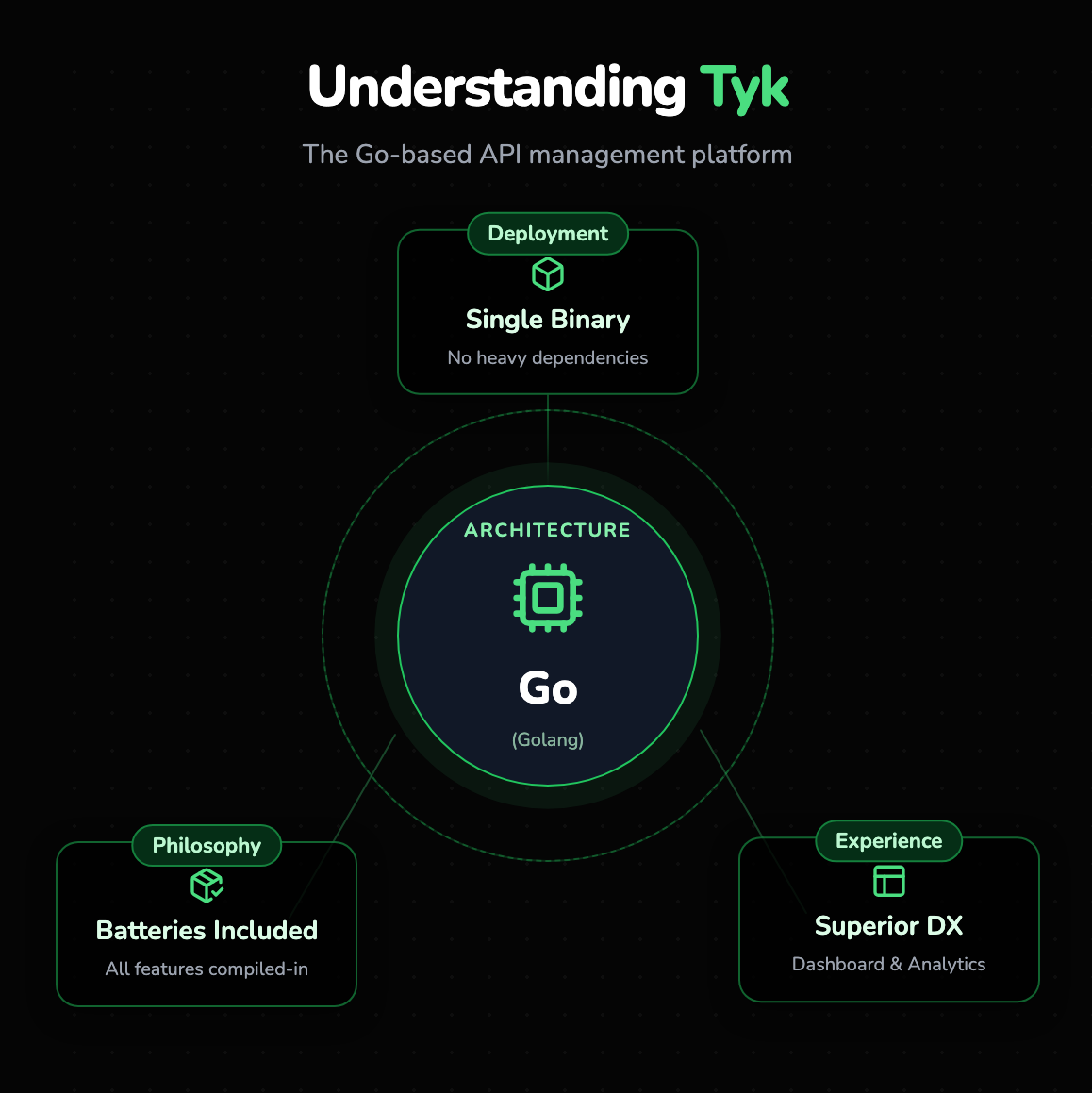
This Go-based architecture allows Tyk to offer impressive parallelism and low latency, making it a favorite for modern engineering teams who prefer the operational simplicity of a compiled language. Tyk is often praised for its Developer Experience (DX), pairing its open-source gateway and analytics pump with a full management dashboard (a licensed component), which lowers the barrier to entry for teams needing immediate visibility.
What is Kong?
Kong is arguably the most widely recognized name in the API gateway space. Built on top of NGINX and utilizing OpenResty (LuaJIT), Kong inherits the legendary stability and raw throughput of NGINX. It is designed as a modular toolkit: the core gateway is lean, lightweight, and focused purely on routing traffic, while almost all advanced logic, from authentication to rate limiting, is offloaded to a vast ecosystem of plugins.
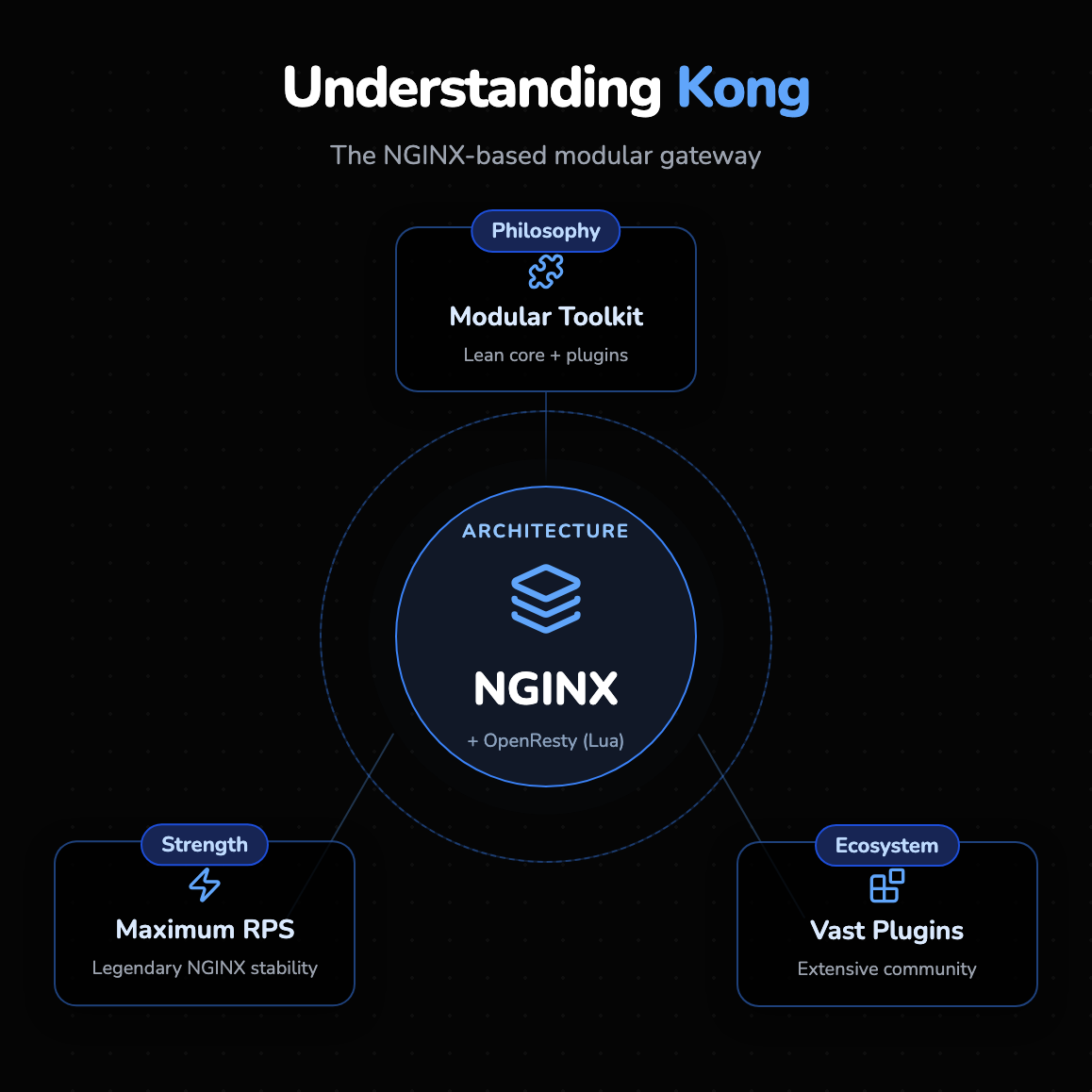
Kong’s philosophy is rooted in extensibility. Because it relies on NGINX, it fits naturally into environments where Ops teams already possess deep NGINX expertise. It is the default choice for organizations prioritizing maximum Requests Per Second (RPS) and those who prefer a "build-your-own-platform" approach by stitching together various plugins to meet specific needs.
How should you decide between Tyk and Kong?
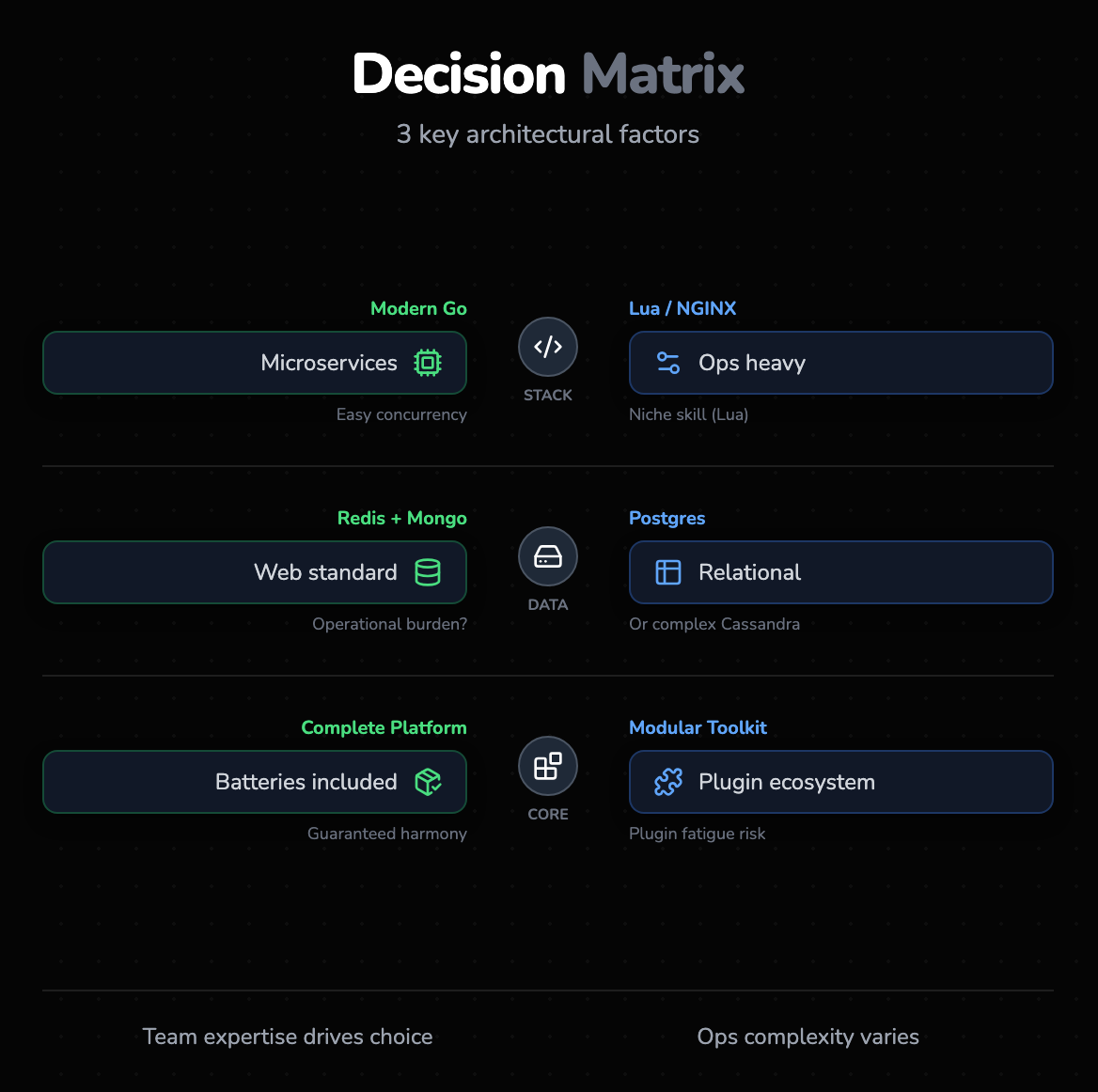
Before diving into feature-by-feature comparisons, it is crucial to frame the decision around three high-level architectural considerations. These are the factors that will impact your engineering team long after the contract is signed.
1. The tech stack
Your team’s existing expertise should weigh heavily on your decision.
- Tyk (Go): If your backend infrastructure is moving toward Kubernetes, Docker, and Go-based microservices, Tyk fits seamlessly. Go’s static typing and concurrency model (Goroutines) make it easier for modern backend developers to write custom plugins or understand the gateway’s behavior.
- Kong (Lua/NGINX): If your Ops team consists of NGINX veterans who can tune nginx.conf files in their sleep, Kong will feel like home. However, customizing Kong often requires writing Lua scripts. Lua is fast and lightweight, but it is a niche skill compared to Go, potentially creating a "bus factor" risk if only one or two engineers understand your custom gateway logic.
2. Database requirements
Both gateways require backing databases to store configuration, policies, and keys, but their choices have different operational footprints.
- Tyk: primarily relies on Redis for hot data (rate limiting keys, tokens) and MongoDB or PostgreSQL for the Dashboard’s long-term storage and analytics. Running and scaling that extra datastore is a real operational task.
- Kong: typically uses PostgreSQL, or runs in DB-less mode from declarative config files. Postgres is ubiquitous and reliable for most use cases. Cassandra support was removed in Kong Gateway 3.4.
3. Built-in features vs. plugins
- Tyk: Adopts a "Complete Platform" approach. OIDC, complex auth flows, and extensive rate limiting are baked into the core binary. They are optimized, tested, and guaranteed to work together.
- Kong: Adopts a "Modular Toolkit" approach. The core is empty. You must select, install, and configure plugins for every feature. This offers flexibility (you don't load what you don't use) but introduces "plugin fatigue," where upgrading the core gateway might break a third-party plugin you rely on.

How do Tyk and Kong compare?
Ultimately, the choice between Tyk and Kong is a choice between a "Complete Platform" and a "Modular Toolkit." Tyk aims to give you a finished product out of the box, minimizing the time to the first API call. Kong aims to give you a high-performance engine and a box of parts, allowing you to assemble exactly the machine you want, provided you have the engineering time to build it.
| Feature | Tyk | Kong | DigitalAPI (layer above both) |
|---|---|---|---|
| Core Technology | Go (Golang) | NGINX + Lua (OpenResty) | Control plane (not a traffic proxy) |
| Architecture | Single Binary | Modular Toolkit (Core + Plugins) | Connects to Tyk, Kong and other gateways |
| Dependencies | Redis (Gateway) + MongoDB or PostgreSQL (Dashboard) | PostgreSQL or DB-less (Cassandra removed in 3.4) | Runs alongside your gateways; traffic stays on them |
| Performance Profile | Low, consistent latency; CPU efficient | High throughput; NGINX raw speed | No added hop; traffic stays on Tyk and Kong |
| Plugin Language | Go, Python, JS, Lua, gRPC | Lua (Native), Go, Python, JS | Uses each gateway’s own plugins |
| GraphQL Support | Universal Data Graph (Native Stitching) | Proxy / Adapter via Plugins | Catalogs APIs from both gateways |
| Management UI | Dashboard (commercial licence) | Kong Manager OSS (basic, free); full GUI in Enterprise / Konnect | One portal and console across all gateways |
| Analytics | Tyk Pump (Pluggable to any backend) | Plugins (OSS) / Vitals (Enterprise) | Aggregated across Tyk, Kong and other gateways |
| Scaling | Vertical scaling is efficient; easy clustering | Horizontal scaling via DB; complex clustering | Independent of gateway traffic |
| Best For | "Batteries-included" preference, Go shops, GraphQL | High-traffic edge, NGINX experts, customization | Running both, with one catalog and one partner portal across them |
Tyk or Kong? Most teams end up managing both. One control plane for all.
See DigitalAPI Gateway Manager
1. Architecture and operational complexity
The architectural choice between a compiled Go binary and an NGINX wrapper fundamentally shapes your deployment strategy. This decision impacts everything from dependency management to routine maintenance. DevOps teams must evaluate whether they prefer the simplicity of a single binary or the granular control of a multi-layered web server stack.
| Feature | Tyk | Kong |
|---|---|---|
| Runtime | Single Go Binary | NGINX + Lua (OpenResty) |
| Dependencies | Redis + MongoDB or PostgreSQL | PostgreSQL or DB-less |
| Ops Complexity | Low (Drop-in) | High (Requires NGINX tuning) |
The architectural divergence between Tyk and Kong is the root of all their performance and operational differences.

Tyk: the go binary
Tyk is a compiled Go binary. This provides distinct advantages in terms of deployment simplicity: you drop the binary onto a server or into a container, and it runs. Go’s garbage collection and concurrency model allow Tyk to handle complex processing logic (like transformation and validation) with very stable latency.
Kong: the NGINX wrapper
Kong is effectively a Lua application running inside NGINX. This architecture is practically unbeatable for raw throughput. NGINX’s event loop is legendary for handling tens of thousands of connections with minimal overhead. However, this performance comes with complexity. When a request hits Kong, it passes through the NGINX worker, then into the OpenResty Lua environment, passes through a chain of Lua plugins, and then goes upstream.
2. Core features and plugins
This comparison highlights the split between Tyk's "batteries-included" design and Kong's "build-your-own" toolkit approach. Architects must decide between a pre-compiled platform where features work instantly out-of-the-box, or a lean canvas that offers immense flexibility but requires significant effort to assemble and configure via plugins.
| Feature | Tyk | Kong |
|---|---|---|
| Philosophy | "Batteries Included" | "Modular Toolkit" |
| Native Logic | Pre-compiled (Fast) | Lua Plugins (Interpreted) |
| Setup Time | Instant (All-in-one) | Slow (Install plugins) |
This is where the "Batteries Included" vs. "Plugin Marketplace" distinction becomes most apparent.
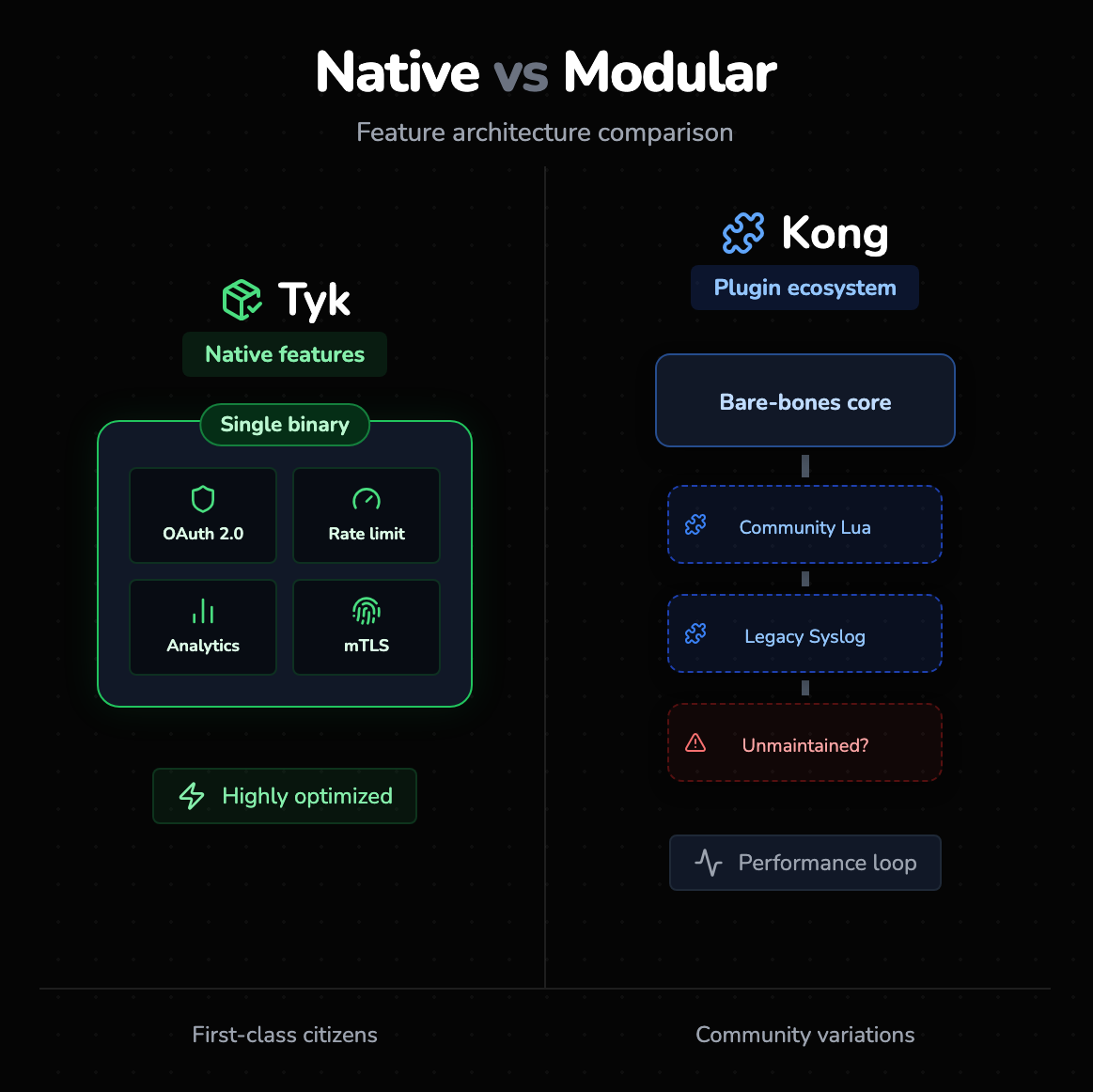
Tyk’s native capabilities
Tyk treats API Management features as first-class citizens. When you install Tyk, you immediately have access to advanced authentication methods (OAuth 2.0, OpenID Connect, mTLS), sophisticated rate limiting (including quota management and context-based limits), and detailed analytics. Because these are compiled into the binary, they are highly optimized.
Kong’s plugin ecosystem
Kong’s core is intentionally bare-bones. To add functionality, you turn to the Plugin Hub. The advantage here is the sheer volume of community-contributed plugins. If you need a niche integration, say a specific logging output to a legacy syslogger, someone in the Kong community has likely written a Lua plugin for it. However, this modularity is a double-edged sword. Community plugins vary in quality, maintenance, and performance.
3. Speed and traffic handling
Both gateways are enterprise-grade, but the distinction lies in optimizing for raw throughput versus consistent low latency. High-volume edge routing favors one architecture, while complex API mediation involving data transformation requires another. Understanding this nuance is vital for modern AI and financial applications where stable processing times trump raw speed.
| Feature | Tyk | Kong |
|---|---|---|
| Strength | Consistent Low Latency | Maximum Raw Throughput |
| Processing | CPU Efficient (Go) | High Concurrency (NGINX) |
| Best For | Complex Logic / AI | Simple High-Volume Edge |
When reading benchmarks, it is easy to get lost in "Requests Per Second" (RPS), but for modern Architects, the nuance lies in Throughput vs. Latency.
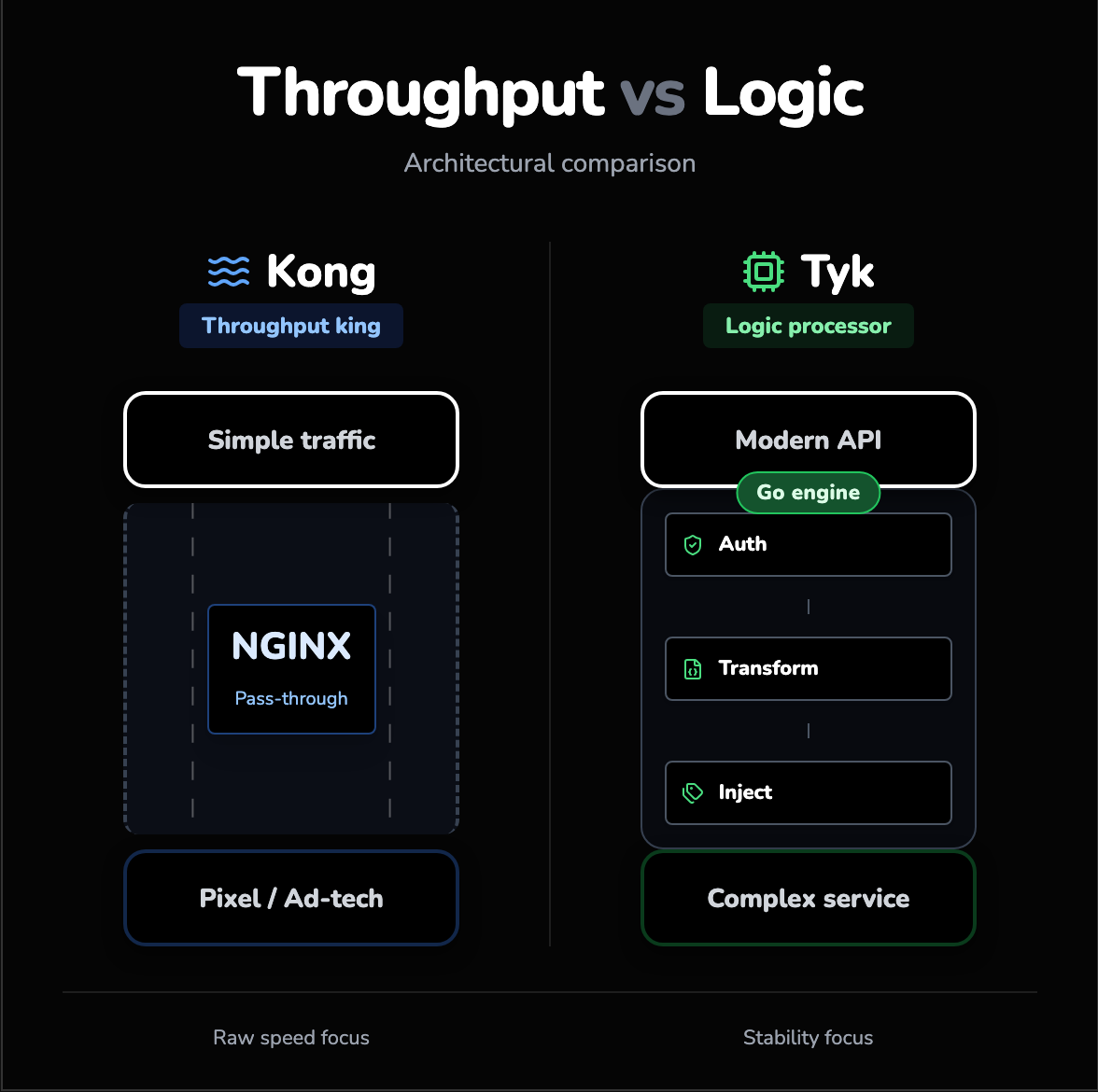
Kong: the throughput king
If your primary requirement is to pipe a massive volume of simple requests (e.g., ad-tech pixel tracking or simple pass-through traffic) where every microsecond of overhead counts, Kong is likely the winner. NGINX is optimized for this exact scenario. It can saturate a 10Gbps link more efficiently than almost anything else.
Tyk: the logic processor
However, most modern APIs are not just pass-through pipes; they are intelligent proxies. They validate tokens, transform JSON to XML, inject headers, and aggregate data. In scenarios where the gateway performs work, Tyk often shines. Go is excellent at CPU-bound tasks. As the complexity of request processing increases, Tyk’s latency tends to remain more consistent compared to Kong, where heavy logic in Lua scripts can start to tax the JIT compiler.
The AI/LLM context
- Shift to Streaming: In the era of AI, we are moving from short, bursty REST requests to long-lived streaming connections (like ChatGPT responses).
- Tyk's Stability: Tyk’s architecture, leveraging Go’s concurrency, handles these long-lived connections and WebSockets with exceptional stability.
- NGINX Complexity: NGINX handles connections well, but the complexity of managing streaming timeouts and buffers in a Lua/NGINX stack can be higher than in a native Go environment.
4. Security and control
Effective governance depends on enforcing consistent policies without configuration drift. In large-scale environments, the mechanism used to apply security rules whether via centralized policy objects or granular, route-specific plugin configurations determines scalability. This section examines how each platform balances rigid centralized control with flexible, service-specific security requirements.
| Feature | Tyk | Kong |
|---|---|---|
| Config Model | Centralized Policy Objects | Declarative / Plugin-based |
| Governance | Global & Modular | Per-Service / Per-Route |
| Drift Risk | Low (Shared Policies) | Moderate (Plugin config) |
Security is not just about blocking hackers; it's about governance: who can change what, and how easy is it to make a mistake?
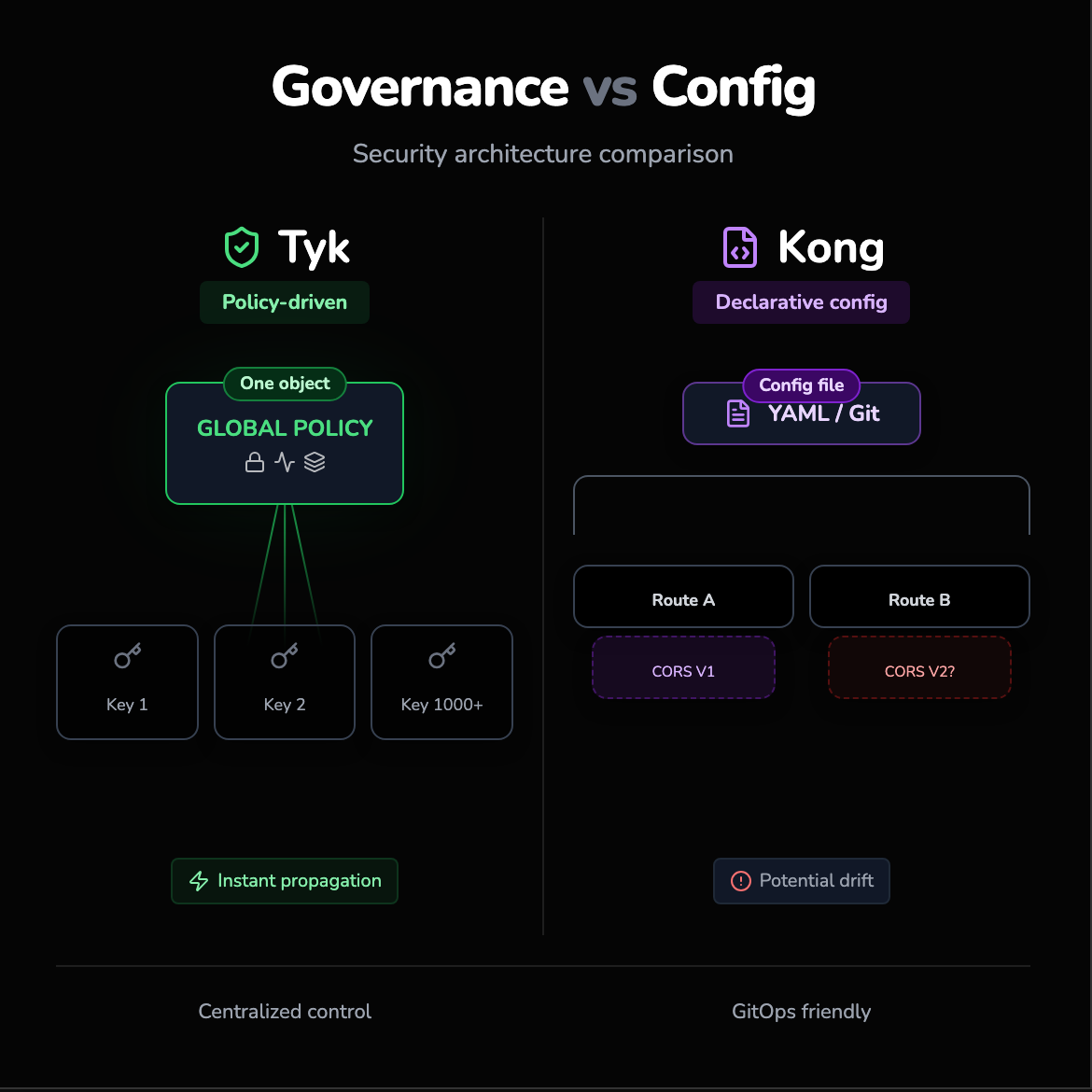
Tyk’s policy-driven security
Tyk shines in centralized governance. It uses a "Policy" object that wraps all security rules (ACLs, rate limits, and quotas) into a single entity. You can apply a Policy to thousands of keys instantly. This is crucial for large enterprises. If you need to rotate a key or change a quota tier, you update the Policy, and it propagates instantly. Tyk also supports complex security flows like "Keyless Access" with fallback to specific auth methods, which is difficult to orchestrate in other gateways.
Kong’s declarative configuration
Kong (specifically in DB-less mode or using Kong Konnect) pushes for a declarative configuration model. You define your services, routes, and plugins in a YAML file and apply it. Although this is GitOps-friendly, the granularity of security is often tied to individual plugins attached to specific routes. This can lead to "configuration drift", where one route has the CORS plugin configured one way, and another route has it configured differently.
5. Developer experience
The speed at which a new developer can publish their first secure API depends heavily on out-of-the-box tooling. In an era where "Developer Experience" is critical, the friction in onboarding defines success. We compare the accessibility of a GUI-driven approach with a CLI-first methodology to determine which one best suits your team.
| Feature | Tyk | Kong |
|---|---|---|
| OSS UI | None in OSS; Dashboard needs a licence | Kong Manager OSS (basic, since 3.4) |
| Onboarding | Fast (< 5 mins) | Moderate (Learning Curve) |
| Visibility | Native graphs in the licensed Dashboard | Basic in Kong Manager OSS; richer in Enterprise / Konnect |
How fast can a new developer publish an API?
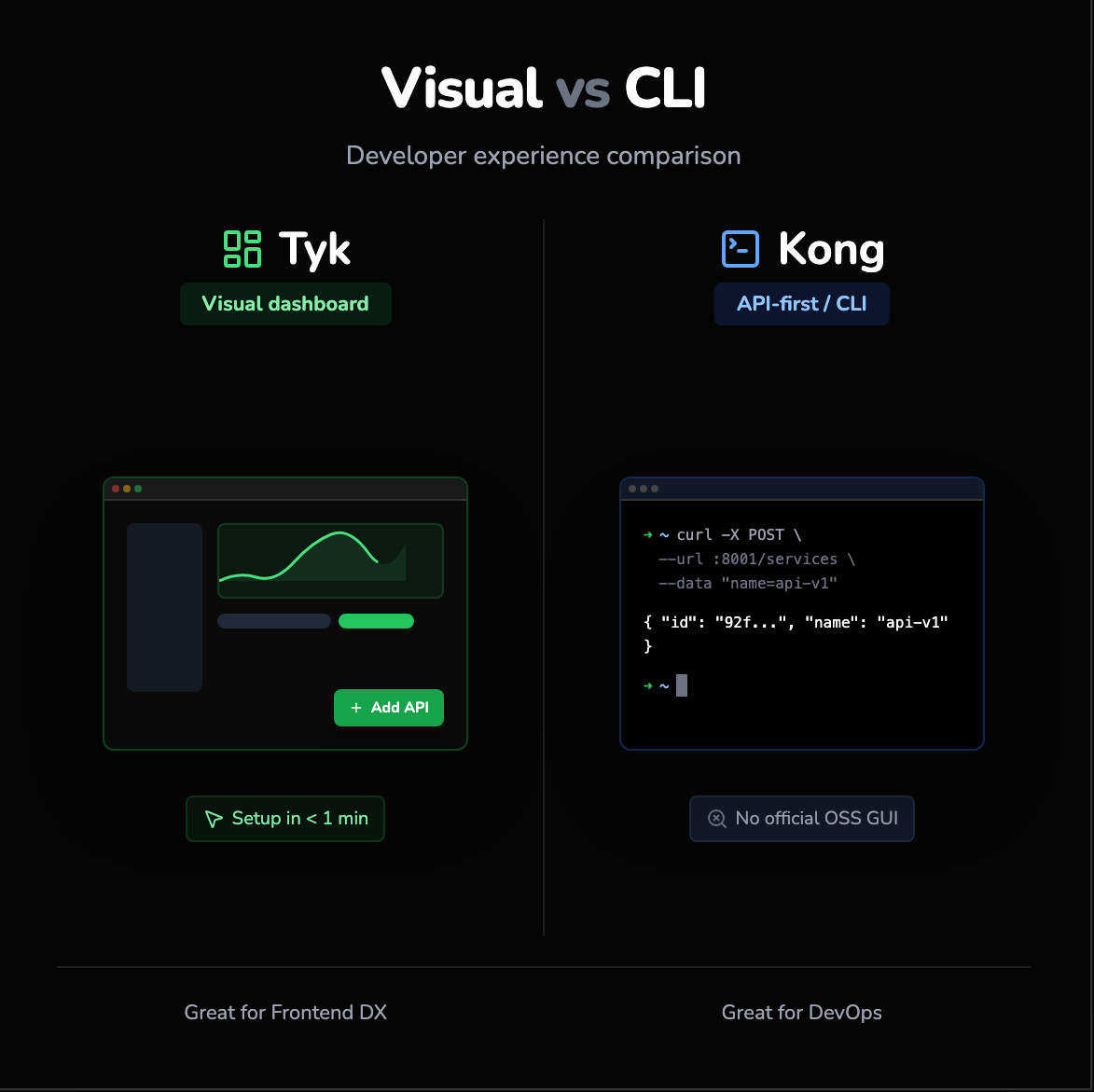
Tyk: The visual dashboard
Tyk’s Dashboard is a full GUI for managing APIs, policies and analytics. It is a licensed component rather than part of the open-source Gateway, but once in place it is a big win for Developer Experience (DX). A developer can log in, click "Add API," set up an authentication token, and have a secured endpoint running in under a minute. Visualizing the traffic, errors, and latency graphs immediately helps developers understand their APIs without needing CLI mastery.
Kong: API-First / CLI
Kong is API-first. Since Kong Gateway 3.4, the open-source version includes Kong Manager OSS, a basic GUI for services, routes, plugins and certificates. Most teams still work through the Admin API with curl, or apply YAML files via the CLI. Workspaces, RBAC and richer dashboards need Kong Enterprise or Kong Konnect (SaaS). For a DevOps engineer, this CLI approach is fine. For a frontend developer trying to debug a gateway issue, it is a significant friction point.
6. GraphQL and integrations
As API ecosystems evolve beyond REST, natively handling and stitching GraphQL schemas becomes a critical differentiator. Gateways must now act as intelligent mediation layers rather than simple proxies. This section explores whether you need a true Universal Data Graph or just a performant pass-through adapter for existing GraphQL servers.
Modern gateways must be more than REST proxies; they must be protocol-agnostic.
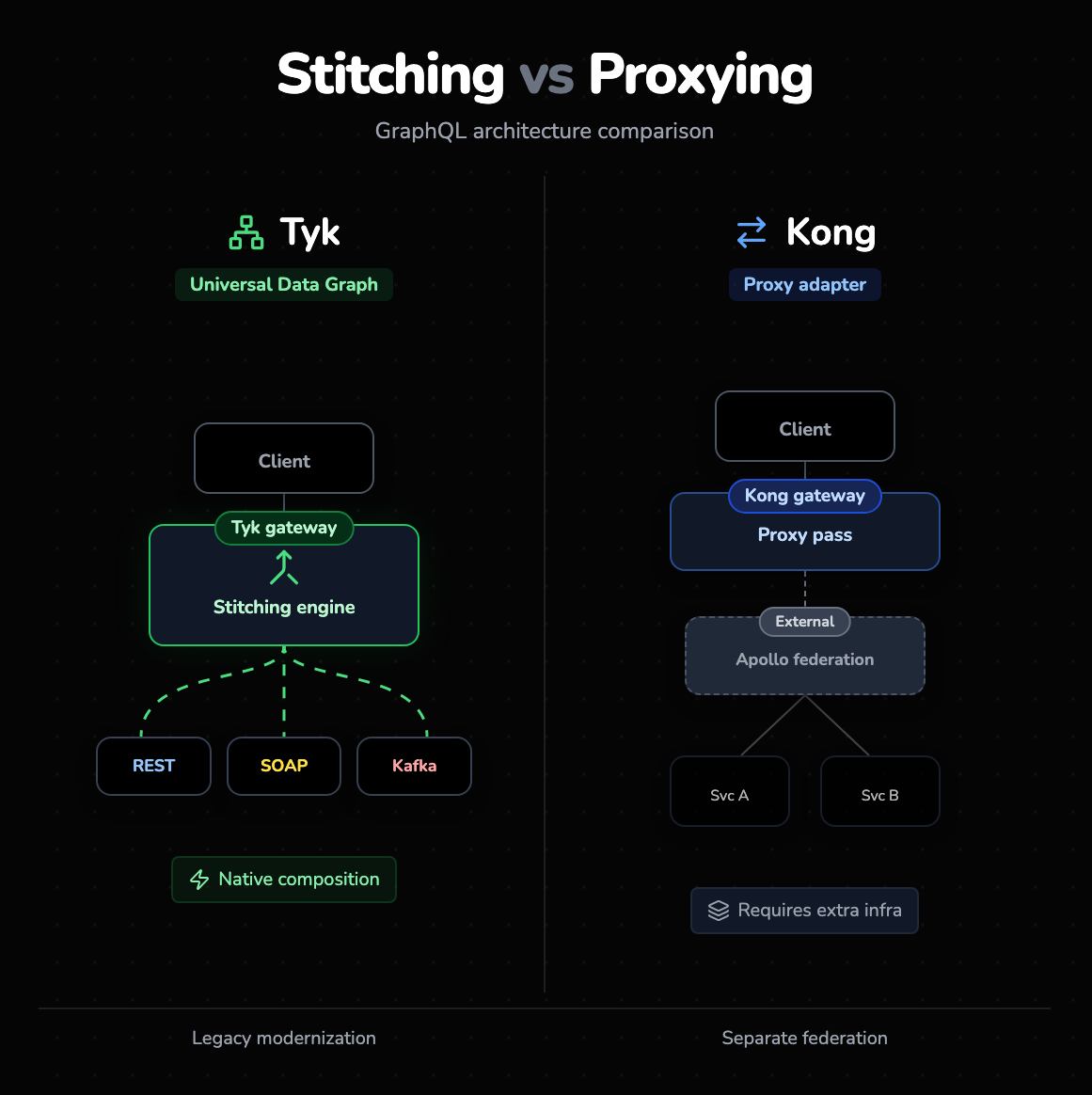
Tyk: Universal Data Graph (UDG)
Tyk has made a massive bet on GraphQL with its Universal Data Graph. This is not just a proxy; it’s a stitching engine built into the gateway. You can take multiple REST APIs, legacy SOAP services, and Kafka streams, and "stitch" them together into a single GraphQL schema exposed to the client. The gateway handles the complexity of fetching data from the different upstreams. This is a game-changer for organizations trying to modernize legacy tech without rewriting the backend.
Kong: Adapters and Proxying
Kong supports GraphQL, but largely via plugins that act as adapters. It can validate GraphQL queries and proxy them to a GraphQL server (like Apollo). However, it lacks the native "Stitching" capabilities of Tyk. If you want to compose a graph from multiple microservices in Kong, you usually need to run a separate Apollo Federation server behind Kong. In Tyk, the gateway is the federation server.
7. Monitoring and analytics
Deep visibility is essential, but the difference lies in whether analytics are a built-in component or an external plugin. A decoupled, asynchronous approach ensures stability, while tight coupling risks performance impact. We analyze how each platform extracts critical data and what that means for your monitoring stack's reliability.
| Feature | Tyk | Kong |
|---|---|---|
| Architecture | Decoupled "Pump" | Plugin-based |
| Impact | Low (Async offload) | Variable (Plugin dependent) |
| Backends | Pluggable (Any DB) | Pluggable (Specific tools) |
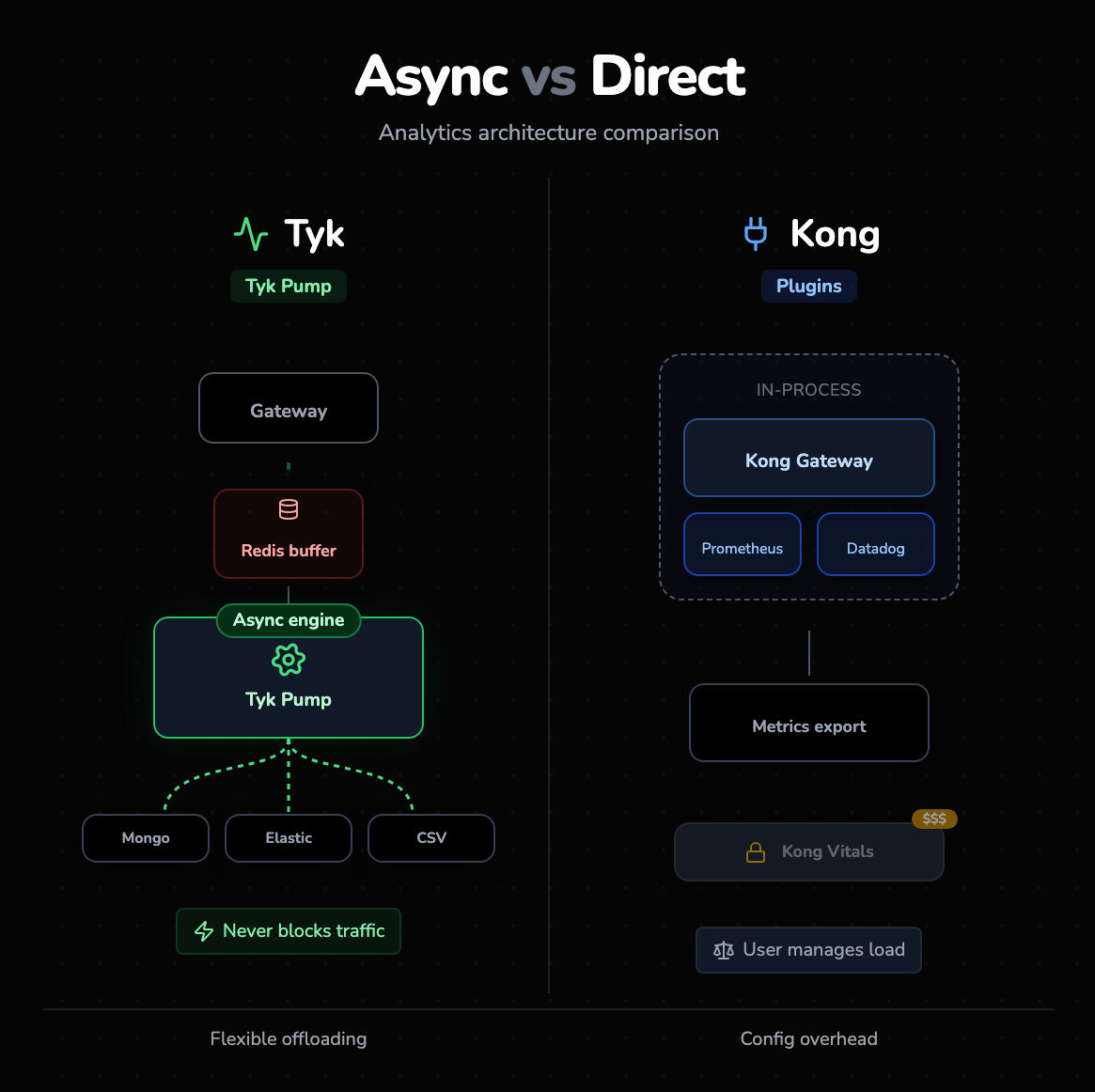
Tyk Pump
Tyk’s approach to analytics is unique. It separates the analytics engine from the gateway using a component called "Tyk Pump." The gateway writes metadata to Redis, and the "Pump" asynchronously moves that data to any backend you want: MongoDB, ElasticSearch, Prometheus, InfluxDB, or CSV.
Kong Vitals & Plugins
Open-source Kong relies on plugins for monitoring. You enable the prometheus plugin or the datadog plugin to export metrics. Although effective, it puts the burden on the user to configure the sampling rates correctly so performance isn't impacted. "Kong Vitals," their deep-dive visual analytics tool, is reserved for the Enterprise tier.
8. Pricing and open source licenses
Understanding what is truly free versus what is gated behind an enterprise license is vital for long-term budget planning. Both platforms have open-source roots, yet their monetization strategies differ significantly regarding management planes and analytics. This section breaks down licensing models to help you avoid unexpected costs as you scale.
| Feature | Tyk | Kong |
|---|---|---|
| OSS License | MPL + Proprietary (Dash) | Apache 2.0 |
| Free Tier | Gateway + Pump (Dashboard needs a licence) | Gateway core + Kong Manager OSS |
| Enterprise | Dashboard, Developer Portal, Multi-DC, support | SaaS control plane, full GUI, advanced plugins |
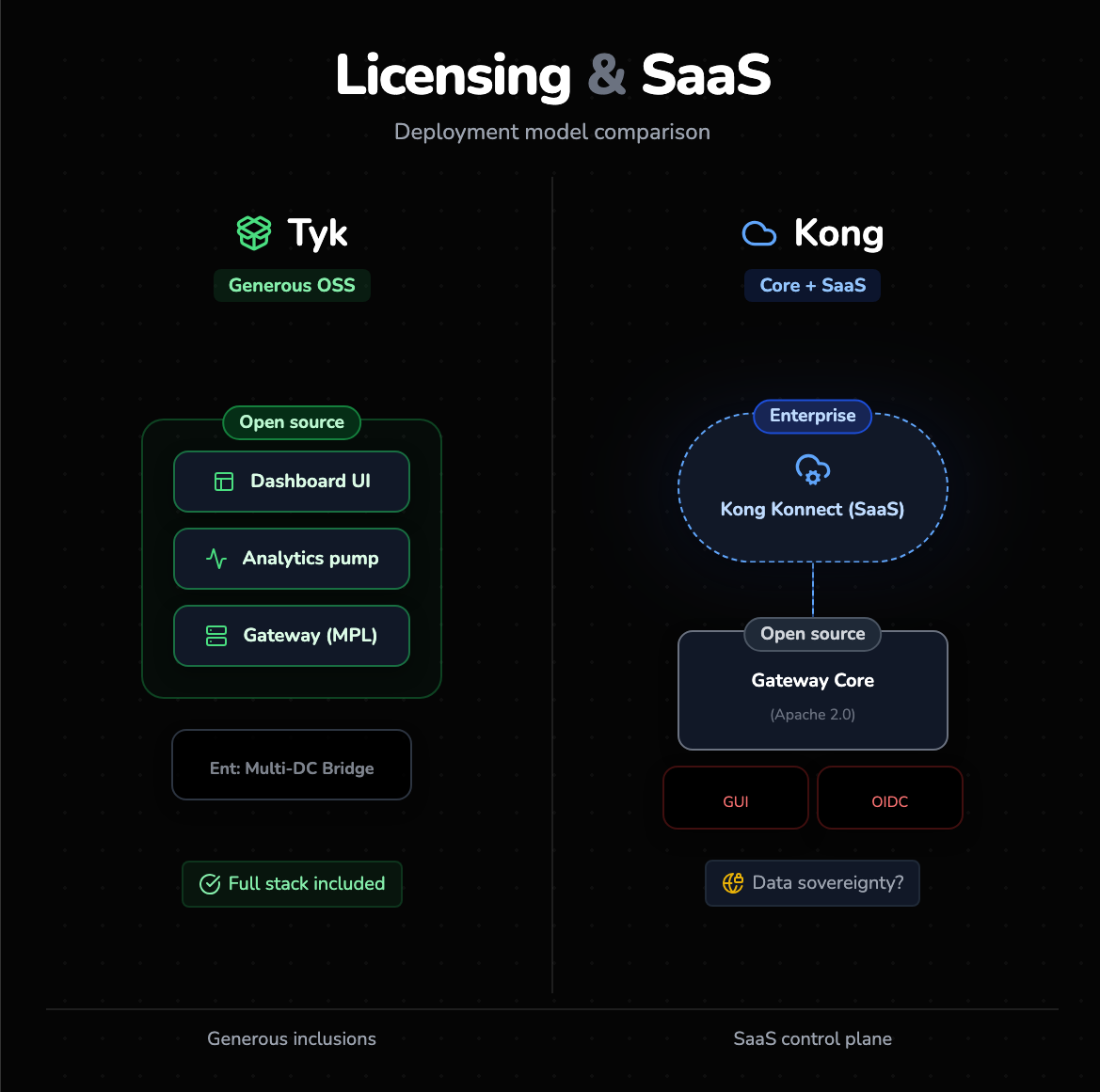
Tyk:
- Open Source: The Gateway and Pump are open source under the Mozilla Public License (MPL 2.0). The Dashboard and Developer Portal are proprietary and need a licence; free developer licences come with usage limits.
- Enterprise: Adds Multi-Data Center Bridge (MDCB), Developer Portal, and commercial support.
Kong:
- Open Source: Apache 2.0. Very permissive. You can run the gateway core anywhere, and it includes Kong Manager OSS, a basic GUI. Advanced security plugins (like OIDC), RBAC and Vitals analytics are Enterprise features.
- Enterprise: Moving to "Kong Konnect," a SaaS-based control plane. This separates the management layer (SaaS) from the data plane (your infrastructure). This is convenient but introduces data sovereignty questions for some banks and government entities.
Which gateway should you choose?
Choose Tyk If:
- You value "Time to Value": You want a gateway that includes OIDC, rate limiting, and a full management dashboard in one product without hunting for plugins.
- You are a Go Shop: Your team understands Golang and wants to extend the gateway using a language they already know.
- You need GraphQL Stitching: You have a mess of REST and SOAP services that you want to expose as a clean GraphQL API without building a separate middleware layer.
- You prefer a consolidated architecture: You want a single binary rather than an NGINX wrapper with Lua scripts.
Choose Kong If:
- Raw Throughput is King: You are processing hundreds of thousands of requests per second for simple routing tasks.
- You have NGINX Expertise: Your Ops team is already comfortable managing, tuning, and scaling NGINX instances.
- You need the largest ecosystem: You want the security of knowing that if a plugin exists, it probably exists for Kong first.
- You want a pure "Infrastructure" approach: You prefer the declarative, config-driven model over a dashboard-driven model.
Choose both and add DigitalAPI if:
- Two gateways, two jobs: You use Kong and Tyk for different domains, teams or trust boundaries and want to keep both.
- One catalog: You want partners and internal teams to find every API in one place, wherever it runs.
- Consistent rules: You need the same access, quota and security standards applied across both gateways.
- No migration: You want a single partner portal without moving APIs off either gateway.
What if you already run both Tyk and Kong?
Keep both if each gateway has a clear job. Running two gateways works when their responsibilities are separate, and causes problems when both try to manage the same APIs. Teams usually use one of three patterns:
- Split by domain: For example, Kong for public cloud APIs and Tyk for internal or regulated APIs, so no request passes through both.
- Edge plus internal: Kong handles public ingress and TLS at the edge, while Tyk applies internal API policies behind it. Every request then crosses two layers.
- During a migration: APIs move from one gateway to the other one by one, with a set end date.
Whichever pattern you use, plan for these risks:
| Risk | What goes wrong | How to manage it |
|---|---|---|
| Two control planes, one API | Both gateways manage the same routes and policies, and settings drift | Give every API one system of record for its routes and policies |
| Double authentication | Both gateways check identity, adding latency and confusion | Decide which layer authenticates consumers and which checks internal service identity |
| Conflicting rate limits | Limits set in both places block valid traffic | Set consumer quotas in one layer and service protection in the other |
| Scattered analytics | Each console shows only half the picture | Correlate request IDs and view traffic from both gateways in one place |
DigitalAPI is one way to manage that overlap without migrating either gateway. It connects to Tyk and Kong, puts every API in one catalog, and gives partners one self-serve portal, while each gateway keeps handling its own traffic.
Looking beyond Kong? Explore the top modern Kong alternatives
The AI-first alternative: DigitalAPI
Tyk and Kong are both strong gateways, and many teams end up running one of them alongside other gateways. DigitalAPI.ai adds an AI-First API Management layer above them. It doesn’t replace your gateways; it unifies your entire ecosystem and prepares it for the age of AI Agents.
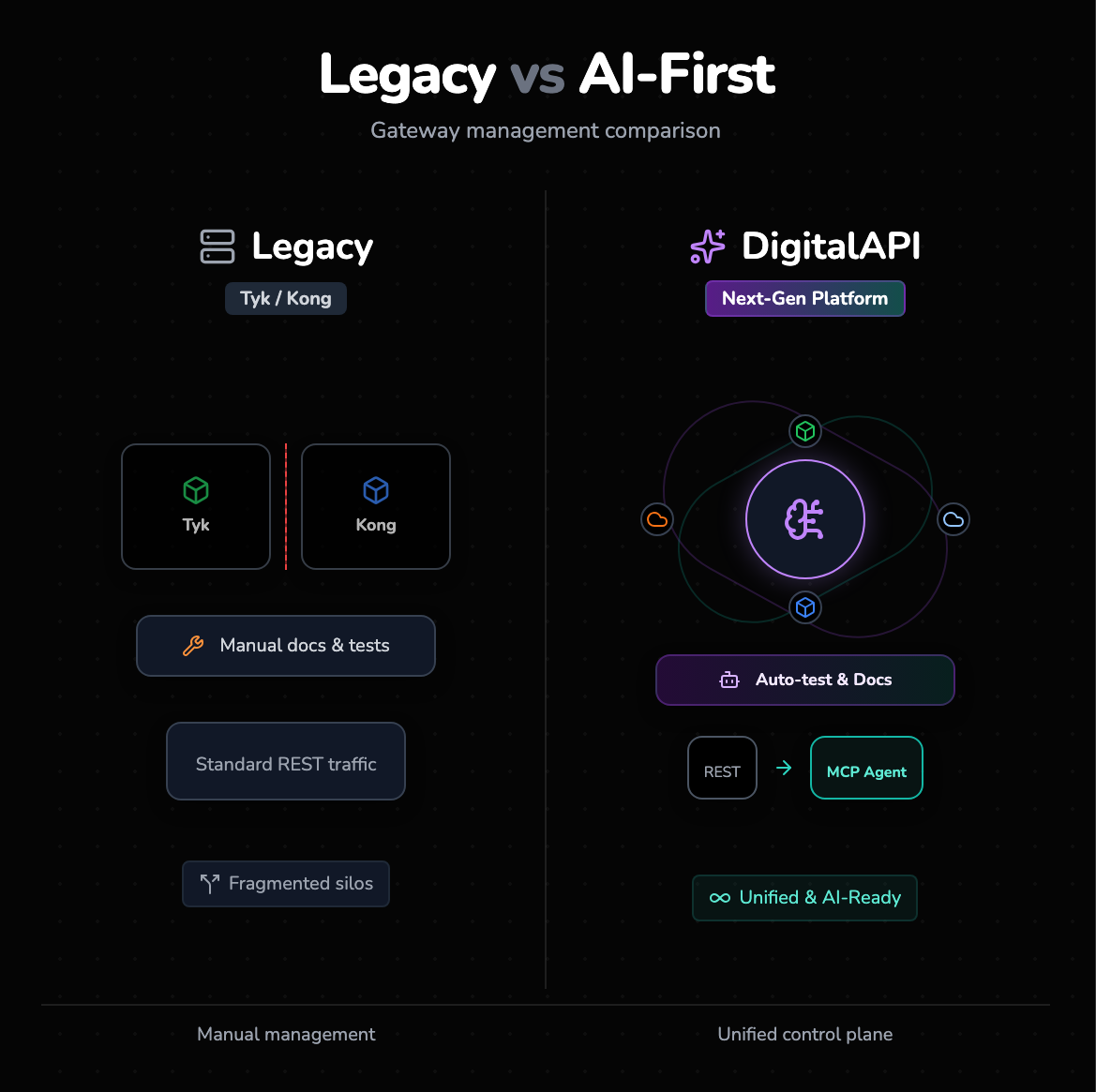
1. The "Gateway Agnostic" advantage
- Unified Control Plane: Stop managing gateways in silos. DigitalAPI acts as a single pane of glass to manage, govern, and secure APIs across Kong, Apigee, AWS, and Azure simultaneously.
- No "Rip and Replace": You can keep your existing Kong or Tyk instances for data-plane traffic while using DigitalAPI for superior governance and visibility.
2. AI-First features for modern teams
- Instant MCP Readiness: Convert any REST API into a Model Context Protocol (MCP) agent in one click, making your APIs instantly consumable by LLMs and AI Agents.
- AI-Powered Automation: Say goodbye to manual grunt work. DigitalAPI uses AI to auto-generate documentation, write test cases, and detect duplicate APIs ("API Sprawl") across your organization.
- DigitalAPI API Gateway: Need a new gateway? The DigitalAPI API Gateway is a lightweight, AI-native gateway built for low-latency AI workloads.
3. Monetization & growth
- White-Label Developer Portal: Launch a branded, monetization-ready developer portal in minutes, not months.
- Universal Discovery: An AI-driven catalog that makes every API in your organization discoverable, regardless of which gateway hosts it.
Frequently asked questions
1. How does vendor lock-in apply to Tyk vs Kong?
Both platforms are open-source, which reduces lock-in compared to proprietary SaaS like Apigee. However, "Logic Lock-in" is real. If you write complex custom logic in Kong’s Lua plugins, migrating away becomes difficult because you have to rewrite that logic. Tyk’s native features reduce this risk slightly, but migrating distinct architectural concepts (like Tyk’s specific Policy objects) to another gateway still requires significant refactoring.
2. Which platform is better for large enterprises?
Both serve Fortune 500 companies. Kong is often favored by enterprises with massive, existing on-premise infrastructure and NGINX legacy. Tyk is often favored by enterprises undergoing "Modernization" or "Digital Transformation" initiatives that favor agility, Kubernetes-native deployments, and Developer Experience over legacy tooling.
3. Does Kong require a database?
Not necessarily. Kong can use PostgreSQL, or run in "DB-less mode" (using declarative YAML config), which has been available since 2019 and is common with the Kubernetes Ingress Controller (KIC). Cassandra support was removed in Kong Gateway 3.4. DB-less mode removes the database requirement, but it also removes some dynamic capabilities (like creating consumers on the fly via API) unless you use a control plane like Kong Konnect to manage the config. Tyk creates a similar effect by using Redis for temporary state but still requires MongoDB or PostgreSQL for its Dashboard.
4. Which platform offers better native support for GraphQL?
Tyk is the clear winner for native support. Its Universal Data Graph allows you to create GraphQL endpoints from existing data sources without writing code. Kong supports GraphQL proxying and some validation but generally relies on you having a separate GraphQL server to do the heavy lifting.
5. How do the deployment models compare?
Kong is often deployed as an Ingress Controller in Kubernetes or as a standalone gateway on VMs. Tyk is similar but also offers a "Hybrid Cloud" model (Tyk MDCB), where the Management Control Plane is SaaS (or centralized), but the Gateways (Data Plane) sit in your private VPCs. Kong offers a similar hybrid model via Kong Konnect. Both are fully compatible with Docker, Kubernetes, and bare metal.
6. Is Tyk’s dashboard open source?
No. Tyk’s Gateway and Pump are open source under the Mozilla Public License (MPL 2.0), but the Tyk Dashboard and Developer Portal are proprietary and need a licence for on-premises use. Tyk offers free developer licences with usage limits, and its commercial plans include the Dashboard.
7. Can you run Tyk and Kong together?
Yes. The cleanest way is to give each gateway a separate job, for example Kong for public cloud APIs and Tyk for internal or regulated APIs, or both side by side during a migration. Give every API one system of record for its routes and policies, decide which gateway authenticates consumers, and keep one API catalog across both. DigitalAPI can provide that shared catalog and partner portal above both gateways.
8. What are the best alternatives to Kong and Tyk?
Common alternatives are Apigee and Azure API Management for enterprise API management, Gravitee and WSO2 for open-source full-lifecycle platforms, Apache APISIX (API7) for high-performance cloud-native gateways, and Zuplo for a managed edge gateway. If you already run several gateways, a layer such as DigitalAPI can manage them together instead of replacing them. See our list of top Kong alternatives.
Dhayalan Subramanian is Associate Director, Product Growth at DigitalAPI, where he leads go-to-market and product growth for the company’s multi-gateway API management platform. His work focuses on helping large enterprises and mid-market cloud companies consolidate APIs across AWS, Azure, Apigee, Kong, MuleSoft, and other gateways into a single control plane for governance, discovery, monetization, and agent consumption.
Dhayalan brings 14+ years of experience across product strategy, enterprise architecture, and engineering leadership. Earlier in his career, he held senior roles at Encora (as Associate Architect and Technical Manager), Mindtree (Technology Lead), Tech Mahindra (Technical Lead), and Primus Analytics, where he designed integration frameworks and delivered enterprise-grade digital platforms for global customers.
At DigitalAPI, he works directly with platform, integration, and developer experience leaders at Fortune 500 organizations to operationalize unified API catalogs, developer portals, and MCP-ready APIs. He writes regularly on API developer experience, API governance, and AI agent architectures.
One email a fortnight. Worth opening.
A short digest of what we're writing, what we're learning from customers, and the handful of links you'd actually want from us. No tracking pixels.

.avif)