



API Productization: How to Turn Enterprise APIs Into Products
Most enterprise APIs are plumbing, not products. Here is how API productization adds packaging, pricing, SLAs and analytics to the APIs you already run.

TL;DR
API productization is the practice of turning an internal API into a managed product: a packaged set of endpoints with a named audience, documentation, self-service access, a subscription plan, an SLA, usage analytics, and a price.
The code does not change.
What changes is everything around it.
A technical API answers "can this system be called?" An API product answers "who is this for, what does it cost, and what happens when it breaks?"
Enterprises productize APIs to turn existing engineering investment into partner reach and revenue.
What Is API Productization?
API productization is the discipline of wrapping an existing API in the things that make it buyable: a defined audience, packaging, documentation, self-service onboarding, access control, a service level agreement, usage analytics, and a commercial model. It is a product management exercise, not a re-platforming exercise. In most enterprises the API already works. What is missing is everything a customer needs in order to find it, trust it, pay for it, and depend on it.
The test is simple. Ask your team who owns the API's roadmap, who its top five consumers are, and what the 99th percentile latency commitment is. If three different people give three different answers, you have an endpoint. If one person answers all three, you have a product.
What Are the Components of an API Product?
Six things separate an API product from an API. Treat this as a checklist, because an API product is only as strong as its weakest component.
- A named consumer segment. Internal platform teams, integration partners, or public developers. Not "everyone."
- Packaging. One or more APIs bundled into a unit a consumer can subscribe to, rather than a raw endpoint list.
- Documentation and a sandbox. Reference, guides, and a way to make a first successful call without talking to a human.
- Self-service access. Registration, credential issuance, and a subscription plan with a quota.
- A commitment. Uptime and latency targets, a versioning policy, and a deprecation notice period.
- Measurement. Usage, adoption, error rates, and revenue attributed per consumer and per plan.
What Is the Difference Between an API as a Product and an API as a Technical Asset?
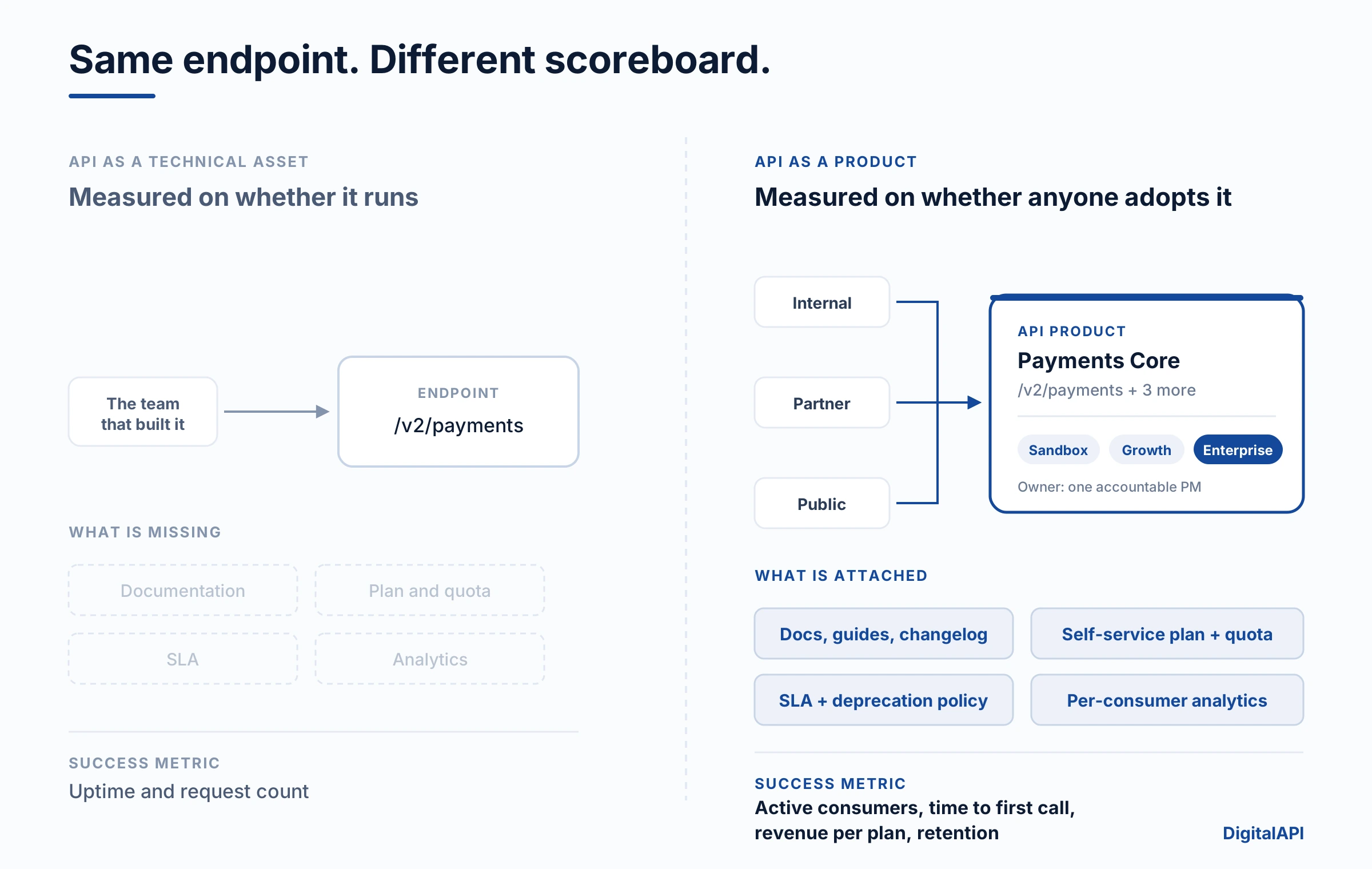
The difference is accountability. A technical asset is measured on whether it runs. An API as a product is measured on whether anyone adopts it, renews on it, and builds revenue on it. Same endpoint, different scoreboard.
Use this table to locate where your own programme sits today. Most enterprise APIs land in the left column on at least five of the eight rows.
Why the Distinction Has Teeth
The asset view produces a predictable failure. Engineering ships an API, nobody can find it, so a second team builds a near-duplicate. Six months later you are paying to run both and governing neither. Cloudflare's 2024 application security research found organisations had a median of 33% more public-facing API endpoints than they were aware of, with close to a quarter qualifying as shadow APIs (Cloudflare Application Security Report, 2024).
Productization inverts the sequence. You define the consumer and the plan first, then publish. Duplication becomes visible before it is built, because every new API has to justify itself against an existing catalog.
Why Does API Productization Matter in 2026?
Because API revenue is now mainstream, API estates are too large to govern informally, and a new non-human consumer has arrived. The organisations treating APIs as products are measurably further ahead on revenue than those treating them as plumbing.
The numbers worth putting in front of a CFO:
- 65% of organisations that use APIs now generate revenue from them, up from 62% the year before (Postman State of the API Report, 2025).
- Among those that monetize, 74% attribute at least 10% of total company revenue to APIs, and a quarter attribute more than half (Postman, 2025).
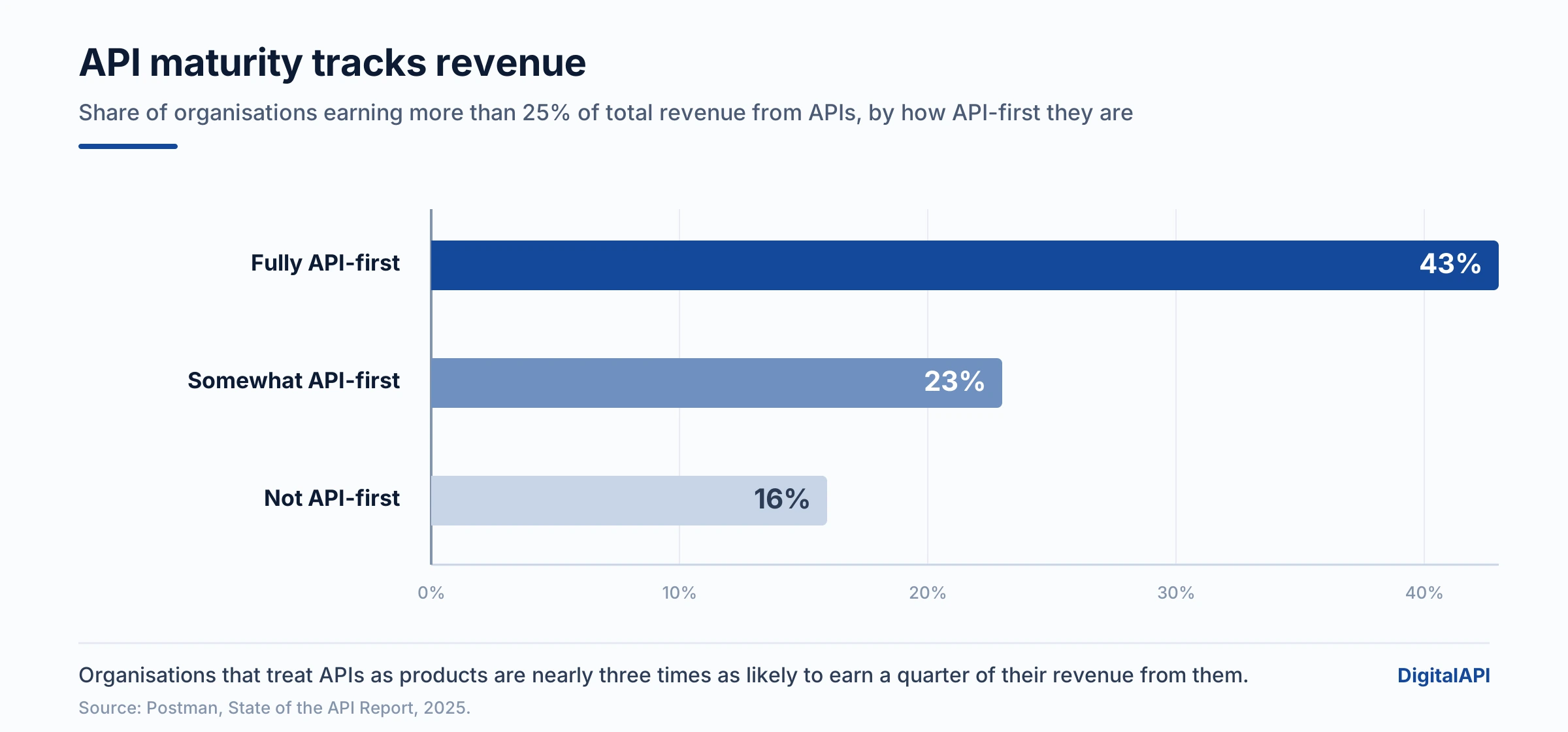
- Maturity correlates with money. 43% of fully API-first organisations earn over 25% of revenue from APIs, against 16% of organisations that are not API-first (Postman, 2025). This is the single strongest argument for an API product strategy over ad hoc exposure.
- Scale has outrun informal governance. Median enterprise API estates now exceed 5,900 endpoints, while only 23% of organisations know which of their APIs return sensitive data, down from 40% in 2022 (Akamai API Security Impact Study, 2026).
- API traffic is now roughly 60% of all dynamic web traffic (Cloudflare, 2024), and Cloudflare's 2025 Radar review confirmed it remains above half.
What Changed Most Recently
The consumer base stopped being exclusively human. Gartner projected that more than 30% of the increase in API demand would come from AI and tools using large language models by 2026 (Gartner, March 2024). Most API programmes have not adjusted: only 24% of organisations report designing APIs with AI agents in mind, while 60% still design primarily for human developers (Postman, 2025).
That gap is the opportunity. An API that is already productized, with a catalog entry, a plan, a quota, and metered usage, is most of the way to being agent-ready. An undocumented internal endpoint is not.
Who Actually Consumes Your API?
Every API product has exactly one primary consumer tier, and productization decisions change completely depending on which one it is. Pick the tier before you pick the packaging. Teams that skip this step build public-grade documentation for an internal API, or ship an internal-grade portal to paying partners.
How Do You Identify Your API Consumers?
You do not need a research programme. Four sources tell you most of it inside a week.
- Gateway logs. Group calls by credential, then by owning team or company. Your top ten consumers by volume are your first product's real audience.
- Your support queue. Every recurring integration ticket names a consumer and a missing product component. Repeated "how do I authenticate" tickets are a documentation product gap, not a developer failure.
- Your sales pipeline. Ask which deals stalled on an integration requirement. Those requirements are a partner API product waiting to be named.
- Shadow usage. Credentials issued years ago, still active, owned by nobody. Akamai's 2026 study put the average annual cost of API-related security incidents at roughly US$700,000 per organisation, with 87% of organisations reporting at least one in the prior twelve months. Unowned consumers are where that cost accumulates.
Good API product management starts here rather than at the pricing page. You cannot package for an audience you have not named.
How Do You Package APIs Into Products?
Packaging means grouping endpoints by the job a consumer is hiring them to do, then attaching plans that control how much of that job each consumer can perform. One backend API can become several commercial products. Three endpoints can become one. The boundary follows the use case, never the microservice.
A worked example. A payments platform runs a single transactions API with twelve endpoints. A sound API packaging strategy splits it into three products:
- Payments Core, for partners who need to initiate and query a payment. Four endpoints.
- Reconciliation Feed, for finance systems that need settled-batch exports. Three endpoints, higher quotas, lower price per call.
- Transaction Insights, for analytics consumers who need aggregated data and no write access at all. Five read endpoints, priced on data volume rather than requests.
Same codebase. Three audiences, three price points, three roadmaps.
Four Packaging Rules That Hold Up in Production
- Bundle by job, not by service boundary. If a consumer needs four endpoints to complete one task, those four ship together.
- Never publish a write and a read product under the same plan. Risk profiles and quotas differ too much.
- Keep the free or sandbox tier functionally complete. Reduce the quota, not the capability. A crippled trial produces evaluation abandonment, not upgrades.
- One product, one owner, one changelog. Shared ownership is the most reliable predictor of a stale spec.
Here is the actual shape of an API product and its plans:
product: payments-core
  display_name: Payments Core API
  audience: contracted partners
  apis:
    - payments-initiate-v2
    - payments-status-v2
  owner: api-pm-payments
  sla:
    availability: 99.95%
    p99_latency_ms: 400
    support_response: 4h business hours
  deprecation_notice_days: 180

  plans:
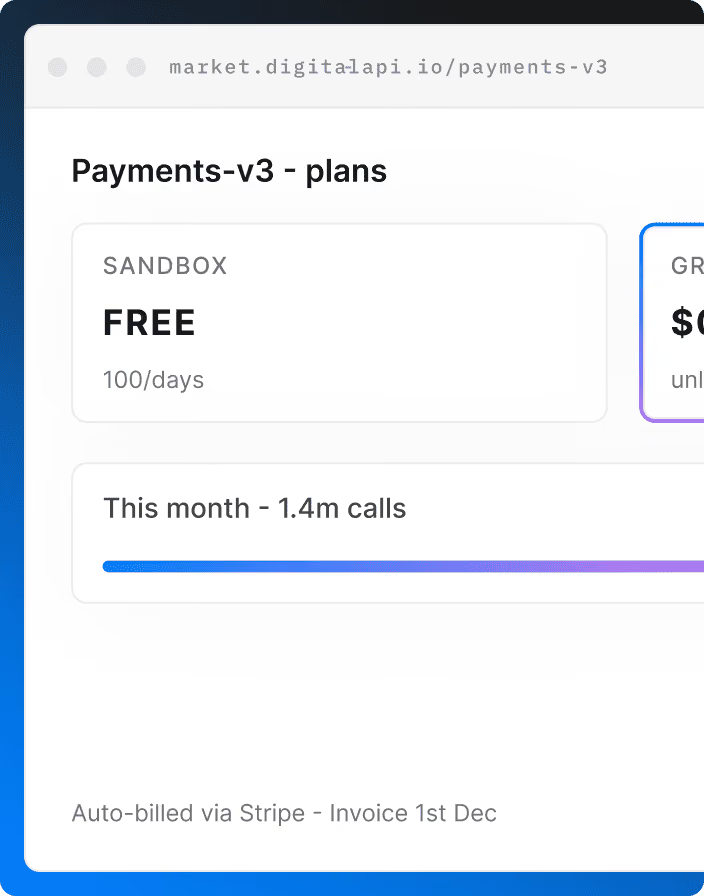
    - name: sandbox
      price: 0
      quota: 1000/day
      environment: sandbox-only
    - name: growth
      price: 0.004/call
      quota: 250000/month
      overage: 0.006/call
    - name: enterprise
      price: contracted
      quota: negotiated
      rate_limit: 500/sec
If your organisation cannot produce a filled-in version of that for your top three APIs, the productization work has not started yet, whatever the roadmap says. Attaching plans is where the commercial layer becomes real. For a narrower worked example, see how to productize event APIs.
What Does an API Product Need Beyond Working Code?
Five layers: documentation, access and subscriptions, service commitments, analytics, and support tiering. These are the layers consumers actually evaluate. Working code is the entry ticket, not the product.
Documentation That Functions as a Product Surface
Documentation is the sales page for an API product, and it is where most programmes quietly fail. Postman's 2025 research found 55% of API teams struggle with inconsistent documentation and 34% cannot find APIs that already exist inside their own organisation. Both numbers describe a product problem, not a writing problem.
What a productized doc set contains: a quickstart that produces a successful call, a complete reference generated from the spec so it cannot drift, runnable examples in the languages your consumers actually use, a changelog, and an error catalog with remediation. Generated-from-spec is the non-negotiable part. Hand-maintained reference docs are stale within two releases.
Access and Subscriptions
Access has to be a workflow, not a favour. The productized version: a consumer registers an application, selects a plan, receives credentials immediately or after a defined approval step, and can see their own quota consumption without asking anyone. Revocation has to be equally clean, taking effect on the next request rather than at the next deploy.
SLAs and the Commitments Nobody Writes Down
This is the layer enterprise buyers ask about first, and the one most API programmes skip. An API product's commercial terms need four published artifacts:
- Availability and latency targets, per plan, with the measurement window stated.
- A versioning policy, naming what counts as a breaking change.
- A deprecation notice period. 90 days for internal, 180 or more for paid external products.
- Support tiers tied to plans, so a free-tier consumer and a contracted partner have different, documented response expectations.
Without these, procurement cannot sign and your API cannot be sold. Governance is not the brake on monetization, it is the precondition for it.
Analytics That Answer Product Questions
Infrastructure monitoring tells you the API is up. Product analytics tells you whether it is working as a product. Track time to first successful call, activation rate within the first seven days, active consumers by plan, error rate by consumer (not just in aggregate), quota exhaustion events, and revenue per plan. Error rate by consumer is the one most teams lack, and it is the earliest churn signal you will get.
How Do You Price and Monetize an API Product?
Pick the pricing model that matches how your consumer derives value, then make sure your gateway can actually meter and enforce it. The second half of that sentence is where most API productization programmes stall. A pricing page you cannot enforce at the request layer is a pricing aspiration.
What Has to Be True Before You Can Charge?
Three prerequisites, in order. Skipping any of them turns a pricing launch into a finance incident.
- Metering you trust. Per-consumer, per-plan request and data counts, reconciled against the gateway rather than estimated from logs.
- Enforcement at the edge. Quotas, rate limits, and overage behaviour applied on the request path, so a consumer on the growth plan cannot transparently consume enterprise volume.
- Billing integration. Usage records flowing into whatever your finance team already runs, with invoices they recognise.
Know Your Cost to Serve
This step gets skipped more than almost any other in digital products through APIs, so it is worth saying plainly: price against your own unit economics, not against someone else's list price. Calculate infrastructure cost per million calls, add the support cost per active consumer, and add the engineering cost of maintaining the version. Compare that to the plan price. A usage-based plan with a negative gross margin at high volume is a real and common outcome, particularly for AI-backed APIs where the underlying inference cost moves independently of your price.
API productization succeeds when commercial design and technical enforcement are the same project, owned by the same person.
How Do You Productize APIs Spread Across Multiple Gateways?
You separate the product layer from the runtime layer: publish one catalog of products over the gateways you already run, and leave live traffic where it is. Most productization advice assumes a single gateway and a clean slate. Almost no enterprise has either.
The real starting position in a large organisation: Apigee from a 2018 programme, AWS API Gateway from a cloud migration, Azure API Management from an acquisition, Kong in front of the Kubernetes estate, and a few services exposed directly. Each has its own portal, its own credential model, and its own idea of what an API is.
The instinct is to consolidate first and productize afterwards. That sequence is why productizing APIs stalls for years. Gateway migration is a multi-year programme with no business-visible outcome until it finishes, so it gets deprioritised, and the product work waits behind it.
The Alternative Sequence
Invert it. Put a management plane above the gateways:
- Connect, do not migrate. Import API definitions from each existing gateway read-only. Nothing moves, no traffic reroutes.
- Normalise metadata. One description, owner, version, and category standard across every source.
- Publish products, not gateways. The consumer sees Payments Core, not "the Apigee one." Which gateway serves the request is an implementation detail.
- Govern centrally, enforce locally. Standards, scoring, and approval workflows live in the management plane. Rate limits and auth stay on whichever gateway already handles that traffic.
- Consolidate later, if ever. Once products exist and usage is visible, gateway consolidation becomes an optimisation with a measurable case, not a prerequisite.
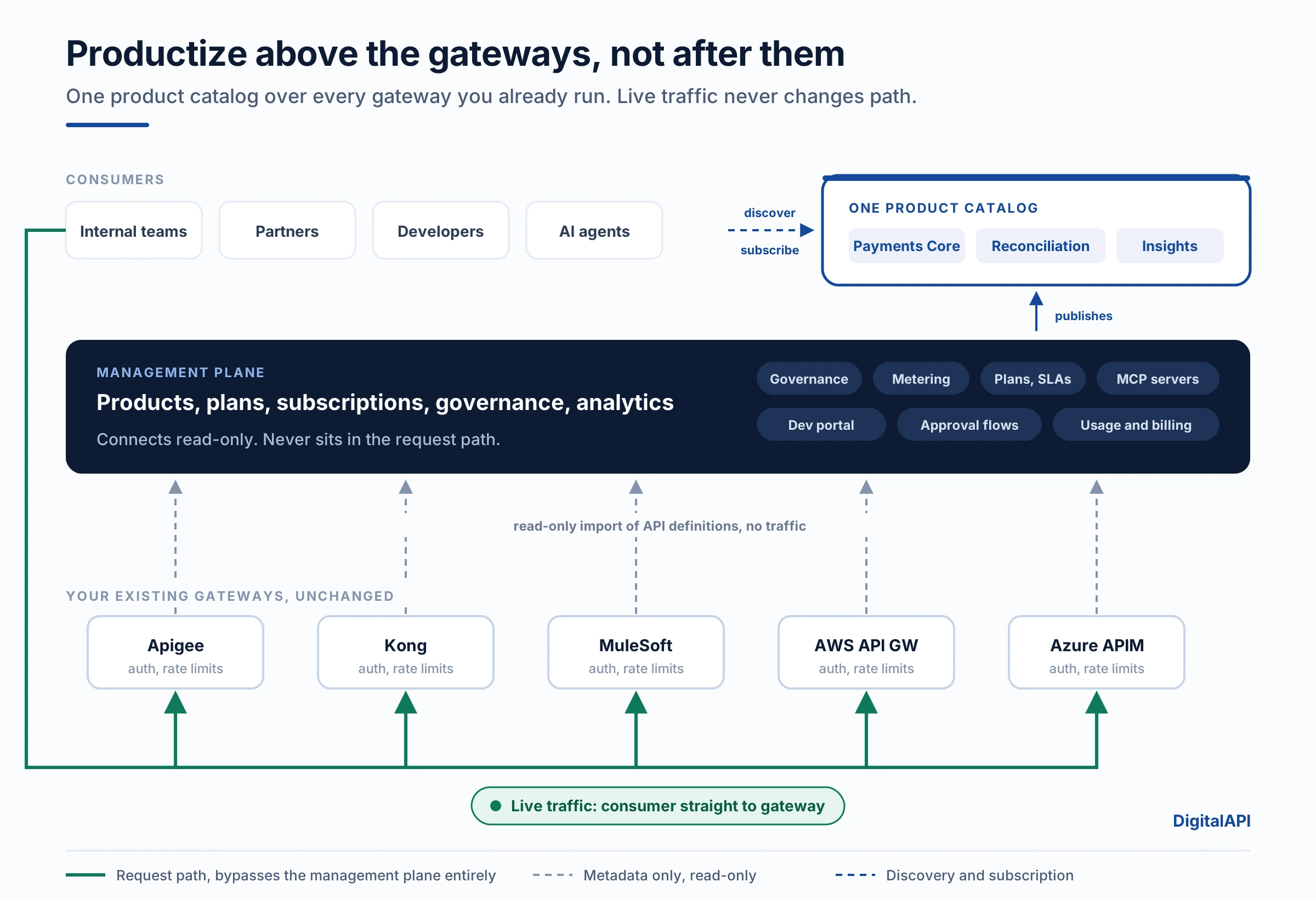
This is exactly the architecture DigitalAPI's API Marketplace implements: a provider control plane that connects read-only to Apigee, Apigee X, Kong, MuleSoft, AWS API Gateway, Azure APIM, IBM API Connect, Tyk, and APISIX, publishes governed products over all of them, and stays out of the request path entirely. Teams adopting it start publishing API products in weeks rather than waiting for a gateway consolidation to land.
How Do You Make API Products Consumable by AI Agents?
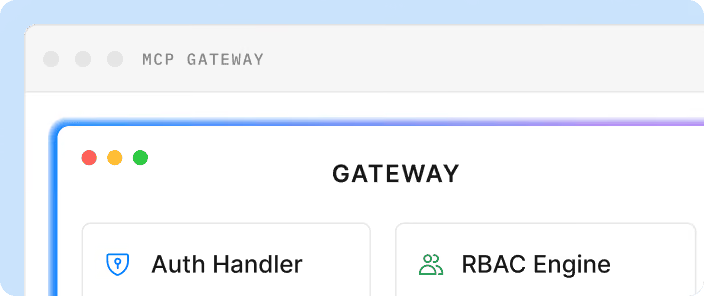
You treat the agent as a subscriber: it gets credentials, a plan, a quota, and an audit trail, exactly like a human developer, and you expose the API in a format an agent can discover and call without custom integration code. In practice that means publishing your API product as an MCP server alongside its REST interface.
Most API productization guidance still assumes the consumer is a human developer. Gartner put over 30% of API demand growth by 2026 at the feet of AI and LLM-based tools, and Akamai's 2026 study attributed 42% of API security incidents to APIs powering AI applications, models, and agents.
What Agents Need That Human Developers Do Not
The Practical Route
If an API is already productized, agent-readiness is a short step rather than a project. The components you built for human consumers (a catalog entry, a current spec, a plan, a quota, metered usage) are the same components an agent needs. What is added is the protocol surface and tighter scoping.
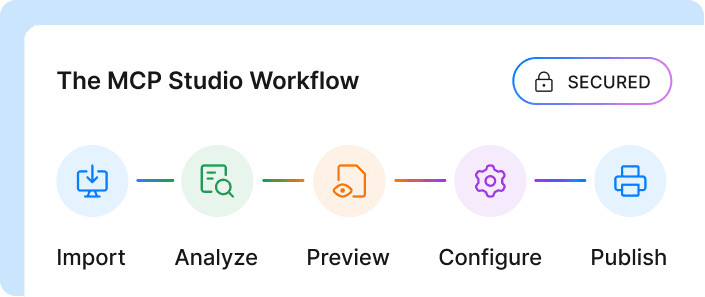
MCP Studio converts a published API into an MCP server from its OpenAPI specification without bespoke code, generating one tool per operation, and MCP Gateway governs the resulting agent traffic under the same credentials, plans, and rate limits as every other consumer. Organisations running both treat agents as a consumer tier in the existing catalog rather than a parallel integration programme, which is what keeps agentic access auditable instead of shadow.
The strategic point for an API product strategy in 2026: the 24% of organisations already designing for agents are building a durable distribution advantage. An API product that an agent can discover and call is reachable by every assistant your customers use. One that requires a human to read documentation is not.
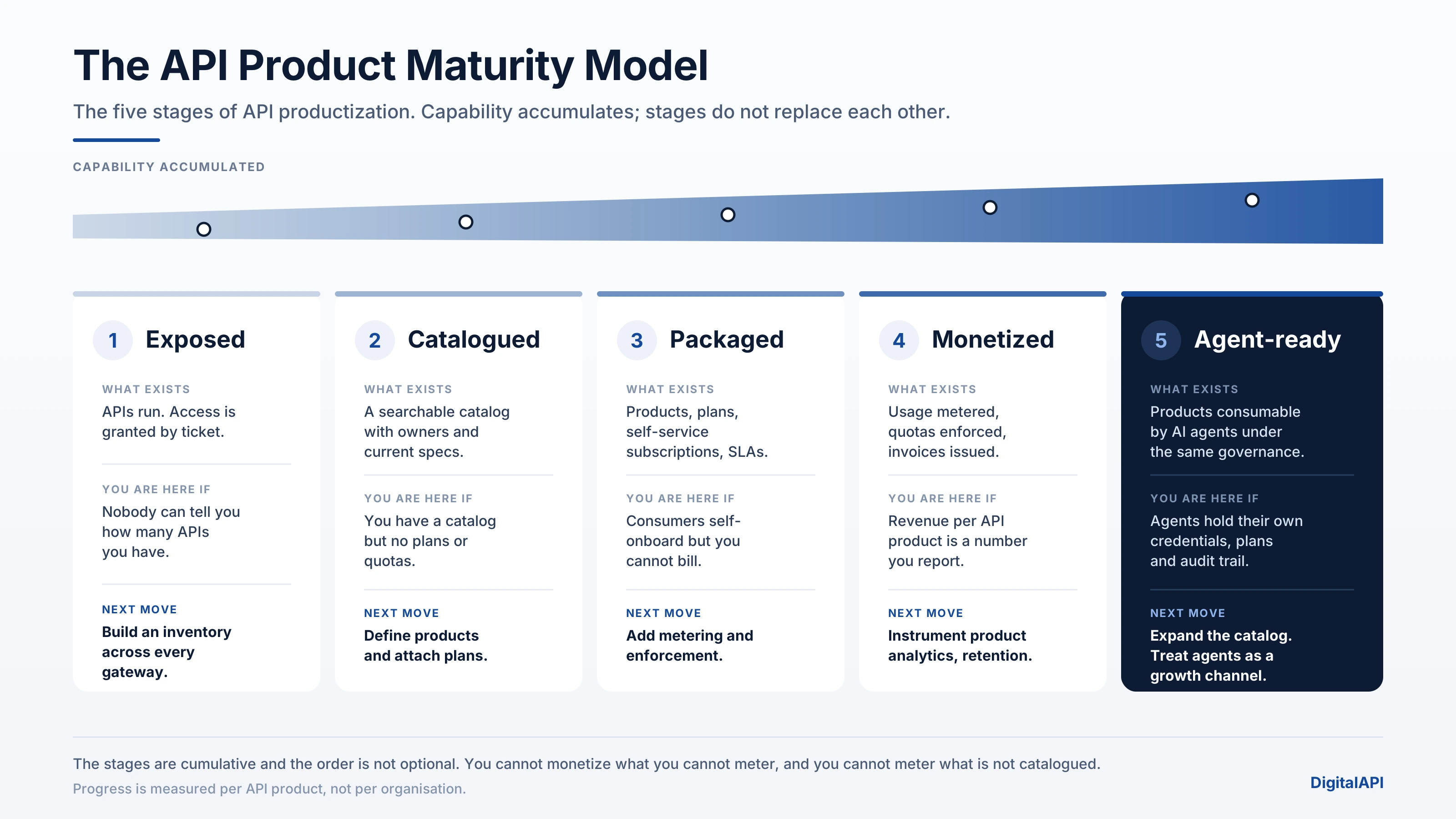
What Are the Stages of API Product Maturity?
There are five stages, and most enterprises are at stage 2 while believing they are at stage 4. Use the diagnostic signal column to place yourself honestly, then work the next stage rather than the end state.
How to Use the Model
The stages are cumulative and the order is not optional. Three rules learned from programmes that tried to skip ahead:
- You cannot monetize what you cannot meter, and you cannot meter what is not catalogued. Stage 4 attempted from stage 2 produces a pricing page with no enforcement behind it.
- Stage 5 does not bypass stage 3. Exposing an uncatalogued API to agents creates ungoverned machine traffic against an endpoint nobody owns. That is the shape of the incidents in Akamai's 42% figure.
- Progress is per product, not per organisation. A mature programme runs its payments product at stage 4 and its new analytics product at stage 2 simultaneously. Averaging the two tells you nothing useful.
What Does Good Developer Experience Look Like for an API Product?
Measure one thing first: how long it takes a new consumer to make a successful authenticated call without human help. Every other developer experience metric is downstream of that number. If it is measured in days, you have a product problem that no amount of documentation rewriting will fix.
The effort is real, and it is where your consumers' time goes. Postman's 2025 research found 69% of developers spend ten or more hours a week on API-related work, with testing, building, and documenting leading the list. Friction you leave in the onboarding path is billed to them weekly.
The Four-Step Path Worth Instrumenting
- Discover. The consumer finds the product in a catalog, with enough description to know it is the right one.
- Register. They create an application and subscribe to a plan without opening a ticket.
- Call. They make a first request against a sandbox with realistic data, not an empty mock.
- Depend. They see their own usage, quota, and errors, and know what happens when something breaks.
Put a timestamp on each transition. The gap between step 2 and step 3 is where most API products lose consumers, and it is almost always a credentials or sandbox-data problem rather than a documentation problem.
Failure Modes to Watch For
- The sandbox returns empty objects. Consumers cannot build against it and go quiet without telling you.
- Credentials require approval but nobody owns the queue. Signup converts to nothing.
- The reference is hand-maintained. It drifts from the live API and every error the consumer hits is unexplained.
- Errors return a status code and no remediation. Support volume becomes the product's main cost line.
- No changelog. Consumers discover breaking changes in production, which ends partner trust permanently.
Is API Productization Right for You?
What Are the Most Common API Productization Mistakes?
The recurring failure is sequencing: organisations build the commercial layer before the catalog layer, or migrate gateways before they productize anything. Seven mistakes account for most stalled programmes.
- Publishing a pricing page you cannot enforce. Quotas that exist in marketing copy and not on the request path produce revenue leakage and angry renewal conversations.
- Treating gateway consolidation as a prerequisite. It delays every business outcome by years. Productize above the gateways instead.
- Packaging by microservice. Consumers get six products where they needed one, and abandon the integration halfway.
- Assigning ownership to a committee. An API product with four part-time owners has none. Specs go stale, roadmaps do not exist.
- Shipping a sandbox with no realistic data. The most common single cause of evaluation drop-off, and the hardest to detect, because nobody files a ticket before they leave.
- Skipping the deprecation policy. The first breaking change costs you the partner relationship you spent a year building.
- Exposing APIs to AI agents without governance. Agents inherit whatever permissions they are given and call everything they can. Ungoverned agent access to an unowned endpoint is how machine traffic becomes an incident.
The Mistake Behind the Mistakes
All seven share a root cause: the API is still owned by the team that built it rather than by someone accountable for who uses it. Fix ownership and most of the rest becomes tractable. Leave it unfixed and the best platform in the world will not help, because nobody is accountable for the decisions a platform exists to execute.
Conclusion
API productization is not a re-platforming project. It is the decision to put an owner, an audience, a plan, and a commitment around capabilities you already run and already pay for. The engineering investment is largely sunk. What productization recovers is the return on it.
The sequence that works is consistent: inventory what exists across every gateway, catalogue it with owners and current specs, package it into products aimed at a named consumer tier, attach plans you can actually enforce, then open the same catalog to AI agents under the same governance. Each stage is useful on its own, which is what makes the programme fundable. Organisations building digital products through APIs this way report revenue against individual API products rather than against an undifferentiated platform cost line, and that single reporting change is usually what secures the next round of investment.
Start with one product. Pick the API with the most external consumers, give it an owner, and take it to stage 3. The second one takes a third of the time.
Turn your existing APIs into products, without a gateway migration
See how teams publish governed, priced API products across Apigee, Kong, MuleSoft, AWS, and Azure from one catalog, with live traffic staying exactly where it is.
Book a 30-minute walkthrough
Not ready?
Explore the API Marketplace
Frequently Asked Questions About API Productization
1. What Is API Productization in Simple Terms?
API productization is the process of turning a working API into something a customer can find, subscribe to, pay for, and rely on. It adds a named audience, packaging, documentation, self-service access, a service level agreement, usage analytics, and a price to an API that already functions technically. The code does not usually change.
2. What Is the Difference Between an API and an API Product?
An API is a technical interface that allows one system to call another. An API product is a commercially framed bundle of one or more APIs, published with its own documentation, access plan, support commitment, and success metrics, and owned by a single accountable product manager. The API answers whether a system can be called. The API product answers who it is for, what it costs, and what happens when it breaks.
3. Do You Need to Monetize an API for It to Be a Product?
No. Internal API products are common and valuable. An internal API product still has a named consumer tier, packaging, documentation, self-service access, and an SLA. The commercial model is chargeback, showback, or simply nothing at all. The discipline is identical; only the pricing layer differs.
4. Who Owns API Productization in an Enterprise?
An API product manager owns it, accountable for adoption, roadmap, and commercial performance rather than for uptime. In practice the role sits in a platform organisation or a digital business unit, with engineering owning the runtime and the product manager owning the consumer relationship. Shared or committee ownership is the most reliable predictor of a stalled programme.
5. How Long Does API Productization Take?
For a first product on an API that already exists and is documented, four to eight weeks is realistic: naming the consumer tier, defining the product and plans, publishing to a catalog, and instrumenting usage. Adding metering and billing enforcement typically adds another four to six weeks. Subsequent products take substantially less time because the catalog, governance, and plan structures already exist.
6. Can You Productize APIs Without Migrating to a New Gateway?
Yes, and it is usually the faster path. A management plane sits above existing gateways, imports API definitions read-only, and publishes governed products over all of them, while live traffic continues to flow through whichever gateway already handles it. This decouples productization from gateway consolidation, which otherwise delays every business outcome by years.
7. How Do You Make API Products Available to AI Agents?
Treat the agent as a subscriber. Issue it credentials, assign it a plan with a quota, log its calls against an identity, and expose the API in a machine-consumable form, typically an MCP server generated from the OpenAPI specification. An API that is already productized needs only the protocol surface and tighter permission scoping to become agent-ready.
Dhayalan Subramanian is Associate Director, Product Growth at DigitalAPI, where he leads go-to-market and product growth for the company’s multi-gateway API management platform. His work focuses on helping large enterprises and mid-market cloud companies consolidate APIs across AWS, Azure, Apigee, Kong, MuleSoft, and other gateways into a single control plane for governance, discovery, monetization, and agent consumption.
Dhayalan brings 14+ years of experience across product strategy, enterprise architecture, and engineering leadership. Earlier in his career, he held senior roles at Encora (as Associate Architect and Technical Manager), Mindtree (Technology Lead), Tech Mahindra (Technical Lead), and Primus Analytics, where he designed integration frameworks and delivered enterprise-grade digital platforms for global customers.
At DigitalAPI, he works directly with platform, integration, and developer experience leaders at Fortune 500 organizations to operationalize unified API catalogs, developer portals, and MCP-ready APIs. He writes regularly on API developer experience, API governance, and AI agent architectures.
One email a fortnight. Worth opening.
A short digest of what we're writing, what we're learning from customers, and the handful of links you'd actually want from us. No tracking pixels.

.avif)