



Marketplace Developer Portal: How to Create an API Marketplace
A marketplace developer portal combines API discovery, subscription management, and automated billing in one platform. Learn what it is, how it differs from a standard developer portal, and how to build one that generates real revenue.

TL;DR
1. A marketplace developer portal is a self-service platform where API providers publish APIs as products and developers discover, test, subscribe to, and pay for them, with billing, access control, and usage tracking all managed automatically.
2. A developer portal focuses on the technical experience of working with APIs. An API marketplace focuses on the commercial experience of selling and buying API access as a product.
3. Core marketplace components include: API product catalog, tiered pricing plans, self-serve subscription workflows, sandbox testing, automated billing and invoicing, white-label branding, and revenue analytics.
4. The biggest mistakes teams make: publishing too many undifferentiated APIs, ignoring pricing strategy, skipping the sandbox, and launching without a clear monetization model.
5. DigitalAPI's API Marketplace delivers the full stack: white-labelled portal, usage-based and subscription billing (Stripe and Braintree), API product bundling, sandbox environments, and real-time revenue analytics, live in weeks, not months.
6. Zurich Insurance, Fiserv, and Chenosis have already used DigitalAPI's marketplace to turn internal APIs into external revenue streams at scale.
Most organisations reach a turning point in their API journey. Internal teams are using the APIs. Documentation exists. A basic portal is live. And then someone asks the question that changes everything: "Can we charge for this?"
That question marks the shift from a developer portal to an API marketplace. It's not just a feature addition. It's a fundamentally different operating model, where APIs stop being technical utilities and start being products with pricing, subscriptions, billing, and measurable revenue.
Getting this transition right takes more than slapping a payment form onto an existing portal. A marketplace developer portal is a distinct infrastructure layer that combines the discoverability of a catalog, the experience of a developer portal, and the commercial machinery of a product storefront. This guide explains what it is, how it differs from a standard portal, and how to build one that generates real revenue.
What Is a Marketplace Developer Portal?
A marketplace developer portal is a branded, self-service platform where an organisation publishes APIs as commercial products, and developers or partners discover, evaluate, test, subscribe to, and pay for access, with the entire transaction and access lifecycle managed automatically.
The developer portal handles the technical layer: documentation, versioning, credential management, and sandbox testing. The marketplace layer handles the commercial layer: pricing tiers, subscription management, billing automation, invoicing, and usage metering. A marketplace developer portal integrates both into one experience.
Think of it as the difference between a library and a bookshop. Both let you find and use books. One does it for free, internally, with a card catalogue. The other does it commercially, with pricing, self-checkout, and a receipt.
Developer Portal vs. API Marketplace: Understanding the Distinction
This distinction matters because many teams try to monetize APIs using infrastructure that was never designed for it. A standard developer portal can document an API and issue credentials. It cannot manage subscription tiers, automate billing, or track revenue. Trying to add these features through plugins and custom code is the path to a six-month engineering project that still doesn't work properly at scale.
Here is how the two layers differ across every dimension that matters for commercial API programs:
Most mature API programs need both. The internal catalog and governance layer is a developer portal. The external-facing commercial layer is the marketplace. DigitalAPI's platform delivers both from a single system, letting organizations promote APIs from an internal catalog to an external marketplace without switching tools.
Core Components of a Marketplace Developer Portal
Here are the components every API marketplace needs to function as a real commercial platform. Below are the features that separate an API marketplace that generates revenue from one that generates support tickets.
1. API Product Catalog
An API marketplace is not a raw list of endpoints. It is a curated storefront of API products, where each product bundles related APIs into a clear, consumer-friendly offering with a defined value proposition.
DigitalAPI lets you group multiple APIs into a single product. A banking organisation might create an "Open Banking Bundle" that combines Account Balance, Transaction History, and KYC APIs under one subscription key. A healthcare provider might create a "Patient Data Access" product combining FHIR-compliant record APIs. Consumers subscribe to the product and get a single credential, rather than managing separate keys for every endpoint they use. This is what turns an API catalog into a commercial product line.
2. Tiered Pricing Plans
A marketplace without pricing is a catalog. Real API monetization requires well-defined pricing tiers that match different consumer segments and usage patterns.
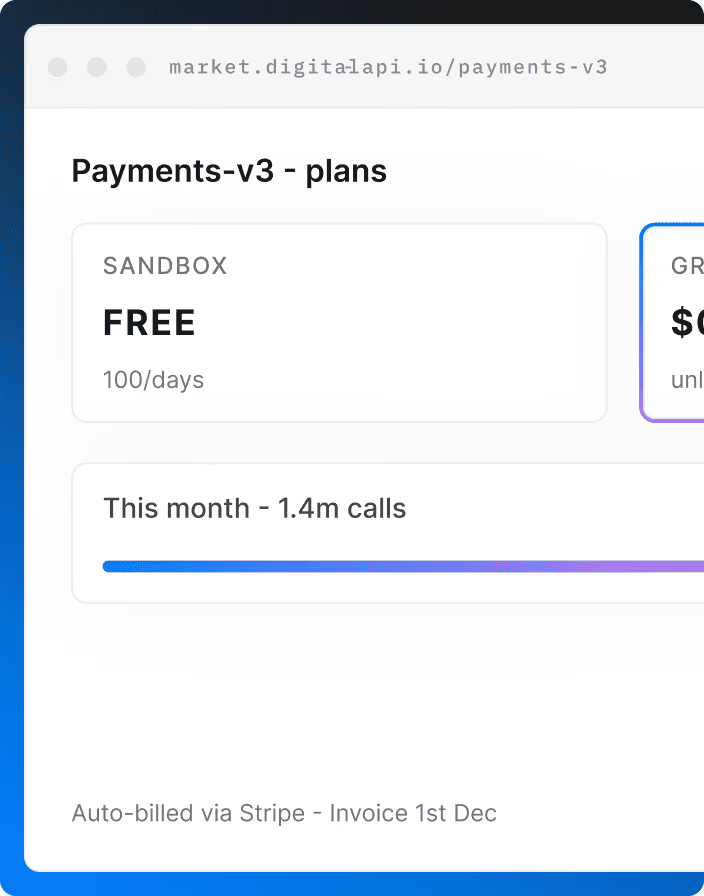
DigitalAPI supports the full range of monetization models through its API Monetization platform:
- Freemium: Free access up to a usage threshold, paid plans for higher volumes or advanced features
- Tiered subscription: Fixed monthly plans (Silver, Gold, Platinum) with defined rate limits and feature sets
- Usage-based: Charge per API call, per data unit, or per transaction
- Enterprise licensing: Custom contracts for high-volume or regulated use cases
- Revenue sharing: Split revenue with partners who build on top of your APIs
The right model depends on your APIs, your consumers, and how your business measures value. What matters is that pricing is visible, enforced automatically at the gateway level, and adjustable without requiring engineering work every time you want to iterate.
3. Self-Serve Subscription Workflow
Manual approval processes are the fastest way to kill API adoption. A developer who discovers an API on Monday and can't get credentials until Thursday is a developer who will find an alternative.
A marketplace developer portal automates the subscription journey completely. A developer finds an API product, reviews the pricing tier, selects a plan, and receives credentials instantly. For higher-sensitivity APIs that require review, approval workflows can be configured, but the approval itself happens inside the portal with a single admin click, not through a ticket system.
Fiserv used DigitalAPI's marketplace to build exactly this flow for fintech onboarding: subscription management, tiered pricing, billing, and usage tracking in one platform, with partner onboarding going from weeks to days.
4. Sandbox Testing Before Subscription
Developers don't buy what they can't try. A marketplace that expects developers to subscribe and pay before testing anything will have high abandonment and low conversion.
DigitalAPI's API Sandboxing provides an isolated testing environment where developers can validate API behavior, inspect response structures, and test edge cases against realistic mock data, all before committing to a subscription. This reduces integration errors, builds developer confidence, and significantly improves trial-to-paid conversion rates.
5. Automated Billing and Invoicing
Usage metering, billing calculation, invoice generation, and payment collection must all happen automatically at scale. Manual billing processes break when you have hundreds of subscribers, each on different plans with different usage patterns.
DigitalAPI integrates natively with Stripe and Braintree, supporting any payment gateway your organisation already uses. Usage data flows from the gateway to the billing system automatically. Invoices are generated and sent without manual intervention. Overages trigger billing logic in real time. Admins get a complete view of all orders, subscriptions, and revenue in one dashboard.
6. White-Label Branding
A marketplace developer portal needs to look like your organisation's product, not a vendor tool. Consumers building on your APIs are building on your brand. The portal is the first experience they have with that brand as a product.
DigitalAPI's White-Labelled Developer Portal delivers full branding control: logo, colors, domain, navigation, and layout. Zurich Insurance used this to build a fully branded API marketplace that handles millions of transactions under their own identity. The portal feels like a Zurich product because it is presented as one.
7. Revenue and Adoption Analytics
An API marketplace without revenue analytics is a black box. You need to know which products generate the most revenue, where developers drop off in the subscription funnel, which pricing tiers drive the most conversions, and which APIs have the highest churn rate.
DigitalAPI's API Analytics gives marketplace operators two distinct views: API-level performance data (latency, error rates, traffic patterns) and business-level marketplace data (subscription growth, revenue trends, customer acquisition costs, and churn). These aren't the same thing, and both matter for running a healthy API business.
How to Create an API Marketplace: Step by Step
Here is the step-by-step process for building a marketplace developer portal that converts API capabilities into a commercial product line.
1. Audit and Select APIs for Commercialization
Not every API belongs in a marketplace. Start by identifying which of your APIs have value that external partners or paying customers would actually pay for. The selection criteria: unique data or functionality, a clear external use case, and governance and security standards that can withstand external exposure.
DigitalAPI's unified catalog ingests APIs from Kong, AWS, Azure, Apigee, and MuleSoft, giving you full visibility across your entire estate to make this selection with confidence, including AI Affinity scanning to identify duplicate or redundant APIs before you publish them.
2. Define Your API Products
Package selected APIs into commercial products. Name them for their business value, not their technical implementation. Write descriptions that explain what a partner can build with them, not what endpoints they expose. Group related APIs under one subscription key wherever possible.
The goal is a product line that a business decision-maker can understand and evaluate, not a technical catalog that requires an architect to interpret.
3. Design Your Pricing Strategy
Choose a primary monetization model for each product. Freemium works for broad developer adoption. Tiered subscription works when different consumer segments have materially different usage needs. Usage-based works when the value delivered scales directly with consumption.
Price relative to value delivered and competitive alternatives. Start conservatively, instrument everything, and iterate based on actual conversion and churn data, not assumptions.
4. Configure Subscription Plans and Access Rules
Set up your subscription tiers in DigitalAPI's marketplace platform. Define rate limits, quotas, feature access, and pricing for each plan. Configure approval workflows where needed for sensitive API products. Set up automatic credential provisioning so approved subscribers receive API keys instantly.
5. Connect the Billing Infrastructure
Connect your payment gateway. Configure usage metering to align with your pricing model (per call, per data unit, per time period). Set up automated invoice generation and payment collection. Test the full billing flow from trial to subscription to invoice.
6. Enable Sandbox and Documentation
Publish complete, accurate documentation for every product in the marketplace. Enable sandbox access for trial users so they can test before they subscribe. DigitalAPI's AI Documentation Generator creates structured documentation from API specifications automatically, keeping everything current as APIs evolve.
7. Set Access Tiers and Audience Controls
Define who can see what. Public visitors can browse product descriptions and pricing. Authenticated users can access the sandbox. Verified subscribers get production credentials. Admins manage the full catalog. DigitalAPI enforces these tiers automatically through RBAC.
8. Brand, Launch, and Instrument
Apply your branding. Configure your custom domain. Run end-to-end tests: register a test account, subscribe to a product, generate credentials, test in sandbox, verify billing. Publish. Then monitor adoption, conversion, and revenue from day one, because the data from the first weeks of a marketplace launch is the most valuable signal you will get.
Common Mistakes When Building an API Marketplace
Teams that build marketplaces for the first time tend to make the same avoidable mistakes. Here are the ones worth knowing before you start.
- Publishing everything instead of curating. A marketplace with 200 undifferentiated API endpoints is not a marketplace. It is a catalog that nobody can navigate. Curate ruthlessly. Package related APIs into products. Make every listing answer "what can I build with this?"
- Skipping pricing strategy. Launching without defined pricing, or launching with a single plan for all consumers, leaves revenue on the table. Segment your audience, define what each segment values, and price accordingly.
- No sandbox means no conversion. Requiring a credit card before a developer can test is one of the fastest ways to lose them. Sandbox access before subscription is not optional in 2026.
- Treating billing as an afterthought. Manual billing breaks at scale. Every billing workflow that isn't automated is a future support ticket waiting to happen.
- Forgetting governance. A marketplace that exposes APIs without consistent security policies, OWASP compliance, and access controls is a liability. DigitalAPI's API Governance layer runs automated checks across every published API, ensuring the marketplace never exposes an endpoint that hasn't passed security and quality validation.
API Marketplace in Different Industries: Banking, Insurance, and Healthcare
The commercial value of an API marketplace is particularly high in regulated industries, where proprietary data and domain expertise are exactly what external developers and partners need and can't easily replicate themselves.
- Banking: Open banking regulations in many markets require banks to expose customer data APIs to licensed third parties. A marketplace developer portal is how banks turn regulatory compliance into a revenue opportunity. Canara Bank used DigitalAPI to double transaction volume while cutting infrastructure costs by 50%, with a structured marketplace enabling partner integrations at scale.
- Insurance: Policyholders, partners, and InsurTech developers all need access to policy, claims, and product APIs. Zurich Insurance built a branded marketplace on DigitalAPI that now handles millions of API transactions, converting internal data capabilities into a structured external product program.
- Fintech: Chenosis, an API marketplace for African telecoms, used DigitalAPI to build a monetizable developer ecosystem, moving from scattered internal APIs to a structured marketplace with subscription management and analytics built in.
Explore DigitalAPI's industry solutions for banking and insurance to see how these programs are structured at scale.
The pattern across every industry above is the same: regulated data, external partners, and a commercial layer that needs to run automatically rather than through manual workflows. DigitalAPI's API marketplace is built specifically for this model: governed access, automated billing, and branded self-service onboarding, running on top of whatever gateway infrastructure is already in place. The section below covers exactly why it remains the fastest route from the internal API estate to the external revenue program.
Why DigitalAPI is the fastest path to a live API marketplace
Most organizations don't fail at building APIs. They fail at turning those APIs into a commercial product because the infrastructure required to do that, such as payment processing, user management, and analytics, doesn't exist in a standard developer portal.
DigitalAPI's API Marketplace Portal solves this problem at the platform level, not the custom-code level.
One Platform. Every Layer of a Commercial Marketplace.
DigitalAPI delivers the full commercial stack in a single system:
1. White-Labelled Portal: Your marketplace runs under your brand, your domain, and your design. Zurich Insurance built a fully branded API marketplace on DigitalAPI's white-labeled developer portal that now processes millions of transactions without a single "powered by" badge from a third-party vendor.
2. API Product Bundling: Group related APIs into clean, consumer-facing products. One subscription key. One billing relationship. One product your partners can evaluate and buy without needing a technical architect to explain it.
3. Flexible Billing Stripe and Braintree Native: Digital API connects directly to Stripe and Braintree out of the box. Usage-based billing, tiered subscriptions, freemium thresholds, and enterprise licensing are all configurable through the API monetization platform without custom engineering. Usage flows from the gateway to the billing engine automatically: no manual reconciliation, no spreadsheet invoicing.
4. Sandbox Environments Built In: Developers test before they subscribe. DigitalAPI's API sandboxing environment gives trial users access to realistic mock data so they can validate integration behavior, inspect response structures, and build with confidence before a single payment is taken.
5. Real-Time Revenue Analytics: DigitalAPI gives marketplace operators two distinct analytics layers: API performance data and business revenue data. Subscription growth, churn, conversion rates, and revenue trends are tracked separately from latency and error metrics through API analytics because running an API business requires both views, and they answer different questions.
6. Automated Governance Before Every Publish: Every API published to the marketplace passes through DigitalAPI's API governance layer. Security checks, OWASP compliance, and quality validation run automatically. Nothing reaches your external marketplace without passing that gate.
From Internal Catalog to External Revenue Without Replacing Your Stack
DigitalAPI ingests APIs from Kong, AWS, Azure, Apigee, and MuleSoft. You don't replace your existing gateway infrastructure. You add the commercial layer on top of it and promote APIs from your internal catalog to the external marketplace with a defined workflow, not a rebuild.
Fiserv used this model to take fintech partner onboarding from weeks to days. Chenosis used it to build a monetizable API ecosystem for African telecoms from scratch. Canara Bank used it to double transaction volume while cutting infrastructure costs by 50%.
Live in Weeks, Not Months
A custom-built API marketplace takes 12 or more months to reach production readiness. DigitalAPI's platform goes live in 4 to 8 weeks with subscription management, billing, sandbox environments, white-label branding, and analytics ready on day one.
The Bottom Line
Creating an API marketplace is not a portal upgrade. It is a business decision to treat your APIs as products and build the commercial infrastructure to support that. The right marketplace developer portal makes APIs discoverable as business offerings, lets developers try before they subscribe, automates the entire billing and subscription lifecycle, and gives operators the analytics to run the program as a business.
DigitalAPI delivers all of this from one platform, live in weeks, without requiring you to replace your existing gateways or build custom billing infrastructure. Zurich, Fiserv, Chenosis, and Canara Bank are already running mature API marketplace programs on it.
Your APIs are ready to generate revenue. The question is whether your portal is ready to support that.
Book a demo with DigitalAPI to see the marketplace developer portal in a live environment. Or explore the API Marketplace product to understand the full commercial feature set available today.
Frequently Asked Questions
1. What is a marketplace developer portal?
A marketplace developer portal is a branded, self-service platform where API providers publish APIs as commercial products with defined pricing, and developers discover, test, subscribe to, and pay for access. It combines the documentation and discovery layer of a developer portal with the subscription management, billing, and revenue analytics of a commercial product platform.
2. What is the difference between a developer portal and an API marketplace?
A developer portal focuses on the technical experience of working with APIs: documentation, credentials, sandboxing, and lifecycle management. An API marketplace focuses on the commercial experience: API products with pricing tiers, subscription workflows, automated billing, and revenue tracking. Most mature API programs need both, and they work best when integrated into one platform.
3. How do you monetize APIs through a marketplace developer portal?
You monetize APIs by packaging them as products with defined pricing plans, subscription tiers, and usage limits. Common models include freemium (free up to a threshold, paid beyond it), tiered subscription (Silver, Gold, Platinum plans), usage-based (pay per call or transaction), and enterprise licensing. The portal handles subscription management, billing, credential issuance, and invoicing automatically.
4. How long does it take to build an API marketplace?
Building a custom API marketplace from scratch typically takes 12 or more months to reach production readiness. Using an enterprise platform like DigitalAPI, organisations can launch a fully branded marketplace with subscription management, automated billing, and sandbox environments in 4 to 8 weeks, integrating with existing gateway infrastructure rather than replacing it.
5. What APIs should go in an API marketplace?
APIs that belong in a marketplace are those that offer unique value external developers or partners would pay for: proprietary data, domain-specific functionality, or capabilities that are difficult to build independently. APIs that are purely internal infrastructure, undocumented, or lack a clear external use case should stay in the internal catalog until they are ready for commercial exposure.
Dhayalan Subramanian is Associate Director, Product Growth at DigitalAPI, where he leads go-to-market and product growth for the company’s multi-gateway API management platform. His work focuses on helping large enterprises and mid-market cloud companies consolidate APIs across AWS, Azure, Apigee, Kong, MuleSoft, and other gateways into a single control plane for governance, discovery, monetization, and agent consumption.
Dhayalan brings 14+ years of experience across product strategy, enterprise architecture, and engineering leadership. Earlier in his career, he held senior roles at Encora (as Associate Architect and Technical Manager), Mindtree (Technology Lead), Tech Mahindra (Technical Lead), and Primus Analytics, where he designed integration frameworks and delivered enterprise-grade digital platforms for global customers.
At DigitalAPI, he works directly with platform, integration, and developer experience leaders at Fortune 500 organizations to operationalize unified API catalogs, developer portals, and MCP-ready APIs. He writes regularly on API developer experience, API governance, and AI agent architectures.

One email a fortnight. Worth opening.
A short digest of what we're writing, what we're learning from customers, and the handful of links you'd actually want from us. No tracking pixels.

.avif)