





How to Implement API Keys for an API Marketplace
API keys function as the enforcement mechanism behind your commercial model. In an API marketplace, pricing logic, subscription tiers, and usage entitlements must translate into runtime control.

TL;DR
1. API keys secure and identify application access in an API marketplace
2. Proper implementation requires automated generation, secure storage, and gateway-level validation
3. API keys enable rate limiting, quota enforcement, analytics, and API monetization
4. Lifecycle management includes rotation, revocation, scoped access, and anomaly monitoring
5. DigitalAPI manages API keys through Arelio API Gateway and a white-labelled developer portal
Schedule a demo with DigitalAPI
An API marketplace without structured API key management exposes security gaps, billing inconsistencies, and governance risks. APIs operate as commercial assets, and each request must be authenticated, tracked, and aligned with subscription rules. API key management ensures controlled access, accurate usage enforcement, and reliable monetization across the marketplace ecosystem.
This guide explains how to implement API keys for an API marketplace, how to enforce monetization rules, and how to manage the full lifecycle of API credentials using a gateway and developer portal.
What Are API Keys in an API Marketplace?
An API key uniquely identifies an application accessing your API and authenticates the calling system instead of the end user. In a marketplace with multiple partners and subscription tiers, this enables controlled traffic validation. API keys ensure consistent enforcement of monetization rules, access policies, and governance controls.
In an API marketplace, API keys:
- Authenticate application traffic
- Associate usage with a billing account
- Enforce subscription plans
- Enable rate limiting and quotas
- Provide usage visibility
The API gateway validates the key before forwarding traffic to backend services. Without that validation layer, APIs remain exposed and difficult to monetize.
Why API Keys Are Critical for API Marketplace Monetization
API keys function as the enforcement mechanism behind your commercial model. In an API marketplace, pricing logic, subscription tiers, and usage entitlements must translate into runtime control. Without a reliable enforcement layer, monetization remains theoretical rather than operational. API key validation ensures that commercial rules are applied consistently across every request.
API Keys for Usage-Based Billing and Tier Enforcement
Accurate billing depends on precise usage tracking. API keys connect each request to a subscription record, enabling:
- Pay-per-call billing
- Monthly usage caps
- Tier-based subscription limits
- Overage enforcement
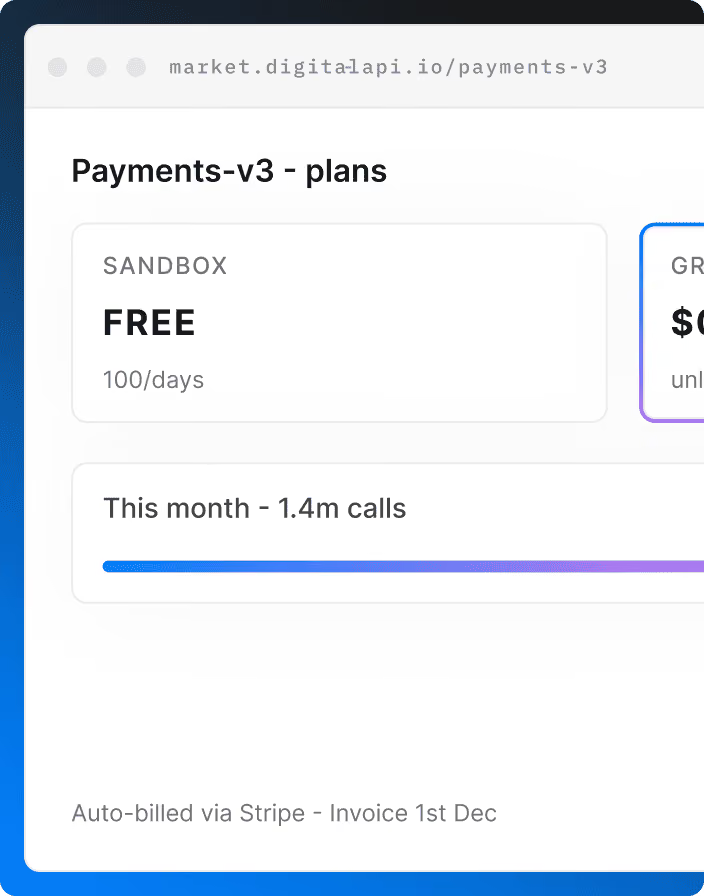
When integrated with your API monetization framework, API keys automatically apply entitlements at runtime. Upgrades, downgrades, and plan limits are reflected immediately in gateway policies. This eliminates manual reconciliation between billing systems and traffic logs.
API Keys for Rate Limiting and API Governance
Infrastructure must remain stable regardless of traffic patterns or usage spikes. In a marketplace environment, traffic behavior varies significantly across customers and subscription tiers. Without controlled enforcement, a single consumer can unintentionally degrade performance for others. API keys allow governance policies to be applied at the individual application level, preserving system stability.
Through structured API governance, organizations can:
- Apply per-key rate limits
- Enforce burst limits
- Protect backend services from overload
- Prevent abuse or scraping
- Maintain fair resource allocation
If a key exceeds its quota, the gateway blocks the request before reaching backend systems. This protects performance, preserves availability for other consumers, and ensures fair usage across tiers. Gateway-level throttling prevents infrastructure strain while maintaining predictable and controlled application behavior.
API Keys for API Usage Analytics and Business Insights
API keys enable granular tracking of behavior across consumers and applications. Each request can be attributed to a specific subscription tier, partner, or integration. This level of visibility allows teams to measure real consumption patterns rather than relying on aggregate traffic metrics. Key-level tracking becomes the foundation for operational and commercial insight.
Key-level data supports:
- Endpoint popularity analysis
- Identification of heavy consumers
- Detection of integration errors
- Upsell signals based on usage growth
When connected to API analytics, marketplace operators gain visibility into performance trends, customer adoption, and potential churn risks. Usage intelligence strengthens both product and revenue strategy.
Step-by-Step Implementation of API Keys for an API Marketplace
Successful implementation requires coordination between your developer portal, API gateway, and billing infrastructure.
Step 1: Automated API Key Generation and Provisioning
Developers expect instant access in self-service marketplaces. Delayed key provisioning slows integration and reduces adoption. Automated API key generation enables structured access control while maintaining onboarding speed and operational efficiency.
When an application is registered:
- Generate a cryptographically secure random key
- Store the key in a protected datastore
- Associate it with the correct subscription tier
- Display it only once
A white-labelled developer portal should automate provisioning and synchronize policies with the gateway instantly. Manual workflows slow adoption and increase operational burden.
Step 2: Secure Storage and Transmission of API Keys
API keys must be treated as sensitive credentials across environments. Secure storage, encrypted transmission, and defined rotation policies reduce exposure risk and prevent accidental misuse or unauthorized access.
Implementation standards should include:
- No hardcoding in frontend or mobile apps
- Storage in secure vaults or environment variables
- Header-based transmission (x-api-key or Authorization)
- Enforced HTTPS encryption
- No exposure through URL parameters
URL-based keys appear in browser history and server logs, increasing risk exposure. Security training for developer users also reduces accidental leaks.
Step 3: Real-Time API Key Validation at the Gateway
Validation must happen before requests reach backend services. The API gateway centralizes authentication and policy enforcement, preventing inconsistencies, reducing technical debt, and ensuring uniform governance controls across all API traffic.
The gateway must:
- Confirm key existence and active status
- Validate subscription tier
- Enforce rate limits and quotas
- Reject invalid or suspended keys
Immediate rejection protects infrastructure and maintains predictable performance. In production environments, latency added by validation should remain minimal. Gateway-level enforcement prevents distributed validation logic across microservices.
API Key Security Best Practices for Enterprise API Marketplaces
API key management extends beyond authentication and simple access control. A secure marketplace must address rotation policies, scoped permissions, monitoring, and revocation workflows. Each of these controls reduces exposure risk and strengthens governance posture. Security should be embedded into the lifecycle of every key.
Mandatory API Key Rotation Policies
Static credentials increase risk exposure over time. If a key is compromised and remains unchanged, misuse can continue undetected for extended periods. Periodic rotation reduces the window of vulnerability. A structured rotation policy ensures that credential hygiene remains consistent across the marketplace.
Rotation policies should:
- Require periodic renewal (90–180 days)
- Allow overlapping keys during transition
- Support automated regeneration
- Log rotation activity
Rotation reduces the potential impact of leaked or exposed credentials by limiting the window during which compromised keys remain valid. Scheduled renewal policies, combined with temporary overlap support, allow seamless transition without disrupting active integrations. A structured rotation framework strengthens long-term security posture across the marketplace.
Scope-Based Access and Least Privilege Controls
Each API key should grant only the permissions required.
| Scope | Access | Use Case |
|---|---|---|
| Read | GET only | Reporting, dashboards |
| Write | POST, PUT, DELETE | Data submission systems |
| Admin | Full access | Internal operations |
| Endpoint-specific | Selected APIs | Third-party integrations |
Scope-based control prevents misuse and limits blast radius in case of compromise.
IP Whitelisting and Network-Level Restrictions
IP whitelisting strengthens access control by adding a network-level verification layer. Even if a credential is exposed, requests from unauthorized locations can be blocked automatically. This reduces the likelihood of external misuse. Combining IP restrictions with subscription enforcement improves overall security posture.
Organizations can:
- Restrict keys to known IP ranges
- Block requests from unknown locations
- Combine IP rules with rate limits
This adds an additional verification layer beyond credential validation.
Managing the API Key Lifecycle in an API Marketplace
Lifecycle oversight governs generation, rotation, suspension, and revocation. Continuous management ensures API keys remain aligned with subscription status, security policies, and evolving access requirements.
API Key Revocation, Suspension, and Expiry
A marketplace must support:
- Instant revocation for compromised keys
- Automatic expiry for sandbox credentials
- Subscription-linked suspension
- Admin-triggered deactivation
Revocation must propagate immediately to the gateway to prevent unauthorized traffic from continuing after deactivation. Real-time synchronization between administrative controls and enforcement layers ensures that compromised or inactive credentials are blocked without delay. This responsiveness protects infrastructure and maintains trust within the marketplace ecosystem.
Monitoring API Keys for Behavioral Anomalies
Static rate limits do not capture all misuse patterns. Some forms of abuse occur within allowed thresholds but still indicate suspicious behavior. Monitoring usage anomalies helps detect deviations from historical traffic patterns. Behavioral oversight complements quota enforcement and strengthens governance.
Monitoring systems should detect:
- Sudden request spikes
- Geographic inconsistencies
- Traffic outside historical patterns
- Repeated authorization failures
Anomaly detection strengthens governance by identifying suspicious usage patterns early. Monitoring unusual spikes, geographic anomalies, and repeated authorization failures enables faster investigation and shifts API key management from reactive control to proactive oversight.
API Keys and OAuth: When to Use Both
API keys identify applications, not individual users. In many enterprise scenarios, applications act on behalf of end users who require separate authorization. Application-level authentication and user-level authorization serve different purposes. Understanding this distinction prevents misuse of API keys for identity management.
For user-level access:
- API key authenticates the application
- OAuth token authenticates the user
This dual model protects user data while preserving marketplace-level enforcement. Enterprise marketplaces frequently require this hybrid authentication pattern.
How DigitalAPI Automates API Key Management
Internal development of key management infrastructure requires expertise in distributed systems, cryptography, and gateway policy enforcement. DigitalAPI provides an integrated approach:
- Automated key provisioning via the Developer Portal
- Runtime validation through Arelio API Gateway
- Unified governance policies
- Real-time analytics
- Native monetization alignment
Arelio API Gateway validates keys, enforces quotas, and removes credentials before forwarding traffic upstream. Policies remain centralized across environments. The control plane allows consistent enforcement across multiple gateways.
Custom API Key Implementation vs DigitalAPI Platform
| Capability | Custom Build | DigitalAPI |
|---|---|---|
| Key Generation | Custom development required | Automated provisioning |
| Policy Enforcement | Distributed logic | Centralized configuration |
| Validation | Implementation dependent | Optimized gateway validation |
| Analytics | Separate tooling | Integrated dashboards |
| Monetization Sync | Complex integration | Native tier enforcement |
Custom builds demand ongoing maintenance and governance oversight. A unified platform reduces fragmentation.
Build a Secure and Monetized API Marketplace Strategy
API keys convert APIs into managed commercial assets. They enable identity, billing attribution, traffic control, and operational insight. A complete API key management strategy includes:
- Automated provisioning
- Secure storage
- Gateway validation
- Lifecycle governance
- Billing integration
- Continuous monitoring
Enterprises launching an API marketplace must treat API key management as foundational infrastructure rather than an afterthought. DigitalAPI provides the tooling required to secure, govern, and monetize APIs at scale.

Frequently Asked Questions
Why are API keys required for an API marketplace?
API keys provide structured control over how applications access marketplace APIs. They authenticate calling systems, associate requests with subscription accounts, enforce quotas, and apply rate limits at runtime. This linkage ensures every API call aligns with monetization rules, governance policies, and usage entitlements, preventing unauthorized access and billing discrepancies.
Can API keys replace user authentication?
API keys authenticate applications, not individual users. They verify which system is calling the API but do not validate user identity or permissions. When APIs act on behalf of end users, OAuth or OpenID Connect is required to authorize user-level access. Combining both ensures application authentication and user authorization remain clearly separated.
How often should API keys rotate?
API key rotation should follow a defined security policy, with renewal every 90 to 180 days as a standard practice. Regular rotation reduces exposure if credentials are leaked or misused. Immediate regeneration is required if compromise is suspected. Overlapping keys during transition helps prevent disruption to active integrations.
What happens if an API key is stolen?
If an API key is compromised, it must be revoked immediately at the gateway to block further access. Administrators should review traffic logs to detect abnormal spikes, geographic inconsistencies, or unauthorized usage patterns. Prompt investigation limits exposure, protects backend systems, and prevents misuse from continuing undetected.
Is DigitalAPI compatible with existing gateways?
DigitalAPI operates through a gateway-agnostic control plane, allowing organizations to manage API keys without replacing existing infrastructure. It integrates with Arelio API Gateway and other enterprise gateways, applying centralized validation, quota enforcement, and governance policies across environments while maintaining consistent monetization and analytics controls.
Dhayalan Subramanian is Associate Director, Product Growth at DigitalAPI, where he leads go-to-market and product growth for the company’s multi-gateway API management platform. His work focuses on helping large enterprises and mid-market cloud companies consolidate APIs across AWS, Azure, Apigee, Kong, MuleSoft, and other gateways into a single control plane for governance, discovery, monetization, and agent consumption.
Dhayalan brings 14+ years of experience across product strategy, enterprise architecture, and engineering leadership. Earlier in his career, he held senior roles at Encora (as Associate Architect and Technical Manager), Mindtree (Technology Lead), Tech Mahindra (Technical Lead), and Primus Analytics, where he designed integration frameworks and delivered enterprise-grade digital platforms for global customers.
At DigitalAPI, he works directly with platform, integration, and developer experience leaders at Fortune 500 organizations to operationalize unified API catalogs, developer portals, and MCP-ready APIs. He writes regularly on API developer experience, API governance, and AI agent architectures.



One email a fortnight. Worth opening.
A short digest of what we're writing, what we're learning from customers, and the handful of links you'd actually want from us. No tracking pixels.

.avif)