




SECURe your APIs
API Security and Compliance
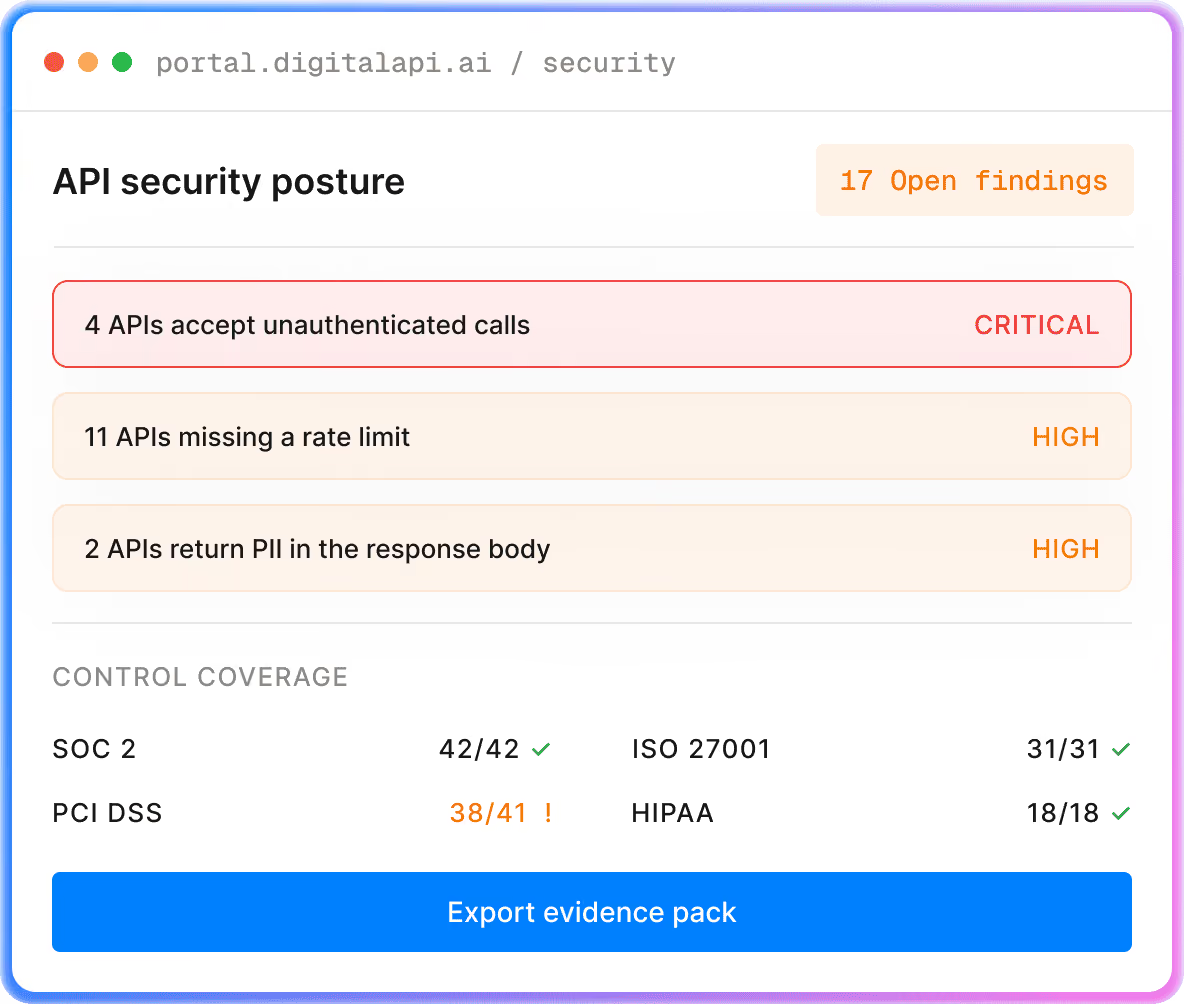
DigitalAPI gives you API security management across every gateway you own including Apigee, Kong, AWS, and Azure. It helps identify which APIs accept a call with no credential, which return sensitive fields, which scopes are too broad, and how every control maps to SOC 2, ISO 27001, PCI DSS, HIPAA, and GDPR.
ISO 27001 certified
Posture and audit evidence in one place


Trusted by 240+ API teams
From cloud-first banks to global telcos








Definition
What is API discovery?
API security posture management is the practice of continuously assessing how exposed your APIs are, rather than waiting for something to attack them. It answers which APIs are reachable, which accept a call without a credential, which return sensitive data, and which scopes grant more than they should, across every gateway and cloud, and it maps each answer to a compliance control you can evidence.
Compliance is the other half. A control that is enforced but cannot be demonstrated fails an audit just as surely as one that was never enforced. Posture tells you where you stand. Evidence lets you prove it.
Posture
The exposure. Which APIs are reachable, unauthenticated, over-scoped, or leaking fields, right now.
Enforcement
The control. Auth, transport, and access rules applied consistently on every gateway.
Evidence
The proof. The export an assessor accepts, without a screenshot exercise.
How it works
How does API security management work with DigitalAPI?
You go from an estate nobody can vouch for to a posture you can defend in four steps, without putting an agent in the request path.
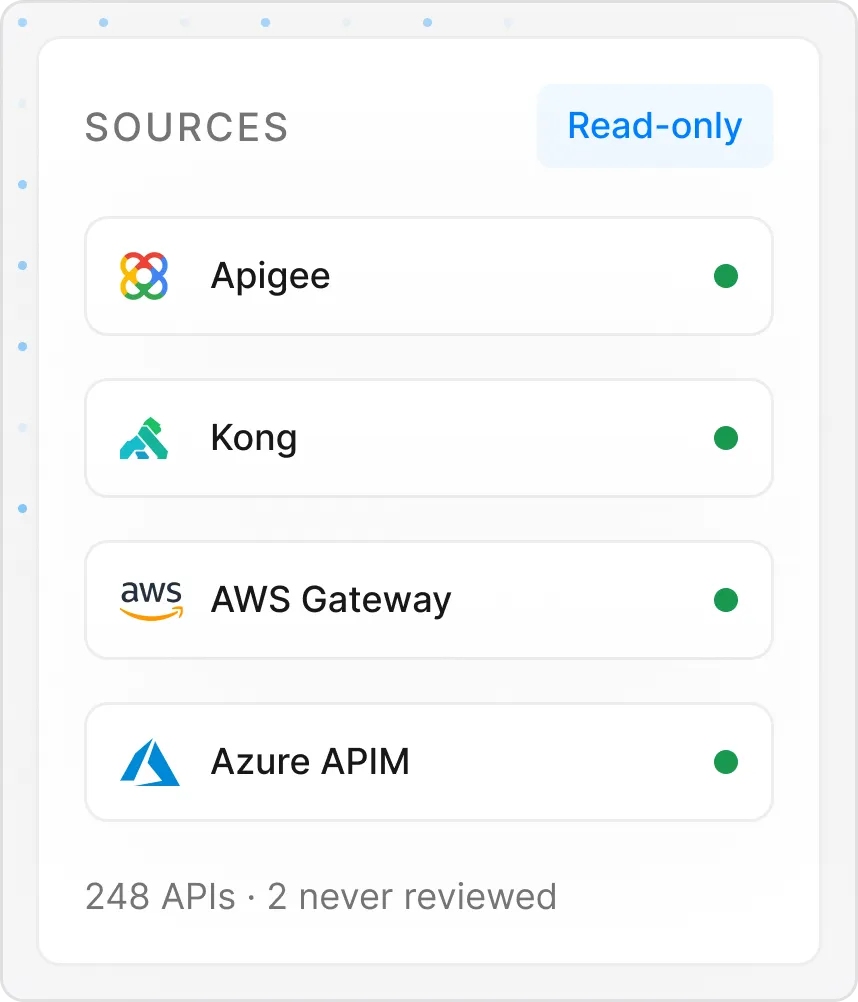
Connect every gateway, read-only
Link Apigee, Kong, AWS, and Azure with read-only credentials. DigitalAPI inventories every API, including the ones no security review has ever seen.
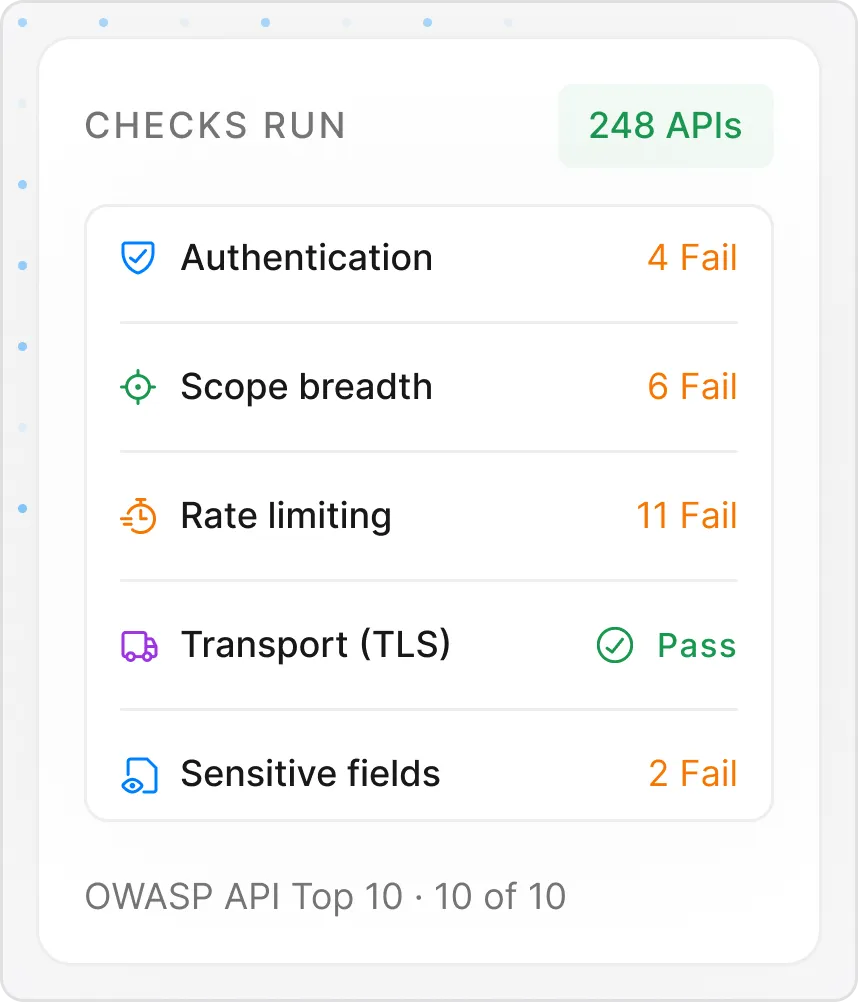
Assess posture on every API
Every spec and endpoint is checked for authentication, scope breadth, transport, rate limiting, and sensitive fields in request and response bodies.
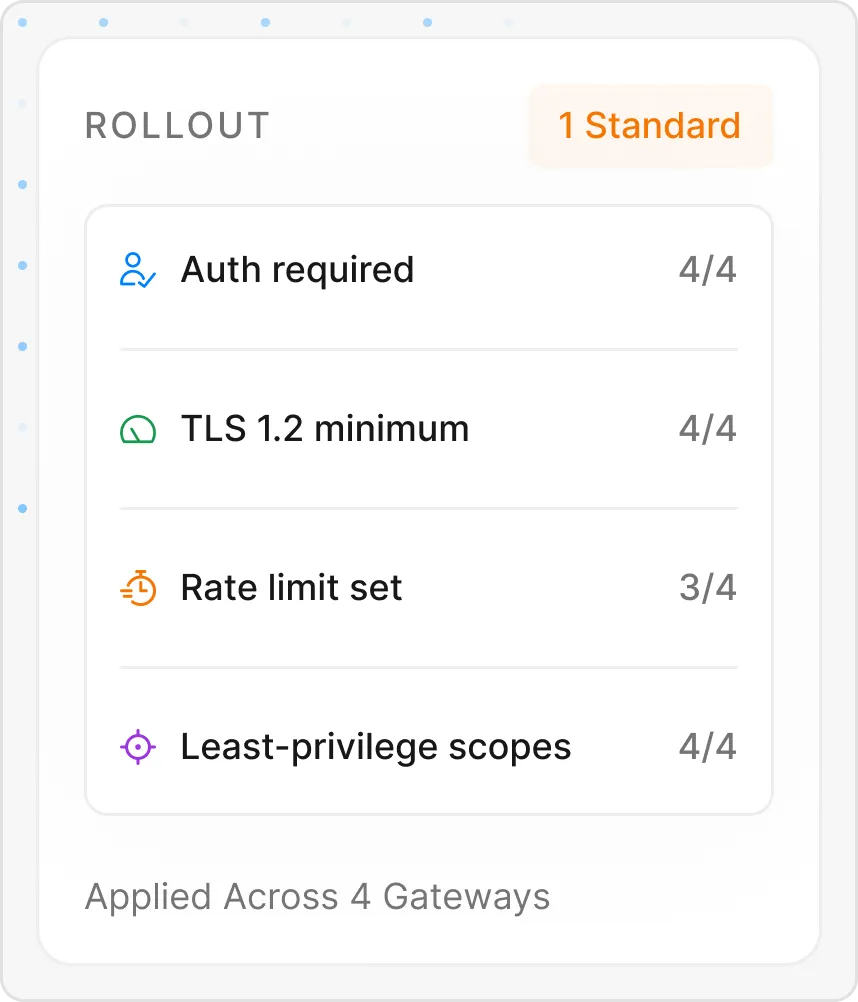
Enforce the control, everywhere
Set the standard once and DigitalAPI applies it across every gateway, so an API on Azure is held to the same auth and transport rules as one on Apigee.
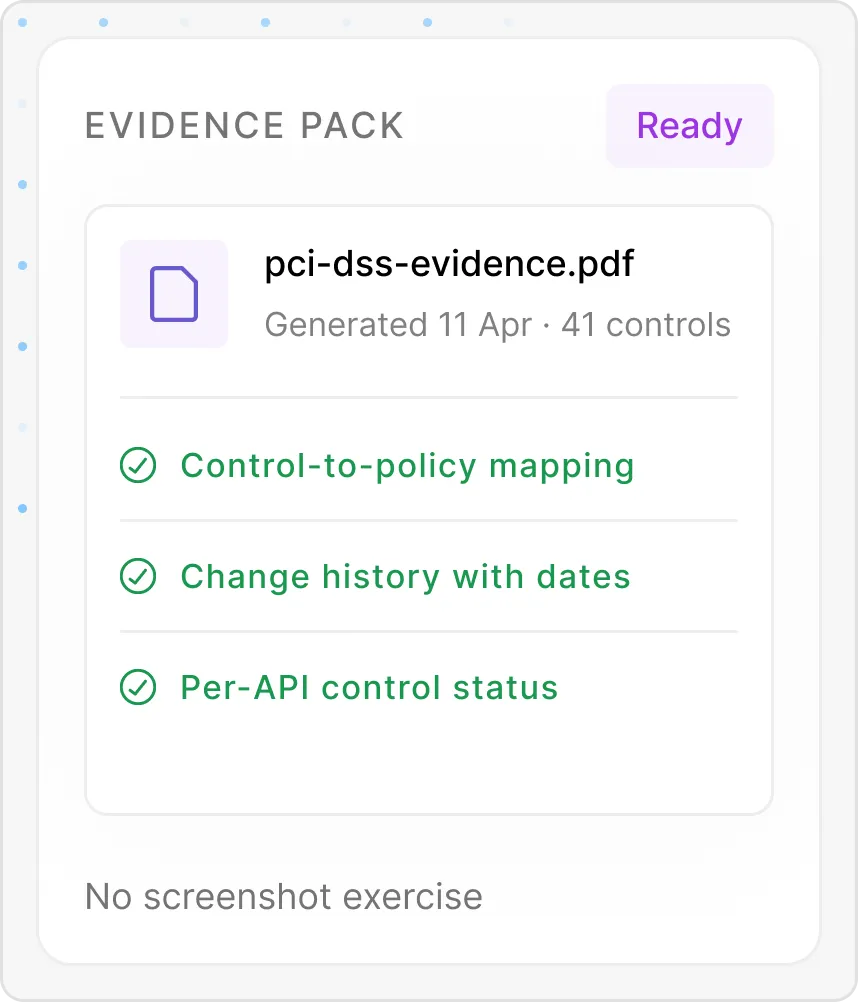
Export the evidence
Map each control to SOC 2, ISO 27001, PCI DSS, HIPAA, and GDPR, and export the pack an assessor asks for, with the dates and the change history attached.
What a catalog needs
What does API security and compliance cover?
Strong API security is not one control, it is a posture across eight dimensions, held consistently on every gateway and provable on demand. DigitalAPI covers all eight.

Authentication posture
Which APIs will accept a call with no credential at all, on any gateway.

Authorization and scope hygiene
Over-broad scopes and shared service accounts, surfaced per API and per consumer.

OWASP API Security Top 10
The ten checks applied to every spec, not just the APIs someone remembered to submit.

Sensitive data exposure
PII, PCI, and PHI fields visible in request and response schemas.

Unmanaged and shadow exposure
Externally reachable APIs no security review has ever seen. Sprawl management retires them.

Transport and encryption
TLS and mTLS requirements enforced the same way across every runtime.

Control mapping
Every policy mapped to SOC 2, ISO 27001, PCI DSS, HIPAA, and GDPR controls, aligned to the NIST CSF functions.

Evidence packs for assessors
Export the proof an auditor asks for, without a screenshot exercise.
Why DigitalAPI
Why choose DigitalAPI for API security management?
Runtime security tools watch traffic on the paths they are deployed on. Gateway consoles secure their own estate. Neither can tell you the posture of every API you run, or hand an auditor the evidence. DigitalAPI sits above all your gateways and does both.
.svg)
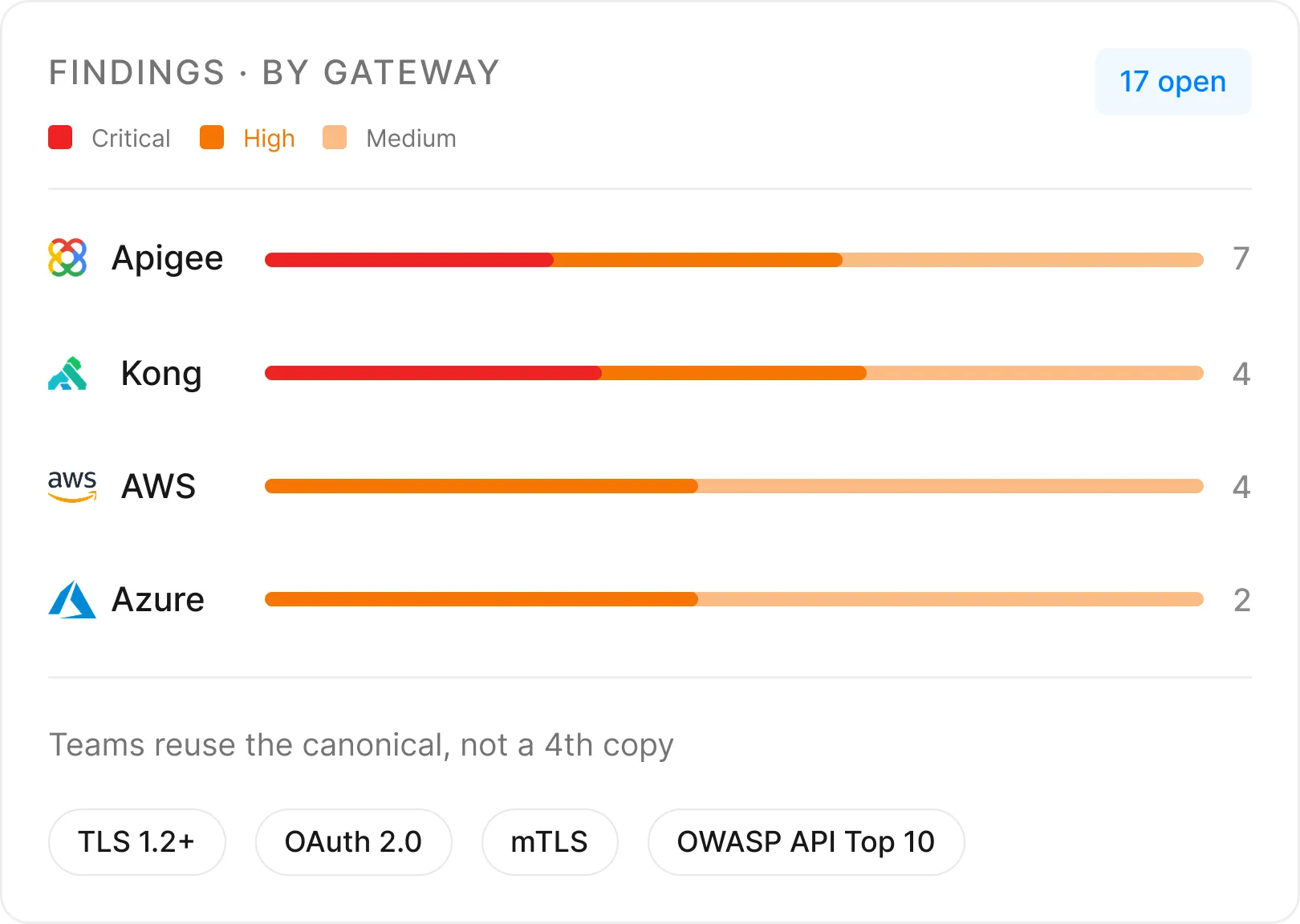
Posture across every gateway, not just one
One security view over Apigee, Kong, AWS, and Azure. An unauthenticated API on Azure shows up beside one on Apigee, in the same list, ranked by the same severity.
.svg)
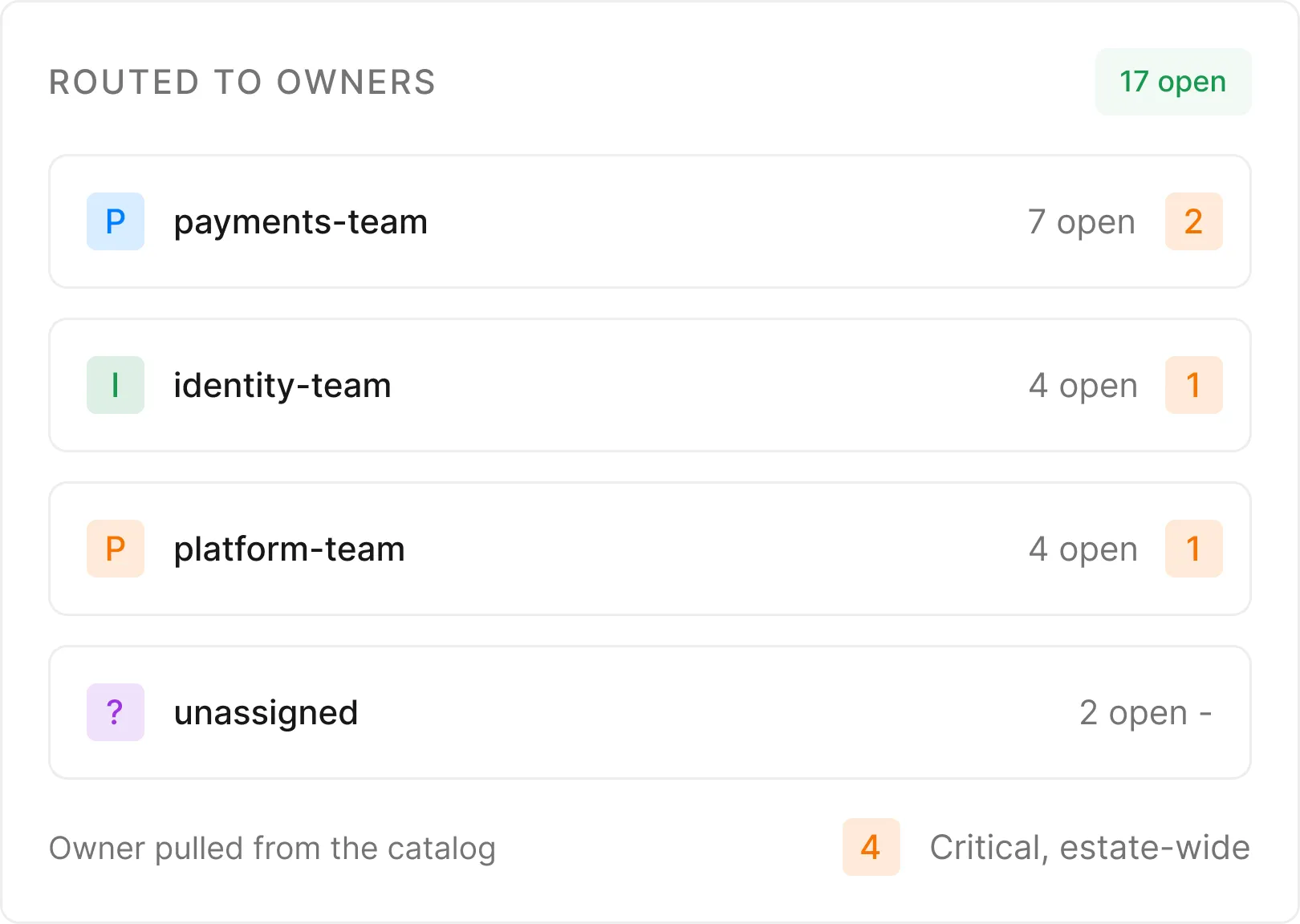
Findings ranked by severity, with an owner
Every finding names the API, the owning team, and what to change. Security stops being a spreadsheet handed to a platform team once a quarter.
.svg)
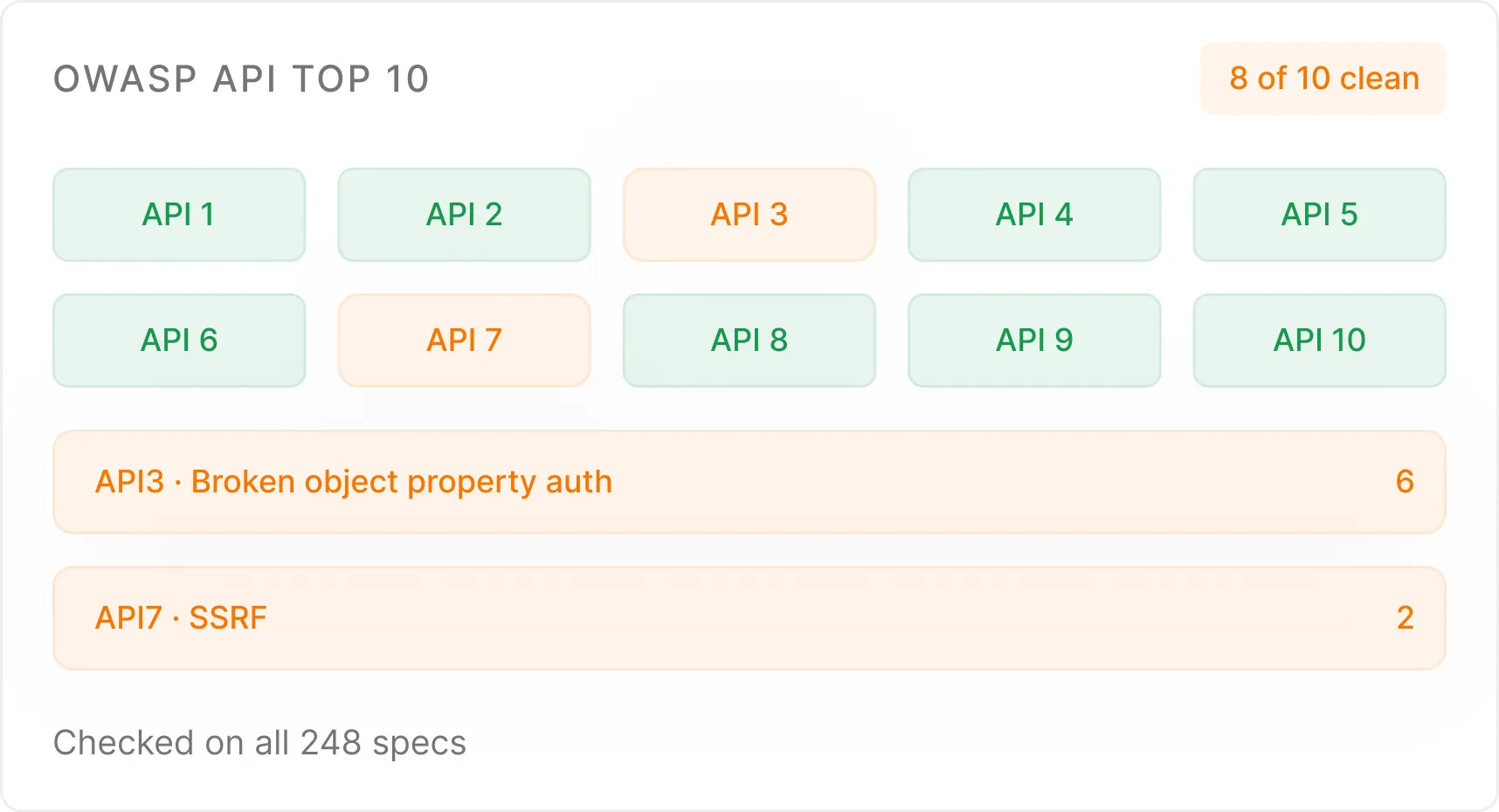
OWASP API Top 10, checked on every spec
The ten most exploited API weaknesses, applied automatically to every API in the catalog rather than to the handful that made it into a pen test.
.svg)
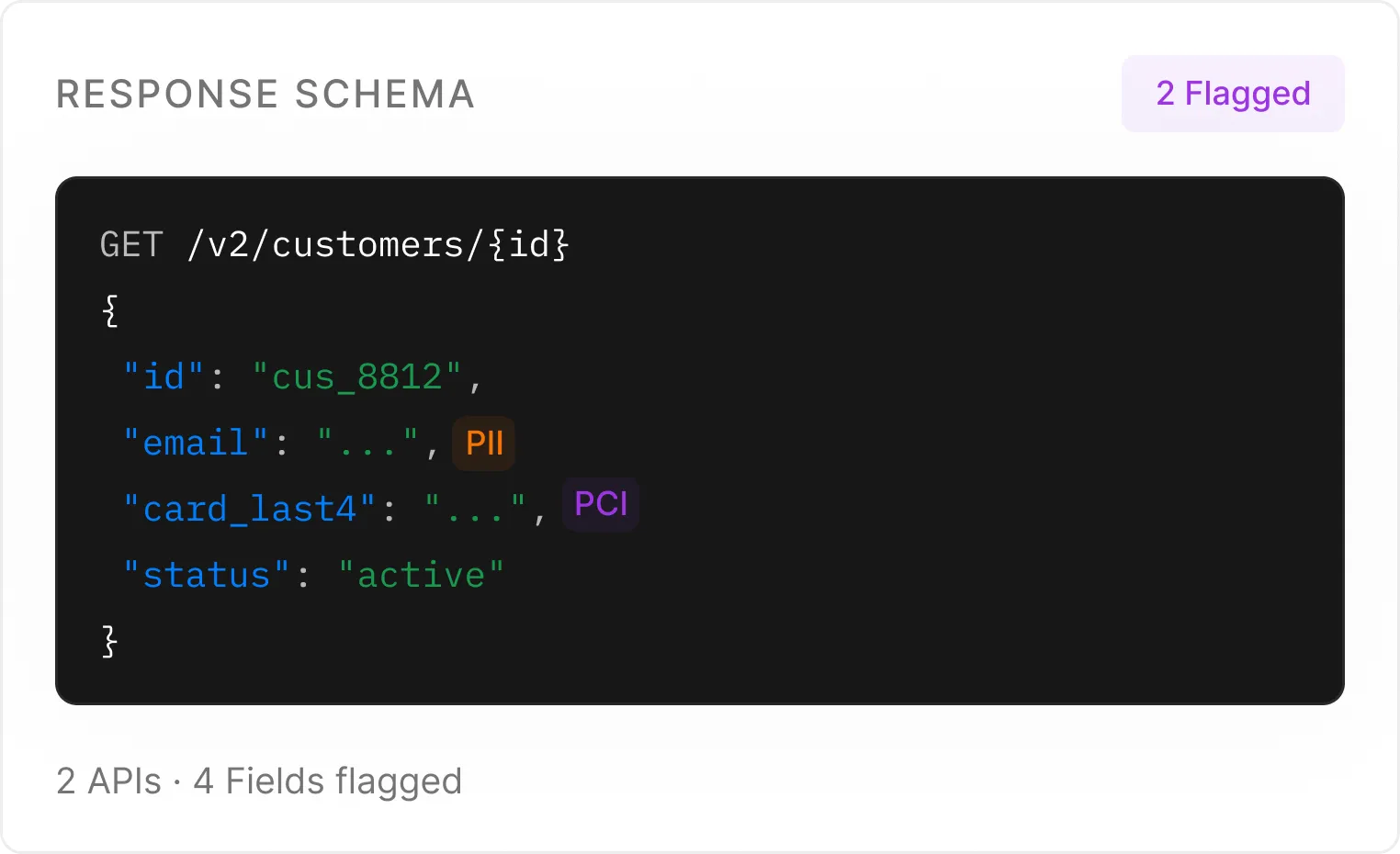
Sensitive fields found in the schema
DigitalAPI reads the request and response schemas and flags the fields that carry personal, card, or health data, so you find the exposure before a regulator does.
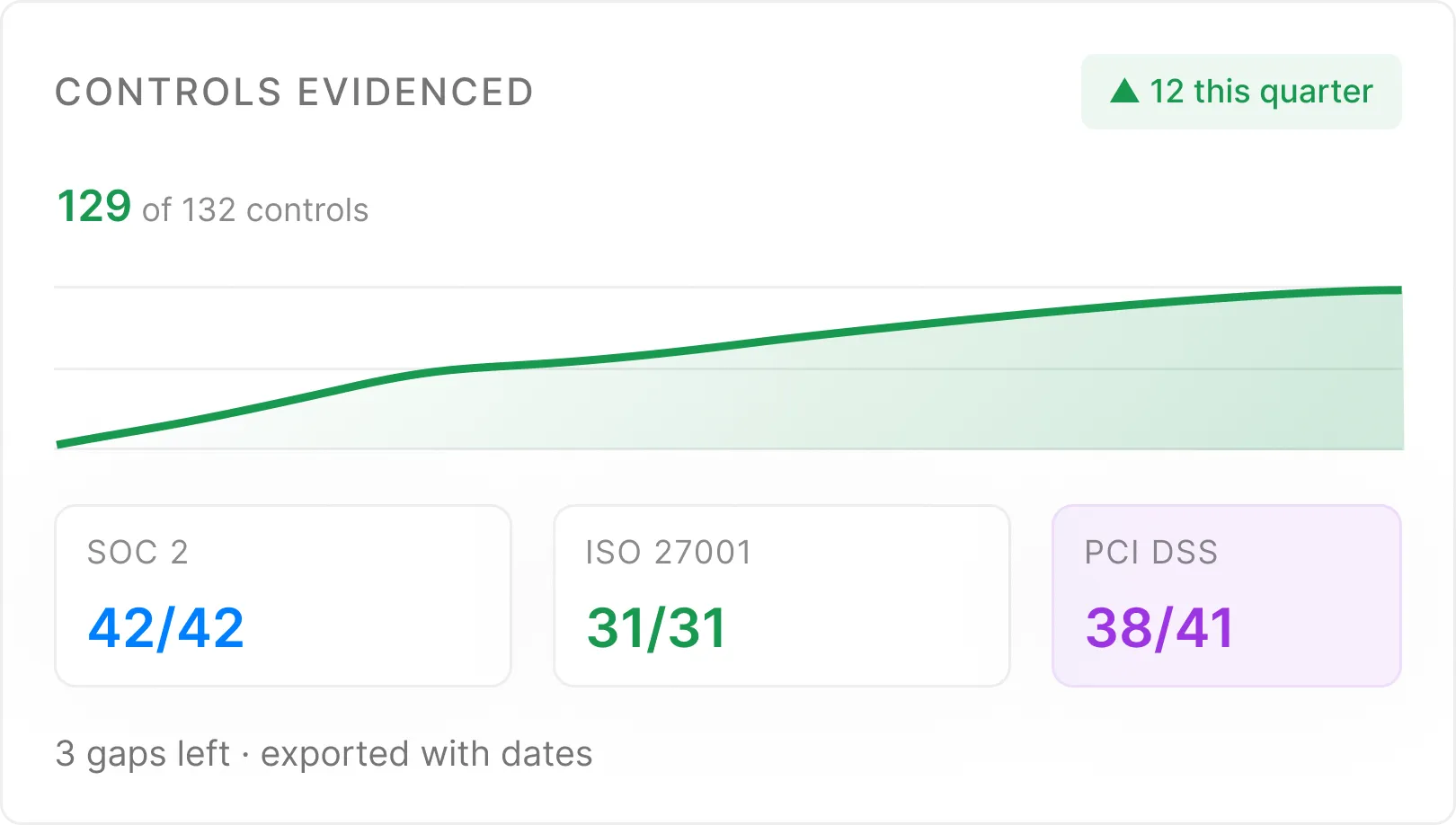
Control mapping and evidence export
Each control maps to the frameworks you are assessed against, and the evidence exports with dates and change history, so audit prep stops being a screenshot exercise.
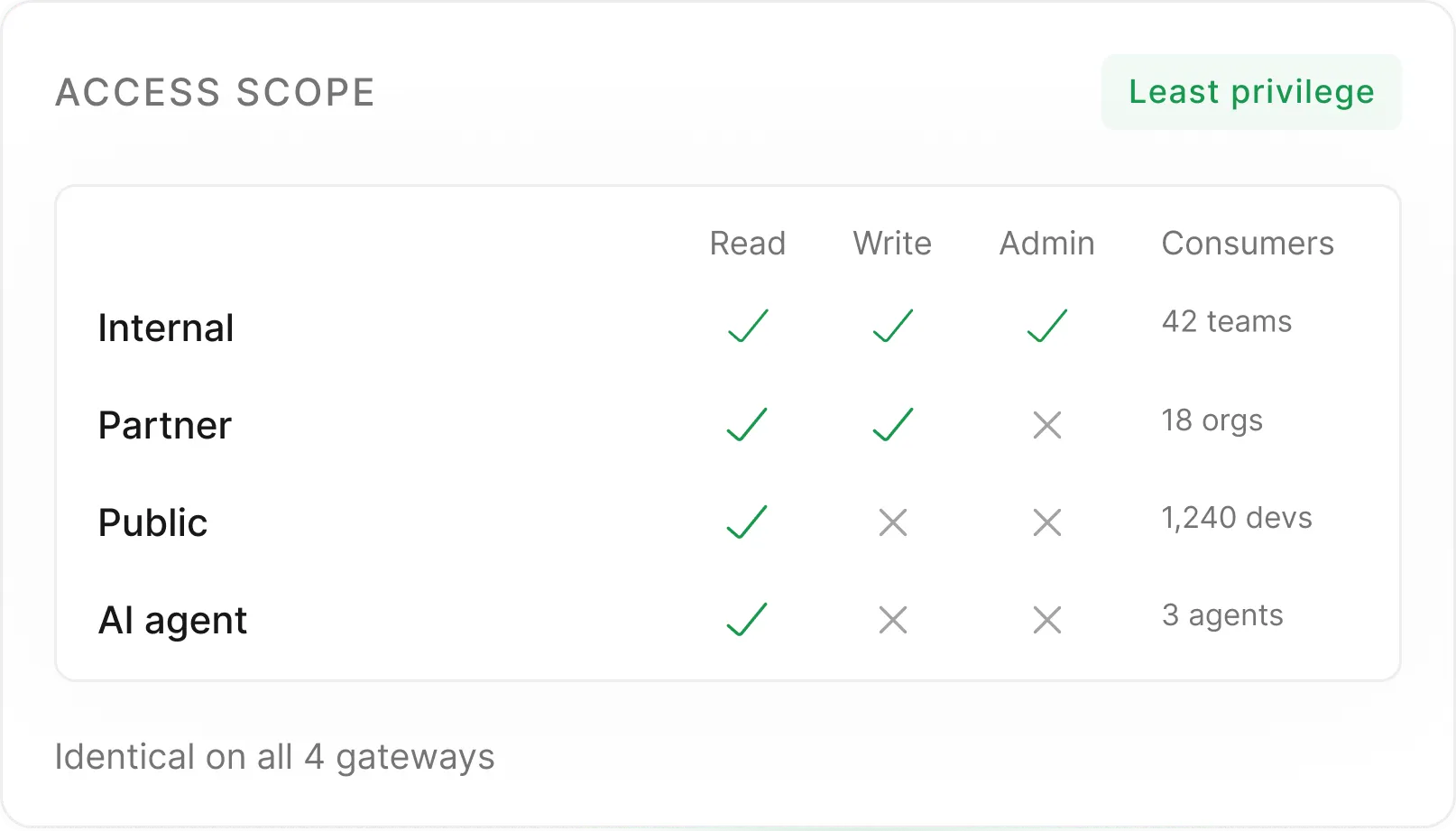
Least-privilege access, held consistently
Internal teams, partners, public developers, and AI agents each get the narrowest scope that works, applied identically on every gateway rather than configured four times.
Agent-era security
New
Agents are your newest privileged consumer
An agent authenticates as itself, not as the person who asked it. That breaks the assumption behind every access review you have ever run, and assessors are already asking who authorised a given action. DigitalAPI inventories non-human identities alongside human ones and holds each to a scope.
Non-human identities inventoried beside human and machine ones
Blast radius contained by scope, not by prompt
Every tool call attributed to an agent, an owner, and a purpose
.avif)
How we compare
How does DigitalAPI compare to other API security approaches?
Three categories of tool address API security, and they solve genuinely different problems. Runtime security platforms detect and block attacks in the request path. Gateway-native security secures the APIs on that gateway. Spec and code scanners test for weaknesses before release.
Capability
%20(1).svg)
Runtime API security
Gateway-native security
Spec and code scanners
Coverage across every gateway and cloud
Connector-based, all gateways
Sensors per path
Own gateway
Repos only
Design-time checks on spec, schema, and scopes
Limited
Authentication and scope posture per API
Estate-wide
Partial
Own gateway
Unauthenticated or shadow exposure
Own estate
Sensitive-field detection in schemas
Schema-based
Traffic-based
Partial
Regulation-to-control mapping
SOC 2, ISO, PCI, HIPAA, GDPR
Audit evidence export
One evidence pack
Limited
Per gateway
Report only
Blocking live attacks in the request path
Enforced through your gateway, not replaced
Covers AI agent and MCP access
MCP-native
Emerging
Emerging
Coverage across every gateway and cloud
Connector-based, all gateways
Runtime API security
Sensors per path
Gateway-native security
Own gateway
Spec and code scanners
Repos only
Design-time checks on spec, schema, and scopes
Runtime API security
Gateway-native security
Limited
Spec and code scanners
Authentication and scope posture per API
Estate-wide
Runtime API security
Partial
Gateway-native security
Own gateway
Spec and code scanners
Unauthenticated or shadow exposure
Runtime API security
Gateway-native security
Own estate
Spec and code scanners
Sensitive-field detection in schemas
Schema-based
Runtime API security
Traffic-based
Gateway-native security
Spec and code scanners
Partial
Regulation-to-control mapping
SOC 2, ISO, PCI, HIPAA, GDPR
Runtime API security
Gateway-native security
Spec and code scanners
Audit evidence export
One evidence pack
Runtime API security
Limited
Gateway-native security
Per gateway
Spec and code scanners
Report only
Blocking live attacks in the request path
Enforced through your gateway, not replaced
Runtime API security
Gateway-native security
Spec and code scanners
Covers AI agent and MCP access
MCP-native
Runtime API security
Emerging
Gateway-native security
Emerging
Spec and code scanners
Outcomes
What results can you expect?
%20(1).avif)
%20(1).avif)
1 view
Security posture across every gateway and cloud.
10 / 10
OWASP API Top 10 checks applied to every spec.
70%
Frameworks map: SOC 2, ISO 27001, PCI DSS, HIPAA, GDPR.
0
Agents in your request path. Nothing to deploy inline.
Frequently asked questions
API security FAQs
What is API security management?
API security management is the practice of keeping every API in your estate held to the same security standard, and being able to show it. It covers authentication and authorization posture, transport requirements, sensitive data exposure, and access scope, applied consistently across every gateway rather than configured separately in each one.
What is API security posture management?
API security posture management is the continuous assessment of how exposed your APIs are, rather than waiting for an attack to reveal it. It answers which APIs are reachable, which accept a call without a credential, which return sensitive data, and which scopes grant more than they should, across every gateway and cloud.
Which compliance frameworks does it support?
DigitalAPI maps API controls to SOC 2, ISO 27001, PCI DSS, HIPAA, and GDPR, and exports the evidence an assessor asks for with dates and change history attached. It provides controls and evidence that support these frameworks. It does not replace your own certification or legal review.
What should an API security checklist cover?
At minimum: authentication required on every endpoint, least-privilege scopes, TLS enforced, rate limits set, sensitive fields identified in request and response schemas, the OWASP API Security Top 10 checked, shadow APIs surfaced, and every control mapped to a compliance framework with exportable evidence. DigitalAPI covers all eight across every gateway.
What is the difference between API security and API governance?
Governance answers whether your APIs are built to standard: naming, schema, versioning, and breaking-change rules. Security answers whether your APIs are exposed, and whether you can prove your controls are working. They overlap at access control and audit, and DigitalAPI covers both, on separate pages because they serve different teams.
Does DigitalAPI replace a runtime API security tool?
No, and it should not be positioned that way. Runtime security platforms detect and block attacks in the request path, and that is genuinely their core capability. DigitalAPI covers posture, policy consistency, and compliance evidence across every gateway, and enforcement is applied through your existing gateways rather than through an inline agent. The two are complementary.
How do you find APIs that are exposed without authentication?
DigitalAPI connects to every gateway with read-only credentials, inventories every API including ones that were never registered, and checks each one for whether a call succeeds with no credential. Because the check runs across all gateways at once, an unauthenticated API on Azure appears in the same ranked list as one on Apigee.

.avif)