





How to build an API catalog: A practical guide for modern enterprises
In this guide, we’ll break down how to actually build an API catalog the right way, covering the frameworks, steps, tooling, and real-world pitfalls most overlook.

TL;DR
1. Building an API catalog is the fastest way to eliminate API sprawl and create a single source of truth across gateways, teams, and clouds.
2. The only scalable approach is a unified, automated catalog that syncs with Git, CI/CD, and multiple API gateways.
3. A strong metadata model, ownership, lifecycle, domains, versions is the foundation of reliable API discovery and governance.
4. Most fails come from manual updates, gateway-only views, or treating the catalog as a one-time project instead of a living system.
5. DigitalAPI unifies, documents, governs, and AI-enables your entire API estate across gateways and clouds, giving you an enterprise-grade catalog from day one.
Get started with DigitalAPI today. Book a Demo!
Building an API catalog has become a top priority for modern engineering teams, but most organizations still struggle with scattered specs, inconsistent documentation, and APIs spread across multiple gateways and teams. A strong API catalog is a single source of truth that powers discovery, governance, and AI-ready automation across your entire estate.
In this guide, we’ll break down how to actually build an API catalog the right way, covering the frameworks, steps, tooling, and real-world pitfalls most overlook. So, whether you’re consolidating APIs across Apigee, MuleSoft, AWS, Kong, or Git, this is your practical, scalable playbook for creating a unified, always-in-sync API catalog.
What is an API Catalog?
An API catalog is a centralized, structured inventory of every API your organization owns, including internal, external, partner, microservices, event streams, and more. It consolidates API specifications, documentation, metadata, ownership, lifecycle status, domains, and version history into a single, searchable, and consistent system.
Unlike a traditional documentation site, an API catalog is dynamic: it continuously syncs with gateways, repositories, and CI/CD pipelines to prevent spec drift and outdated entries. A good catalog also layers governance, analytics, and AI-ready structures so developers and architects can instantly discover the right API, understand how to use it, and trust that it’s up to date.
8 reasons why enterprises need an API Catalog
Most large organizations reach a tipping point where APIs become too scattered, too duplicated, and too inconsistent to manage manually. At that stage, simply having good documentation isn’t enough; you need a centralized source of truth. An API catalog gives enterprises the visibility, governance, and control required to manage APIs at scale and prepare for an AI-driven future.
- Stop API sprawl across gateways, clouds, and teams: APIs live in Apigee, MuleSoft, AWS, Kong, Azure, Git, Postman, and legacy services. Without a unified inventory, teams can’t see what exists or what’s duplicated. A catalog consolidates everything into one searchable, authoritative place.
- Eliminate documentation drift and inconsistent specs: Specs live in Git, docs live elsewhere, and gateway metadata is outdated, resulting in drift. An automated catalog keeps specifications, documentation, and metadata always aligned with real deployments.
- Enable instant API discovery for developers and architects: A catalog gives teams a single place to find APIs, check versions, view docs, and integrate faster. It eliminates Slack chases, knowledge silos, and time wasted figuring out “where things live.”
- Build a single source of truth for ownership and metadata: Ownership confusion slows down every API program. A catalog standardizes metadata, owners, lifecycle states, domains, versions, and SLAs, so every API has clear responsibility and traceability.
- Strengthen governance, compliance, and security: A catalog enables consistent governance across the estate. Teams can enforce standards, detect shadow APIs, identify outdated versions, and run compliance checks, all from one unified system.
- Improve API lifecycle management and version control: Managing APIs through design, deployment, and deprecation becomes easier with clear visibility. A catalog simplifies version migrations, reduces breaking changes, and ensures clean lifecycle hygiene.
- Accelerate onboarding for internal and partner developers: Unified documentation, examples, and search help developers integrate faster, even when APIs span multiple platforms or teams. Partner onboarding becomes dramatically simpler and faster.
- Prepare your API estate for AI agents and automation: AI agents require structured, machine-readable API data to safely call services. A strong API catalog becomes the foundation for MCP, agent orchestration, and enterprise-grade, AI-driven automation.
.png)
How to prepare to build an API catalog: First principles framework
Building an API catalog isn’t about choosing a tool; it’s about understanding the underlying realities of your API landscape. A first-principles approach strips away assumptions and forces you to design a catalog around how APIs actually behave, not how you wish they behaved. These five principles form the foundation of every successful, scalable API catalog.
Principle 1: APIs behave like living systems, not static assets
APIs evolve constantly, new versions, new endpoints, new owners, new policies. Documentation and spreadsheets cannot keep pace. Your catalog must be designed around continuous change, with syncing, automation, and drift detection as core requirements from day one.
Principle 2: API fragmentation is natural, not an anomaly
In modern enterprises, APIs will always exist across gateways (Apigee, MuleSoft, AWS, Kong), Git repos, Postman collections, internal services, and partner systems. Trying to force centralization at the source never works. A catalog must assume fragmentation and unify heterogeneous sources without rewriting or relocating APIs.
Principle 3: Metadata is the real product, not the spec
Specs define how APIs work, but metadata defines everything that makes them usable, including ownership, domains, lifecycle state, risk, version history, SLAs, and tags. A useful catalog starts with a strong metadata model, not just a pile of OpenAPI files. Rich metadata is what enables discovery, governance, and AI consumption.
Principle 4: The Source of truth must be intentional, not accidental
Without a declared source of truth for each field, specs, docs, owners, lifecycle, versioning, your catalog will diverge instantly. Designing the catalog means mapping where every piece of information originates and which system “wins” when conflicts occur. This is the foundation of accuracy and trust.
Principle 5: Great discovery mirrors how humans think, not how systems store APIs
Developers look for APIs by domain, capability, use case, or product, not by team or folder. Your catalog’s information architecture must reflect mental models, not org charts. If the structure is intuitive, discovery becomes instant; if not, even a technically perfect catalog will see low adoption.
3 main ways companies try to build an API catalog (only one works at scale)
Every enterprise eventually realizes its APIs are scattered across gateways, repos, and teams, and someone says, “We need a catalog.” What happens next usually falls into one of three paths. Two of them look promising at first, and then collapse under the weight of real-world complexity. Here are the three patterns we see again and again.
1. The spreadsheet catalog: The honeymoon phase ends quickly
This usually starts with good intentions: someone creates a shared spreadsheet called “API Inventory, Master.xlsx.” It has columns for owners, versions, environments, and links to specs. For the first 10–20 APIs, it feels organized and almost elegant. Then reality hits.
Teams forget to update rows. Specs change without notice. Owners rotate. A new business unit adds 40 more APIs. Before you know it, the file forks into six conflicting versions, and no one can tell which one is real.
Verdict: Fast to start, impossible to maintain. Every spreadsheet catalog becomes obsolete within weeks.
2. The gateway-only catalog: Looks complete, but hides half the estate
This path feels logical: “We use Apigee (or MuleSoft, AWS, Kong), so let’s just use its built-in catalog.” At first glance, it looks great: clean UI, auto-populated metadata, native integration.
But here’s the iceberg: Not all your APIs live on that gateway. Not even close.
Most enterprises also have:
- Functions running on AWS or Azure
- Internal microservices are not routed through the gateway
- Partner APIs
- Git-based services
- Postman collections
- Legacy SOAP services
- New APIs built by teams outside the gateway’s domain
The result? Your catalog only represents a slice of reality. Which makes it worse than no catalog, because people trust it blindly.
Verdict: Solid for single-gateway shops. Breaks instantly in multi-gateway, multi-cloud, modern enterprises.
3. The modern unified catalog: Built for ecosystems, not silos
This is the only approach that works at scale. A modern catalog assumes fragmentation from the start. It doesn’t ask teams to move APIs or change tools; it unifies everything automatically.
A unified catalog:
- Pulls APIs from Apigee, MuleSoft, AWS, Kong, Azure & NGINX
- Reads specs from Git, SwaggerHub, Postman & code repositories
- Normalizes metadata across sources
- Auto-generates docs
- Adds governance & version checks
- Provides search, filters & domains
- Stays continuously in sync with CI/CD
- Is machine-readable for AI agents
Instead of forcing one “correct” location, it stitches every source of truth into one coherent map. The result is a living inventory that stays accurate, scalable, and trustworthy.
Verdict: The only truly enterprise-ready path. Works across teams, clouds, gateways, and the AI-agent future.
.png)
Step-by-Step guide to build an API catalog
Now that you understand the principles and the common problems, here’s the practical part: how to actually build an API catalog in a modern enterprise. This is the blueprint teams use to turn scattered APIs into a single, reliable, always-up-to-date system of record.
- Inventory every API across gateways, repos, and services: Start by pulling APIs from all known sources like Apigee, MuleSoft, AWS, Kong, Azure, NGINX, Git repos, Postman collections, SwaggerHub, and internal microservices. You don’t need perfect accuracy, just visibility. The biggest failures happen when teams only catalog the APIs they remember, not the APIs they actually have.
- Bring all specs into a consistent, machine-readable format: Normalize everything to a common standard. Validate the specs, fix broken references, and ensure parameters and authentication types match the deployed reality. A catalog is only as strong as the quality and consistency of its specifications.
- Define and attach essential metadata to each API: For every API, assign an owner, domain, lifecycle stage, environment links, version, SLAs, and risk level. This metadata powers discovery, governance, and AI consumption. If the metadata is missing, incomplete, or inconsistent, your catalog becomes another list, not a system of record.
- Auto-generate unified documentation for every API: Instead of relying on manually written docs scattered across Confluence, GitHub, or internal wikis, generate consistent docs directly from specs. Add examples, schemas, authentication details, and FAQs so every API feels complete and self-explanatory.
- Group APIs into domains, capabilities, and products: Create a logical structure that mirrors how your organization thinks: payments, onboarding, fraud, internal tooling, customer data, partner APIs, etc. When developers search by “What API helps me onboard a merchant?”, the catalog should surface exactly that.
- Add governance rules and quality checks: Set rules for versioning, naming, required metadata, security headers, deprecation flows, and standard policies. Run automated governance checks to detect violations or drift. This step is where your catalog becomes more than storage; it becomes a guardrail.
- Integrate your catalog with CI/CD and source systems: Connect Git repos, pipelines, and gateway management APIs so the catalog updates automatically when APIs change. Trigger validations whenever a spec is updated, a new version is deployed, or an API is deprecated.
- Publish everything in a developer portal: Surface the catalog through an internal or partner-facing portal with rich search, filters, tags, try-it-out consoles, and domain navigation. This is where your catalog becomes usable, not just technically correct.
- Activate analytics, usage insights & lifecycle tracking: Connect runtime analytics so teams can see who’s using what, which APIs are underutilized, which need deprecation, and where performance issues appear. These insights turn your API catalog into a strategic asset for planning and modernization.
- Make the catalog AI-ready for future automation: Expose your catalog in a structured, machine-readable format. Align your specifications and metadata so AI agents (via MCP/A2A frameworks) can safely discover, evaluate, and call APIs. This step future-proofs your catalog for the agentic era.
Common mistakes companies make when building an API catalog and how to avoid them
Most failed API catalogs don’t die because of “wrong tools,” they die because of small strategic mistakes that compound over time. The good news: almost all of them are predictable. If you know what to watch out for, you can design your catalog to stay trusted, used, and up to date from day one.
Treating the catalog like a one-time project, not a living system
- Mistake: Teams run a “catalog initiative,” import everything once, and call it done.
- How to avoid: Design for continuous sync with gateways, Git, CI/CD, and ownership changes. Your catalog should update itself as APIs evolve.
Only cataloging what’s on a single gateway
- Mistake: Assuming “everything important” is on Apigee/MuleSoft/AWS and ignoring internal services, partner APIs, and Git-only specs.
- How to avoid: Start with a full source map, gateways, repos, Postman, internal tools, then unify. Assume fragmentation; don’t hide it.
Using spreadsheets or wikis as the long-term catalog
- Mistake: Starting with “API_inventory.xlsx” or a Confluence page and trying to scale it.
- How to avoid: Use spreadsheets only as a temporary discovery tool. Move quickly to a system that can validate specs, sync automatically, and enforce metadata standards.
Ignoring metadata in favor of just specs
- Mistake: Believing OpenAPI files alone are enough.
- How to avoid: Define a minimum metadata model (owner, domain, lifecycle, environment, version, SLAs, tags, risk) and enforce it for every API. No metadata = no catalog entry.
Leaving ownership fields empty or outdated
- Mistake: Catalog entries with “TBD,” team names, or no clear owner.
- How to avoid: Make ownership mandatory. Integrate with your org directory or IAM, and set a clear rule: no owner → API is not considered production-ready.
Designing the structure around org charts, not developer mental models
- Mistake: Grouping APIs by departments or internal team names that no one outside understands.
- How to avoid: Organize by domains, capabilities, and products, payments, onboarding, fraud, accounts, not “Team Alpha” or “BU-3.”
Bolting governance on later instead of baking it in
- Mistake: Launching a catalog as “just a directory” and planning to “do governance later.”
- How to avoid: From day one, define rules for versioning, naming, security, required fields, and deprecation. Use the catalog to enforce them automatically.
Relying on manual updates for changes and deprecations
- Mistake: Expecting humans to remember to update the catalog every time a spec or version changes.
- How to avoid: Connect to CI/CD and gateways so changes trigger updates and checks. Treat manual edits as the exception, not the norm.
How DigitalAPI helps you build an enterprise-grade API catalog?
Most organizations don’t struggle because they lack APIs; they struggle because their APIs live everywhere. DigitalAPI is built for this exact reality. Instead of asking teams to reorganize, rewrite, or migrate their APIs, DigitalAPI unifies your entire estate into one consistent, governed, always-up-to-date catalog. It removes the guesswork, eliminates manual effort, and gives enterprises the API clarity they’ve chased for years.
1. Connects every API source into one unified catalog
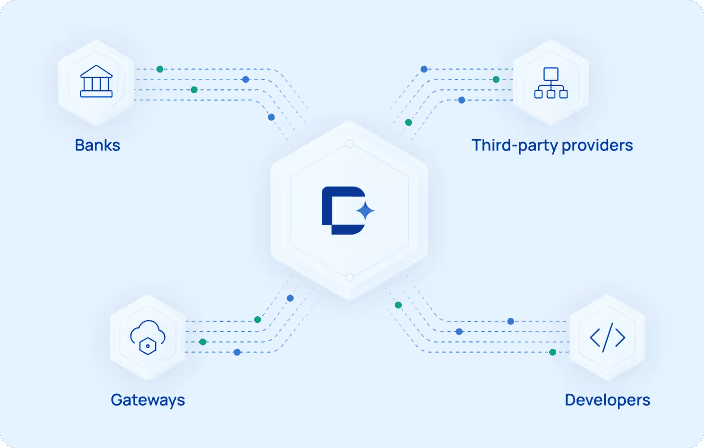
DigitalAPI plugs into Apigee, MuleSoft, AWS, Kong, Azure, Git repositories, Postman, and internal services, automatically pulling and normalizing every API you have. No more partial inventories or gateway-only views. Every API, from legacy to serverless to partner-facing, lands in one clean, searchable space without friction or rework.
2. Normalizes specs, metadata, and documentation automatically
The platform standardizes API specifications, validates structure, repairs inconsistencies, and enriches each API with ownership, lifecycle, domain, and SLAs. Documentation is generated directly from specs, ensuring accuracy and eliminating drift. You get a catalog you can trust, without chasing teams for manual updates.
3. Embeds governance and quality checks into the catalog itself
DigitalAPI runs continuous governance checks, versioning standards, security rules, naming conventions, deprecation readiness, broken links, and more. Instead of governance happening in spreadsheets or Slack threads, it becomes systematic, automated, and uniform across all gateways, environments, and teams.
4. Publishes APIs in a modern, developer-first portal
With deep search, domain navigation, filters, try-it-out consoles, code samples, and usage examples, DigitalAPI turns the catalog into a true developer experience. Internal teams, partner developers, and business units can all explore your API estate without guessing where things live or chasing documentation scattered across tools.
5. Makes your API estate AI-ready with structured, machine-readable data
DigitalAPI exposes your catalog in a format AI agents can consume safely. By unifying specs, metadata, rules, and governance signals, it creates a foundation for MCP-based interactions, automated workflows, and AI-driven API orchestration. This ensures your API catalog isn’t just useful today, it’s ready for the agentic era.
FAQs
1. What is an API catalog?
An API catalog is a centralized inventory of all your APIs, including internal, partner, and external services. It organizes specs, documentation, ownership, lifecycle stages, and metadata into one searchable place. A good API catalog also adds governance, versioning, and automated updates so teams can reliably discover, evaluate, and use APIs without dealing with scattered documents or outdated information.
2. Why do enterprises need an API catalog?
Enterprises build an API catalog to reduce sprawl, eliminate manual documentation drift, improve governance, and give developers instant visibility across distributed systems. With APIs spread across gateways, clouds, and teams, a catalog becomes the single source of truth for specs, metadata, lifecycle state, and security. It also accelerates onboarding, prevents duplication, and prepares organizations for AI-driven automation.
3. How do I build an API catalog?
To build an API catalog, start by aggregating all APIs across gateways, repos, and tools like Apigee, MuleSoft, AWS, Kong, Git, and Postman. Next, normalize metadata, import OpenAPI/RAML specs, add documentation, define ownership, and group APIs by domains. Then add governance rules, search filters, and versioning. Finally, publish it through a developer portal and automate sync to keep everything up to date.
4. What should a good API catalog include?
A high-quality API catalog should include standardized API specs, accurate documentation, metadata (owner, lifecycle, domain, version), search and filtering, automated governance checks, analytics, version history, and portal-ready API cards. It should support multi-gateway sources, detect drift, and provide a machine-readable structure for AI-enabled discovery. The catalog should also integrate with Git, CI/CD, and your API gateways.
5. Can I use my API gateway to build an API catalog?
API gateways like Apigee, MuleSoft, AWS, and Kong provide basic cataloging, but they usually cover only the APIs deployed on that gateway. Modern enterprises run APIs across multiple gateways, clouds, and repositories, so gateway-native catalogs quickly become incomplete. To build a reliable enterprise catalog, you typically need a multi-source platform that can unify everything into one consistent, searchable system.
Dhayalan Subramanian is Associate Director, Product Growth at DigitalAPI, where he leads go-to-market and product growth for the company’s multi-gateway API management platform. His work focuses on helping large enterprises and mid-market cloud companies consolidate APIs across AWS, Azure, Apigee, Kong, MuleSoft, and other gateways into a single control plane for governance, discovery, monetization, and agent consumption.
Dhayalan brings 14+ years of experience across product strategy, enterprise architecture, and engineering leadership. Earlier in his career, he held senior roles at Encora (as Associate Architect and Technical Manager), Mindtree (Technology Lead), Tech Mahindra (Technical Lead), and Primus Analytics, where he designed integration frameworks and delivered enterprise-grade digital platforms for global customers.
At DigitalAPI, he works directly with platform, integration, and developer experience leaders at Fortune 500 organizations to operationalize unified API catalogs, developer portals, and MCP-ready APIs. He writes regularly on API developer experience, API governance, and AI agent architectures.

One email a fortnight. Worth opening.
A short digest of what we're writing, what we're learning from customers, and the handful of links you'd actually want from us. No tracking pixels.

.avif)