




Partner APIs: Building & Growing Your API Ecosystem
Partner APIs: Build powerful ecosystems. Strategically design, secure, and monetize your APIs to extend market reach, drive innovation, and ensure sustained growth.

TL;DR
1. Partner APIs are strategic assets that enable companies to extend reach, create new revenue streams, and build powerful, interconnected ecosystems.
2. Building a thriving API ecosystem requires clear strategy, robust technical design, comprehensive documentation, and a strong focus on developer experience.
3. Effective API management, including security, versioning, and monetization, is essential for sustained growth and partner trust.
4. A dedicated developer portal is critical for partner onboarding, discovery, support, and fostering a vibrant community around your APIs.
5. Success hinges on continuous measurement, adaptation, and a commitment to treating your APIs as true products, evolving with partner needs.
Monetize your APIs with DigitalAPI Marketplace. Book a Demo!
Digital connections are reshaping how businesses interact, transforming isolated operations into vast, interconnected networks. At the heart of this shift lies the concept of what is an API – not just for internal efficiency, but as external gateways to collaboration and innovation. Partner APIs: How Companies Build API Ecosystems isn't just a technical discussion; it's a strategic imperative. By exposing carefully designed APIs, organizations can unlock new markets, streamline integrations, and create value far beyond their direct capabilities, fostering a synergistic environment where growth is a shared endeavor. It's about enabling others to build on your strengths, creating a network effect that benefits everyone involved.
The Strategic Imperative of Partner APIs
Partner APIs are digital interfaces that allow external businesses or developers to access and integrate with a company's data, services, or functionalities. Unlike internal APIs, which are designed for internal systems or teams, or public APIs, which are open to everyone, partner APIs are explicitly created for a select group of trusted third-party businesses. These partners might include vendors, distributors, resellers, platform integrators, or complementary service providers. The strategic value of these APIs lies in their ability to extend a company's reach, create new revenue channels, and foster a network effect that drives innovation.
In today's interconnected landscape, no single company can meet every customer need or develop every innovative solution. Partner APIs address this by enabling a collaborative ecosystem where businesses can leverage each other's strengths. For instance, a logistics company might offer third-party APIs for tracking shipments, allowing e-commerce platforms to provide real-time delivery updates directly to their customers. A financial institution could use open banking APIs to allow fintech startups to build innovative new services on top of their core banking infrastructure. This not only expands the parent company's market presence but also enhances customer experiences through seamless, integrated solutions.
Key Benefits of Cultivating an API Ecosystem
Building a robust API ecosystem through Partner APIs: How Companies Build API Ecosystems offers a multitude of benefits that extend beyond mere technical integration. These advantages contribute significantly to business growth, innovation, and market positioning.
- Market Expansion and New Revenue Streams: Partner APIs open doors to new markets and customer segments that might be difficult or costly to reach directly. By enabling partners to embed your services into their offerings, you effectively multiply your sales force and distribution channels. This can lead to entirely new API monetization models and significant revenue growth, transforming your API from a cost center into a profit center.
- Accelerated Innovation: An API ecosystem becomes a hotbed for innovation. External developers and partners bring fresh perspectives and diverse skill sets, often conceiving novel applications and use cases for your core services that you might not have envisioned internally. This co-creation significantly speeds up product development and allows your core team to focus on strategic initiatives.
- Enhanced Customer Experience: Integrations powered by partner APIs create more seamless and comprehensive experiences for end-users. Customers benefit from unified workflows, reduced friction, and access to a wider array of services directly within the applications they already use, boosting loyalty and satisfaction.
- Increased Brand Visibility and Reach: When partners integrate your APIs, your brand gains exposure to their customer base. This organic marketing can significantly increase your brand's visibility and solidify your position as a valuable, integrated component within a larger digital landscape.
- Operational Efficiency and Cost Reduction: Automating data exchange and business processes through APIs reduces manual effort, minimizes errors, and improves overall operational efficiency. This can lead to substantial cost savings in areas like data entry, reconciliation, and customer support.
Foundational Pillars: Designing Partner APIs for Success
The success of any partner API ecosystem hinges on a well-thought-out design strategy. This involves not just technical robustness but also a deep understanding of partner needs and the overall developer experience.
1. Strategic Planning and API as a Product Thinking
Before writing a single line of code, clearly define the business objectives for your partner APIs. What value are you trying to create for your partners and their customers? What problems are you solving? Treat your API as a product, with a clear roadmap, target audience, and value proposition. This 'API as a product' mindset is crucial for long-term success, ensuring your APIs evolve based on market demand and partner feedback. Consider the legal and contractual frameworks necessary for partner agreements, including SLAs and data privacy considerations.
2. Robust and Consistent API Design
The quality of your API design directly impacts developer adoption. Adhere to API design principles, using clear, predictable, and consistent conventions. This includes naming, data formats (e.g., JSON), error handling, and resource modeling. APIs should be intuitive to understand and use, minimizing the learning curve for partners. Think about the REST API best practices to build scalable, maintainable APIs that partners will find reliable.
3. Comprehensive Documentation and Developer Experience
Exceptional documentation is the cornerstone of a successful partner API program. Provide clear, interactive, and up-to-date good API documentation that includes:
- Detailed API specifications (e.g., OpenAPI/Swagger).
- Authentication and authorization guides.
- Code samples and SDKs in popular languages.
- Use cases and tutorials.
- Clear error messages and troubleshooting guides.
A dedicated API developer portal is essential. This portal acts as a central hub for partners to discover, learn about, test, and manage their API integrations. It should support a self-serve developer experience, allowing partners to onboard quickly, generate API keys, access sandbox environments, and monitor their usage.
4. Strong Security and Access Management
Security is paramount for partner APIs, as you are exposing internal systems to external entities. Implement robust API security measures, including:
- Authentication: Securely verify partner identities using industry standards like OAuth 2.0 or API Keys. Implement strong API authentication strategies.
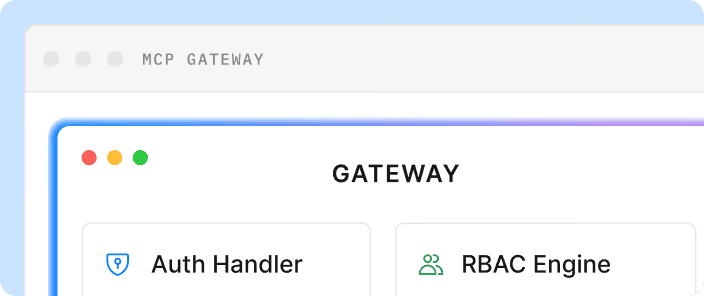
- Authorization: Implement granular access control (Role-Based Access Control - RBAC) to ensure partners only access the data and functionalities they are permitted to.
- Data Encryption: All communication should be encrypted using HTTPS/TLS. Sensitive data should be encrypted at rest and in transit.
- Input Validation: Validate all input from partners to prevent common vulnerabilities like SQL injection and XSS.
- Rate Limiting and Throttling: Protect your backend systems from abuse and ensure fair usage by implementing API rate limiting.
- Auditing and Monitoring: Implement comprehensive logging and monitoring to detect and respond to suspicious activities or security incidents promptly.
5. Versioning and Lifecycle Management
APIs are living products and will evolve. A clear API versioning strategy is crucial to introduce new features or breaking changes without disrupting existing partner integrations. Communicate changes transparently and provide ample deprecation periods. Effective API lifecycle management ensures that APIs are properly managed from design and development to deprecation and retirement, maintaining a healthy ecosystem.
6. Developer Support and Community Building
Beyond documentation, provide accessible support channels for partners, such as forums, dedicated support teams, or clear contact information. Fostering a community around your APIs encourages collaboration, shared learning, and feedback, which can be invaluable for continuous improvement and innovation.
Monetization Strategies for Partner APIs
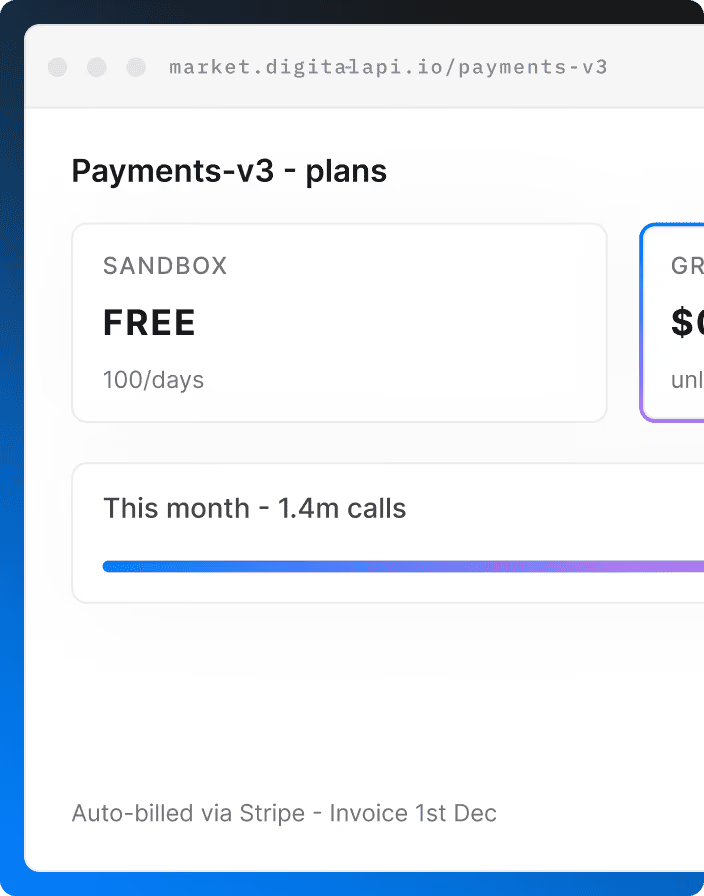
While some partner APIs are offered for free to drive adoption or create strategic alliances, many companies explore monetization strategies to generate direct revenue or offset development costs. Common API pricing strategies include:
- Freemium Model: Offer a free tier with limited usage or features, encouraging adoption, and then charge for premium tiers with higher limits or advanced capabilities.
- Tiered Pricing: Different pricing tiers based on usage volume, features, or level of support.
- Pay-per-Use (Transaction-based): Charge for each API call or specific transaction.
- Subscription Model: Fixed monthly or annual fees for unlimited access within a certain scope.
- Value-Based Pricing: Price APIs based on the value they create for the partner, which can be complex to measure but highly effective.
Implementing billing quotas and SLAs is vital for any monetization strategy. Implementing billing quotas and SLAs ensures fair usage, manages infrastructure costs, and guarantees service levels for paying partners.
Measuring Success and Continuous Improvement
To ensure your partner API ecosystem thrives, continuous measurement and iterative improvement are essential. Define key performance indicators (KPIs) and regularly track them:
- API Adoption Rates: Number of new partners, active integrations, and time to first call.
- Usage Volume: Total API calls, peak usage, and growth trends.
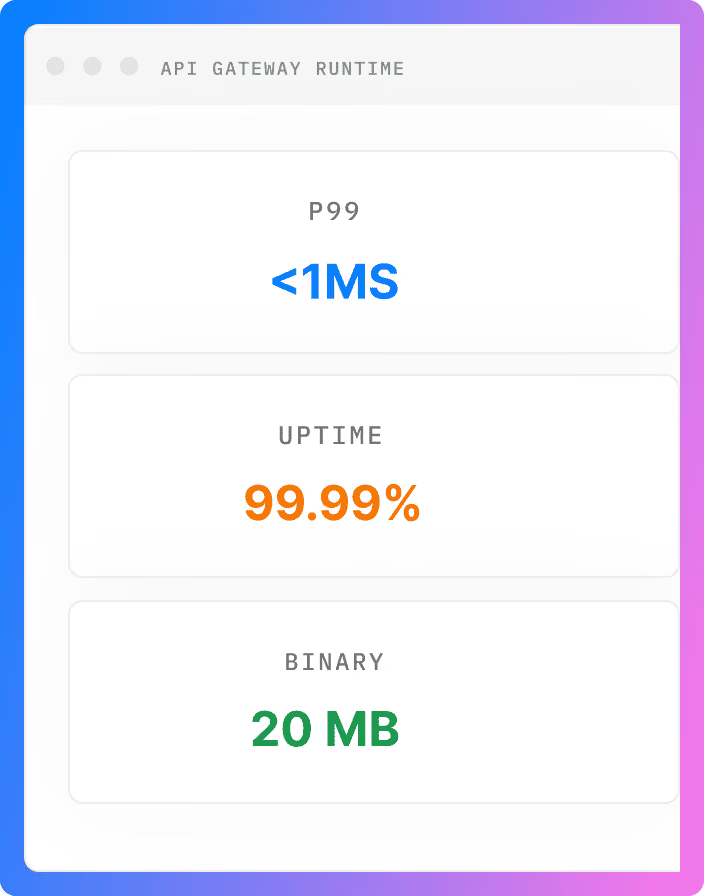
- API Performance: Latency, uptime, error rates.
- Partner Satisfaction: Feedback scores, support ticket volume, retention rates.
- Monetization Metrics: Revenue generated, conversion rates from free to paid tiers.
Gather feedback from partners through surveys, forums, and direct communication channels. Use this feedback, along with API analytics KPIs, to inform your API roadmap, prioritize new features, and address pain points. The API management platform plays a critical role here, providing the tools for monitoring, analytics, and reporting.
Challenges and How to Overcome Them
While the benefits are substantial, building and growing a partner API ecosystem comes with its own set of challenges:
- "Build It and They Will Come" Fallacy: Simply creating APIs isn't enough. You need to actively promote them, provide excellent support, and demonstrate their value to potential partners.
- API Sprawl and Governance: As your API portfolio grows, managing consistency, security, and quality across numerous APIs can become challenging. Strong API governance is essential to prevent chaos.
- Security Risks: Exposing internal services externally inherently increases your attack surface. Continuous vigilance and robust API security best practices are non-negotiable.
- Version Management: Managing breaking changes and supporting multiple API versions simultaneously can be complex and resource-intensive.
- Partner Onboarding and Support: Ensuring partners can quickly and easily integrate, and receive timely support, requires dedicated resources and efficient processes. Tools that streamline partner onboarding with self-serve sandbox APIs are invaluable.
Overcoming these challenges requires a strategic approach, investing in the right API management tools and platforms, fostering an API-first culture, and committing to continuous engagement with your partners. It's an ongoing journey of refinement and adaptation, but one that yields significant returns in market reach, innovation, and long-term business growth.
Conclusion
The era of isolated enterprise operations is rapidly fading, replaced by a dynamic landscape where interconnectedness drives competitive advantage. Partner APIs: How Companies Build API Ecosystems is more than a technical blueprint; it's a strategic framework for future-proofing your business. By embracing partner APIs, organizations can transcend traditional boundaries, fostering a vibrant ecosystem of collaboration and innovation. The journey demands meticulous planning, robust technical execution, an unwavering commitment to developer experience, and a keen eye on security and governance. Yet, for those who successfully navigate this path, the reward is an expanded market footprint, accelerated innovation, and a powerful network effect that cements their position as leaders in the digital economy. The future is connected, and partner APIs are the essential threads weaving that future together.
FAQs
1. What is the difference between an internal, public, and partner API?
Internal APIs are used within an organization to connect its own systems and applications. Public APIs are exposed for anyone to use, often with varying access tiers. Partner APIs, however, are specifically designed for a select group of trusted third-party businesses or developers, enabling deeper, more strategic integrations often under formal agreements.
2. Why are developer portals so important for partner APIs?
A developer portal is crucial for partner APIs because it acts as a central hub for everything a partner needs: comprehensive documentation, authentication guides, code samples, SDKs, sandbox environments for testing, API key management, usage analytics, and support. It streamlines the onboarding process, improves developer experience, and fosters a self-service environment, accelerating adoption and reducing support overhead.
3. How do companies ensure the security of their partner APIs?
Companies ensure partner API security through a multi-layered approach. This includes strong authentication (e.g., OAuth 2.0, API Keys) and granular authorization mechanisms (RBAC), enforced via an API Gateway. It also involves using HTTPS for all communication, rigorous input validation to prevent injection attacks, implementing rate limiting to prevent abuse, continuous security monitoring, and adhering to API security best practices like those outlined by OWASP.
4. What are some common challenges in building an API ecosystem?
Common challenges include the "build it and they will come" fallacy (underestimating marketing and support needs), managing API sprawl and maintaining consistency across a growing portfolio, ensuring robust security, handling API versioning and deprecation gracefully, and providing adequate partner onboarding and ongoing support. Addressing these requires a strategic, product-oriented approach with strong API management.
5. How can companies monetize their partner APIs?
Companies monetize partner APIs using various models, including freemium (free tier, paid premium features), tiered pricing (based on usage or features), pay-per-use (transaction-based), and subscription models (fixed fees for access). Successful monetization also involves implementing clear API monetization strategies like billing quotas and service level agreements (SLAs) to manage costs and define service levels for partners.
Dhayalan Subramanian is Associate Director, Product Growth at DigitalAPI, where he leads go-to-market and product growth for the company’s multi-gateway API management platform. His work focuses on helping large enterprises and mid-market cloud companies consolidate APIs across AWS, Azure, Apigee, Kong, MuleSoft, and other gateways into a single control plane for governance, discovery, monetization, and agent consumption.
Dhayalan brings 14+ years of experience across product strategy, enterprise architecture, and engineering leadership. Earlier in his career, he held senior roles at Encora (as Associate Architect and Technical Manager), Mindtree (Technology Lead), Tech Mahindra (Technical Lead), and Primus Analytics, where he designed integration frameworks and delivered enterprise-grade digital platforms for global customers.
At DigitalAPI, he works directly with platform, integration, and developer experience leaders at Fortune 500 organizations to operationalize unified API catalogs, developer portals, and MCP-ready APIs. He writes regularly on API developer experience, API governance, and AI agent architectures.
One email a fortnight. Worth opening.
A short digest of what we're writing, what we're learning from customers, and the handful of links you'd actually want from us. No tracking pixels.

.avif)