


Market leaders across industries trust DigitalAPI





.svg)



Go Beyond Just Documentation:
Get a Self-Serve Developer Experience with DigitalAPI
A developer's path from first click to first production call involves rich documentation as documentation. DigitalAPI not only does that as well as Swagger or Stoplight, but steps two through six are where docs-only tools stop and DigitalAPI shines.

Read the docs
(Swagger ends here)

Sign up at
developer portal

Get API credentials

Test API in a
sandbox

Choose levels
of access

Ship & observe
usage
.svg)
.svg)
Why Should You Choose DigitalAPI Over Swagger UI?
Swagger hub is great at documentation but journey ends roughly where the developer says "okay, now how do I actually use this?".
DigitalAPI is what every enterprise API program needs after: self-serve signup, sandbox, key lifecycle, partner onboarding, governance and AI exposure.
.svg)
%201.png)
Centralized API Catalog Across Gateways and BUs
One self-serve catalog for APIs scattered across Apigee, Kong, Azure and every BU. Consistent search, governance and discovery, instead of three docs portals and a Confluence page nobody updates.

Lifecycle and rotation built in
Set per-user key rotation policies (90, 120, 180 days, your call), automated reminders before expiry, audit-ready logs. The platform enforces the policy; your engineers don't.

Self-serve sign-up, sandbox and SSO
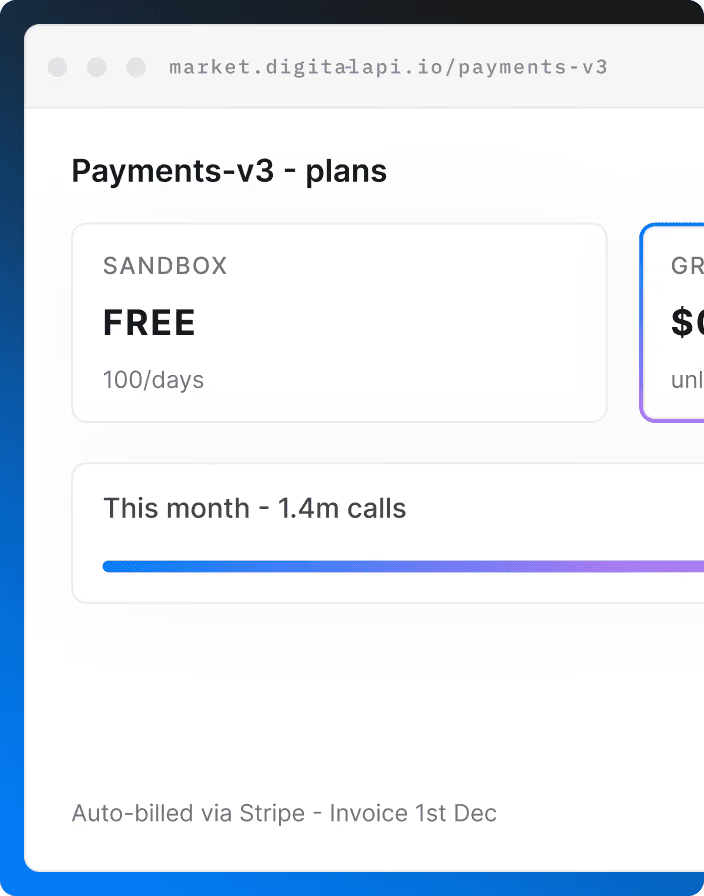
Internal and external developers, consumers, and partners sign up via SSO, create an app, get credentials, and make a first sandbox call in minutes. No tickets, no Word docs, no manually issued keys.

Rich Documentation, the Foundation
OpenAPI rendering, embedded videos, getting-started guides, FAQs, changelogs, support content, code samples in multiple languages. Docs is the starting line, and we run it well.
.png)
Interactive API explorer and sandboxing
Get an interactive sandbox inside the portal with pre-filled auth tokens, saved history, and shareable examples. Collapses the gap from "discovered the API" to "made the first call" from days to minutes.

AI-Ready: Native MCP Layer for LLM Agents
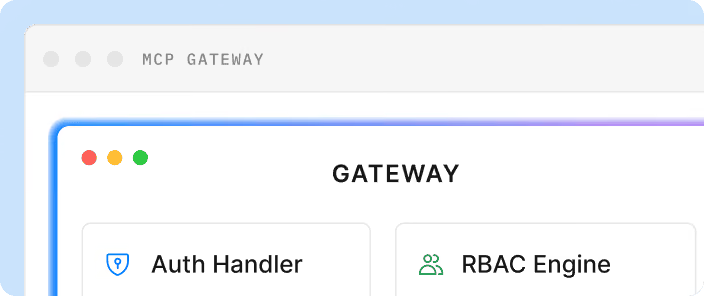
Expose your APIs as tools to LLMs and agent frameworks, with scoped credentials, rate limits and audit trails. When LLM-based consumption hits in the next two to three years, the wiring is in place.

Sits on top of your gateway, No rip-and-replace
Keep your existing OpenAPI specs, Stoplight design workflows, and Apigee, Kong, AWS or Azure APIM gateway. DigitalAPI is the consumer-facing self-serve layer above them, not a replacement for any of them.

Extensible: Webhooks, Iframes, Ticketing, MCP
Developers can sign up with SSO, create an app, get credentials, and makes a first sandbox call in minutes be it an internal engineer, external developer, or a partner.
DigitalAPI vs Swagger UI: Feature Breakdown
Capability for capability, side by side. Full Compaision!
Capability


Core purpose

Self-serve API platform with documentation built in

Documentation rendering tool, ends at the docs page
Documentation depth
OpenAPI plus videos, guides, FAQs and changelogs
OpenAPI rendering with Markdown only
Developer onboarding
Self-serve sign-up via SSO and RBAC
No sign-up flow, manual ticket-based access
API key lifecycle
Full lifecycle: issue, rotate, revoke, environment-scoped
Manual key handling via the underlying gateway
Feature
Core purpose

.png)
Documentation rendering tool, ends at the docs page
Documentation depth
OpenAPI plus videos, guides, FAQs and changelogs
OpenAPI rendering with Markdown only
Developer onboarding
Self-serve sign-up via SSO and RBAC
No sign-up flow, manual ticket-based access
API key lifecycle
Full lifecycle: issue, rotate, revoke, environment-scoped
Manual key handling via the underlying gateway
Sandbox and evaluation
Real sandbox with scoped credentials, 30, 60 or 90-day access
Mock server only, no time-bounded evaluation
Multi-gateway catalogue
Unified catalogue across Apigee, Kong, AWS and Azure APIM
Single repository per spec, no gateway integration
Partner and B2B onboarding
Approval workflows, tiered access and contract-bound credentials
No partner workflow, manual multi-week email threads
Usage analytics
Live per-app, per-API dashboards: calls, errors, latency, quota
No runtime analytics, ends at the docs page
Time to launch and TCO
Branded portal in two to six weeks, transparent subscription
06 to 12 months for an in-house portal build
One API Platform for Internal, Partner, and External Consumption
Most API tools force a choice: internal developer experience, partners or an external one.
DigitalAPI runs all three on the same catalogue, with different identity, access and visibility rules per audience.

Engineering teams across BUs
Discover and consume APIs published by other teams in the same enterprise without raising a ticket.
Contracted consumers and Partners
Banks, insurers, fintechs, distributors. Approval-gated access with contract-bound tiers and audit.

Native MCP layer for LLM agents
Anyone on the internet. Sandbox access, plan upgrades, and an MCP-exposed surface for agents.
Self-Serve Helps Both the API Provider and the API Consumer
Most API tools force a choice: internal developer experience, partners or an external one.
DigitalAPI runs all three on the same catalogue, with different identity, access and visibility rules per audience.
[For API Providers]
Stop Being the Credentials Helpdesk!
Ship a branded, self-serve portal in less than a week, not a twelve-month build. Sign-up, keys, rotation and partner onboarding all run themselves, so your platform team stops being the credentials helpdesk.


[For API Consumers]
Sign up, get a key, ship before lunch!
Sign up, get scoped credentials, and hit a real sandbox in under five minutes. No ticket, no word document, no sales call. Live dashboards show calls, errors and quota burn once you ship.

.webp)
Powering Fortune 500 Companies with a Unified API Management Platform

.svg)

.avif)
.svg)
.svg)
.svg)
.svg)
.svg)

Still using Swagger UI? A docs portal is the starting line, not the finish!
Your developers want sign-up, sandbox, keys and shipping. Your account managers want renewal visibility. Your platform team wants to stop being the credentials helpdesk. None of those needs are met by a Swagger UI page or a SwaggerHub design tool.
DigitalAPI gives you all of that on top of the Swagger or SwaggerHub setup you already run. Same OpenAPI specs. Same gateway. The self-serve layer your developers expected three years ago, ready in two to six weeks instead of twelve to twenty-four months.

.svg)
Is DigitalAPI a Swagger Replacement?
.svg)
Then it adds the self-serve layer on top with sign-up, credentials, sandbox, key lifecycle, partner workflows, governance and AI exposure. You don't replace your docs tool, you replace the gap between your docs and your developers.
What does "self-serve API" actually mean?
We are using "Spotlight" today. Do we have to migrate?
Can the same platform serve internal, partner and external consumers?
Can it handle key rotation policies and lifecycle?
Does it integrate with Salesforce for account manager visibility?
How is DigitalAPI different from an API gateway like Apigee, Kong or AWS?
Can DigitalAPI expose APIs to AI agents?
How long does implementation take?
.png)
.avif)