




What are Shadow APIs? Everything you need to know!
Shadow APIs are application programming interfaces that have been developed, deployed, and are actively running within an organization's infrastructure without the knowledge, approval, or formal oversight of central IT, security teams, or API governance bodies.


TL;DR
1. Shadow APIs are undocumented, unmanaged APIs operating without central IT or security awareness, often created unintentionally.
2. They present critical risks including severe data breaches, regulatory non-compliance, and an expanded, hidden attack surface.
3. Discovering Shadow APIs requires a multi-pronged approach: network traffic analysis, cloud environment audits, developer interviews, and specialized API discovery tools.
4. Securing against them involves implementing robust API governance, continuous monitoring, standardized security policies, and automated testing across the entire API lifecycle.
5. Proactive API management, a centralized API catalog, and a culture of visibility are essential to prevent their emergence and maintain a secure API landscape.
Eliminate Shadow APIs with DigitalAPI’s API Management Platform!! Book a Demo!
In the expansive and interconnected digital architecture of modern organizations, APIs have become the lifeblood, facilitating communication between disparate systems and services. Yet, beneath this visible layer of structured integration lies a less apparent, often unseen phenomenon: Shadow APIs. These unmanaged interfaces proliferate silently, born from rapid development cycles or isolated team initiatives, existing outside the purview of central IT or security protocols. Their presence introduces a hidden dimension of risk, capable of undermining an organization's security posture and compliance efforts without immediate detection. Understanding their nature, their inherent dangers, and the strategies for their discovery and mitigation is no longer optional but a critical imperative for any enterprise navigating the complexities of its digital ecosystem.
What are Shadow APIs?
Shadow APIs are application programming interfaces that have been developed, deployed, and are actively running within an organization's infrastructure without the knowledge, approval, or formal oversight of central IT, security teams, or API governance bodies. Unlike "Zombie APIs," which are intentionally deprecated but remain active, or "Rogue APIs," which are maliciously designed for illicit purposes, Shadow APIs are often created with good intentions by developers seeking quick solutions or bypassing perceived bureaucratic hurdles. They exist in the "shadows" because they lack official documentation, formal lifecycle management, security reviews, or inclusion in any central API inventory.
These APIs typically share several distinguishing characteristics:
- Undocumented: They lack proper specifications (e.g., OpenAPI/Swagger) or comprehensive guides on their functionality, endpoints, or usage.
- Unmanaged: They are not part of an API gateway's managed routes, don't adhere to standardized security policies, and don't undergo formal testing or updates.
- Unknown Ownership: The clear ownership and accountability for these APIs are often unclear, making maintenance and incident response challenging.
- Inconsistent Security: They rarely benefit from consistent authentication, authorization, or input validation, leaving them vulnerable by default.
- Isolated Development: They often arise from decentralized development efforts, where individual teams or developers provision services to meet immediate needs without broader architectural awareness.
The insidious nature of Shadow APIs lies in their anonymity. Because they are unknown, they cannot be secured, monitored, or managed, creating significant blind spots that attackers can exploit.
The Stealthy Proliferation: Why Shadow APIs are a Growing Concern
The existence of Shadow APIs poses a multi-faceted threat to any organization, impacting security, compliance, operational efficiency, and future innovation. Their unmanaged nature transforms them into gaping holes in an otherwise carefully constructed security perimeter.
- Severe Data Breaches and Exposure: Shadow APIs are a prime target for attackers due to their inherent lack of security controls. Without proper authentication, authorization, rate limiting, or input validation, they can easily expose sensitive data. Attackers can leverage these undocumented endpoints to gain unauthorized access to databases, customer information, intellectual property, or critical internal systems, leading to devastating data breaches.
- Compliance and Regulatory Violations: Organizations are subject to a growing number of data protection regulations, such as GDPR, CCPA, HIPAA, and PCI DSS. Shadow APIs, by definition, operate outside of compliance frameworks. They can inadvertently process or expose sensitive data without the necessary safeguards, consent mechanisms, or audit trails, leading to hefty fines, legal repercussions, and severe reputational damage.
- Expanded and Fragile Attack Surface: Every active API endpoint represents a potential entry point for attackers. When these endpoints are unknown to security teams, they cannot be monitored, patched, or defended. Shadow APIs dramatically expand an organization's attack surface, creating a "soft underbelly" that attackers can easily probe and exploit, often undetected until a breach occurs.
- Operational Blind Spots and Resource Wastage: The lack of visibility into Shadow APIs creates significant operational challenges. Teams may unknowingly build duplicate functionality, leading to wasted resources, redundant infrastructure, and increased maintenance costs. Furthermore, if a critical business process relies on a Shadow API that suddenly fails or is deprecated, it can cause severe operational disruptions with no clear path to resolution.
- Integration Challenges and Technical Debt: Future development and integration efforts are hampered by the presence of Shadow APIs. Without proper documentation and clear APIs, developers struggle to discover existing functionality, leading to new APIs being built when an existing one could have served the purpose. This creates technical debt, slows down innovation, and makes it difficult to evolve the overall system architecture.
- Difficulty in Incident Response: When a security incident occurs, a swift and informed response is critical. However, if an attack vector is a Shadow API, security teams will struggle to identify the compromised service, its owner, its purpose, or its interdependencies. This lack of information can severely delay containment, eradication, and recovery efforts, exacerbating the impact of the breach.
- Undermining API Governance and Security Policies: Organizations invest heavily in establishing robust API governance frameworks and security policies. The existence of Shadow APIs directly undermines these efforts. They demonstrate a breakdown in process and control, creating a precedent for non-compliance and making it harder to enforce consistent security standards across the entire API estate.
Unmasking the Unknown: How Shadow APIs Emerge
Shadow APIs don't appear out of thin air; they are typically the byproduct of organizational dynamics, technological trends, and development practices. Understanding these root causes is crucial for preventing their proliferation.
1. Rapid Development Cycles and Agile Methodologies
In the push for faster time-to-market, developers often prioritize speed over formal processes. Spinning up a quick API to connect two services or expose specific data for a new feature can seem like an efficient shortcut, but if not immediately documented and registered, it quickly becomes a shadow.
2. Decentralized Development and Organizational Silos
Large enterprises often have numerous development teams, business units, or even external contractors working on different projects. Without a centralized platform or clear communication channels for API registration and discovery, APIs can easily be developed and deployed in isolation, remaining unknown to other parts of the organization.
3. Microservices Architectures and Cloud-Native Development
The shift to microservices and cloud-native architectures encourages the creation of many small, independently deployable services, each potentially exposing its own API. While beneficial for agility, this distributed landscape makes it harder to maintain a holistic view of all APIs without robust discovery tools and governance.
4. Third-Party Integrations and SaaS Solutions
Organizations frequently integrate with third-party vendors and Software-as-a-Service (SaaS) solutions, which often expose their own APIs. If these integrations are not properly documented, controlled, and inventoried internally, the APIs used to connect to them can inadvertently become "shadows" within the organization's broader ecosystem, especially if they expose internal services to external systems.
5. Legacy Systems and Forgotten Endpoints
Older systems can have APIs that were developed years ago, perhaps for internal use or specific projects, and have since been forgotten. These "legacy shadows" can persist long after their original purpose has faded, posing a risk if not properly decommissioned or secured.
6. Developer Tools and Shortcuts
Developers might create temporary APIs for testing, internal dashboards, or proof-of-concept projects. If these "temporary" solutions accidentally remain active in production environments, they transition into Shadow APIs. Similarly, local development environments or staging servers that become publicly accessible can inadvertently expose APIs.
7. Misconfigured Proxies or Gateways
Human error in configuring API gateways, load balancers, or reverse proxies can lead to unintended exposure of internal services or development APIs to the public internet or broader internal networks. These misconfigurations create shadow access points that bypass intended security controls.
The Hunt for the Hidden: Discovery and Inventory Strategies
The first step in addressing Shadow APIs is acknowledging their existence and actively hunting them down. This requires a systematic and comprehensive approach, leveraging both technical tools and organizational processes.
- Comprehensive API Inventory and Catalog: Begin by establishing a single, authoritative API catalog for all known APIs. This provides a baseline against which unknown APIs can be identified. Encourage all teams to register their APIs, making this catalog the primary source of truth for discovery and documentation. This is a foundational step for both discovery and prevention.
- Network Traffic Analysis and Deep Packet Inspection (DPI): Monitor all ingress and egress network traffic for API-like patterns (e.g., HTTP/S requests to specific paths, JSON/XML payloads, RESTful verbs). Solutions like API discovery tools or network performance monitoring (NPM) tools can passively detect API endpoints communicating across your network, even if they aren't registered with a gateway.
- Cloud Service Provider (CSP) Audits and Configuration Reviews: Actively scan your cloud environments (AWS, Azure, GCP) for exposed endpoints, misconfigured load balancers, open ports, and API Gateway configurations that might be routing traffic to unmanaged services. Cloud security posture management (CSPM) tools can automate this process, flagging potential Shadow API exposures.
- API Gateway Logs and Configuration Reviews: Even if Shadow APIs bypass the primary API gateway, existing gateway logs might reveal attempts to access them, or misconfigurations could accidentally expose them. Regularly review API gateway configurations for unmanaged routes, wildcard rules, or bypasses.
- Endpoint Scanning and Fuzzing: Proactively scan your public-facing IP ranges and internal networks for active services on unexpected ports or paths. Tools can perform basic port scans, vulnerability scans, and even API fuzzing to discover undocumented endpoints by trying common API path patterns.
- Developer Interviews and Code Scans: Engage directly with development teams. Many Shadow APIs are known to their creators but not to central IT. Conduct interviews, workshops, or surveys to understand what APIs individual teams are building. Additionally, perform automated code scans on repositories to identify API definitions (e.g., OpenAPI specs, route declarations in frameworks) that might not be deployed via official channels.
- Leveraging Dedicated API Discovery Tools: Specialized API security platforms offer automated discovery capabilities. These tools can integrate with your network, cloud providers, and development pipelines to continuously map your API ecosystem, identify new or previously unknown APIs, and categorize them as managed, unmanaged, or shadow.
- Regular Penetration Testing and Bug Bounty Programs: External security assessments, including penetration testing, can often uncover Shadow APIs that internal teams have missed. Ethical hackers are adept at probing for unexpected entry points. Bug bounty programs can also incentivize external researchers to find and report these hidden vulnerabilities.
Fortifying the Perimeter: Security Best Practices for Shadow APIs
Once discovered, Shadow APIs must be brought under control and secured. Beyond detection, preventing their future emergence requires a holistic security strategy that integrates into the entire API lifecycle.
1. Implement a Robust API Gateway for Centralized Control
A comprehensive API gateway should be the mandatory ingress point for all APIs, internal and external. It centralizes authentication, authorization, traffic management, and policy enforcement. By routing all API traffic through a gateway, even newly discovered Shadow APIs can be quickly brought under management, allowing for immediate application of security policies.
2. Enforce Strict API Design and Development Standards
Establish clear, mandatory standards for API design, including consistent authentication mechanisms (e.g., OAuth 2.0, API keys), authorization models (RBAC/ABAC), input validation, error handling, and data schemas. Integrate these standards into development pipelines and code reviews to ensure all APIs are built with security in mind from day one.
3. Automated API Security Testing in CI/CD
Integrate API security testing tools into your Continuous Integration/Continuous Deployment (CI/CD) pipelines. This includes static application security testing (SAST) for code analysis, dynamic application security testing (DAST) for runtime vulnerability scanning, and API-specific penetration testing. Automated checks can identify vulnerabilities or non-compliance before APIs are deployed.
4. Continuous API Monitoring and Threat Detection
Implement real-time monitoring of all API traffic, including requests, responses, and error rates. Use API security firewalls (API WAFs) and specialized API security platforms to detect anomalous behavior, identify potential attacks (e.g., DDoS, injection attempts, excessive data retrieval), and alert security teams instantly. Behavioral analytics can be particularly effective in spotting deviations from normal API usage.
5. Adopt Zero-Trust Principles for API Access
Apply zero-trust principles, meaning no user, device, or API should be trusted by default, regardless of its location or previous authentication. Implement granular access controls and continuously verify identity and authorization for every API request, minimizing the blast radius if an API is compromised.
6. Strong Access Control and Authentication for All APIs
Ensure that every API, regardless of its perceived importance, has robust authentication and authorization mechanisms. Avoid weak API keys, hardcoded credentials, or relying solely on network-level security. Implement multi-factor authentication (MFA) where appropriate and enforce the principle of least privilege.
7. Regular Security Audits and Penetration Testing
Beyond automated testing, conduct periodic manual security audits and penetration tests specifically targeting your API ecosystem. These assessments can uncover complex vulnerabilities and business logic flaws that automated tools might miss, providing a crucial external perspective on your API security posture.
How DigitalAPI.ai Helps Eliminate Shadow APIs (Without Slowing Teams Down)
Shadow APIs are not a tooling failure, they are a visibility and governance failure. Most enterprises don’t lack gateways or security controls; they lack a single, continuously updated view of their entire API surface across teams, gateways, and environments. This is where DigitalAPI.ai fits in.
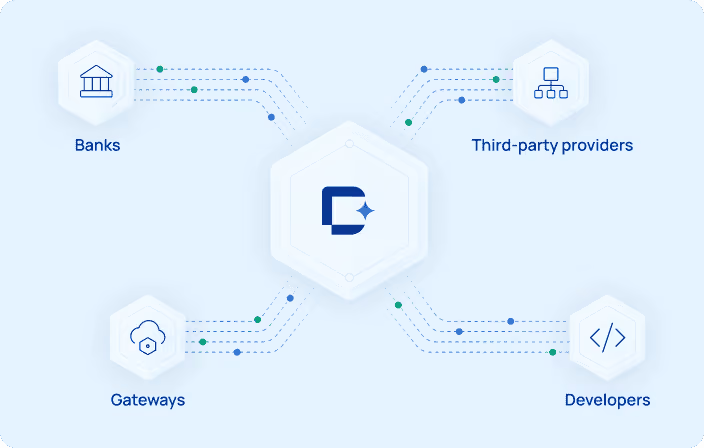
DigitalAPI.ai acts as a central intelligence layer for APIs, sitting above existing gateways, cloud services, and developer tools. Instead of forcing teams to rip and replace their current stack, it focuses on discovering, unifying, and governing APIs wherever they already exist.
1. Continuous API Discovery Across Gateways, Clouds, and Repos
DigitalAPI.ai continuously discovers APIs across:
- Multiple API gateways (Apigee, AWS, Kong, MuleSoft, etc.)
- Cloud environments and exposed endpoints
- Repositories, specs, and runtime traffic
This ensures that no API remains invisible, including internal, external, legacy, or accidentally exposed endpoints. Shadow APIs are surfaced automatically and flagged as unmanaged or unknown, giving platform and security teams immediate awareness.
2. A Centralized, Living API Catalog (Single Source of Truth)
All discovered APIs are normalized into a single API catalog with:
- Clear ownership and lifecycle status
- Linked specifications, environments, and gateways
- Visibility into which APIs are governed vs unmanaged
This catalog becomes the system of record for APIs across the enterprise, making it far harder for Shadow APIs to exist undetected, and far easier for teams to reuse existing APIs instead of creating new ones in isolation.
3. Governance That Works Across Teams, Not Against Them
Instead of enforcing governance through manual reviews or blocking developer velocity, DigitalAPI.ai enables:
- Policy-based governance applied consistently across all APIs
- Standardized security and access requirements, regardless of where an API is deployed
- Automated identification of APIs that bypass governance controls
This allows organizations to bring Shadow APIs back into compliance without breaking workflows or slowing delivery.
4. Runtime Visibility and Observability for Unknown APIs
Shadow APIs are dangerous because they are active but unobserved. DigitalAPI.ai provides:
- Runtime visibility into API usage patterns
- Insights into who (users, systems, or agents) is accessing which APIs
- Early signals of risky behavior or unexpected exposure
This helps security teams move from reactive discovery after a breach to proactive risk detection.
5. Designed for the AI and Agent Era
As AI agents begin consuming APIs autonomously, the cost of invisible APIs increases dramatically. DigitalAPI.ai extends discovery and governance to support:
- Agent-aware API catalogs
- Clear identity and authorization models for agent + user access
- Observability into how AI agents interact with APIs
This ensures that Shadow APIs don’t become blind spots for AI-driven access.
.png)
FAQs
1. What is a Shadow API?
A Shadow API is an API endpoint that has been developed and deployed within an organization's infrastructure without the knowledge, approval, or formal management of central IT or security teams. It typically lacks documentation, security controls, and inclusion in official API inventories.
2. Why are Shadow APIs dangerous?
Shadow APIs are dangerous because they create significant security blind spots. They often lack proper authentication, authorization, and validation, making them highly vulnerable to data breaches, unauthorized access, and other cyberattacks. They can also lead to compliance violations, operational disruptions, and increased technical debt due to their unmanaged nature.
3. How do Shadow APIs get created?
Shadow APIs commonly arise from rapid development cycles, decentralized teams, microservices architectures, or temporary solutions that become permanent. Developers might create them to quickly address specific needs or bypass perceived bureaucratic processes, inadvertently exposing services without formal oversight.
4. How can I find Shadow APIs?
Discovering Shadow APIs requires a multi-faceted approach. Key strategies include network traffic analysis, auditing cloud service provider configurations, reviewing API gateway logs, performing endpoint scanning, engaging with development teams through interviews and code scans, and leveraging dedicated API discovery tools that passively map your entire API ecosystem.
5. How can I secure my organization against Shadow APIs?
Securing against Shadow APIs involves both detection and prevention. Implement a strong API gateway for centralized control, enforce strict API design and security standards, integrate automated security testing into your CI/CD pipelines, and continuously monitor API traffic for anomalies. Proactively, establish a mandatory API registration process, maintain a comprehensive API catalog, foster cross-functional collaboration, and educate developers on secure API practices to prevent future shadows.
Dhayalan Subramanian is Associate Director, Product Growth at DigitalAPI, where he leads go-to-market and product growth for the company’s multi-gateway API management platform. His work focuses on helping large enterprises and mid-market cloud companies consolidate APIs across AWS, Azure, Apigee, Kong, MuleSoft, and other gateways into a single control plane for governance, discovery, monetization, and agent consumption.
Dhayalan brings 14+ years of experience across product strategy, enterprise architecture, and engineering leadership. Earlier in his career, he held senior roles at Encora (as Associate Architect and Technical Manager), Mindtree (Technology Lead), Tech Mahindra (Technical Lead), and Primus Analytics, where he designed integration frameworks and delivered enterprise-grade digital platforms for global customers.
At DigitalAPI, he works directly with platform, integration, and developer experience leaders at Fortune 500 organizations to operationalize unified API catalogs, developer portals, and MCP-ready APIs. He writes regularly on API developer experience, API governance, and AI agent architectures.
One email a fortnight. Worth opening.
A short digest of what we're writing, what we're learning from customers, and the handful of links you'd actually want from us. No tracking pixels.

.avif)