




How to Test Open Banking APIs Before Production Launch
Open Banking represents a paradigm shift in financial services, allowing third-party providers (TPPs) to securely access customer financial data with explicit consent.


TL;DR
1. Testing Open Banking APIs rigorously before launch is non-negotiable due to sensitive financial data, strict regulatory compliance, and complex multi-party interactions.
2. Key testing areas include functional accuracy, robust security (OAuth2, FAPI), performance under load, regulatory compliance, data integrity, and excellent developer experience.
3. A dedicated Open Banking API sandbox is critical for simulating real-world scenarios, testing consent flows, and validating third-party integrations in a safe, isolated environment.
4. Best practices involve comprehensive test automation, continuous integration, collaborative testing with TPPs, and real-time monitoring.
5. DigitalAPI provides the tools and infrastructure to establish a robust testing framework, including a powerful API sandbox, to ensure your Open Banking APIs are secure, compliant, and ready for production.
Ensure your Open Banking APIs are production-ready. Book a Demo!
Bringing new financial services to market through Open Banking APIs presents both immense opportunity and significant responsibility. The exchange of sensitive customer data and the intricate web of regulatory requirements mean that every API interaction must be flawless. Rushing to production without comprehensive testing is a recipe for disaster, potentially leading to security breaches, compliance failures, and irreparable damage to trust. The journey from development to deployment demands meticulous validation, ensuring that these powerful financial conduits operate securely, reliably, and in full adherence to global standards. This guide will walk you through the essential strategies on how to test open banking apis before production launch, empowering your team to deliver robust and trustworthy solutions.
The Criticality of Pre-Production Testing for Open Banking APIs
Open Banking represents a paradigm shift in financial services, allowing third-party providers (TPPs) to securely access customer financial data with explicit consent. This ecosystem, built on banking APIs, fundamentally relies on trust and security. Unlike traditional APIs, Open Banking APIs handle highly sensitive personal and financial information, making their integrity paramount. Any vulnerability or functional flaw can have severe consequences, from massive financial losses and data breaches to hefty regulatory fines and irreversible reputational damage.
The complexity of Open Banking standards, such as PSD2 in Europe, CDR in Australia, and similar frameworks globally, adds layers of mandatory compliance. Failing to meet these standards can halt market entry or result in significant penalties. Therefore, rigorous pre-production testing is not merely a best practice; it is an absolute necessity to mitigate risks, ensure regulatory adherence, and guarantee a seamless, secure experience for both financial institutions and their customers. It’s about building a foundation of confidence before exposing your critical financial infrastructure to the public.
Unique Challenges of Open Banking API Testing
Testing Open Banking APIs comes with a distinct set of challenges that go beyond typical API validation. The very nature of Open Banking introduces complexities that demand specialized approaches:
- High Stakes Data: Dealing with personal financial information means any lapse in security or data integrity can lead to severe consequences. Test environments must simulate this sensitivity without compromising real data.
- Complex Regulatory Compliance: Adhering to standards like PSD2, FAPI, and regional data protection laws requires specific tests for consent management, data access logging, and transparent communication. This isn't optional; it's a legal mandate.
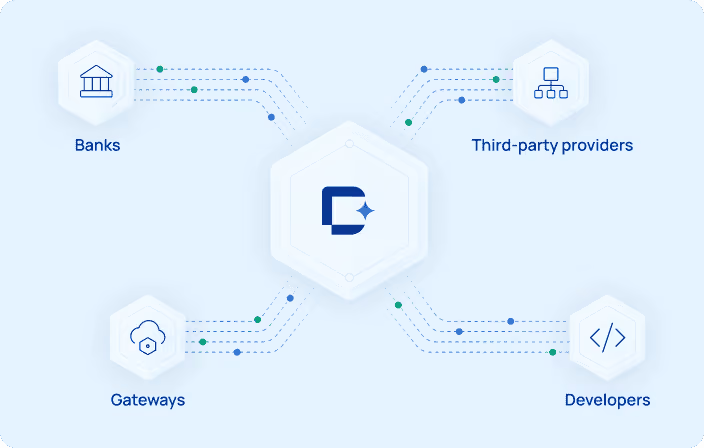
- Multi-Party Ecosystem: Open Banking involves banks, TPPs, and often other intermediaries. Testing must account for interactions across multiple entities, ensuring consistent behavior and secure handoffs between disparate systems.
- Dynamic Consent Flows: User consent is central. Testing must cover various consent scenarios—granting, revoking, scope changes—and verify that data access rights are precisely managed at every step.
- Advanced Security Protocols: Open Banking APIs mandate robust security mechanisms like OAuth 2.0 with FAPI profiles, mTLS, and strong customer authentication (SCA). Validating these protocols requires specialized security challenges and tools.
- Performance Under Interoperability: These APIs must perform reliably under varying loads and network conditions, especially when integrating with numerous TPPs. Performance bottlenecks can cripple the entire ecosystem.
- Evolving Standards: Open Banking regulations and technical specifications are continuously updated, requiring a flexible testing strategy that can adapt quickly to new requirements.
.png)
Key Pillars of Effective Open Banking API Testing
To comprehensively test Open Banking APIs before production launch, a multi-faceted approach addressing various dimensions of quality is essential. Here are the core pillars:
1. Functional Testing: Ensuring Correct Operations
Functional testing verifies that each API endpoint performs its intended action correctly, adheres to the specified request/response formats, and handles all valid and invalid inputs gracefully. For Open Banking, this means:
- Endpoint Validation: Confirming each API endpoint (e.g., account information, payment initiation) responds with the correct data structure and status codes.
- Input/Output Verification: Testing with various data sets, including edge cases and boundary conditions, to ensure expected outputs and error handling.
- Business Logic Confirmation: Validating that underlying financial logic, such as balance calculations or transaction processing, is accurate and compliant with banking rules.
- Error Handling: Ensuring APIs return appropriate and informative error messages for invalid requests, missing parameters, or unauthorized access, without exposing sensitive information.
Tools for functional testing often include Postman, SoapUI, or automated frameworks like RestAssured. Comprehensive API contract testing is crucial here, ensuring that your API adheres to its OpenAPI or Swagger specification, preventing breaking changes and promoting interoperability with TPPs.
2. Security Testing: Fortifying Against Threats
Given the sensitive nature of financial data, API security testing is paramount for Open Banking. This pillar ensures that APIs are resilient against cyber threats and unauthorized access:
- Authentication & Authorization: Rigorously testing API authentication methods like client credentials, JWTs, and especially OAuth 2.0 and FAPI profiles, verifying token validity, scope enforcement, and secure token storage.
- Data Encryption: Confirming that all data in transit and at rest is encrypted using strong cryptographic standards (e.g., TLS 1.2+ for HTTPS).
- Vulnerability Scanning: Employing tools to detect common vulnerabilities such as SQL injection, XSS, broken authentication, and insecure deserialization, aligning with OWASP API Security Top 10.
- Consent Management: Validating that user consent mechanisms are robust, ensuring data access is only granted with explicit user approval and can be revoked instantly.
- Threat Modeling: Identifying potential threats and designing tests to counteract them proactively.
Leveraging specialized API security tools and solutions is vital to uncover subtle vulnerabilities that standard functional tests might miss. These tools can simulate various attack vectors and analyze API responses for security weaknesses.
3. Performance & Load Testing: Ensuring Scalability and Responsiveness
Open Banking APIs must handle a high volume of requests from numerous TPPs without degradation. Performance and load testing evaluate the API's responsiveness, stability, and scalability under anticipated and peak traffic conditions:
- Latency Measurement: Assessing the response time of each API endpoint under various load scenarios.
- Throughput Testing: Determining the number of requests an API can handle per unit of time without performance degradation.
- Stress Testing: Pushing the API beyond its limits to identify breaking points and observe how it recovers.
- Scalability Testing: Verifying if the API infrastructure can scale horizontally and vertically to meet increasing demand.
- Resource Utilization: Monitoring CPU, memory, and network usage to identify bottlenecks.
Tools like JMeter, LoadRunner, or k6 are commonly used. Integrating with API monitoring tools post-launch can help track actual performance against test benchmarks and detect anomalies in real-time. Ensuring smooth operation under load is essential for a positive user experience and continuous service availability.
4. Compliance & Regulatory Testing: Meeting Legal Obligations
This pillar ensures that Open Banking APIs fully comply with regional and global regulatory frameworks. Compliance testing is non-negotiable and failure can lead to severe legal and financial repercussions:
- Regulatory Alignment: Validating that API behavior and data handling conform to specific Open Banking standards (e.g., PSD2, FAPI, GDPR, CCPA). This includes consent flows, data minimization, and audit trail requirements.
- Data Residency and Sovereignty: Ensuring that data is stored and processed according to geographical regulations, especially for multi-national operations.
- Audit Trail Verification: Testing that all API calls, consent grants, and data access events are logged appropriately for auditing purposes.
- Strong Customer Authentication (SCA): For payment initiation services, verifying that SCA mechanisms are correctly implemented and enforced where required.
Specialized compliance tools and expert legal consultation are often necessary to navigate the intricate landscape of financial regulations. Automated tests should be designed to cover as many compliance points as possible.
5. User Experience (UX) & Developer Experience (DX) Testing: Driving Adoption
While not always seen as "technical" testing, the experience for both end-users (UX) and developers (DX) is crucial for the success of Open Banking APIs. Poor UX or DX can lead to low adoption and frustration:
- End-User Consent Flows: Testing the clarity, ease, and security of the consent process from the end-user's perspective. Is it intuitive? Is the language clear?
- Developer Portal Usability: Evaluating the API developer portal for ease of navigation, clarity of good API documentation examples, and availability of code samples.
- SDK & Client Library Testing: If provided, testing SDKs and client libraries for functionality and ease of integration.
- Onboarding Process: Verifying that TPPs can easily register, obtain credentials, and start consuming APIs.
- Feedback Mechanisms: Ensuring channels for developers to report issues and provide feedback are effective.
Involving actual TPP developers and conducting usability tests with mock end-users can provide invaluable insights into improving both UX and DX. A smooth developer journey is key to accelerating partner adoption.
6. Data Validation & Integrity Testing: Ensuring Accuracy
Open Banking APIs transmit highly sensitive financial data, making data integrity critical. This testing pillar ensures that data remains accurate, complete, and consistent throughout its lifecycle:
- Format Validation: Verifying that data adheres to specified formats (e.g., ISO 20022 for payments, specific date/time formats).
- Data Type Verification: Ensuring that data types (e.g., string, integer, decimal) are correctly handled and validated.
- Completeness Checks: Confirming that all mandatory fields are present and correctly populated.
- Consistency Across Systems: When data passes between various internal systems or TPPs, ensuring consistency and preventing discrepancies.
- Referential Integrity: Validating relationships between different data entities (e.g., an account ID exists before transactions are linked to it).
- Data Minimization: Confirming that only the data explicitly authorized by the user and required by the TPP is exposed.
Automated data validation routines should be integrated into your CI/CD pipeline, and comprehensive end-to-end tests involving data flow across the entire ecosystem are essential.
The Power of a Dedicated Open Banking API Sandbox
When you need to know how to test open banking apis before production launch effectively, a dedicated API sandbox moves beyond theoretical validation into practical, real-world simulation. An API sandbox is an isolated, simulated environment designed to mimic a production environment, but using synthetic data. For Open Banking, this capability is not just convenient; it's indispensable.
What is an API Sandbox?
An API sandbox is a replica of your production API environment, complete with mock data, simulated responses, and controlled error conditions. It allows developers to interact with the API without affecting live systems or using real customer data. This isolated space is crucial for early-stage development, integration testing, and proof-of-concept creation, enabling rapid iteration and experimentation.
The key differentiator between a sandbox and a regular test environment is often its self-service nature and its focus on mimicking external developer interaction. A sandbox vs. test environment comparison reveals that while both are for testing, sandboxes are typically more accessible to external parties for development and early integration, providing a safer, contained space.
Why an Open Banking Sandbox is Essential
For Open Banking, a specialized Open Banking API sandbox is vital for several reasons:
- Risk Mitigation: It eliminates the risk of exposing sensitive customer data during development and testing, ensuring compliance with privacy regulations.
- Accelerated TPP Onboarding: TPPs can quickly integrate and test their applications against your APIs, reducing the time to market. This is critical for streamlining partner onboarding with self-serve sandbox APIs.
- Regulatory Compliance Validation: Sandboxes allow for thorough testing of complex consent flows, security protocols, and data access controls in a compliant environment before going live.
- Simulated Production Environment: It provides a realistic testing ground for performance, error handling, and edge cases without impacting production systems.
- Innovation Catalyst: Developers can experiment with new services and features freely, fostering innovation without fear of breaking live systems.
- Realistic Scenarios: A good sandbox allows you to simulate diverse user profiles, account types, transaction histories, and consent statuses.
Key Features of a Robust Open Banking Sandbox
An effective Open Banking API sandbox should offer a rich set of features to facilitate comprehensive testing:
- Realistic Mock Data: Synthetic but representative financial data across various customer profiles, account types, and transaction histories. This is where realistic data patterns for modern API sandboxes become crucial.
- Configurable Scenarios: Ability to simulate specific conditions like insufficient funds, declined payments, revoked consent, or network errors.
- Support for Security Protocols: Full implementation of Open Banking security standards, including OAuth 2.0 with FAPI, mTLS, and client certificate management.
- Consent Management Simulation: Tools to simulate user consent journeys, including granting, modifying, and revoking access.
- Developer Tools & Documentation: Integration with a developer portal providing API specifications, interactive documentation, and testing tools.
- Self-Service Capabilities: TPPs should be able to register, generate API keys, and manage their applications independently.
- API Monitoring: Basic API monitoring capabilities to track sandbox usage and identify potential issues.
Simple API Sandbox Architecture: How it Works
A simple API sandbox architecture typically involves a proxy layer that intercepts API requests, routes them to a mock service, and returns simulated responses. This mock service can be configured to respond with various data sets or error conditions. For Open Banking, this architecture is enhanced with components for identity and access management (simulating an Authorization Server), consent management, and data generation services to create realistic financial data. This setup ensures isolation and control over the testing environment, allowing developers to focus on integration logic rather than backend complexities.
Best Practices for Testing Open Banking APIs Before Production Launch
Mastering how to test open banking apis before production launch involves more than just selecting tools; it's about embedding a robust testing culture and strategy throughout your development lifecycle. Here are crucial best practices:
1. Automate Everything Possible
Manual testing for Open Banking APIs is prone to errors, slow, and unsustainable due to the sheer volume of scenarios, compliance checks, and security validations required. Automate:
- Functional Tests: Use frameworks like Postman, Karate, or RestAssured.
- Security Scans: Integrate DAST (Dynamic Application Security Testing) tools into your pipeline.
- Performance Tests: Employ tools like JMeter or LoadRunner.
- Compliance Checks: Build scripts that validate responses against regulatory schemas.
Automation ensures consistency, speed, and comprehensive coverage, allowing your team to focus on complex test cases that require human intervention.
2. Integrate with CI/CD
Embed your automated tests directly into your Continuous Integration/Continuous Delivery (CI/CD) pipeline. Every code commit should trigger a suite of tests—functional, security, contract—to catch issues early. This continuous feedback loop helps maintain code quality and prevents regressions. Automated deployments to sandbox and staging environments should also be part of this process, enabling rapid testing cycles and faster iteration.
3. Collaborate with Third-Party Providers (TPPs)
Open Banking is an ecosystem. Active collaboration with TPPs is invaluable:
- Early Access to Sandbox: Provide TPPs with access to your sandbox as early as possible for integration testing.
- Feedback Loops: Establish clear channels for TPPs to provide feedback on API usability, documentation, and any issues encountered.
- Joint Testing Sessions: Conduct joint testing sessions to resolve interoperability challenges proactively.
Their real-world integration experience can uncover blind spots that internal testing might miss, fostering stronger partnerships and a more robust ecosystem.
4. Continuous Monitoring and Iteration
Testing doesn't stop at launch. Implement continuous API observability tools and monitoring in pre-production and production environments to track API health, performance, and security. Use tools for performance monitoring to identify anomalies. Iteratively improve your APIs and testing strategies based on real-time data and feedback. This ongoing process is crucial for adapting to evolving regulations and market demands.
5. Comprehensive Documentation and Developer Experience
While technically part of DX, the role of comprehensive documentation in testing is often underestimated. Clear, accurate, and up-to-date API documentation acts as a critical reference point for testers and integrators. It guides the expected behavior, data formats, and error codes. Any discrepancy between documentation and actual API behavior indicates a test failure. Invest in best API documentation tools and platforms to ensure clarity and consistency.
Leveraging DigitalAPI for Seamless Open Banking API Testing
For financial institutions grappling with how to test Open Banking APIs before production launch, DigitalAPI offers a comprehensive platform designed to streamline and secure this critical process. DigitalAPI's capabilities are specifically tailored to meet the rigorous demands of the Open Banking ecosystem, enabling you to build, manage, and test APIs with confidence.
- Robust API Sandbox: DigitalAPI provides a powerful, self-service API sandbox that allows developers to simulate complex Open Banking scenarios with realistic data. This environment facilitates comprehensive functional, security, and performance testing without impacting live systems, accelerating TPP integration and reducing development cycles.
- Advanced Security Features: Our platform is built with enterprise-grade security, supporting advanced authentication methods like OAuth 2.0 with FAPI, mTLS, and comprehensive API access management. It helps you enforce granular access controls and ensure data privacy in line with regulatory requirements.
- Comprehensive Test Automation Integration: DigitalAPI seamlessly integrates with your existing CI/CD pipelines and preferred best API testing tools and platforms, enabling automated functional, security, and performance tests to run with every code change. This ensures continuous quality and accelerates your release cycles.
- Developer Portal for Enhanced DX: Our intuitive developer portal offers rich, interactive documentation, code samples, and self-service tools, empowering TPPs to quickly understand, integrate, and test your Open Banking APIs. A superior developer experience drives faster adoption and stronger partnerships.
- Compliance and Governance Support: DigitalAPI assists in enforcing regulatory compliance and governance policies across your API estate. From consent management to audit trails, our platform provides the control and visibility needed to meet Open Banking mandates.
By choosing DigitalAPI, you equip your team with the tools necessary to confidently navigate the complexities of Open Banking, ensuring your APIs are secure, compliant, high-performing, and ready for a successful production launch.
FAQs
1. Why is pre-production testing crucial for Open Banking APIs?
Pre-production testing for Open Banking APIs is crucial because they handle sensitive financial data and are subject to strict regulatory compliance. Rigorous testing prevents security breaches, ensures data integrity, guarantees performance under load, and verifies adherence to complex standards like PSD2 and FAPI, mitigating risks of financial losses, regulatory fines, and reputational damage before going live.
2. What are the key areas to focus on when testing Open Banking APIs?
When testing Open Banking APIs, focus on functional accuracy, robust security (including OAuth 2.0 and FAPI), performance and load handling, regulatory compliance, data validation and integrity, and a positive developer experience. These pillars ensure the API works as intended, is secure against threats, can handle expected traffic, meets all legal obligations, and is easy for TPPs to integrate with.
3. What role does an API sandbox play in Open Banking API testing?
An API sandbox is essential for Open Banking API testing as it provides an isolated, simulated environment to test APIs with synthetic data without impacting live systems. It allows TPPs to integrate and test their applications, helps validate complex consent flows and security protocols, simulates various production scenarios, and accelerates the onboarding process in a risk-free, compliant setting.
4. How can I ensure regulatory compliance during Open Banking API testing?
Ensure regulatory compliance by designing specific tests for consent management, data access logging, strong customer authentication (SCA), and data minimization, all aligned with standards like PSD2 and FAPI. Integrate automated compliance checks into your testing pipeline and conduct thorough audits to verify that API behavior and data handling consistently meet all legal and industry mandates.
5. What are some best practices for an effective Open Banking API testing strategy?
Effective Open Banking API testing involves automating as many test cases as possible, integrating testing into your CI/CD pipeline for continuous validation, collaborating closely with Third-Party Providers (TPPs) for real-world feedback, and implementing continuous API monitoring post-launch. Comprehensive and up-to-date API documentation is also vital for guiding testers and ensuring consistent API behavior.
Dhayalan Subramanian is Associate Director, Product Growth at DigitalAPI, where he leads go-to-market and product growth for the company’s multi-gateway API management platform. His work focuses on helping large enterprises and mid-market cloud companies consolidate APIs across AWS, Azure, Apigee, Kong, MuleSoft, and other gateways into a single control plane for governance, discovery, monetization, and agent consumption.
Dhayalan brings 14+ years of experience across product strategy, enterprise architecture, and engineering leadership. Earlier in his career, he held senior roles at Encora (as Associate Architect and Technical Manager), Mindtree (Technology Lead), Tech Mahindra (Technical Lead), and Primus Analytics, where he designed integration frameworks and delivered enterprise-grade digital platforms for global customers.
At DigitalAPI, he works directly with platform, integration, and developer experience leaders at Fortune 500 organizations to operationalize unified API catalogs, developer portals, and MCP-ready APIs. He writes regularly on API developer experience, API governance, and AI agent architectures.
One email a fortnight. Worth opening.
A short digest of what we're writing, what we're learning from customers, and the handful of links you'd actually want from us. No tracking pixels.

.avif)