



How to Launch External Partner API Portal Without Security Risks
External partner API portals are strategic gateways, transforming how businesses connect, collaborate, and innovate.

TL;DR
1. Partner portals fail on security the moment internal and external APIs share one surface: Role-based visibility and audience scoping are not nice-to-have, they are the first line of defence.
2. OAuth 2.0, mTLS, and scoped API keys are table stakes: Anything less is a compliance conversation waiting to happen.
3. Isolated sandbox environments protect production data on day one: Partners test with real shapes and fake data, never the reverse.
4. Per-partner entitlements, analytics, and audit trails close the governance loop: You see who called what, when, and whether they were supposed to.
5. Security and developer experience are not a trade-off: The portals that onboard fastest are usually the ones with the tightest controls, because both come from the same design discipline.
6. DigitalAPI ships these controls native, across every gateway you run: Kong, Apigee, AWS, Azure, and MuleSoft stay in place, the security layer is unified on top.
Ready to secure your external API ecosystem? Book a Demo!
Opening your digital capabilities to external partners through a dedicated API portal unlocks immense potential for collaborative innovation and market expansion. Yet, this strategic move introduces a complex array of security challenges, often overlooked in the rush to deliver new services. Successfully inviting external developers to integrate with your core systems requires more than just functional APIs and polished documentation. It demands a rigorous, security-centric strategy that protects your valuable data, maintains compliance, and safeguards your reputation. This comprehensive blog details precisely how to launch an external partner API portal without security risks, ensuring your ecosystem thrives on trust and resilience.
The Promise and Peril of External Partner API Portals
External partner API portals are strategic gateways, transforming how businesses connect, collaborate, and innovate. They enable seamless data exchange, foster new revenue streams through API monetization models, and accelerate the development of integrated solutions. Enterprises leverage these portals to:
- Expand their ecosystem by allowing partners to build on their services.
- Accelerate time-to-market for new products and features.
- Create new business models and revenue opportunities.
- Enhance customer experiences through broader integrations.
However, exposing internal APIs to an external audience, even trusted partners, inherently broadens the attack surface. Without stringent security measures, an API portal can become a critical vulnerability point, leading to data breaches, service disruptions, compliance violations, and severe reputational damage. The challenge lies in balancing accessibility and ease of use for partners with impenetrable security for your core systems.
Still scoping partner auth, sandbox isolation, and audit logging across three different gateways?
See DigitalAPI's unified security layer in a 30-minute walkthrough.
Core Pillars of a Secure External Partner API Portal Launch
Launching an external partner API portal without security risks requires a multi-layered, proactive approach, addressing security at every stage from architecture to ongoing operations. Here are the core pillars:
Pillar 1: Robust API Security Architecture
The foundation of any secure external API portal is a resilient API security architecture that acts as a gatekeeper for all interactions.
The API Gateway: Your First Line of Defense
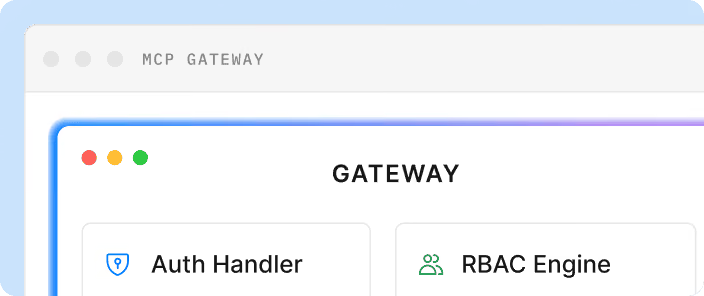
A robust API gateway is non-negotiable for external-facing APIs. It acts as a single enforcement point, abstracting backend services, and applying security policies before requests ever reach your internal infrastructure. Key gateway functions for security include:
- Traffic Management: Routing, load balancing, and preventing direct access to backend services.
- Policy Enforcement: Applying rules for authentication, authorization, rate limiting, and data transformation.
- Threat Protection: Filtering malicious requests, protecting against SQL injection, XSS, and other common API attacks.
For a deeper dive into how to secure your gateway, explore API Gateway security core pillars.
Fortifying Authentication and Authorization
Every external interaction must be rigorously authenticated and authorized. This involves verifying the identity of the partner application and user, and then determining what resources they are permitted to access.
- Strong Authentication: Implement strong API authentication mechanisms. This typically involves industry standards like OAuth 2.0 for delegated authorization, or secure API keys for simpler use cases. Understanding the differences between authentication methods like OAuth and API Keys is crucial for making the right choice.
- Granular Authorization: Leverage robust access management to define precise permissions. Partners should only have access to the specific APIs and data scopes necessary for their integration, following the principle of least privilege.
- Token Management: Securely generate, validate, revoke, and manage API tokens and keys. Implement short-lived tokens and refresh token mechanisms where appropriate.
Implementing Rate Limiting and Throttling
To protect your APIs from abuse, denial-of-service (DoS) attacks, and resource exhaustion, implement comprehensive rate limiting and throttling policies.
- API Rate Limiting Strategies: Define the maximum number of requests a partner application can make within a given time frame. Exceeding this limit should result in temporary blocking or error responses.
- API Throttling: Implement more dynamic controls to handle bursts of traffic or prioritize certain partners, ensuring fair usage and system stability.
Ensuring Data Encryption and Integrity
All data exchanged via your API portal, whether in transit or at rest, must be encrypted to prevent eavesdropping and tampering.
- TLS/SSL: Enforce TLS 1.2 or higher for all API communications, ensuring encrypted channels between clients and the API gateway.
- Data at Rest Encryption: Ensure sensitive data stored in databases or caches is encrypted.
- Integrity Checks: Use digital signatures or HMACs to verify data integrity, confirming that data has not been altered during transmission.
Adhering to API Security Best Practices
Stay updated with industry-recognized security guidelines. The OWASP API Security Top 10 provides a comprehensive list of the most critical security risks to web APIs and practical recommendations to mitigate them. Regularly review and apply these guidelines to your API development and portal management processes.
.png)
Pillar 2: Secure Developer Portal Design and Functionality
The developer portal itself, where partners discover, onboard, and manage their API access, must be designed with security at its forefront.
Granular Role-Based Access Control (RBAC)
Within the portal, implement granular Role-Based Access Control (RBAC). Different partner roles (e.g., administrator, developer, auditor) should have distinct permissions regarding portal features, API subscription, application management, and analytics viewing. This prevents unauthorized actions and ensures partners only see what's relevant to their role.
Streamlined and Secure Partner Onboarding
The onboarding process for external partners should be efficient yet secure. A secure API portal onboarding process includes:
- Identity Verification: Robust mechanisms to verify partner identities before granting portal access.
- Self-Service but Controlled: Allow partners to self-register applications but require approval for API subscriptions or access to sensitive APIs.
- API Key / Credential Management: Provide secure mechanisms for partners to generate, rotate, and revoke their API keys or OAuth client credentials directly within the portal.
Isolated Sandbox Environments for Safe Exploration
Provide API sandbox testing environments that are completely isolated from your production systems. This allows partners to experiment, test integrations, and develop their applications without risking your live data or services. For a deeper understanding of these isolated spaces, learn what an API sandbox is.
Comprehensive Security-Focused Documentation
Good documentation goes beyond API functionality; it educates partners on secure usage. Include clear guidelines on:
- API key management and rotation.
- Best practices for handling sensitive data.
- Error codes related to security (e.g., authentication failures, authorization errors).
- Expected security headers and payload encryption.
Auditing, Logging, and Activity Tracking
The portal must provide comprehensive logging of all user and application activities. This includes:
- User logins and logouts.
- API subscription requests and approvals.
- Application creation and modification.
- API key generation and revocation.
These logs are critical for forensic analysis, troubleshooting, and demonstrating compliance.
Pillar 3: Proactive API Monitoring and Incident Response
Security is not a one-time setup; it requires continuous vigilance and the ability to respond swiftly to threats.
Continuous API Monitoring and Observability
Implement robust API monitoring across your entire API ecosystem. This involves:
- Usage Analytics: Track API consumption patterns, identify abnormal spikes, or unusual access from specific partners.
- Performance Monitoring: Ensure APIs are performing as expected, as performance degradation can sometimes signal an attack.
- Security Monitoring: Look for failed authentication attempts, authorization errors, or attempts to access unauthorized resources. Leveraging the best API monitoring tools can significantly enhance this capability.
Advanced Threat Detection and Alerting
Utilize security information and event management (SIEM) systems or dedicated API security solutions to detect sophisticated threats. These tools can identify:
- Credential stuffing attempts.
- Broken authentication patterns.
- Data exfiltration attempts.
- Abnormal behavioral patterns indicative of a compromised partner account.
Set up real-time alerts for critical security events, ensuring your security team is notified immediately.
Developing a Robust Incident Response Plan
Prepare for the inevitable: a security incident. A well-defined incident response plan is crucial for minimizing damage and recovering quickly. This plan should outline:
- Detection: How incidents are identified.
- Analysis: How to investigate the scope and nature of the incident.
- Containment: Steps to prevent further damage (e.g., revoking API keys, blocking IPs).
- Eradication: Removing the root cause of the incident.
- Recovery: Restoring affected systems and data.
- Post-Incident Review: Learning from the incident to improve future security.
Pillar 4: Unwavering Data Governance and Compliance
Handling sensitive data through an external API portal necessitates strict adherence to data governance policies and regulatory compliance.
Navigating Regulatory Landscapes
Understand and comply with all relevant data privacy regulations, such as GDPR, CCPA, HIPAA, LGPD, and local industry-specific mandates. This impacts how you design APIs, manage data, and audit access. Ensure your API contracts and terms of service with partners clearly outline their responsibilities regarding data protection and compliance.
Data Masking, Anonymization, and Tokenization
Whenever possible, avoid exposing raw sensitive data. Implement techniques such as:
- Data Masking: Obscuring sensitive data with realistic but non-sensitive data for non-production environments.
- Anonymization: Removing personally identifiable information (PII) from data sets.
- Tokenization: Replacing sensitive data with a unique, non-sensitive token, with the original data stored securely elsewhere. Understanding tokenization in data security is key for protecting payment card data and other sensitive information.
Consent Management and Privacy Controls
For APIs handling personal data, ensure that mechanisms are in place for obtaining, managing, and tracking user consent. The API portal should facilitate transparency regarding data usage and allow users (via partner applications) to exercise their privacy rights, such as data access, rectification, and erasure.
Building Your Secure API Portal with DigitalAPI
DigitalAPI understands that a truly secure external partner API portal must be both powerful and effortless to manage. Our platform is engineered to address the complexities of external API exposure, providing a holistic solution that prioritizes security without stifling innovation. We provide a modern API developer portal that integrates seamlessly with your existing API infrastructure.
1. Unifying Security Across Diverse API Landscapes
DigitalAPI offers a unified approach to API management, enabling enterprises to consolidate APIs from various gateways (Apigee, MuleSoft, Kong, AWS, Azure, etc.) into a single, secure catalog. This eliminates blind spots and ensures consistent API security practices are applied across your entire external API estate. Our platform acts as an intelligent intermediary, centralizing security policy enforcement, monitoring, and governance.
2. Empowering Granular Access Control and Onboarding
Our developer portal is built with robust RBAC capabilities, allowing you to define precise permissions for different partner organizations and individual developers. This ensures partners only interact with authorized APIs and features. DigitalAPI streamlines partner onboarding with configurable workflows, secure credential management, and dedicated sandbox environments. Partners can self-register, manage their applications, and generate API keys securely, all while adhering to your predefined security protocols.
3. Providing Integrated Monitoring and Governance
DigitalAPI integrates comprehensive API monitoring and analytics directly into the portal experience. Track API usage, identify suspicious patterns, and receive real-time alerts on potential security incidents. Furthermore, our platform helps you establish strong API governance policies, enforcing standards for authentication, authorization, rate limiting, and data handling across all external APIs. This continuous enforcement and visibility significantly reduce the risk of security vulnerabilities.
By choosing robust API management platforms like DigitalAPI, you gain a partner dedicated to helping you launch your external API portal securely, efficiently, and effectively.
Your Step-by-Step Secure Launch Checklist
To summarize, here’s a practical checklist to guide your secure external partner API portal launch:
- Define Comprehensive Security Requirements: Clearly outline the data sensitivity, compliance needs, and threat models for each API to be exposed.
- Select a Robust API Management Platform: Choose a platform (like DigitalAPI) that offers strong gateway security, RBAC, analytics, and partner onboarding capabilities out-of-the-box.
- Implement Strong Authentication & Authorization: Enforce OAuth 2.0 or secure API keys, and define granular access policies per partner and API.
- Design with Granular RBAC: Configure roles and permissions within your portal for different partner user types to control access to APIs and portal features.
- Provide Secure Sandbox Environments: Offer isolated, non-production sandboxes for partners to test and validate their integrations without affecting live systems.
- Enforce API Governance Policies: Establish and automate policies for API design, versioning, data handling, and deprecation to maintain security and consistency.
- Set Up Comprehensive Monitoring & Alerting: Implement continuous API usage, performance, and security monitoring with real-time alerts for anomalies or attacks.
- Establish a Detailed Incident Response Plan: Develop and regularly test a plan for detecting, containing, eradicating, and recovering from security incidents.
- Conduct Regular Security Audits & Penetration Testing: Periodically engage third-party security experts to identify and address potential vulnerabilities in your APIs and portal.
- Educate Partners on Secure API Usage: Provide clear documentation and guidelines within the portal on best practices for consuming and integrating with your APIs securely.
FAQs
1. What is an external partner API portal?
An external partner API portal is a dedicated web interface that allows external businesses, developers, or clients to discover, access, and integrate with a company's APIs. It typically provides documentation, self-service onboarding, application management, sandbox environments, and tools necessary for external parties to build applications and services using the exposed APIs.
2. Why is security paramount for external API portals?
Security is paramount because external API portals expose a company's digital assets and data to third parties, significantly broadening the attack surface. Inadequate security can lead to data breaches, unauthorized access, service disruptions, compliance violations, and severe reputational damage. Robust security measures are essential to protect sensitive information, maintain trust, and ensure the stability of core systems.
3. What are the key security components for such a portal?
Key security components include a robust API Gateway for policy enforcement, strong authentication (e.g., OAuth 2.0, API Keys) and authorization (e.g., granular RBAC), rate limiting and throttling to prevent abuse, end-to-end data encryption, isolated sandbox environments, comprehensive auditing and logging, continuous API monitoring, and adherence to security best practices like the OWASP API Security Top 10.
4. How does DigitalAPI enhance external API portal security?
DigitalAPI enhances external API portal security by offering a unified platform for multi-gateway API management, centralizing security policy enforcement, and providing robust RBAC for granular access control. It streamlines secure partner onboarding, provides isolated sandbox environments, integrates comprehensive monitoring and analytics for threat detection, and facilitates strong API governance to ensure consistent security across all external APIs.
5. What role does a sandbox play in a secure external API portal?
A sandbox plays a critical role in a secure external API portal by providing a safe, isolated, and non-production environment for external partners to test and develop their integrations. This prevents partners from inadvertently or maliciously impacting live data or production systems during their development process, significantly reducing security risks associated with early-stage API exploration and integration.
Dhayalan Subramanian is Associate Director, Product Growth at DigitalAPI, where he leads go-to-market and product growth for the company’s multi-gateway API management platform. His work focuses on helping large enterprises and mid-market cloud companies consolidate APIs across AWS, Azure, Apigee, Kong, MuleSoft, and other gateways into a single control plane for governance, discovery, monetization, and agent consumption.
Dhayalan brings 14+ years of experience across product strategy, enterprise architecture, and engineering leadership. Earlier in his career, he held senior roles at Encora (as Associate Architect and Technical Manager), Mindtree (Technology Lead), Tech Mahindra (Technical Lead), and Primus Analytics, where he designed integration frameworks and delivered enterprise-grade digital platforms for global customers.
At DigitalAPI, he works directly with platform, integration, and developer experience leaders at Fortune 500 organizations to operationalize unified API catalogs, developer portals, and MCP-ready APIs. He writes regularly on API developer experience, API governance, and AI agent architectures.
One email a fortnight. Worth opening.
A short digest of what we're writing, what we're learning from customers, and the handful of links you'd actually want from us. No tracking pixels.

.avif)