






Realistic Data Patterns for Modern API Sandboxes: Best practices and Strategies
Crafting robust APIs demands more than just functional code; it requires a development environment that mirrors the complexities of the real world.

TL;DR
1. Relying on dummy data in API sandboxes leads to inaccurate testing, missed bugs, and poor user experiences.
2. Realistic data ensures higher quality APIs by simulating production conditions, including volume, variety, relationships, and edge cases.
3. Strategies for realistic data include masking production data, synthetic generation, subsetting, and manual curation.
4. Effective implementation requires robust tooling, automated refresh cycles, CI/CD integration, and strong data governance.
5. Overcoming challenges like privacy, performance, and data volume is crucial for maintaining an effective and compliant sandbox.
Crafting robust APIs demands more than just functional code; it requires a development environment that mirrors the complexities of the real world. Many teams begin building with simplistic, placeholder data in their sandboxes, assuming it will suffice for initial testing. However, this often creates a disconnect, hiding critical issues that only emerge in production. The journey from static, fictional entries to dynamic, production-like datasets is not merely an upgrade; it's a fundamental shift towards building truly resilient, high-performing APIs that stand up to genuine user interactions and intricate business logic. This transition from dummy to dynamic data is pivotal for any organization aiming for excellence in their API offerings.
The Imperative for Realistic Data in API Sandboxes
Developer sandboxes are the proving ground for new APIs, where ideas are tested and refined. But the fidelity of these environments directly impacts the quality of the resulting APIs. When sandboxes are populated with generic, unrealistic, or sparse data, developers operate under false pretenses. This creates a dangerous gap between development and production, leading to overlooked bugs, performance bottlenecks, and a general lack of confidence in the API's readiness for real-world scenarios. The core challenge is that real-world data is messy, complex, and unpredictable, qualities that dummy data rarely captures.
The Limitations of Dummy Data
Dummy data, while quick to set up, offers a shallow representation of reality. It can give a false sense of security, making simple API calls appear functional when underlying complexities remain unaddressed.
When developers test with uniform, predictable data, they miss the edge cases that real users inevitably expose. Think of varying data lengths, special characters, null values, or unexpected formats. These discrepancies often lead to runtime errors, unexpected behavior, and frustrating debugging sessions when the API finally encounters production data.
Performance testing with dummy data also paints an inaccurate picture. Small, consistent datasets don't mimic the volume, concurrency, or data distribution of live environments. An API might perform flawlessly with 10 records, but buckle under the weight of a million diverse entries, or when faced with concurrent requests from a multitude of distinct user profiles. This can lead to critical performance issues only discovered post-deployment.
Furthermore, dummy data stifles innovation in user experience design. Developers cannot truly understand how an API's responses will shape the frontend experience if the data lacks realistic variety, relationships, and nuanced details. This can result in generic UIs, awkward data visualizations, and missed opportunities to create truly intuitive and powerful applications.
Finally, relying on basic placeholder data can significantly slow down developer onboarding and productivity. New team members struggle to grasp real-world scenarios or complex data flows when the sandbox data offers no context. They spend more time trying to simulate scenarios rather than focusing on building and testing features with data that accurately reflects customer use cases.
What Constitutes "Realistic Data"?
Realistic data in an API sandbox goes beyond mere presence; it's about accurately mimicking the characteristics of production data in a safe, controlled environment. It's the difference between a static photograph and a dynamic, interactive simulation. Achieving this realism requires attention to several key attributes that define the complexity and behavior of live data.
Key Attributes of High-Fidelity Sandbox Data
True realism in sandbox data is a multifaceted concept, encompassing various dimensions that directly impact testing quality and developer confidence.
- Volume and Variety: Realistic data must reflect the scale of production environments. This includes the sheer number of records, but also the diversity of those records. Are there enough different customer types, product categories, or transaction statuses to thoroughly test all API paths and business logic?
- Data Relationships and Interdependencies: Real-world data is rarely isolated. It exists within complex relationships, a customer has multiple orders, an order has many items, items belong to specific vendors. Sandbox data needs to accurately represent these relational complexities, allowing developers to test joins, nested objects, and foreign key constraints effectively.
- Edge Cases and Anomalies: The most valuable aspect of realistic data is its inclusion of edge cases. This means data that falls outside typical parameters: invalid inputs, very long strings, null values, specific dates (e.g., leap years), or data that triggers error conditions. It also includes anomalies that might arise from real-world user behavior or system quirks.
- Statefulness and Dynamics: APIs often deal with data that changes over time (e.g., order status, subscription expiry, inventory levels). Realistic sandbox data needs to support state changes, allowing developers to simulate sequences of operations and test how the API handles transitions, race conditions, and temporal logic.
- Privacy and Compliance: While striving for realism, data privacy and compliance (e.g., GDPR, HIPAA, CCPA) are paramount. Realistic data should mimic the structure and behavior of sensitive information without exposing actual personally identifiable information (PII) or other protected data. This often involves anonymization, tokenization, or synthetic generation.
.png)
Strategies for Populating Your Sandboxes with Realistic Data
Generating realistic data isn't a one-size-fits-all solution; it often involves a combination of techniques, each with its own advantages and considerations. The chosen strategy depends on the sensitivity of your data, the complexity of your API, and your overall development workflow. Several proven methods can help bridge the gap between dummy data and production-grade realism.
1. Data Masking and Anonymization (from Production)
This involves taking a copy of actual production data and systematically obfuscating or transforming sensitive fields to remove any PII or confidential information. Techniques include shuffling, encryption, tokenization, and substitution. The advantage is that the data retains its real-world distribution, relationships, and edge cases, but without the privacy risks. The challenge lies in ensuring irreversible masking while maintaining data integrity.
2. Synthetic Data Generation
This technique creates entirely new datasets that statistically resemble real data but contain no actual production information. Tools and algorithms analyze the patterns, distributions, and relationships in your production data and then generate new, artificial records with similar characteristics. This is ideal for highly sensitive environments and for generating vast amounts of data quickly, but it requires careful validation to ensure the synthetic data accurately reflects all real-world nuances.
3. Subsetting Production Data
Instead of copying the entire production database, subsetting involves selecting a smaller, representative portion of the data while preserving its referential integrity. This creates a manageable, yet realistic, dataset for sandboxes. It's faster to generate, uses less storage, and often provides sufficient complexity for most testing scenarios. However, ensuring the subset truly captures all critical edge cases and data relationships can be complex.
4. Manual Curation and Seed Data
For specific, complex scenarios or critical user journeys, manual curation can be invaluable. This involves carefully crafting a set of data records (seed data) that specifically target difficult-to-reproduce bugs, particular business logic paths, or integration points. While labor-intensive for large datasets, it's essential for ensuring coverage of unique, high-value test cases that automated methods might miss.
5. Leveraging Public/Open Datasets
Depending on the domain, publicly available datasets can provide a rich source of realistic, non-sensitive information. Datasets from government agencies, research institutions, or open-source initiatives can simulate customer profiles, product catalogs, geographical data, or financial transactions. Integrating these datasets can quickly add a layer of realism and variety without the overhead of generating data from scratch.
Implementing Realistic Data: Best Practices
Successfully incorporating realistic data into API sandboxes is not just about choosing a generation method; it's about building a sustainable and integrated process. This involves careful planning, tooling, and operational discipline to ensure data remains relevant and accessible to developers.
- Choose the Right Tools and Platforms: Invest in tools designed for data generation, masking, or subsetting. This might include dedicated data management platforms, synthetic data generators, or custom scripts integrated into your infrastructure. The right tools automate repetitive tasks and ensure consistency across sandbox environments.
- Automate Data Refresh and Maintenance: Realistic data loses its value if it becomes stale. Implement automated processes to regularly refresh sandbox data, whether by regenerating synthetic data, re-masking production subsets, or pulling updated public datasets. Define a refresh cadence that balances data currency with processing overhead.
- Integrate with CI/CD Workflows: Data provisioning should be a seamless part of your continuous integration and continuous deployment pipelines. When a new feature branch is created, or a new environment is spun up, realistic data should be automatically provisioned, ensuring developers always have a consistent and up-to-date dataset to work with.
- Empower Developers with Data Control: Provide developers with self-service capabilities to manipulate or reset sandbox data. This could involve simple UIs to create specific test scenarios, tools to inject fault data, or commands to roll back a sandbox to a pristine state. Empowering developers reduces dependencies and accelerates testing cycles.
- Prioritize Data Security and Compliance: Even with masked or synthetic data, maintaining rigorous security practices in sandboxes is crucial. Implement access controls, encryption for data at rest and in transit, and regular security audits. Ensure your data generation methods consistently meet all relevant privacy regulations (e.g., GDPR, HIPAA) to prevent accidental data leakage.
Navigating the Challenges
While the benefits of realistic data in API sandboxes are clear, implementing it comes with its own set of hurdles. Addressing these challenges proactively is key to building a robust and sustainable development ecosystem.
- Balancing Realism with Performance: Highly realistic datasets can be large and complex, potentially slowing down sandbox environments or increasing processing times for data generation. Solution: Strategically use data subsetting, optimize data storage, and ensure sandbox infrastructure is adequately provisioned. Focus realism efforts on the most critical API paths and data attributes, rather than replicating an entire production database indiscriminately.
- Ensuring Privacy and Regulatory Compliance: The risk of exposing sensitive data is a constant concern when dealing with production-derived information. Solution: Implement robust data masking and anonymization techniques, ideally using certified tools. Conduct regular security audits and compliance checks on your sandbox data to ensure it meets all regulatory requirements and internal privacy policies.
- Managing Data Scale and Costs: Large volumes of realistic data require significant storage and compute resources, which can incur substantial costs. Solution: Employ intelligent data subsetting strategies to keep sandbox data manageable. Utilize cloud storage tiers effectively, and consider on-demand provisioning for resource-intensive data generation tasks to optimize costs.
- Keeping Data Current: Production data evolves constantly, and maintaining currency in sandboxes can be challenging. Solution: Automate data refresh pipelines with a frequency that balances realism with operational overhead. Leverage event-driven architectures to update sandbox data in response to significant production changes where feasible.
- Complexity of Setup and Maintenance: Building and maintaining a realistic data pipeline requires specialized skills and ongoing effort. Solution: Invest in dedicated data engineering expertise or leverage specialized third-party tools that simplify data generation and management. Standardize data schemas and processes to reduce maintenance complexity across different sandbox environments.
The Future of API Sandboxes: Beyond Simulation
The evolution of API sandboxes is moving beyond simple replication to intelligent, adaptive environments. As technology advances, particularly in AI and machine learning, the ability to generate and manage realistic data will become even more sophisticated, enabling unprecedented levels of testing fidelity and developer productivity. The next generation of sandboxes will be characterized by greater intelligence and autonomy in data management.
1. AI-Driven Data Synthesis
Advances in AI and generative models are enabling the creation of hyper-realistic synthetic data that closely mimics complex production patterns, including temporal sequences and nuanced relationships. AI can automatically identify data characteristics, generate new data on demand, and even detect gaps in existing test data coverage, leading to more comprehensive and efficient testing.
2. Hyper-Personalized Sandbox Environments
The future will see sandboxes that can dynamically adapt to the specific needs of individual developers or testing scenarios. Developers will be able to request data sets tailored to particular user personas, geographical regions, or specific business events, with the data being generated and provisioned on-the-fly, ensuring maximum relevance and minimal overhead.
3. Self-Healing and Adaptive Data
Future sandboxes will likely incorporate self-healing data mechanisms. As APIs evolve or production data changes, the sandbox data will automatically adjust to remain consistent and valid. This adaptive capability, potentially driven by machine learning, will ensure that sandboxes are always ready for testing, reducing manual intervention and increasing developer trust in the environment.
How DigitalAPI Enables Realistic API Sandboxes
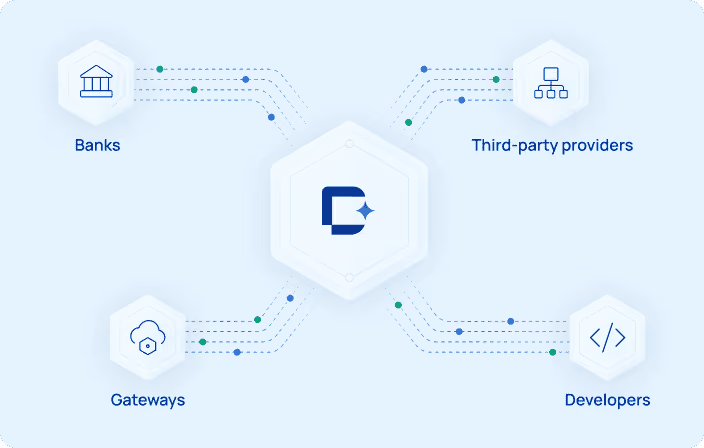
Creating realistic API sandboxes is as much a platform challenge as it is a data one. DigitalAPI sits above existing API gateways to provide a unified sandbox experience across environments, allowing developers to interact with APIs in a consistent way regardless of where they are hosted. This removes fragmentation and ensures sandbox APIs reflect real production behaviour, not just isolated mock responses.
DigitalAPI enables sandboxes to simulate production-like workflows and state changes, so developers can test real API interactions such as lifecycle transitions, multi-step transactions, and dependency relationships. By integrating with masked, synthetic, or subset datasets, DigitalAPI preserves data realism while enforcing governance, access control, and compliance, critical for regulated enterprise environments.
With DigitalAPI's self-serve developer portal and built-in visibility, teams can observe how APIs are tested in sandbox before production release. This creates a feedback loop between design, testing, and consumption, helping platform teams catch gaps early and deliver APIs that are reliable, predictable, and ready for real-world use.
FAQs
1. What is realistic data in an API sandbox?
Realistic data in an API sandbox refers to datasets that accurately mimic the volume, variety, relationships, edge cases, and dynamic nature of data found in a production environment. This allows developers to test APIs under conditions that closely resemble real-world usage without exposing actual sensitive information.
2. Why is realistic data important for API development?
Realistic data is crucial because it enables more accurate testing, helps uncover edge cases and performance bottlenecks early, improves the quality of API responses, and allows developers to design better user experiences. It reduces the risk of discovering critical bugs or performance issues only after deployment to production.
3. How can I generate realistic data for my API sandboxes?
Common strategies include data masking and anonymization (transforming production data to remove sensitive info), synthetic data generation (creating new data statistically similar to production), subsetting production data (selecting a representative portion), manual curation for specific scenarios, and leveraging public datasets.
4. What are the main challenges of using realistic data in sandboxes?
Key challenges include ensuring data privacy and compliance (e.g., GDPR), balancing data realism with sandbox performance, managing large data volumes and associated storage costs, keeping the data current and aligned with production changes, and the initial complexity of setting up and maintaining data pipelines.
5. How do data privacy regulations affect realistic data in sandboxes?
Data privacy regulations (like GDPR or HIPAA) mean you cannot directly use production data containing PII or sensitive information in sandboxes without proper anonymization. Realistic data strategies must prioritize irreversible masking, tokenization, or the generation of entirely synthetic data to ensure compliance and avoid legal repercussions.
Dhayalan Subramanian is Associate Director, Product Growth at DigitalAPI, where he leads go-to-market and product growth for the company’s multi-gateway API management platform. His work focuses on helping large enterprises and mid-market cloud companies consolidate APIs across AWS, Azure, Apigee, Kong, MuleSoft, and other gateways into a single control plane for governance, discovery, monetization, and agent consumption.
Dhayalan brings 14+ years of experience across product strategy, enterprise architecture, and engineering leadership. Earlier in his career, he held senior roles at Encora (as Associate Architect and Technical Manager), Mindtree (Technology Lead), Tech Mahindra (Technical Lead), and Primus Analytics, where he designed integration frameworks and delivered enterprise-grade digital platforms for global customers.
At DigitalAPI, he works directly with platform, integration, and developer experience leaders at Fortune 500 organizations to operationalize unified API catalogs, developer portals, and MCP-ready APIs. He writes regularly on API developer experience, API governance, and AI agent architectures.

One email a fortnight. Worth opening.
A short digest of what we're writing, what we're learning from customers, and the handful of links you'd actually want from us. No tracking pixels.

.avif)