





What Is Open Banking vs Open Finance? (2026 Guide)
Distinguish Open Banking's focus on bank accounts from Open Finance's broader reach across all financial products. Grasp their key differences, benefits, and future implications.

TL;DR
1. Open Banking allows third-party access to bank account data and payment services, primarily driven by regulations like PSD2.
2. Open Finance is a broader concept, extending data sharing and API access across all financial products, including investments, pensions, insurance, and credit.
3. The core difference lies in scope: Open Banking is specific to traditional banking, while Open Finance encompasses the entire financial ecosystem.
4. Open Banking is more mature and widely implemented due to clear regulatory mandates; Open Finance is still evolving with fragmented frameworks.
5. Open Finance aims for a holistic view of an individual's financial life, enabling more integrated, personalized, and innovative services beyond just bank accounts.
The digital pulse of economies now increasingly flows through data, redefining how individuals and businesses interact with their finances. This shift has propelled 'open' concepts to the forefront of financial services, promising greater transparency and control. While 'Open Banking' has firmly taken root, enabling a new era of connectivity within traditional banking, a broader, more ambitious vision is rapidly emerging: 'Open Finance'. These terms, often used interchangeably, represent distinct yet interconnected stages in the evolution of financial data sharing. Understanding their nuances is crucial for anyone navigating the future of money, from everyday consumers seeking better services to innovative fintechs building the next generation of financial solutions.
In a world where financial products are becoming ever more interconnected, knowing the distinction between Open Banking and Open Finance is more than just academic; it's fundamental to comprehending the direction of innovation, regulation, and consumer empowerment in the financial sector. This deep dive will unravel these two powerful paradigms, clarifying their origins, scope, benefits, and challenges, providing a comprehensive guide to their key differences.
What Exactly IS Open Banking?
Open Banking represents a significant paradigm shift in how consumers and businesses manage their finances. At its core, Open Banking is a secure way to share financial information with trusted third parties, subject to explicit consent. This is typically achieved through Application Programming Interfaces (APIs), which allow different financial service providers to communicate and exchange data seamlessly and securely.
Get started with your Open Banking journey today with DigitalAPI, Book a Demo!
Definition and Scope
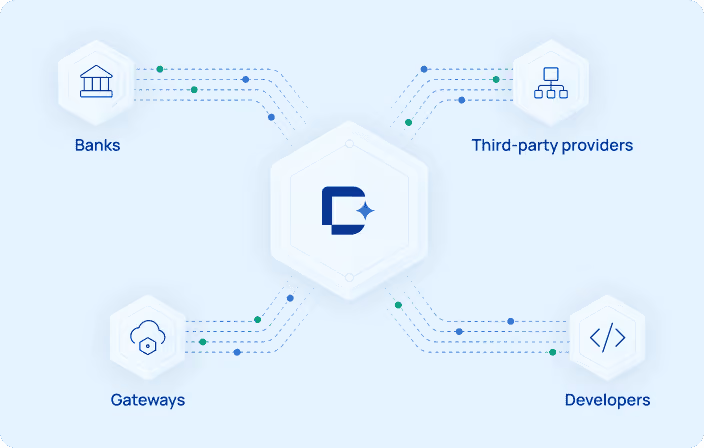
Open Banking primarily focuses on bank accounts and payment services. It mandates that banks open up their customer data, with customer permission, to regulated third-party providers (TPPs) such as fintech companies. This data typically includes account balances, transaction history, and account details. Beyond data sharing, Open Banking also allows TPPs to initiate payments directly from a customer's bank account, again, with their explicit consent.
Regulatory Origins
The driving force behind Open Banking in many regions, particularly the UK and Europe, has been regulatory mandates. The Revised Payment Services Directive (PSD2) in the European Union is a prime example. PSD2 came into force to foster competition, enhance consumer protection, and promote innovation in the payments market. It legally obliged banks to provide secure API access to customer account data and payment initiation services for authorized TPPs. Similar initiatives, though sometimes less prescriptive, have emerged in Australia, Canada, Brazil, and other markets.
Key Features of Open Banking
- API-driven Data Sharing: Secure interfaces for TPPs to access customer account information.
- Payment Initiation Services (PIS): Allowing TPPs to initiate payments on behalf of customers directly from their bank accounts, bypassing traditional card networks.
- Account Information Services (AIS): Enabling TPPs to retrieve and aggregate account information from various banks into a single view.
- Strong Customer Authentication (SCA): Enhanced security measures to protect consumer data and transactions.
- Customer Consent: Central to the entire framework, ensuring individuals retain control over their data.
Benefits of Open Banking
- Enhanced Financial Management: Consumers can use apps that aggregate accounts from different banks, offering a holistic view of their spending and saving.
- Improved Payment Experience: Faster, cheaper, and more secure payment options direct from bank accounts.
- Personalized Products: Fintechs can analyze transaction data to offer tailored loans, budgeting tools, and financial advice.
- Increased Competition: Lower barriers to entry for new players, driving innovation and better services from traditional banks.
- Fraud Reduction: Secure API connections and SCA protocols can enhance payment security.
While Open Banking has undeniably laid a robust foundation for a more interconnected financial world, its scope remains primarily anchored within the traditional banking sphere. This limitation is precisely where Open Finance steps in, pushing the boundaries much further.

What Exactly IS Open Finance?
Open Finance represents the natural evolution and expansion of the principles established by Open Banking. It takes the concept of secure, consent-driven data sharing and extends it beyond bank accounts and payments to encompass virtually every aspect of an individual's financial life.
Definition and Broader Scope
Open Finance envisions a world where consumers can securely share data from all their financial products with authorized third parties. This includes not just current accounts and savings, but also investments (stocks, bonds, mutual funds), pensions, insurance policies (life, health, property), mortgages, credit cards, loans, and even alternative assets. The goal is to provide a comprehensive, 360-degree view of an individual's entire financial portfolio.
Evolution from Open Banking
Open Finance isn't a replacement for Open Banking; rather, it builds upon its successes and infrastructure. Open Banking demonstrated the immense value of secure data sharing and the power of APIs to foster innovation. Open Finance simply applies these proven mechanisms to a much wider array of financial data points, acknowledging that a consumer's financial health is determined by more than just their bank balance.
Key Features of Open Finance
- Holistic Financial View: Aggregation of data from all financial products across different providers.
- Cross-Sector Data Sharing: Enables data flow between banking, insurance, investment, lending, and pension sectors.
- Enhanced Personalization: More comprehensive data allows for highly customized financial advice, product recommendations, and wealth management strategies.
- API-First Approach: Continued reliance on secure APIs to facilitate interoperability and data exchange.
- Broader Consent Management: More sophisticated consent frameworks required to manage data sharing across diverse financial products.
Benefits of Open Finance
- Integrated Financial Management: Tools that can analyze a customer's full financial picture – income, expenses, assets, liabilities – to offer truly personalized insights and advice.
- Improved Financial Inclusion: A wider range of data can help assess creditworthiness for individuals with thin credit files or non-traditional income sources.
- Seamless Product Switching: Easier for consumers to compare and switch providers for mortgages, insurance, or investments based on their entire financial profile.
- Wealth Management Innovation: New platforms can emerge to optimize investment portfolios, retirement planning, and insurance coverage.
- Proactive Financial Health: AI-powered tools can identify potential financial risks or opportunities across a consumer's complete financial life.
The vision of Open Finance is ambitious, promising to unlock unprecedented levels of financial transparency and control for consumers. However, its implementation brings a unique set of challenges, particularly around regulatory harmonization and technical complexity, given the diverse nature of financial products it seeks to encompass.
What's the ONE Key Difference: Open Banking vs. Open Finance?
While both Open Banking and Open Finance are driven by the same foundational principles of secure data sharing and API connectivity, their key differences lie in their scope, regulatory drivers, maturity, and ultimate objectives. Understanding these distinctions is crucial for anyone engaging with the evolving financial landscape.
1. Scope of Data and Services
- Open Banking: Primarily limited to data held by traditional banks concerning current accounts, savings accounts, and payment services. Its focus is on making banking data more accessible and enabling third-party payment initiation.
- Open Finance: Expands this scope exponentially. It includes all financial products and services beyond basic banking, such as investment portfolios, pension funds, insurance policies (life, health, property, auto), mortgages, various forms of credit (personal loans, credit cards), wealth management, and even aspects of financial planning. It aims for a comprehensive view of an individual's entire financial ecosystem.
2. Regulatory Drivers and Mandates
- Open Banking: Largely driven by explicit, legally binding regulations in many regions, such as PSD2 in Europe or specific mandates in the UK and Australia. These regulations often specify the types of data to be shared, the security standards, and the consent mechanisms. This has led to relatively clear implementation guidelines.
- Open Finance: While building on the principles of Open Banking, it is currently less driven by overarching, unified regulatory mandates. Instead, its progression is more organic, stemming from market demand, industry collaboration, and evolving regulatory sandboxes. Regulators are still exploring how best to extend data sharing principles to new sectors, which poses challenges due to the diverse legal frameworks governing different financial products (e.g., insurance vs. pensions vs. investments).
3. Maturity and Implementation
- Open Banking: Is a more mature concept, with many countries having implemented operational frameworks and seen the rise of numerous fintechs leveraging its capabilities. Standards for APIs (e.g., Open Banking UK standards) are well-defined in many markets, leading to clearer pathways for integration.
- Open Finance: Is still in its nascent stages globally. While pilot programs and discussions are underway in various jurisdictions (e.g., the UK's Smart Data Strategy, Australia's Consumer Data Right expansion), a fully unified and interoperable Open Finance ecosystem is years away. The complexity of integrating diverse data types from different sectors means that technical standards and regulatory frameworks are still being developed.
4. Impact and Objectives
- Open Banking: Has fundamentally reshaped the payments landscape and enhanced competition in basic banking services. Its primary objective was to unbundle banking services, empower consumers with their banking data, and stimulate innovation in payment solutions and basic account management.
- Open Finance: Seeks to achieve a far grander objective: to create a truly interconnected financial world where individuals can optimize every aspect of their financial well-being. This includes personalized wealth management, holistic risk assessment for insurance, comprehensive retirement planning, and highly tailored lending solutions. Its impact will extend far beyond payments to touch every corner of personal and business finance.
In essence, Open Banking is a specific, regulated framework for sharing bank account data and payment services, whereas Open Finance is an overarching vision for comprehensive, consent-driven data sharing across the entire financial services industry. Open Banking is a crucial stepping stone, demonstrating the feasibility and benefits that Open Finance aims to multiply across the broader financial spectrum.
Who Cares About Open Banking vs Open Finance Differences?
The distinction between Open Banking and Open Finance is more than semantic; it carries significant implications for various stakeholders within the financial ecosystem. Understanding where these two concepts diverge helps in strategic planning, innovation, and navigating the future regulatory landscape.
For Consumers: Empowerment and Expectations
For individuals, the difference matters for managing expectations and understanding the true extent of their data control. Open Banking offers insights into their banking habits; Open Finance promises a holistic mirror of their entire financial life. Knowing this distinction helps consumers:
- Understand Data Sharing Boundaries: Clearly comprehend which data points (e.g., bank transactions vs. pension contributions) are potentially shareable under current frameworks.
- Leverage Broader Tools: Anticipate and demand services that go beyond basic budgeting to encompass wealth management, insurance optimization, and retirement planning.
- Assess Personal Financial Health: Gain unparalleled insights into their complete financial picture, enabling better decision-making across all financial products.
For Businesses: Strategic Planning and Innovation
For financial institutions, fintechs, and third-party providers, the difference between Open Banking and Open Finance dictates strategic investments and innovation pathways:
- Scope of Opportunity: Fintechs currently leveraging Open Banking can identify future expansion opportunities into insurance, investment, or lending data under Open Finance.
- Investment in Infrastructure: Financial institutions need to plan for infrastructure that can handle diverse data types and API standards beyond those specific to banking.
- Product Development Roadmaps: Open Finance enables the creation of truly integrated financial super-apps and personalized advisory services that transcend traditional product silos.
- Competitive Positioning: Early movers in Open Finance will gain a significant competitive advantage by offering more comprehensive and valuable services.
For Regulators: Balancing Innovation and Protection
Regulators face a complex challenge in expanding from Open Banking to Open Finance. The difference impacts their approach to:
- Harmonization: Creating consistent data-sharing standards and consent models across diverse financial sectors, each with its own regulatory history and data sensitivities.
- Consumer Protection: Ensuring robust data privacy, security, and dispute resolution mechanisms as data sharing becomes more pervasive and complex.
- Market Development: Fostering innovation while preventing anti-competitive practices or the creation of new systemic risks.
Ultimately, the distinction highlights the progression from a segment-specific revolution (banking) to a cross-sector transformation (finance). It signals where the immediate opportunities lie and where the future potential of truly integrated financial services awaits.
How Do You Move from Open Banking to Open Finance?
The transition from Open Banking to Open Finance is not a sudden leap but rather a logical, incremental journey. Open Banking has served as an invaluable proof of concept, demonstrating the feasibility and benefits of data sharing, and laying the groundwork for a more expansive vision.
1. Open Banking as a Stepping Stone
Open Banking's mandatory nature in many jurisdictions provided the necessary push for traditional banks to adopt APIs and embrace data portability. This forced collaboration between banks and fintechs, leading to:
- Established Technical Standards: Development of common API specifications and security protocols.
- Consumer Education: Increased awareness and, gradually, trust in sharing financial data with third parties.
- Regulatory Precedent: A framework for data governance, consent management, and dispute resolution.
- Innovation Catalyst: A fertile ground for new applications in budgeting, lending, and payment processing.
Without these foundational achievements, the broader ambition of Open Finance would be significantly harder to realize.
2. The Natural Progression of Data Sharing
As consumers grew accustomed to the conveniences offered by Open Banking applications (e.g., aggregated bank account views), the demand for similar functionalities across their entire financial portfolio became evident. Why should a budgeting app only show bank transactions when investments, pensions, and insurance also heavily influence financial health? This consumer-driven demand, coupled with the proven success of Open Banking, provides the impetus for the industry and regulators to consider the next logical step.
3. Future Outlook and Convergence
The future undoubtedly points towards a convergence where the lines between banking, insurance, investment, and lending become increasingly blurred by seamless data flows. This doesn't mean the abolition of distinct financial institutions, but rather a more interconnected ecosystem where data from all these entities can be harmonized and utilized, with consent, to provide unparalleled insights and services.
Several countries are already progressing towards Open Finance through various initiatives:
- Australia's Consumer Data Right (CDR): Initially applied to banking, it is now expanding to energy and will eventually include superannuation (pensions) and insurance, demonstrating a clear Open Finance trajectory.
- UK's Smart Data Strategy: While broader than just finance, it includes a focus on extending data sharing principles to sectors like pensions and insurance, building on the success of Open Banking.
- Global Discussions: Regulatory bodies and industry consortia worldwide are actively exploring frameworks for broader financial data sharing, recognizing the competitive and consumer benefits.
The journey is complex, requiring careful consideration of data privacy, security, and regulatory arbitrage across different sectors. However, the momentum is clear: Open Banking was just the beginning of a profound transformation towards a fully integrated Open Finance ecosystem.
What Revenue Does Open Finance Unlock vs Open Banking?
The expansion from Open Banking to Open Finance promises to unlock a new generation of financial services, delivering benefits that extend far beyond what is currently possible. These advantages impact individuals, businesses, and the broader economy, fostering a more transparent, efficient, and inclusive financial system.
1. Enhanced Personalization and Integrated Financial Advice
With access to a comprehensive view of a customer's entire financial life – including income, spending, savings, investments, pensions, and liabilities – financial service providers can offer truly bespoke advice and products. This goes beyond generic recommendations to hyper-personalized strategies for wealth accumulation, debt management, retirement planning, and insurance coverage, all tailored to an individual's unique circumstances and goals.
2. Improved Financial Inclusion and Access to Credit
Open Finance can significantly benefit underserved populations. By allowing lenders to access a wider array of financial data points (e.g., rental payments, utility bills, savings patterns across different accounts, not just current accounts), they can build more accurate credit profiles for individuals with limited or no traditional credit history. This can unlock access to affordable credit, mortgages, and other financial products for millions who are currently excluded.
3. Streamlined Financial Management and Administration
Imagine a single dashboard that not only shows your bank balances but also your investment portfolio performance, pension projections, and insurance policy details. Open Finance enables platforms that aggregate all this information, simplifying financial tracking, tax preparation, and estate planning. It reduces the administrative burden of managing multiple accounts and policies across different providers.
4. Accelerated Innovation and New Product Development
By opening up more diverse data sets, Open Finance provides fertile ground for fintechs and incumbent institutions to innovate. We can expect to see new categories of financial applications emerge, such as:
- AI-powered wealth managers that dynamically rebalance portfolios based on real-time life events.
- Personalized insurance products that adapt to changing lifestyle and risk profiles.
- Subscription management services that identify and cancel unused subscriptions across all payment methods.
- Integrated financial wellness platforms that link physical health data with financial incentives.
5. Greater Competition and Consumer Choice
The ability to easily port and compare financial data across different providers will intensify competition across all financial sectors. This forces institutions to offer better products, more competitive pricing, and superior customer service. Consumers will benefit from more options, lower fees, and a greater ability to switch providers effortlessly for every financial product they hold.
6. Better Risk Management and Fraud Detection
A consolidated view of financial data allows for more sophisticated risk assessment and fraud detection models. By analyzing patterns across different accounts and product types, institutions can identify suspicious activities more effectively, leading to enhanced security for consumers and reduced losses for providers.
The journey to Open Finance is complex, but the potential rewards – a more efficient, inclusive, and customer-centric financial world – are immense.
What Challenges Come With Open Finance Expansion?
While the vision of Open Finance offers immense potential, its implementation comes with significant challenges that must be carefully addressed. Moving beyond the relatively contained environment of Open Banking to a broad financial ecosystem introduces complexities that require robust solutions.
1. Data Privacy and Security Concerns
As the volume and sensitivity of shared data increase, so do concerns about privacy and security. A breach in an Open Finance ecosystem could expose a customer's entire financial life, from bank balances to investment strategies and health insurance details. Key considerations include:
- Robust Encryption: Ensuring all data in transit and at rest is securely encrypted.
- Advanced Access Controls: Implementing granular permissions and strong authentication for TPPs.
- Minimizing Data Collection: Adhering to the principle of collecting only necessary data.
- Consumer Control: Providing clear, easy-to-use mechanisms for granting, revoking, and managing consent.
2. Regulatory Harmonization and Fragmentation
One of the biggest hurdles is the fragmented regulatory landscape across different financial sectors. Banking, insurance, pensions, and investments are often governed by distinct laws and supervisory bodies. Extending Open Banking principles to Open Finance requires:
- Cross-Sectoral Cooperation: Regulators from different domains must collaborate to create consistent rules.
- Standardization: Developing common technical standards and API specifications for diverse financial products.
- International Alignment: Avoiding a patchwork of country-specific Open Finance regulations that could hinder global innovation.
3. Consumer Trust and Education
Despite the benefits, many consumers remain wary of sharing their financial data. The expansion to Open Finance necessitates a renewed focus on:
- Transparency: Clearly explaining what data is being shared, with whom, and for what purpose.
- Education: Informing consumers about the benefits and risks in an accessible manner.
- Empowerment: Ensuring consumers feel in control of their data and can easily manage permissions.
4. Technical Interoperability and Legacy Systems
Integrating data from a wide array of financial institutions, many of which operate on older legacy systems, presents a significant technical challenge. Ensuring seamless and reliable data exchange requires:
- Robust API Infrastructure: Building and maintaining high-performance, secure APIs across all providers.
- Data Normalization: Developing mechanisms to standardize disparate data formats and definitions from various sources.
- Scalability: Designing systems capable of handling the massive increase in data volume and API calls.
5. Commercial Incentives and Business Models
For Open Finance to truly flourish, there needs to be a clear business case for all participants. Financial institutions must see the value in opening up their data, and TPPs need sustainable revenue models. This involves addressing:
- Data Monetization: Fair and transparent models for data sharing that benefit all parties.
- Ecosystem Development: Fostering collaborative environments where new services can thrive.
- Competition vs. Collaboration: Balancing the need for healthy competition with the necessity of industry-wide cooperation for common standards.
Navigating these challenges will be critical to realizing the full potential of Open Finance, ensuring it becomes a force for good that benefits consumers and drives sustainable innovation across the entire financial services industry.
Conclusion
The journey from Open Banking to Open Finance represents an inexorable march towards a more interconnected and data-driven financial future. While Open Banking has skillfully unbundled traditional banking services, enabling greater competition and consumer control over bank accounts and payments, Open Finance envisions a far more expansive world. It aims to integrate every facet of an individual's financial life from investments and pensions to insurance and credit, into a seamless, consent-driven ecosystem.
The key difference lies in scope: specific to banking versus encompassing the entire financial spectrum. Open Banking is a foundational, regulatory-driven success story, providing the blueprint for secure API connectivity. Open Finance is the ambitious next chapter, driven by market demand for holistic financial management and evolving regulatory thought. While challenges remain in areas like regulatory harmonization, data security, and consumer trust, the benefits of enhanced personalization, financial inclusion, and unparalleled innovation are too compelling to ignore.
For consumers, Open Finance promises unprecedented control and clarity over their financial health. For businesses, it opens new frontiers for product development and competitive advantage. For regulators, it presents the critical task of balancing innovation with robust protection. Understanding these distinctions is not just academic; it's essential for anyone seeking to navigate, innovate, or simply thrive in the rapidly evolving landscape of financial services.
Testing & implementation tip: As open banking and open finance initiatives move from theory to real-world integrations, many development and product teams begin with an open banking API sandbox to safely prototype API workflows, validate consent and data flows, and uncover issues before launching into production.
FAQs
1. What is Open Banking?
Open Banking is a regulated framework that allows customers to securely share their bank account data (e.g., balances, transactions) and initiate payments through authorized third-party providers (TPPs) via APIs. Its primary focus is on current accounts, savings, and payment services, often driven by regulations like PSD2 in Europe.
2. What is Open Finance?
Open Finance is a broader concept that extends the principles of Open Banking to cover all financial products and services. This includes investments, pensions, insurance, mortgages, loans, and credit cards. It aims to provide a holistic view of an individual's entire financial life by enabling secure, consent-driven data sharing across these diverse sectors.
3. How are Open Banking and Open Finance different?
The main difference is scope. Open Banking is limited to bank accounts and payment services, while Open Finance encompasses the entire financial ecosystem, including investments, pensions, and insurance. Open Banking is more mature and often mandated by specific regulations; Open Finance is still evolving with broader market and regulatory discussions.
4. Why is Open Finance important?
Open Finance is important because it moves beyond a fragmented view of finances to offer a holistic, integrated perspective. It can lead to highly personalized financial advice, improved financial inclusion for underserved populations, streamlined financial management, and a new wave of innovative products and services across all financial sectors, ultimately empowering consumers with greater control and choice.
5. What are the benefits of Open Finance?
Key benefits include enhanced personalization of financial products and advice, improved financial inclusion by broadening credit assessment, streamlined financial management through aggregated data, accelerated innovation for new financial services, increased competition leading to better consumer choice, and more robust risk management and fraud detection across an individual's entire financial portfolio.
Dhayalan Subramanian is Associate Director, Product Growth at DigitalAPI, where he leads go-to-market and product growth for the company’s multi-gateway API management platform. His work focuses on helping large enterprises and mid-market cloud companies consolidate APIs across AWS, Azure, Apigee, Kong, MuleSoft, and other gateways into a single control plane for governance, discovery, monetization, and agent consumption.
Dhayalan brings 14+ years of experience across product strategy, enterprise architecture, and engineering leadership. Earlier in his career, he held senior roles at Encora (as Associate Architect and Technical Manager), Mindtree (Technology Lead), Tech Mahindra (Technical Lead), and Primus Analytics, where he designed integration frameworks and delivered enterprise-grade digital platforms for global customers.
At DigitalAPI, he works directly with platform, integration, and developer experience leaders at Fortune 500 organizations to operationalize unified API catalogs, developer portals, and MCP-ready APIs. He writes regularly on API developer experience, API governance, and AI agent architectures.

One email a fortnight. Worth opening.
A short digest of what we're writing, what we're learning from customers, and the handful of links you'd actually want from us. No tracking pixels.

.avif)