

Why Hardcoded API Calls Break Your AI Agents
Hardcoded API calls break AI agents every time an API changes, a key rotates or a new API ships. See the 8 failure modes and a 7-step path to dynamic tool discovery.

Hardcoded API calls break AI agents because the endpoints, schemas and credentials are fixed in the agent's code or prompt. Any API change, new endpoint, key rotation or permission change then means someone has to edit and redeploy the agent. Until they do, the agent fails, or worse, keeps running and gets things wrong.
Most agents start this way because it's the fastest route to a demo. It also reflects how few APIs are built for agents today. Postman's 2025 State of the API found that 89% of developers use AI, but only 24% design APIs with AI agents in mind. When APIs aren't built for agents, teams wire them in by hand.
This guide covers what hardcoding looks like, why teams do it, the eight ways it breaks, what it costs, how it differs from function calling, and a seven-step path to dynamic tools.
TL;DR
• What it is: endpoint URLs, payload shapes, tool definitions or API keys written directly into an agent's prompt, code or workflow.
• Why it breaks: schema drift, version changes, invisible new APIs, key rotation, shared identity, tool bloat, environment drift and duplicated code.
• The fix: dynamic tool discovery. The agent reads tools from an MCP server or catalog at runtime, and credentials live at the gateway.
• When it's fine: prototypes and a single stable, read-only API.
What is a hardcoded API call in an AI agent?
A hardcoded API call is an API endpoint, request format or credential written directly into an agent's prompt, code or workflow instead of being looked up at runtime. The agent only knows the APIs someone typed in, exactly as they looked on the day they were typed.
[fs-toc-omit]The 4 ways agents get hardcoded
- Endpoints in the prompt: the system prompt says "to check an order, call GET https://api.example.com/v1/orders/{id}."
- Fixed tool definitions in code: a list of function schemas is written into the agent's source and shipped with it.
- Keys in the agent: API keys sit in an environment file, a prompt, a config file or a skill script.
- Fixed method lists in low-code agents: an n8n or Zapier agent node is set up with a set list of API methods.
[fs-toc-omit]What does it look like in code?
Every line that matters here is frozen: the version, the URL, the schema, the description and the key.
Why do teams hardcode API calls in the first place?
Teams hardcode API calls because it's the fastest way to get an agent working, and most tutorials teach it that way. For a demo with one or two stable APIs, it's a reasonable choice.
Three forces push teams toward it:
- Speed: a working agent in an afternoon beats a platform project.
- Tutorials: most function-calling examples define tools inline with a key in an environment variable.
- Missing infrastructure: without an API catalog or MCP server, there's nothing to look tools up from.
The trouble starts when the demo becomes a product, the second agent arrives, or the API team ships its next version.
Why do hardcoded API calls break AI agents?
Hardcoded API calls break AI agents because APIs, keys and permissions keep changing while the agent's copy of them stays frozen. There are eight common failure modes.
[fs-toc-omit]Schema drift
A field is renamed from total to amount_total. What you see: the agent sends bad payloads and gets errors, or reads responses without any error and reports the wrong number.
[fs-toc-omit]Version changes
The API team deprecates v1 and retires it on schedule. What you see: the agent fails overnight on every call to that API. Our guide to API versioning and deprecation explains why retirements are routine, not rare.
[fs-toc-omit]New APIs the agent can't see
Another team ships a shipments API that would answer half your support questions. What you see: nothing. The agent never learns it exists and keeps telling customers it can't help.
[fs-toc-omit]Credential rotation
Security rotates the key, as policy requires. What you see: every agent that holds the old key fails until someone updates and redeploys each one. See our roundup of API key management tools for why rotation should be routine.
[fs-toc-omit]One shared identity
Every agent and every user acts with the same baked-in key. What you see: a junior support agent's assistant can do what an admin can, and the API logs can't tell you who asked for what.
[fs-toc-omit]Tool-list bloat
Each new API adds another tool definition to the context. Anthropic reports 58 tools from five servers taking about 55,000 tokens before a conversation starts, and says the most common failures are wrong tool selection and wrong parameters. What you see: slower, more expensive runs and more wrong calls.
[fs-toc-omit]Environment drift
A sandbox URL ships to production, or a production key lands in a test agent. What you see: test data in live systems, or live data in test logs.
[fs-toc-omit]Duplicated tool code across agents
Ten agents each carry their own copy of the same orders integration. What you see: a fix lands in one agent and the other nine keep the bug.
What does a hardcoded-API failure look like in production?
In production, hardcoded-API failures show up as wrong answers, duplicate actions or sudden outages, often with no error anyone notices. Three short scenarios show the pattern.
- The silent wrong answer: the billing API renames a field. The agent's hardcoded parser reads an empty value as zero and tells 300 customers they owe nothing. No error fires.
- The double refund: the agent's hardcoded refund call has no idempotency key. A network timeout triggers a retry, and the customer is refunded twice.
- The Friday lockout: a scheduled key rotation runs at 6pm on Friday. Every support agent fails until Monday, when someone finds which config files held the key.
What do hardcoded API calls cost you?
Hardcoded API calls cost you in redeploys, broken runs, duplicated engineering work and security exposure, and the cost grows with every agent and every API you add.
A maritime connectivity provider shows how this plays out. Its n8n agent has three API methods predefined. The team wants that list to be dynamic, with method metadata coming from the platform, so they don't have to re-teach the agent each time. Teams in that spot often start by pulling every API into one catalog with DigitalAPI, so the agent has a single source to read from.
Count your own exposure with one line: agents × hardcoded endpoints × API changes per quarter. Five agents with 12 endpoints each, against APIs that change three times a quarter, is 180 places something can break every quarter.
Is function calling the same as hardcoding?
No. Function calling is the mechanism an agent uses to call a tool, and hardcoding is about where the tool's definition comes from. You can use function calling with hardcoded definitions or with definitions fetched at runtime.
Here's the same tool, fetched instead of typed in:
Function calling isn't the problem. Frozen definitions and keys are. For the full comparison, see MCP vs function calling.
Hardcoded vs dynamic tool discovery: what's the difference?
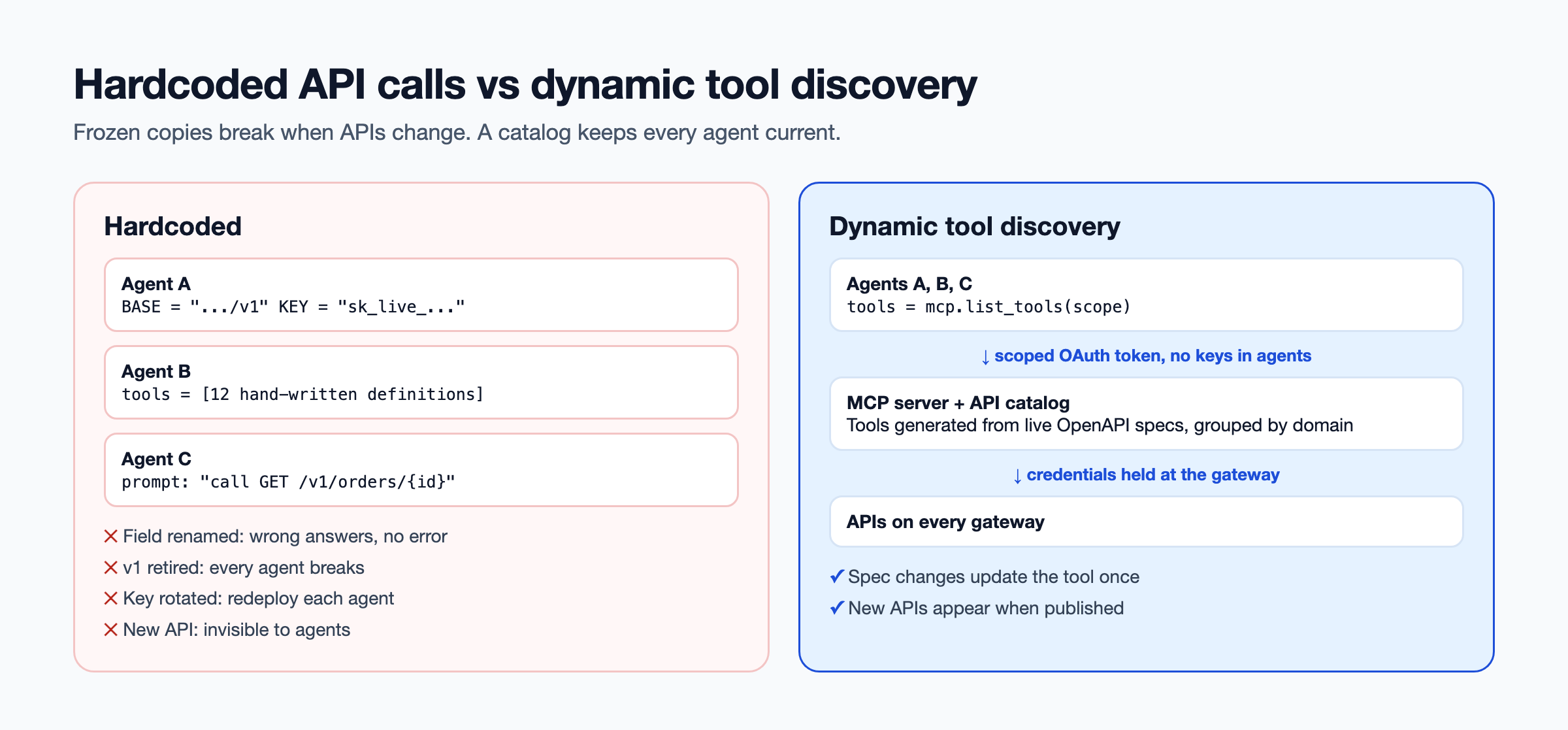
With hardcoded tools the agent carries a fixed copy of each API; with dynamic tool discovery the agent asks a server or catalog for the current tools each time it runs.
[fs-toc-omit]How does dynamic discovery work?
The agent's client calls tools/list on an MCP server and gets the current tool definitions. When tools change, the server sends a notifications/tools/list_changed message and the client fetches the list again. With large catalogs, a tool-search step shortlists the relevant tools first, so the agent never loads hundreds of definitions. Our MCP tools guide covers the mechanics.
How do you move from hardcoded calls to dynamic tools?
Move to dynamic tools in seven steps: inventory the calls, fix the specs, generate tools, serve them through MCP, move auth to the gateway, publish an approved catalog, and delete the hardcoded copies.
- Inventory every hardcoded call: search agent code, prompts, configs and low-code workflows for URLs and keys.
- Check each API has an accurate OpenAPI spec: the spec becomes the source of truth for the tool.
- Generate tools from the specs: don't hand-write them. See how to convert OpenAPI specs into an MCP server.
- Serve them through MCP: agents connect to the server instead of carrying tools.
- Move credentials to the gateway: agents get scoped OAuth tokens and never hold raw keys.
- Publish an approved catalog: keep an MCP registry of tools each agent may use.
- Remove the hardcoded copies and test: delete inline definitions, rotate the old keys, and test the agent against a schema change.
Before and after, in one view:
When is hardcoding still fine?
Hardcoding is fine for prototypes, a single stable read-only API, or a one-team tool that nobody else depends on. It stops being fine at predictable trigger points.
Keep it hardcoded if:
- You're proving an idea, not shipping a product.
- The agent reads from one internal API that rarely changes.
- No write actions or customer data are involved.
Switch to dynamic tools when any of these happens:
- A third API joins the agent.
- A second agent needs the same API.
- The agent gets a write action.
- The agent touches regulated or customer data.
- A key rotation or API version change has already broken it once.
For the wider picture, see the common pitfalls of AI agents consuming APIs.
How does a federated API catalog replace hardcoded agent calls?
A federated API catalog replaces hardcoded calls by giving every agent one current source of tools, built from the real specs of every API across every gateway. When an API changes, the catalog and the tools change with it.
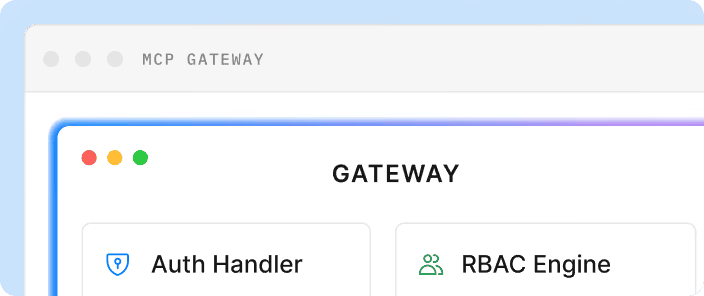
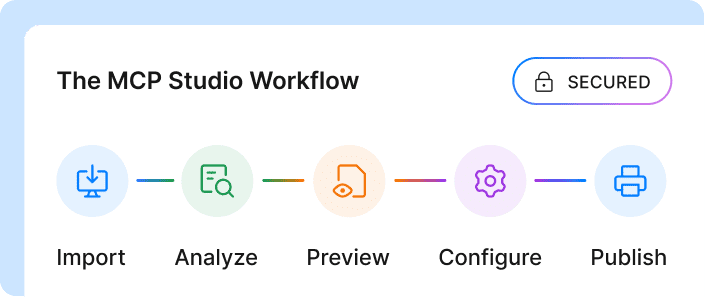
Teams using DigitalAPI connect their existing gateways, such as Apigee, Kong, AWS and Azure API Management, into one catalog. MCP Studio then generates MCP tools from those specs, grouped by domain and tagged as read, write or sensitive. Agents discover tools at runtime, and DigitalAPI enforces OAuth 2.1, API keys or mTLS at the gateway with deny-by-default scopes, so no key ever sits inside an agent.
For the step-by-step connection pattern, see how to connect AI agents to internal APIs.
FAQs
[fs-toc-omit]What is a hardcoded API call?
A hardcoded API call is an API endpoint, request format or credential written directly into code, a prompt or a workflow instead of being looked up at runtime. In AI agents, it means the agent only knows the APIs a developer typed in, in the form they had on that day.
[fs-toc-omit]Is function calling the same as hardcoding?
No. Function calling is how an AI model asks to run a tool. Hardcoding is about where that tool's definition comes from. Function calling works with tool definitions fetched at runtime from an MCP server or catalog, which avoids the problems hardcoding causes.
[fs-toc-omit]Can an AI agent discover APIs on its own?
Yes, if the APIs are exposed through a discovery layer. With MCP, an agent calls tools/list to get current tool definitions and is notified when the list changes. Paired with an API catalog, agents can find new APIs as soon as they're published, without a code change.
[fs-toc-omit]How do I stop API keys leaking into prompts?
Keep keys out of the agent entirely. Put credentials at the gateway or MCP server, and give each agent a scoped OAuth token instead. Then rotate any keys that were ever in prompts, code or config files, and scan agent repositories for secrets.
[fs-toc-omit]What happens to my agent when an API changes?
With hardcoded calls, the agent breaks or returns wrong results until someone updates and redeploys it. With dynamic tools generated from the API's spec, the tool definition updates centrally, and every agent picks up the change the next time it lists its tools.
[fs-toc-omit]Does MCP fix hardcoded API calls?
MCP fixes the discovery and credential parts, because agents fetch tools at runtime and never hold raw keys. It doesn't fix bad specs. If the API's OpenAPI spec is wrong or vague, the generated tools will be too, so accurate specs are part of the fix.
[fs-toc-omit]How many tools can an agent handle before accuracy drops?
There's no fixed number, but accuracy and cost both worsen as tool lists grow. Anthropic reports 58 tools taking about 55,000 tokens of context, and recommends tool search once definitions pass about 10,000 tokens or 10 tools. Scoping tools per agent keeps lists short.
Final word
Hardcoding isn't a mistake on day one. It becomes one on the day the second agent, the third API or the first key rotation arrives, and in most companies that day comes fast.
Run the count from the cost section: agents × hardcoded endpoints × API changes per quarter. If the number is bigger than your team can track by hand, it's time to give your agents a catalog instead of a copy.
Tired of re-teaching agents every time an API changes?
See how DigitalAPI lets agents discover every API at runtime.
Dhayalan Subramanian is Associate Director, Product Growth at DigitalAPI, where he leads go-to-market and product growth for the company’s multi-gateway API management platform. His work focuses on helping large enterprises and mid-market cloud companies consolidate APIs across AWS, Azure, Apigee, Kong, MuleSoft, and other gateways into a single control plane for governance, discovery, monetization, and agent consumption.
Dhayalan brings 14+ years of experience across product strategy, enterprise architecture, and engineering leadership. Earlier in his career, he held senior roles at Encora (as Associate Architect and Technical Manager), Mindtree (Technology Lead), Tech Mahindra (Technical Lead), and Primus Analytics, where he designed integration frameworks and delivered enterprise-grade digital platforms for global customers.
At DigitalAPI, he works directly with platform, integration, and developer experience leaders at Fortune 500 organizations to operationalize unified API catalogs, developer portals, and MCP-ready APIs. He writes regularly on API developer experience, API governance, and AI agent architectures.
One email a fortnight. Worth opening.
A short digest of what we're writing, what we're learning from customers, and the handful of links you'd actually want from us. No tracking pixels.