

Control Plane vs Data Plane: What's the Difference in API Management?
The control plane decides and the data plane does. Learn how they differ in networking, Kubernetes, cloud and API management, and why separating them matters.

The control plane decides how a system should behave, and the data plane does the work of handling live traffic. In networking, the control plane builds routing tables and the data plane forwards packets. In API management, the control plane holds the catalog, policies, keys and developer portal, while API gateways in the data plane process every API call.
The short version: the control plane decides, the data plane does. Keeping them separate lets traffic keep flowing when the control plane is down, lets each side scale on its own and lets one control plane manage gateways in many clouds.
This guide covers what each plane does, how they differ in networking, Kubernetes, cloud and API management, where the management plane fits, and how to choose a deployment model.
TL;DR
The control plane is configuration and decision-making: it changes rarely and can tolerate some delay.
The data plane is runtime: it handles every request and must stay fast and available.
In API management, put policies, catalog, portal and analytics in the control plane and keep gateways in the data plane, close to your backends.
If you run several gateways, one control plane over all of them gives you one place to govern APIs without moving traffic.
What is the control plane?
The control plane is defined as the part of a system that decides how traffic and resources should be handled and pushes those decisions to the components that do the work. It holds configuration, policies and state, and it changes when an operator or an automated process changes something.
AWS describes control planes as the administrative and configuration APIs used to create, read, update, delete and list resources, in its Fault Isolation Boundaries whitepaper. Launching a virtual machine or creating a storage bucket is a control plane action.
Typical control plane jobs:
- Routing decisions: Running routing protocols such as BGP or OSPF and building routing tables.
- Configuration: Storing the desired state of a system and applying changes.
- Policy: Defining who can access what, and with which limits.
- Administrative APIs: Handling requests to create, update or delete resources.
What is the data plane?
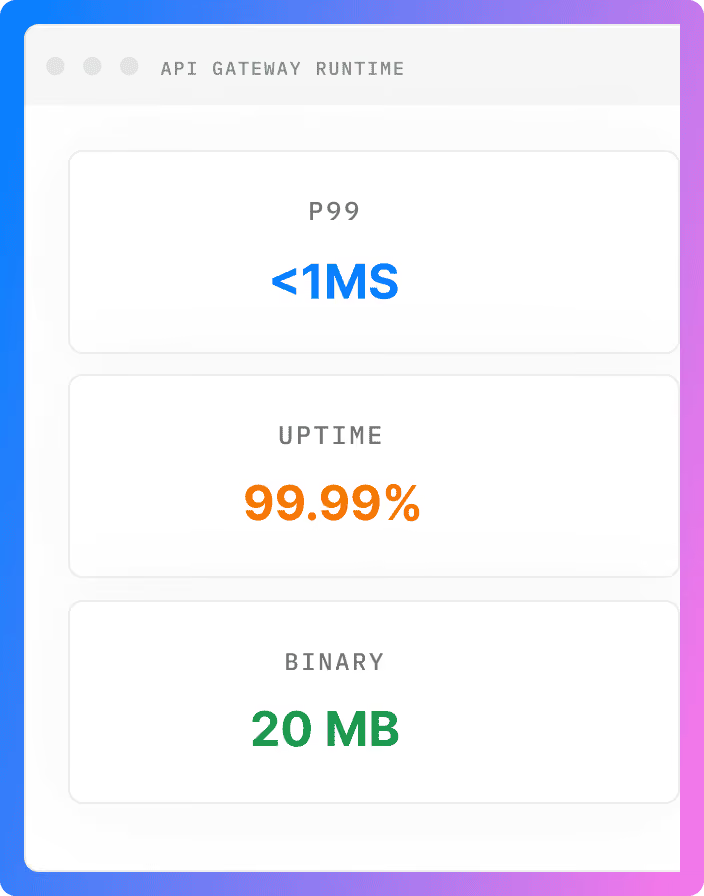
The data plane is defined as the part of a system that carries out the control plane's decisions on live traffic, such as forwarding packets or serving API requests. It handles every request, so it must be fast, simple and highly available.
In the same whitepaper, AWS defines the data plane as what provides the primary function of a service. A running virtual machine, reading and writing a disk volume, or answering DNS queries is the data plane at work. AWS keeps data planes simpler on purpose, with fewer dependencies, which makes them more reliable.
Typical data plane jobs:
- Forwarding: Moving packets or requests to the right destination.
- Enforcement: Applying the authentication, rate limits and rules the control plane set.
- Processing: Running workloads, reading and writing data, transforming payloads.
- Telemetry: Emitting logs and metrics about each request.
What is the difference between the control plane and data plane?
The control plane decides and configures, while the data plane executes on every request. The control plane is busy when something changes. The data plane is busy all the time.
The most important row is failure. A well-designed data plane keeps working with the last configuration it received, even when the control plane is unavailable. AWS calls this static stability.
What is the management plane?
The management plane is the layer operators and tools use to configure and monitor the system; it sits above the control plane. Some models fold it into the control plane, which is why definitions vary.
In API management, the line between management and control planes is thin. The console where you publish an API (management) and the service that pushes the policy to gateways (control) usually ship as one product, so most vendors call both the control plane.
How do control and data planes work in different systems?
The control and data plane split appears in networking, Kubernetes, cloud services and service meshes, with the same idea in each: decisions in one place, execution in another. The names of the components change, the pattern doesn't.
Networking
In a router, the control plane runs routing protocols, learns routes and builds the routing table. The data plane forwards each packet using that table, often in dedicated hardware. Software-defined networking (SDN) moves the control plane to a central controller that programs many switches.
Kubernetes
Yes, Kubernetes has a control plane. According to the Kubernetes documentation, it runs the kube-apiserver, etcd, the scheduler and the controller manager, which store the cluster's desired state and decide where pods run. The worker nodes are the data plane: the kubelet, kube-proxy and container runtime run the pods that serve traffic.
Cloud services
Cloud providers split every service. Creating a storage bucket goes through the control plane. Reading and writing objects goes through the data plane. In Azure, for example, Azure Resource Manager handles control plane operations, while each service's own endpoints handle data plane operations.
Service mesh
In a service mesh, a central controller holds routing and security configuration and sends it to sidecar or node proxies. The proxies are the data plane: they handle every service-to-service call. Our guide to API gateways vs service meshes covers where each fits.
What are the control plane and data plane in API management?
In API management, the control plane is where you define, publish and govern APIs, and the data plane is the API gateway that enforces those rules on every call. The control plane never needs to see a request. The gateway sees every one.
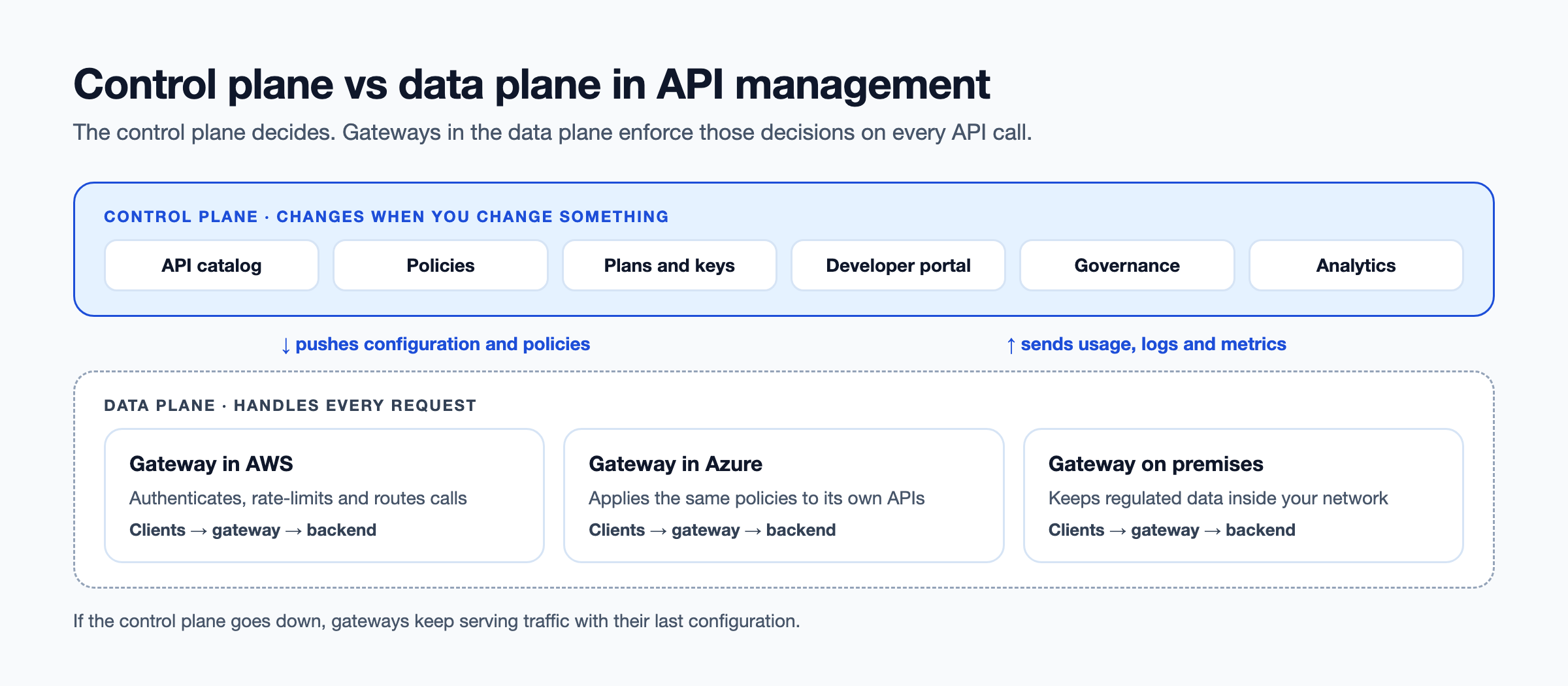
The gateway works from the configuration the control plane gave it. If you publish a new rate limit, the control plane pushes it and the gateway enforces it from the next request. Our guide to API gateways vs API management explains the wider difference.
Is an API gateway a control plane or a data plane?
An API gateway is a data plane component. It processes live API traffic. Most gateway products ship with a console or admin API that acts as their control plane, which is why the two are easy to confuse.
Why separate the control plane from the data plane?
You separate the control plane from the data plane so that traffic keeps flowing when management fails, each side scales on its own, and sensitive data stays where it must. Each reason solves a real operational problem.
- Reliability: If the control plane goes down or is being upgraded, gateways keep serving traffic with their last known configuration.
- Independent scaling: Add gateway capacity for traffic spikes without scaling the management layer.
- Security and data residency: Run gateways inside your own network or region, so request data never leaves it, while management runs anywhere.
- Smaller blast radius: A bad configuration change can be caught before rollout, and a gateway failure doesn't touch the catalog or portal.
- Multi-gateway management: One control plane can configure many data planes, including gateways in different clouds.
What are the deployment models for API control and data planes?
API platforms use four deployment models: fully managed SaaS, hybrid, fully self-hosted and multi-gateway. The right one depends on where your data must stay and how many gateways you already run.
The hybrid model is the most common choice for enterprises, because it keeps request data local without making teams run a management stack. Platforms such as DigitalAPI support all four, including air-gapped on-premises installs.
Can one control plane manage data planes from different vendors?
Yes, one control plane can manage gateways from different vendors; this is called gateway federation. The control plane connects to each gateway, syncs its APIs and policies, and presents them as one catalog and one portal.
This matters because few enterprises run a single gateway. Our guide to why enterprises end up with multiple API gateways covers how it happens. A pattern we see often: a luxury travel brand had point-to-point integrations, an AWS gateway and some MuleSoft. It wanted one control plane across all of them, and no product it looked at offered that in one step.
Federation has limits. Policies are still enforced by each gateway, so a control plane can only apply what each gateway supports. Our guide to federated API management covers how it works in practice.
What does a federated control plane look like in practice?
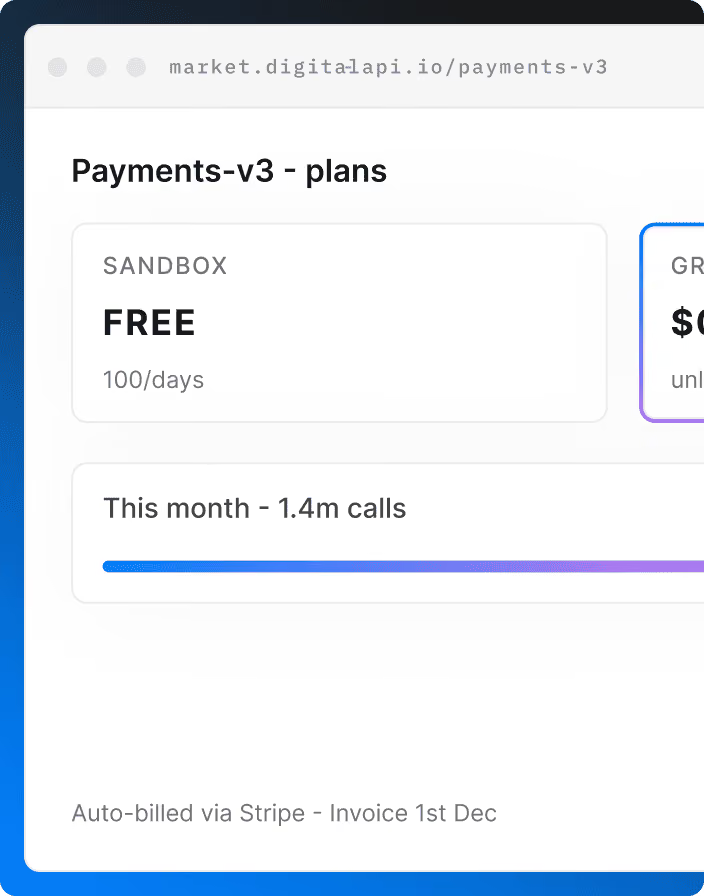
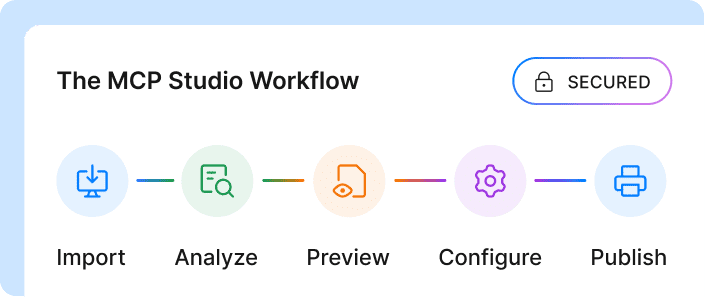
In a federated setup, the API marketplace is the control plane. DigitalAPI's API marketplace holds the catalog, governance, products and plans, subscriptions, the developer portal and analytics, and it sits outside the request path, except when you choose proxy mode for real-time monetization. The data plane is its own API gateway or the gateways you already run, such as Apigee, Kong, AWS API Gateway, Azure API Management and IBM.
Teams using DigitalAPI keep traffic on the gateways that already run it and govern every API from one place, deployed as SaaS, in a private cloud or on premises. The API marketplace page shows the architecture.
What is an AI control plane?
An AI control plane applies the same split to AI agents and models: one layer defines which agents can use which tools and models, and a gateway enforces it on every call. It's the newest use of the pattern.
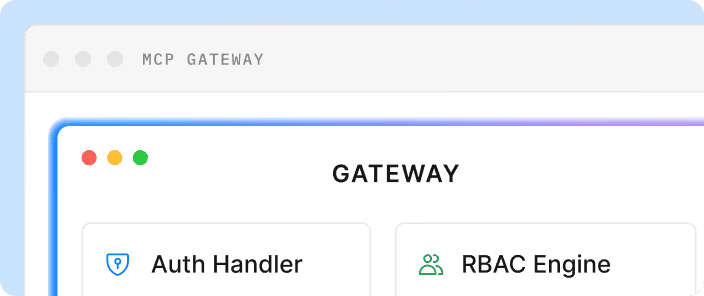
For AI agents, the control plane holds the registry of approved MCP servers and tools, per-agent permissions and budgets. The data plane is the MCP gateway or AI gateway that checks each tool call or model request against those rules and logs it. Our guides to MCP gateway architecture and AI gateways vs MCP gateways vs API gateways go deeper.
FAQs
1. What is a control plane vs data plane?
The control plane decides how a system handles traffic and resources, such as building routing tables or defining API policies. The data plane carries out those decisions on live traffic, such as forwarding packets or processing API requests. The control plane changes configuration; the data plane handles every request.
2. Is Kubernetes a control plane?
Kubernetes has a control plane, made up of the kube-apiserver, etcd, the scheduler and the controller manager. It stores the cluster's desired state and decides where workloads run. The worker nodes, with the kubelet, kube-proxy and container runtime, are the data plane that runs the pods.
3. What is a management plane?
The management plane is the layer that operators and tools use to configure and monitor a system, such as a web console, CLI or admin API. It sits above the control plane. Many products combine the management and control planes and call both the control plane.
4. What happens if the control plane goes down?
In a well-designed system, the data plane keeps running with its last known configuration when the control plane goes down. Existing traffic continues, but you can't make changes, such as publishing a new API or updating a policy, until the control plane is back.
5. Is an API gateway a control plane or data plane?
An API gateway is a data plane component, because it processes live API traffic: it authenticates calls, applies rate limits and routes requests. The API management platform that configures the gateway is the control plane.
6. What is a hybrid API gateway deployment?
A hybrid API gateway deployment runs the control plane in the vendor's cloud and the gateways, the data plane, in your own cloud or data center. Request data stays in your network while the vendor operates the management layer.
7. What is the control plane and data plane in Azure?
In Azure, control plane operations manage resources and go through Azure Resource Manager, such as creating a storage account. Data plane operations use the resource itself, such as reading a blob or querying a database, and go to that service's own endpoint.
8. What is an AI control plane?
An AI control plane is the layer that defines which AI agents can use which models, tools and data, with what permissions and budgets. An AI gateway or MCP gateway in the data plane enforces those rules on every model request or tool call and logs it.
Final word
The control plane vs data plane split is one of the oldest ideas in networking, and it now runs through Kubernetes, the cloud, API management and AI agents. The rule stays the same: decide in one place, execute close to the traffic.
For API teams, the practical test is simple. If your management layer went down for an hour, would your APIs keep working? And could you change one policy across every gateway you run from one place?
Want one control plane across every gateway you run?
See how DigitalAPI governs APIs without moving your traffic.
Dhayalan Subramanian is Associate Director, Product Growth at DigitalAPI, where he leads go-to-market and product growth for the company’s multi-gateway API management platform. His work focuses on helping large enterprises and mid-market cloud companies consolidate APIs across AWS, Azure, Apigee, Kong, MuleSoft, and other gateways into a single control plane for governance, discovery, monetization, and agent consumption.
Dhayalan brings 14+ years of experience across product strategy, enterprise architecture, and engineering leadership. Earlier in his career, he held senior roles at Encora (as Associate Architect and Technical Manager), Mindtree (Technology Lead), Tech Mahindra (Technical Lead), and Primus Analytics, where he designed integration frameworks and delivered enterprise-grade digital platforms for global customers.
At DigitalAPI, he works directly with platform, integration, and developer experience leaders at Fortune 500 organizations to operationalize unified API catalogs, developer portals, and MCP-ready APIs. He writes regularly on API developer experience, API governance, and AI agent architectures.

One email a fortnight. Worth opening.
A short digest of what we're writing, what we're learning from customers, and the handful of links you'd actually want from us. No tracking pixels.