




What Is an MCP Registry? Top Registries, Public vs Private, and Enterprise Governance
An MCP registry is a catalog of MCP servers. Compare the top MCP registries, public vs private models, and how to govern MCP servers at enterprise scale.

TL;DR:
1. What it is: An MCP registry is a catalog of MCP servers that tells AI agents which servers exist and how to connect to them, storing metadata rather than code.
2. The top registries: The official MCP Registry is the canonical source, while the GitHub MCP Registry, Smithery, Glama, and PulseMCP are the main directories for browsing thousands of servers.
3. Public vs private: The official registry does not host private servers, so enterprises run a private or hybrid registry to cover internal ones.
4. Governance: In production a registry needs a centralized catalog, identity-based access, audit logging, and policy enforcement, which is where a gateway works alongside it.
5. Bottom line: For regulated, enterprise estates, a governed registry plus gateway (like DigitalAPI) delivers both discovery and control in one place.
As AI agents move into production, the number of MCP servers is climbing fast, and so is the number of places to find them. Without one place to discover, vet, and control them, you get the AI-era version of API sprawl. This guide explains what an MCP registry is, compares the registries that matter in 2026, and shows when you need a private, governed one.
What is an MCP registry?
An MCP registry is a centralized catalog of MCP servers. It tells MCP clients, the AI applications and agents that call tools, which servers exist, what they do, and how to connect to them. Think of it as an app store for MCP servers: a single list an agent can query instead of every server being wired up by hand.
The official MCP registry launched in preview at registry.modelcontextprotocol.io, backed by trusted contributors including Anthropic, GitHub, PulseMCP, and Microsoft. It is the canonical source of metadata for publicly available servers, which is why people also search for it as the official MCP registry or the anthropic MCP registry. One distinction matters before anything else: the registry stores metadata, not code.
MCP registry vs package registry (npm, PyPI, Docker Hub)
Package registries like npm, PyPI, and Docker Hub host the actual code and binaries. The MCP registry does not. It holds metadata that points to those packages. For example, a weather-mcp package can live on npm, and an entry in the MCP registry maps the weather server to npm:weather-mcp, along with the description, capabilities, and instructions an agent needs to install and run it. That design keeps the registry lightweight and lets it sit on top of infrastructure you already use.
Registry vs directory vs marketplace
The word registry gets used loosely. There are really three kinds of MCP discovery source, and knowing which you are looking at saves a lot of confusion:
- Registry: A canonical, machine-readable source of truth for server metadata, built for programmatic discovery. The official MCP Registry and the GitHub MCP Registry are registries.
- Directory or marketplace: A browsable catalog for humans, usually with search, ratings, and one-click install. Smithery, Glama, PulseMCP, and mcp.so are directories.
- Meta-index: A list of registries and directories, such as the community awesome-mcp-servers lists.
Registries feed directories. A directory typically ingests the official registry and layers its own curation, previews, and install tooling on top.
MCP registry vs MCP server vs MCP gateway
These three get mixed up constantly, so here is the clean separation:
- MCP server: The component that exposes a single tool, data source, or API to an agent. One server per capability.
- MCP registry: The catalog of those servers. It answers what servers exist and how do I reach them, much like an mcp server list that an agent can query programmatically.
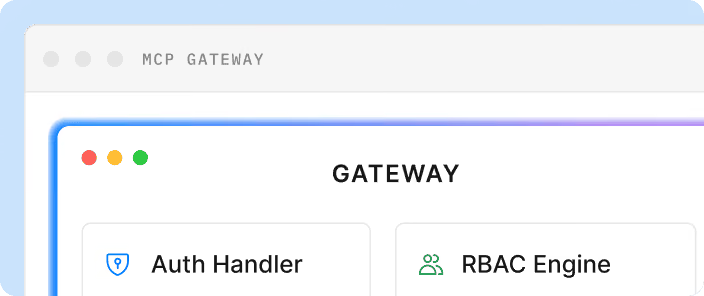
- MCP gateway: The runtime control point that sits in front of servers and enforces authentication, rate limits, and policy on every call.
A registry handles discovery. A gateway handles control at request time. Mature enterprise setups use both.
The top MCP registries in 2026
If you just want to find and use MCP servers, these are the registries and directories that matter. Server counts move fast and vary by source, so treat them as directional.
| Registry | Type | Servers (approx) | Hosting | Private servers | Best for |
|---|---|---|---|---|---|
| Official MCP Registry | Canonical registry | Source of truth | Metadata only | No | Programmatic discovery |
| GitHub MCP Registry | Registry | Curated set | Metadata, in GitHub | Org allow-list | Discovery in GitHub and Copilot |
| Smithery | Directory plus hosting | ~7,000+ | CLI and hosted | No | Installing and running servers |
| Glama | Automated directory | ~20,000+ | Metadata only | No | Broadest browse |
| PulseMCP | Curated directory | ~11,000+ | Metadata only | No | Quality-filtered discovery |
Official MCP Registry
Hosted at registry.modelcontextprotocol.io, this is the canonical, community-governed source of public server metadata, backed by Anthropic, GitHub, PulseMCP, and Microsoft. It is built for programmatic discovery rather than casual browsing, supports public servers only, and is still in preview. If you want one source of truth that other tools build on, this is it.
GitHub MCP Registry
GitHub's registry, launched in September 2025, surfaces MCP servers inside GitHub and Copilot and lets an organization configure an approved registry for its developers. It is the most-searched registry after the head term, because so many teams already work in GitHub. Good for discovery in the GitHub and Copilot workflow and for org-level allow-listing.
Smithery
At smithery.ai, often called the Docker Hub of MCP, Smithery lists roughly 7,000 or more servers and lets you install them locally through a CLI or run them as hosted remote servers on Smithery's infrastructure. Best when you want to install and run servers quickly, not just read about them.
Glama
At glama.ai/mcp, Glama is the largest automated directory, with around 20,000 or more servers, visual previews, and daily updates. It acts as a meta-registry that pulls broadly from the ecosystem. Best for the widest browse, with the caveat that breadth includes forks and abandoned servers.
PulseMCP
At pulsemcp.com, PulseMCP lists around 11,000 or more servers, hand-reviewed daily. It trades raw volume for curation, so it is the pick when you want quality-filtered discovery with meaningful descriptions rather than the longest possible list.
Honorable mentions: MCP.so, with around 20,000 community-submitted servers and strong coverage of newer and experimental tools, and the Docker MCP Catalog for containerized servers.
A quick way to choose: use the official registry for programmatic discovery, Smithery to install and run, Glama or mcp.so for the broadest browse, and PulseMCP when you want curation.
How an MCP registry works
At a high level, a registry runs four jobs: it accepts server submissions, verifies who owns them, exposes a discovery API, and lets other registries build on top of it.
Server metadata and the server.json format
Every entry follows a standardized server.json format. It records:
- Server name: A unique, reverse-DNS identifier such as io.github.username/server-name.
- Location: Where to find the server, for example an npm package name or a remote server URL.
- Execution instructions: The command-line arguments and environment variables needed to run it.
- Discovery data: Description, capabilities, and the other fields an agent uses to decide whether the server fits the task.
1. Namespace authentication (reverse-DNS, GitHub, DNS)
To stop anyone from publishing a server under a name they do not own, the registry uses namespace authentication. Names follow a reverse-DNS pattern tied to a verified source, and publishers prove ownership through a GitHub account, a DNS record, or an HTTP challenge before they can publish under that namespace. This is what keeps a public mcp server registry from filling up with spoofed or malicious entries.
2. Discovery API and federation (subregistries)
The registry exposes a REST API and an OpenAPI spec so clients and aggregators can query it in a standard way. Just as important, it is built for federation. The official registry is the canonical source of public metadata, and downstream aggregators, marketplaces, and private subregistries can ingest, mirror, or augment that data. A private registry can implement the same OpenAPI interface, which means it works with any MCP host application that already supports the official one. Federation is the hinge the enterprise story turns on, because it is how a company combines public servers with its own internal ones under a single, governed interface.
Public, private, or hybrid: choosing your registry model
Here is the fact most introductions skip. The official MCP registry, by design, does not host private servers. The documentation is explicit: if you want to publish private servers, the recommendation is to host your own private MCP registry. Private servers, the ones on an internal network like mcp.acme-corp.internal or in a private artifact repository, are out of scope for the public catalog. That single constraint is what forces the public-versus-private decision for any serious deployment.
Why the official registry does not host private servers
The public registry is optimized for open discovery and community trust, not for confidentiality. It assumes a server is either installable from a public package or reachable at a public URL. An internal payroll or claims-processing server is neither, and you would not want it listed publicly even if it were. So the moment your agents need to reach internal systems, the public catalog stops being enough.
When you need a private, self-hosted MCP registry
You need a private MCP registry when any of the following is true:
- Internal servers: Your agents call services that are not, and should not be, publicly accessible.
- Access control: Different teams, agents, or partners should see different servers, and you need to enforce that.
- Audit and compliance: You must record who accessed which server, when, and under what identity.
- Curation: You want an approved, vetted allow-list rather than every public server on the internet.
This is the category buyers search for with queries like private mcp registry, enterprise mcp, and managed mcp server deployment platforms. A private registry is usually run as core infrastructure owned by a platform engineering team, often as a subregistry that federates the public catalog and adds internal servers on top.
| Factor | Public (official) registry | Private registry | Hybrid subregistry |
|---|---|---|---|
| Server types | Public servers only | Internal servers only | Public and internal, unified |
| Access control | None (open) | Full RBAC | Full RBAC |
| Audit logging | No | Yes | Yes |
| Compliance fit | Low | High | High |
| Best for | Discovering community servers | Regulated, internal-only estates | Most enterprises |
For most enterprises the answer is hybrid: keep the reach of the public catalog, but put a governed private layer in front so internal servers, access rules, and audit trails live in one place.
Governing MCP servers in the enterprise
A registry that only lists servers solves discovery. It does not solve governance. The reason mcp governance and mcp registry are searched together is that, in production, you cannot have one without the other.
The four pillars of MCP governance
A complete enterprise MCP governance framework needs four capabilities working together:
- Centralized catalog: One searchable inventory of every MCP server, internal and external, so nothing runs in the shadows.
- Identity-based access control: RBAC and SSO so each user, team, or agent identity sees and uses only the servers it is entitled to.
- Structured audit logging: An attributable record of who accessed which server, tied to a verified identity, exportable to your SIEM.
- Real-time policy enforcement: Rate limits, scoping, and allow-lists applied at request time, which is where a gateway works alongside the registry.
Compliance for regulated industries
In banking, insurance, and healthcare, a registry has to satisfy the same controls as the rest of your API estate. Three requirements show up in every regulated review:
- Attributable access: Every call linked to a verified identity, with immutable, retained logs.
- Data residency: The ability to keep sensitive data and metadata inside defined regions such as EU, US, or APAC.
- Vendor risk documentation: Evidence that the governance infrastructure itself, including SOC 2 posture, is sound.
A registry without these is a directory. A registry with these is governance.
Connecting the registry to your API estate and gateway
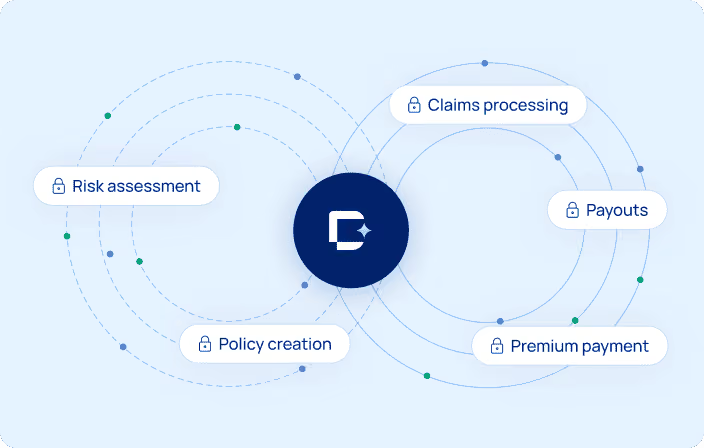
Most MCP servers are not new capabilities. They are agent-facing front doors to APIs you already run. That is why a standalone registry, disconnected from your gateways and API catalog, recreates the same sprawl you were trying to fix. The stronger pattern is to treat MCP discovery as an extension of API management: one catalog that spans your gateways, your APIs, and your MCP servers, with the same identity, policy, and audit model across all of them. An enterprise mcp platform with api management built in is what turns a list of servers into a controlled estate.
Enterprise MCP registry platforms
The public registries above are built for discovery. Once you need private servers, access control, and audit, you move to enterprise platforms. The landscape is moving fast, so evaluate on capability and governance fit rather than price.
| Platform | Type | Private servers | Governance (RBAC, audit) | Ties to API gateway |
|---|---|---|---|---|
| Official MCP Registry | Public catalog | No | No | No |
| ServiceNow MCP Registry | Private subregistry | Yes | Yes | Limited |
| AWS Agent Registry (preview) | Private catalog | Yes | Yes | AWS-centric |
| Azure API Center | Inventory and discovery | Yes | Partial | Azure-centric |
| JFrog | AI catalog | Yes | Partial | No |
| Kong | Registry and gateway | Yes | Yes | Yes |
| DigitalAPI | Governed registry and gateway | Yes | Yes | Yes, gateway-agnostic |
Build vs buy
You can self-host the open registry codebase, but the maintainers do not support self-hosting it for production, so you would own all of the operations, security, and upkeep. For a single team experimenting, that can be fine. For an enterprise that needs RBAC, audit, data residency, and multi-gateway reach, buying a governed mcp management service is faster and lowers risk, because the discovery, control, and compliance layers arrive pre-integrated.
How DigitalAPI delivers a governed MCP registry
DigitalAPI gives enterprises a private, governed MCP registry as part of a single API management platform, so discovery and governance are not two separate tools.
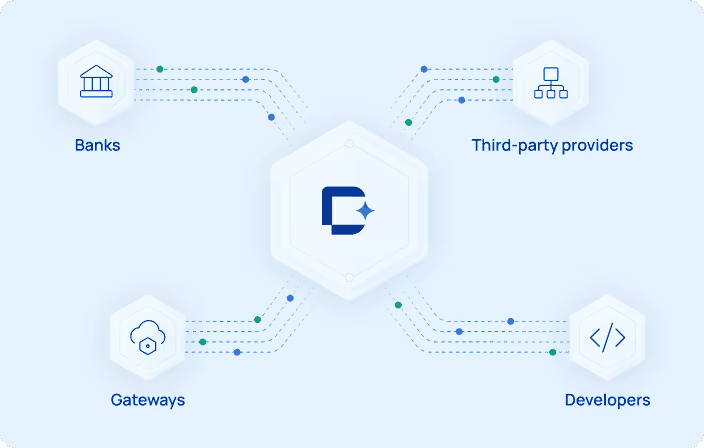
- Unified catalog across your estate: Aggregate APIs and MCP servers from every gateway, including Apigee, Kong, AWS, and Azure, into one searchable catalog. As a Google Apigee Premier Partner, DigitalAPI is gateway-agnostic by design.
- Governance built in: SSO via SAML 2.0 and OIDC, RBAC with custom roles, SCIM provisioning, and immutable audit logs that export to Splunk, Datadog, or any SIEM. SOC 2 Type II ready, with data residency across EU, US, and APAC.
- Agent-ready by default: Auto-generate MCP-ready endpoints from your existing OpenAPI specs, with OAuth 2.0 machine-to-machine authentication and per-agent rate limits, so a server is governed the moment it is published.
- Proven at enterprise scale: Trusted by HSBC, Fiserv, and Zurich Insurance, with 100+ enterprise deployments and a typical 3 days to first integration.
If your agents are starting to reach internal systems and you need one place to discover and govern every MCP server, book a demo and we will map it to your gateways.
FAQs
What are the best MCP registries?
For programmatic discovery, use the official MCP registry. To install and run servers, use Smithery. For the broadest browse, use Glama or mcp.so. For curated, hand-reviewed discovery, use PulseMCP. Enterprises that need private servers and governance use a platform like DigitalAPI.
What is the GitHub MCP registry?
It is GitHub's registry of MCP servers, launched in September 2025, that surfaces servers inside GitHub and Copilot and lets an organization configure an approved registry for its developers.
What is the official MCP registry?
It is the canonical, community-governed catalog of public MCP server metadata at registry.modelcontextprotocol.io, backed by Anthropic, GitHub, PulseMCP, and Microsoft. It is in preview and supports public servers only.
What does MCP stand for?
MCP stands for Model Context Protocol, an open standard that lets AI agents discover and use tools and APIs through a consistent interface instead of custom, one-off integrations.
What is the difference between an MCP server and an MCP registry?
An MCP server exposes a single tool or API to an agent. An MCP registry is the catalog of many servers that tells agents which ones exist and how to connect to them.
Is an MCP registry the same as an MCP gateway?
No. A registry handles discovery, meaning what servers exist. A gateway handles control at request time, meaning authentication, rate limits, and policy on each call. Enterprises usually run both.
Does the official MCP registry support private servers?
No. The official registry only lists publicly accessible servers, and its own documentation recommends hosting your own private MCP registry for internal servers.
What is a private MCP registry?
A private MCP registry is a self-hosted or vendor-run catalog of an organization's internal and approved external MCP servers, with the access control, audit logging, and policy enforcement that the public registry does not provide.
How is an MCP registry different from an API marketplace?
A registry stores neutral metadata for discovery. A marketplace, or downstream aggregator, adds curation, ratings, and a consumer experience on top of registry data.
Do I need an MCP registry if I already have an API gateway?
Yes, if you want agents to discover servers programmatically. The strongest setup pairs a registry for discovery with a gateway for control, ideally in one platform so identity, policy, and audit stay consistent.
Dhayalan Subramanian is Associate Director, Product Growth at DigitalAPI, where he leads go-to-market and product growth for the company’s multi-gateway API management platform. His work focuses on helping large enterprises and mid-market cloud companies consolidate APIs across AWS, Azure, Apigee, Kong, MuleSoft, and other gateways into a single control plane for governance, discovery, monetization, and agent consumption.
Dhayalan brings 14+ years of experience across product strategy, enterprise architecture, and engineering leadership. Earlier in his career, he held senior roles at Encora (as Associate Architect and Technical Manager), Mindtree (Technology Lead), Tech Mahindra (Technical Lead), and Primus Analytics, where he designed integration frameworks and delivered enterprise-grade digital platforms for global customers.
At DigitalAPI, he works directly with platform, integration, and developer experience leaders at Fortune 500 organizations to operationalize unified API catalogs, developer portals, and MCP-ready APIs. He writes regularly on API developer experience, API governance, and AI agent architectures.
.png)
One email a fortnight. Worth opening.
A short digest of what we're writing, what we're learning from customers, and the handful of links you'd actually want from us. No tracking pixels.

.avif)