



Best API Test Automation Frameworks for 2026
REST Assured, Karate, Playwright, pytest, SuperTest, Newman and Pact compared by language, style, contract testing and CI fit. Versions and licences checked against each project's registry on 27 November 2026, with a short test for each.

TL;DR:
Which framework is used for API test automation?
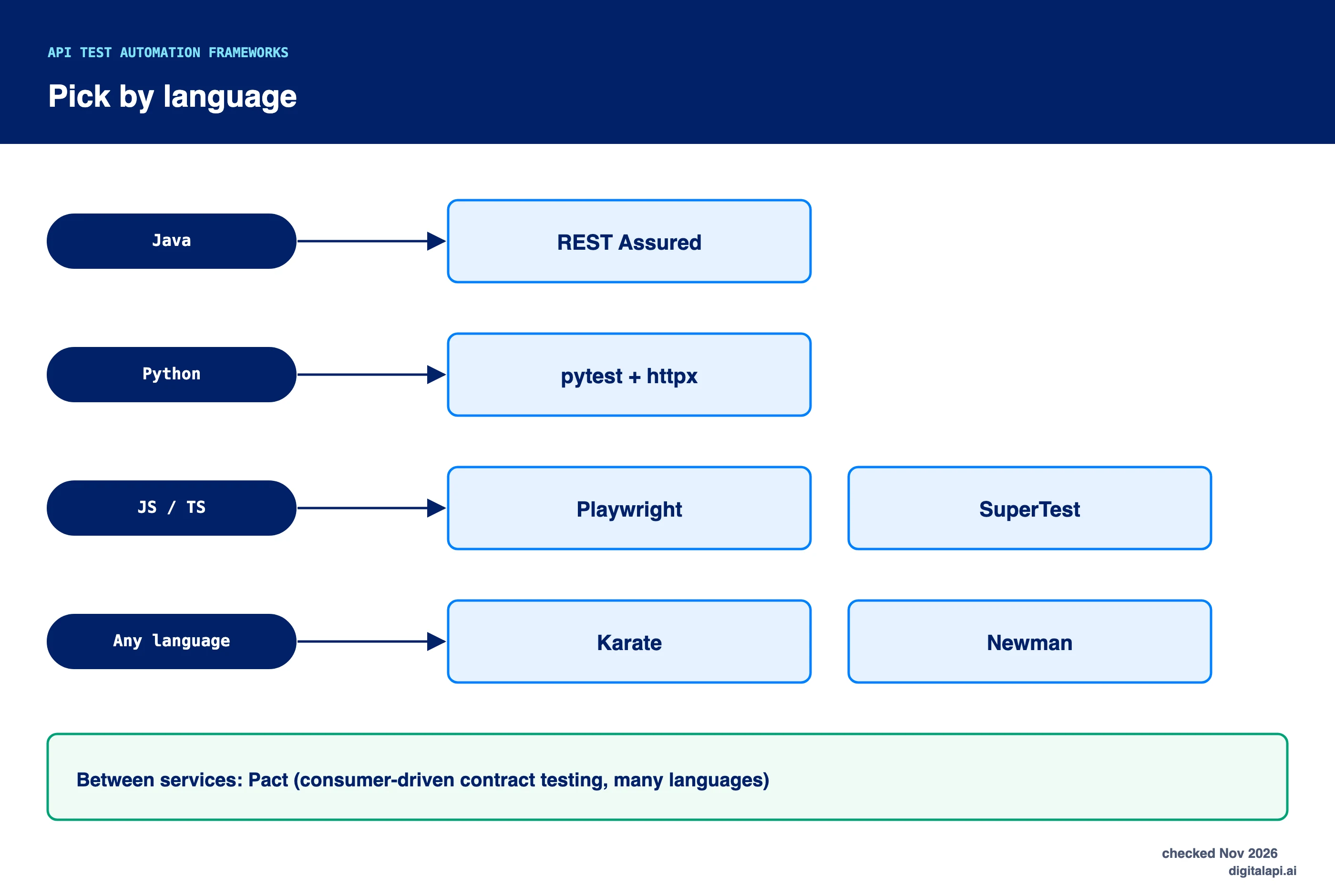
The right API testing framework depends on your language. Use REST Assured for Java, pytest with httpx or requests for Python, and Playwright or SuperTest for JavaScript and TypeScript.
Pick Karate for a no-code-style DSL, Newman to run Postman collections in CI, and Pact for contract testing between services.
Which framework is used in API automation testing? Most teams pick the one that matches their service language. Java shops reach for REST Assured, Python teams use pytest, and Node teams use Playwright or SuperTest. Karate covers teams that want one readable DSL across languages.
The choice matters because API tests run on every commit. Postman's 2025 State of the API report found testing is the most common API activity, done by 81% of respondents. A framework that fights your stack slows every one of those runs.
This guide compares seven options on language, style, contract testing and CI fit. We checked every version and licence against its official registry on 27 November 2026. Each profile includes a short sample test.
What is an API testing framework?
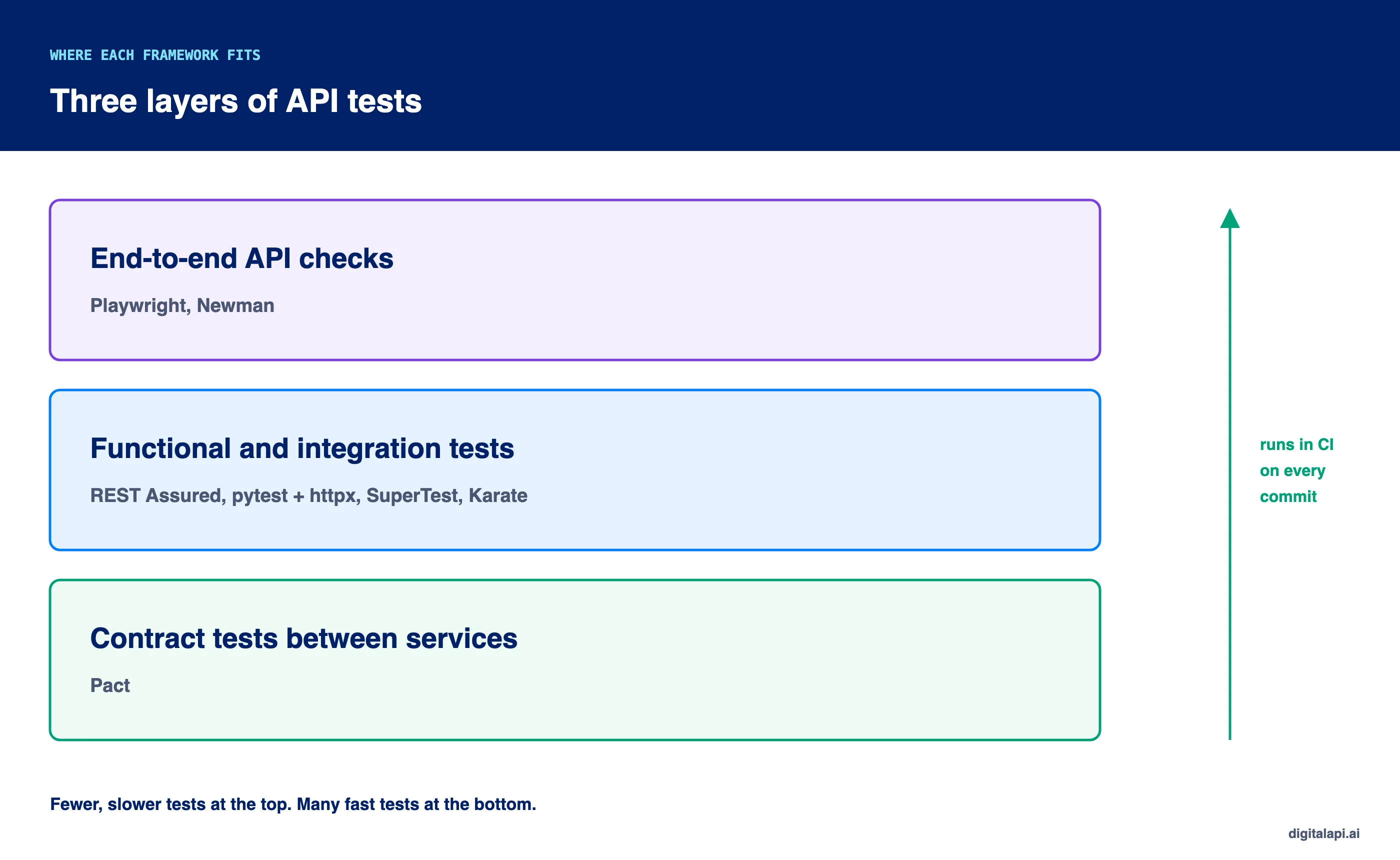
An API testing framework is a code library that sends requests to an API and checks the responses against expected results. It runs as part of your test suite, so the same tests run on a laptop and in CI. That makes it different from a GUI tool where a person clicks through requests.
An API automation framework usually gives you four things:
- A request builder for methods, headers, auth and payloads.
- Assertions on status codes, JSON fields, schemas and response times.
- A test runner that groups tests, runs them in parallel and retries flaky ones.
- Reports in a format CI systems read, such as JUnit XML.
New to the topic? Start with what is API testing and the types of API testing.
What is the difference between an API testing framework and an API testing tool?
A framework is code you write tests with. A tool is an application you test through. Frameworks live in your repo and run in CI. Tools such as GUI clients are better for exploring an API by hand.
Most teams need both. Developers explore a new endpoint in a GUI client, then capture the checks as code. The code version is what protects every release.
Lists of API automation testing tools often mix the two. This page covers code frameworks only. For GUI platforms such as request clients and enterprise test suites, see our guide to the best API testing tools and platforms.
Which API testing framework should you use for each language?
Match the framework to the language your team already writes. Tests in the same language as the service are easier to review, debug and maintain.
- Java and Kotlin: REST Assured
- Python: pytest with httpx or requests
- JavaScript and TypeScript (any backend): Playwright API testing
- Node.js (in-process app tests): SuperTest
- Any language, readable DSL: Karate
- Existing Postman collections: Newman
- Contracts between services: Pact
The table compares them on the factors that matter in CI.
1. REST Assured (Java)
REST Assured is the standard API testing framework for Java. It uses a fluent given/when/then style that reads like a test spec. The latest stable release on Maven Central is 6.3.0 (October 2026).
A 7.0.0 release candidate shipped on 12 November 2026. Per the REST Assured project, it moves to the JDK HTTP client by default, drops the Groovy dependency and requires Java 17. Expect some breaking changes when you upgrade.
- Strengths: mature, works with JUnit and TestNG, strong JSON and XML path assertions, Spring MockMvc support.
- Watch out for: Java only, and the 7.0 upgrade needs planning.
Teams that want REST Assured alternatives on the JVM usually pick Karate for its DSL. Outside Java, they move to the language-native options below. Those are the most common REST Assured alternatives.
2. Karate (DSL)
Karate is an open-source framework that writes API tests in a readable Gherkin-style DSL. Testers can write and read tests without deep Java knowledge. Version 2.1.4 shipped in October 2026, under the MIT licence.
Karate 2 added virtual threads, a single-binary CLI and soft assertions, per the Karate documentation. It also covers mocks, performance tests and UI tests in the same syntax.
- Strengths: readable tests, powerful
matchkeyword for full JSON comparison, built-in parallel runs and mocks. - Watch out for: a DSL to learn, and complex logic can push you into JavaScript inside features.
3. Playwright API testing (JavaScript and TypeScript)
Playwright, known for browser testing, also has a built-in API testing client. You get the same runner, fixtures and reports for API and UI tests. The @playwright/test package is at 1.65.1 (November 2026), Apache 2.0.
The Playwright API testing guide shows how to send requests with the request fixture. You can also use it to set up state through the API before a UI test.
- Strengths: one runner for UI and API, parallel by default, HTML reports and traces.
- Watch out for: heavier install than a pure HTTP library if you only test APIs.
4. pytest with httpx or requests (Python)
For Python, the common pattern is pytest as the runner with httpx or requests as the HTTP client. pytest 9.2.0 shipped in October 2026, MIT licence. httpx 0.29.0 (BSD-3) adds async support and HTTP/2; requests 2.34.2 (Apache 2.0) stays the simple sync option.
The pytest documentation covers fixtures, which share setup such as auth tokens across tests. Plain assert statements keep tests short.
- Strengths: minimal syntax, huge plugin ecosystem, easy parametrised and data-driven tests.
- Watch out for: you assemble the stack yourself (client, schema checks, reporting).
Building the API in Python too? See the best Python API frameworks.
5. SuperTest (Node.js)
SuperTest tests a Node.js HTTP app in-process, without starting a server on a port. It is a light choice for Express and similar apps. Version 7.3.2 shipped in November 2026 under MIT, and the SuperTest repository has about 14,000 GitHub stars.
- Strengths: fast, no network setup, works with Jest, Mocha or Vitest.
- Watch out for: best for your own Node app; less suited to testing external APIs.
6. Postman collections with Newman (CI runner)
Newman is the command-line runner for Postman collections. It lets teams that already keep tests in Postman run them in CI without a GUI. Version 6.2.3 shipped in October 2026, Apache 2.0.
- Strengths: reuses collections and test scripts the team already has, JUnit output for CI.
- Watch out for: tests live in collection JSON, which is harder to review in pull requests than plain code.
Newman fits teams moving from manual collections toward automation. For the Postman app itself and other GUI clients, see the API testing tools guide.
7. Pact (contract testing)
Pact checks that a consumer and a provider agree on an API contract, before either deploys. The consumer test records expected requests and responses into a contract file. The provider then replays that contract against its real code.
That catches breaking changes that functional tests on one side miss. Pact has libraries for JavaScript, the JVM, Python, Go and more; pact-js is at 17.1.4 (September 2026), MIT. See the Pact documentation for the workflow.
The gap is wide. Postman's 2025 report found functional and integration testing at 67% adoption, but contract testing at only 17%. For the concepts, read our guide to API contract testing.
- Strengths: catches breaking changes early, lets teams deploy services independently.
- Watch out for: needs a shared contract store and buy-in from both teams.
How do you choose the best API automation framework?
Choose by language first, then by test type and team skills. The best API automation framework is the one your team will keep writing tests in every sprint.
Use these questions:
- What language is the service in? Default to the matching framework from the list above.
- Who writes the tests? Developers prefer code. Mixed QA teams often prefer Karate's DSL.
- Do services call each other? Add Pact for contracts on top of functional tests.
- Do you already have Postman collections? Run them with Newman while you move key flows into code.
- Do you test UI too? Playwright covers both with one runner.
Every option here runs from the command line, which matters for CI. Postman's 2025 report found 75% of respondents use CI/CD pipelines, so tests that can't run headless won't keep up.
A code API testing framework is right for you if:
- Tests must run on every commit in CI, not only before a release.
- Developers own quality and review tests in pull requests.
- You test many endpoints and need data-driven or parallel runs.
It is not right for you if:
- You are exploring a new API by hand. A GUI client is faster for that.
- Nobody on the team can maintain test code. Start with a GUI tool and Newman.
Where should automated API tests run before go-live?
Run automated API tests against an isolated sandbox that behaves like production. Tests against production risk real data. Tests against bare mocks miss auth, rate limits and multi-step state.
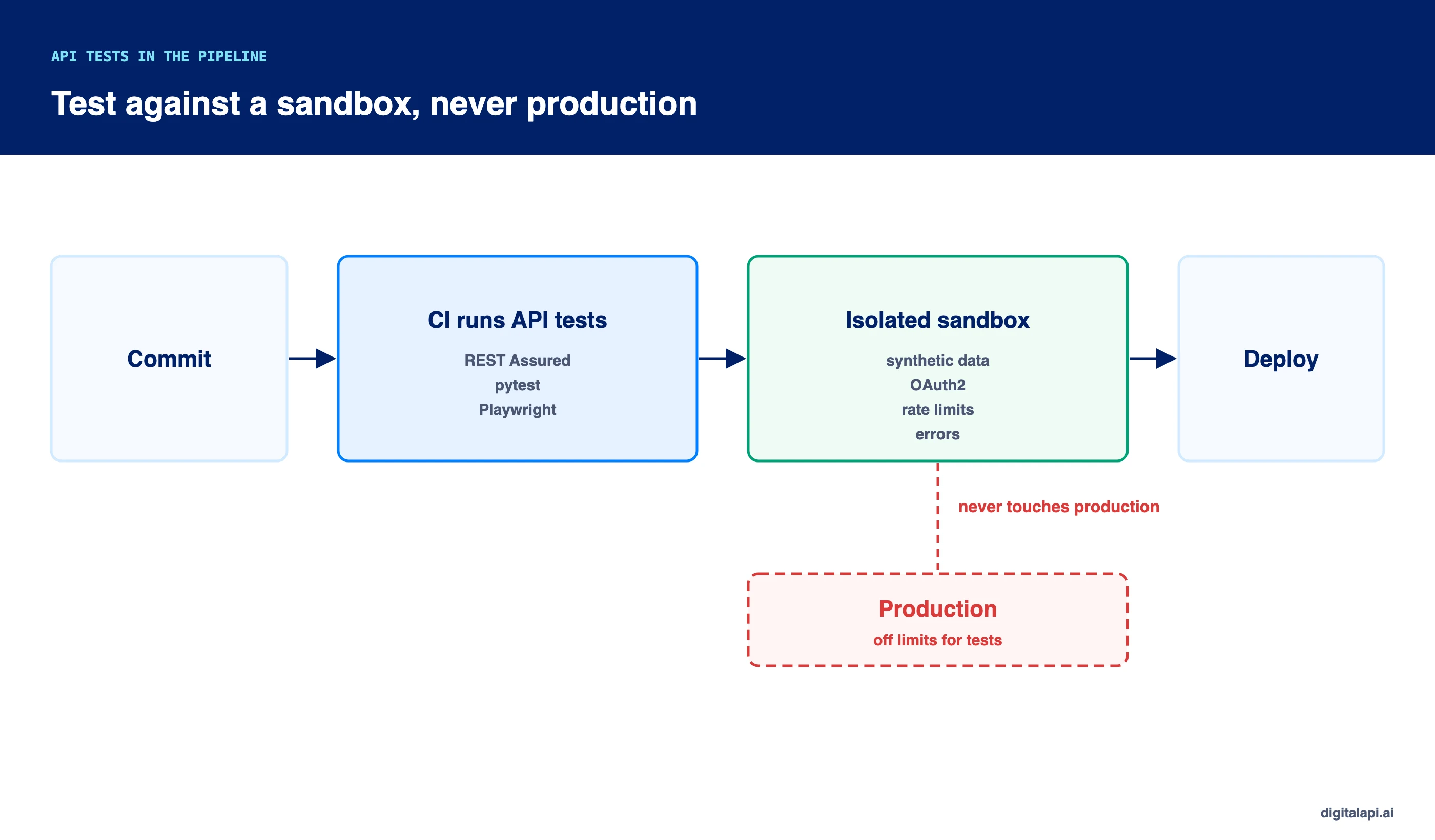
A good sandbox gives your framework realistic targets:
- Synthetic data, so tests never touch customer records.
- Production-like auth, so OAuth2 and API key flows are tested for real.
- Rate limits and errors, so you can assert on 429s, timeouts and 5xx responses.
- State across calls, so create, fetch and update flows behave like the real API.
Teams that use DigitalAPI API Sandboxing can spin up isolated sandboxes from an OpenAPI spec or a connected Apigee, Kong, AWS or Azure gateway. Sandboxes keep state across calls and mirror production auth and rate limits. Errors, timeouts and 429s can be triggered on demand, so your framework tests every edge case. For the practice itself, read API sandbox testing.
See how DigitalAPI gives your API tests a production-like sandbox before go-live → Book a Demo
Key takeaways
- Pick the API testing framework that matches your language: REST Assured for Java, pytest for Python, Playwright or SuperTest for JavaScript and TypeScript.
- Karate suits mixed teams that want one readable DSL for API tests, mocks and performance.
- Newman runs Postman collections in CI, a bridge from manual tests to automation.
- Add Pact for contracts. Only 17% of teams do contract testing, per Postman's 2025 report.
- Frameworks and tools are different. Use GUI tools to explore, and frameworks to protect every release.
- Test against a production-like sandbox, not production and not bare mocks.
Frequently asked questions
1. Which framework is used in API automation testing?
It depends on the language. REST Assured is the most common choice for Java. Python teams use pytest with httpx or requests, and JavaScript teams use Playwright or SuperTest. Karate offers a readable DSL for any team, Newman runs Postman collections in CI, and Pact handles contract testing between services.
2. What is the best API automation framework?
There is no single best API automation framework. The best one matches your service language and your team's skills. REST Assured leads for Java, pytest for Python and Playwright for JavaScript and TypeScript. Karate suits teams that want a DSL. Add Pact if your services depend on each other's APIs.
3. What are the best REST Assured alternatives?
On the JVM, Karate is the main REST Assured alternative, with a readable DSL plus built-in mocks and parallel runs. Outside Java, use pytest with httpx for Python, Playwright or SuperTest for JavaScript and TypeScript, and Pact for contract testing. Teams with Postman collections can run them in CI with Newman.
4. What is the difference between an API testing framework and an API testing tool?
An API testing framework is a code library for writing automated tests that live in your repository and run in CI. An API testing tool is usually a GUI application for sending requests and exploring an API by hand. Teams often use a tool to explore and a framework to automate checks on every commit.
5. Is Postman an API testing framework?
Postman is mainly an API platform with a GUI client, so it is closer to a testing tool. Its tests are written as scripts inside collections. Newman, Postman's command-line runner, lets you run those collections in CI. For tests stored as plain code in your repo, a framework such as REST Assured, pytest or Playwright fits better.
6. Can Playwright be used for API testing?
Yes. Playwright includes an API testing client through the request fixture in @playwright/test. You can send HTTP requests, assert on status codes and JSON bodies, and run API tests in the same runner as UI tests. Teams also use it to set up test data through the API before running browser tests.
7. What is contract testing in API automation?
Contract testing checks that an API consumer and provider agree on the requests and responses they exchange. With Pact, the consumer test records a contract, and the provider replays it against its real code. It catches breaking changes before deployment. Postman's 2025 report found only 17% of teams use contract testing.
Conclusion
The best API testing framework is the one that fits your stack. Use REST Assured for Java, pytest for Python and Playwright or SuperTest for JavaScript and TypeScript. Karate covers mixed teams, Newman bridges Postman collections into CI, and Pact protects contracts between services.
Start with one critical flow, such as sign-in or checkout. Write it as code in the matching framework and run it in CI on every commit. Then point those tests at a sandbox that behaves like production, so a passing build means a working release.
Give every API test run an isolated, production-like sandbox with DigitalAPI, with synthetic data, real auth and rate limits. Test against realistic sandboxes before go-live
Prefer a walkthrough? Book a Demo
Dhayalan Subramanian is Associate Director, Product Growth at DigitalAPI, where he leads go-to-market and product growth for the company’s multi-gateway API management platform. His work focuses on helping large enterprises and mid-market cloud companies consolidate APIs across AWS, Azure, Apigee, Kong, MuleSoft, and other gateways into a single control plane for governance, discovery, monetization, and agent consumption.
Dhayalan brings 14+ years of experience across product strategy, enterprise architecture, and engineering leadership. Earlier in his career, he held senior roles at Encora (as Associate Architect and Technical Manager), Mindtree (Technology Lead), Tech Mahindra (Technical Lead), and Primus Analytics, where he designed integration frameworks and delivered enterprise-grade digital platforms for global customers.
At DigitalAPI, he works directly with platform, integration, and developer experience leaders at Fortune 500 organizations to operationalize unified API catalogs, developer portals, and MCP-ready APIs. He writes regularly on API developer experience, API governance, and AI agent architectures.
One email a fortnight. Worth opening.
A short digest of what we're writing, what we're learning from customers, and the handful of links you'd actually want from us. No tracking pixels.