








Definition
What Is a Service Catalog?
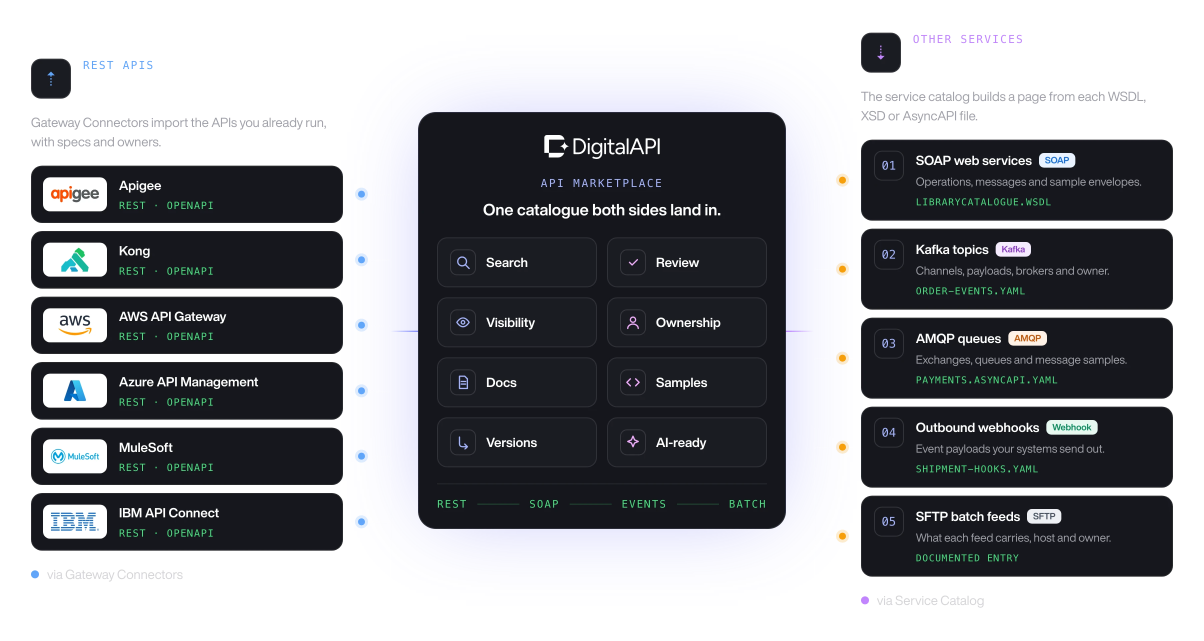
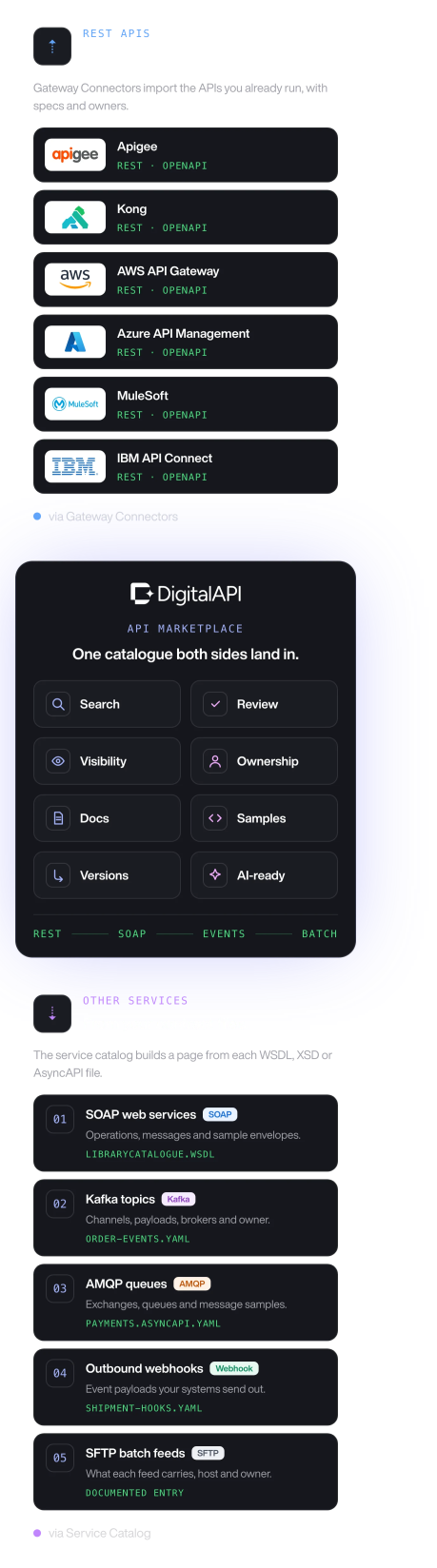
A service catalog lists the interfaces that are not REST APIs: SOAP web services, Kafka topics, AMQP and RabbitMQ queues, outbound webhooks and SFTP batch feeds. In the DigitalAPI API Marketplace they sit in the same catalogue as your REST APIs, with the same search, visibility and review.
SOAP and event-driven entries are generated from the WSDL, XSD or AsyncAPI files you already have, and every entry records how to connect and who owns it. The catalogue covers documentation and discovery; access to the service still runs through your existing processes.

What Does DigitalAPI Build From Your Contract Files?
Add a WSDL, XSD or AsyncAPI file to DigitalAPI's portal and it builds a read-only service page for your developer portal, next to your REST APIs. Here is what it builds, part by part.
Every operation, with its types
Each operation in the WSDL is listed with its input and output, along with the XSD types behind it.
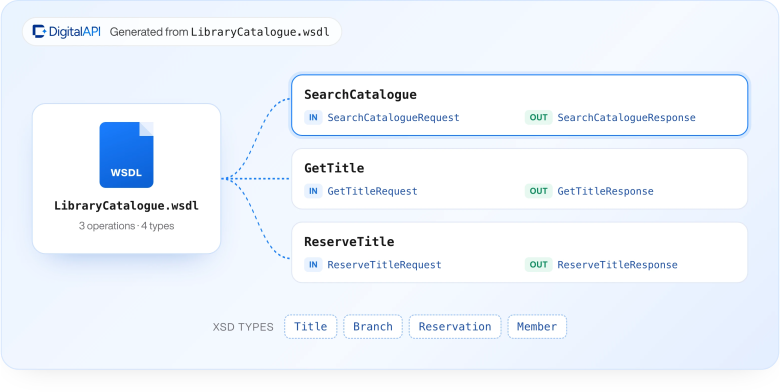
Parses the WSDL
Links input to output
Resolves XSD types
Every message, with a sample payload
Each request and response comes with a generated sample payload, so developers see the shape of a message before they integrate.
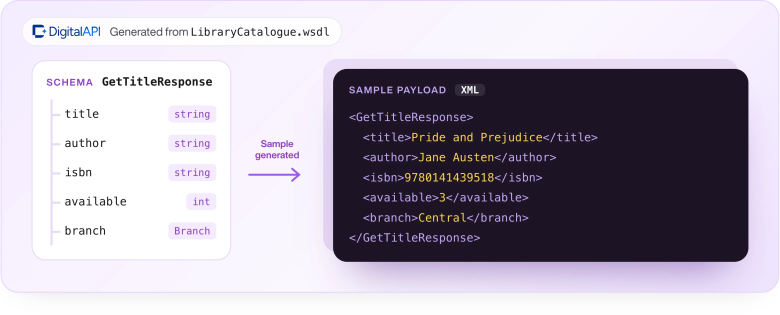
Covers both sides
Generates samples
In the portal first
A ready-to-copy envelope for each operation
Every operation gets a complete sample envelope, so developers start from a working request instead of the raw contract.
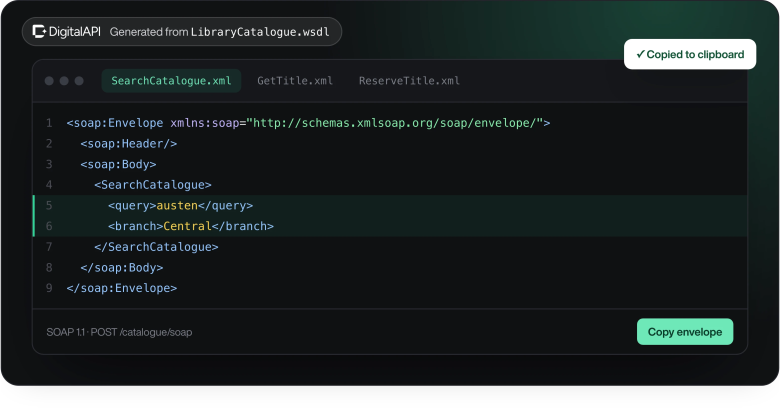
One per operation
Ready to copy
Beside your REST APIs
Channels, topics and how to connect
For event-driven services described in AsyncAPI, each channel and topic is laid out with its messages and sample payloads, plus the brokers, channels or hosts it uses and who owns it.
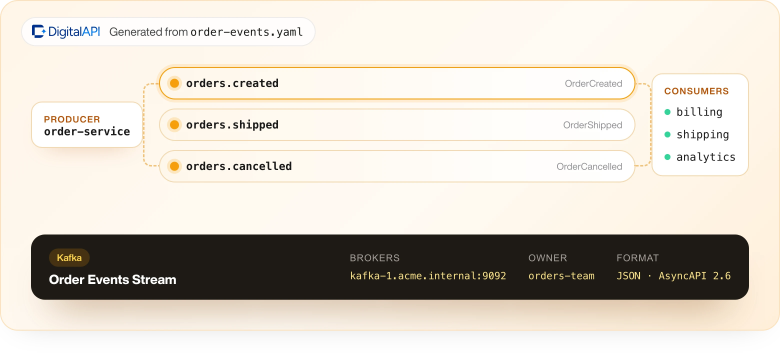
Channels and messages
How to connect
Who owns it
Supported interfaces
Which Services Can You Catalogue with DigitalAPI API Marketplace?
Six kinds of interface share one catalogue. How deep DigitalAPI's support goes depends on the format.
REST APIs
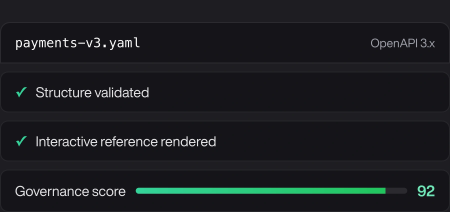
From OpenAPI 3.x, Swagger 2.0 or Postman collections
Rendered as an interactive API reference, validated and scored against governance rules.
SOAP web services
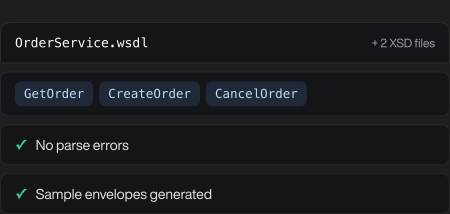
From WSDL and XSD files, including multi-file sets
Operations, types, messages and sample envelopes are generated from the files, and the WSDL is checked for parse errors.
From AsyncAPI files, or as structured entries
Event and batch interfaces are listed with their channels, messages, connection details and owner. They are documented, not validated.
Kafka topics
Channels, messages, brokers
AMQP and RabbitMQ queues
Queues, messages, connection details
Outbound webhooks
Event messages with samples
SFTP batch feeds
What each feed carries, hosts, owner
GraphQL and gRPC are not supported today.
How it works
How Does a Service Get Into the Catalogue?
Three steps from a contract file to a published entry.
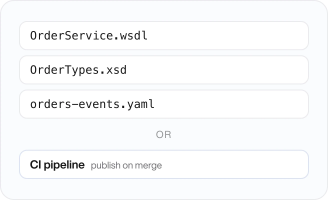
Add the contract
Upload the WSDL, XSD or AsyncAPI file, or publish it from your CI pipeline. A pipeline re-run updates the entry instead of duplicating it.
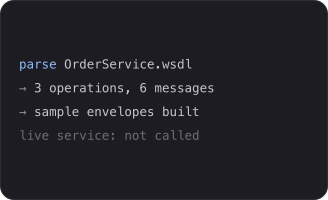
Docs are generated from the file
The page is built from the contract alone. Your live service is never called, so no test traffic reaches it.
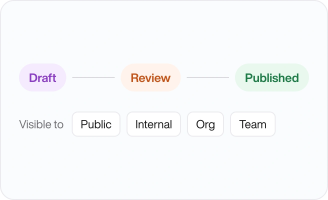
Reviewed, then published
Every new service lands as a draft. Once approved, it appears in search to the people you choose.
With Gateway Connectors
One Search for Your Whole Integration Estate
Connectors bring in your REST APIs. The service catalog adds everything else.
How we compare
How Does the Service Catalog Compare to the Alternatives?
Teams usually keep non-REST services in a wiki or spreadsheet, or leave them out of a developer portal built for REST APIs.
Capability

Wiki or spreadsheet
REST-only developer portal
SOAP, Kafka, AMQP, webhook and SFTP entries
Listed beside REST APIs
As free text
Not listed
Docs from WSDL, XSD and AsyncAPI
Generated from the files
Written by hand
OpenAPI only
One search across APIs and services
Yes, one catalogue
Separate from the portal
APIs only
SOAP, Kafka, AMQP, webhook and SFTP entries
Listed beside REST APIs
Wiki or spreadsheet
As free text
REST-only developer portal
Not listed
Docs from WSDL, XSD and AsyncAPI
Generated from the files
Wiki or spreadsheet
Written by hand
REST-only developer portal
OpenAPI only
One search across APIs and services
Yes, one catalogue
Wiki or spreadsheet
Separate from the portal
REST-only developer portal
APIs only
Outcomes
What Results Can You Expect?


70%
Increase in API discovery across teams.
3x
Higher API adoption and reuse.
6x
Faster API onboarding.
40%
Lower operational overhead across the API estate.
Frequently asked questions
Service Catalog FAQs
What is a service catalog?
A service catalog lists the interfaces that are not REST APIs, such as SOAP web services, Kafka topics, AMQP and RabbitMQ queues, outbound webhooks and SFTP batch feeds. In the DigitalAPI API Marketplace they sit in the same catalogue as your REST APIs, with the same search, visibility and review.
What is the difference between a service catalog and an API catalog?
An API catalog usually lists REST APIs described in OpenAPI. A service catalog also covers the interfaces that are not REST: SOAP web services, Kafka topics, AMQP queues, outbound webhooks and SFTP batch feeds. In DigitalAPI both live in one catalogue, with the same search, visibility and review.
Which services and contract files are supported?
SOAP web services from WSDL and XSD files, including multi-file XSD sets. Kafka topics, AMQP and RabbitMQ queues, outbound webhooks and SFTP batch feeds are listed as structured service entries with their connection details, and event-driven interfaces can be documented from AsyncAPI files. REST APIs use OpenAPI 3.x, Swagger 2.0 or Postman collections, which are converted to OpenAPI.
Does DigitalAPI call our live services to build the docs?
No. Documentation is generated from the contract file alone, and the live service is never called.
Are SOAP and AsyncAPI contracts validated like OpenAPI?
No. Support depth follows the format. Validation and governance linting cover OpenAPI. WSDL files are checked for parse errors and rendered as generated documentation, and event and batch entries are documented rather than validated.
Can services be published from a CI pipeline?
Yes, through the CI publish API. Each entry is keyed by an external identifier, so a re-run updates the entry instead of duplicating it, and every pipeline submission lands as a draft for review.
Do you support GraphQL or gRPC services?
Not today. The supported formats are OpenAPI, Swagger and Postman for REST, WSDL and XSD for SOAP, AsyncAPI for event-driven interfaces, and structured entries for Kafka, AMQP, webhooks and SFTP. gRPC support is on the roadmap.
Does the catalogue control access to our services?
No. Service entries cover documentation and discovery, so consumers cannot subscribe to a Kafka topic or queue here. Access to each service still runs through your existing processes.