



Best Python API Frameworks in 2026
FastAPI, Django REST Framework, Flask, Litestar, Falcon, Django Ninja and Sanic compared on async support, OpenAPI output, licence and current version. Every hello-world endpoint in this guide was run and tested on Python 3.14 in November 2026.

TL;DR:
What is the best Python API framework in 2026?
The best Python API framework for most new projects in 2026 is FastAPI: async, typed and with automatic OpenAPI docs.
Pick Django REST Framework or Django Ninja if you already run Django, Flask for small services, Litestar for async APIs with more structure, and Falcon or Sanic for lean, high-throughput services.
Your team needs a new internal API by the end of the sprint. One engineer wants FastAPI because "everyone uses it", another wants Django because the admin and ORM are already there, and someone else still runs Flask in production and sees no reason to move. All three are right for some project. The question is which Python API framework is right for this one.
This guide compares seven frameworks on the things that decide the choice in practice: async support, OpenAPI output, typing, licence, maturity and ecosystem. Every version, licence and star count below was checked on 24 November 2026, and every hello-world endpoint was run and called on Python 3.14.6.
It also covers the part most framework lists skip: what happens after the API works on your laptop and has to be documented, secured and shared with other teams.
What are the best Python API frameworks in 2026?
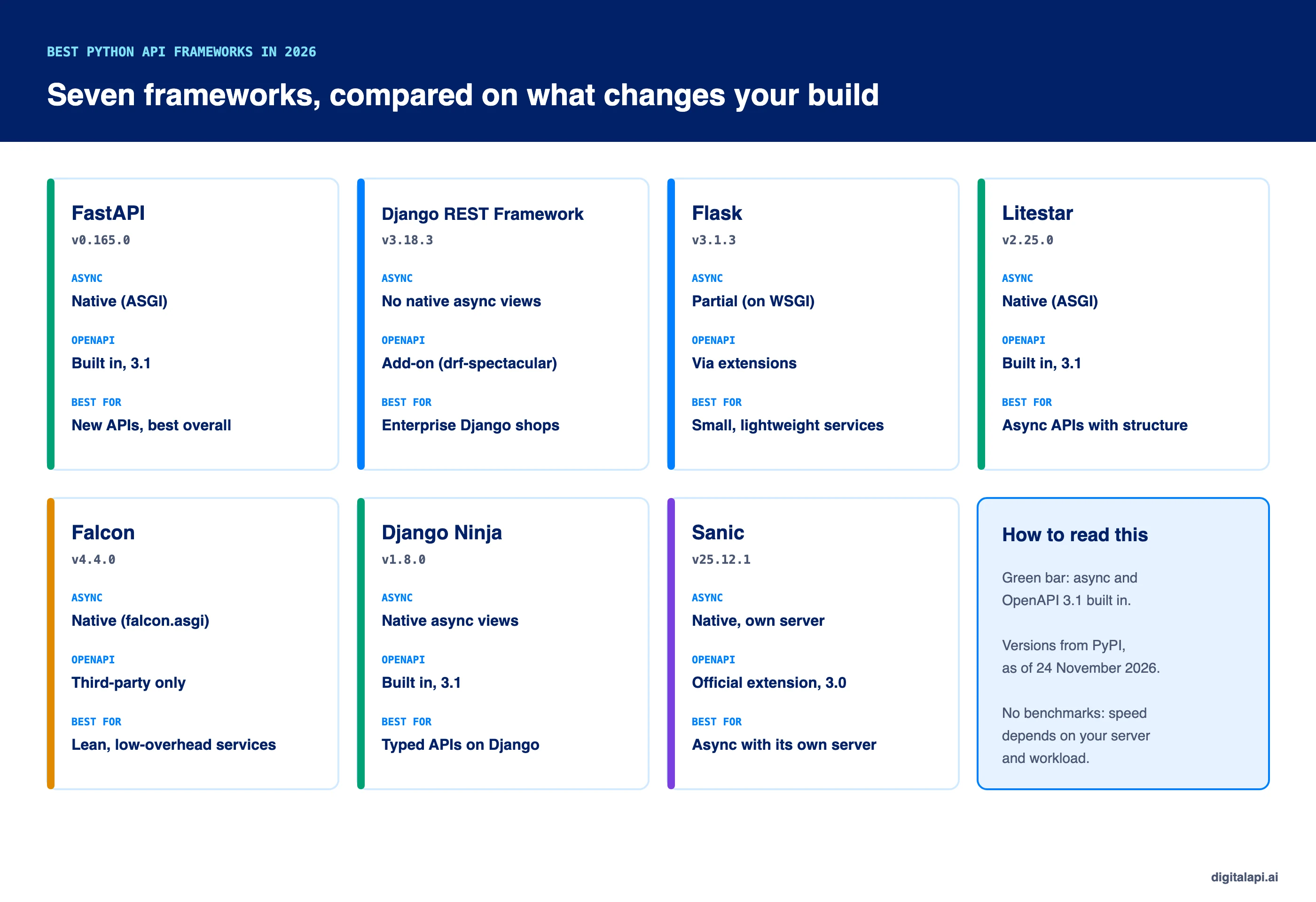
The seven Python API frameworks worth shortlisting in 2026 are FastAPI, Django REST Framework, Flask, Litestar, Falcon, Django Ninja and Sanic. They cover the full range, from full-stack Django add-ons to minimal async toolkits.
Quick picks by use case:
How did we compare these Python API frameworks?
We scored each framework on five criteria that change how you build and run an API: async support, OpenAPI support, typing and validation, ecosystem and maturity, and licence. We did not run performance benchmarks. Throughput depends on the server, worker count and workload far more than on the hello-world handler, and published numbers rarely match production.
- Async support: can a handler be
async defand run on an event loop without blocking a worker? - OpenAPI support: does the framework generate an OpenAPI document by itself, through an official extension, or only through third-party packages?
- Typing and validation: do type hints drive request validation and docs?
- Ecosystem and maturity: first release date, GitHub stars, release cadence.
- Licence: all seven are permissive open source (MIT, BSD-3-Clause or Apache-2.0), so licence rarely blocks a choice, but it matters for legal review.
How we tested: each hello-world endpoint below was saved as a file, served with its usual server (Uvicorn 0.54.0 for the ASGI apps, the Flask and Django development servers, and Sanic's own server), and called with an HTTP GET on Python 3.14.6 (macOS) on 24 November 2026. Each returned 200 and {"message": "Hello, world"}. Where a framework serves an OpenAPI document, we fetched it too and recorded the spec version it reported.
Python API frameworks compared side by side
FastAPI, Litestar and Django Ninja generate OpenAPI 3.1 out of the box. Sanic does it through its official extension, Flask and DRF need add-ons, and Falcon leaves it to third-party libraries. The table is the summary most readers need.
Versions, licences, first releases and Python requirements from PyPI; stars from GitHub; all as of 24 November 2026. OpenAPI versions are what each framework's generated document reported in our test.
1. FastAPI
FastAPI is the default choice for new Python APIs: async, driven by type hints, and it publishes OpenAPI docs with no extra setup. It is the best Python API framework for most greenfield services in 2026.
FastAPI is built on Starlette for the web layer and Pydantic for validation, according to the FastAPI docs. You declare parameter and body types once, and FastAPI validates requests, serialises responses and writes the OpenAPI schema. Swagger UI is served at /docs and ReDoc at /redoc.
Tested: GET /hello/world returned 200, and /openapi.json reported "openapi": "3.1.0".
- Best for: new microservices, ML and AI model serving, internal APIs that need docs on day one.
- Watch out for: no ORM, admin or auth system in the box. You assemble those yourself. FastAPI is still on 0.x versioning, so read release notes before upgrading.
- Who uses it: the FastAPI homepage quotes engineers from Microsoft and Uber, and notes that Netflix built its open-source Dispatch crisis-management tool with it.
2. Django REST Framework (DRF)
Django REST Framework is the mature, batteries-included option for teams already on Django. It adds serializers, viewsets, authentication, permissions, throttling and a browsable API on top of Django's ORM and admin.
DRF is the safe enterprise choice when your data model already lives in Django. Two gaps matter in 2026. First, DRF has no native async views: when we declared an async def view with @api_view, DRF 3.18.3 raised an error because the view returned a coroutine. Django itself supports async views, but DRF's request handling is synchronous. Second, the DRF schema docs state that built-in OpenAPI schema generation is deprecated and point to drf-spectacular for OpenAPI 3.
Tested on Django 6.1.3: GET /hello/world/ returned 200.
- Best for: CRUD-heavy business apps, teams that want the Django admin, ORM and auth, regulated environments that value maturity.
- Watch out for: more boilerplate than FastAPI, sync-only handlers, and a separate package for OpenAPI.
FastAPI vs Django: which should you pick?
Pick FastAPI for API-only services where async and automatic docs matter. Pick Django (with DRF or Ninja) when you also need an ORM, migrations, admin and user management. The FastAPI vs Django question is really "API service or full web application?" FastAPI is a focused API toolkit. Django is a full framework with an API layer added. Many teams run both: Django for the core product, FastAPI for model serving or edge services.
3. Flask (with Flask-Smorest or Flask-RESTX)
Flask is still the simplest way to stand up a small Python API, and it remains actively maintained in 2026. Flask 3.1.3 shipped in February 2026, and the project has about 75,000 GitHub stars.
Flask's core is deliberately small. That's its strength for small services and its weakness for large APIs, because validation, serialisation and OpenAPI come from extensions. The Flask docs explain the async story clearly: with pip install flask[async] you can write async def views, but Flask is a WSGI app, so each request still ties up one worker. The docs suggest Quart, an ASGI reimplementation of Flask, for mainly async codebases.
Tested: GET /hello/world returned 200.
For a REST API with docs, add an extension:
- Flask-Smorest (MIT, 0.47.0) builds OpenAPI documents with marshmallow and apispec. In our test it served
openapi.jsonand Swagger UI onceOPENAPI_URL_PREFIXwas set. - Flask-RESTX (BSD-3-Clause, 1.3.2) is a community fork of Flask-RESTPlus. Our test showed its
swagger.jsonuses Swagger 2.0, not OpenAPI 3, which matters if your tooling expects OpenAPI 3.x. - Best for: small services, prototypes, teams with existing Flask code.
- Watch out for: you choose and maintain every extension; async gives no extra concurrency.
4. Litestar
Litestar is an async-first ASGI framework with more built in than FastAPI: dependency injection, several data-modelling libraries and OpenAPI 3.1. It is one of the strongest Flask alternatives and FastAPI alternatives for teams that want structure.
The project started in December 2021 as Starlite and has published as Litestar since 2023 (2.0.0 shipped in August 2023, per PyPI). The Litestar docs list support for Pydantic, attrs, dataclasses, TypedDict and msgspec models, and serve interactive docs at /schema with ReDoc, Swagger UI, Stoplight Elements and RapiDoc options.
Tested: GET /hello/world returned 200, and /schema/openapi.json reported "openapi": "3.1.0".
- Best for: larger async APIs, teams that want opinionated structure and plugin points.
- Watch out for: a smaller community (about 8,600 stars) means fewer tutorials and answers. The changelog lists several APIs that will be removed in 3.0, so plan for that upgrade.
5. Falcon
Falcon is a minimal, dependency-light framework for REST services where you want full control and very little magic. It runs on WSGI (falcon.App) or ASGI (falcon.asgi.App), per the Falcon docs. ASGI and WebSocket support arrived in Falcon 3.0 in April 2021.
Falcon uses resource classes with on_get, on_post and similar responders, which maps neatly to REST resources. It has no built-in OpenAPI generation, so teams either write the spec first or add a third-party library.
Tested: GET /hello/world returned 200.
- Best for: lean microservices, spec-first teams, services where you want to control every layer.
- Watch out for: no automatic docs, and validation is up to you.
6. Django Ninja
Django Ninja gives you FastAPI-style typed endpoints and async views inside a Django project. It is the modern alternative to DRF when you want Django's ORM and admin but Pydantic validation and automatic docs.
The Django Ninja site lists type hints, Pydantic, async support and generated OpenAPI docs (Swagger UI or Redoc) as core features. In our test, an async def Ninja endpoint ran fine under Django 6.1.3, where the same pattern failed in DRF.
Tested: GET /api/hello/world returned 200, and /api/openapi.json reported "openapi": "3.1.0". Interactive docs are at /api/docs.
- Best for: Django teams starting new APIs, gradual migration away from DRF serializers.
- Watch out for: a smaller ecosystem than DRF for things like third-party auth and filtering packages.
7. Sanic
Sanic is an async-native framework that ships its own production web server, so you don't need Uvicorn or Gunicorn. It uses calendar versioning (25.12.1 is the current release).
OpenAPI comes from Sanic Extensions (sanic-ext), the official add-on, which generates OpenAPI 3.0 and serves Redoc and Swagger UI under /docs. When sanic-ext is installed, Sanic loads it automatically.
Tested (with --single-process): GET /hello/world returned 200, and /docs/openapi.json reported "openapi": "3.0.3".
- Best for: async services that want one package for app and server, websockets, streaming.
- Watch out for: OpenAPI 3.0 rather than 3.1, and a smaller hiring pool than FastAPI or Django.
How do you choose the right Python API framework?
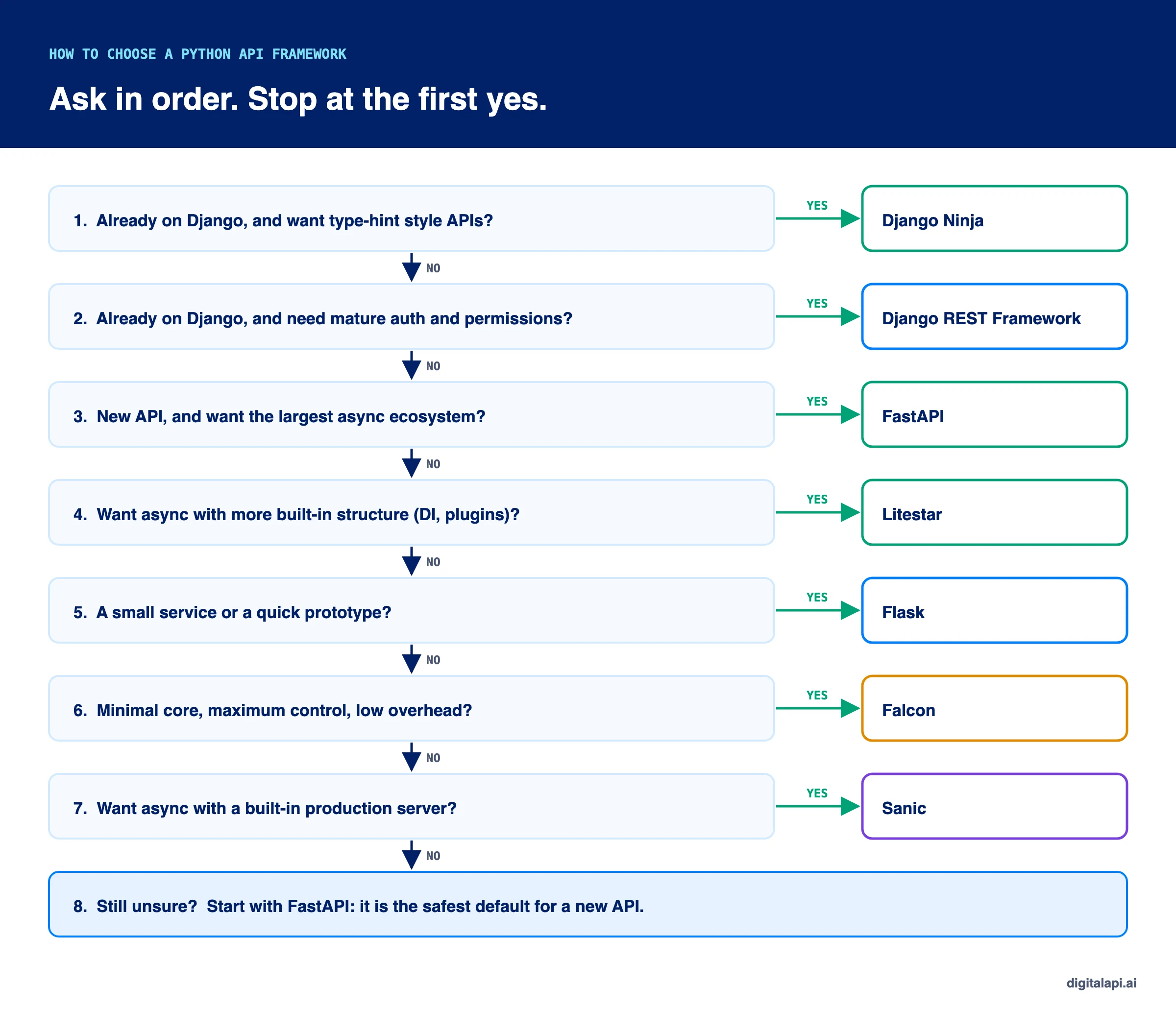
Start from what you already run, then from whether you need async and automatic docs. Framework choice is cheap at the start and expensive to reverse later, so match it to the team, not to a benchmark chart.
- Already on Django? Use DRF for mature, permission-heavy CRUD apps, or Django Ninja for typed, async endpoints.
- New API-only service? Use FastAPI. Choose Litestar if you want built-in dependency injection and more structure from the start.
- Small service or existing Flask code? Stay on Flask and add Flask-Smorest for OpenAPI 3.
- Spec-first or minimal footprint? Falcon.
- Want one package for app and server? Sanic.
A good python rest api framework choice also considers the team's hiring pool. FastAPI, Django and Flask have by far the largest communities, which means more answers, more examples and easier onboarding.
Which is better, Flask, Django or FastAPI?
None is better in every case: FastAPI is best for new async APIs, Django for full applications with data models and admin, and Flask for small, simple services. In a FastAPI vs Flask comparison, FastAPI wins on built-in validation, async and docs; Flask wins on simplicity and the size of its extension ecosystem.
From Python API framework to production: docs, gateway and governance
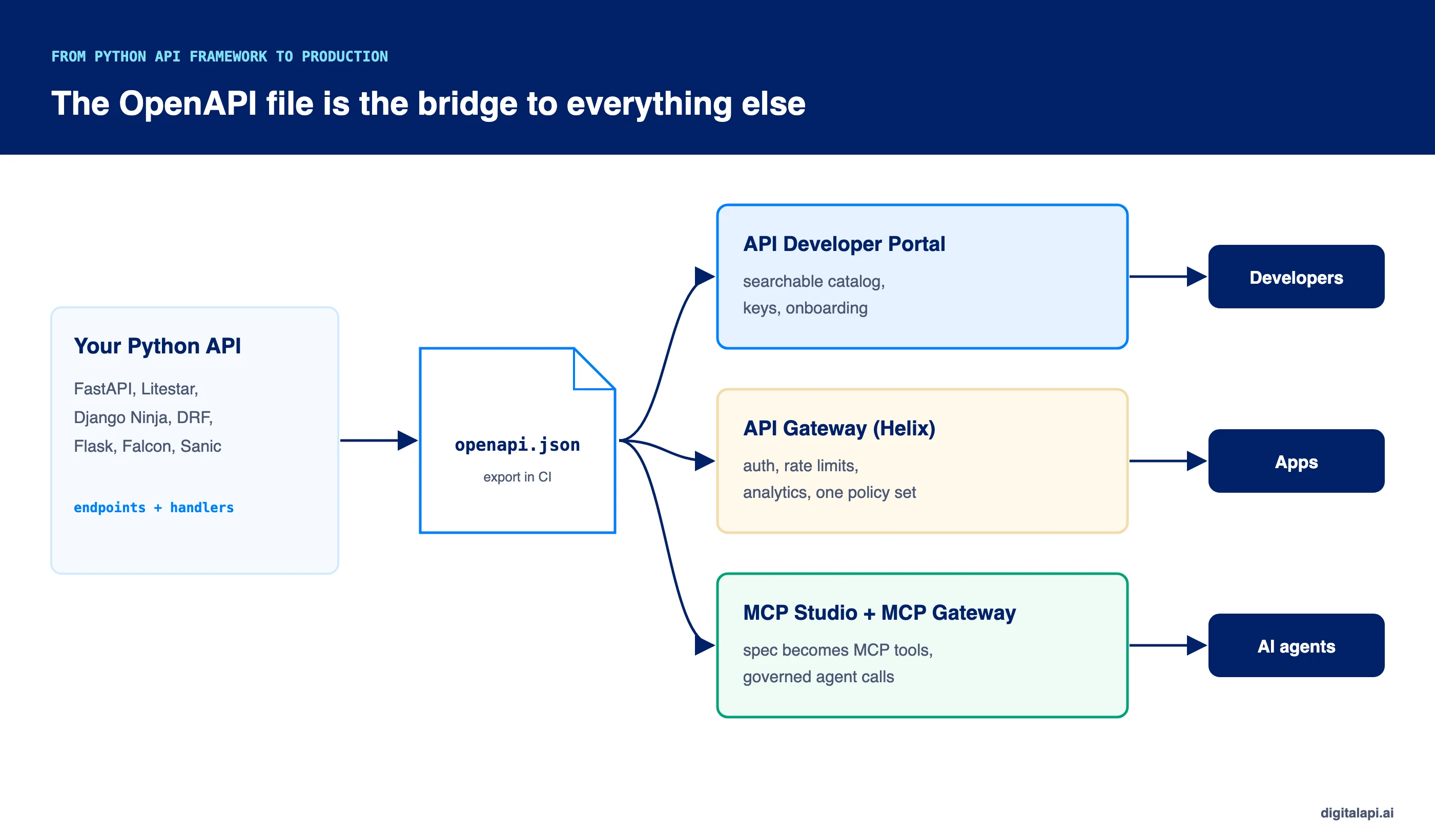
Your framework gives you endpoints and an OpenAPI file. Production needs more: a catalog people can find, consistent auth and rate limits, versioning, and visibility across every team's APIs. That layer sits outside any single Python API framework.
Four frameworks in this guide emit OpenAPI automatically (FastAPI, Litestar, Django Ninja and Sanic with its official extension), and that file is the bridge to everything else. A few practical steps:
- Treat the generated OpenAPI file as a release artefact. Export it in CI and review diffs, so a renamed field doesn't ship unnoticed. Our REST API best practices guide covers versioning and error formats.
- Publish it to a developer portal. Swagger UI at
/docsworks for the author. Consumers need a searchable catalog with ownership, keys and onboarding. The DigitalAPI API Developer Portal imports OpenAPI specs and gives consumers self-serve access. - Put a gateway in front. Auth, rate limiting and analytics belong in one place, not in seven frameworks' middleware. Helix, the DigitalAPI API Gateway, applies the same policies to a FastAPI service and a Django one.
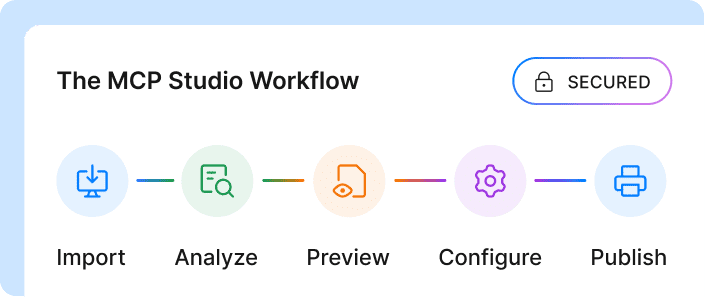
- Expose it to AI agents safely. The same OpenAPI file can become MCP tools. See how to convert OpenAPI specs into an MCP server, or do it without code in MCP Studio. Route agent traffic through the MCP Gateway so tool calls get the same governance as API calls. If you want to write the server by hand in Python, follow how to build an MCP server.
Working in more than one language? Compare this list with our top Golang API frameworks, top Java REST API frameworks and the cross-language top 10 API frameworks.
Key takeaways
- FastAPI is the best Python API framework for most new projects: async, typed, with OpenAPI 3.1 and the largest community (about 105,000 GitHub stars).
- On Django, choose DRF for maturity or Django Ninja for typing and async. DRF has no native async views, and its built-in OpenAPI generator is deprecated in favour of drf-spectacular.
- Flask is still maintained and still a good fit for small services, but async gives no extra concurrency on WSGI, and Flask-RESTX emits Swagger 2.0, not OpenAPI 3.
- Litestar, Falcon and Sanic are strong specialists: structured async, minimal control and a built-in server respectively.
- All seven use permissive licences (MIT, BSD-3-Clause or Apache-2.0).
- The framework is only step one. Publish the OpenAPI file to a portal and put a gateway in front before other teams depend on the API.
Frequently asked questions
1. What is the best Python API framework in 2026?
For most new projects, FastAPI is the best Python API framework in 2026. It is async, uses type hints for validation and generates OpenAPI 3.1 docs automatically. Django REST Framework or Django Ninja is better if you already run Django, and Flask remains a good choice for small, simple services.
2. Which is better, Flask or Django or FastAPI?
It depends on the project. FastAPI is best for new API-only services that need async and automatic docs. Django, with DRF or Django Ninja, is best for full applications that need an ORM, admin and user management. Flask is best for small services and teams that want a minimal core they extend themselves.
3. Is Flask still used in 2026?
Yes. Flask is actively maintained: version 3.1.3 was released in February 2026, and the repository has about 75,000 GitHub stars. It remains common for small APIs, internal tools and existing codebases. For new async-heavy APIs, most teams now pick FastAPI or Litestar instead.
4. Can FastAPI replace Django?
For API-only services, yes. For full web applications, usually not on its own. Django includes an ORM, migrations, admin, authentication and templates, while FastAPI focuses on the API layer. You can rebuild those pieces with other libraries, but many teams instead keep Django for the core product and use FastAPI for separate services.
5. What is FastAPI used for?
FastAPI is used to build HTTP APIs in Python: microservices, internal APIs, backends for web and mobile apps, and machine learning model serving. Its type-hint validation and automatic OpenAPI docs make it popular for APIs that other teams or AI agents consume, because the contract is always documented.
6. Is Netflix using FastAPI?
Yes, at least for some tools. The FastAPI homepage notes that Netflix built Dispatch, its open-source crisis management orchestration framework, with FastAPI. That does not mean all of Netflix's services run on FastAPI; large companies use many languages and frameworks.
7. Does Django REST Framework support async?
Not natively. DRF 3.18 handles requests synchronously, and an async def view decorated with @api_view fails because DRF expects a response, not a coroutine. Django itself supports async views, so teams that need async on Django often use Django Ninja or a third-party async add-on for DRF.
8. Which Python frameworks generate OpenAPI docs automatically?
FastAPI, Litestar and Django Ninja generate OpenAPI 3.1 out of the box. Sanic generates OpenAPI 3.0 through its official Sanic Extensions package. Flask needs an extension such as Flask-Smorest (OpenAPI 3) or Flask-RESTX (Swagger 2.0), DRF recommends drf-spectacular, and Falcon relies on third-party libraries.
9. What are the best Flask alternatives?
The main Flask alternatives are FastAPI for typed, async APIs with automatic docs, Litestar for structured async APIs, Falcon for minimal REST services, and Quart, an ASGI reimplementation of Flask that the Flask docs recommend for mainly async codebases. Sanic is another option if you want a built-in server.
Conclusion
There is no single winner, but there is a sensible default. For a new service, FastAPI is the Python API framework that gives you async, validation and OpenAPI docs with the least effort. If you live in Django, DRF and Django Ninja keep you close to your data. Flask, Litestar, Falcon and Sanic each fit a narrower job very well.
Whichever you choose, the OpenAPI file it produces is the real hand-off. Publish it, put it behind a gateway and keep it in a catalog, and the framework choice stops being a risk for the rest of the organisation.
Built your Python API? Publish, document and govern it in DigitalAPI's developer portal. Publish Your API in the Developer Portal
Prefer a walkthrough? Book a Demo
Dhayalan Subramanian is Associate Director, Product Growth at DigitalAPI, where he leads go-to-market and product growth for the company’s multi-gateway API management platform. His work focuses on helping large enterprises and mid-market cloud companies consolidate APIs across AWS, Azure, Apigee, Kong, MuleSoft, and other gateways into a single control plane for governance, discovery, monetization, and agent consumption.
Dhayalan brings 14+ years of experience across product strategy, enterprise architecture, and engineering leadership. Earlier in his career, he held senior roles at Encora (as Associate Architect and Technical Manager), Mindtree (Technology Lead), Tech Mahindra (Technical Lead), and Primus Analytics, where he designed integration frameworks and delivered enterprise-grade digital platforms for global customers.
At DigitalAPI, he works directly with platform, integration, and developer experience leaders at Fortune 500 organizations to operationalize unified API catalogs, developer portals, and MCP-ready APIs. He writes regularly on API developer experience, API governance, and AI agent architectures.
One email a fortnight. Worth opening.
A short digest of what we're writing, what we're learning from customers, and the handful of links you'd actually want from us. No tracking pixels.