




FastAPI Alternatives: 7 Python API Frameworks to Consider
FastAPI is the most used Python web framework, but it is not the right fit for every API. This guide compares FastAPI vs Flask vs Django and seven alternatives, with versions checked on PyPI in November 2026.

TL;DR:
What are the best FastAPI alternatives?
The best FastAPI alternatives in 2026 are Litestar for async APIs with more structure, Django Ninja for FastAPI-style typing inside Django, and Flask for small services. Sanic, Falcon, Robyn and BlackSheep suit lean or high-throughput services.
Most teams should stay on FastAPI unless they hit a specific limit.
Your FastAPI service started as three endpoints. A year later it has 80 endpoints and a custom auth layer. The admin team now wants a back-office UI. Someone asks whether you picked the wrong framework.
Usually you did not. FastAPI is now the most used Python web framework. But a few concrete limits do push teams toward FastAPI alternatives, and knowing them saves a rewrite you did not need.
The PSF and JetBrains Python Developers Survey 2024 found 38% of Python developers use FastAPI, up from 21% in 2021. Django sat at 35% and Flask at 34%.
This guide starts with the triggers that make teams look elsewhere. It then compares FastAPI vs Flask vs Django and profiles seven alternatives, with versions checked on PyPI on 26 November 2026.
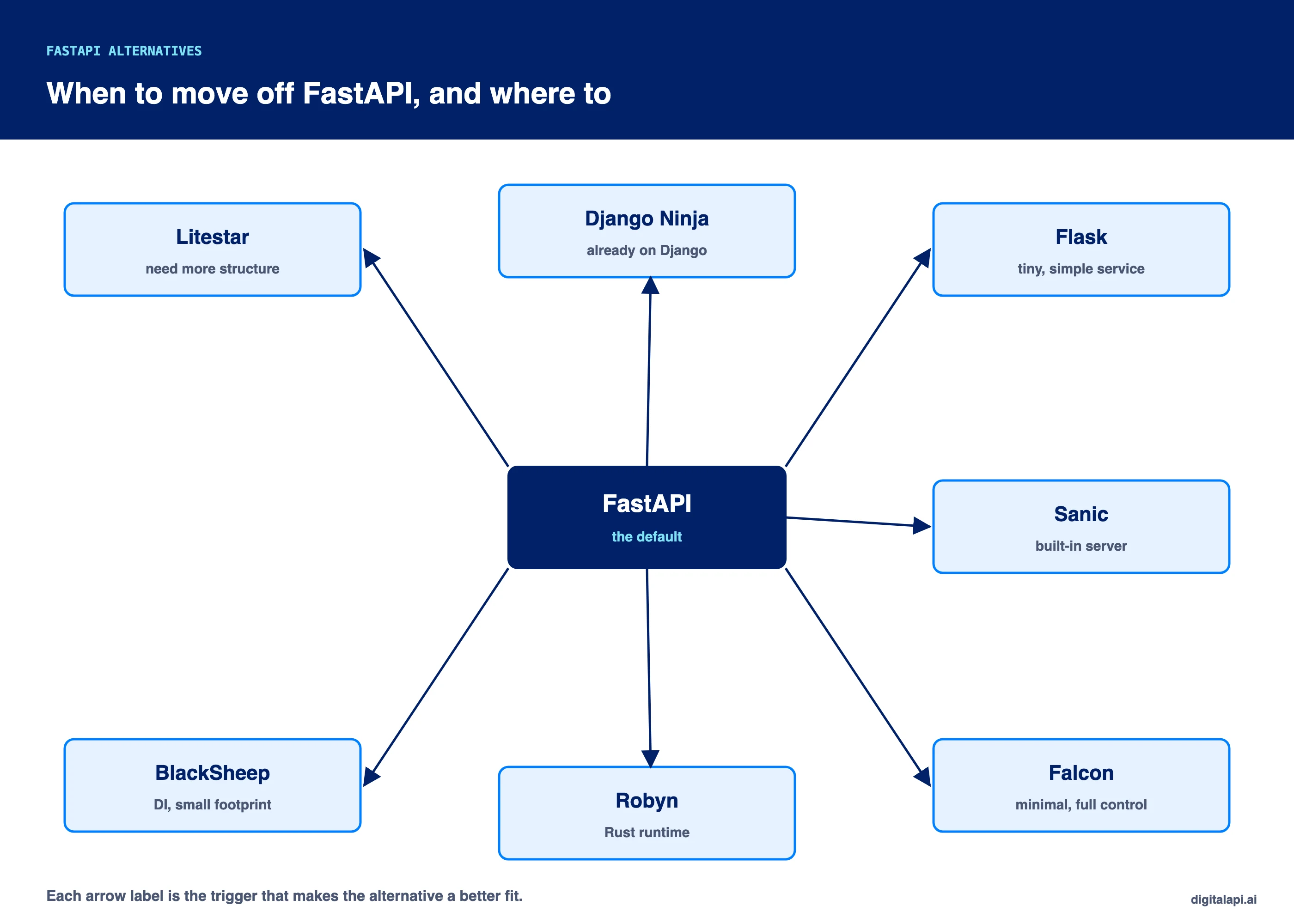
Why do teams look for FastAPI alternatives?
Teams look for alternatives to FastAPI when a project outgrows a micro-framework, needs Django's built-ins, or wants a different release model. FastAPI itself is healthy. The triggers are about fit, not decline.
The five triggers we see most often:
- Version stability. FastAPI is still on 0.x versioning (0.165.0 on 18 November 2026). Some enterprise teams want a 1.x or 2.x contract before they standardise.
- Missing built-ins. FastAPI has no ORM, migrations, admin or user system. Teams that need all four end up rebuilding Django.
- Structure at scale. Large codebases want stronger conventions, layered dependency injection and plugin points out of the box.
- Existing estate. A team already running Django or Flask may get more from typing its current stack than from a migration.
- Runtime choices. Some teams want a built-in server or a Rust runtime. Others compare Uvicorn alternatives such as Granian or Hypercorn.
If none of these apply, stay on FastAPI. The rest of this guide helps when one does.
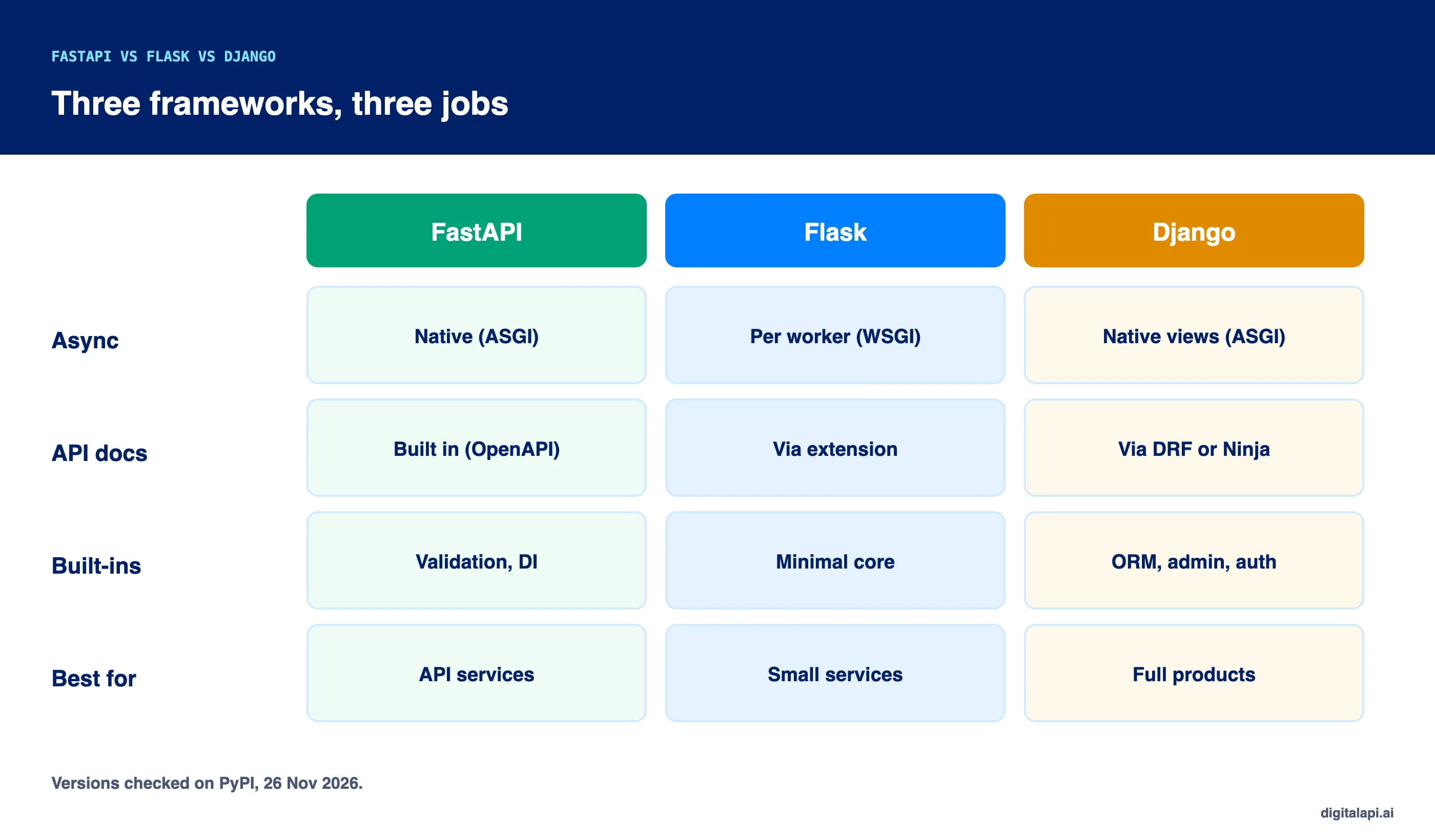
FastAPI vs Flask vs Django: how do they compare?
FastAPI is an async API toolkit with automatic OpenAPI docs. Flask is a minimal synchronous micro-framework. Django is a full web framework with an ORM and admin. The right one depends on whether you are building an API service, a small app or a full product.
Versions, dates, licences and Python requirements from PyPI; stars from GitHub; all checked 26 November 2026.
Adoption is close at the top. The Stack Overflow 2025 Developer Survey found 14.8% of all respondents used FastAPI, 14.4% Flask and 12.6% Django. The survey called FastAPI's 5-point rise one of the biggest shifts among web frameworks.
FastAPI vs Flask: which is better?
FastAPI is better for new APIs that need async I/O, request validation and generated docs. Flask is better for small sync services and teams with existing Flask code. On FastAPI vs Flask, the deciding factor is usually async concurrency and docs, not raw speed.
Flask can run async def views, but the Flask docs note each request still ties up a worker. FastAPI runs handlers on an event loop, so one worker serves many waiting requests. If you love Flask's style but need async, Quart is the ASGI version of Flask, from the same Pallets team.
FastAPI vs Django: which should you pick?
Pick FastAPI for API-only services. Pick Django when you also need an ORM, migrations, admin and user management. The FastAPI vs Django choice is "API service or full web product?"
Many teams run both. Django holds the core product and data model, and FastAPI serves models or edge APIs. For a typed API inside Django, Django Ninja gives you FastAPI-style code without leaving the framework.
What are the best FastAPI alternatives?
Seven frameworks cover the realistic alternatives: Litestar, Django Ninja, Flask, Sanic, Falcon, Robyn and BlackSheep. Each one beats FastAPI for a specific need, and each has a different migration cost.
Versions, licences and dates from PyPI; stars and licences from GitHub; checked 26 November 2026.
We do not quote throughput benchmarks. Public suites such as the TechEmpower Framework Benchmarks test synthetic workloads, and production speed depends far more on your database, server and worker count. For tested hello-world code for most of these frameworks, see our best Python API frameworks guide.
1. Litestar
Litestar is the closest like-for-like alternative: async, typed and OpenAPI-first, with more built in than FastAPI. It adds layered dependency injection, plugins and support for Pydantic, attrs, dataclasses and msgspec models, per the Litestar docs.
- Beats FastAPI when: a large codebase needs conventions, controllers and DI scopes that FastAPI leaves to you.
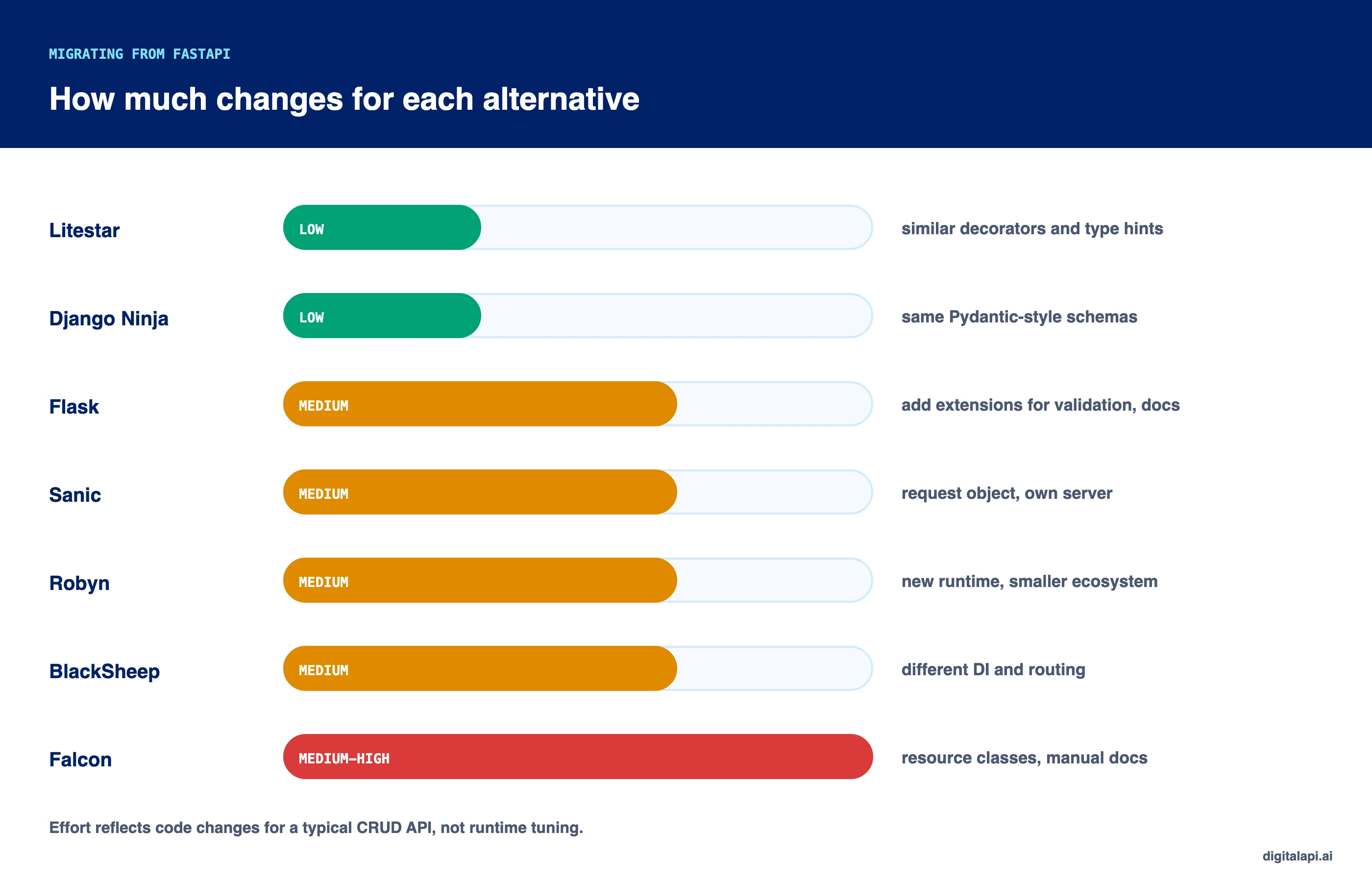
- Migration effort: low to medium. Route decorators and type-hinted handlers look similar, so most changes are mechanical.
- Watch out for: a smaller community, and planned removals in 3.0.
Searches for Litestar vs FastAPI usually come down to this trade: FastAPI has the bigger ecosystem, Litestar has more structure in the box.
2. Django Ninja
Django Ninja brings FastAPI-style type hints and OpenAPI docs to Django views. It runs inside a Django project, so you keep the ORM, admin and auth.
- Beats FastAPI when: your data model already lives in Django, or you need the admin.
- Migration effort: low from FastAPI (similar syntax), but you adopt all of Django.
- Watch out for: one maintainer leads the project, so check release cadence for your risk profile.
3. Flask
Flask is small, stable and still active, with 3.1.3 released in February 2026. Validation and docs come from extensions such as Flask-Smorest. Teams weighing Flask alternatives often move the other way, from Flask to FastAPI or Quart.
- Beats FastAPI when: the service is small, synchronous and your team already knows Flask.
- Migration effort: medium. You lose automatic validation and docs and must add extensions.
- Watch out for: async views do not add concurrency on WSGI.
4. Sanic
Sanic is an async framework that ships its own production server. It also runs on ASGI servers, and its official Sanic Extensions package adds OpenAPI docs.
- Beats FastAPI when: you want one package for app and server, with no Uvicorn decision.
- Migration effort: medium. Handlers take a request object instead of typed parameters.
- Watch out for: OpenAPI and validation live in the extension, not the core.
5. Falcon
Falcon is a minimal framework for REST services, with resource classes and no hidden magic. Version 4.4.0 supports both WSGI and ASGI apps.
- Beats FastAPI when: you want a small dependency tree and explicit control over every response.
- Migration effort: medium to high. You rewrite handlers as resource classes and add your own validation.
- Watch out for: no built-in OpenAPI generation.
6. Robyn
Robyn is an async Python framework with a Rust runtime, multi-core scaling and automatic OpenAPI generation. Its GitHub README also lists WebSockets and direct Rust integration.
- Beats FastAPI when: you want Rust-level runtime work without writing Rust, and are happy on a pre-1.0 project.
- Migration effort: medium. Routing looks familiar, but the request model and server differ.
- Watch out for: 0.x versioning (0.88.0) and a smaller ecosystem.
7. BlackSheep
BlackSheep is an ASGI framework with built-in dependency injection, automatic binding by type and OpenAPI generation. Its GitHub README documents all three.
- Beats FastAPI when: you want DI as a first-class feature in a compact, MIT-licensed framework.
- Migration effort: medium. Binding uses its own
FromJSONandFromQuerytypes. - Watch out for: the smallest community here (about 2,400 stars).
How do you choose among FastAPI alternatives?
Start from the trigger that made you look, then pick the framework that removes it with the least migration. If no trigger applies, FastAPI stays the default.
Stay on FastAPI if:
- Your service is API-only and the async, typed, docs-first model fits.
- Your team is productive and the 0.x versioning has not caused real upgrade pain.
- You can add structure yourself with routers, dependencies and a shared project template.
Pick an alternative if:
- You need structure in the box: Litestar.
- You already run Django: Django Ninja.
- The service is tiny and sync: Flask.
- You want one package for app and server: Sanic.
- You want a minimal core: Falcon.
- You want a Rust runtime: Robyn.
- You want built-in DI in a small framework: BlackSheep.
Before you migrate, read each project's repository. Searching for FastAPI alternatives on GitHub shows release cadence, open issues and maintainer count, which matter more than feature lists.
What happens after you pick a framework?
Whatever you choose, the API still needs docs, security and a way for consumers, including AI agents, to use it. Every framework above can produce an OpenAPI document, natively or through an extension.
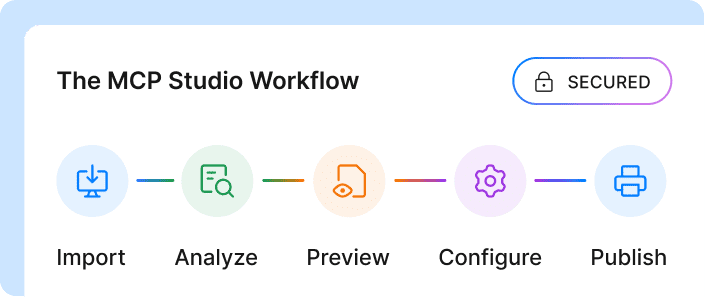
That document is now the bridge to agents. Agents call tools over the Model Context Protocol (MCP), and each endpoint needs an MCP definition first. You can build an MCP server by hand. Or use DigitalAPI MCP Studio: paste your OpenAPI URL and it publishes a secure MCP server, with no wrapper code.
See how DigitalAPI turns any Python API into a governed, agent-ready MCP server → Book a Demo
Key takeaways
- FastAPI is still the default. It led the 2024 PSF and JetBrains survey at 38%, and Stack Overflow 2025 put it at 14.8%.
- Look at FastAPI alternatives for a reason. Common triggers are 0.x versioning, missing built-ins, structure at scale and an existing Django or Flask estate.
- FastAPI vs Flask: FastAPI for async APIs with generated docs; Flask for small sync services.
- FastAPI vs Django: FastAPI for API-only services; Django when you need ORM, admin and auth.
- Litestar and Django Ninja are the easiest moves. Their syntax is closest to FastAPI.
- Check the repository, not only the feature list. Release cadence and maintainers matter for long-lived APIs.
Frequently asked questions
1. What is the best alternative to FastAPI?
Litestar is the closest alternative for most teams. It is async, typed and generates OpenAPI docs, and it adds dependency injection and plugins that FastAPI leaves to you. If you already run Django, Django Ninja is the better choice because it keeps the ORM and admin. For small synchronous services, Flask remains a simple option.
2. Is FastAPI or Flask better?
FastAPI is better for new APIs that need async I/O, request validation and generated OpenAPI docs. Flask is better for small synchronous services and teams with existing Flask code. Flask supports async views, but each request still uses a worker. If you like Flask's style but need async, consider Quart, the ASGI version of Flask.
3. Is FastAPI still in demand?
Yes. The PSF and JetBrains Python Developers Survey 2024 found 38% of Python developers use FastAPI, up from 21% in 2021. The Stack Overflow 2025 Developer Survey put FastAPI at 14.8% of all respondents, ahead of Flask and Django. The project released version 0.165.0 on 18 November 2026.
4. Should I use FastAPI or Django?
Use FastAPI for API-only services such as microservices or model serving, where async and automatic docs matter. Use Django when you also need an ORM, migrations, an admin panel and user management. Many teams run both. If you want typed APIs inside Django, Django Ninja offers FastAPI-style syntax.
5. What are the best Flask alternatives?
FastAPI is the most common Flask alternative for new APIs, thanks to async support and built-in docs. Quart keeps Flask's API but runs on ASGI. Litestar suits larger async projects, and Falcon suits teams that want a minimal core. Django with Django Ninja fits when the project grows into a full product.
6. What are the alternatives to Uvicorn?
Granian and Hypercorn are the main Uvicorn alternatives for serving ASGI apps such as FastAPI. Granian is an HTTP server written in Rust, and Hypercorn is an ASGI server inspired by Gunicorn. Some frameworks avoid the choice: Sanic ships its own production server, and Robyn runs on its own Rust runtime.
7. Is Netflix using FastAPI?
Netflix has used FastAPI for at least one public project. The FastAPI homepage quotes Netflix's announcement of Dispatch, an open-source crisis management orchestration framework built with FastAPI. That does not mean Netflix runs all of its services on FastAPI.
Conclusion
Most teams should not switch. FastAPI is the most used Python web framework, and it fits API-only services well. Look at FastAPI alternatives when a specific trigger appears: 0.x versioning, missing built-ins, structure at scale or an existing Django or Flask estate.
When one does, pick the alternative that removes it with the least migration. Litestar and Django Ninja are the easiest moves. Flask, Sanic, Falcon, Robyn and BlackSheep each fit a narrower need.
Then plan for what comes next: docs, security and agent access built on your OpenAPI document.
Paste your OpenAPI URL and publish a secure MCP server your agents can use, with DigitalAPI MCP Studio. Turn your Python API into an MCP server without code
Prefer a walkthrough? Book a Demo
Dhayalan Subramanian is Associate Director, Product Growth at DigitalAPI, where he leads go-to-market and product growth for the company’s multi-gateway API management platform. His work focuses on helping large enterprises and mid-market cloud companies consolidate APIs across AWS, Azure, Apigee, Kong, MuleSoft, and other gateways into a single control plane for governance, discovery, monetization, and agent consumption.
Dhayalan brings 14+ years of experience across product strategy, enterprise architecture, and engineering leadership. Earlier in his career, he held senior roles at Encora (as Associate Architect and Technical Manager), Mindtree (Technology Lead), Tech Mahindra (Technical Lead), and Primus Analytics, where he designed integration frameworks and delivered enterprise-grade digital platforms for global customers.
At DigitalAPI, he works directly with platform, integration, and developer experience leaders at Fortune 500 organizations to operationalize unified API catalogs, developer portals, and MCP-ready APIs. He writes regularly on API developer experience, API governance, and AI agent architectures.
One email a fortnight. Worth opening.
A short digest of what we're writing, what we're learning from customers, and the handful of links you'd actually want from us. No tracking pixels.