



Ecommerce APIs: Types, Examples, and How to Manage Them
Every online store runs on APIs for catalog, cart, payments, orders and shipping. This guide defines each type, labels real examples by category and shows how to integrate and manage ecommerce APIs safely at scale.

TL;DR:
What is an ecommerce API?
An ecommerce API is an interface that lets software read and change store data: products, carts, payments, orders and shipments.
Platforms, payment providers and carriers each publish their own.
Most stores connect a dozen or more, so the hard part is managing them, not finding them.
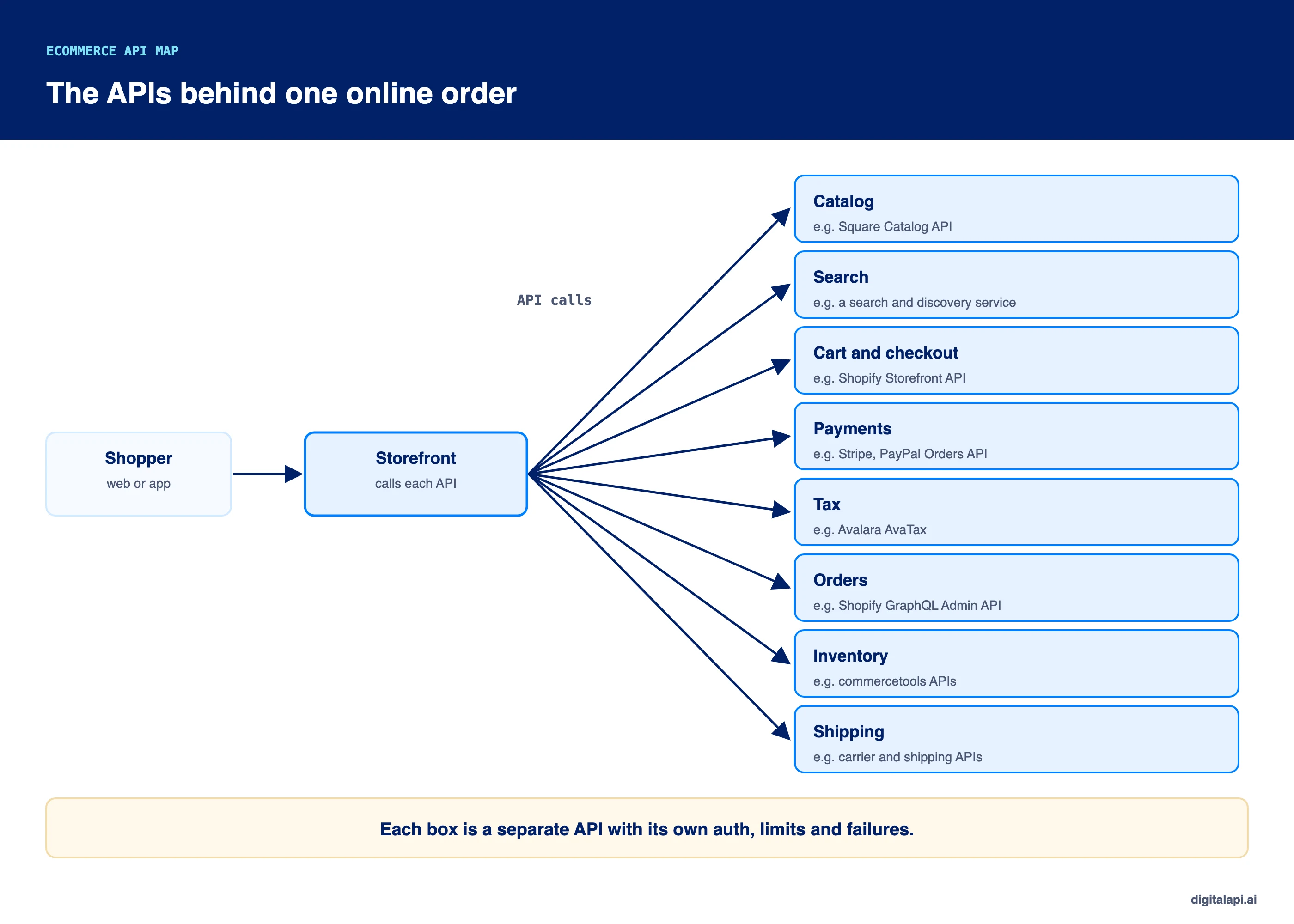
Open the network tab on any checkout page. You will see calls to catalog, cart, payment, tax and shipping services. Each one is an ecommerce API.
Online sales keep growing, so this traffic keeps growing too. The US Census Bureau's Q3 2026 release put e-commerce at 17.9% of total US retail sales. That is up 10.4% from a year earlier.
This guide defines the main types of ecommerce APIs and labels popular examples by category. It then covers headless commerce, integration patterns and pitfalls, and how to manage commerce APIs when partners depend on them.
What is an ecommerce API?
An ecommerce API is a set of endpoints that exposes commerce functions, such as products, carts and orders, to other software. Storefronts, mobile apps, ERPs, marketplaces and partners call these APIs instead of reading the store's database directly.
When people search "What is API ecommerce?", they usually mean one of two things. The first is API-based commerce, where every store function is reachable through APIs. The second is a single provider's API, such as a payments API.
Both share one idea: commerce logic sits behind APIs, and the front end calls them.
An API ecommerce platform is a commerce platform built this way. Every capability, from catalog to checkout, is available as an API first, and any user interface sits on top.
What are the main types of ecommerce APIs?
Most ecommerce APIs fall into nine categories, one for each step a product takes from listing to delivery. Each category has its own data model, failure modes and security needs.
- Catalog and product APIs: create and read products, variants, prices, images and collections.
- Search and discovery APIs: return ranked products for a query, filter or recommendation.
- Cart and checkout APIs: hold items, apply discounts and turn a cart into an order.
- Payment APIs: authorize, capture and refund payments, and handle wallets and saved cards.
- Order management APIs: track order status, splits, returns and cancellations.
- Inventory APIs: report and reserve stock by location or warehouse.
- Shipping and fulfillment APIs: quote rates, buy labels and track parcels.
- Tax APIs: calculate sales tax or VAT for an address and product at checkout.
- Customer and identity APIs: manage accounts, addresses, consent and loyalty data.
Two more show up in larger estates. Marketplace and channel APIs push listings and pull orders from selling platforms. Partner APIs let suppliers, affiliates and resellers read catalog or stock data from you.
What are popular ecommerce API examples?
The most cited ecommerce API examples come from commerce platforms, payment providers and marketplaces. The table labels each one by category, so you can see which job it does.
Facts were checked against each provider's developer docs on 27 Nov 2026. Versions change often, so confirm before you build.
Does Amazon use API?
Yes. Amazon gives sellers, vendors and their software partners the Selling Partner API (SP-API). It replaced the older Amazon MWS. SP-API covers listings, orders, inventory, fulfillment, finance and reports.
Amazon announced fees for third-party SP-API developers in November 2025. It cancelled them in May 2026. Sellers who use SP-API only for their own business were never in scope. For how seller sync differs from B2B API marketplaces, see marketplace API integration.
Does Shopify allow API?
Yes. Shopify publishes several APIs, including the GraphQL Admin API for back-office data and the Storefront API for custom storefronts. Shopify's docs now label the REST Admin API as legacy. Since 1 April 2025, new public apps in the Shopify App Store must use GraphQL.
Shopify does not list a per-call price for its APIs. Access is rate limited instead. The GraphQL Admin API uses a calculated query cost, and the allowance depends on the store's plan. Developers can build and test on free development stores through the Shopify Partner Program. For a REST and GraphQL refresher, see GraphQL vs REST.
What is headless ecommerce, and where do APIs fit?
Headless ecommerce separates the storefront, or "head", from the commerce back end. The two talk only through APIs. The front end can be a web app, a mobile app, a kiosk or an AI agent.
Composable commerce goes one step further. Instead of one platform behind the head, you assemble best-of-breed services for search, payments, content and orders. APIs are the glue.
The MACH Alliance describes this model as MACH architecture: Microservices, API-first, Cloud-native SaaS and Headless. It is a set of principles, not a standard, so implementations vary.
API-first work is now common outside retail too. Postman's 2025 State of the API Report found 82% of organizations have some level of API-first approach.
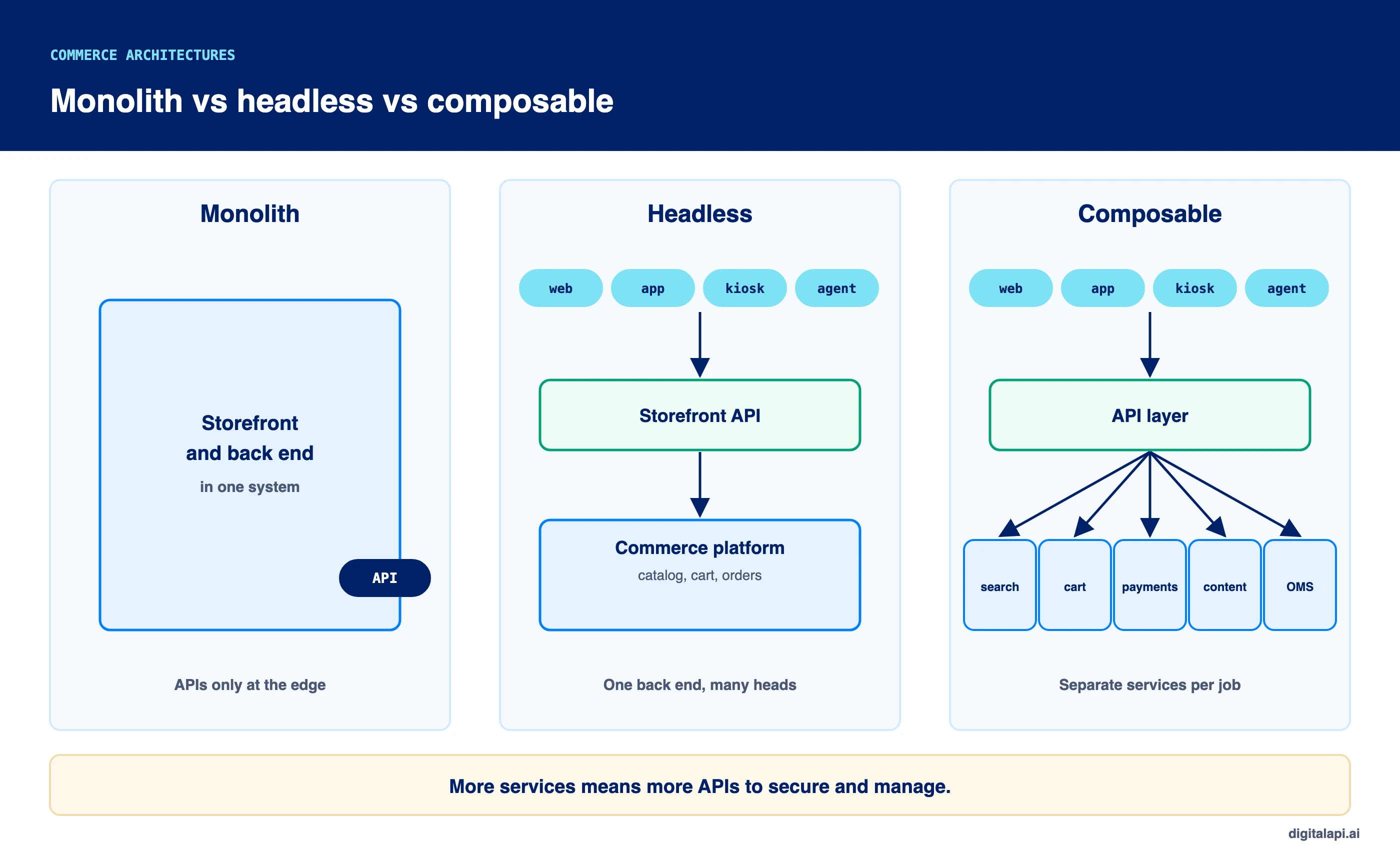
The trade-off: headless and composable setups free the front end, but multiply the APIs you must secure, version and monitor.
How does ecommerce API integration work?
Ecommerce API integration connects a store's systems so data moves between them without manual work. Most integrations use one of four patterns, often in combination.
- Direct API calls. One system calls another on demand. Example: checkout calls the tax API for each cart. Simple, but each new link adds a point-to-point dependency.
- Webhooks and events. The platform sends an event when something changes, such as "order created". Webhooks cut polling and keep systems in near real time.
- Scheduled batch sync. A job pulls changes on a timer, such as nightly price updates to an ERP. It suits large volumes that do not need real time.
- Middleware or iPaaS. An integration platform maps data between systems and handles retries. It helps when you connect many SaaS tools.
What are the common integration pitfalls?
Most ecommerce integration failures come from rate limits, duplicate writes and silent version changes. Plan for each one before launch.
- Rate limits at peak. Platforms throttle by request count or query cost. A flash sale can exhaust your allowance. Queue writes and back off on 429 or throttle errors.
- Duplicate orders or charges. Retries after a timeout can repeat a write. Use idempotency keys so the provider processes each request once.
- Lost webhooks. Endpoints go down and events get missed. Verify signatures, store event IDs and run a reconciliation job.
- Version drift. Platforms retire API versions on a schedule. Track deprecation dates and test against new versions early.
- Inventory races. Two channels can sell the last unit at once. Reserve stock through one inventory source of truth.
- Over-broad tokens. An app token with full write access is a large breach risk. Request only the scopes each integration needs, as covered in OAuth scopes.
How do you manage ecommerce APIs at scale?
At scale, the work shifts from building integrations to governing them: who can call which API, how often, and with what data. That matters most once partners, marketplaces and AI agents call your APIs, not only your own apps.
Retailers also publish APIs. Suppliers need stock levels, affiliates need product feeds and delivery partners need order status. Each is a new consumer with its own keys and risk.
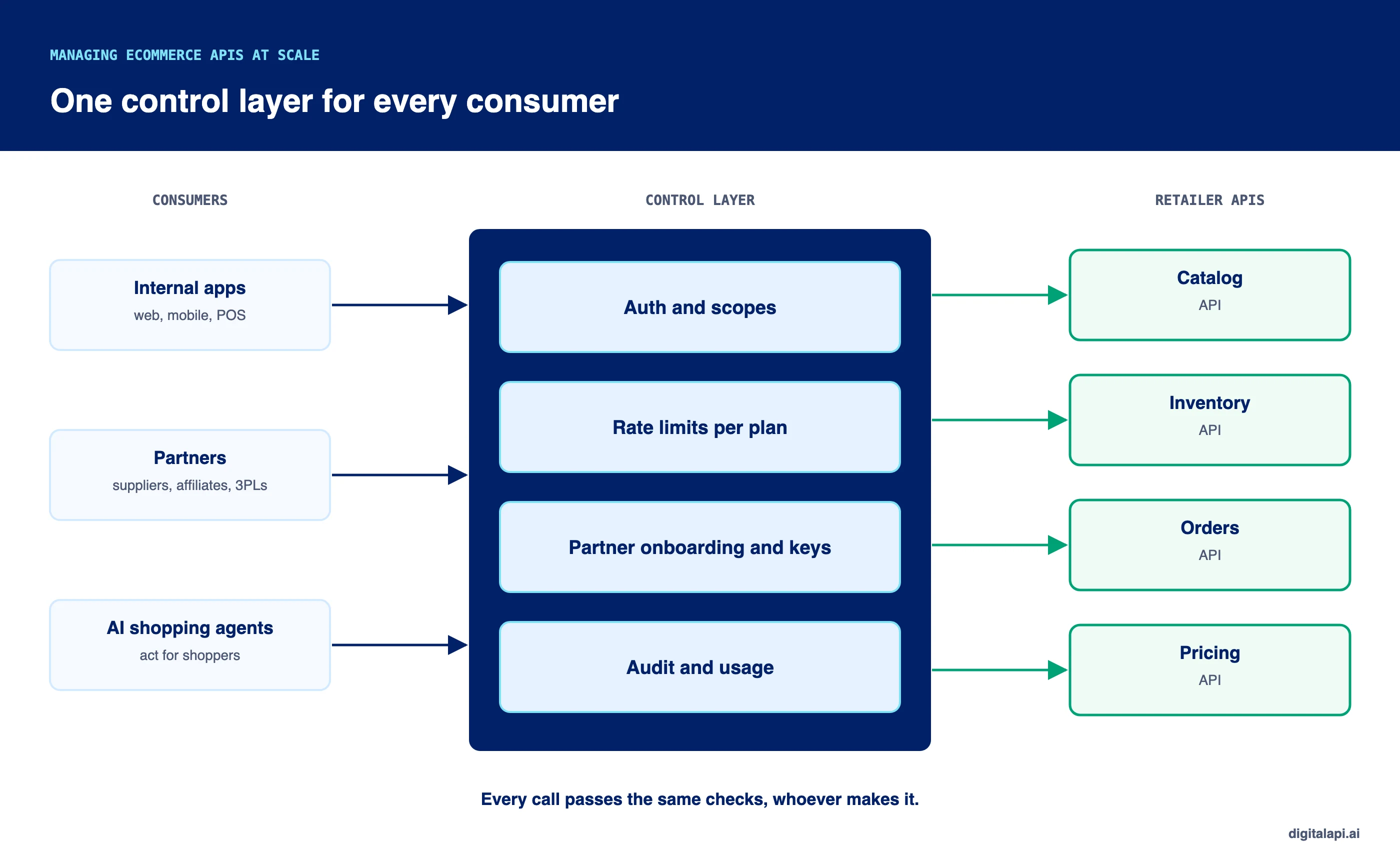
The controls that matter most:
- Authentication and scopes. Give every consumer its own credentials. Scope partner keys to read-only where possible.
- Rate limits per consumer. Set limits by partner plan, so one heavy caller cannot slow checkout for shoppers. See API rate limiting best practices.
- Self-serve partner onboarding. Manual key requests by email take weeks. A portal with approval flows and a sandbox cuts that down. See how to provide an API sandbox to your partners.
- One catalog across gateways. Commerce APIs often sit behind several gateways and clouds. Partners should find them in one place.
- Usage visibility. Track calls per partner, so you can spot abuse and plan capacity before peak season.
- Agent readiness. AI shopping agents now call commerce APIs too. Read how AI agents enable personalised shopping for where that is heading.
If you plan to charge partners for API access, that is a separate decision. The guide to monetizing ecommerce APIs covers pricing models.
Direct integrations are enough if:
- You connect a few providers, such as one platform, one payment provider and one carrier.
- Only your own apps call your APIs, with no partner or agent access.
- Traffic is steady, and platform rate limits cover your peak days.
You need an API management layer if:
- Partners, suppliers or affiliates call your APIs and each needs its own keys and limits.
- Your APIs sit behind several gateways or clouds, and nobody has one list of them.
- Partner onboarding takes weeks because keys and sandbox access are manual.
- AI agents or marketplaces are starting to consume your catalog and order data.
The DigitalAPI API Developer Portal gives partners self-service onboarding, sandbox access and keys that arrive once a request is approved. Partners rotate their own keys, admins can revoke access at once, and per-tier rate limits apply by plan.
See how DigitalAPI takes commerce partners from access request to first API call without manual keys → Book a Demo
Key takeaways
- An ecommerce API exposes one commerce function, such as catalog, cart, payments, orders, shipping or tax, to other software.
- Label APIs by category. Nine core types cover the path from listing to delivery.
- Amazon and Shopify both publish APIs. Amazon offers SP-API. Shopify offers GraphQL Admin and Storefront APIs, and its REST Admin API is legacy.
- Headless and composable commerce run on APIs, which multiplies the APIs you must secure and manage.
- Most integration failures are predictable: rate limits, duplicate writes, lost webhooks and version drift.
- At scale, governance matters more than building. Give partners scoped keys, limits per plan and self-serve onboarding.
Frequently asked questions
1. What is API ecommerce?
API ecommerce means running online store functions through APIs. Catalog, cart, checkout, payments, orders and shipping each sit behind an API, and storefronts, apps and partners call them. It lets one back end serve many front ends, such as a website, a mobile app and a marketplace. The term also covers single provider APIs, such as a payments or tax API.
2. Does Amazon use API?
Yes. Amazon offers the Selling Partner API (SP-API) to sellers, vendors and their software partners. It replaced the older Amazon MWS and covers listings, orders, inventory, fulfillment, finance and reports. Amazon announced third-party developer fees for SP-API in November 2025, then cancelled them in May 2026.
3. Does Shopify allow API?
Yes. Shopify offers the GraphQL Admin API for back-office data, the Storefront API for headless storefronts and other APIs for checkout, customer accounts and payments apps. Its REST Admin API is now legacy. New public apps submitted to the Shopify App Store must use GraphQL since 1 April 2025.
4. How much does Shopify API cost?
Shopify does not list a per-call price for its APIs. Access is limited by rate limits instead. The GraphQL Admin API uses calculated query cost, and the allowance depends on the merchant's plan. Developers can build and test for free on development stores through the Shopify Partner Program. Merchants pay for their Shopify plan and any paid apps.
5. What are the main types of ecommerce APIs?
The main types are catalog and product, search, cart and checkout, payments, order management, inventory, shipping and fulfillment, tax, and customer APIs. Larger retailers add marketplace or channel APIs to sell on other platforms. They also add partner APIs that share catalog, stock or order data with suppliers and affiliates.
6. What is a headless commerce API?
A headless commerce API is the API a custom front end calls to read products, manage carts and run checkout. The front end can be a web app, mobile app, kiosk or AI agent. Shopify's Storefront API and BigCommerce's GraphQL Storefront API are common examples. The back end stays the same while teams change the front end freely.
7. What is the difference between headless and composable commerce?
Headless commerce separates the storefront from one commerce back end, and they talk through APIs. Composable commerce replaces that single back end with several specialized services for search, payments, content and orders. All are joined by APIs. The MACH Alliance describes composable systems as Microservices, API-first, Cloud-native SaaS and Headless.
8. How do you secure ecommerce APIs shared with partners?
Give every partner its own credentials and scope them to the data it needs, often read-only. Set rate limits per partner plan, so one caller cannot slow checkout. Use a portal for onboarding, sandbox testing and key rotation. Log usage per partner, and revoke keys at once when a contract ends or a key leaks.
Conclusion
Every online order passes through many ecommerce APIs. An ecommerce API for catalog, one for payments, one for tax and one for shipping make up the basic set. Headless and composable commerce add more.
Start by listing every commerce API you call and every one you expose, labelled by category. Then fix the predictable failures: rate limits, retries, webhooks and versions.
Once partners and agents call your APIs, treat access as a product. Scoped keys, limits per plan and self-serve onboarding keep the store fast and the data safe.
Give suppliers, affiliates and partners self-serve access to your commerce APIs with scoped keys, sandbox testing and per-tier limits in the DigitalAPI partner portal. Expose your commerce APIs to partners safely
Prefer a walkthrough? Book a Demo
Dhayalan Subramanian is Associate Director, Product Growth at DigitalAPI, where he leads go-to-market and product growth for the company’s multi-gateway API management platform. His work focuses on helping large enterprises and mid-market cloud companies consolidate APIs across AWS, Azure, Apigee, Kong, MuleSoft, and other gateways into a single control plane for governance, discovery, monetization, and agent consumption.
Dhayalan brings 14+ years of experience across product strategy, enterprise architecture, and engineering leadership. Earlier in his career, he held senior roles at Encora (as Associate Architect and Technical Manager), Mindtree (Technology Lead), Tech Mahindra (Technical Lead), and Primus Analytics, where he designed integration frameworks and delivered enterprise-grade digital platforms for global customers.
At DigitalAPI, he works directly with platform, integration, and developer experience leaders at Fortune 500 organizations to operationalize unified API catalogs, developer portals, and MCP-ready APIs. He writes regularly on API developer experience, API governance, and AI agent architectures.
One email a fortnight. Worth opening.
A short digest of what we're writing, what we're learning from customers, and the handful of links you'd actually want from us. No tracking pixels.