





Best Node.js API Frameworks in 2026
Express, Fastify, NestJS, Hono, Koa, AdonisJS and Hapi compared on version, licence, TypeScript support, OpenAPI output and benchmark speed. Every version and download figure was checked on npm in November 2026.

TL;DR:
What is the best Node.js API framework?
The best Node.js API framework for most new APIs in 2026 is Fastify, for speed with schema validation. Large TypeScript teams should pick NestJS.
Express remains the safe default with the biggest ecosystem. Hono fits edge and multi-runtime APIs. Koa suits minimal stacks, AdonisJS suits full-stack TypeScript apps, and Hapi suits config-heavy enterprise services.
Your team needs a new orders API. One engineer reaches for Express because everyone knows it. Another wants NestJS because the codebase will grow. A third points at a benchmark and says Fastify is faster.
All three have a point. The right Node.js API framework depends on team size, TypeScript habits and where the API will run.
Node.js is not going anywhere. In the Stack Overflow 2025 Developer Survey, 48.7% of respondents used Node.js, more than any other web framework or technology. This guide compares seven frameworks on facts you can check, with tested code for the most popular ones.
What are the best Node.js API frameworks in 2026?
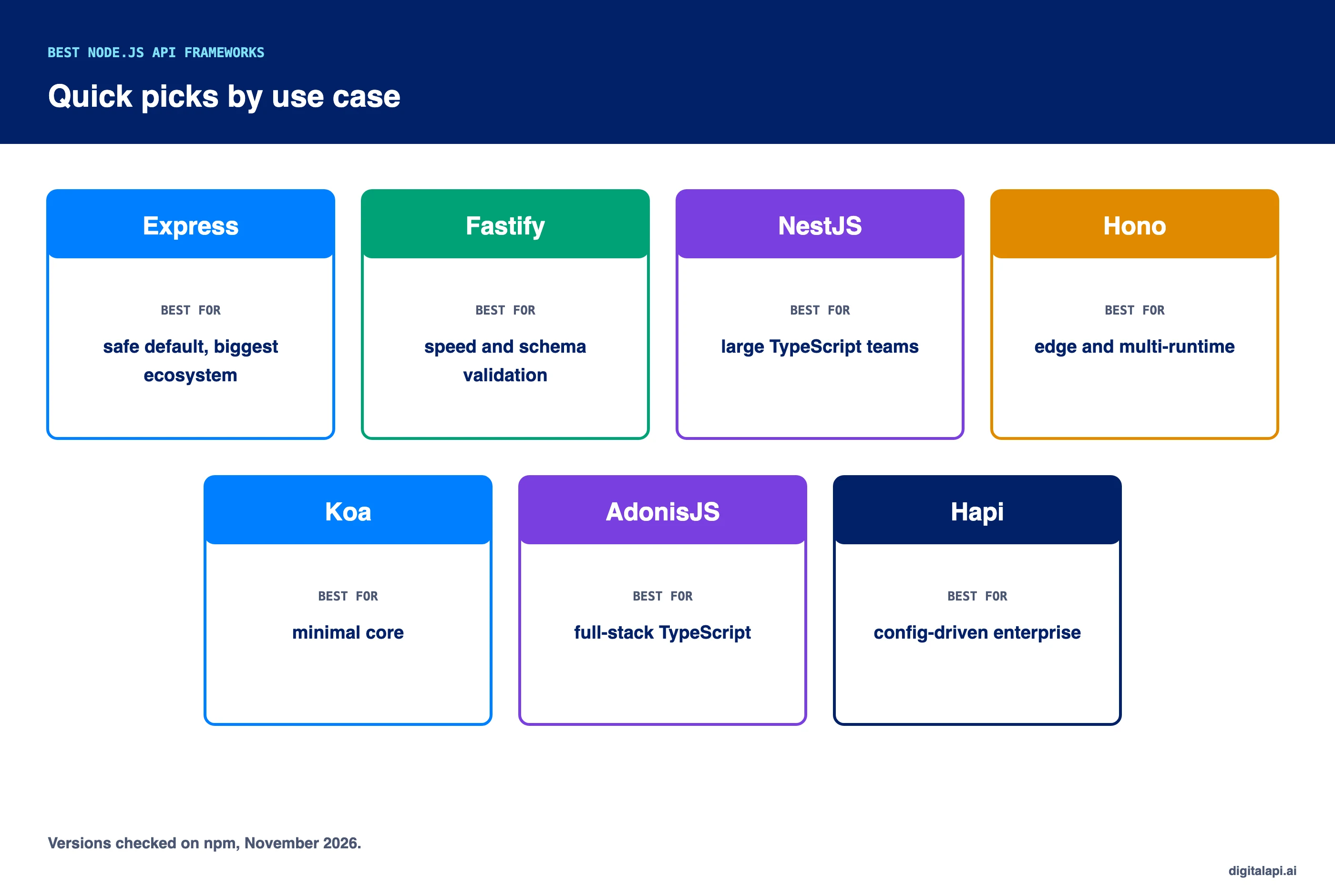
The best Node.js API frameworks in 2026 are Express, Fastify, NestJS, Hono, Koa, AdonisJS and Hapi. Each one wins for a different kind of team. Here are the quick picks:
- Express: best for a safe default. The largest ecosystem and the most tutorials, now on version 5.
- Fastify: best for speed with validation. JSON Schema validation and fast serialisation are built in.
- NestJS: best for large TypeScript teams. Modules, dependency injection and decorators give big codebases structure.
- Hono: best for edge and multi-runtime APIs. One codebase runs on Node.js, Bun, Deno and edge platforms.
- Koa: best for a minimal core. A small, async-first base where you add only what you need.
- AdonisJS: best for full-stack TypeScript apps. Routing, ORM, auth and validation ship together.
- Hapi: best for config-driven enterprise services. Strong plugin isolation and built-in input validation patterns.
If you only want a fast answer to "what is the best Node.js framework?", start with Fastify for new APIs. Start with NestJS when more than one team will work in the same codebase.
How did we compare these Node API frameworks?
We compared each Node API framework on facts you can check. These are version, licence, TypeScript and OpenAPI support, weekly downloads and one published benchmark. We avoided star counts and opinion scores.
- Version and licence: taken from the npm registry on 26 November 2026.
- TypeScript: whether the package ships its own type definitions.
- OpenAPI: whether docs come from the core or from a plugin, and which one.
- Downloads: npm weekly downloads for 19 to 25 November 2026. Downloads include installs pulled in by other packages, so treat them as reach, not popularity.
- Speed: the Fastify benchmarks page, updated 14 November 2026. It is published by the Fastify team, so read it as one data point.
- Code: we ran a "get order by ID" endpoint for Express, Fastify, Hono, Koa and Hapi on Node.js 24.18.
For the design rules behind any of these APIs, see our guide to REST API design principles.
How do the best Node.js API frameworks compare?
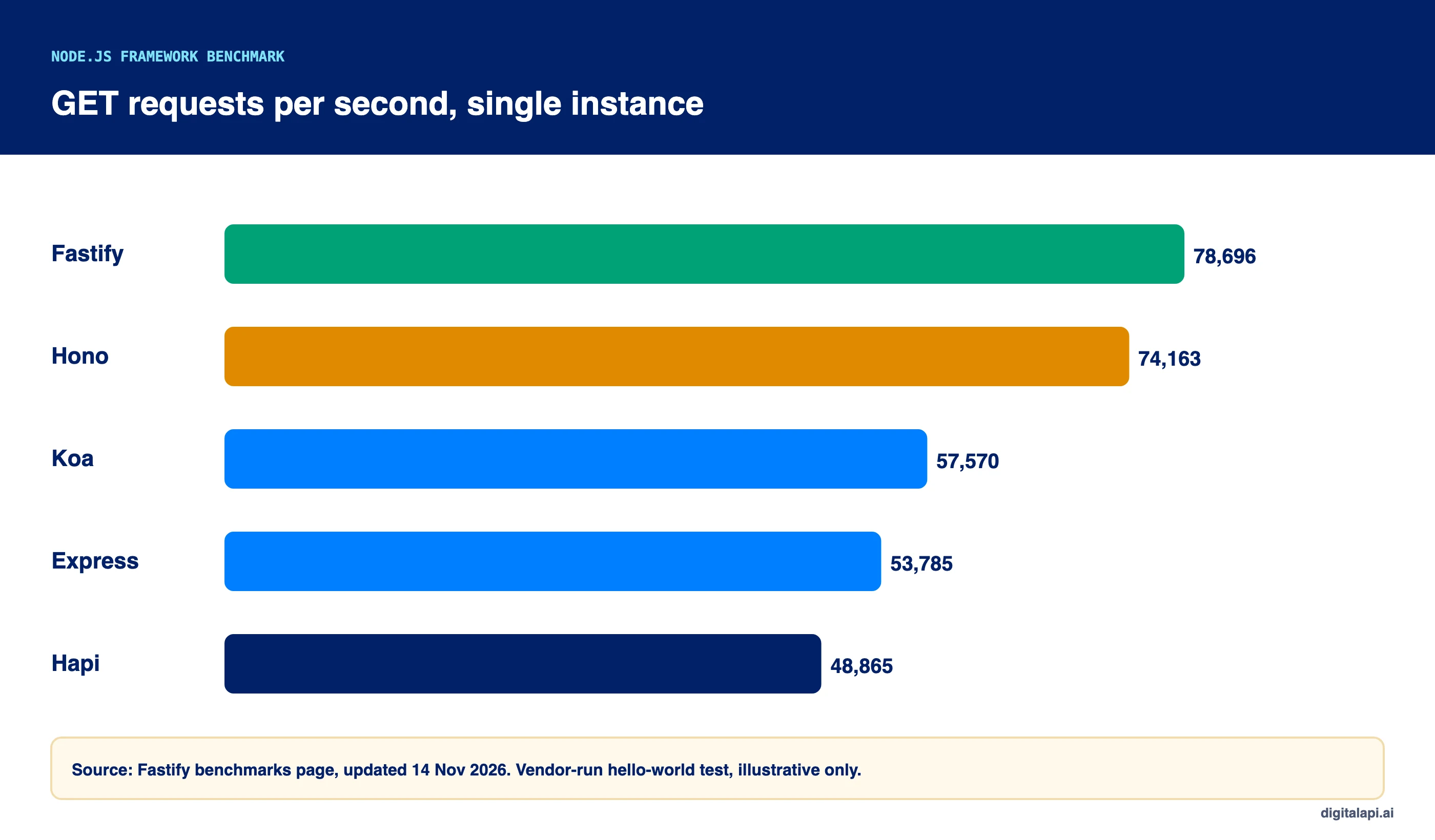
Fastify and Hono lead on raw speed, NestJS and AdonisJS lead on structure, and Express leads on ecosystem size. All seven are open source, and six use the MIT licence.
The benchmark is a single-instance "hello world" test, so real APIs with databases will show smaller gaps. On the POST test with a parsed JSON body, Fastify served 47,248 requests per second against 27,924 for Express.
1. Express
Express is the most widely used Node.js framework and the safe default for a new API. Version 5 shipped in September 2024 and is now the latest tag on npm. It needs Node.js 18 or later.
In the Stack Overflow 2025 survey, 19.9% of respondents used Express. NestJS was at 6.7% and Fastify at 2.9%. That reach means more middleware, more answers and easier hiring.
Express 5 adds native promise support in route handlers, so rejected promises reach your error handler. It has no built-in validation or OpenAPI output, so you add libraries for both.
Pick Express if your team wants the largest ecosystem and minimal ceremony. Skip it if you need schema-first validation or the highest throughput.
2. Fastify
Fastify is the speed pick, with JSON Schema validation and serialisation built into the core. It is the most common answer when teams look for Express js alternatives that still feel familiar.
You attach a schema to each route. Fastify validates input against it and uses it to speed up output serialisation. The same schemas feed @fastify/swagger, so your OpenAPI document stays in sync with the code.
Fastify ships its own TypeScript types and a plugin system with encapsulation, so plugins do not leak state into each other. Version 5 launched in September 2024.
Pick Fastify if throughput and validation matter from day one. Skip it if your team relies on Express-only middleware without equivalents.
3. NestJS
NestJS is the structure pick: a TypeScript-first framework with modules, dependency injection and decorators. It suits large teams that want one way to build every service.
NestJS runs on top of an HTTP adapter, Express by default, with an official Fastify adapter for speed. Version 12 shipped in August 2026 and requires Node.js 20 or later.
The official @nestjs/swagger module reads your decorators and DTO classes to build the OpenAPI document. Controllers, providers and guards keep auth, validation and business logic in separate layers.
The trade-off in NestJS vs Express is setup. NestJS adds more files and concepts up front. It pays off when the codebase and team grow.
Pick NestJS if several teams share a codebase or you come from Angular or Spring. Skip it if you are building a small service with a single owner.
4. Hono
Hono is the multi-runtime pick: one small, TypeScript-first framework that runs on Node.js, Bun, Deno and edge platforms. It is built on Web Standard Request and Response objects.
On Node.js, you add the @hono/node-server adapter. The same app code can then deploy to an edge platform without a rewrite.
For OpenAPI, @hono/zod-openapi defines routes with Zod schemas and generates the document. Hono served 74,163 requests per second in the Fastify GET benchmark, second only to Fastify.
Pick Hono if you deploy to edge runtimes or want one codebase across runtimes. Skip it if you need a large set of Node-specific middleware.
5. Koa
Koa is the minimal pick: a small, async-first core from the team behind Express. It ships no router or body parser, so you add only what you use.
Koa 3 shipped in April 2025 and needs Node.js 18 or later. Its middleware uses async functions and a shared context object, which makes error handling clean. Routing comes from @koa/router.
Koa has no official OpenAPI plugin, and its ecosystem is smaller than Express. That makes it a good fit for teams that want control over every layer.
Pick Koa if you want a thin, modern core and plan to choose each piece. Skip it if you want batteries included.
6. AdonisJS
AdonisJS is the full-stack pick: a TypeScript-first framework with routing, ORM, auth, validation and mail in one package. It feels closest to Laravel or Rails.
AdonisJS 7 shipped in February 2026 and requires Node.js 24 or later. Its Lucid ORM, VineJS validator and auth module are first-party, so they are versioned and tested together.
OpenAPI output comes from community packages rather than the core. AdonisJS has the smallest download count in this list, about 336,000 a week, so expect a smaller community.
Pick AdonisJS if you want one framework for an API plus its database, auth and jobs. Skip it if you only need a thin HTTP layer.
7. Hapi
Hapi is the configuration-first pick, built for large services where plugins and rules must stay isolated. It started at Walmart Labs and now ships under the BSD-3-Clause licence.
Routes are plain configuration objects, which makes them easy to review and generate. Hapi bundles its own TypeScript types, and the hapi-swagger plugin builds OpenAPI docs from route config.
Hapi was the slowest framework in the Fastify benchmark, at 48,865 requests per second. For most enterprise APIs, the database will matter more than that gap.
Pick Hapi if you value explicit configuration and strict plugin boundaries. Skip it if raw speed or a large middleware ecosystem is your priority.
How do you choose the right Node.js API framework?
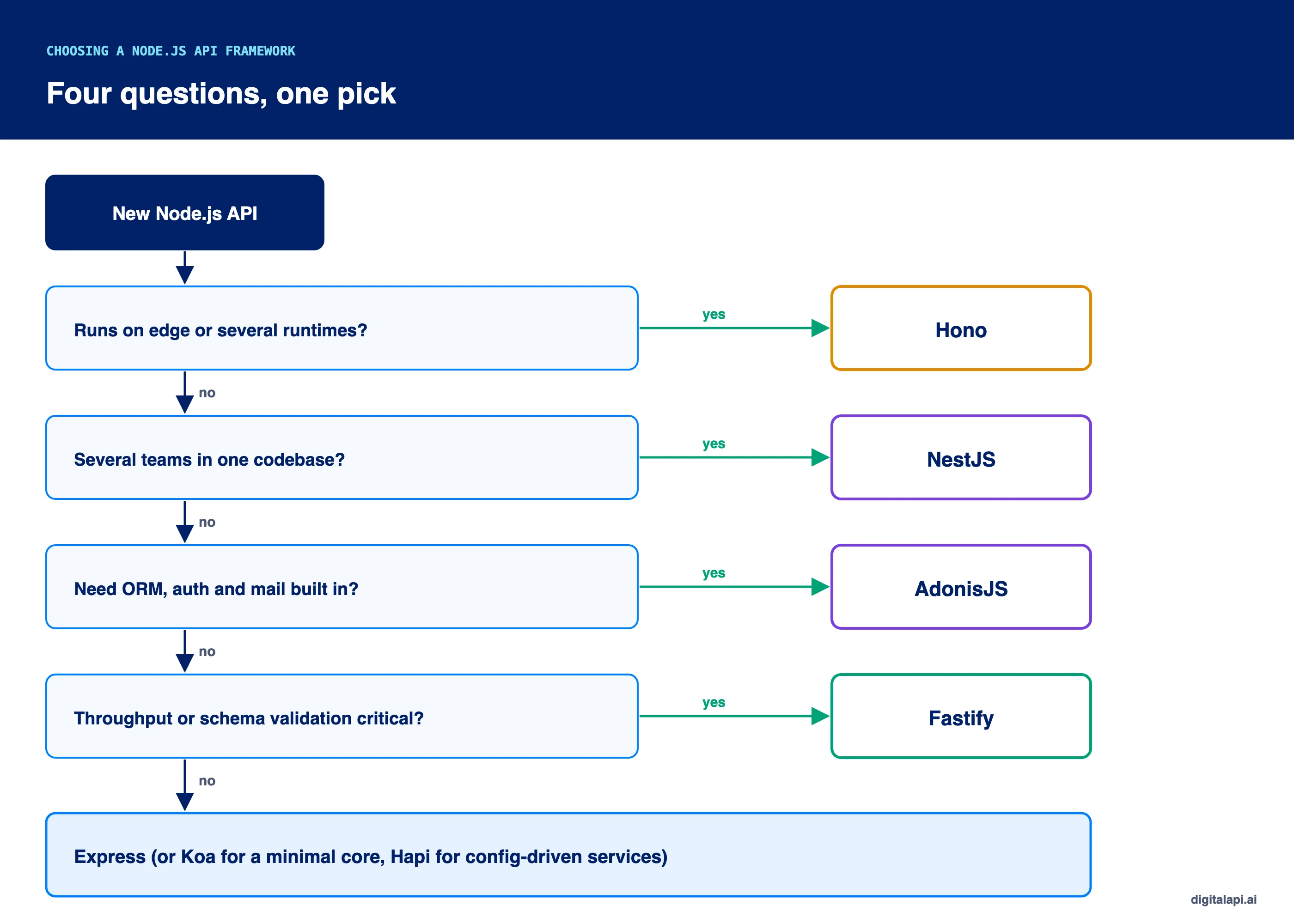
Choose by team size and runtime first, then by speed. A small team can ship fast on Express or Fastify. A large team usually gains more from NestJS structure than from extra requests per second.
Use these rules:
- Edge or several runtimes? Pick Hono.
- Several teams in one codebase? Pick NestJS, with the Fastify adapter if speed matters.
- Need ORM, auth and validation built in? Pick AdonisJS.
- Throughput and validation critical? Pick Fastify.
- Small service, familiar stack? Pick Express, or Koa for a thinner core.
Fastify is right for you if:
- You are starting a new API and want validation from the first route.
- You care about latency and server cost at high traffic.
- You want OpenAPI docs generated from the same schemas.
Fastify is not right for you if:
- Your team depends on Express-only middleware.
- You need the structure of a framework like NestJS for many teams.
Whatever you pick, publish an OpenAPI document. It feeds docs, client SDKs, tests and your gateway. Teams that publish to the DigitalAPI API Developer Portal get docs rendered from that one OpenAPI 3.1 spec, with auto-generated JavaScript code samples and per-environment sandboxes.
See how DigitalAPI turns your Node.js API into a documented, governed product → Book a Demo
For frameworks in other languages, compare the best Python API frameworks, the top 10 API frameworks and our guide to top backend frameworks.
Key takeaways
- The best Node.js API framework depends on team and runtime. Fastify for speed, NestJS for structure, Express for ecosystem, Hono for edge.
- Fastify is the top Express alternative. It served 78,696 GET requests per second against 53,785 for Express in the Fastify benchmark.
- NestJS fits large TypeScript teams. Modules and dependency injection keep big codebases consistent.
- Hono runs everywhere. One codebase deploys to Node.js, Bun, Deno and edge platforms.
- Six of seven use the MIT licence. Hapi uses BSD-3-Clause.
- Node.js is still the most used web technology. 48.7% of Stack Overflow 2025 respondents used it.
Frequently asked questions
1. What is the best Node.js framework for APIs in 2026?
Fastify is the best choice for most new Node.js APIs in 2026. It is fast, validates input with JSON Schema and generates OpenAPI docs through an official plugin. NestJS is better for large TypeScript teams that want modules and dependency injection. Express remains the safe default when ecosystem size and familiarity matter most.
2. Is FastAPI better than Node.js?
They are different layers. FastAPI is a Python framework, while Node.js is a JavaScript runtime. The fair comparison is FastAPI against a Node.js framework such as Fastify or NestJS. All three validate input and generate OpenAPI docs. Pick the one that matches your team's language. Use Python for data and ML work, and Node.js for shared JavaScript or TypeScript code.
3. Is Node.js still relevant in 2026?
Yes. In the Stack Overflow 2025 Developer Survey, 48.7% of respondents used Node.js, more than any other web framework or technology. Express, NestJS and Fastify all shipped new releases in late 2026. Node.js 24 and Node.js 26 are both supported long-term support lines.
4. Is Node.js 26 LTS?
Yes. According to the Node.js release schedule, Node.js 26 (codename Lithium) entered long-term support on 28 October 2026. It moves to maintenance in October 2027 and reaches end of life in April 2029. Node.js 24 and Node.js 22 are also still supported.
5. Is Node.js in decline?
No. Node.js usage in the Stack Overflow survey peaked at 51% in 2020 and was 48.7% in 2025. It remains the most used web technology in the survey. Runtimes like Bun and Deno have grown, but frameworks such as Hono run on all three, so code moves between them.
6. What are the best Express js alternatives?
The best Express alternatives are Fastify, Hono, Koa and NestJS. Fastify keeps a similar routing style but adds schema validation and higher throughput. Hono adds multi-runtime and edge support. Koa offers a smaller async core. NestJS adds structure for large teams and can run on Express or Fastify underneath.
7. Which Node.js frameworks generate OpenAPI docs?
NestJS and Fastify have official OpenAPI modules: @nestjs/swagger and @fastify/swagger. Hono uses @hono/zod-openapi, and Hapi uses the hapi-swagger plugin. Express, Koa and AdonisJS rely on community packages or a hand-written spec. Generating the spec from code keeps docs in sync with each release.
Conclusion
There is no single best Node.js API framework, but there is a best fit for each team. Fastify wins on speed and validation. NestJS wins on structure for large teams. Express wins on familiarity, and Hono wins on runtime reach.
Start with the decision rules above. Build one real endpoint in your top two choices, with validation and an OpenAPI document. Measure it with your own database and traffic, not a hello-world benchmark.
Then make the API easy to find and use. A published spec, clear docs and a sandbox matter more to consumers than which framework served the response.
Publish your Node.js API with docs rendered from your OpenAPI spec, sandboxes and self-serve keys in the DigitalAPI developer portal. Ship your Node API with docs and governance built in
Prefer a walkthrough? Book a Demo
Dhayalan Subramanian is Associate Director, Product Growth at DigitalAPI, where he leads go-to-market and product growth for the company’s multi-gateway API management platform. His work focuses on helping large enterprises and mid-market cloud companies consolidate APIs across AWS, Azure, Apigee, Kong, MuleSoft, and other gateways into a single control plane for governance, discovery, monetization, and agent consumption.
Dhayalan brings 14+ years of experience across product strategy, enterprise architecture, and engineering leadership. Earlier in his career, he held senior roles at Encora (as Associate Architect and Technical Manager), Mindtree (Technology Lead), Tech Mahindra (Technical Lead), and Primus Analytics, where he designed integration frameworks and delivered enterprise-grade digital platforms for global customers.
At DigitalAPI, he works directly with platform, integration, and developer experience leaders at Fortune 500 organizations to operationalize unified API catalogs, developer portals, and MCP-ready APIs. He writes regularly on API developer experience, API governance, and AI agent architectures.

One email a fortnight. Worth opening.
A short digest of what we're writing, what we're learning from customers, and the handful of links you'd actually want from us. No tracking pixels.