



Understanding API Platforms: Architecture, Components, Benefits
An API platform centralizes the entire API lifecycle. Discover its architecture, core components, and benefits like accelerated innovation, enhanced security, and new monetization opportunities.

TL;DR
1. An API platform is an integrated ecosystem that centralizes the entire API lifecycle, from design to deprecation.
2. Its architecture unifies critical components like gateways, developer portals, security, and analytics into a cohesive system.
3. Key components such as API gateways, developer portals, and robust security measures are foundational to platform functionality.
4. Benefits include accelerated innovation, enhanced developer experience, stringent security, and significant monetization opportunities.
5. Choosing the right platform means evaluating scalability, integration, security, and its alignment with future-ready capabilities like AI integration.
Get started with DigitalAPI's API Management Platform today. Book a Demo!
In the intricate web of modern software, where services interact across boundaries, the underlying infrastructure that facilitates these connections is paramount. Simply exposing APIs isn't enough; orchestrating their entire lifecycle, ensuring their security, discoverability, and adoption, demands a sophisticated approach. This is precisely where an API platform emerges as a critical enabler. Far more than just a collection of tools, it serves as a unified ecosystem designed to empower organizations to build, manage, and scale their API programs with unparalleled efficiency. Understanding its architecture, core components, and the transformative benefits it delivers is essential for any enterprise navigating today’s interconnected digital landscape.
What is an API Platform? Architecture, Components & Benefits
An API Platform represents a comprehensive, integrated solution that encompasses all aspects of an organization's API strategy, from initial design to eventual deprecation. Unlike individual tools for API management or isolated gateways, a true API platform provides a holistic environment. It acts as a centralized hub, unifying diverse capabilities necessary for the successful delivery, consumption, and governance of APIs across internal, partner, and external ecosystems.
Its primary goal is to abstract away the complexity of managing a large API estate, offering a seamless experience for both API providers and consumers. This includes not only the technical mechanisms for exposing and securing APIs but also the tools for fostering developer adoption, ensuring compliance, and extracting business value. Essentially, an API platform transforms an organization's collection of APIs into a cohesive, manageable, and valuable product portfolio.
The Foundational Architecture of an API Platform
The architecture of an API platform is designed for resilience, scalability, and extensibility, orchestrating various services to work in harmony. While implementations can vary, a typical architecture comprises several interconnected layers and modules, each playing a vital role in the overall system:
- API Creation & Design Layer: This layer focuses on the initial stages, providing tools for designing, documenting, and modeling APIs. It supports various API specifications (e.g., OpenAPI, AsyncAPI) and facilitates collaboration among design teams.
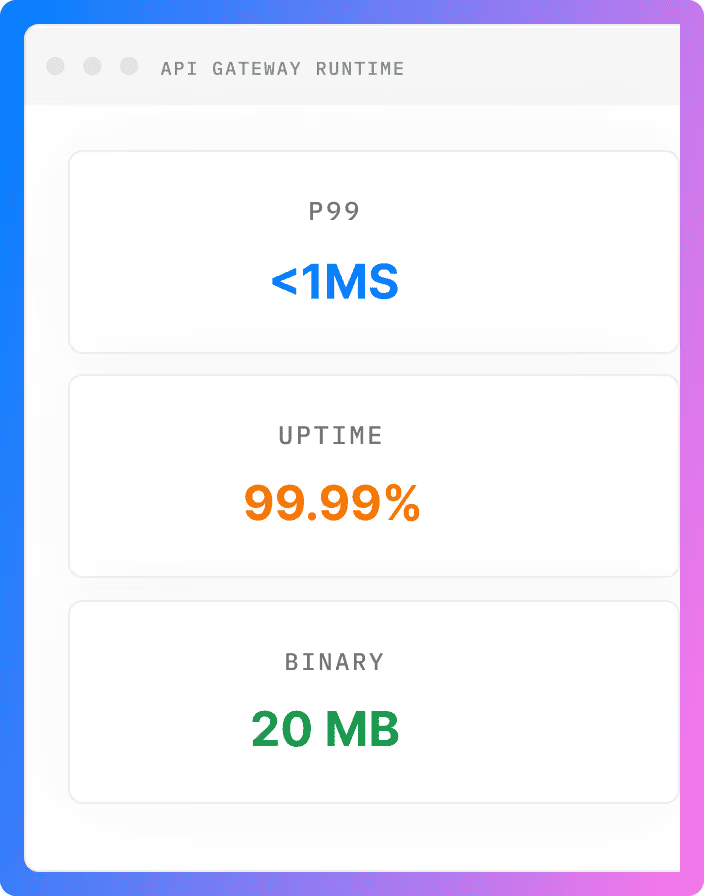
- API Runtime & Execution Layer: This is where API requests are processed. It includes the API Gateway, which handles traffic routing, policy enforcement, and initial security checks, often interacting with backend services.
- API Control & Management Layer: This layer governs the API lifecycle, applying policies, managing versions, and handling access controls. It's the brain that ensures APIs behave as intended and meet business requirements.
- API Analytics & Monitoring Layer: Essential for observability, this layer collects data on API usage, performance, and errors, providing insights into API health and adoption.
- Developer Experience & Engagement Layer: Centered around the developer portal, this layer provides resources for API consumers, including documentation, SDKs, and a self-service registration process.
- Security & Governance Layer: Integrated across all other layers, this ensures that APIs are protected from threats, adhere to regulatory standards, and follow organizational policies.
These layers interact continuously, ensuring that an API designed in one part of the system is correctly implemented, secured, monitored, and made discoverable to its intended audience.
Core Components of a Comprehensive API Platform
A robust API platform is built upon a suite of interconnected components, each specializing in a particular aspect of API delivery and management:
1. API Gateway
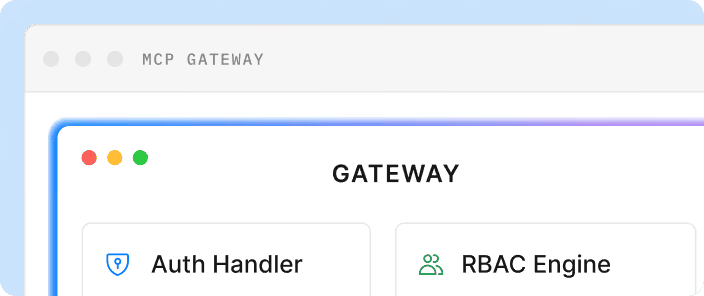
The API Gateway acts as the single entry point for all API requests, sitting between clients and backend services. It’s a crucial component for:
- Traffic Management: Routing requests to appropriate backend services, load balancing, and managing traffic spikes.
- Policy Enforcement: Applying policies such as rate limiting, caching, and request/response transformation.
- Security: Handling API authentication, authorization, and threat protection, often serving as the first line of defense.
- Monitoring: Collecting real-time metrics and logs for performance analysis and troubleshooting.
2. Developer Portal
The developer portal is a self-service website that serves as the primary interface for API consumers. It's vital for:
- API Discovery: Enabling developers to easily find and understand available APIs via a comprehensive API catalog.
- Documentation: Providing interactive, up-to-date API documentation, code samples, and tutorials.
- Onboarding & Registration: Allowing developers to register, obtain API keys, and manage their applications.
- Support & Community: Offering forums, FAQs, and support channels to assist developers.
3. API Lifecycle Management Tools
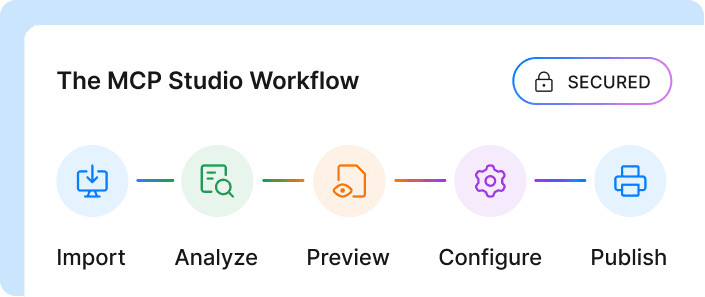
This suite of tools supports the entire journey of an API, from conception to retirement. Key functions include:
- API Design: Tools for defining API contracts and specifications (e.g., OpenAPI).
- Development: Facilitating the coding and implementation of API logic.
- Testing: Ensuring API functionality, performance, and security through various API testing methodologies.
- Deployment: Managing the release and deployment of API versions.
- Versioning: Handling changes and deprecating older API versions gracefully.
4. API Analytics & Monitoring
These tools provide visibility into API usage and performance. They are essential for:
- Usage Tracking: Monitoring API call volumes, unique users, and data transfer.
- Performance Metrics: Tracking latency, error rates, and uptime.
- Alerting: Notifying administrators of issues or anomalies.
- Business Insights: Understanding which APIs drive the most value and identifying opportunities for optimization or API monetization. Detailed insights are critical for effective API monitoring.
5. API Security Frameworks
A robust API security framework is integrated throughout the platform, ensuring protection at multiple layers. This includes:
- Authentication & Authorization: Verifying identities and managing access permissions (e.g., OAuth, API Keys).
- Threat Protection: Defending against common attacks like SQL injection, DDoS, and API abuse.
- Encryption: Ensuring data in transit and at rest is secure.
- Compliance: Adhering to industry standards and regulatory requirements.
6. API Monetization Capabilities
For organizations looking to turn their APIs into revenue streams, platforms offer features for:
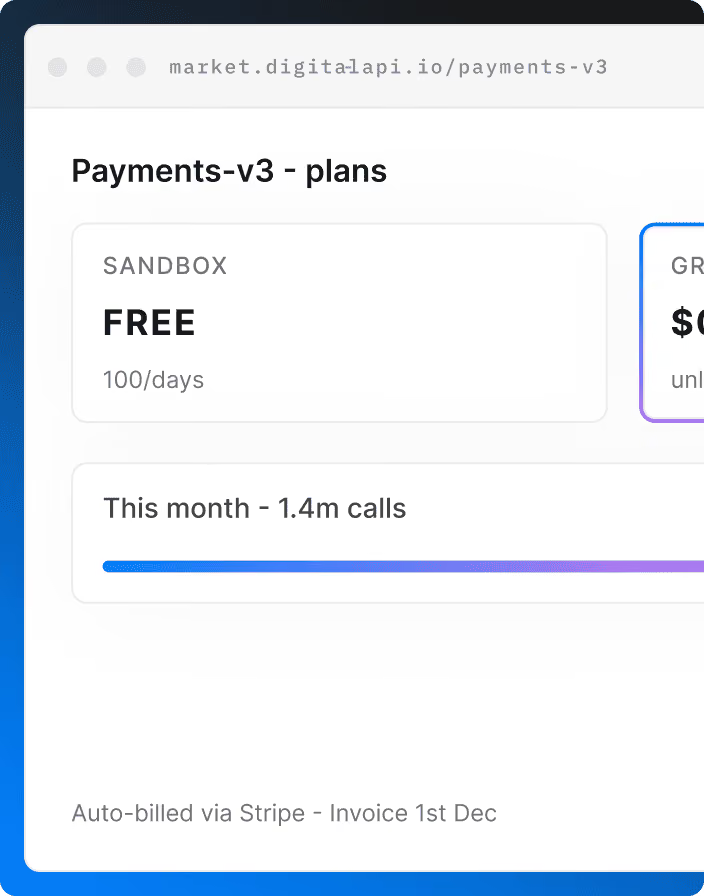
- Flexible Pricing Models: Supporting various API pricing strategies, including freemium, tiered, and usage-based models.
- Billing & Metering: Tracking API usage for accurate billing.
- Subscription Management: Handling developer subscriptions and access levels.
- Reporting: Providing insights into revenue generation and API product performance.
7. API Governance and Standardization
API governance ensures consistency, quality, and compliance across all APIs. This involves:
- Policy Definition: Establishing rules for API design, security, and usage.
- Auditing: Monitoring compliance with defined policies.
- Standardization: Promoting reusable patterns and best practices.
- Lifecycle Oversight: Guiding APIs through their various stages in a controlled manner.
8. Testing and Sandbox Environments
Providing controlled environments for developers to experiment and test integrations is crucial for adoption and reliability. This includes:
- Sandbox Environments: Isolated environments with simulated data for safe API exploration.
- Automated Testing: Tools to run comprehensive tests against APIs during development and deployment.
- Mock Servers: Enabling client development even before backend APIs are fully implemented. These environments are often referred to as API sandboxes.
Unpacking the Benefits: Why Enterprises Need a Unified API Platform
The adoption of a comprehensive API platform delivers a multitude of strategic and operational benefits:
1. Enhanced Developer Experience (DX) and Adoption
A well-implemented API platform significantly improves the experience for developers, both internal and external. Through intuitive developer portals, rich documentation, and easy access to API keys and sandboxes, developers can quickly discover, understand, and integrate APIs. This frictionless experience drives higher adoption rates, fosters innovation, and reduces time-to-market for new applications and services.
2. Accelerated Innovation and Time-to-Market
By providing reusable API building blocks and streamlining the API lifecycle, platforms empower development teams to build and deploy new products and features faster. They minimize redundant work, promote collaboration, and allow developers to focus on core business logic rather than infrastructure complexities. This agility is crucial for staying competitive in rapidly evolving markets.
3. Robust Security and Compliance
Centralizing API management on a platform allows for consistent application of API gateway security policies across the entire API estate. It simplifies adherence to regulatory requirements (e.g., GDPR, HIPAA, PCI DSS) by providing centralized controls for authentication, authorization, auditing, and threat protection. This reduces the attack surface and ensures sensitive data remains protected.
4. Improved Scalability and Performance
API platforms are built to handle high volumes of traffic and complex request patterns. Components like API gateways offer load balancing, caching, and rate limiting capabilities that ensure APIs remain responsive and available even under heavy loads. This inherent scalability supports business growth without compromising performance or requiring significant manual intervention.
5. Streamlined Governance and Control
With a centralized platform, organizations can enforce consistent API governance policies, design standards, and security protocols across all APIs. This prevents API sprawl, reduces technical debt, and maintains order in a complex API landscape. It provides clear visibility into API ownership, lifecycle status, and usage, enabling better decision-making and risk management.
6. New Revenue Opportunities
For businesses looking to externalize and monetize their data and services, an API platform provides the necessary tools for tracking usage, managing subscriptions, and implementing various API monetization strategies. It transforms APIs from mere integration points into valuable products that can generate new revenue streams and expand market reach.
7. Better API Visibility and Discovery
In large enterprises, APIs can become scattered and undocumented, leading to API sprawl. A unified API platform, with its robust cataloging and discovery features, solves this problem. Developers can quickly find existing APIs, understand their purpose, and avoid creating redundant services, fostering efficiency and consistency across the organization.
Key Considerations When Choosing an API Platform
Selecting the right API platform is a strategic decision that can profoundly impact an organization's digital capabilities. Here are crucial factors to consider:
- Scalability: Can the platform handle your current and future API traffic volumes? Does it scale horizontally and vertically with ease?
- Security Features: Does it offer comprehensive security, including authentication, authorization, threat protection, and robust API access management?
- Developer Experience: Is the developer portal intuitive, with excellent documentation, sandbox environments, and easy API key management?
- Integration Capabilities: Can it seamlessly integrate with your existing infrastructure, CI/CD pipelines, identity providers, and various API gateways (e.g., multiple API gateways)?
- API Lifecycle Support: Does it provide robust tools for design, development, testing, deployment, versioning, and deprecation?
- Analytics & Monitoring: Are the API metrics and monitoring capabilities granular and actionable?
- Cost: Evaluate the total cost of ownership, including licensing, infrastructure, and operational expenses.
- Support for API Types: Does it support REST, SOAP, GraphQL, and event-driven APIs?
- Cloud vs. On-Premise: Determine if a cloud-native, on-premise, or hybrid deployment model best suits your needs and compliance requirements.
- Vendor Lock-in: Assess the flexibility of the platform and the potential for vendor lock-in.
A thorough evaluation against these criteria will help identify the best API management platforms that align with your organizational goals and technical landscape.
The Future of API Platforms: AI Integration and Beyond
The landscape of API platforms is not static; it's continuously evolving, driven by new technologies and changing business demands. One of the most significant upcoming shifts is the deeper integration of Artificial Intelligence (AI) and machine learning into platform capabilities. AI-powered API management is set to revolutionize how APIs are designed, governed, and consumed.
Future API platforms will increasingly leverage AI for:
- Automated API Design: AI could assist in generating API specifications, ensuring consistency, and adhering to best practices based on learned patterns.
- Intelligent Governance: AI can detect policy violations in real-time, identify security vulnerabilities, and recommend optimal API design improvements.
- Predictive Monitoring & Optimization: Machine learning algorithms will analyze usage patterns to predict potential performance bottlenecks, optimize resource allocation, and even suggest proactive caching strategies.
- Enhanced Discovery for AI Agents: As AI agents become more prevalent, API platforms will need to expose APIs in a machine-readable format that allows agents to autonomously discover, understand, and interact with services, driving new levels of automation and composability.
- Personalized Developer Experience: AI could tailor documentation, provide smart code suggestions, and offer personalized support to developers, further enhancing the DX.
Beyond AI, the future will likely see greater emphasis on unified API and event stream management, enabling real-time, event-driven architectures. Platforms will also need to support an increasingly diverse set of protocols and integration patterns, ensuring they remain the central nervous system for digital ecosystems.
Conclusion
In an era defined by interconnected services and rapid digital transformation, the API platform is no longer a luxury but a fundamental necessity. It serves as the bedrock upon which modern enterprises build their digital strategies, offering a holistic solution to the complexities of managing a dynamic API landscape. By unifying critical components, from robust gateways and developer-friendly portals to stringent security and insightful analytics, API platforms empower organizations to unlock innovation, ensure operational excellence, and seize new revenue opportunities. Embracing a comprehensive API platform means not just managing APIs, but strategically leveraging them as powerful engines for growth and competitive advantage, paving the way for a more agile, secure, and interconnected future. The choice to invest in a unified platform is an investment in the very foundation of tomorrow's digital economy.
FAQs
1. What is the primary difference between API Management and an API Platform?
API Management typically refers to a subset of functionalities focused on the runtime governance, security, and publishing of APIs, often centered around an API Gateway and Developer Portal. An API Platform, however, is a much broader, integrated ecosystem that covers the *entire* API lifecycle, from design and development to testing, deployment, monetization, and advanced governance, unifying many disparate tools into a cohesive solution. It's a strategic infrastructure, not just a set of tools.
2. Why is an API Gateway a core component of an API Platform?
The API Gateway is crucial because it acts as the single entry point for all API requests. It centralizes critical functions like traffic management, policy enforcement, rate limiting, and initial security checks (authentication/authorization). By offloading these responsibilities from backend services, it enhances performance, scalability, and security across the entire API estate, making the platform efficient and resilient.
3. How does an API Platform benefit developers?
An API Platform significantly enhances the developer experience by offering a centralized developer portal with comprehensive documentation, interactive tools, easy access to API keys, and sandbox environments for testing. This self-service approach reduces onboarding time, accelerates integration, fosters adoption, and empowers developers to innovate faster by providing all the necessary resources in one intuitive location.
4. What role does API security play within an API Platform?
API security is a foundational, pervasive element within an API Platform, not an add-on. The platform integrates security measures across all layers, from the API Gateway's traffic filtering and authentication to robust API security tools, authorization controls, and compliance monitoring. It helps protect sensitive data, prevent unauthorized access, and defend against common cyber threats, ensuring the integrity and trustworthiness of your API ecosystem.
5. Can an API Platform help with API monetization?
Yes, a comprehensive API Platform often includes robust API monetization capabilities. It provides tools for defining various pricing models (e.g., freemium, tiered, usage-based), tracking API consumption for accurate billing, managing developer subscriptions, and generating detailed revenue reports. This allows organizations to effectively turn their APIs into valuable products, creating new revenue streams and fostering a vibrant API economy.
Dhayalan Subramanian is Associate Director, Product Growth at DigitalAPI, where he leads go-to-market and product growth for the company’s multi-gateway API management platform. His work focuses on helping large enterprises and mid-market cloud companies consolidate APIs across AWS, Azure, Apigee, Kong, MuleSoft, and other gateways into a single control plane for governance, discovery, monetization, and agent consumption.
Dhayalan brings 14+ years of experience across product strategy, enterprise architecture, and engineering leadership. Earlier in his career, he held senior roles at Encora (as Associate Architect and Technical Manager), Mindtree (Technology Lead), Tech Mahindra (Technical Lead), and Primus Analytics, where he designed integration frameworks and delivered enterprise-grade digital platforms for global customers.
At DigitalAPI, he works directly with platform, integration, and developer experience leaders at Fortune 500 organizations to operationalize unified API catalogs, developer portals, and MCP-ready APIs. He writes regularly on API developer experience, API governance, and AI agent architectures.
One email a fortnight. Worth opening.
A short digest of what we're writing, what we're learning from customers, and the handful of links you'd actually want from us. No tracking pixels.

.avif)