


Tyk vs AWS API Gateway: A Practical Comparison
AWS API Gateway is a managed, pay-per-call service. Tyk is a gateway you run anywhere, open source at its core. This guide compares them on cost at three traffic levels, limits, security, portals and lock-in.

TL;DR:
Should you choose Tyk or AWS API Gateway?
Choose AWS API Gateway if your APIs run on AWS and you want zero servers to manage.
Choose Tyk if you need to run the same gateway across clouds, on premises or in Kubernetes.
On cost in the Tyk vs AWS API Gateway race, AWS wins at low traffic. Self-managed Tyk gets cheaper at high volume.
Most Tyk vs AWS API Gateway debates start with a bill. A team launches on AWS API Gateway because it costs nothing to start. Traffic grows to hundreds of millions of calls a month. Someone asks whether a self-managed gateway would be cheaper.
Sometimes it is. Sometimes the savings vanish once you count Redis, upgrades and on-call time. This guide gives you the numbers to decide. The stakes keep rising: the Postman 2025 State of the API report found 82% of organizations have adopted some level of API-first.
Tyk vs AWS API Gateway: which should you choose?
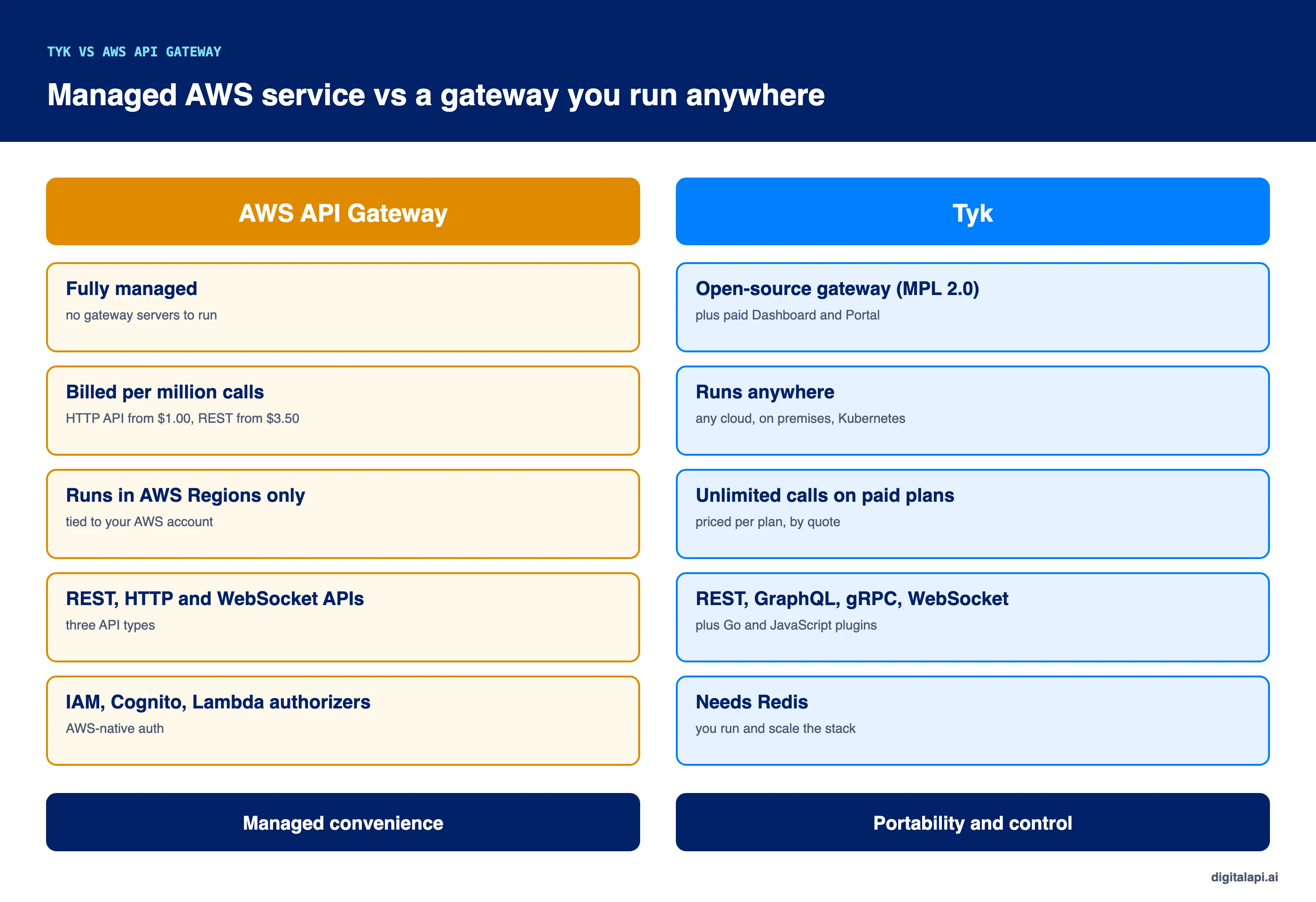
AWS API Gateway suits AWS-only teams that value managed operations. Tyk suits teams that need portability, deep customization or flat costs at high volume. Both handle authentication, rate limits, quotas and routing well. The difference is who runs the gateway and how you pay for it.
AWS figures from the AWS API Gateway quota pages, checked 27 Nov 2026. Tyk figures from the Tyk pricing page and docs, checked 27 Nov 2026.
How much do Tyk and AWS API Gateway cost at 10M, 100M and 1B calls?
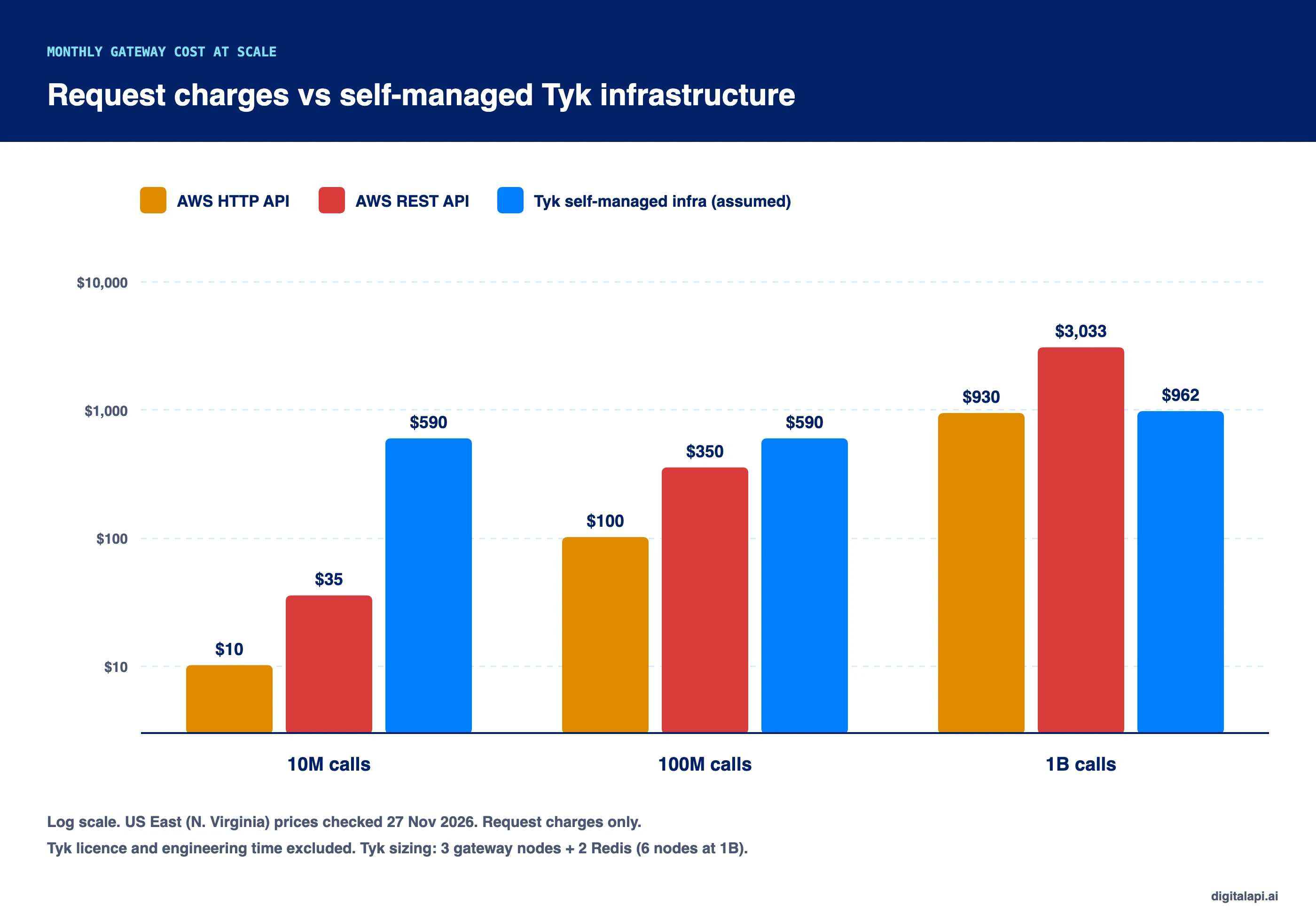
At 10M and 100M calls a month, AWS API Gateway costs less than running Tyk yourself. At 1B calls, an HTTP API and a small self-managed Tyk cluster cost about the same. A REST API costs roughly three times more. The table below shows request charges only.
AWS prices per the AWS API Gateway pricing page, US East (N. Virginia), checked 27 Nov 2026. Free tier and data transfer excluded.
AWS rates used (checked 27 Nov 2026):
- HTTP APIs: $1.00 per million for the first 300 million calls, then $0.90 per million.
- REST APIs: $3.50 per million for the first 333 million, $2.80 for the next 667 million, $2.38 for the next 19 billion, then $1.51.
- Free tier: 1 million REST and 1 million HTTP API calls a month for 12 months.
- Extras: optional REST API caching from $0.02 per hour (0.5 GB), plus data transfer out.
Tyk sizing assumptions (yours to change):
- 10M and 100M calls: three c6i.xlarge gateway nodes ($0.17 per hour) and two cache.m6g.large Redis nodes ($0.149 per hour), 730 hours a month.
- 1B calls: six gateway nodes and the same Redis pair.
- Not included: load balancer, data transfer, monitoring, engineering time and any Tyk licence.
EC2 and ElastiCache rates are on-demand, US East (N. Virginia), checked 27 Nov 2026. These sizes are planning assumptions, not benchmarks. Tyk's paid Core and Professional plans include unlimited API calls but have no list prices. Our Tyk pricing guide breaks down each plan.
With the three-node setup, an HTTP API stays cheaper until about 622 million calls a month. A REST API crosses that line near 169 million. Run the model with your own numbers:
Is Tyk an API gateway, and how do the architectures differ?
Yes. Tyk is an open-source API gateway written in Go, with paid management tools on top. AWS API Gateway is a managed service with no servers for you to run. That one difference drives most of the trade-offs below.
Tyk deployment options:
- Self-managed: you run gateways, Redis and the control plane on your own infrastructure.
- Hybrid: you run only the gateways and their local Redis. Tyk Cloud hosts the control plane, so API traffic stays with you.
- Tyk Cloud: Tyk runs everything as a managed service.
Tyk needs Redis in production for sessions, rate limits and quotas. The latest gateway release is v5.16.0, published 27 Oct 2026 on GitHub. AWS API Gateway gives you nothing to patch: you deploy a stage and pay per call.
What are the different types of gateways in AWS?
AWS API Gateway offers three API types: REST APIs, HTTP APIs and WebSocket APIs. Each has different features and prices.
- REST API: the most features. It adds API keys, usage plans, caching, request validation, AWS WAF, private APIs and response streaming.
- HTTP API: lower cost and latency, with JWT authorizers and fewer features. No usage plans, caching or WAF.
- WebSocket API: two-way connections, billed per message and connection minute.
REST APIs come in edge-optimized, Regional and private endpoint types. NAT gateways, internet gateways and Transit Gateway are network services, not API gateways.
Tyk vs AWS API Gateway performance: latency, throughput and limits
AWS API Gateway gives you fixed quotas and managed scaling. Tyk gives you no fixed ceiling, but its speed depends on the hardware and plugins you choose. Neither vendor's claims replace your own load test.
On Tyk vs AWS API Gateway performance, start with the limits AWS publishes:
Source: AWS API Gateway quota pages, checked 27 Nov 2026.
Latency. AWS publishes no gateway latency figures. CloudWatch reports Latency and IntegrationLatency per API. The gap between them is the gateway's own overhead.
Throughput. The 10,000 RPS quota is shared by every API in the account and Region. Tyk throughput scales with the nodes you add, and a shared Redis counter keeps rate limits accurate across nodes.
Cold starts. AWS API Gateway has no instances to warm. Cold starts come from Lambda backends. Tyk nodes run all the time, but new pods take time to start when you scale out.
Vendor benchmarks. Tyk publishes RPS and P99 results from AWS, GCP and Azure, with an open-source test method (checked 27 Nov 2026). Treat them as vendor data and rerun them on your hardware.
How do Tyk and AWS API Gateway compare on security?
Both cover the standard methods. AWS ties security to IAM and Cognito. Tyk supports more methods inside the gateway itself.
AWS is simpler if callers already hold IAM roles. Tyk fits better when partners bring their own identity providers.
Which has the better developer portal?
Tyk's Developer Portal covers more of the API product lifecycle. AWS API Gateway portals are newer and narrower.
AWS API Gateway portals share REST APIs only, within one Region, with access through Cognito user pools. AWS now sells API Portal for discovery and documentation. A documentation portal costs $125 a month and includes 400 APIs, per the AWS pricing page (checked 27 Nov 2026).
Tyk includes its Developer Portal in the Core and Professional plans, with catalogues, self-service keys and monetization. Neither portal shows APIs from other gateways. See our guide to the best developer portal for AWS API Gateway for the options.
How locked in are you with each gateway?
AWS API Gateway ties you to AWS. Tyk keeps the gateway portable, but its paid tools still create some dependency.
- AWS: you can export OpenAPI definitions, but they carry AWS extensions. Authorizers, mapping templates and IAM policies do not move to another gateway.
- Tyk: the gateway is open source, so you can export API definitions and run them on Tyk OSS. If a paid licence lapses, existing APIs keep serving traffic. You cannot create or update APIs until you renew.
- Kubernetes: Tyk Operator 1.6 supports the Kubernetes Gateway API (GatewayClass, Gateway and HTTPRoute) with the Tyk Dashboard.
Where do Kong and other alternatives fit?
Kong and Tyk are the two open-source gateways teams compare most often against AWS. The AWS API Gateway vs Kong trade-off looks much like this one. You give up managed operations to gain portability and plugins.
For the open-source head-to-head, read Tyk vs Kong. For a wider list of AWS API Gateway alternatives, see top AWS API Gateway alternatives. Weighing Tyk alternatives instead? Compare Tyk vs Apigee, Tyk vs Azure API Management or the full list of Tyk alternatives.
Which should you choose: Tyk or AWS API Gateway?
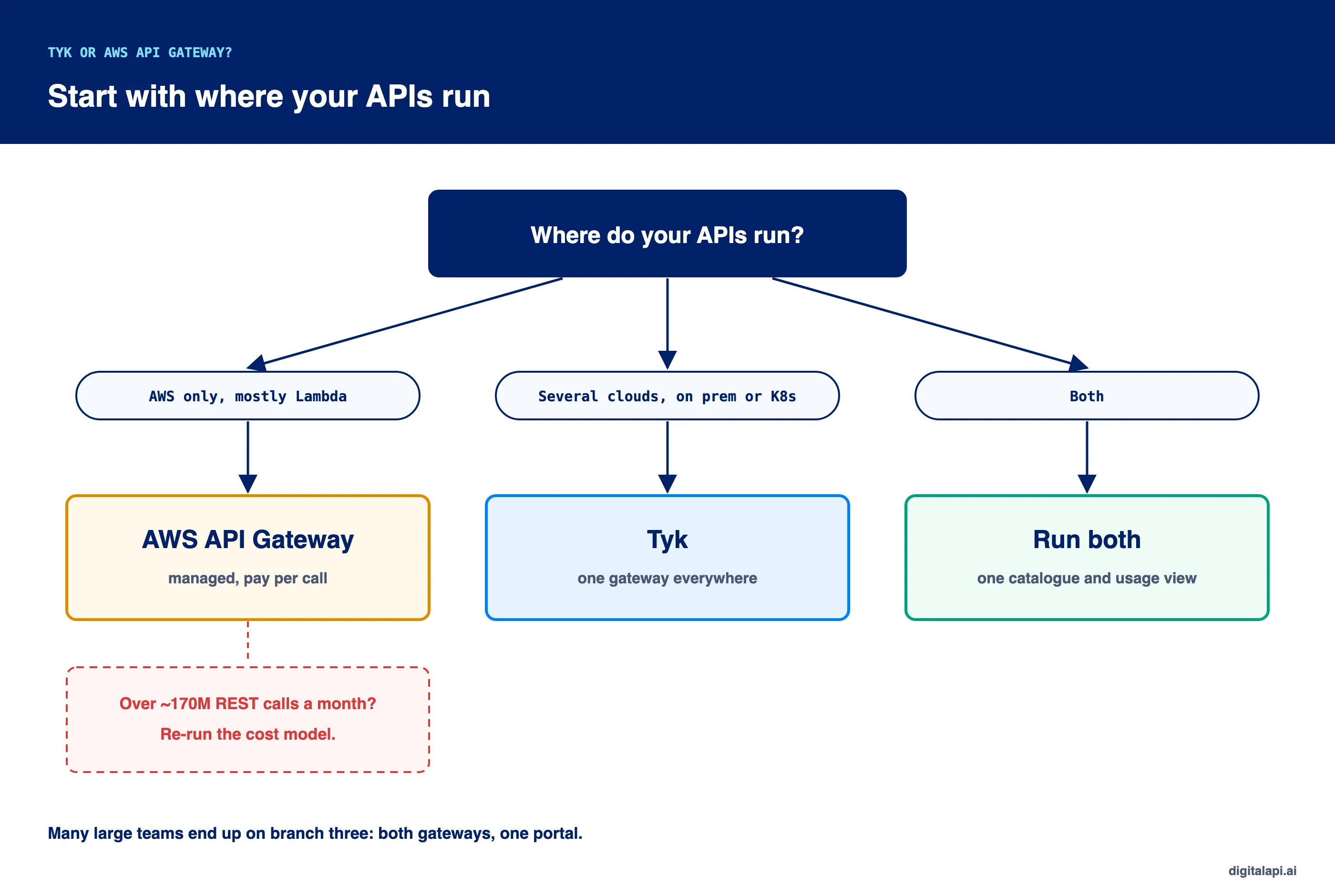
Pick the gateway that matches where your APIs run and who will operate it. Many large teams end up running both.
Choose Tyk if:
- Your APIs span several clouds, on premises or edge locations.
- You need custom gateway logic in Go or gRPC plugins.
- You expect high volume and want costs tied to infrastructure, not calls.
- You run Kubernetes and want Gateway API and GitOps support.
Choose AWS API Gateway if:
- Your backends run on AWS, especially Lambda.
- You want no gateway servers to patch, scale or monitor.
- Traffic is low to moderate, or spiky and hard to predict.
- Your callers already use IAM roles or Cognito.
Running both is common after acquisitions or migrations. The pain is that each gateway has its own catalogue, keys and usage reports.
DigitalAPI Gateway Connectors read AWS API Gateway and Tyk in place, with no migration. Runtime traffic and keys stay on each gateway. You get one catalogue, and usage from both gateways in one view. For the AWS setup steps, see how to connect AWS API Gateway to an API marketplace.
See how DigitalAPI puts your Tyk and AWS APIs in one catalogue without a migration → Book a Demo
Key takeaways
- Tyk vs AWS API Gateway is managed convenience versus portability. AWS runs the gateway for you. Tyk runs wherever you do.
- AWS is cheaper at low volume. At 10M calls, an HTTP API costs $10 a month (US East, checked 27 Nov 2026).
- Self-managed Tyk can win at high volume. Under our assumptions, it beats a REST API above about 169M calls a month.
- Know the AWS quotas. 10,000 RPS per account per Region, 10 MB payloads and a 29 s REST timeout by default.
- Tyk needs Redis and an owner. Count operations time before you count savings.
- Many teams run both. Unify the catalogue and usage instead of forcing a migration.
Frequently asked questions
1. Is Tyk an API gateway?
Yes. Tyk is an open-source API gateway written in Go and licensed under MPL 2.0. It handles authentication, rate limiting, quotas, transformation and routing. Tyk also sells a management layer: the Dashboard, Developer Portal and Tyk Operator. You can run it self-managed, in a hybrid model or as Tyk Cloud.
2. What are the different types of gateways in AWS?
AWS API Gateway has three API types. REST APIs offer the most features, including API keys, usage plans, caching and WAF. HTTP APIs cost less and offer fewer features. WebSocket APIs handle two-way connections. Separately, AWS uses NAT gateways, internet gateways and Transit Gateway for network traffic, not API calls.
3. Is Tyk faster than AWS API Gateway?
There is no neutral benchmark that compares them directly. Tyk publishes vendor benchmarks of RPS and P99 latency across AWS, GCP and Azure. AWS publishes no gateway latency figures but reports Latency and IntegrationLatency in CloudWatch. Test both with your own payloads, plugins and traffic.
4. Is AWS API Gateway cheaper than Tyk?
At low and moderate volume, yes. An HTTP API costs $1.00 per million calls and a REST API $3.50 per million in US East (checked 27 Nov 2026). At hundreds of millions of calls, a self-managed Tyk cluster can cost less. That holds only if you count Redis, nodes and operations time.
5. Is Kong an API gateway?
Yes. Kong Gateway is an open-source API gateway built on NGINX and OpenResty. It adds authentication, rate limiting and routing through plugins. Kong also sells a managed control plane called Konnect. Like Tyk, it runs on any cloud, on premises or in Kubernetes.
6. Which comes first, an API gateway or a load balancer?
It depends on the gateway. With a self-hosted gateway such as Tyk, a load balancer usually sits in front and spreads traffic across gateway nodes. With AWS API Gateway, the gateway comes first. It can then reach private services through a VPC link to a Network or Application Load Balancer.
7. Is the Gateway API replacing Ingress?
In Kubernetes, yes, over time. The Ingress API is frozen and gets no new features. New routing features go into the Kubernetes Gateway API, which uses GatewayClass, Gateway and HTTPRoute resources. Ingress still works, but new projects should start with the Gateway API.
8. Can you call Lambda without API Gateway?
Yes. Lambda function URLs give a function its own HTTPS endpoint with no gateway. An Application Load Balancer can also invoke Lambda. You lose gateway features such as usage plans, API keys, request validation and caching. Use API Gateway when you need those controls.
Conclusion
The Tyk vs AWS API Gateway choice is about who runs the gateway and how you want to pay. AWS removes the operations work and charges per call. Tyk gives you portability and flat costs, and asks you to run it.
Start with the cost model above and your real traffic. Then check the AWS quotas against your peak load. If both gateways stay in your estate, plan for one catalogue from the start.
Running Tyk and AWS side by side? Unify them in the DigitalAPI multi-gateway Marketplace, with no migration. Unify Tyk and AWS in one catalogue
Prefer a walkthrough? Book a Demo
Dhayalan Subramanian is Associate Director, Product Growth at DigitalAPI, where he leads go-to-market and product growth for the company’s multi-gateway API management platform. His work focuses on helping large enterprises and mid-market cloud companies consolidate APIs across AWS, Azure, Apigee, Kong, MuleSoft, and other gateways into a single control plane for governance, discovery, monetization, and agent consumption.
Dhayalan brings 14+ years of experience across product strategy, enterprise architecture, and engineering leadership. Earlier in his career, he held senior roles at Encora (as Associate Architect and Technical Manager), Mindtree (Technology Lead), Tech Mahindra (Technical Lead), and Primus Analytics, where he designed integration frameworks and delivered enterprise-grade digital platforms for global customers.
At DigitalAPI, he works directly with platform, integration, and developer experience leaders at Fortune 500 organizations to operationalize unified API catalogs, developer portals, and MCP-ready APIs. He writes regularly on API developer experience, API governance, and AI agent architectures.
One email a fortnight. Worth opening.
A short digest of what we're writing, what we're learning from customers, and the handful of links you'd actually want from us. No tracking pixels.