


How to Choose an API Gateway for Scalable Applications
Most gateway shortlists are built from feature lists and vendor demos. This guide gives you 8 selection criteria, a fair way to load-test candidates, a managed vs self-hosted vs hybrid decision, and a weighted scoring template you can copy.

TL;DR:
How do you choose an API gateway for scalable applications?
To decide how to choose an API gateway, score each candidate on 8 criteria: architecture fit, performance at your target load, deployment model, security and auth, extensibility, developer portal and productization, AI and MCP readiness, and total cost of ownership. Weight each criterion for your context, load-test the top two at your own peak traffic, and pick the highest weighted score.
A platform team picks a gateway after a 45-minute demo. Six months later, p99 latency doubles when they turn on auth and logging plugins. The demo ran with every plugin off.
That is the most common mistake in gateway selection: comparing feature lists instead of testing behavior under your traffic. This guide shows you how to choose an API gateway with a repeatable method. You get 8 criteria, a fair load-test recipe, a deployment decision and a weighted scoring template.
If you want a list of named products instead, read our guide to the best API gateway options. This page is the framework you use to judge them.
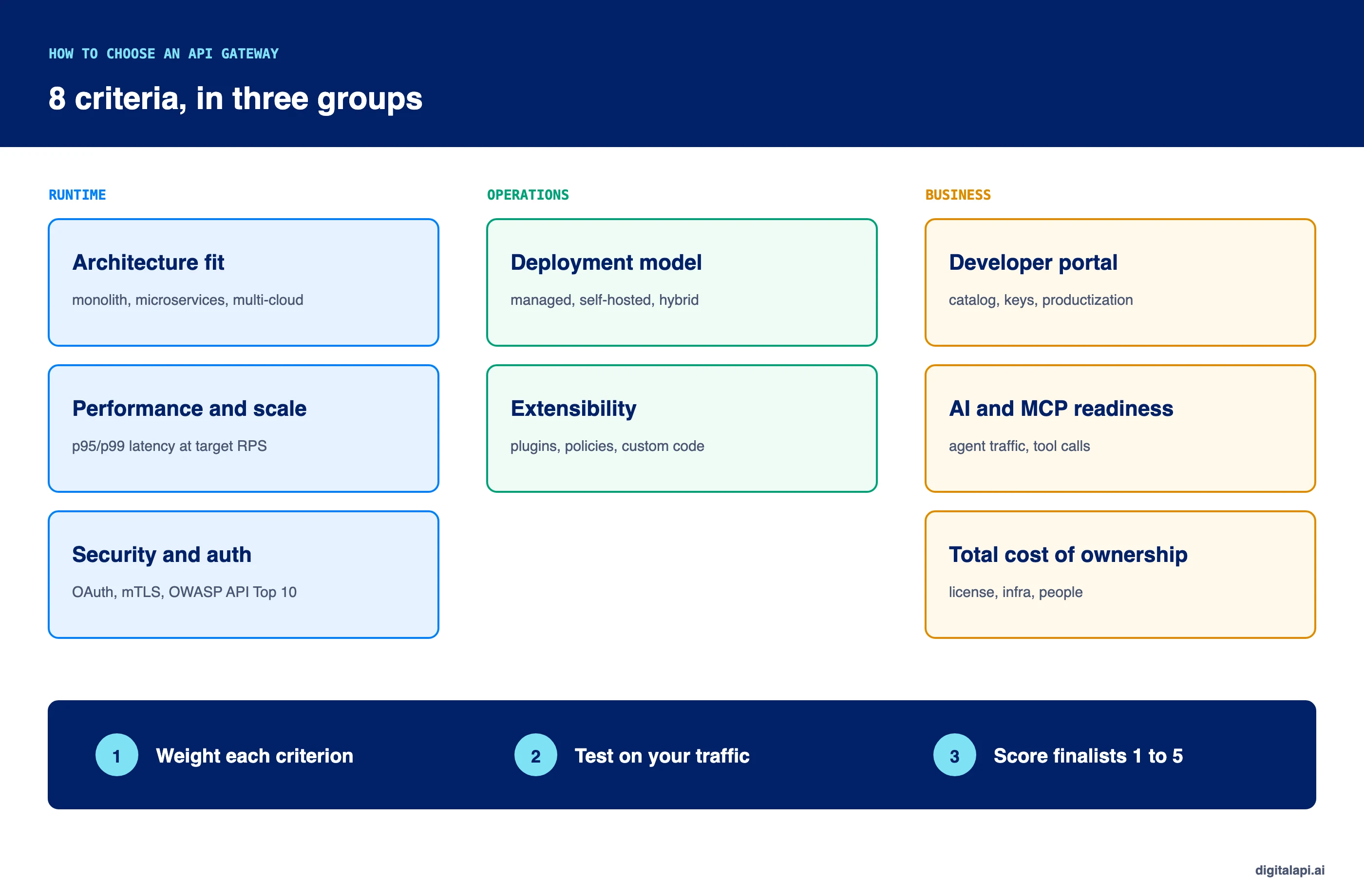
How to choose an API gateway: what are the 8 criteria?
Score every candidate on the same 8 criteria, weighted for your architecture and team. The criteria below cover runtime behavior, operations and business value. Skip none of them, even if you weight some low.
The sections below explain what "good" looks like for each, then turn them into a scorecard.
How does your architecture shape the gateway you need?
Your architecture decides which gateway pattern you need before any feature matters. A monolith needs one edge gateway. Microservices need routing across many services, and multi-cloud needs consistent policy across regions and providers. Our API gateway guide covers the core patterns.
Map your current and 2-year target architecture first:
- Monolith or a few services. One edge gateway handles auth, rate limits and TLS. Simple configuration and low operational load matter most.
- Microservices on Kubernetes. You need service discovery, per-route policy and declarative config in Git. Check whether the gateway supports the Kubernetes Gateway API and runs as a controller.
- Multi-cloud or hybrid. You need one control plane that pushes the same policy to data planes in each cloud and data center. Check active-active failover across regions.
- Many gateways already. A management layer across gateways may matter more than a new runtime.
Kubernetes is now the default target for most teams. The CNCF Annual Cloud Native Survey (2026) found that 82% of container users run Kubernetes in production.
Picking the best API gateway for microservices starts with how your services talk to each other. North-south traffic (clients to services) needs a gateway. East-west traffic (service to service) often goes to a service mesh instead. Our guide to the API gateway in microservices covers those patterns in detail.
How do you test API gateway performance and scalability?
Load-test each finalist at a fixed target request rate, with your real plugins on, and compare p95 and p99 latency. Vendor benchmarks run with minimal config. Your numbers are the only ones that count.
A scalable API gateway keeps p99 flat as traffic grows and scales out by adding stateless nodes. Use an open-source load tool that holds a constant request rate, such as k6 or wrk2.
This matters because closed-loop tools slow down when the server slows down. That hides latency spikes, a problem known as coordinated omission.
Follow these steps for a fair test:
- Set the target. Use your expected peak RPS in 18 months, plus 50% headroom.
- Fix the hardware. Give every gateway the same CPU, memory, instance type and network.
- Turn on real plugins. Enable JWT or OAuth validation, rate limiting, request logging and tracing on every candidate.
- Isolate the load generator. Run it on separate machines so it never competes with the gateway for CPU.
- Measure a baseline. Hit the backend directly first. Gateway overhead is the difference.
- Hold a constant arrival rate. Run at 50%, 100% and 150% of target for at least 30 minutes each, after a warm-up.
- Record p95, p99 and error rate. Also note CPU per node and how many nodes you needed.
- Test failure. Kill a node mid-run and watch recovery time and dropped requests.
Here is a minimal k6 scenario that holds 5,000 requests per second and fails the run if p99 crosses 100 ms. The constant-arrival-rate executor keeps the rate fixed even when responses slow down.
Good looks like this: flat p99 from 50% to 150% of target, linear scaling as you add nodes, and no dropped requests when a node dies.
Should you choose a managed, self-hosted or hybrid API gateway?
Choose based on where your data must stay, who runs the infrastructure and how much control you need. Managed gateways cut operations work. Self-hosted gateways give full control, and hybrid splits the control plane from the data plane.
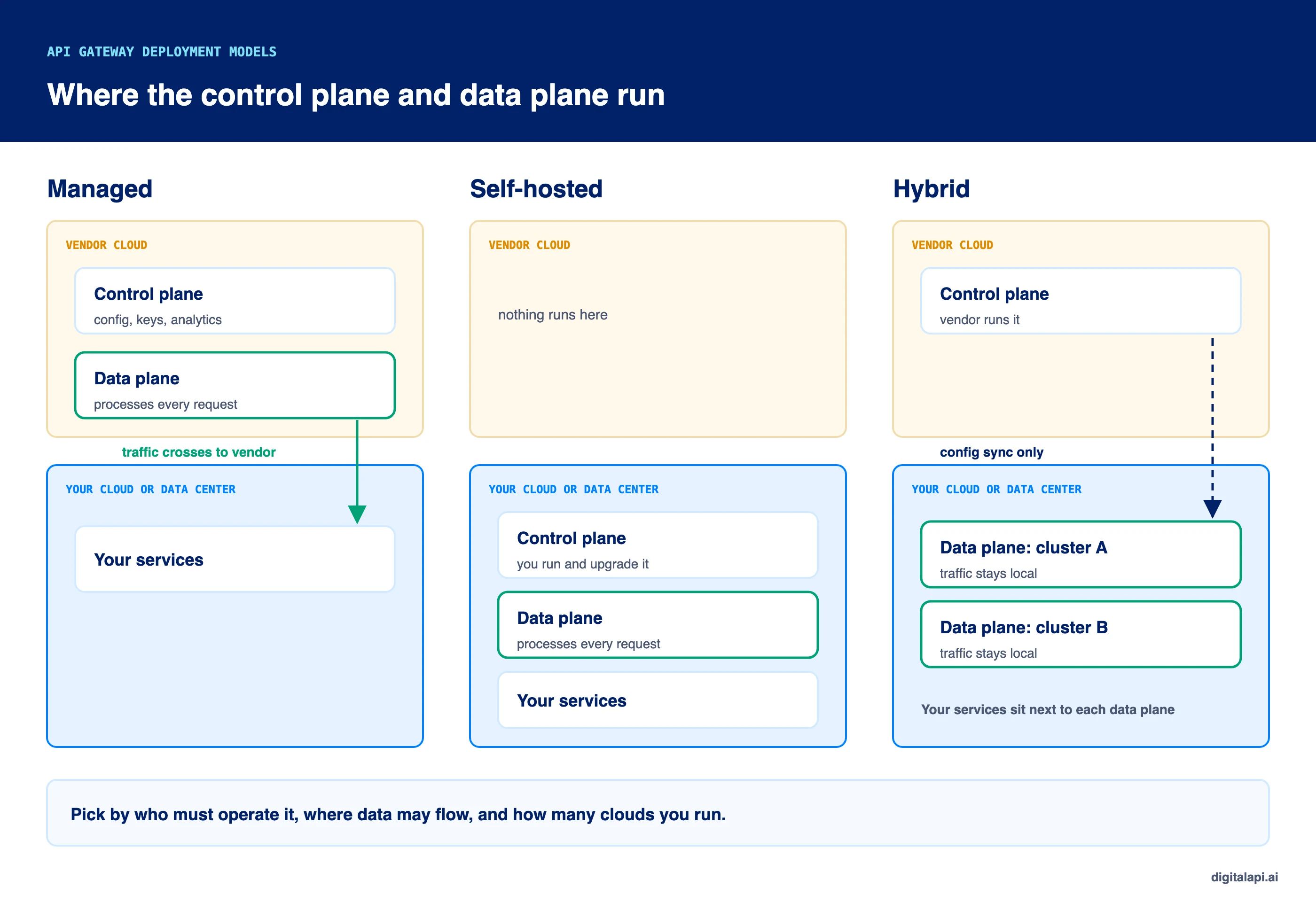
Choose managed if:
- You run in one cloud and want the shortest path to production.
- Your team has no capacity for gateway operations.
- Data residency rules allow traffic to pass through the provider.
Choose self-hosted if:
- Regulation requires all traffic and logs to stay in your network.
- You run on-premises, at the edge or in air-gapped environments.
- You have a platform team that already operates Kubernetes.
Choose hybrid if:
- You span several clouds or regions and want one policy set.
- You need local data planes for latency or residency, with central management.
What security and authentication features should a gateway have?
A gateway should validate every caller, enforce least-privilege access and block the top API attack patterns at the edge. Treat missing auth standards as a hard fail, not a low score.
Check for these capabilities:
- Standard auth: OAuth 2.0 and OpenID Connect (OIDC) token validation, JWT signature checks, API keys and mutual TLS (mTLS). RFC 8705 defines certificate-bound tokens over mTLS.
- Fine-grained authorization: scopes, role-based access control (RBAC) and per-route policy.
- Traffic protection: per-consumer rate limits, quotas, payload size limits and schema validation.
- Secrets and keys: integration with your secret store and automatic key rotation.
- Audit: structured logs for every request, with consumer identity attached.
Map each candidate against the OWASP API Security Top 10 (2023). Broken object level authorization and unrestricted resource consumption both need gateway controls. Ask each vendor which of the 10 risks the gateway mitigates, and how.
How much extensibility do you need from plugins?
You need enough extensibility to add custom logic without forking the gateway or learning a niche language. Most enterprises need at least one rule no vendor ships, such as a legacy token format.
Score extensibility on four points:
- Language. Can your team write plugins in a language it already knows? A proprietary DSL (domain-specific language) adds training and hiring cost.
- Isolation. Does a broken plugin crash the gateway, or fail safely?
- Performance cost. Measure latency with your custom plugin on, as part of the load test.
- Upgrade path. Do plugins survive major version upgrades without rewrites?
Also check for native OpenTelemetry export, so you never write a custom logging plugin.
Does the gateway need a developer portal and API productization?
Yes, if anyone outside the team that built the API needs to find and use it. A gateway secures traffic, but a portal turns APIs into products that partners and internal teams can adopt.
Look for:
- Self-service onboarding: sign-up, app creation, key issuance and sandbox access.
- Docs from specs: reference docs rendered from OpenAPI, so docs never drift from the API.
- Plans and quotas: tiered access with per-tier rate limits enforced at the gateway.
- Usage analytics: per-consumer dashboards for you and for the consumer.
- Multi-gateway catalog: one portal for APIs that live on more than one gateway.
The last point matters in large companies. If your APIs already sit on several gateways, a portal tied to one runtime leaves the rest invisible. A gateway-neutral API developer portal catalogs APIs from any gateway in one place.
Is the gateway ready for AI agents and MCP?
An AI-ready gateway identifies agent traffic, applies separate limits to it and can expose APIs as tools agents can call. AI agents call APIs in bursts and chains, so they stress auth and rate limits differently from human-driven apps.
Security teams already worry about this traffic. The Postman 2025 State of the API Report found that 51% of developers worry about unauthorized or excessive API calls from AI agents.
Ask each candidate:
- Can it tell agents from apps? Look for separate credentials, rate limits and audit trails for non-human callers.
- Can it expose APIs as MCP tools? Some gateways generate MCP tools from published APIs. Others need a separate MCP server.
- Does it pass MCP traffic cleanly? The MCP Streamable HTTP spec uses Server-Sent Events. Your gateway must not buffer them or rewrite the Authorization header.
For the full placement question, see MCP server vs API gateway.
What is the total cost of owning an API gateway?
Total cost of ownership (TCO) is the licence plus infrastructure plus the people who run the gateway, over 3 years. The sticker price is often the smallest part.
Build a 3-year TCO for each finalist:
- Licence or usage fees. Per-call pricing grows with traffic. Model your 3-year volume, not today's.
- Infrastructure. Count the nodes your load test needed at target RPS, across every region.
- People. Estimate engineers needed for upgrades, on-call, plugin work and policy changes.
- Migration. Include the cost of moving existing APIs, plugins and consumers.
- Exit cost. Estimate what it would take to leave: proprietary config, plugins and portal content.
Managed gateways look cheap at low volume and expensive at high volume. For pricing models in detail, read API gateway pricing for enterprise teams.
How do you use a scoring template to choose an API gateway?
Assign each criterion a weight that adds up to 100%, score every finalist from 1 to 5, and multiply. The highest weighted total wins, unless a candidate fails a hard requirement.
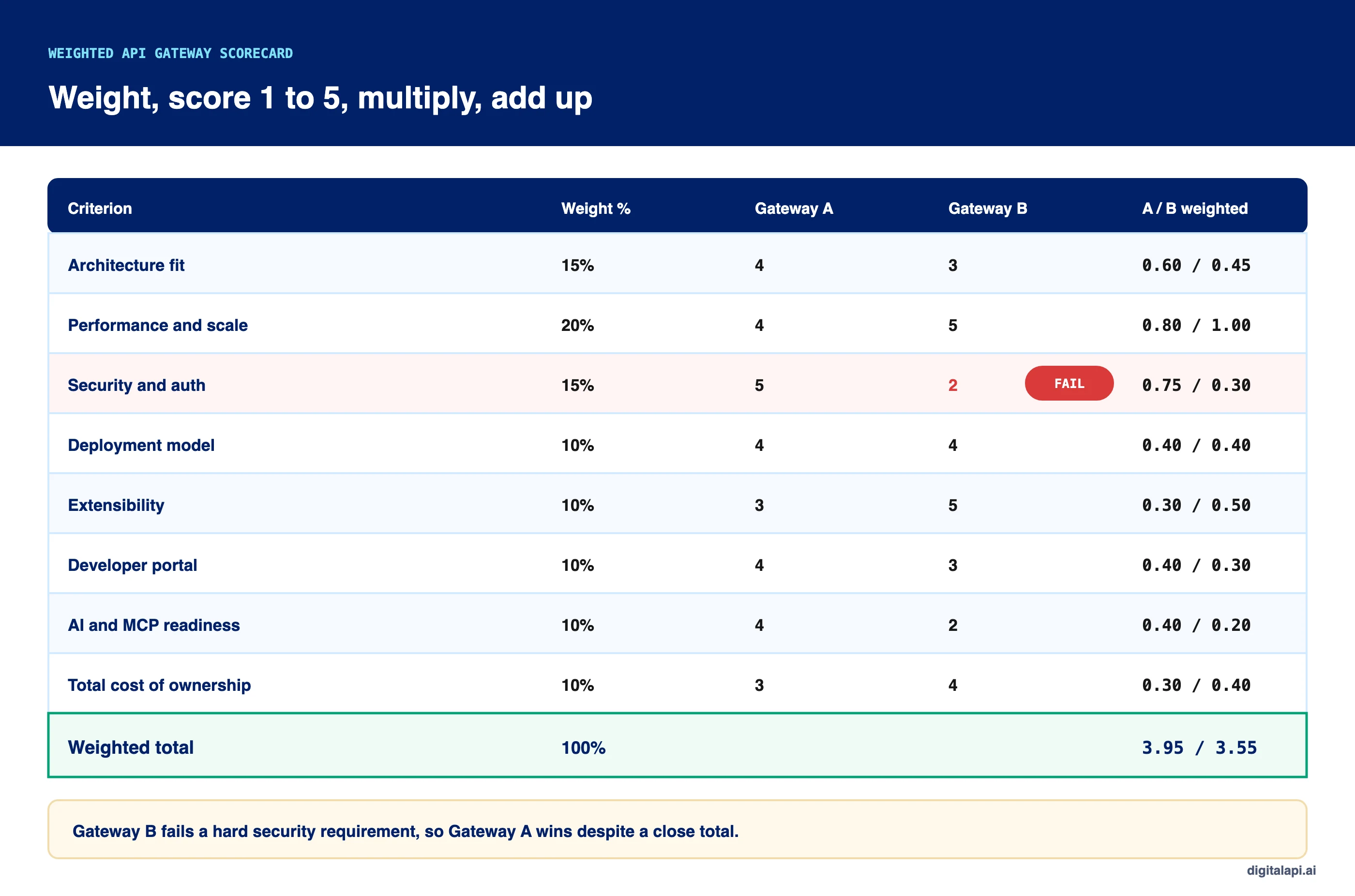
For a pass or fail list of must-have features, use our API gateway checklist for enterprise teams. Copy this template and adjust the weights:
Run the scoring in five steps:
- Set hard requirements first. Any candidate that fails one is out, whatever its score.
- Agree weights before demos. This stops the best demo from rewriting your priorities.
- Score from evidence. Use load-test results, docs and proof-of-concept notes, not slides.
- Have three people score separately. Average the scores and discuss any gap of 2 points or more.
- Multiply and total. Weighted score = weight × score. Compare totals, then check the top two against TCO again.
Shift weights to your context. A regulated bank might move security to 30%. An AI-first product team might raise AI and MCP readiness to 15%.
See how your shortlist scores against your own traffic → Book an architecture review with DigitalAPI
Where does Helix fit in your gateway evaluation?
Score Helix with the same template as every other candidate. It targets teams that need a self-hosted or hybrid gateway with agent-ready features.
On the criteria above, the DigitalAPI API Gateway (Helix) runs on bare metal, virtual machines, Kubernetes, edge or cloud, with multi-region active-active deployment. It supports OAuth, OIDC and mTLS with built-in RBAC, and exports telemetry through OpenTelemetry. Every published API can become an MCP tool, with scoped agent credentials, separate rate limits and audit trails.
Shadow traffic testing lets you run the load test above on real traffic while your current gateway stays live.
Key takeaways
- Knowing how to choose an API gateway means scoring 8 criteria, not comparing feature lists.
- Start with architecture. Monolith, microservices and multi-cloud need different gateway patterns.
- Load-test at a constant arrival rate with real plugins on, and compare p95 and p99 against a direct-to-backend baseline.
- Pick the deployment model from data residency and team capacity: managed, self-hosted or hybrid.
- Treat security standards as hard requirements and map candidates to the OWASP API Security Top 10.
- Weight the scorecard before demos and model TCO over 3 years at projected volume.
Frequently asked questions
1. How do I choose an API gateway for scalable app development?
Define your target RPS for the next 18 months plus headroom. Shortlist gateways that scale out with stateless nodes and support your deployment model. Load-test the finalists at a constant arrival rate with auth, rate limiting and logging plugins on. Choose the one with flat p99 latency, linear scaling and the best weighted score across all 8 criteria.
2. Which API gateway is best for microservices?
No single gateway is best for every microservices setup. The best fit supports your platform, often Kubernetes, with declarative config and service discovery. It applies per-route policy, scales horizontally and exports OpenTelemetry traces. Score candidates on your own architecture and load test.
3. What are the most important criteria for choosing an API gateway?
The 8 core criteria are architecture fit, performance and scalability, deployment model, security and authentication, extensibility, developer portal and productization, AI and MCP readiness, and total cost of ownership. Most enterprises weight performance and security highest. Treat security standards such as OAuth 2.0, OIDC and mTLS as hard requirements rather than scored items.
4. Should I use a managed or self-hosted API gateway?
Use a managed gateway if you run in one cloud, want the fastest start and have no team to operate infrastructure. Use a self-hosted gateway if regulation keeps traffic in your network or you run on-premises or at the edge. Choose hybrid if you span several clouds and want central policy with local data planes.
5. How do you load-test an API gateway fairly?
Give every candidate identical hardware and the same plugins, including auth, rate limiting and logging. Run the load generator on separate machines. Use a tool that holds a constant request rate, such as k6 or wrk2. Measure a direct-to-backend baseline, then record p95 and p99 latency and errors at 50%, 100% and 150% of target.
6. What is a good p99 latency for an API gateway?
It depends on your service level objectives. Set a gateway overhead budget as a share of your end-to-end p99 target. Compare p99 through the gateway against a direct-to-backend baseline at the same request rate. A good gateway keeps that overhead small and flat as traffic grows.
7. Do I need an API gateway that supports MCP?
You need MCP support if AI agents will call your APIs. An MCP-ready gateway identifies agent traffic and gives it separate credentials, rate limits and audit trails. It passes Streamable HTTP traffic without buffering streams. Some gateways can also expose published APIs as MCP tools, which removes the need to hand-build MCP servers.
Conclusion
Learning how to choose an API gateway comes down to discipline. Agree on 8 criteria and their weights before any demo. Then test the finalists under your own traffic with your own plugins on.
Start with your architecture, pick a deployment model that fits your data rules, and treat security standards as hard requirements. Build a 3-year TCO from load-test node counts, not list prices. The gateway with the highest weighted score and no hard fails is your answer.
Run your shortlist through an architecture review and see how DigitalAPI's API Gateway scores on your traffic, deployment model and security needs. Score your gateway options with DigitalAPI
Prefer a walkthrough? Book a Demo
Dhayalan Subramanian is Associate Director, Product Growth at DigitalAPI, where he leads go-to-market and product growth for the company’s multi-gateway API management platform. His work focuses on helping large enterprises and mid-market cloud companies consolidate APIs across AWS, Azure, Apigee, Kong, MuleSoft, and other gateways into a single control plane for governance, discovery, monetization, and agent consumption.
Dhayalan brings 14+ years of experience across product strategy, enterprise architecture, and engineering leadership. Earlier in his career, he held senior roles at Encora (as Associate Architect and Technical Manager), Mindtree (Technology Lead), Tech Mahindra (Technical Lead), and Primus Analytics, where he designed integration frameworks and delivered enterprise-grade digital platforms for global customers.
At DigitalAPI, he works directly with platform, integration, and developer experience leaders at Fortune 500 organizations to operationalize unified API catalogs, developer portals, and MCP-ready APIs. He writes regularly on API developer experience, API governance, and AI agent architectures.
One email a fortnight. Worth opening.
A short digest of what we're writing, what we're learning from customers, and the handful of links you'd actually want from us. No tracking pixels.