


API Gateway for MCP: What Your Gateway Can and Cannot Do
Your API gateway can already carry some MCP traffic. This guide shows what MCP needs from a gateway, what AWS, Azure, Kong and Apigee support as of November 2026, and when to add a dedicated MCP gateway.

TL;DR:
Can an API gateway be an MCP gateway?
Partly. An API gateway for MCP can authenticate agents, rate-limit calls and log traffic, and several now turn REST APIs into MCP tools.
Most still lack per-tool policy, discovery across many MCP servers and agent-aware credentials. A dedicated MCP gateway adds those.
Your security team approved the first AI agent pilot this week. The agent needs three internal APIs, and the platform team asks the obvious question. Do we buy an MCP gateway, or can the gateway we already run do the job?
That is the API gateway for MCP question. The answer changed in 2026. The MCP spec became stateless, and the four biggest gateway vendors shipped MCP features.
Demand is real. In the Stack Overflow 2025 Developer Survey, 31% of developers said they use AI agents at work. Among agent users, 34% named MCP servers as one of their uses.
This guide covers what MCP traffic needs, what your gateway already covers and where it stops. It closes with two deployment patterns and a checklist.
Can an API gateway act as an MCP gateway?
Partly. An API gateway can front MCP servers with the same identity, limits and logging it gives REST traffic. It cannot govern individual tools unless the vendor added MCP features.
MCP is the open protocol agents use to discover and call tools, with JSON-RPC 2.0 messages such as tools/call.
People search for an MCP API gateway expecting one product. In practice, it is a set of capabilities, and your gateway may already have some. If you are weighing MCP vs API gateway as two separate products, read our MCP gateway vs API gateway comparison.
What does MCP traffic need from a gateway?
MCP traffic needs a gateway that knows methods and tool names, checks OAuth 2.1 tokens and streams responses. The current spec makes the first job easier.
The MCP specification, version 2026-07-28, changed four things that matter to a gateway:
- No more protocol sessions. The spec removed the
Mcp-Session-Idheader and theinitializehandshake. Every request now carries its own protocol version and client details. Any gateway node can handle any request. - Routing headers. Each Streamable HTTP POST must carry
Mcp-Method(for exampletools/call) andMcp-Name(the tool name). The spec says this lets gateways route and inspect requests without parsing the body. - Request-scoped streams. A reply arrives as JSON or as a Server-Sent Events (SSE) stream tied to that request. SSE keeps one HTTP response open and sends data as it is ready. Change notifications use one long-lived stream through
subscriptions/listen. - Strict OAuth rules. A protected MCP server acts as an OAuth 2.1 resource server. It must publish Protected Resource Metadata (RFC 9728). It must not accept or pass through tokens issued for another service.
Those rules map to six gateway requirements:
- Method and tool awareness, read from headers or the JSON-RPC body.
- Token validation for the MCP server's own audience.
- Streaming passthrough, with buffering off and long idle timeouts.
- Per-tool policy, so one agent can list tools but not call
delete_customer. - Tool discovery across several MCP servers behind one endpoint.
- Tool-level audit, recording which agent called which tool with which outcome.
What does a standard API gateway already cover?
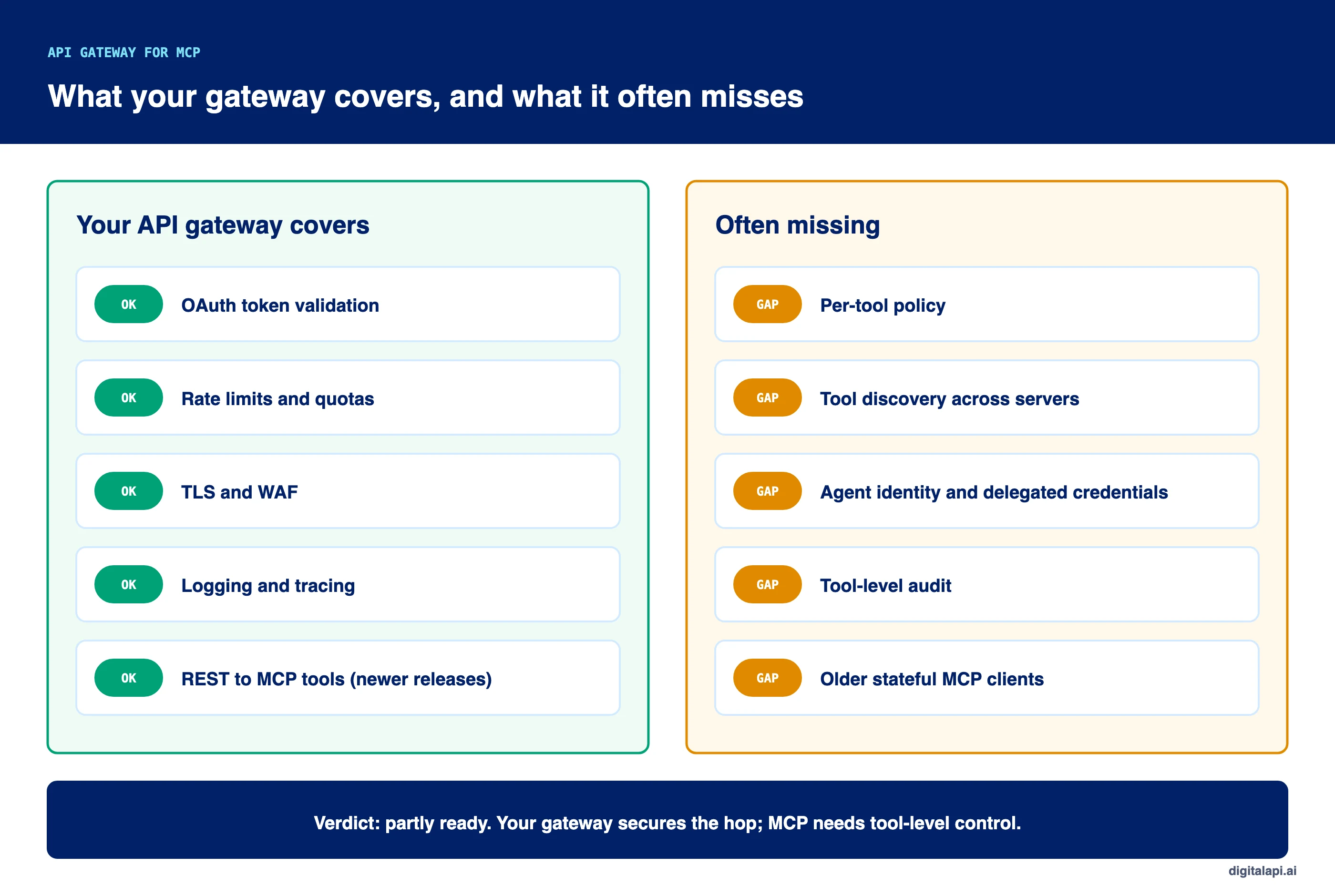
A standard API gateway covers transport, identity, limits and logs, about half the MCP job. If it proxies HTTP and validates JWTs, it can protect a remote MCP server today.
Here is what you get without MCP-specific features:
- TLS termination and WAF rules in front of every MCP endpoint.
- OAuth 2.0 and JWT validation, including audience checks that match the MCP server's URI.
- Rate limits and quotas per consumer, which cap runaway agent loops.
- Header-based routing. With the 2026 spec, a gateway can route or rate-limit on
Mcp-MethodandMcp-Namelike any other header. - Logs and traces that tie each call to a consumer key.
One caution: clients on older protocol versions may not send the routing headers. The spec says gateways that enforce policy on them should reject such requests.
The MCP server vs API gateway guide explains the full request flow from agent to backend.
Where do API gateways fall short for MCP?
The gaps are tool-level control, multi-server discovery and agent identity. These are the parts that turn a proxy into an MCP gateway.
- Per-tool policy. Many gateways apply one policy to a whole MCP server. Every tool then gets the same rules, so a read tool and a write tool share limits and access.
- Discovery across servers. Agents call
tools/listto see what they can do. A gateway in front of ten MCP servers needs to merge those lists and filter them per agent. A plain proxy returns each server's full list. - Agent identity and delegation. An agent often acts for a user. The gateway must know both identities and pass the right credential to each backend.
- Credential brokering. Backends may need API keys or service accounts that agents should never see. Someone must swap the agent's token for the backend secret.
- Tool-level audit. A log line that says "POST /mcp 200" does not show which tool ran. Compliance teams need the tool name and arguments.
Security risk sits in these gaps. In the same Stack Overflow survey, 81% of developers said AI agents raise data security and privacy concerns.
How do AWS, Azure, Kong and Apigee handle MCP today?
All four now offer some MCP support, but depth varies. The table uses each vendor's public docs, checked on 26 November 2026. "Not documented" means we found no statement either way.
Treat the table as a snapshot, and check release notes before you decide. For Microsoft's broader AI gateway features, see our Azure AI gateway guide.
Pattern 1: How do you put an API gateway in front of MCP servers?
Route MCP traffic through the gateway you already run, as one more API. It is the fastest start for one team and a few servers.
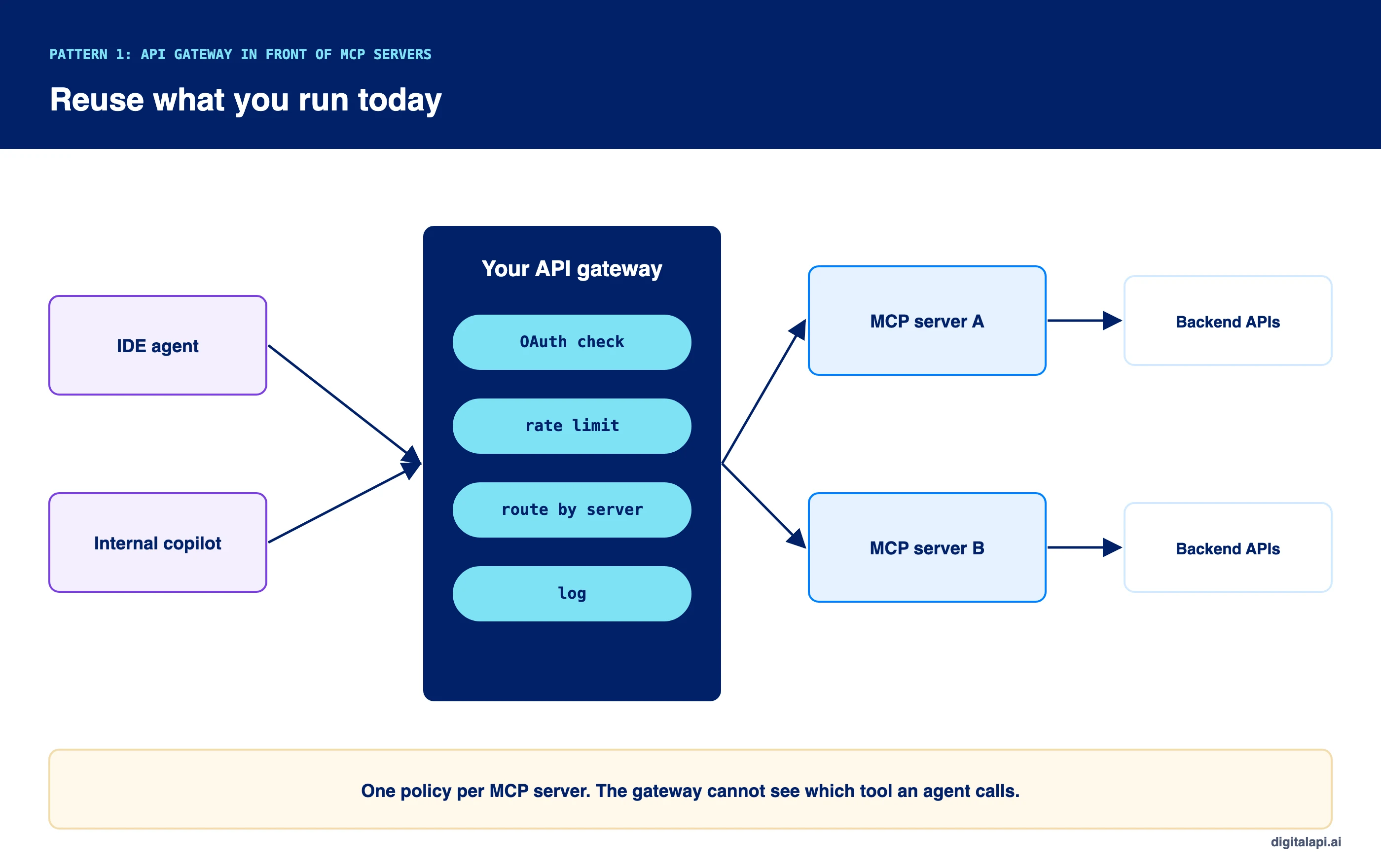
Set it up in five steps:
- Publish each MCP server as a gateway route, for example
/mcp/ordersand/mcp/billing. - Validate tokens at the gateway and check that the audience matches each MCP server's URI.
- Turn off response buffering for
text/event-streamand raise idle timeouts on MCP routes. - Rate-limit per consumer, and add stricter limits on
tools/callusing theMcp-Methodheader. - Log the
Mcp-Nameheader so every call shows which tool ran.
If your vendor supports REST to MCP conversion, it can expose simple APIs as tools without new MCP servers. Check the table for limits first.
Pattern 2: When do you add a dedicated MCP gateway alongside?
Add an MCP gateway when many agents, many MCP servers or sensitive tools are involved. It sits beside your API gateway, not in place of it. Agent traffic flows through the MCP gateway, and backend calls still pass through the API gateway.
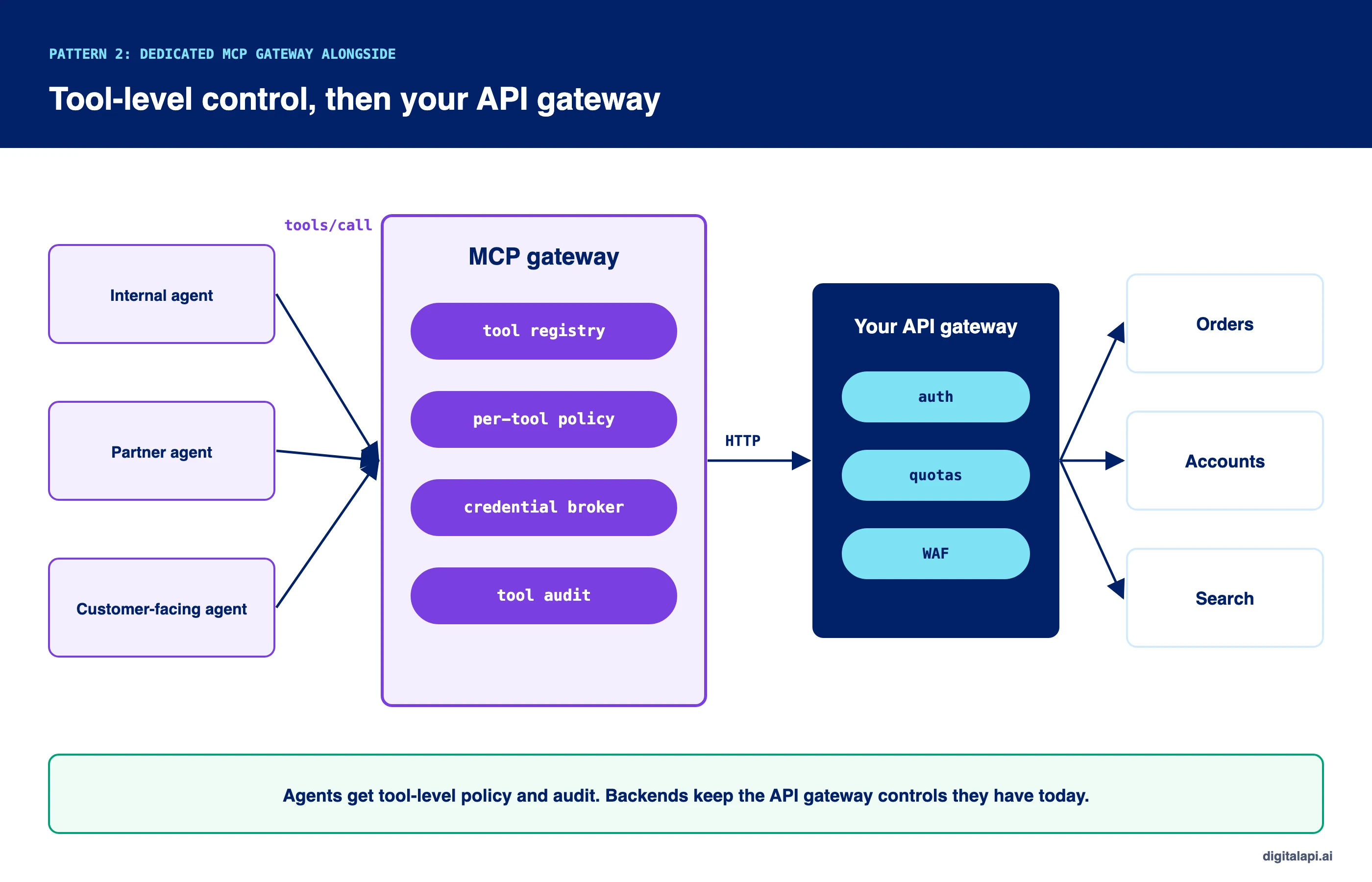
This split keeps each layer on its own job:
- The MCP gateway handles discovery, per-agent and per-tool policy, credential brokering and tool-level audit.
- The API gateway keeps its existing auth, quotas, WAF and routing for every backend call.
Teams that choose this pattern keep their gateway investment. The DigitalAPI MCP Gateway sits beside Apigee, Kong, AWS API Gateway or Azure API Management. It scopes access per agent, per tool and per partner. Every MCP call goes through the same audit and metering as HTTP API traffic.
For the components inside this layer, read MCP gateway architecture. For a buyer's view of the options, see the best MCP gateways in 2026.
See how DigitalAPI adds MCP governance without replacing your gateway → Book a Demo
API gateway for MCP: which pattern fits you?
Start with Pattern 1 while agents and tools are few and low-risk. Move to Pattern 2 when tools multiply or start to change data. Use this checklist to decide.
Your API gateway is enough if:
- One team runs one to three MCP servers for internal agents.
- Tools are mostly read-only, so one policy per server is acceptable.
- Your gateway validates OAuth tokens and streams SSE without buffering.
- Your vendor supports the MCP features you need, per the table above.
Add an MCP gateway if:
- Different agents need different tools from the same server.
- Partners or customers bring their own agents, each needing scoped access.
- Backends need secrets that agents must never hold.
- Auditors ask which agent called which tool, for whom and with what result.
- You run several gateways, and want one tool registry across all of them.
Either way, keep agents inside your existing identity system, not a separate login stack.
Key takeaways
- An API gateway for MCP covers about half the job. It handles TLS, tokens, rate limits and logs for MCP servers.
- The 2026-07-28 spec helps gateways. No sessions, plus
Mcp-MethodandMcp-Nameheaders, make MCP traffic easier to route. - Tool-level control is the main gap. Per-tool policy, multi-server discovery and credential brokering usually need MCP-specific features.
- Vendor support is uneven. As of November 2026, Kong and Apigee document per-tool access. Azure applies policy per server.
- Two patterns cover most teams. Put the gateway in front of MCP servers first. Add a dedicated MCP gateway alongside as agents and tools grow.
Frequently asked questions
1. Can an API gateway be used as an MCP gateway?
Partly. An API gateway can front remote MCP servers and apply authentication, rate limits, TLS and logging to MCP traffic. Several gateways now also convert REST APIs into MCP tools. Most lack per-tool policy, tool discovery across many servers and credential brokering for agents. A dedicated MCP gateway adds those, usually alongside the existing API gateway.
2. What is the difference between an MCP gateway and an API gateway?
An API gateway governs HTTP calls to your services with authentication, quotas and routing. An MCP gateway governs agent calls to tools over the Model Context Protocol. It filters which tools each agent sees, enforces per-tool policy, brokers backend credentials and logs tool-level activity. Most enterprises run both, with the MCP gateway calling backends through the API gateway.
3. Does AWS API Gateway support MCP?
Yes, since December 2025. Amazon API Gateway can add a REST API stage as a target of an Amazon Bedrock AgentCore Gateway, which exposes the API's methods as MCP tools. Per AWS docs, only public REST APIs are supported. APIs protected by Cognito user pools or Lambda authorizers are not reachable by MCP clients.
4. Does Azure API Management support MCP?
Yes. Azure API Management can expose a managed REST API as an MCP server or front an existing MCP server. You can apply rate limits, JWT validation, IP filtering and caching. As of its September 2026 docs, policies apply to all tools in a server, and converted REST APIs expose tools but not resources or prompts.
5. Do I need an MCP gateway if I already have an API gateway?
Not always. If one team runs a few MCP servers with mostly read-only tools, your API gateway can protect them. Add an MCP gateway when different agents need different tools or when partners bring their own agents. It also helps when backends need secrets agents must not hold, or when auditors need tool-level records.
6. How does an API gateway route MCP traffic?
In the MCP 2026-07-28 spec, each Streamable HTTP request carries Mcp-Method and Mcp-Name headers. A gateway can route, rate-limit or log on those headers without parsing the JSON-RPC body. Requests from clients on older protocol versions may lack the headers. The spec advises intermediaries to reject such requests rather than trust missing values.
7. Is there an open source AI gateway or MCP gateway?
Yes. Several open source projects act as MCP gateways or AI gateways, and some API gateways offer MCP features in community editions. Check three things before you adopt one. Look for support for the current MCP spec version, per-tool access control and integration with your identity provider. Also check who maintains the project and how often it releases.
Conclusion
An API gateway for MCP is a good first step, not the full answer. Your gateway already handles tokens, limits, streaming and logs, and the 2026 spec made MCP easier to route.
The gaps are tool-level. Per-tool policy, discovery across servers, agent credentials and tool audit decide whether agents stay governed as they scale.
Start with your existing gateway in front of one or two MCP servers. Track which agents call which tools. When that list grows, add an MCP gateway beside the API gateway, not instead of it.
Give agents one governed path to your APIs, with per-tool scopes and the same audit as your HTTP traffic, using DigitalAPI MCP Gateway. Add MCP governance without replacing your gateway
Prefer a walkthrough? Book a Demo
Dhayalan Subramanian is Associate Director, Product Growth at DigitalAPI, where he leads go-to-market and product growth for the company’s multi-gateway API management platform. His work focuses on helping large enterprises and mid-market cloud companies consolidate APIs across AWS, Azure, Apigee, Kong, MuleSoft, and other gateways into a single control plane for governance, discovery, monetization, and agent consumption.
Dhayalan brings 14+ years of experience across product strategy, enterprise architecture, and engineering leadership. Earlier in his career, he held senior roles at Encora (as Associate Architect and Technical Manager), Mindtree (Technology Lead), Tech Mahindra (Technical Lead), and Primus Analytics, where he designed integration frameworks and delivered enterprise-grade digital platforms for global customers.
At DigitalAPI, he works directly with platform, integration, and developer experience leaders at Fortune 500 organizations to operationalize unified API catalogs, developer portals, and MCP-ready APIs. He writes regularly on API developer experience, API governance, and AI agent architectures.
One email a fortnight. Worth opening.
A short digest of what we're writing, what we're learning from customers, and the handful of links you'd actually want from us. No tracking pixels.