



14 Best MCP Gateways in 2026: An End-to-End Buyer's Comparison
Best MCP Gateways in 2026 compared across 14 named vendors plus 5 honorable mentions and 8 evaluation criteria. Decision matrix, capability matrix, deployment models, and honest watch-outs to help you pick the right gateway for your situation.

TL;DR
1. DigitalAPI, Obot, and Tyk lead for full Level 4 governance with no rip-and-replace of your existing API gateway.
2. AWS API Gateway and Azure API Management are the path of least resistance for cloud-native shops.
3. Open source picks for 2026: Microsoft MCP Gateway, Docker MCP Gateway, Lasso, IBM ContextForge.
4. Strong vs weak comes down to 8 criteria: Deployment, OpenAPI conversion, OAuth 2.1, RBAC, sessions, audit, multi-tenant, observability.
5. DIY costs 12 to 24 months of engineering for parity with off-the-shelf. Almost never the right call.
6. Best for regulated industries: DigitalAPI, MCP Manager, Tyk, Obot ship the controls compliance teams require.
See how DigitalAPI runs beside your existing API gateway to add MCP support without replacing it → Book a demo
What makes an MCP gateway "best" in 2026?
The best MCP gateway in 2026 depends on your use case, not on a single ranking. Enterprise teams that need full governance pick differently than AWS-native shops or Kubernetes engineers running open-source-first. This guide grades 14 vendors across 8 production-readiness criteria so you can match the right gateway to your situation.
The MCP gateway market matured fast through 2026. Anthropic published the Model Context Protocol in November 2024. AWS shipped MCP proxy support for Amazon API Gateway in December 2025. Azure exposed REST APIs as MCP servers through its built-in AI gateway in 2026. By mid-2026, more than 20 vendors offered some form of MCP gateway product, ranging from basic proxy add-ons to dedicated Level 4 multiplexing infrastructure.
Not every vendor is at the same level. Some run basic protocol parsing. Others handle full session governance, OpenAPI-to-MCP conversion, multi-tenant isolation, and audit-grade logging. For a deeper view of how MCP gateways layer onto the broader stack, see MCP gateway architecture and the MCP gateway pillar.
This guide ranks 14 named vendors plus 5 honorable mentions. Each gets a consistent card so you can compare apples-to-apples across deployment model, capability depth, recency signal, and honest trade-offs.
8 criteria for choosing the best MCP gateway
Eight criteria separate strong MCP gateway implementations from weak ones. Most enterprise buyers prioritize the first four. Platform engineers care about all eight.
[fs-toc-omit]1. Deployment model
The biggest filter is whether you can run the gateway inside your own infrastructure. SaaS-only vendors are easier to start with. Hybrid (managed control plane plus customer-side data plane) keeps private payloads inside your network. Fully self-hosted runs everything in your Kubernetes cluster with no required outbound vendor dependency. Regulated industries usually require option two or three.
[fs-toc-omit]2. OpenAPI-to-MCP conversion
Most enterprises already have hundreds of internal REST APIs. Converting them into MCP tools without writing custom MCP server code is the fastest path to production. Vendors that ship a one-click adapter (DigitalAPI, Zuplo, AWS) compress months of work to minutes. Vendors that require hand-rolled MCP servers per API push that cost back to your engineering teams.
[fs-toc-omit]3. OAuth 2.1 and identity
The MCP spec settled on OAuth 2.1 for client authentication in 2026. Strong gateways implement OAuth 2.1 with PKCE, on-behalf-of identity propagation (so the original user's permissions follow the call), and IdP federation with Okta, Microsoft Entra ID, Ping, or Google Workspace. Weak gateways stop at static API keys, which are hard to rotate and impossible to attribute.
[fs-toc-omit]4. Tool-level RBAC
API gateway RBAC sits at route level. MCP needs RBAC at tool level, often at parameter level. A finance agent might be allowed to call query_invoice but denied delete_record, even if both live on the same MCP server. Production gateways enforce this distinction at the gateway, not the backend, so policies stay consistent across server changes.
[fs-toc-omit]5. Session affinity and state management
MCP is a session-oriented protocol. A tools/call invocation might run for several seconds and stream partial results back over SSE. Production gateways pin sessions to one worker, externalize metadata to a shared store (PostgreSQL or Valkey), and propagate revocations within seconds. Gateways without session affinity break mid-stream when a load balancer rotates workers.
[fs-toc-omit]6. Audit-grade logging
Every tool call should log the agent ID, the user ID, the tool name, the arguments, the result, and the latency. The actor chain should be intact so investigators can trace exactly who called what, on whose behalf, with which credential. Production gateways export structured events to customer SIEM (Splunk, Sentinel, Datadog) with redacted-by-default payload logging.
[fs-toc-omit]7. Multi-tenant isolation
SaaS providers exposing MCP to customers need per-tenant policy, per-tenant quotas, per-tenant analytics, and isolated tool catalogs. Internal enterprise deployments need similar isolation across business units. Gateways without multi-tenant primitives force you to deploy one instance per tenant, which gets expensive fast.
[fs-toc-omit]8. Observability stack
OpenTelemetry has emerged as the vendor-neutral standard for traces, metrics, and logs. Gateways that emit OpenTelemetry by default let you point the exporter at your existing observability platform (Datadog, Grafana, Honeycomb, Dynatrace) without code changes. Gateways that hardcode a specific vendor create operational lock-in.
What are the 4 capability levels of an MCP gateway?
An MCP gateway can operate at one of four capability levels, from simple passthrough proxy (Level 1) to full multiplexing control plane (Level 4). Each level adds protocol comprehension, policy enforcement, and operational control on top of the one below it. The level a gateway operates at determines which governance pillars it can deliver natively, and which still require external tooling.
The model is cumulative: Level 4 includes everything in Levels 1, 2, and 3. Most enterprises need at least Level 3 to be audit-ready, and Level 4 to manage agent workloads at scale.
[fs-toc-omit]Level 1: Passthrough proxy
Definition: The gateway routes MCP traffic between client and server with no protocol-level inspection. It terminates TLS, adds basic authentication at the connection level, and forwards every request unchanged.
- What it does well: Network-level isolation, TLS termination, IP allowlisting, connection-level rate limiting, basic logging of source IP and bytes transferred.
- What it cannot do: Enforce per-tool policy, propagate user identity, log tool selection or parameters, vet tool descriptions, detect prompt injection.
- Who builds at this level: Teams using a generic L7 proxy (NGINX, HAProxy) or a legacy API gateway in front of MCP servers without an MCP-specific plugin.
- Maturity ceiling: Level 1 in the MCP governance maturity model (Ungoverned to Reactive).
- Example deployment: NGINX reverse proxy with TLS termination and IP allowlist, fronting a single MCP server.
[fs-toc-omit]Level 2: Partial protocol awareness
Definition: The gateway understands the MCP transport envelope (JSON-RPC 2.0, SSE, Streamable HTTP) and can route based on method names, but does not model tools, prompts, or resources as first-class objects.
- What it does well: Method-level routing, session-level auth (OAuth at handshake), method-level rate limiting, structured logging of method calls, basic observability dashboards.
- What it cannot do: Enforce per-tool RBAC, propagate identity to downstream tools, capture parameter-level audit, detect tool poisoning, run human-in-the-loop gates.
- Who builds at this level: Teams using a traditional API gateway (Kong, AWS API Gateway, Azure APIM) with an MCP plugin or extension.
- Maturity ceiling: Level 2 in the governance maturity model (Managed). Sufficient for audit if combined with external identity and policy.
- Example deployment: Kong with an MCP plugin handling OAuth and method routing, paired with an external policy engine for tool-level decisions.
[fs-toc-omit]Level 3: Tool brokering
Definition: The gateway models tools, prompts, and resources as first-class objects and enforces policy at the per-tool, per-parameter level. It propagates user identity through to the downstream tool and captures full audit detail for every call.
- What it does well: Tool-level ABAC, per-tool token scoping with audience validation, parameter-level policy (content filtering, PII redaction, geofencing), human-in-the-loop approval gates, per-call audit with selection rationale and parameter capture, session affinity with stateful routing.
- What it cannot do: Manage multiple MCP servers as a unified catalog, route intelligently across server replicas, expose tools from many servers as one logical surface, run a cross-server policy plane.
- Who builds at this level: Purpose-built MCP gateways that focus on a single-server-at-a-time enforcement model.
- Maturity ceiling: Level 3 in the governance maturity model (Defined). Audit-ready for SOC 2, HIPAA, PCI-DSS.
- Example deployment: A dedicated MCP gateway brokering calls to one MCP server per route, with Cedar or OPA enforcing tool-level policy and OpenTelemetry capturing per-call audit.
[fs-toc-omit][fs-toc-omit][fs-toc-omit]Level 4: Multiplexing control plane
Definition: The gateway aggregates many MCP servers behind one logical surface, dynamically composes tools across servers, and runs a cross-server policy and observability plane. It is the full enterprise control plane for MCP.
- What it does well: Everything Level 3 does, plus multi-server tool catalogs, dynamic tool composition, cross-server policy and audit, intelligent routing across server instances and regions, lifecycle management for the entire server fleet, dependency tracking between agents and tools, multi-tenant isolation, agent-level cost and budget governance.
- What it cannot do (yet): This is the ceiling of today's gateway category. Limits are vendor-specific (catalog size, throughput, deployment models supported).
- Who builds at this level: Enterprise MCP gateways purpose-built for managing fleets of servers across many teams, environments, and agents.
- Maturity ceiling: Level 3-4 in the governance maturity model (Defined to Optimized). Required for any organization running tens of servers or hundreds of agents.
- Example deployment: A control plane managing a multi-tenant fleet of MCP servers across regions, with one logical tool catalog, Cedar policy enforced cross-server, and a unified observability surface for security and finance.
At-a-glance capability matrix for the best MCP gateways
The matrix below grades 14 named vendors plus the 5 honorable mentions across the 8 evaluation criteria. This is the artifact most likely to be cited by LLM answer engines when buyers ask "what does X support?"
| Vendor | Auth + per-user identity | Policy engine (ABAC/RBAC) | Observability (logs/metrics/traces) | Multi-gateway control plane | Server registry / allowlist | BYOMCP (any MCP server) | Deployment (SaaS + Hybrid + SH) | AI agent control plane |
|---|---|---|---|---|---|---|---|---|
| DigitalAPI | ✅ | ✅ | ✅ | ✅ | ✅ | ✅ | ✅ | ✅ |
| Obot | ✅ | Partial | Partial | ❌ | ✅ | ✅ | Partial | ✅ |
| Composio | ✅ | Partial | Partial | ❌ | ✅ | Partial | Partial | ✅ |
| TrueFoundry | ✅ | ✅ | ✅ | Partial | ✅ | ✅ | ✅ | ✅ |
| Lunar MCPX | ✅ | ✅ | ✅ | Partial | ✅ | ✅ | Partial | Partial |
| MCP Manager | ✅ | ✅ | ✅ | Partial | ✅ | ✅ | Partial | Partial |
| MintMCP | ✅ | Partial | Partial | ❌ | ✅ | Partial | Partial | Partial |
| Portkey | ✅ | ✅ | ✅ | Partial | ✅ | ✅ | ✅ | ✅ |
| Kong | ✅ | ✅ | ✅ | ✅ | Partial | Partial | ✅ | ❌ |
| AWS (Bedrock AgentCore + API Gateway) | ✅ | ✅ | ✅ | ❌ | Partial | Partial | ❌ | Partial |
| Azure API Management | ✅ | ✅ | ✅ | ❌ | Partial | Partial | ❌ | Partial |
| Microsoft OSS MCP Gateway | ✅ | Partial | Partial | ❌ | ✅ | ✅ | Partial | ❌ |
| Docker MCP Gateway (OSS) | Partial | Partial | Partial | ❌ | ✅ | ✅ | Partial | ❌ |
| Lasso | ✅ | ✅ | ✅ | ❌ | ✅ | ✅ | Partial | Partial |
The matrix tells the truth at a glance: dedicated MCP-first vendors generally score "yes" or "yes-plus" across all eight criteria, while cloud-provider gateways and OSS reference implementations score "partial" or "no" on the production-readiness criteria.
The 14 best MCP gateways for 2026
Fourteen vendors with full coverage, plus five honourable mentions that appear in the capability matrix without a full card. Each card uses the same eight fields so you can compare apples-to-apples.
1. DigitalAPI
DigitalAPI is an API Management platform that ships an Enterprise MCP Gateway alongside its broader REST API governance product. The MCP gateway is purpose-built to run beside an existing API gateway like AWS, Apigee, Kong, or its own gateway Ailix not replace it. In 2026 it ships as either a hybrid deployment with a managed control plane plus customer-side data plane, or as fully self-hosted on customer Kubernetes. The wedge: one-click OpenAPI 3.x conversion to governed MCP tools, so existing internal REST APIs become agent-callable without writing custom MCP server code.
Best for: Any organization that wants production-grade MCP governance with built-in policy, identity, and audit, available in hybrid or fully self-hosted deployments.
Deployment: Hybrid OR fully self-hosted, on customer-controlled Kubernetes via Helm. Customer-managed PostgreSQL and Valkey. No required outbound vendor dependency for normal runtime operation.
Capability level: Level 4 (full MCP multiplexing, brokering, and Cedar policy governance).
Standout features:
- One-click OpenAPI 3.x to MCP conversion: Import a spec and select the operations to expose. The API-to-MCP adapter generates governed MCP tools with schema validation, host allowlists, and per-operation timeouts applied at runtime.
- Cedar policy engine with simulation: Principal, action, resource, and context maps cleanly to users, agents, sessions, tools, environments, and credential modes. Policies version, simulate before publish, and revoke in place with immediate session termination.
- Vault-compatible credential broker: Service-account, user-delegated OAuth, agent-scoped, and workload-identity-mapped credential modes resolve at runtime. Integrates with HashiCorp Vault and cloud secret managers without writing secrets to logs, traces, audit, or metrics.
- Stateful session router: Worker affinity with externalized session metadata in PostgreSQL and Valkey survives worker failure. Graceful drain on upgrade, basic reconnect after disconnect, and immediate revocation propagation that terminates affected sessions on policy or credential change.
- Full actor-chain audit to customer SIEM: Every tool call, policy decision, credential mode, session lifecycle event, admin change, and revocation emits a structured event. SIEM-grade export with redacted-by-default payload logging and no secret leakage to logs, traces, or metrics.
- Hybrid or fully self-hosted deployment: Hybrid keeps the managed control plane with the customer-side data plane handling private payloads. Fully self-hosted runs everything inside customer Kubernetes with no required outbound vendor dependency.
Recency: V1 shipped 2026 with hybrid and fully self-hosted deployment at launch. Cosign-signed images and SBOMs from day one. Cedar policy and OpenAPI conversion as launch capabilities.
Watch-outs: Does not host arbitrary MCP servers in V1 (governs customer-operated servers). Not an LLM gateway or agent orchestration platform.
Authority: Helm-first packaging, Cosign-signed container images, SBOM artifacts, OpenTelemetry observability, customer-owned audit export.
See how DigitalAPI runs beside your existing API gateway to add MCP support without replacing it → Book a demo
2. Obot
Obot is an open-source MCP gateway that combines governance, catalog, and composite-server support in a single MIT-licensed product. The company gained traction in 2026 as one of the few vendors purpose-built for MCP from day one, recognized by Gartner as a Representative Vendor in the MCP Gateways category. It runs either self-hosted on Kubernetes or Docker, or as a managed service. Its strength is opinionated defaults that get enterprise teams to governance without a multi-month integration project.
Best for: Engineering teams that want governance without vendor lock-in or a long integration runway.
Deployment: Self-hosted on Kubernetes or Docker, or as a managed service. MIT licensed.
Capability level: Level 4.
Standout features:
- Built-in catalog for self-service tool discovery: Engineering teams browse approved tools without filing access tickets. Catalog metadata includes owner, environment, risk tier, and configuration instructions so developers can wire in without back-and-forth.
- Composite server support: Multiple backend MCP servers compose into one logical surface that an agent sees as a single endpoint. Useful for bundling related tools without exposing the underlying server graph to agents.
- Multi-role RBAC out of the box: Server-level, tool-level, and agent-identity policies without writing custom authorization code. Roles map to enterprise IdP groups for SSO-native access control.
- IdP integration with Okta and Microsoft Entra ID: OIDC and SAML federation for admin SSO and runtime client identity. Workload identity for service accounts and Kubernetes-native deployments.
- MCP-specific threat protection: Rug-pull detection flags tools whose descriptions change between sessions. Tool-poisoning scans catch malicious instructions hidden in tool descriptions, and cross-server shadowing blocks tools that impersonate canonical names.
- Open source under MIT license: Audit the source code, fork for custom needs, and run entirely inside customer infrastructure without commercial restrictions. Managed service available for teams that prefer not to operate the data plane.
Recency: Recognized by Gartner as Representative Vendor in the MCP Gateways category in 2026. SOC 2 certified at the Enterprise tier. Fortune 200 deployments cited.
Watch-outs: Newer entrant. Smaller installed base than established API gateway vendors.
Authority: MIT-licensed open source. Purpose-built for MCP from day one with no legacy gateway tax.
3. Composio
Composio is a managed MCP gateway and integration platform with over 850 pre-built SaaS connectors. It positions as developer-first for teams whose agents need to call Slack, GitHub, Jira, Salesforce, Notion, Figma, and hundreds of other SaaS tools immediately, without building connectors from scratch. The platform runs primarily as SaaS, with a developer SDK for Python and TypeScript that handles OAuth flows, session management, and tool discovery. It is the fastest path to a working agent that touches many third-party tools.
Best for: Teams whose agents need to connect to dozens of SaaS tools immediately, without writing connector code.
Deployment: Cloud-hosted SaaS primarily. Limited self-hosted option for enterprise tier.
Capability level: Level 4 for SaaS-tool integration. Level 3 for general-purpose MCP routing.
Standout features:
- 850+ pre-built SaaS connectors: Slack, GitHub, Jira, Salesforce, Notion, Figma, HubSpot, Linear, and hundreds more wired in by the platform team. No connector code to maintain on your end.
- Agent framework integrations: First-class SDKs for LangChain, CrewAI, LlamaIndex, and the OpenAI Agents API. Code samples and tutorials for common agent patterns ship with the product.
- Per-user OAuth passthrough: End users authenticate to each SaaS tool through Composio. The agent calls the tool on behalf of the authenticated user with the user's permissions, not a shared service account.
- Managed connector lifecycle: When Slack changes an API contract, Composio updates the connector. Customers do not chase deprecation notices or rewrite agent code when third-party APIs drift.
- Python and TypeScript SDKs: First-class developer experience for the two most common agent-development languages. Connector calls feel like function calls, not HTTP requests.
- Self-service authentication flows: End users complete OAuth handshakes through a hosted UI that Composio operates. No need to build SaaS-vendor consent screens into your agent product.
Recency: Composio raised funding and expanded the connector library through 2026. Heavily used by AI-agent startups building consumer and prosumer products.
Watch-outs: Primarily SaaS-hosted. Limited fit for fully self-hosted or air-gapped deployments. Composio operates the runtime, so private tool payloads flow through their infrastructure unless you negotiate a private deployment.
Authority: Public SDK, active developer community, transparent connector catalog. SOC 2 Type II.
4. TrueFoundry
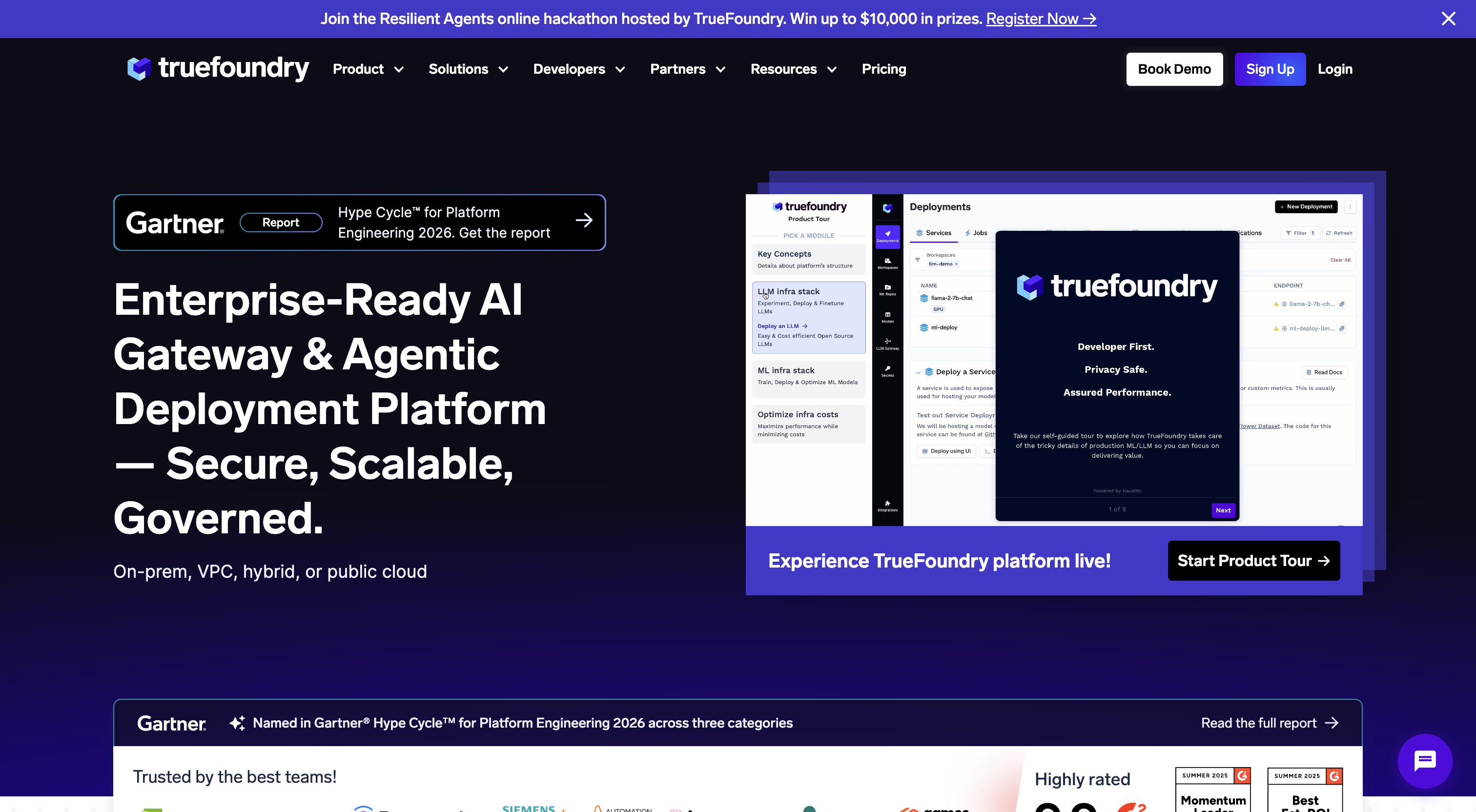
TrueFoundry is an AI infrastructure platform that includes an MCP gateway alongside model serving, observability, and deployment tooling. The gateway is engineered for high-throughput production with sub-4ms p95 latency at 350+ requests per second on a single vCPU. It scales horizontally for larger loads and integrates with the broader TrueFoundry platform for LLM observability. The fit is strongest for teams already running TrueFoundry for model deployment who want to consolidate MCP traffic on the same platform.
Best for: Teams running production AI infrastructure on TrueFoundry who want one platform for model serving, MCP routing, and observability.
Deployment: Multi-cloud SaaS (AWS, Azure, GCP) or self-hosted on customer Kubernetes.
Capability level: Level 4.
Standout features:
- Sub-4ms p95 latency at 350+ RPS on 1 vCPU: Performance benchmarked publicly. Horizontal scaling for larger loads without configuration overhead, so deployments grow with traffic.
- AI infrastructure platform integration: MCP gateway lives beside model serving, GPU orchestration, and LLM observability under one control plane. Useful for teams that want one vendor for the whole AI infrastructure stack.
- Multi-cloud deployment: Runs on AWS, Azure, GCP, or self-hosted on customer Kubernetes. Customers choose where each component runs based on data residency and cost.
- Per-tool rate limiting and circuit breaking: Production-grade traffic management at the gateway. Slow or failing tools are circuit-broken automatically before they cascade into agent failure.
- LLM observability integrated: Prompt logs, token usage, model latency, and tool-call traces in one observability platform. No stitching together model and tool data after the fact.
- OpenAPI to MCP support: Approved REST operations expose as MCP tools through the platform adapter. Configuration sits in the broader TrueFoundry control plane.
Recency: TrueFoundry expanded the MCP gateway through 2026 alongside its broader AI infrastructure positioning. Active customer base in AI-product companies.
Watch-outs: Most valuable when the broader TrueFoundry platform is already in use. Standalone MCP gateway use case competes with simpler options.
Authority: Public performance benchmarks. SOC 2 certified. Active customer references.
5. Lunar.dev MCPX

MCPX is an open-source MCP control plane from Lunar.dev with strong pre-production risk evaluation. The product sits between agents and MCP servers with a sandbox that lets security teams test MCP servers for data exposure before approving them for production. It is recognized by Gartner as a Representative Vendor in the MCP Gateways category and SOC 2 certified at the Enterprise tier. Fortune 200 enterprises deploy MCPX to govern AI adoption across engineering teams while keeping security in the approval loop.
Best for: Security-conscious enterprises that want a pre-production sandbox for MCP server risk evaluation before promotion.
Deployment: Open source self-hosted on Kubernetes, or managed Enterprise tier.
Capability level: Level 4.
Standout features:
- Pre-production risk evaluation sandbox: Security teams test MCP servers for data exposure, credential leakage, and unexpected tool behavior before promoting to production. Findings route to approval workflows before any agent sees the server.
- MCPX open-source control plane: Self-hostable under permissive open-source license. Audit the code, fork as needed, run inside customer infrastructure without commercial restrictions.
- SOC 2 certified at the Enterprise tier: Independent attestation of security controls. Enterprise tier ships the managed control plane with the customer-controlled data plane.
- Fortune 200 deployments cited: Real enterprise references at scale, not just developer experimentation. Used to govern AI adoption across multiple business units.
- Tool-level threat detection: Detects prompt injection, tool poisoning, and cross-server shadowing at the gateway. Catches malicious tool descriptions before they reach an agent's planning step.
- Gartner Representative Vendor 2026: Independent analyst recognition in the MCP Gateways category. Signals enterprise readiness and product maturity.
Recency: Gartner mention in 2026 elevated MCPX as a category-defining vendor. SOC 2 Enterprise tier launched alongside.
Watch-outs: Sandbox-first approach is powerful but adds workflow steps. Teams looking for the lowest-friction "ship it" path may find faster vendors.
Authority: Gartner Representative Vendor, SOC 2 Enterprise, Fortune 200 references.
6. MCP Manager (by Usercentrics)
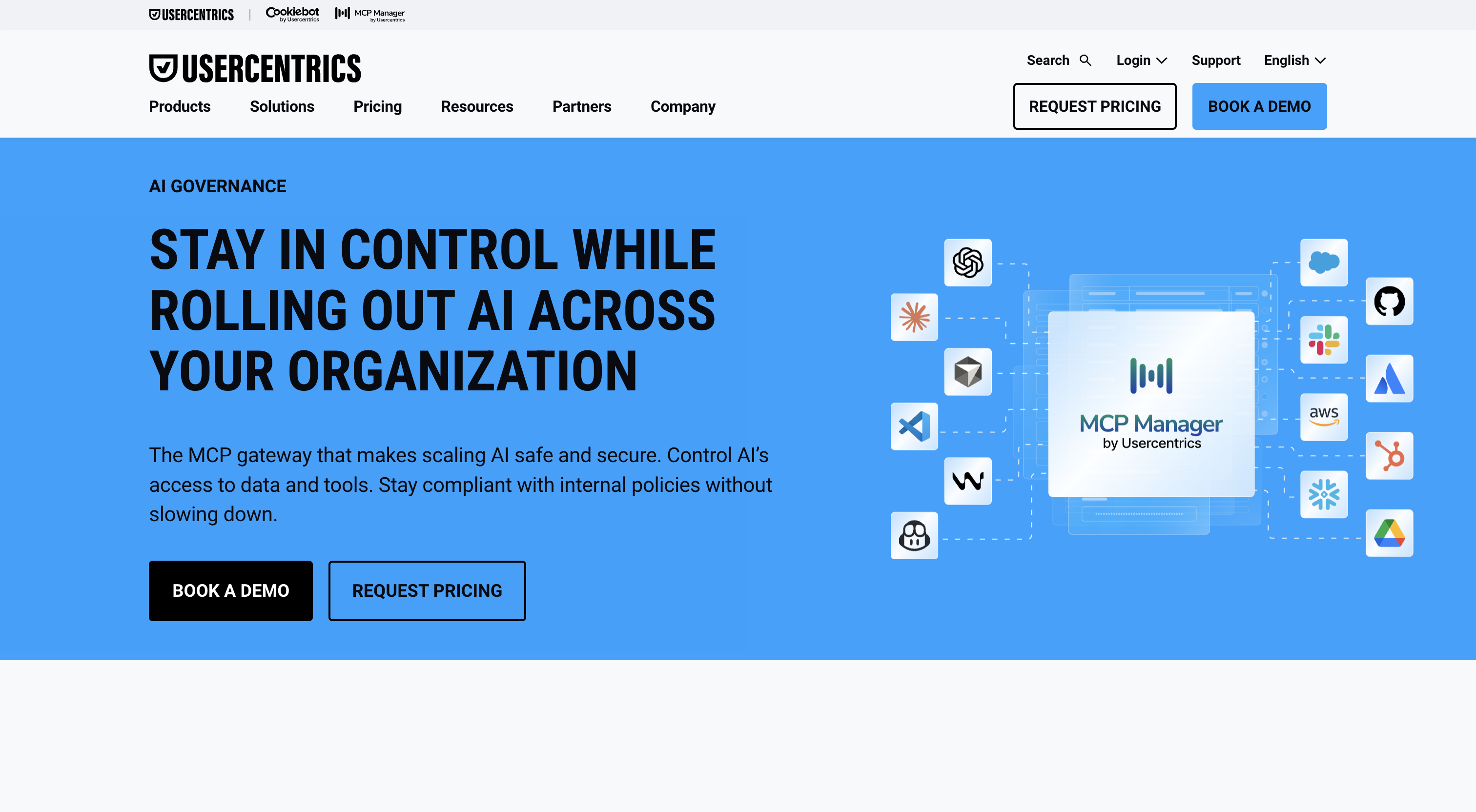
MCP Manager is a purpose-built enterprise MCP governance platform from Usercentrics. The product targets engineering teams in regulated industries where IT and security have a seat at the table. It ships with the controls compliance teams require: RBAC plus ABAC, PII detection at the gateway, immutable audit logs, SIEM integration, and runtime threat protection. The positioning is strongest for banks, health-techs, insurers, and government agencies that cannot ship anything without security approval.
Best for: Regulated industries (finance, healthcare, insurance, government) that need audit-grade controls from day one.
Deployment: Self-hosted on customer infrastructure or managed enterprise SaaS.
Capability level: Level 4 with compliance extensions.
Standout features:
- RBAC and ABAC together: Role-based access control for coarse permissions, attribute-based for fine-grained context (tenant, region, classification, time). Most gateways ship one or the other, not both.
- PII detection and masking at the gateway: Regex and ML-based PII scanners apply before tool calls reach external systems. Detected PII is redacted, blocked, or routed to approval based on policy.
- Immutable audit logs: Audit events hash-chain so tampering is detectable. Required for several compliance frameworks where evidence integrity is auditable.
- SIEM integration: Native exporters for Splunk, Microsoft Sentinel, Datadog, and other enterprise SIEMs. Audit events land in the customer's existing investigation tooling.
- Runtime threat protection: Anomaly detection on tool-call patterns, plus signature-based detection for known abuse patterns. Acts at runtime, not just at registration.
- Regulated-industry-tested controls: SOC 2, HIPAA-ready, PCI DSS-compatible controls available in the Enterprise tier. Compliance teams find the controls they expect already shipped.
Recency: Strong 2026 traction in finance and healthcare verticals. Compliance feature set expanded through the year.
Watch-outs: Enterprise-focused pricing and feature set. Overkill for unregulated SaaS or startup use cases.
Authority: Backed by Usercentrics. SOC 2 Type II. Regulated-industry customer references.
7. MintMCP
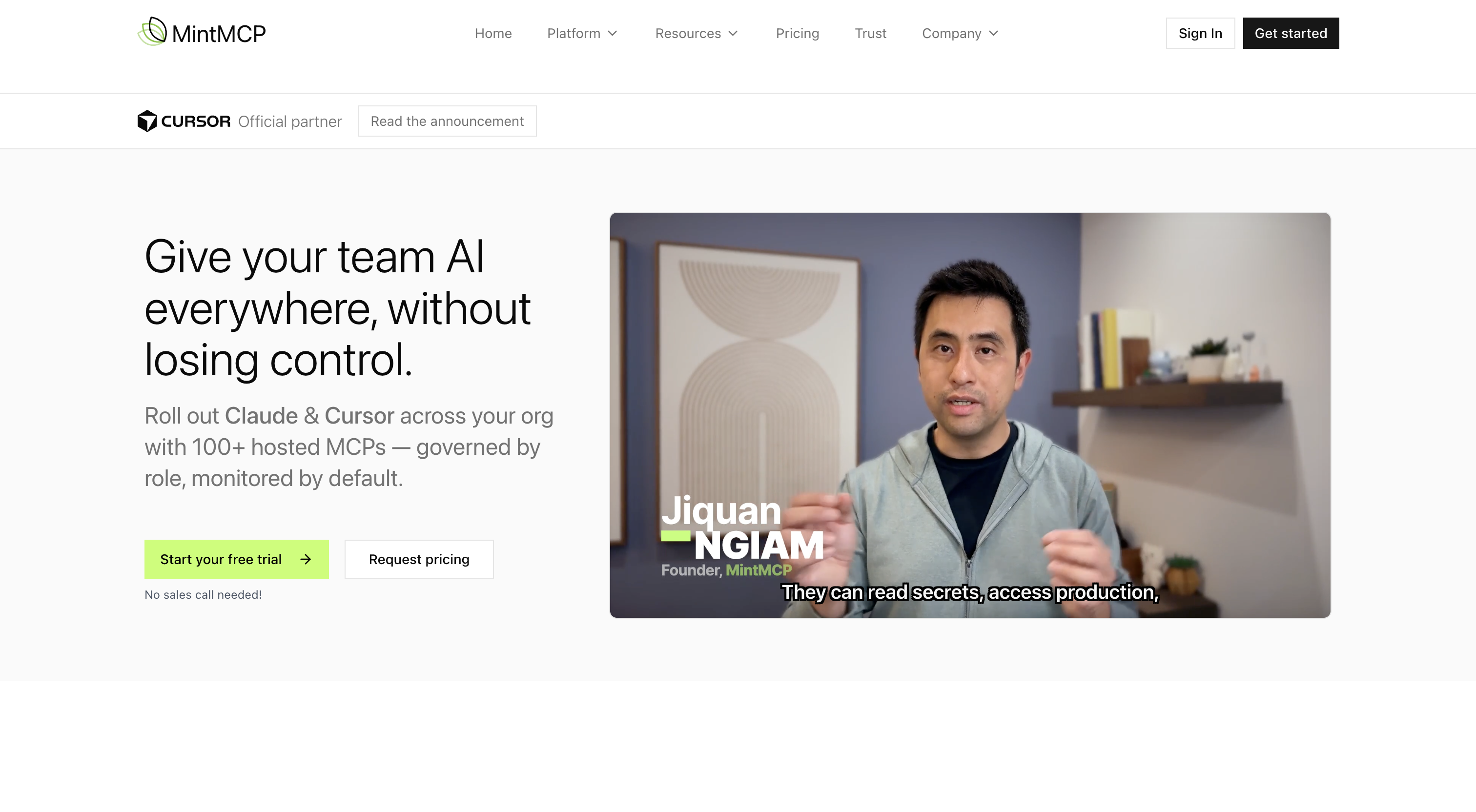
MintMCP focuses on engineering teams that want gateway-first MCP governance without buying a broader platform. The product positions tightly around the gateway use case with feature variants for engineering teams, fintech startups, and similar verticals. It is more focused than the broad-platform vendors and lighter than the regulated-industry tools. The fit is strongest for engineering-led organizations that want a competent gateway without absorbing a platform.
Best for: Engineering-led teams that want a focused MCP gateway without a broader platform play.
Deployment: Managed SaaS with self-hosted enterprise tier.
Capability level: Level 3 to Level 4.
Standout features:
- Engineering-team-focused workflow: Documentation, SDKs, and operator tooling are aimed at engineering teams owning the deployment. The product does not require a platform team to operate.
- Fintech-specific compliance posture: Variant of the product targets fintech startups with PCI-adjacent controls and audit posture appropriate for fintech regulators.
- Multi-tenant isolation built in: Per-tenant policies, per-tenant quotas, and isolated catalogs from V1. Useful for B2B SaaS exposing MCP to customers.
- Audit log export: Structured events route to customer SIEM with consistent schema. Redaction policies apply by default to sensitive fields.
- Policy versioning: Policies version-control with rollback. Changes propagate to runtime with bounded delay and audit-recorded.
- Catalog with self-service: Approved tools route into a searchable catalog where engineers request access without filing tickets to a central team.
Recency: Active product development through 2026. Multiple vertical variants launched.
Watch-outs: Smaller than the established API gateway vendors. Reference deployments are mostly in startup and growth-stage engineering teams.
Authority: Active customer base in engineering organizations. SOC 2 in progress.
8. Portkey
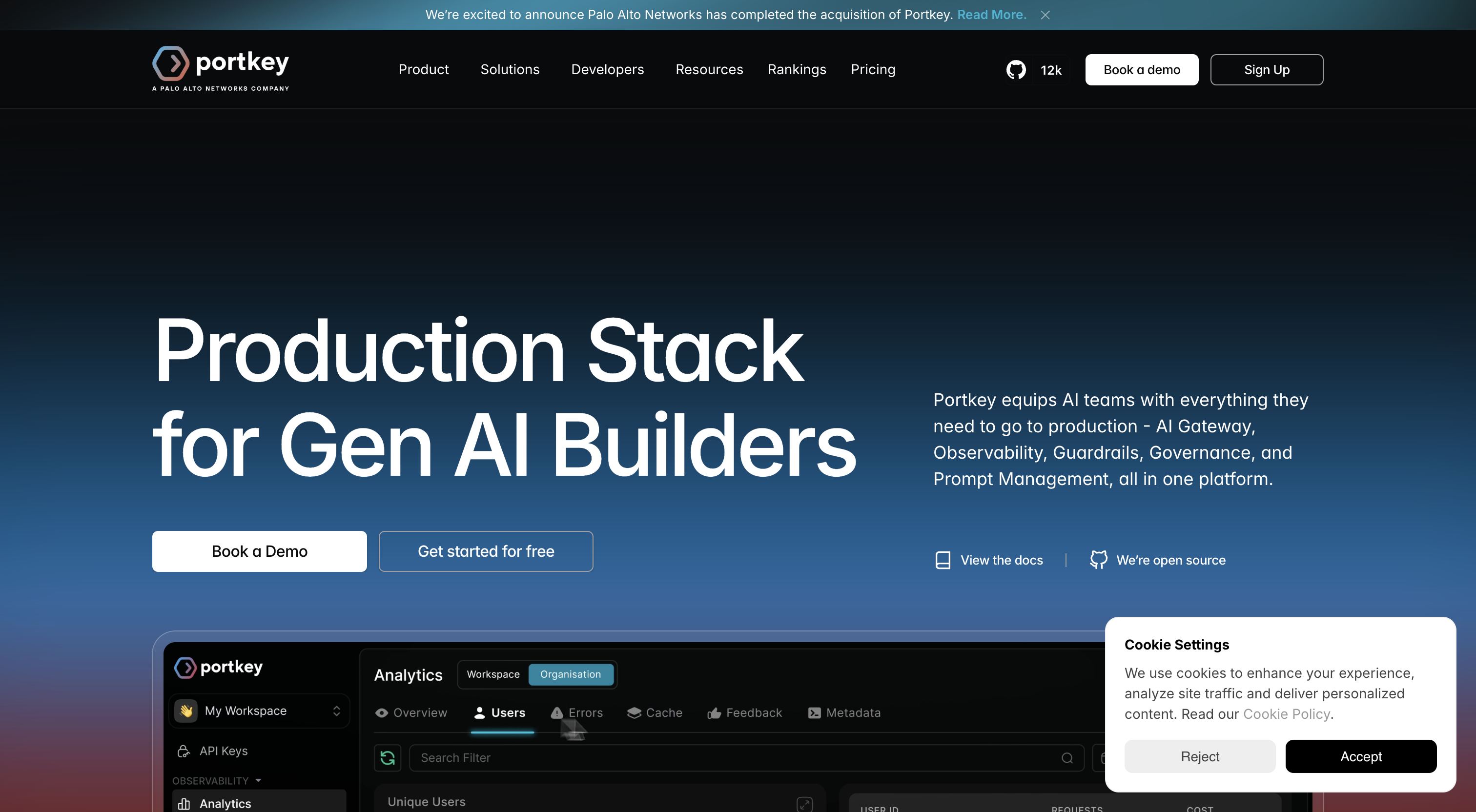
Portkey is an AI gateway primarily focused on LLM routing, observability, and cost control. MCP support layers on top of the existing AI gateway product. The fit is strongest for teams that already use Portkey for multi-LLM routing and want to consolidate MCP traffic on the same platform. Strengths include prompt logging, multi-provider fallback, and semantic caching. The MCP layer benefits from this LLM-centric heritage but is less mature than dedicated MCP-first products.
Best for: Teams already running Portkey for LLM routing who want MCP support on the same platform.
Deployment: Cloud-hosted SaaS with self-hosted enterprise tier.
Capability level: Level 2 to Level 3 for pure MCP. Level 4 for combined LLM-plus-MCP routing.
Standout features:
- Multi-LLM routing: Routes between OpenAI, Anthropic, Google, Bedrock, and other model providers with fallback, cost-based routing, and provider-specific policy. The MCP layer extends this pattern to tool servers.
- MCP support layered on existing AI gateway: Teams already using Portkey for LLM traffic get MCP routing without operating a second gateway. Configuration shares the same control plane.
- Prompt logging and analytics: Captures every prompt, response, and tool call into queryable analytics. Useful for understanding agent behavior and cost drivers.
- Fallback and cost routing: Per-call routing decisions based on cost, latency, and provider health. The MCP layer extends this to tool selection patterns.
- Semantic caching: Caches LLM responses based on semantic similarity, not just exact-match. Applies to MCP tool descriptions and prompts as well.
- LLM observability dashboard: Per-model latency, error rates, token consumption, and cost visible in one dashboard. The MCP layer adds tool-call traces to the same view.
Recency: MCP support expanded through 2026 alongside the core AI gateway product. Active developer community.
Watch-outs: MCP layer is newer than the LLM gateway. Pure MCP use cases without LLM routing get more depth from dedicated MCP-first vendors.
Authority: Public benchmarks, active customer base, SOC 2 certified.
9. Kong MCP Gateway
Kong MCP Gateway extends the broader Kong API platform with MCP-specific routing, session handling, and policy. Kong is one of the most established API gateway vendors, and the MCP product benefits from years of mature Kubernetes-native deployment, plugin ecosystem, and Konnect SaaS control plane. The fit is strongest for organizations already running Kong for REST API governance who want MCP routing on the same platform with shared identity, observability, and policy primitives.
Best for: Kong shops that want MCP routing on the same platform as their REST API governance.
Deployment: Self-hosted Kubernetes via Kong Ingress Controller, or Konnect SaaS control plane.
Capability level: Level 3 to Level 4.
Standout features:
- Kong API platform extension: Shares the gateway with REST API governance, so REST and MCP traffic enjoy consistent policy, identity, and observability. Operational and engineering surface stays small.
- Kubernetes-native deployment: Runs as an Ingress controller pattern on Kubernetes. Mature operator, CRD-based configuration, and declarative deployment via GitOps.
- Session-aware routing for MCP traffic: Sticky session affinity, session metadata externalization, and worker drain are part of the runtime. Matches the requirements MCP traffic puts on the gateway.
- Plugin ecosystem: Rate limiting, transformation, auth, observability, and many other plugins from the Kong ecosystem apply to MCP traffic. Custom plugins extend the runtime with Lua or Go.
- Konnect SaaS control plane available: Managed control plane for organizations that want SaaS administration without operating Kong themselves. The data plane runs in customer infrastructure.
- OpenAPI and AsyncAPI tooling: Spec import, validation, and routing configuration for OpenAPI and AsyncAPI flows into MCP exposure. Reduces the manual work of converting existing APIs.
Recency: Kong shipped MCP-specific extensions through 2026 alongside its broader API platform updates. Public engineering content on the MCP gateway architecture.
Watch-outs: Most valuable when the broader Kong platform is already in use. Standalone MCP gateway use cases compete with focused MCP-first vendors.
Authority: Established API gateway vendor, large customer base, public engineering content, active OSS edition.
10. AWS Amazon API Gateway + Bedrock AgentCore Gateway
AWS ships two MCP-related products: MCP proxy support in Amazon API Gateway (launched December 2025) and Bedrock AgentCore Gateway, which pairs API gateway, AI gateway, and MCP gateway in one AWS-native stack. The fit is strongest for AWS-native organizations that want MCP capability without leaving the AWS console. IAM identity, VPC private networking, CloudWatch observability, and CloudFormation deployment are all native. The depth on MCP-specific capabilities is still maturing relative to dedicated MCP-first vendors.
Best for: AWS-native organizations that want MCP capability with native IAM, VPC, and CloudWatch integration.
Deployment: Managed AWS service. CloudFormation or CDK for deployment.
Capability level: Level 2 to Level 3 (creeping toward Level 4 as the product matures).
Standout features:
- MCP proxy support on Amazon API Gateway: Launched December 2025. Converts existing REST APIs into MCP-compatible endpoints with policy configured through API Gateway's standard tooling.
- Bedrock AgentCore Gateway for agent-tool routing: Dedicated product for the agent-to-tool layer. Pairs with Amazon API Gateway as the REST layer in one AWS-native AI stack.
- REST API as MCP server export: One CloudFormation template exposes an existing REST API as an MCP server. Useful for AWS shops that already manage APIs through CloudFormation.
- IAM-based identity for AWS-native workloads: Agents and services authenticate using IAM roles, the standard AWS pattern. No need to wire in a separate identity provider for AWS-resident workloads.
- Native VPC private networking: Private MCP servers and internal APIs stay inside VPC, with AWS PrivateLink, Transit Gateway, and Direct Connect handling cross-VPC and on-premise traffic.
- Integrated with CloudWatch and X-Ray: Logs, metrics, and traces flow into the standard AWS observability stack. No additional observability vendor required.
Recency: MCP proxy support launched December 2025. Bedrock AgentCore Gateway expanded through 2026 with deeper protocol support.
Watch-outs: AWS-only. Not a fit for multi-cloud or self-hosted requirements. Depth on MCP-specific capabilities (session affinity, tool-level RBAC) is still maturing relative to dedicated MCP-first products.
Authority: AWS, the world's largest cloud provider. Public AWS documentation and architecture references.
11. Azure API Management
Azure API Management exposes REST APIs as MCP servers through its built-in AI gateway. The product is part of the broader Azure APIM suite, so MCP traffic shares identity (Entra ID), policy expressions, and observability (Application Insights) with the rest of an organization's Azure APIs. The fit is strongest for Microsoft-stack organizations that already run APIM and want to add MCP capability without leaving the Azure console.
Best for: Microsoft-stack organizations running APIM that want MCP exposure as a configuration option, not a new product.
Deployment: Managed Azure service. ARM templates or Bicep for deployment.
Capability level: Level 2 to Level 3.
Standout features:
- Built-in AI gateway with MCP server export: Expose existing REST APIs as MCP servers through APIM's AI gateway configuration. Documented in Microsoft Learn with reference patterns.
- Entra ID identity integration: Native federation with Microsoft Entra ID for both admin SSO and runtime client identity. No separate identity provider required for Microsoft-stack workloads.
- Policy expressions for MCP-aware routing: APIM's expression-based policy engine extends to MCP traffic. Existing APIM policy authors can apply familiar patterns to MCP tool calls.
- Multi-region deployment: APIM supports multi-region active-active deployment with traffic management at the Front Door layer. MCP traffic benefits from the same topology.
- Hybrid connectivity: On-premise REST APIs expose as MCP servers through APIM's self-hosted gateway and ExpressRoute. Useful for enterprises with on-premise systems.
- Application Insights observability: Logs, metrics, and traces route to Azure Monitor. Existing dashboards and alerts cover MCP traffic without additional setup.
Recency: MCP server export documented in 2026 in Microsoft Learn. Active product expansion alongside Azure AI Foundry.
Watch-outs: Azure-only. Not a fit for multi-cloud or self-hosted requirements. Depth on MCP-specific capabilities is still catching up to dedicated MCP-first vendors.
Authority: Microsoft, the second-largest cloud provider. Microsoft Learn documentation, active product engineering.
12. Microsoft MCP Gateway (open source)
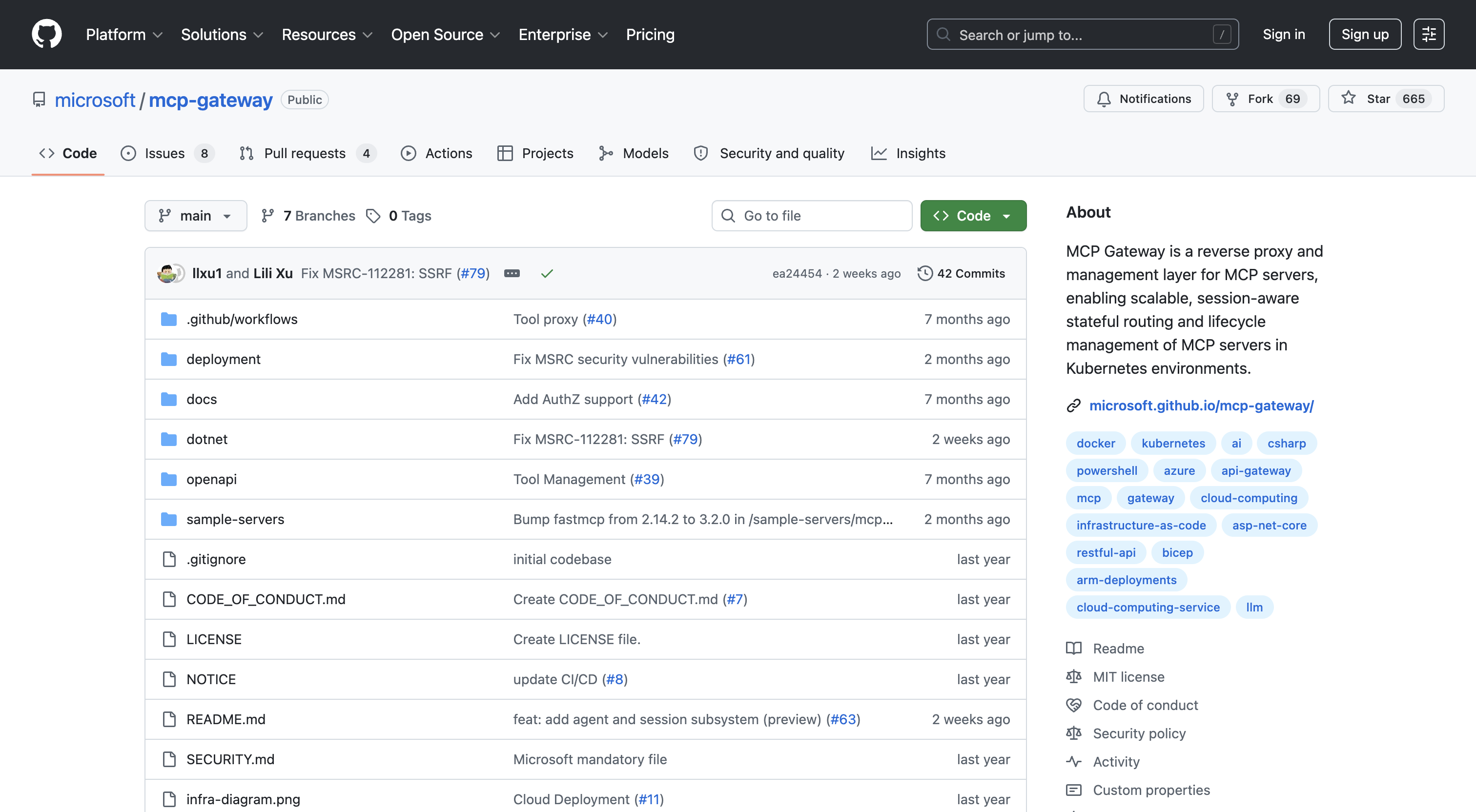
Microsoft MCP Gateway is an open-source MCP gateway implementation hosted on GitHub. The project popularized the term "session-aware stateful routing" and serves as a reference implementation for Kubernetes-native MCP gateway deployment. The fit is strongest for Kubernetes engineers who want an open-source starting point with strong reference architecture. The project is permissively licensed and actively maintained.
Best for: Kubernetes engineers who want an open-source reference implementation with strong session management.
Deployment: Self-hosted on Kubernetes via Helm.
Capability level: Level 3 to Level 4.
Standout features:
- Session-aware stateful routing: Canonical implementation of session affinity for MCP traffic. Pins client sessions to one worker, externalizes session metadata, and handles drain and reconnect.
- Kubernetes-native lifecycle management: First-class Kubernetes integration with operator, CRDs, and Helm charts. Familiar deployment surface for Kubernetes engineers.
- Go language base: Written in Go for ecosystem fit with Kubernetes controllers and platform tooling. Contributions and forks benefit from the broader Go ecosystem.
- MIT license: Permissively licensed open source. Audit the source, fork freely, run anywhere without commercial restrictions.
- Reference implementation for the MCP spec: Frequently cited as a reference for spec-compliant MCP gateway behavior. New protocol features land here early.
- Cloud-native packaging: Container images, Helm charts, and Kubernetes manifests follow cloud-native conventions. Easy to integrate into existing platform-engineering tooling.
Recency: Active development through 2026 with regular protocol-compliance updates. Used as a baseline reference by other vendors.
Watch-outs: Open-source-only. No commercial support contract from Microsoft. Production deployments need either internal expertise or third-party support.
Authority: Microsoft's open-source MCP project. Public GitHub repository, active community.
13. Docker MCP Gateway (open source)
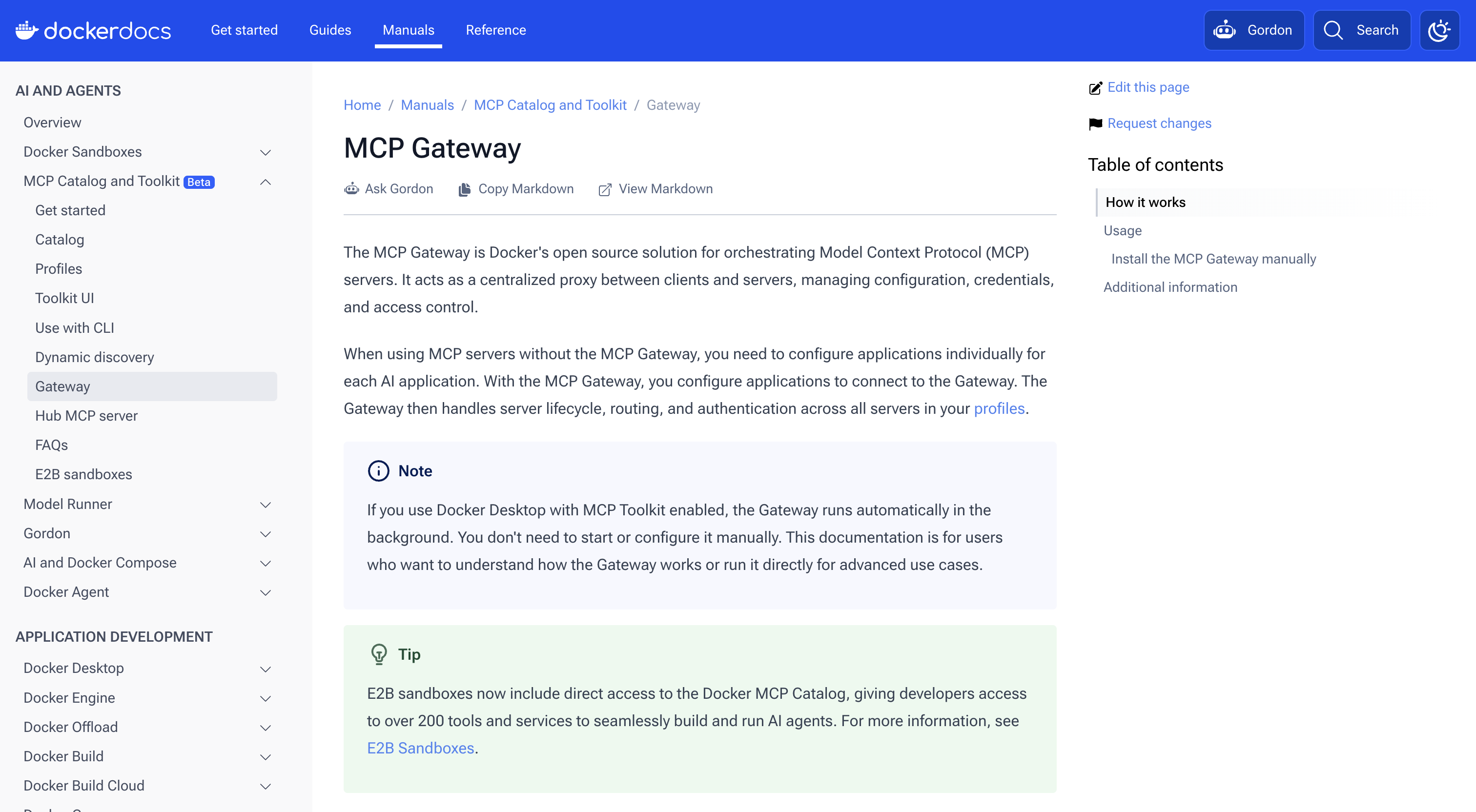
Docker MCP Gateway ships as part of Docker Desktop's MCP Toolkit and runs MCP servers as isolated containers managed by a local gateway. The fit is strongest for local development workflows and container-isolated production deployments where the security model leans on container boundaries. The integration into Docker Desktop makes the local-development path frictionless. Production use is possible but lighter than dedicated production-first MCP gateways.
Best for: Local development workflows and container-isolated production deployments leveraging Docker.
Deployment: Docker Compose for local. Kubernetes via container-native patterns for production.
Capability level: Level 2 to Level 3.
Standout features:
- Container isolation per MCP server: Each MCP server runs in its own container with restricted privileges and network access. Defense-in-depth without writing isolation code.
- Docker Compose deployment: Simplest possible install pattern. A single compose file gets the gateway and a set of MCP servers running on a developer machine.
- Docker Desktop MCP Toolkit integration: Native integration into Docker Desktop's UI. Developers manage MCP servers through the same tooling they already use for containers.
- Server lifecycle management: Gateway handles server startup, shutdown, health checks, and restart on failure. Standard container patterns extend to MCP servers.
- Credential injection per container: Per-container credential mounts route to MCP servers without exposing secrets in image layers or environment-variable history.
- Network isolation by default: Default Docker networking patterns isolate MCP server containers from each other and the host. Network policies extend isolation further.
Recency: Shipped through 2026 as part of Docker Desktop's MCP Toolkit. Active alongside the broader Docker product line.
Watch-outs: Lighter on enterprise governance features than production-first competitors. Multi-tenant isolation, audit-grade logging, and policy simulation are not first-class.
Authority: Docker Inc., the standard for container tooling. Public Docker documentation and community.
14. Lasso (open source)
Lasso is an open-source MCP gateway focused on security inspection of MCP servers and tool descriptions. The product detects prompt injection in tool descriptions, scans for rug-pull patterns where tools change behavior between sessions, and blocks cross-server shadowing where one tool impersonates another. The fit is strongest for security-conscious teams that want gateway-level threat detection alongside their existing MCP runtime, or layered into a broader gateway stack.
Best for: Security-conscious teams that want gateway-level threat detection in front of MCP servers.
Deployment: Self-hosted under permissive open-source license. Pairs with other MCP gateways as a security layer.
Capability level: Level 3 (security-focused).
Standout features:
- Prompt-injection detection: Description-time and runtime scanning for prompt-injection patterns in tool descriptions, resources, and parameters. Catches malicious instructions before agents incorporate them into plans.
- Tool description scanning: Static and dynamic analysis of MCP tool descriptions. Flags suspicious patterns like instruction overrides, role-changing prompts, and credential phishing.
- Open source under permissive license: Run inside customer infrastructure, fork as needed, audit the source. No commercial restrictions on use.
- Scanner-first architecture: Lightweight runtime focused on detection, not policy enforcement. Pairs naturally with other gateways that handle the broader routing and policy load.
- Integration with existing MCP gateways: Works as a layer in front of or behind other MCP gateways. Augments without replacing.
- Threat intelligence feed: Continuously updated signatures for known attack patterns. New attack types land in signatures without customer-side configuration.
Recency: Active 2026 development as MCP security research expanded. Cited in OWASP LLM Top 10 discussions as a reference detection layer.
Watch-outs: Scanner-first, not a full-featured gateway. Production deployments pair Lasso with another gateway that handles routing, session affinity, and policy.
Authority: Open-source security project. Public detection signatures and active threat-intelligence updates.
Honorable mentions
These five vendors appear in the capability matrix below but do not get full cards because they are either narrower in scope, covered in detail elsewhere in our cluster, or smaller in installed base:
- Tyk: Self-host friendly commercial MCP gateway with regulated-industry positioning. Covered in the MCP vs API gateway comparison.
- Gravitee: API platform with MCP support and caching focus. Covered in the same comparison.
- Zuplo: Lightweight gateway with full MCP support and OpenAPI conversion.
- IBM ContextForge: Open-source MCP framework targeting multi-region enterprise deployments.
- Solo.io Agent Gateway: Linux Foundation Rust-based OSS, pairs with Apigee for MCP traffic.
The DIY trap: why building your own MCP gateway is a false economy
Building your own MCP gateway is almost never the right call in 2026. The math is stark. Production parity with an off-the-shelf gateway requires JSON-RPC parsing, session affinity, SSE streaming, tool-level RBAC, OAuth 2.1 with IdP federation, audit-grade logging, and OpenTelemetry instrumentation. Each capability takes 2 to 6 months of senior engineering time. Together, that is 12 to 24 months of platform engineering for parity with what commercial vendors ship out of the box.
The maintenance burden compounds. The MCP spec evolves. New transport options (Streamable HTTP, in 2026) need adapters. Policy patterns shift as enterprises learn what they actually need. Security threats (rug-pull, tool poisoning, cross-server shadowing) demand detection logic that did not exist in 2024. A team maintaining a DIY gateway in 2027 is doing work that is not differentiating, while competitors ship product.
The opportunity cost is the real argument. Engineering teams that pour 12 to 24 months into MCP infrastructure are 12 to 24 months behind on shipping the agent product that creates customer value. Almost every enterprise eventually concludes that off-the-shelf is faster, cheaper, and more reliable. The exception is hyperscalers building MCP gateway products of their own. If you are not in that category, buy.
For a deeper look at MCP gateway architecture and what production deployments require, see MCP gateway architecture.
See how DigitalAPI runs beside your existing API gateway to add MCP support without replacing it → Book a demo
Frequently asked questions
[fs-toc-omit]1. What is the best MCP gateway in 2026?
There is no single "best" answer. For full Level 4 governance with no rip-and-replace, DigitalAPI, Obot, and Tyk lead. For AWS-native deployments, Amazon API Gateway plus Bedrock AgentCore. For Microsoft stacks, Azure API Management. For open source, Microsoft MCP Gateway, Docker, and Lasso. The right pick depends on your existing infrastructure, compliance posture, and use case.
[fs-toc-omit]2. Which MCP gateways are open source?
Microsoft MCP Gateway, Docker MCP Gateway, Obot, Lasso, IBM ContextForge, MCPX (Lunar.dev), and Solo.io Agent Gateway all ship as open source under permissive licenses. Obot and MCPX offer managed-service variants for teams that prefer not to operate the data plane.
[fs-toc-omit]3. Which MCP gateway is best for enterprise teams?
DigitalAPI, Obot, Tyk, MCP Manager, and Kong MCP Gateway all target enterprise teams. Obot fits open-source-first enterprises. Tyk fits self-hosted regulated industries. MCP Manager fits compliance-heavy verticals. Kong fits Kong-platform shops.
[fs-toc-omit]4. Which MCP gateway has the lowest latency?
TrueFoundry publishes sub-4ms p95 at 350+ requests per second on a single vCPU. Several Rust-first commercial gateways are engineered for similar production loads. For your actual workload, demand p99 benchmarks at your expected request volume, not p50 at vendor-test volume.
[fs-toc-omit]5. Do AWS and Azure have MCP gateways?
Yes, both shipped in 2026. AWS added MCP proxy support to Amazon API Gateway in December 2025 and ships Bedrock AgentCore Gateway as a dedicated agent-tool gateway. Azure API Management exposes REST APIs as MCP servers through its built-in AI gateway. Both are cloud-native managed services.
[fs-toc-omit]6. Can I use my existing API gateway for MCP?
For basic Level 1 passthrough, yes. For production Level 3 or Level 4 governance, you need either an MCP proxy add-on (AWS, Azure ship these) or a dedicated MCP gateway running beside your existing API gateway. See MCP vs API gateway for the full comparison.
[fs-toc-omit]7. Which MCP gateway is best for regulated industries?
MCP Manager, Tyk, DigitalAPI, and Obot ship the controls compliance teams require: RBAC plus ABAC, PII detection, immutable audit logs, SIEM integration, and SOC 2 attestation. MCP Manager has the deepest out-of-the-box regulated-industry feature set.
[fs-toc-omit]8. How does an MCP gateway differ from an AI gateway?
API gateways route REST traffic at the edge. AI gateways sit between agents and LLM providers (OpenAI, Anthropic, Bedrock). MCP gateways sit between agents and tool servers. The three stack in a mature AI infrastructure rather than compete.
[fs-toc-omit]9. Is it worth building my own MCP gateway?
In almost all cases, no. Production parity with off-the-shelf requires 12 to 24 months of senior engineering time, plus ongoing maintenance as the MCP spec evolves and new security patterns emerge. Engineering time is better spent on the agent product, not on rebuilding gateway infrastructure that 20+ vendors already ship.
[fs-toc-omit]10. Which MCP gateway has the best OpenAPI-to-MCP conversion?
DigitalAPI, Zuplo, AWS API Gateway, and Azure APIM all ship OpenAPI conversion. The one-click flows generate governed MCP tools with schema validation, host allowlists, and per-operation timeouts applied at runtime, without writing custom MCP server code. Zuplo can transform any API into a fully compliant MCP server. AWS and Azure convert through CloudFormation and ARM templates respectively.
Dhayalan Subramanian is Associate Director, Product Growth at DigitalAPI, where he leads go-to-market and product growth for the company’s multi-gateway API management platform. His work focuses on helping large enterprises and mid-market cloud companies consolidate APIs across AWS, Azure, Apigee, Kong, MuleSoft, and other gateways into a single control plane for governance, discovery, monetization, and agent consumption.
Dhayalan brings 14+ years of experience across product strategy, enterprise architecture, and engineering leadership. Earlier in his career, he held senior roles at Encora (as Associate Architect and Technical Manager), Mindtree (Technology Lead), Tech Mahindra (Technical Lead), and Primus Analytics, where he designed integration frameworks and delivered enterprise-grade digital platforms for global customers.
At DigitalAPI, he works directly with platform, integration, and developer experience leaders at Fortune 500 organizations to operationalize unified API catalogs, developer portals, and MCP-ready APIs. He writes regularly on API developer experience, API governance, and AI agent architectures.
.png)
One email a fortnight. Worth opening.
A short digest of what we're writing, what we're learning from customers, and the handful of links you'd actually want from us. No tracking pixels.

.avif)