


MCP Server vs API Gateway: What's the Difference?
An MCP server and an API gateway are not alternatives. One turns your APIs into tools an AI agent can use; the other controls every call that reaches your backends. This guide compares them, walks through the request flow from agent to backend, and shows where each one belongs.

TL;DR:
What is the difference between an MCP server and an API gateway?
In the MCP server vs API gateway question, the two do different jobs. An MCP server turns capabilities, often your existing APIs, into tools an AI agent can discover and call over the Model Context Protocol.
An API gateway sits in front of APIs and enforces authentication, rate limits, routing and logging for every caller. Most teams need both: the MCP server calls APIs through the gateway.
Your team just wrapped the orders API as an MCP server. An agent in Claude or Cursor can now list orders, check a refund status and open a return. Then someone in the architecture review asks: "If agents talk to the MCP server, do we still need the gateway?" The MCP server vs API gateway question sounds like a choice between two products. It isn't.
An MCP server is a translator for agents. An API gateway is a checkpoint for traffic. Remove the gateway and your new agent path skips every rate limit, quota and audit rule you built for partners and apps. Remove the MCP server and the agent is back to guessing how to call raw endpoints.
This guide compares the two, walks a request from agent to backend, and answers the placement question.
MCP server vs API gateway: what is the difference?
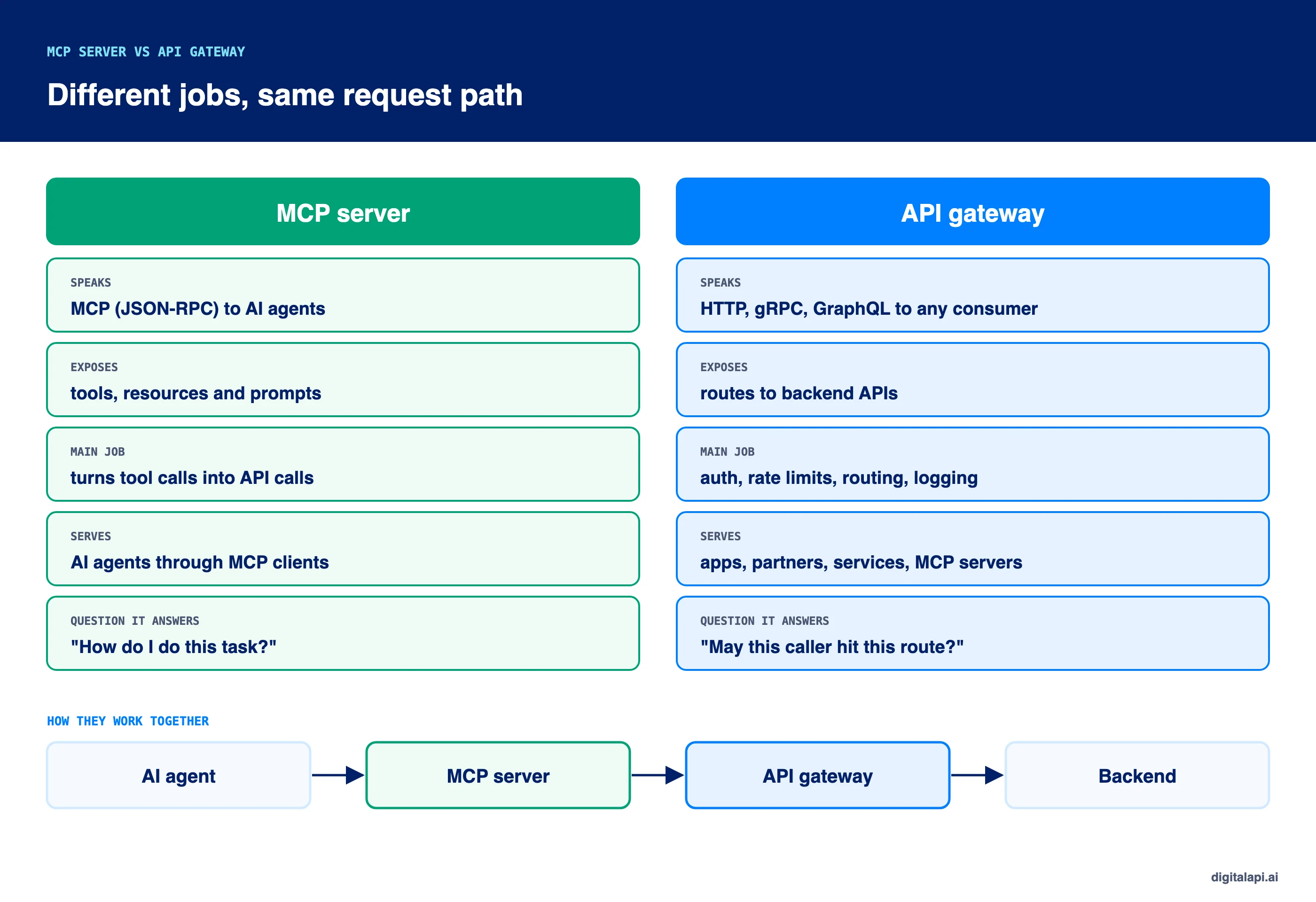
An MCP server decides what an agent can do. An API gateway decides whether a call is allowed to reach a backend. One sits on the agent side and speaks MCP. The other sits on the API side and speaks HTTP.
The short version of the request flow:
- The agent's MCP client asks the MCP server which tools exist (
tools/list). - The model picks a tool, and the client sends
tools/callwith arguments. - The MCP server maps that tool call to one or more API requests.
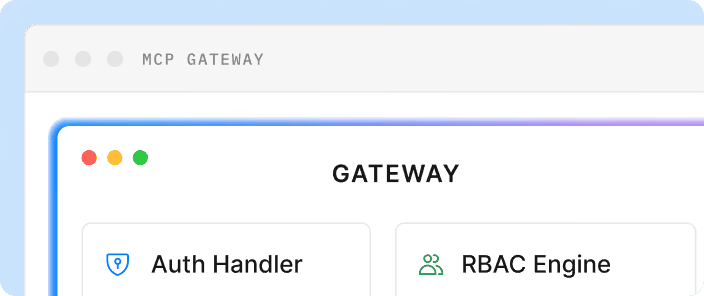
- The API gateway authenticates the request, applies rate limits and policy, and routes it.
- The backend service answers, and the result travels back as a tool result.
So the MCP server vs API question is really about layers: the MCP server is a new consumer-facing layer on top of APIs, and the gateway keeps governing the APIs underneath. For the broader integration trade-off between MCP and plain APIs, see MCP vs APIs: platform or code for integration success.
What is an MCP server?
An MCP server is a program that exposes tools, resources and prompts to AI applications through the Model Context Protocol. It's the part of your stack that an agent can discover and call without custom integration code.
An MCP server offers three core primitives, according to the MCP architecture docs:
- Tools: functions the AI can execute, such as API calls or database queries. Discovered with
tools/list, run withtools/call. - Resources: data that gives the model context, such as file contents or API responses.
- Prompts: reusable templates that structure interactions with the model.
Messages are JSON-RPC 2.0. MCP defines two standard transports: stdio, where the client launches the server as a local subprocess, and Streamable HTTP, where the server runs remotely behind a single HTTP endpoint such as https://example.com/mcp (MCP transports).
That's the core of the MCP server vs REST API distinction. A REST API exposes resources and methods that a developer reads about and codes against. An MCP server exposes named tools with descriptions and JSON Schema inputs that a model reads at runtime. Most enterprise MCP servers don't replace REST APIs; they call them. For a full primer and 25 example servers, see the MCP server guide.
What is an API gateway?
An API gateway is a reverse proxy that sits in front of your APIs and applies the same rules to every caller. It doesn't care whether the caller is a mobile app, a partner backend or an MCP server.
An API gateway has no idea what a "tool" is. It sees HTTP methods, paths, headers and bodies. That's exactly why it still matters when agents arrive: it keeps enforcing your rules on the API calls that tools generate.
How do an MCP server and an API gateway compare?
They sit at different layers, speak different protocols and protect different things. The table compares them on the points architects ask about most.
Notice the "who calls it" row. To the gateway, an MCP server is just another consumer. That's the key to placing them.
How do an MCP server and an API gateway work together?
The MCP server sits between the agent and your APIs, and the gateway sits between the MCP server and your backends. Each hop has its own identity and its own token.
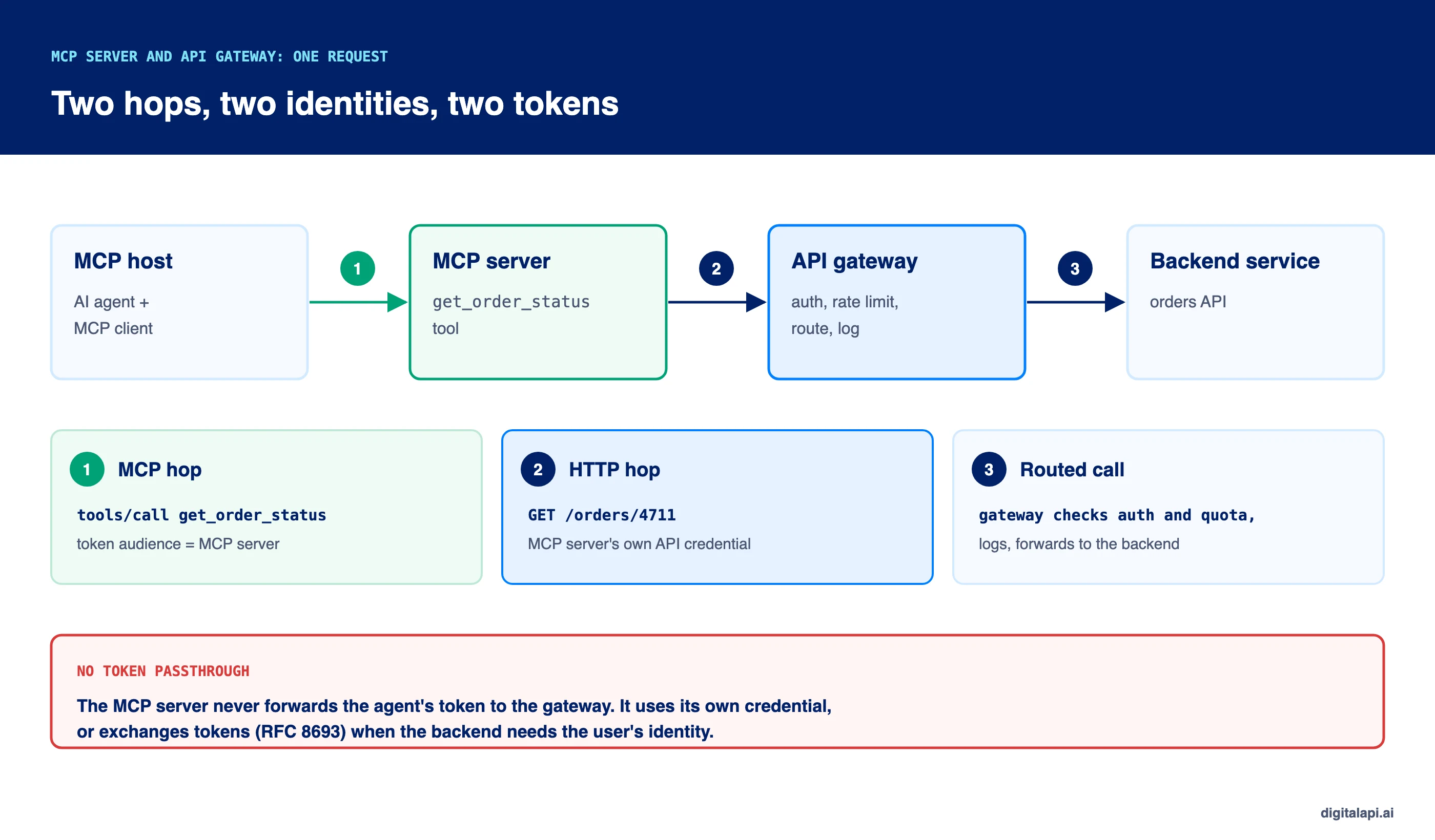
Here is the full flow for an agent that asks "Where is order 4711?":
- Discovery. The MCP client sends
tools/list. The MCP server returnsget_order_statuswith a description and an input schema. - Tool call. The model picks the tool. The client sends
tools/callwith{"order_id": "4711"}to the MCP server's endpoint, with a bearer token issued for that MCP server. - Token check at the MCP server. For HTTP transports, the MCP spec makes the server an OAuth 2.1 resource server that "MUST validate that access tokens were issued specifically for them as the intended audience" (MCP authorization).
- Translation. The MCP server maps the tool call to
GET /orders/4711on your orders API. - Gateway enforcement. The request goes to the API gateway with the MCP server's own API credential. The gateway authenticates it, applies the consumer's rate limit and quota, logs it and routes it.
- Response. The backend answers. The MCP server shapes the JSON into a tool result for the model.
Step 5 is where teams go wrong. The MCP spec says the token used at the upstream API "is a separate token, issued by the upstream authorization server," and the MCP server "MUST NOT pass through the token it received from the MCP client" (MCP security considerations). Forwarding the agent's token to the gateway creates a confused deputy: the backend trusts a token that was never meant for it.
Register each MCP server as its own consumer at the gateway, with its own credential, plan and scopes. If the backend needs the end user's identity, exchange tokens (for example with OAuth 2.0 Token Exchange, RFC 8693) rather than forwarding the original.
Should the MCP server sit behind the API gateway?
Yes for the APIs it calls, and usually yes for its own endpoint too when it runs remotely. There are two separate placements, and they answer different risks.
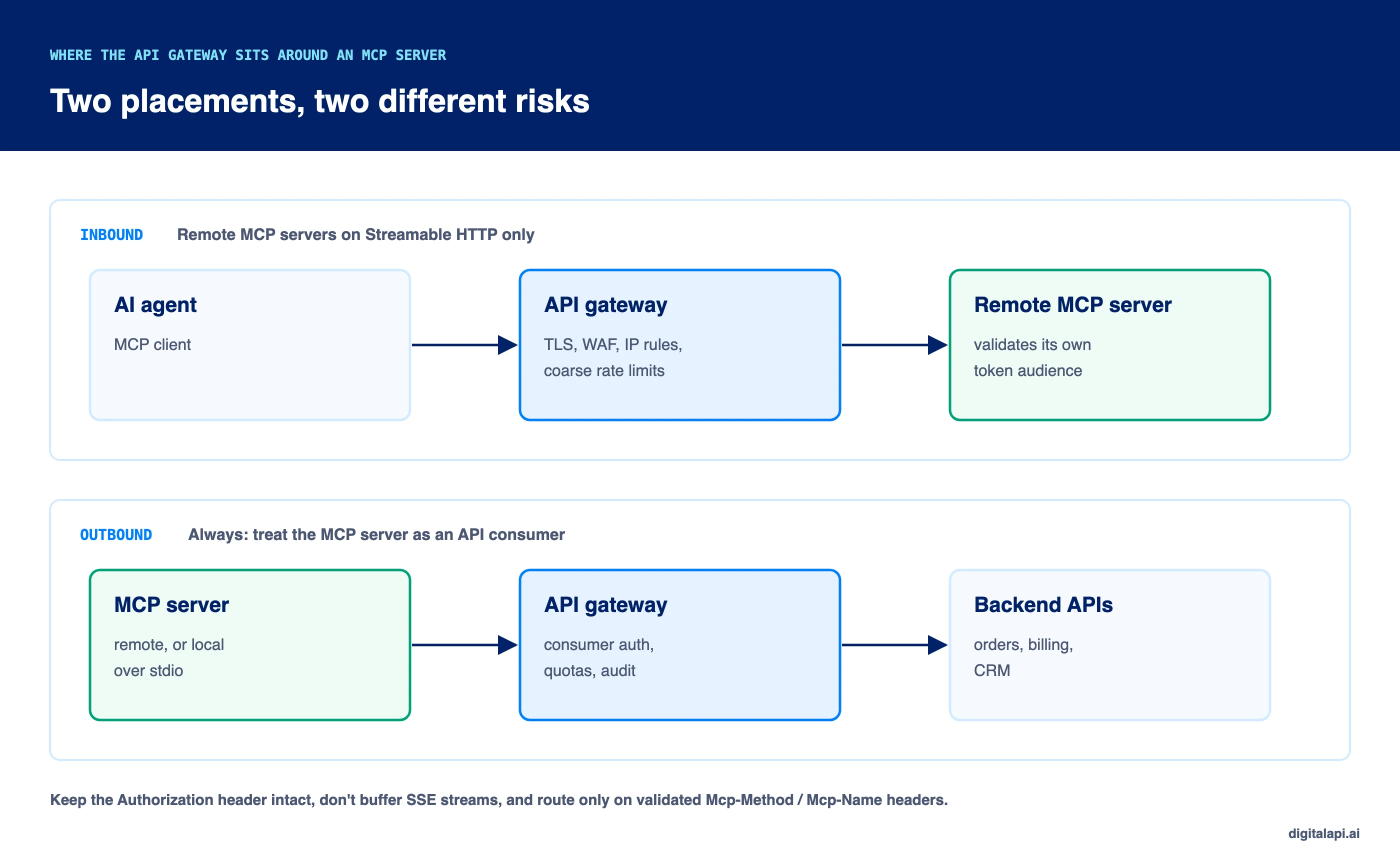
If you front a remote MCP server with an existing gateway, check four things:
- Don't buffer streams. A Streamable HTTP server may answer with Server-Sent Events. The spec says servers SHOULD send
X-Accel-Buffering: noso reverse proxies deliver events immediately. Make sure your gateway doesn't buffertext/event-streamresponses or cut long-lived streams on idle timeouts. - Keep the Authorization header intact. The MCP server validates the token audience itself. A gateway that strips or rewrites the header breaks that check.
- Route on validated headers only. Since the 2026-07-28 revision, clients send
Mcp-MethodandMcp-Nameheaders (for exampleMcp-Method: tools/call,Mcp-Name: get_order_status) so "load balancers, gateways, observability tooling" can route without parsing the body. Servers must reject requests where headers and body disagree, and intermediaries that enforce policy on those headers SHOULD reject requests from older protocol versions (Streamable HTTP). - Allow the right methods. The 2026-07-28 revision uses POST only and removes protocol-level sessions and the GET stream. Servers that still support clients on 2025-11-25 or earlier also need GET, DELETE and the
Mcp-Session-Idheader to pass through.
Here is what a tool call looks like on the wire under the current revision. A gateway can rate-limit tools/call or block a sensitive tool name from the headers alone:
(The body is shortened. Real requests also carry protocol version and client details in params._meta.)
When do you also need an MCP gateway?
You need an MCP gateway when you run many MCP servers and want one place to decide which agent can see and call which tool. An API gateway governs API calls. An MCP gateway governs tool calls.
An API gateway can front one MCP endpoint and apply simple per-method rules. It doesn't aggregate tool catalogs across servers, filter tools/list per agent, require approval for write tools or keep a tool-level audit trail. That's the MCP gateway's job, in front of your MCP servers, while the API gateway stays in front of your APIs.
- One or two MCP servers, internal agents: API gateway on both paths is usually enough.
- Many MCP servers, external or partner agents, write actions: add an MCP gateway in front of the servers.
- Either way: keep the API gateway on the outbound path to your backends.
For a full breakdown of what API gateways lack for MCP traffic, see MCP gateway vs API gateway. For how a gateway differs from a single server, see MCP server vs MCP gateway.
How do you turn existing APIs into MCP servers without losing gateway control?
Generate MCP tools from the OpenAPI specs you already govern, and keep every generated tool calling through the gateway. That way the agent path inherits the auth, quotas and audit you already run.
- Start from the OpenAPI spec, not hand-written wrappers, and group operations into task-shaped tools.
- Mark write and sensitive tools so they can need approval or tighter scopes.
- Give each MCP server its own gateway credential and plan. Never reuse a partner's key.
- Log tool calls and API calls with a shared trace ID.
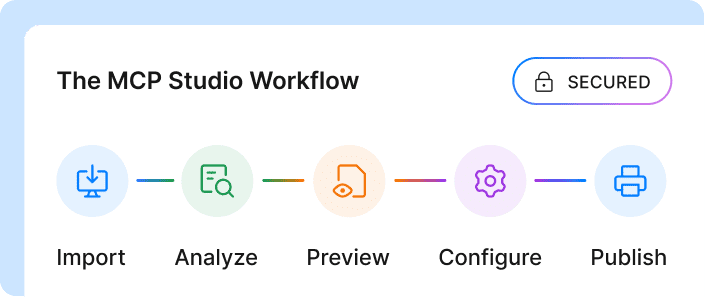
The OpenAPI to MCP guide compares three ways to do the conversion. DigitalAPI MCP Studio imports an OpenAPI spec or Postman collection, maps the API's authentication, flags sensitive write actions, and publishes a hosted MCP server secured by the DigitalAPI MCP Gateway. The MCP Gateway sits beside the API gateways you already run, such as Apigee, Kong, AWS or Azure API Management, and calls them through their existing interfaces, so your API gateway rules still apply.
Key takeaways
- MCP server vs API gateway is not either-or. The MCP server exposes tools to agents; the gateway enforces rules on the API calls those tools make.
- To the gateway, an MCP server is just another consumer. Give it its own credential, plan and scopes.
- Never forward the agent's token upstream. The MCP spec forbids token passthrough; use a separate token or token exchange.
- Put remote MCP endpoints behind a gateway too, but don't buffer SSE, don't strip auth headers and only route on validated
Mcp-MethodandMcp-Nameheaders. - Add an MCP gateway when servers and agents multiply and you need per-tool access, approvals and audit.
Frequently asked questions
1. What is the difference between an MCP server and an API gateway?
An MCP server exposes tools, resources and prompts to AI agents over the Model Context Protocol, so a model can discover and call capabilities at runtime. An API gateway sits in front of APIs and enforces authentication, rate limits, routing and logging for every caller. The MCP server usually calls your APIs through the gateway, so the two work together.
2. Does an MCP server replace an API gateway?
No. An MCP server doesn't enforce quotas, consumer plans or traffic policy across your APIs. It is a consumer of those APIs. If you let it call backends directly, agent traffic skips the controls every other consumer goes through. Keep the gateway on the path between the MCP server and your backends.
3. Should an MCP server sit behind an API gateway?
Yes, on the outbound path to your APIs, always. For remote MCP servers on Streamable HTTP, a gateway in front of the MCP endpoint also helps with TLS, IP rules and abuse protection. Make sure it passes SSE streams without buffering and leaves the Authorization header intact. Local stdio servers only need the outbound path.
4. What is the use of an MCP gateway?
An MCP gateway governs traffic between agents and many MCP servers. It aggregates tool catalogs, filters which tools each agent can see, enforces per-tool access and limits, can require approval for sensitive actions and keeps a tool-level audit trail. It complements the API gateway, which keeps governing the API calls behind those tools.
5. Is an MCP server the same as a REST API?
No. A REST API exposes resources and HTTP methods that developers code against using documentation. An MCP server exposes named tools with descriptions and JSON Schema inputs that a model reads at runtime, over JSON-RPC 2.0. Most enterprise MCP servers wrap existing REST APIs rather than replacing them.
6. Can an existing API gateway route MCP traffic?
Yes, for basic cases. Remote MCP servers use Streamable HTTP, so a gateway can proxy the endpoint. Since the 2026-07-28 MCP revision, clients send Mcp-Method and Mcp-Name headers, so a gateway can route or rate-limit by method and tool without parsing the body. Tool catalog aggregation and per-tool approvals still need an MCP gateway.
7. Can an MCP server pass the user's token to the backend API?
No. The MCP specification says an MCP server must not pass through the token it received from the MCP client. Tokens for the MCP server are bound to it as the audience. To call upstream APIs, the server uses a separate token from the upstream authorization server, or exchanges the original token for one issued for that API.
8. Which comes first, an API gateway or a load balancer?
Both orders exist. A common setup puts a network load balancer in front of several gateway instances for availability, then the gateway routes to services, which may sit behind their own internal load balancers. What matters is that every request, including those from MCP servers, passes through the gateway's policy checks before reaching a backend.
Conclusion
The MCP server vs API gateway question has a simple answer: you need both, at different layers. The MCP server makes your APIs usable by agents. The API gateway makes sure those agent-driven calls follow the same rules as everyone else's. Treat each MCP server as a named consumer with its own credential, never forward the agent's token, and put the gateway on every path to your backends.
Start with one API you already govern. Generate its tools from the OpenAPI spec, publish the server behind your gateway, and watch tool calls and API calls in the same trace. When agents and servers multiply, add an MCP gateway on top.
Convert existing APIs into MCP servers with DigitalAPI MCP Studio, secured by MCP Gateway and governed by the gateways you already run. Turn your APIs into governed MCP servers
Prefer a walkthrough? Book a Demo
Dhayalan Subramanian is Associate Director, Product Growth at DigitalAPI, where he leads go-to-market and product growth for the company’s multi-gateway API management platform. His work focuses on helping large enterprises and mid-market cloud companies consolidate APIs across AWS, Azure, Apigee, Kong, MuleSoft, and other gateways into a single control plane for governance, discovery, monetization, and agent consumption.
Dhayalan brings 14+ years of experience across product strategy, enterprise architecture, and engineering leadership. Earlier in his career, he held senior roles at Encora (as Associate Architect and Technical Manager), Mindtree (Technology Lead), Tech Mahindra (Technical Lead), and Primus Analytics, where he designed integration frameworks and delivered enterprise-grade digital platforms for global customers.
At DigitalAPI, he works directly with platform, integration, and developer experience leaders at Fortune 500 organizations to operationalize unified API catalogs, developer portals, and MCP-ready APIs. He writes regularly on API developer experience, API governance, and AI agent architectures.
One email a fortnight. Worth opening.
A short digest of what we're writing, what we're learning from customers, and the handful of links you'd actually want from us. No tracking pixels.