


AI Gateway vs API Gateway: What's the Difference?
An API gateway counts requests. An AI gateway counts tokens, inspects prompts and picks the model. This guide compares the two feature by feature and shows when the gateway you already run is enough.

TL;DR:
What is the difference between an AI gateway and an API gateway?
In the AI gateway vs API gateway comparison, both are reverse proxies, but they meter different things. An API gateway secures and routes HTTP requests and counts them.
An AI gateway sits in front of LLM providers. It counts tokens, streams responses, inspects prompts, caches by meaning and picks the model.
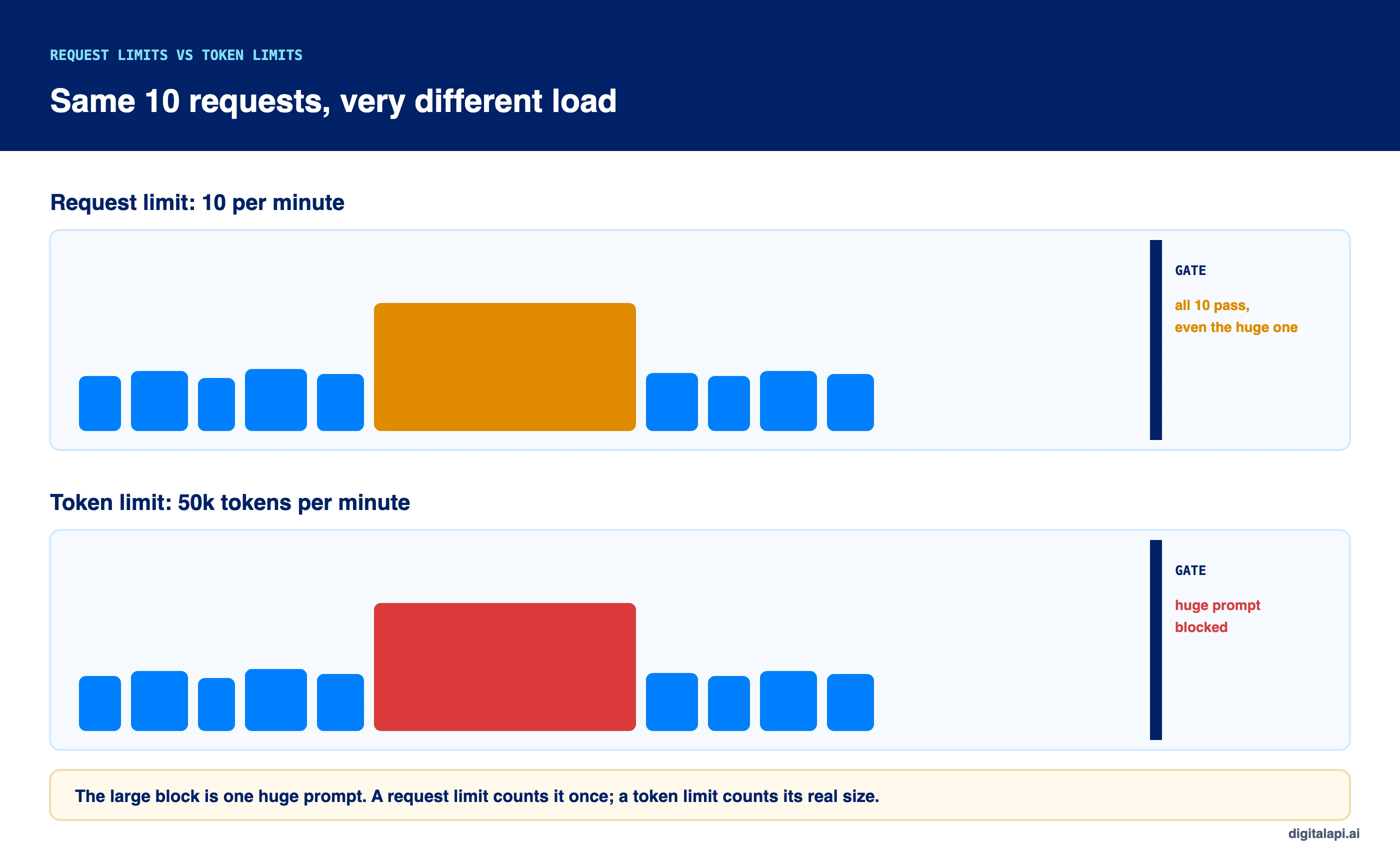
Your team put the first LLM feature behind the API gateway you already run. The rate limit is 100 requests per minute per app. Then one user pastes a 300-page contract into the chat. That single request burns more budget than a day of normal traffic.
That is the AI gateway vs API gateway problem in one line. Your gateway saw one request. Your model provider billed you for hundreds of thousands of tokens.
An API gateway is not wrong for LLM traffic. It is blind to the parts of it that cost money and carry risk. This guide compares the two feature by feature. It covers rate limits, caching, security and cost, and ends with a decision checklist.
AI gateway vs API gateway: what is the difference?
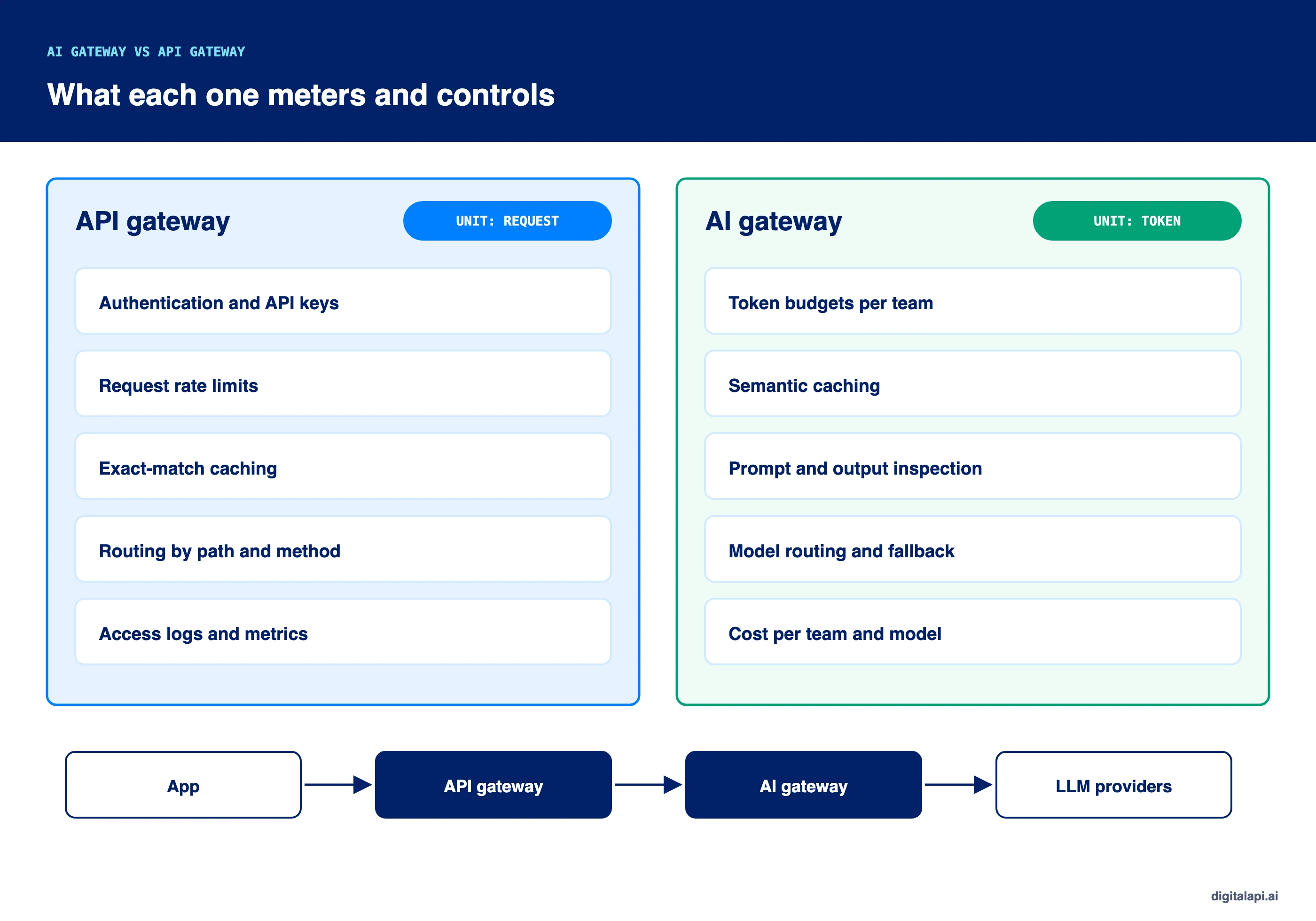
An API gateway governs API calls. An AI gateway governs model calls. Both proxy HTTP traffic. Only the AI gateway reads what is inside an LLM request: the prompt, the model and the token count.
People also search for an AI model gateway or an LLM gateway. In practice the terms mean the same thing: a gateway whose upstream is a model rather than a service. On the AI gateway vs LLM gateway question, "LLM gateway" usually means text models only. "AI gateway" can also cover image, speech and embedding models.
For the full definition and core components, read what is an AI gateway. This post stays on the differences.
Why is LLM traffic different from regular API traffic?
LLM calls vary in cost, stream their answers and return different output for the same input. Each of these breaks an assumption that classic API gateway policies rely on. For a refresher on those policies, see our API gateway guide.
- Cost varies by tokens, not requests. A token is a chunk of text, roughly a word or part of one. Providers bill input and output tokens. Two requests to the same endpoint can differ in cost many times over.
- Responses stream. Chat responses often arrive as Server-Sent Events (SSE). SSE keeps one HTTP response open and sends text as the model writes it. A gateway that buffers the full response breaks the user experience.
- Output is non-deterministic. The same prompt can produce a different answer each time. That makes exact-match caching weak and output checks necessary.
- The payload is the attack surface. In a REST call, risk sits in headers, paths and parameters. In an LLM call, risk sits in free text the model may follow.
- Latency is long and uneven. A completion can take many seconds. Timeouts tuned for 200 ms services cut answers off mid-stream.
These five traits explain every row in the table below.
AI gateway vs API gateway: how do the features compare?
An API gateway covers identity, routing and request limits well. It covers token, prompt and model controls partly or not at all. The table uses Yes, Partial and No for a typical API gateway without AI plugins.
Read the last row too. An AI gateway is not a general API gateway. Most teams keep the API gateway for service traffic and add AI controls for the model path.
That is the API gateway vs AI gateway answer most architects land on. The AI gateway vs MCP gateway vs API gateway guide adds the third layer to this picture.
How does rate limiting change: requests or tokens?
API gateways limit how many calls a consumer makes. AI gateways limit how many tokens a consumer spends. Model providers enforce tokens per minute, so a request limit alone cannot protect your provider quota or your budget.
Here is how a token limit works in practice:
- Estimate before the call. The gateway counts prompt tokens and checks the remaining budget.
- Reserve the maximum output. It uses the request's max output tokens to hold budget for the answer.
- Settle after the call. It reads actual usage from the provider response and corrects the counter.
- Return a clear error. When the budget runs out, it returns HTTP 429 with a retry time, the same pattern your API consumers know.
Keep request limits too. They still stop floods of small calls. Token limits stop the expensive outliers.
How is semantic caching different from exact caching?
Exact caching returns a stored response when a request matches byte for byte. Semantic caching returns a stored answer when a new prompt means the same thing as an earlier one. For chat traffic, exact matches are rare, so semantic caching saves far more calls.
"How do I reset my password?" and "I forgot my password, what now?" miss an exact cache. A semantic cache can serve both from one answer.
The trade-off is accuracy. A threshold set too loose returns a wrong answer for a question that only looks similar.
Use it for stable, low-risk content such as FAQs and docs. Scope cache keys by tenant and user role so one customer never gets another customer's answer. Skip it for prompts with personal data or live account state.
What security does an AI gateway add?
An API gateway checks who is calling. An AI gateway also checks what is being said, on the way in and on the way out. It inspects prompt text, system instructions and model output, which a request-level gateway treats as an opaque body.
The OWASP Top 10 for LLM Applications 2025 lists the risks a gateway can help with:
- LLM01 Prompt Injection. Inputs that override the model's instructions. The gateway can screen prompts and retrieved content for injection patterns.
- LLM02 Sensitive Information Disclosure. The gateway can redact PII, secrets and account numbers from prompts and outputs.
- LLM07 System Prompt Leakage. The gateway can block responses that echo hidden instructions.
- LLM10 Unbounded Consumption. Token limits and budgets cap runaway usage and denial-of-wallet attacks.
Gateway filters are one layer, not the full defense. OWASP also calls for least privilege, output handling in the application and human approval for high-risk actions. Keep the API gateway's controls on every backend the model's tools can reach.
How does an AI gateway control cost and route models?
An AI gateway attributes every token to a team, app or customer, and it picks the model for each call. An API gateway can tell you who called. It cannot tell you what the call cost or send it to a cheaper model.
Spend makes this urgent. Menlo Ventures' 2025 mid-year LLM market update found enterprise LLM spend rose from $3.5B (November 2024) to $8.4B by mid-2025.
The main cost controls an AI gateway adds:
- Budgets per consumer. Monthly token or currency caps per team, app or tenant, with alerts before the cap.
- Model routing. Send simple tasks such as classification to a small model and complex reasoning to a large one.
- Fallback. When a provider returns errors or rate-limit responses, retry on a second model or region.
- Showback. Report cost per feature so product owners see what their prompts spend.
Routing matters because price per token varies widely across models. The Menlo Ventures 2026 State of Enterprise AI report found open-source models handle about one in five tokens. They account for about one in 25 dollars of model spend.
For a deeper playbook, see AI model cost optimization via API gateways.
Can your API gateway become an AI gateway?
Partly. With plugins or custom policies, many API gateways can pass SSE streams, count tokens and route by model name. Semantic caching, prompt inspection and cost attribution usually need a dedicated AI layer. The right answer depends on how much LLM traffic you run and who sends it. For the target design, see AI gateway architecture for safe, scalable AI routing.
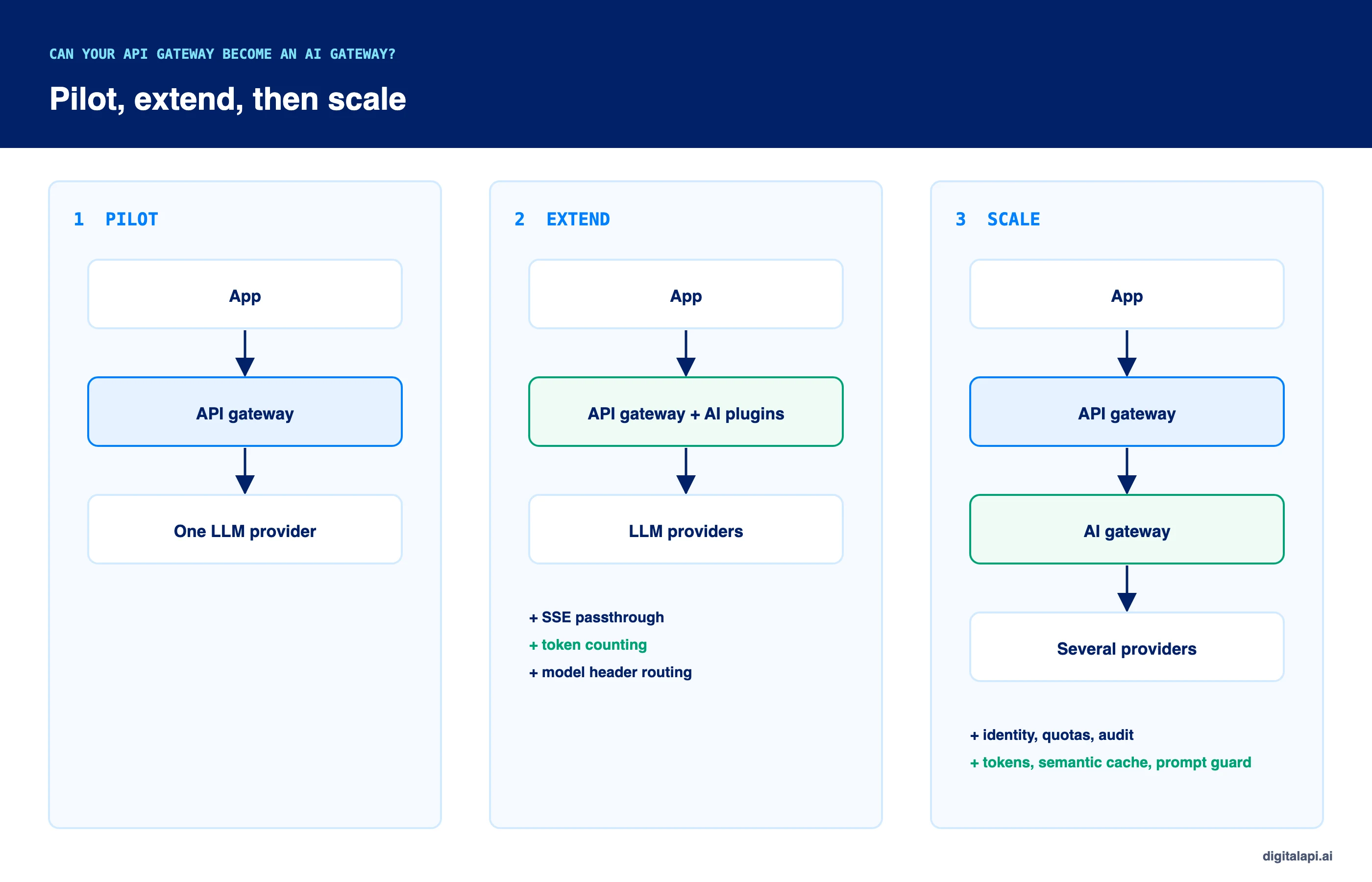
Start by extending what you have:
- Turn off response buffering for
text/event-streamand raise idle timeouts on LLM routes. - Give every LLM consumer its own key and plan, so usage is attributable from day one.
- Log model name and token usage from provider responses into your existing traces.
- Add token limits through a plugin or policy, and keep request limits on top.
Your API gateway is enough if:
- You call one provider for a small number of internal features.
- Traffic is low and predictable, and a monthly provider cap covers your budget risk.
- Prompts carry no customer data, so you don't need redaction or injection screening.
- Your gateway streams SSE without buffering and supports custom policies.
You need an AI gateway if:
- You route across several models or providers and need fallback.
- Many teams or tenants share model spend, and you need budgets and showback.
- Prompts carry customer data or reach tools that act on your systems.
- You want semantic caching to cut cost on repeated questions.
If agents call tools rather than models, that is a different hop. An MCP gateway governs agent-to-tool calls over the Model Context Protocol. See MCP gateway vs API gateway for that comparison.
You don't need to replace the gateway you trust to add AI controls. The DigitalAPI API Gateway tags traffic by consumer, intent or risk. It gives agent traffic its own rate limits and tracks usage per consumer against plan quotas. Its OpenTelemetry traces and JSON audit logs keep model-bound traffic visible next to your service traffic.
See how DigitalAPI brings agent and AI traffic under the same identity, quotas and audit as your APIs → Book a Demo
Key takeaways
- AI gateway vs API gateway is about the unit of control. An API gateway counts requests. An AI gateway counts tokens and understands prompts and models.
- Request limits miss expensive outliers. Add token-based limits and budgets for LLM routes.
- Semantic caching saves calls that exact caching misses, but scope it by tenant and use it for low-risk content.
- Prompts and outputs are the new attack surface. Map gateway filters to the OWASP Top 10 for LLM Applications 2025.
- Model routing and showback control cost. Send simple tasks to cheaper models and report spend per team.
- Most teams run both. Keep the API gateway for identity, quotas and audit, and add AI controls on the model path.
Frequently asked questions
1. What is the difference between an AI gateway and an API gateway?
An API gateway authenticates callers, applies request-based rate limits, routes HTTP calls to services and logs them. An AI gateway sits in front of model providers. It adds token limits, prompt and output inspection, semantic caching, model routing, fallback and cost tracking. Most teams run both, with the API gateway handling identity and the AI gateway handling model traffic.
2. What is an AI model gateway?
An AI model gateway is a proxy between applications and AI model providers. It gives teams one endpoint for several models. Shared policies apply to every call: authentication, token budgets, prompt filtering, caching, routing and fallback. AI gateway, AI model gateway and LLM gateway describe the same pattern. LLM gateway usually means text models only.
3. What is the most commonly used API gateway?
No single gateway leads every survey, and rankings change often. Usage splits across three groups. These are cloud-provider managed gateways, open-source gateways built on proxies such as NGINX or Envoy, and API management platforms. Choose by where your APIs run, the protocols you need and your deployment model. Also weigh whether you need a developer portal.
4. Can an API gateway handle LLM traffic?
Yes, for basic cases. An API gateway can proxy calls to an LLM provider, authenticate callers and apply request limits. It must pass Server-Sent Events without buffering and allow long timeouts. Without plugins or an AI gateway layer, it usually cannot count tokens, cache by meaning, inspect prompts or route by cost.
5. What is the difference between an AI gateway and an LLM gateway?
There is little practical difference. Both proxy calls to model providers and add token limits, routing, caching and safety filters. LLM gateway usually refers to text and chat models only. AI gateway is the broader term and can also cover image, speech and embedding models. Vendors use the two names interchangeably.
6. Why do AI gateways use token-based rate limiting?
Because model providers bill and throttle by tokens, not requests. One long prompt can cost more than hundreds of short ones. A request limit cannot protect a budget or a provider quota. Token limits cap input and output tokens per consumer per time window. They return HTTP 429 when the budget runs out.
7. Is semantic caching safe?
It is safe when you scope and tune it. Set a strict similarity threshold so different questions don't share an answer. Scope cache keys by tenant and user role so one customer never sees another customer's response. Use it for stable content such as FAQs and docs. Skip it for prompts with personal data or live account state.
8. Do I need an MCP gateway as well as an AI gateway?
Only if AI agents call tools. An AI gateway governs calls from your applications to models. An MCP gateway governs calls from agents to tools over the Model Context Protocol. It adds per-agent and per-tool access and a tool-level audit trail. Teams that run agents with tool access often use an API gateway, an AI gateway and an MCP gateway together.
Conclusion
The AI gateway vs API gateway question comes down to what you need to see. An API gateway sees callers and requests. An AI gateway sees tokens, prompts, models and cost.
You don't have to choose one. Keep the API gateway for identity, quotas and audit. Extend it for streaming and token logging first. Add a dedicated AI layer when models, teams or customer data multiply.
Start with one LLM route. Give it its own consumer key, log tokens per call and set a token budget. You will know within a month whether your API gateway is enough.
Bring AI and agent traffic under the same identity, quotas and audit as your APIs with the DigitalAPI API Gateway. Add AI gateway controls to your existing API estate
Prefer a walkthrough? Book a Demo
Dhayalan Subramanian is Associate Director, Product Growth at DigitalAPI, where he leads go-to-market and product growth for the company’s multi-gateway API management platform. His work focuses on helping large enterprises and mid-market cloud companies consolidate APIs across AWS, Azure, Apigee, Kong, MuleSoft, and other gateways into a single control plane for governance, discovery, monetization, and agent consumption.
Dhayalan brings 14+ years of experience across product strategy, enterprise architecture, and engineering leadership. Earlier in his career, he held senior roles at Encora (as Associate Architect and Technical Manager), Mindtree (Technology Lead), Tech Mahindra (Technical Lead), and Primus Analytics, where he designed integration frameworks and delivered enterprise-grade digital platforms for global customers.
At DigitalAPI, he works directly with platform, integration, and developer experience leaders at Fortune 500 organizations to operationalize unified API catalogs, developer portals, and MCP-ready APIs. He writes regularly on API developer experience, API governance, and AI agent architectures.
One email a fortnight. Worth opening.
A short digest of what we're writing, what we're learning from customers, and the handful of links you'd actually want from us. No tracking pixels.