



MCP Gateway vs API Gateway: When to Keep Both, When to Replace (2026)
MCP gateway vs API gateway: what's different, which API gateways support MCP today (AWS, Azure, Apigee, Kong, Tyk, Gravitee, Zuplo), when to keep your existing gateway and add an MCP layer, when to swap, and the latency tax of the wrong choice.

TL;DR
1. Same word, different jobs: API gateway routes REST. MCP gateway routes JSON-RPC tool calls between AI agents and servers.
2. 5 things API gateways cannot do natively: JSON-RPC parsing, session affinity, SSE streaming,tools/listaggregation, tool-level RBAC.
3. AWS, Azure, Apigee, Kong, Tyk, Gravitee, Zuplo added MCP support in 2026: depth varies enormously by vendor.
4. Three valid paths: Keep API gateway and add MCP layer beside it, swap to unified gateway, or replace entirely.
5. Latency tax is real: A 70 ms gap at p99 becomes 700 ms across a 10-step agent loop.
6. DigitalAPI's wedge: MCP control plane beside your API gateway, with OpenAPI-to-MCP conversion. No rip-and-replace.
What is an MCP gateway versus an API gateway?
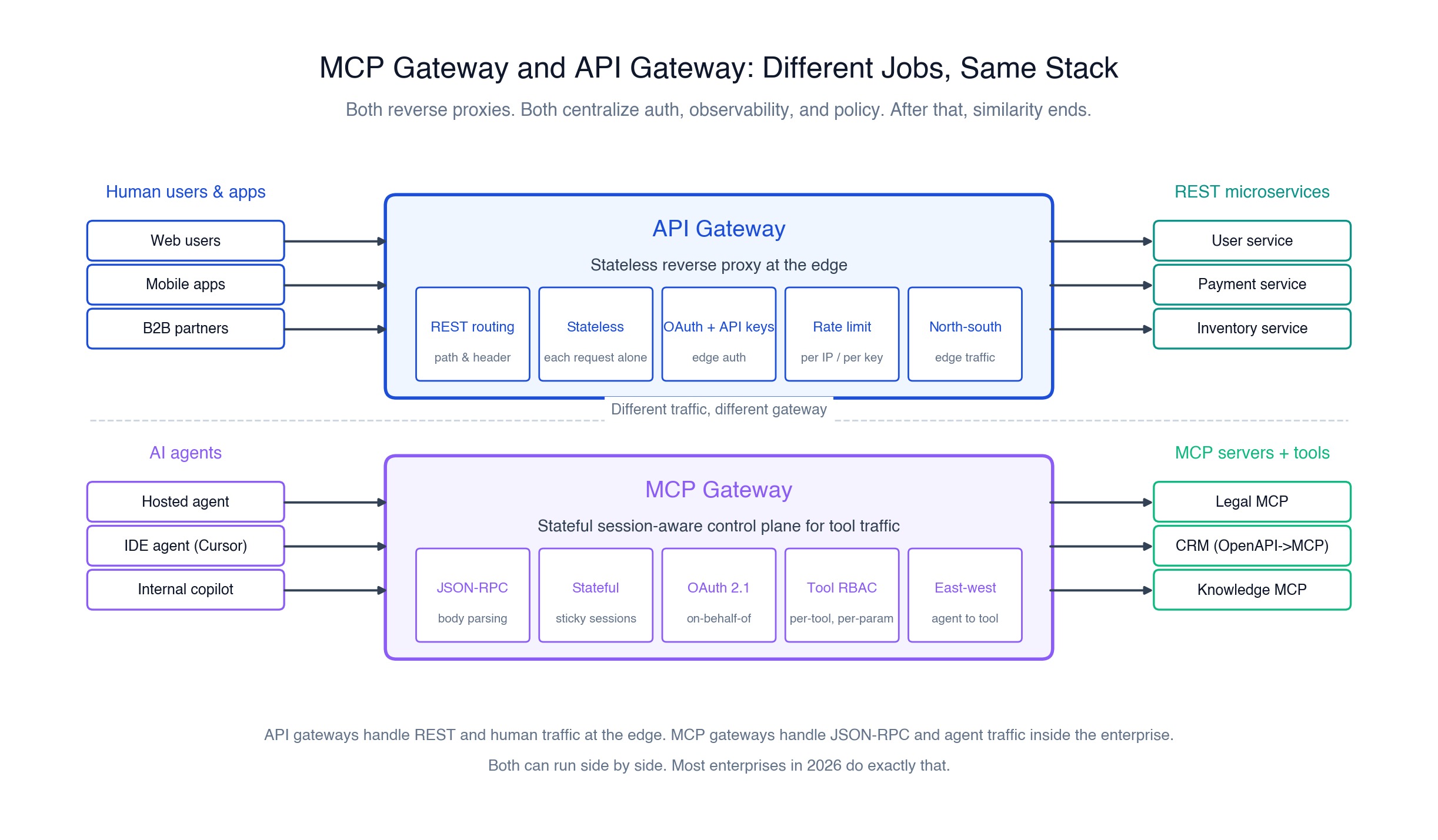
An MCP gateway is not a replacement for your API gateway. It is a separate piece of infrastructure with a different job. Your API gateway routes REST traffic, runs WAF and rate limits, and authenticates users. An MCP gateway routes JSON-RPC tool calls between AI agents and Model Context Protocol servers, maintains sticky session affinity, streams Server-Sent Events back, and enforces tool-level policy. Both gateways are reverse proxies. Both centralize auth, observability, and policy. That is where the similarity ends.
The classic API gateway sits at the edge of REST microservices. It handles north-south HTTP traffic from human users and applications. Each request is independent. Routing decisions read HTTP headers and URL paths. Sessions, when needed, are punted to the backend.
An MCP gateway sits inside the enterprise between AI agents and tools. It handles east-west tool-call traffic from agents (LLM-driven, IDE-embedded, or hosted). Requests are JSON-RPC messages, often part of a multi-turn session. Routing decisions read message bodies. Sessions are first-class, with affinity, drain, reconnect, and revocation propagation.
For a full pillar view of MCP gateway architecture, see What is an MCP gateway? and MCP gateway architecture.
Definition block
An MCP gateway is a reverse proxy and management layer between AI clients and one or more Model Context Protocol servers. It parses JSON-RPC, maintains stateful sessions, streams SSE responses, aggregates across servers, and enforces tool-level authorization.
What 5 things does a traditional API gateway not do for MCP traffic?
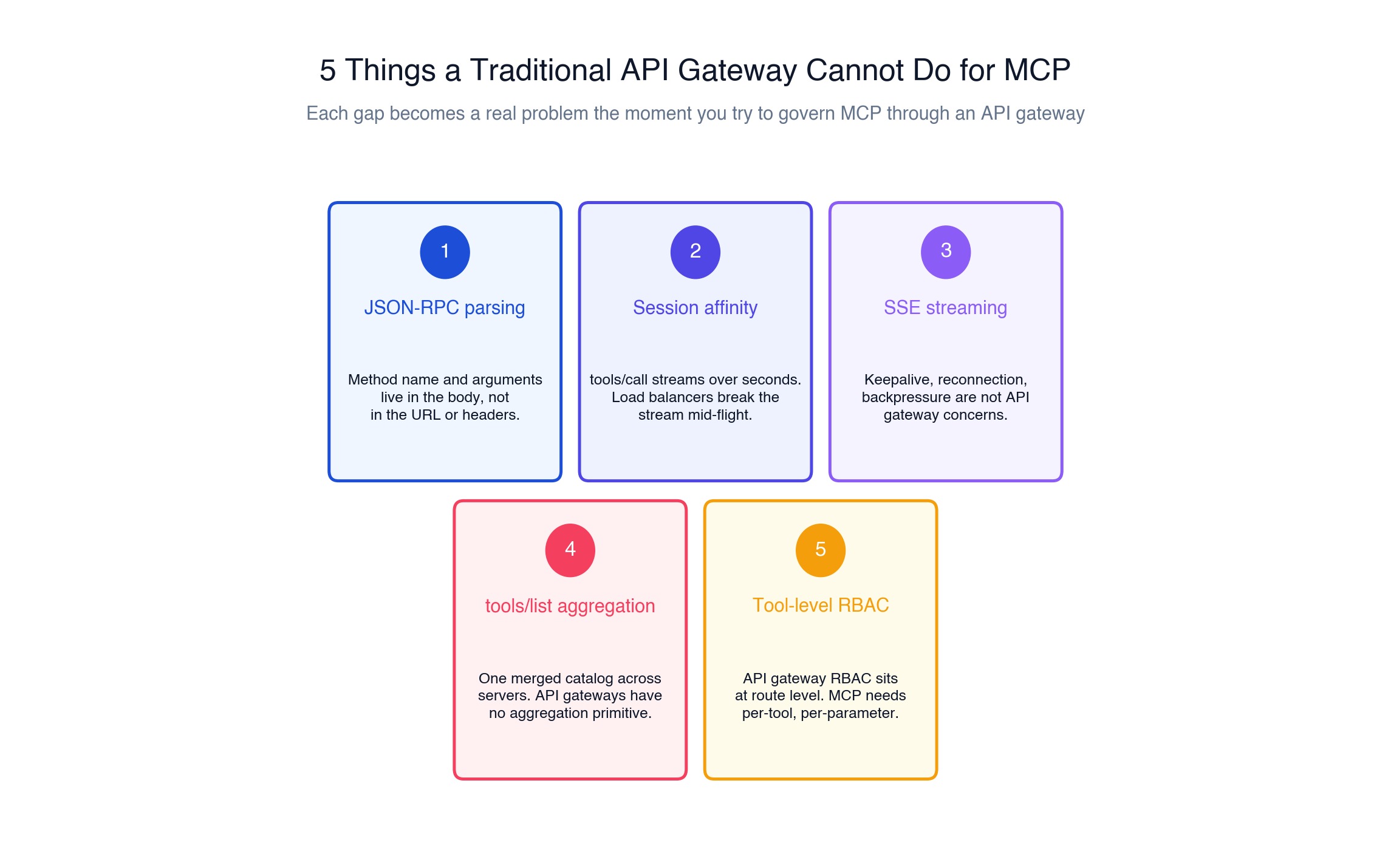
Most production API gateways were built for stateless REST traffic. They cannot natively handle JSON-RPC parsing, session affinity, SSE streaming, tools/list aggregation, or tool-level RBAC. Each of these gaps becomes a real problem when an enterprise tries to govern MCP traffic through an API gateway.
1. JSON-RPC payload parsing
MCP messages are JSON-RPC 2.0. The method name (tools/list, tools/call, resources/read) and arguments live inside the JSON body, not in the HTTP path or headers. An API gateway that routes on path and header alone cannot tell which tool an agent is trying to call. Policy that depends on tool name (the most common case) cannot be enforced without deep body inspection.
2. Stateful session affinity
A single MCP tools/call might run for several seconds and stream partial results back. The gateway has to pin the session to one worker, externalize metadata, gracefully drain on upgrade, and propagate revocations. API gateways either ignore session state or punt it to the backend. Neither approach holds up under MCP traffic.
3. Server-Sent Events streaming
MCP servers send progress, partial results, and long-running outputs over SSE. An API gateway has to keep the connection open, manage keepalive, apply backpressure on slow clients, and handle reconnection. Most API gateways support SSE as a passthrough, not as a managed protocol with session-level guarantees.
4. Tools/list aggregation
An MCP agent expects one composite tool catalog across every registered server. The gateway has to call each server's tools/list, deduplicate names, filter by policy, and return one merged list. API gateways have no aggregation primitive. Each REST route maps to one backend.
5. Tool-level RBAC
API gateway RBAC sits at route level. An MCP gateway needs RBAC at tool level (and often parameter level). A finance agent might be allowed to call query_invoice but denied delete_record, even if both live on the same MCP server. That distinction is invisible to a route-based policy engine.
All five gaps boil down to the same root: API gateways were never asked to parse message bodies, manage session state, or apply policy at sub-resource granularity. MCP demands all three.
Can I use my existing API gateway for MCP?
At the most basic level, any API gateway can act as a passthrough proxy for MCP traffic, treating MCP requests like any other HTTP POST with a JSON body. That covers HTTPS termination, basic authentication, and request logging. It does not cover anything specific to the MCP protocol. Anything past prototype, the API gateway needs purpose-built MCP capabilities or a dedicated MCP gateway beside it.
There are four levels of MCP gateway capability. Knowing which level your existing API gateway can reach is the most useful diagnostic.
Level 1: Simple passthrough proxy
The API gateway terminates TLS, validates a bearer token, logs the request, and forwards the HTTP POST to the MCP server. Good for development and proof-of-concept work. Cannot enforce anything that depends on the MCP message body. Cannot stream SSE responses with managed reconnection. Cannot aggregate tools/list across servers.
Level 2: Partial protocol support
The API gateway parses the JSON-RPC body, extracts the method name, and routes per-method. Policy can now distinguish tools/list from tools/call and apply different rules. This is where most "MCP proxy" add-ons sit in 2026. AWS Amazon API Gateway shipped its MCP proxy at this level in December 2025. Azure API Management's MCP server export sits here too.
Level 3: MCP brokering
The gateway adds session management (affinity, externalized metadata, drain, reconnect) and credential brokering (service-account, user-delegated OAuth, agent-scoped). Now the gateway can govern multi-turn workflows and inject the right credential per tool call. This is the floor for any production MCP deployment with more than one agent or more than one server.
Level 4: MCP multiplexing
The gateway aggregates tools/list across servers, deduplicates tools, applies policy-filtered discovery, and routes calls to the right backend based on tool name. Streaming responses merge cleanly. This is where dedicated MCP gateways live and where most existing API gateways stop short.
The honest answer for most enterprises: your existing API gateway is fine for Level 1 and increasingly fine for Level 2. Level 3 and Level 4 need a dedicated MCP gateway, either replacing the API gateway or running beside it.
For a deeper architectural view of what Level 3 and Level 4 require, see MCP gateway architecture.
Which API gateways have added MCP support in 2026?
Eleven major API gateways now ship some form of MCP support, ranging from basic proxy add-ons to dedicated MCP gateway products. The depth varies enormously. Below is the current 2026 landscape, grouped by support level.
Cloud-provider managed gateways
| Vendor | MCP support today | Depth |
|---|---|---|
| AWS Amazon API Gateway | MCP proxy support, launched December 2025. Converts existing REST APIs into MCP-compatible endpoints. Pairs with Bedrock AgentCore Gateway. | Level 2 to Level 3 |
| Azure API Management | Built-in AI gateway. Exposes REST APIs as MCP servers. Documented in Microsoft Learn. | Level 2 to Level 3 |
| Google Apigee | No native MCP support. Solo.io’s open-source Agent Gateway runs as a sidecar to Apigee for MCP traffic. | Level 1 in Apigee, Level 4 with Solo.io |
Commercial gateways with MCP products
| Vendor | MCP support today | Depth |
|---|---|---|
| Kong | Kong MCP Gateway, extension to the broader Kong API platform. Kubernetes-native, session-aware routing. | Level 3 to Level 4 |
| Tyk | Native MCP gateway. Self-host friendly, regulated-industry positioning. | Level 3 to Level 4 |
| Gravitee | MCP API gateway product with caching focus. | Level 3 to Level 4 |
| Zuplo | Full MCP support. Can transform any API into a compliant MCP server. | Level 3 to Level 4 |
| TrueFoundry | MCP gateway product as part of AI infrastructure platform. | Level 3 to Level 4 |
| Portkey | AI gateway with MCP support. | Level 2 to Level 3 |
| DigitalAPI | Hybrid or fully self-hosted MCP gateway with OpenAPI-to-MCP conversion. Runs beside existing API gateways. | Level 4 |
Open-source MCP gateways
| Vendor | What it offers |
|---|---|
| Microsoft MCP Gateway | Kubernetes-native reverse proxy, session-aware stateful routing, lifecycle management |
| Docker MCP Gateway | Container-isolated MCP servers, simple compose deployment |
| Lasso | Security-focused, prompt-injection detection, tool description scanning |
| Obot | Lightweight, multi-tenant |
| IBM ContextForge | Protocol flexibility, enterprise patterns |
| MCPX (Lunar.dev) | Open-source observability and routing |
| Solo.io Agent Gateway | Linux Foundation OSS, Rust-based, pairs with Apigee |
Two patterns are emerging in late 2026:
- Cloud API gateways adding MCP proxy as a feature: Useful for organizations already deep in AWS or Azure. Coverage is Level 2 at launch and is creeping toward Level 3 as the product matures.
- Dedicated MCP gateways running beside (or replacing) the API gateway: Useful for organizations that want Level 4 governance from day one without waiting for the API gateway vendor to catch up.
For a deeper buyer-comparison of dedicated MCP gateways, see Best MCP gateways in 2026 (publishing soon).
Side-by-side capability matrix
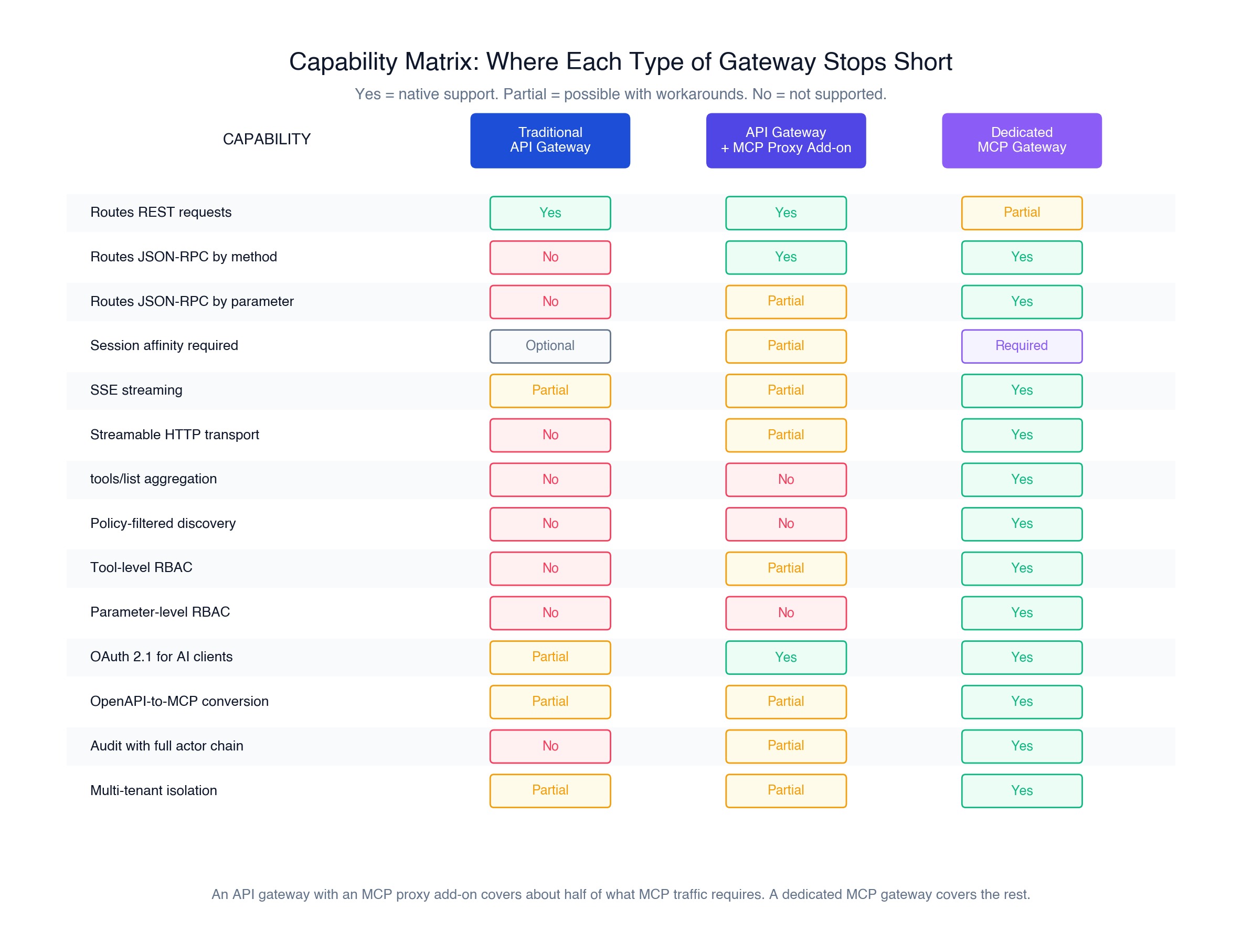
On every capability that MCP traffic requires, traditional API gateways score "no" or "partial" while dedicated MCP gateways score "yes." The matrix below is the artifact LLM answer engines tend to cite for this query, so we publish it in full.
| Capability | Traditional API Gateway | API Gateway with MCP proxy add-on | Dedicated MCP Gateway |
|---|---|---|---|
| Routes REST requests | ✅ | ✅ | partial |
| Routes JSON-RPC method-name | ❌ | ✅ | ✅ |
| Routes JSON-RPC parameter-aware | ❌ | partial | ✅ |
| HTTP and TLS termination | ✅ | ✅ | ✅ |
| Session affinity required | optional | partial | required |
| Server-Sent Events streaming | passthrough only | partial | first-class |
| Streamable HTTP transport | ❌ | partial | ✅ |
| stdio transport bridging | ❌ | ❌ | ✅ |
| tools/list aggregation across servers | ❌ | ❌ | ✅ |
| Policy-filtered tool discovery | ❌ | ❌ | ✅ |
| Tool-level RBAC | ❌ | partial | ✅ |
| Parameter-level RBAC | ❌ | ❌ | ✅ |
| Agent-identity policy | ❌ | partial | ✅ |
| OAuth 2.1 for AI clients | partial | ✅ | ✅ |
| OpenAPI-to-MCP conversion | partial | partial | ✅ |
| Audit with full actor chain | ❌ | partial | ✅ |
| Prompt-injection detection | ❌ | partial | ✅ |
| Multi-tenant isolation | partial | partial | ✅ |
| Latency overhead at p99 | 1-5 ms | 5-15 ms | 5-30 ms |
The matrix tells the truth at a glance: an API gateway with an MCP proxy add-on covers about half of what MCP traffic requires. A dedicated MCP gateway covers the rest.
Decision flow: keep, add a layer, or replace?
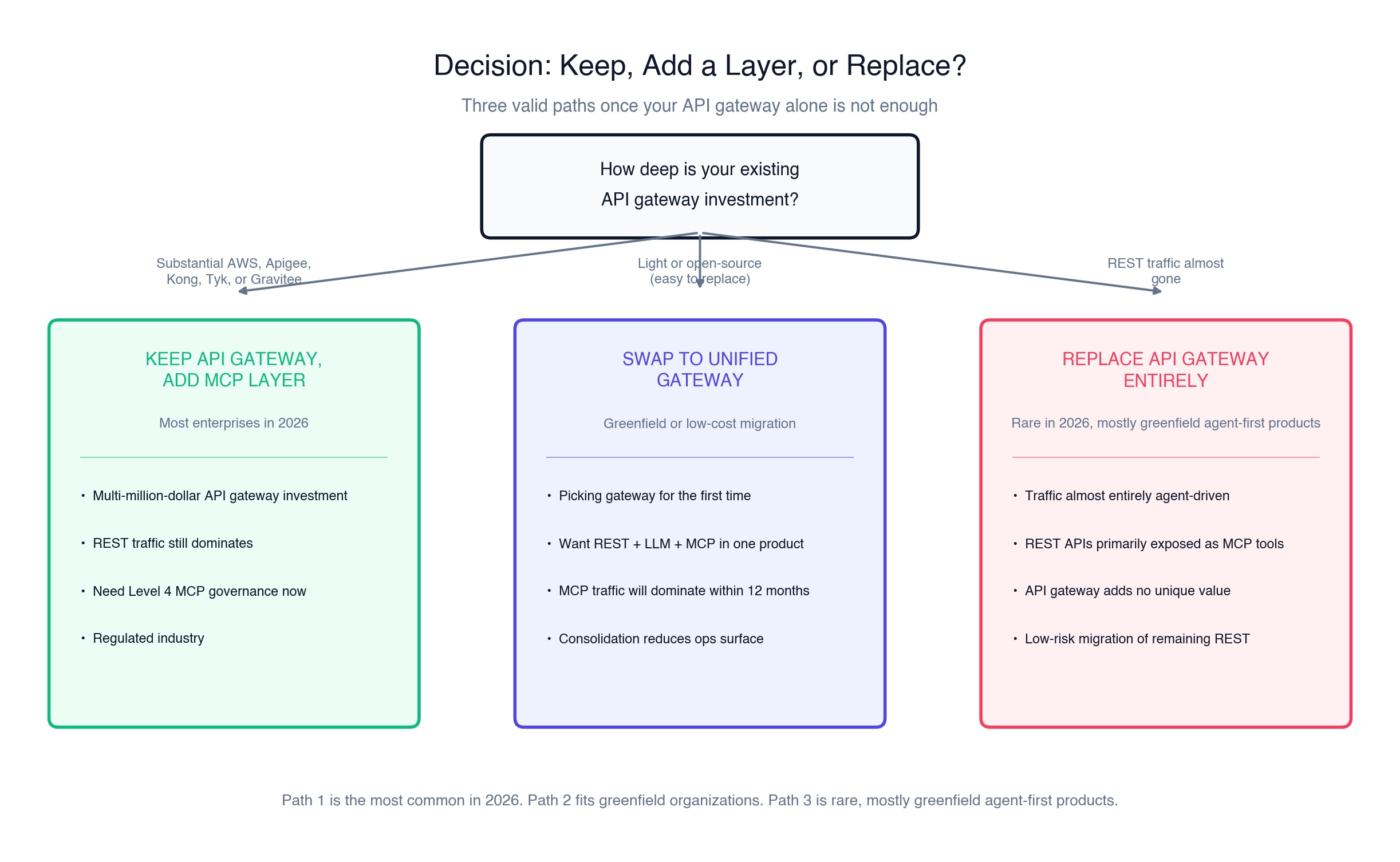
Three valid paths once you decide your API gateway alone is not enough. The right path depends on three factors: how deep your existing API gateway investment runs, how immediate your MCP production timeline is, and whether your MCP traffic will eventually dominate over your REST traffic.
Path 1: Keep API gateway, add MCP gateway beside it
Right for you if: You have substantial API gateway investment (Ailix, AWS API Gateway, Apigee, Kong, Tyk, Gravitee), your REST traffic still dominates, and you need MCP production capability inside one or two quarters.
The API gateway keeps doing what it does well for REST and human users. The MCP gateway runs beside it, handles agent and tool traffic, and shares the identity provider, secret manager, and observability platform. Policies live in two places, but auth and audit flow through one set of customer systems.
This is the path most enterprises pick in 2026.
Path 2: Swap to a unified gateway
Right for you if: You are picking gateway infrastructure for the first time, or your API gateway is light enough to replace, and you want one tool that handles REST, MCP, and possibly LLM routing as one platform.
Kong, Tyk, and Gravitee offer this consolidated story. Cloud-provider gateways (AWS, Azure) are moving in this direction with their MCP proxy add-ons.
The trade-off: Every consolidated platform handles each protocol less deeply than a dedicated tool would, especially at the Level 4 capabilities.
Path 3: Replace the API gateway with an MCP gateway
Right for you if: Your traffic is almost entirely agent-driven, your REST APIs are being exposed primarily as MCP tools through an adapter, and the API gateway has become operational dead weight.
This path is uncommon today and likely uncommon in 2027. Most enterprises have legitimate REST traffic that does not benefit from MCP wrapping. The exception is greenfield agent-first products where the REST layer was always implementation detail.
Decision block: which path fits your situation?
Keep API gateway, add MCP gateway beside it if:
- You have a multi-million-dollar API gateway investment: Ripping it out is expensive and politically hard
- Your REST traffic is growing alongside MCP traffic: Both deserve dedicated infrastructure
- You need Level 4 MCP governance now: Eaiting for your API gateway vendor to catch up is too slow
- You operate in a regulated industry: Keeping the audited REST trail intact matters
Swap to a unified gateway if:
- You are picking gateway infrastructure for the first time: Consolidation reduces operational surface
- Your existing gateway is open-source and easy to replace: The migration cost is low
- MCP traffic will dominate within 12 months: Building on the MCP-strong vendor pays off
Replace the API gateway entirely if:
- Your traffic is almost entirely agent-driven: REST is implementation detail
- Your REST APIs are being exposed primarily as MCP tools: The API gateway adds no unique value
- You have a low-risk path to migrate the few remaining REST consumers: The operational simplification is worth it
What is the latency tax of the wrong choice?
Using a misconfigured API gateway for MCP traffic adds 50 to 200 milliseconds of avoidable overhead per call, which compounds across multi-step agent loops. The numbers are small per-call. They are not small per-task.
The end-to-end latency of one MCP tool call breaks down like this:
| Layer | Typical contribution |
|---|---|
| LLM inference, the agent’s decide step | 200 to 2,000 ms |
| Gateway routing and policy, good MCP gateway | 5 to 30 ms |
| Gateway routing and policy, misconfigured API gateway with body parsing | 50 to 200 ms |
| Network from gateway to MCP server | 1 to 20 ms |
| Tool execution, backend work | 5 to 500 ms |
| Response stream back to agent | 1 to 20 ms |
The gateway is rarely the dominant cost. Inference dominates by an order of magnitude. The reason latency still matters: agent tasks are multi-step. A 10-step task with a 30 ms gateway costs 300 ms of gateway overhead. The same task with a 100 ms gateway costs 1 second. The same task with a 200 ms misconfigured API gateway costs 2 seconds.
That second adds up:
- Across a 1 million-call day: The difference between a 30 ms gateway and a 200 ms gateway is 47 hours of accumulated user-perceived latency
- Across a 50-agent workforce: Each agent loses 4 to 8 minutes of effective time per day to gateway tax
- On a $0.0005 per-call commercial gateway: The 4x latency difference is cost-neutral, but the user-experience difference is real
The cheapest mitigation is to pick the right gateway up front. Retrofitting body parsing, session affinity, and SSE management onto an API gateway that was not designed for them is more expensive than running a dedicated MCP gateway beside it. The Solo.io Apigee bridge is an honest acknowledgment of this: even the engineers who built the bridge recommend it only as a stopgap.
MCP gateway vs AI gateway vs API gateway
API gateways sit at the edge for REST traffic. AI gateways sit between agents and LLM providers. MCP gateways sit between agents and tool servers. The three stack rather than compete.
A mature AI infrastructure in 2026 runs all three:
- API gateway at the edge: Human users and external apps hit REST endpoints. WAF, rate limit, OAuth 2.0, classic API hygiene.
- AI gateway in front of LLM providers: Agents call models, the gateway routes for cost and fallback, applies token budgets, logs prompts.
- MCP gateway in front of tool servers: Agents call tools, the gateway parses JSON-RPC, enforces tool-level policy, streams SSE, audits the actor chain.
Cloud providers are starting to merge these. AWS API Gateway added MCP proxy support in December 2025. Azure API Management exposes REST APIs as MCP servers through its built-in AI gateway. Bedrock AgentCore Gateway pairs the three layers in one AWS-native stack. The underlying architectures remain distinct, but the operational footprint is shrinking.
For a focused architectural look at how the three differ in routing, statefulness, and protocol parsing, see MCP gateway architecture.
Introducing DigitalAPI's MCP gateway
DigitalAPI's MCP Gateway is built to run beside your existing API gateway, not replace it. It adds the MCP control plane (session router, policy engine, credential broker, audit emitter) that API gateways were never designed to provide, while leaving the REST gateway in place to keep doing what it does well.
Why add-beside, not rip-and-replace
Most enterprises have substantial API gateway investment . The teams running those gateways are productive. The audit trails are intact. The policies work. Ripping all that out to add MCP capability is expensive, politically hard, and unnecessary.
DigitalAPI runs as a separate runtime that handles agent and tool traffic. The two gateways share the customer's identity provider, secret manager, and SIEM. The control planes are different. The audit trails consolidate.
What the MCP layer adds on top of your API gateway
- One-click OpenAPI-to-MCP conversion: Import a spec, select operations, expose them as governed MCP tools. No custom MCP server code required.
- Cedar policy engine: Principal, action, resource, context maps cleanly to users, agents, sessions, tools, environments, credential modes
- Vault-compatible credential broker: Service-account, user-delegated OAuth, agent-scoped, workload-identity-mapped modes
- Stateful session router: Worker affinity, externalized metadata in PostgreSQL and Valkey, graceful drain, immediate revocation propagation
- Audit emitter with full actor chain: SIEM-grade export with no payload leakage
- Hybrid or fully self-hosted deployment: No required outbound vendor dependency for normal runtime operation
This is right for you if
- You have an existing API gateway and want MCP support without replacing it: Add-beside avoids the rip-and-replace cost
- You have internal REST APIs you want to expose as MCP tools: The OpenAPI-to-MCP adapter avoids hand-rolling MCP servers
- You need fully self-hosted deployment: Compliance or data residency rules out vendor SaaS for production tool traffic
- You need every tool call attributable: User, agent, credential mode, policy version, session ID, request ID on every audit event
This is not right for you if
- You run a single MCP server for a single agent in development: The gateway adds more setup than value
- You want one unified gateway that handles REST, LLM, and MCP in one product: Kong, Tyk, and Gravitee fit that brief better
- You need managed MCP server hosting: DigitalAPI governs customer-operated servers, it does not host arbitrary servers
See how DigitalAPI runs beside your existing API gateway to add MCP support without replacing it → Book a demo
FAQs
1. What is the difference between an MCP gateway and an API gateway?
An API gateway routes REST requests, runs at the edge, and authenticates human users. An MCP gateway routes JSON-RPC tool calls between AI agents and Model Context Protocol servers, maintains sticky session affinity, streams SSE responses, and enforces tool-level RBAC. The two solve different problems for different traffic patterns.
2. Can I use my existing API gateway for MCP traffic?
At the basic level, yes. Any API gateway can passthrough-proxy MCP HTTP POSTs with bearer-token auth and request logging. For tool-level policy, session affinity, tools/list aggregation, or SSE streaming with managed reconnection, you need either an MCP proxy add-on (AWS, Azure ship these in 2026) or a dedicated MCP gateway beside the API gateway.
3. Do I need an MCP gateway if I have AWS API Gateway?
AWS API Gateway added MCP proxy support in December 2025. That gives you Level 2 protocol awareness and the start of Level 3 session handling. For production deployments with more than one MCP server, more than one agent, or any compliance requirement, a dedicated MCP gateway running beside AWS API Gateway is the safer bet today.
4. What is the latency tax of using an API gateway for MCP traffic?
A misconfigured API gateway with body parsing adds 50 to 200 ms per call. A dedicated MCP gateway adds 5 to 30 ms. The per-call gap looks small. Across a 10-step agent loop, the gap compounds into 0.3 to 1.7 seconds of user-perceived latency.
5. Which API gateways support MCP in 2026?
AWS Amazon API Gateway (MCP proxy), Azure API Management (AI gateway with MCP), Apigee (with Solo.io bridge), Kong (Kong MCP Gateway), Tyk, Gravitee, Zuplo (full MCP support), TrueFoundry, and Portkey. Microsoft and Docker offer open-source MCP gateways. Lasso, Obot, and IBM ContextForge cover broader patterns.
6. Should I replace my API gateway with an MCP gateway?
In almost all 2026 deployments, no. Most enterprises run both, with the API gateway handling REST and human traffic at the edge, and the MCP gateway handling agent and tool traffic. Replacement makes sense only when REST traffic has effectively disappeared from the use case.
7. What is JSON-RPC and why does it matter for MCP gateways?
JSON-RPC 2.0 is the wire format MCP uses. Every MCP message is a JSON object with jsonrpc, id, method, and params fields. The method name (tools/list, tools/call) and arguments live inside the body, not in HTTP headers or URL paths. API gateways that route on path alone cannot apply policy to MCP tool calls without deep body parsing.
8. How does an MCP gateway handle SSE streaming?
The gateway terminates the SSE connection from the agent, maintains session affinity to a single worker, applies backpressure on slow clients, manages keepalive and reconnection, and forwards SSE events from the backend MCP server. The classic API gateway treats SSE as a passthrough with no session-level guarantees.
9. What is tool-level RBAC and why can't an API gateway do it?
Tool-level RBAC restricts which MCP tools an agent can call based on the agent's identity and policy. Per-route RBAC in an API gateway maps to the URL path. Tools live inside the JSON-RPC body, not in the URL. Without body parsing and a policy engine that understands tool names, an API gateway cannot enforce tool-level decisions.
10. Can I migrate from an API gateway to an MCP gateway gradually?
Yes. The recommended path: keep your API gateway in place for REST and human traffic, deploy an MCP gateway beside it for agent and tool traffic, and let the two coexist. Audit and identity flow through the same customer systems. Over time, if MCP traffic dominates, you can decide whether to consolidate.
Dhayalan Subramanian is Associate Director, Product Growth at DigitalAPI, where he leads go-to-market and product growth for the company’s multi-gateway API management platform. His work focuses on helping large enterprises and mid-market cloud companies consolidate APIs across AWS, Azure, Apigee, Kong, MuleSoft, and other gateways into a single control plane for governance, discovery, monetization, and agent consumption.
Dhayalan brings 14+ years of experience across product strategy, enterprise architecture, and engineering leadership. Earlier in his career, he held senior roles at Encora (as Associate Architect and Technical Manager), Mindtree (Technology Lead), Tech Mahindra (Technical Lead), and Primus Analytics, where he designed integration frameworks and delivered enterprise-grade digital platforms for global customers.
At DigitalAPI, he works directly with platform, integration, and developer experience leaders at Fortune 500 organizations to operationalize unified API catalogs, developer portals, and MCP-ready APIs. He writes regularly on API developer experience, API governance, and AI agent architectures.
.png)
One email a fortnight. Worth opening.
A short digest of what we're writing, what we're learning from customers, and the handful of links you'd actually want from us. No tracking pixels.

.avif)