


AI Gateway vs LLM Gateway: What's the Difference?
An LLM gateway controls calls to language models. An AI gateway does that and more: other model types, guardrails, governance and agent traffic. This guide shows where the two overlap, where they differ and which one you need.

TL;DR:
What is the difference between an AI gateway and an LLM gateway?
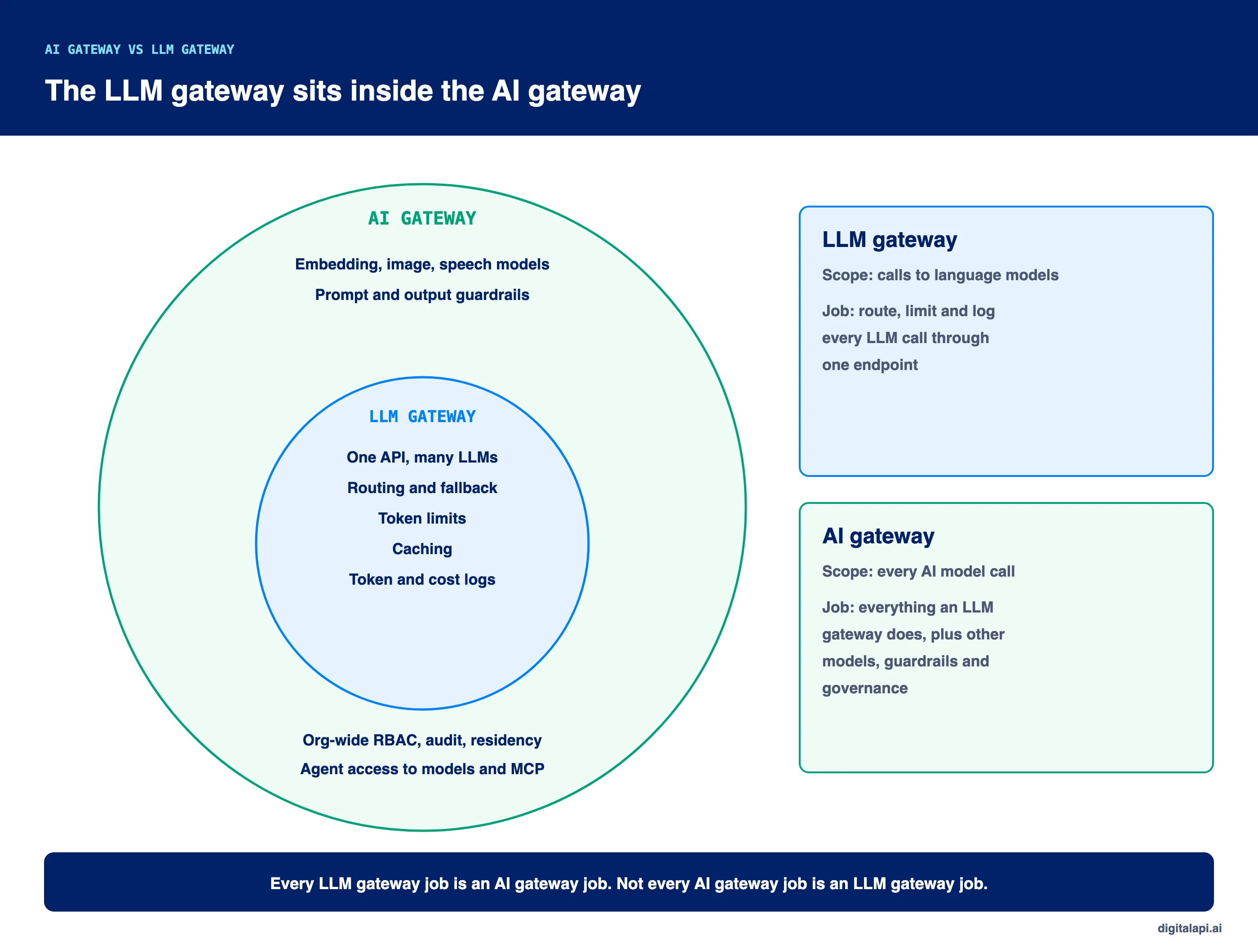
In the AI gateway vs LLM gateway question, an LLM gateway is a subset of an AI gateway.
An LLM gateway routes and controls calls to large language models.
An AI gateway does that job and adds more. It covers embedding, image and speech models, guardrails and governance. It also covers AI agents' access to models and MCP servers.
Your architecture review has two line items. The app team runs an LLM gateway in front of three model providers. The security team wants to buy an AI gateway. Are you about to pay twice for one job?
Often, yes. The AI gateway vs LLM gateway split is mostly about scope and owner, not a different technology. Many products answer to both names.
But scope matters when you buy. A gateway built for chat completions may not cover embeddings, guardrails or agent traffic. This guide shows where the two overlap, where they differ, and how to choose.
AI gateway vs LLM gateway: what is the difference?
An LLM gateway governs calls to language models. An AI gateway governs all AI traffic, and language models are one part of it. The core mechanics are the same: one entry point, policy on every call, and routing to the right model.
The difference shows up in three places:
- Model scope. An LLM gateway targets text and chat models. An AI gateway also covers embedding, vision and speech models.
- Policy scope. An LLM gateway focuses on routing, cost and uptime. An AI gateway adds guardrails and org-wide governance.
- Traffic scope. An AI gateway increasingly covers AI agents, including their calls to MCP servers.
This matches how both terms are used on our own guides. The LLM gateway guide frames it as a developer-facing control plane for model calls. The AI gateway guide frames the broader, enterprise view.
What does an LLM gateway do?
An LLM gateway gives your apps one API for many language models. It handles routing, fallback, token limits and cost tracking behind that API. Swapping models becomes a config change, not a code change.
Its core jobs:
- Route each request to a model by cost, latency or task.
- Fail over to a second model or provider on errors or rate limits.
- Limit tokens per app or team, with budgets.
- Cache repeat prompts to save cost and time.
- Log tokens, latency and cost per call.
Model churn is why teams want this layer. Menlo Ventures' 2025 mid-year LLM market update found 66% of builders moved to newer models from their provider in a year. Only 11% switched vendors.
Upgrades are constant, so the gateway keeps each one out of your application code.
What does an AI gateway do?
An AI gateway is the control point for every AI service your organization uses, not only language models. It does everything an LLM gateway does. It then adds security, governance and agent controls across the estate.
Note the phrase "AI services or models." That is wider than LLMs. On top of LLM routing, an AI gateway usually adds:
- More model types. Embedding models for retrieval, plus vision and speech models.
- Guardrails. Prompt injection screening and PII redaction on inputs and outputs.
- Enterprise governance. SSO, role-based access per team, audit logs, data residency and an inventory of who calls which model.
- Agent traffic. Gartner's Market Overview for AI Gateways (May 2026) covers this. It says AI gateways manage how agents reach models and Model Context Protocol (MCP) servers.
MCP is the open protocol AI agents use to discover and call tools. That last point is the newest shift in the category.
AI gateway vs LLM gateway: how do the scopes compare?
The two share the same core: routing, fallback, token limits, caching and cost logs. They differ in who owns them, which models they cover and how far governance reaches. The table compares scope, not individual features.
Gartner tracks one category, AI gateways. LLM gateways fall inside it.
For the request-level differences with a classic gateway, see the AI gateway vs API gateway guide.
When are the terms used interchangeably?
Most of the time. Many vendors sell one product and call it an AI gateway, an LLM gateway or both. A label tells you little about what the product covers.
Teams tend to say "LLM gateway" when they talk about developer tooling for model calls. They say "AI gateway" when they talk about enterprise control. The products often overlap fully.
So evaluate capabilities, not names. Ask every vendor these five questions:
- Which model types can it route? Chat only, or also embeddings, image and speech?
- Are guardrails built in? Ask about prompt injection screening and PII redaction.
- How far does access control reach? Per app, or per team, role and tenant?
- Does it govern agents? Ask whether agent calls to MCP servers pass through it.
- Where does it run? Managed service, your cloud or on-premises, with data residency options?
A product that answers "chat only" to the first question is an LLM gateway, whatever its name.
Where do API and MCP gateways fit?
Each gateway governs a different hop. An API gateway governs calls to your services. An LLM or AI gateway governs calls to models. An MCP gateway governs agent calls to tools.
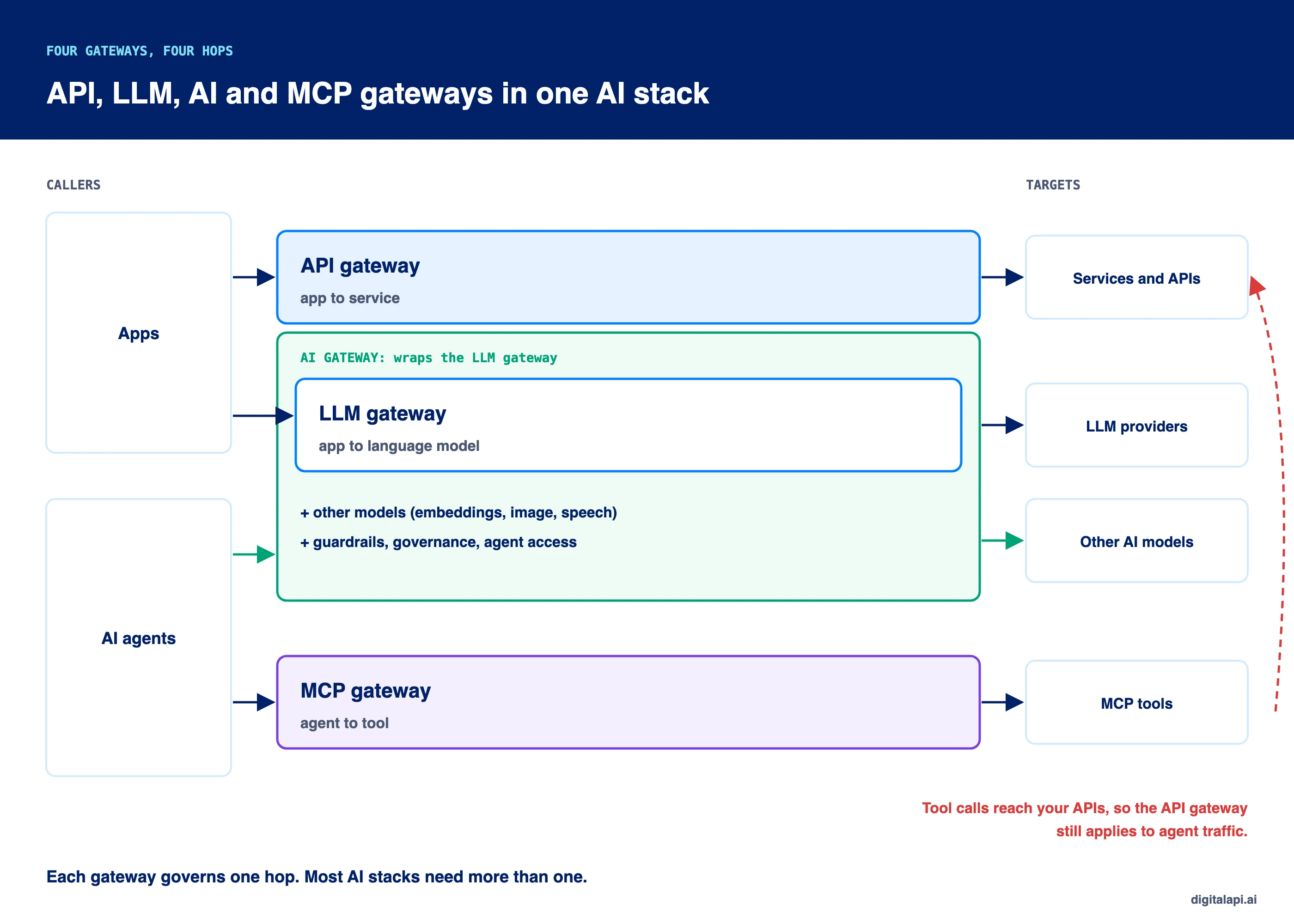
That is the short answer to "AI gateway vs LLM gateway vs API gateway." For the full three-way breakdown, read AI gateway vs MCP gateway vs API gateway. For the AI gateway vs MCP gateway hop alone, see MCP gateway vs API gateway.
Tool calls end at your APIs, so the hops connect. Teams using the DigitalAPI MCP Gateway audit and meter every MCP call like their HTTP API traffic. Compliance sees one view instead of two.
See how DigitalAPI brings API, agent and MCP traffic under one control plane → Book a Demo
AI gateway vs LLM gateway: which one do you need?
Start with an LLM gateway if your problem is model calls. Move to an AI gateway when the problem becomes AI governance.
An LLM gateway is enough if:
- One team or a few apps call language models.
- Your main pain is routing, fallback and cost, not compliance.
- You call chat models only, with no embedding or image workloads at scale.
- No agents call tools in production yet.
You need an AI gateway if:
- Many teams share model spend and need budgets, showback and access by role.
- Prompts carry customer or regulated data, so you need redaction, audit and data residency.
- You run several model types for retrieval, vision or speech.
- AI agents act on your systems through MCP and need governed access.
A practical path:
- Route every model call through one gateway.
- Give each app its own key and budget.
- Add guardrails and audit before customer data reaches a model.
- Put agent and MCP traffic under the same identity and audit as your APIs.
For the target design, see AI gateway architecture for safe, scalable AI routing. On step 4, the DigitalAPI API Gateway gives agent traffic its own scoped credentials, rate limits and audit trail.
Key takeaways
- AI gateway vs LLM gateway is a scope question. An LLM gateway is a subset of an AI gateway.
- The core is shared: one API, model routing, fallback, token limits, caching and cost logs.
- An AI gateway adds other model types, built-in guardrails, org-wide governance and agent traffic.
- Gartner tracks one category, AI gateways, and its May 2026 overview includes agent access to MCP servers.
- Judge products by capability, not label. Ask the five vendor questions before you buy.
- API and MCP gateways govern different hops. Most mature stacks run all of them, ideally from one control plane.
Frequently asked questions
1. Is an LLM gateway the same as an AI gateway?
Mostly, yes. Both proxy calls to model providers and add routing, fallback, token limits, caching and cost tracking. Vendors often use the two names for one product. The difference is scope. An LLM gateway covers language models. An AI gateway also covers embedding, image and speech models, guardrails, org-wide governance and agent traffic.
2. Is an LLM gateway a subset of an AI gateway?
Yes. Every core LLM gateway job is also an AI gateway job. That means one API for many models, routing, fallback, token limits and cost logs. An AI gateway adds more model types, built-in guardrails, enterprise access control and audit. It can also govern AI agents' access to models and MCP servers.
3. What is an LLM gateway used for?
An LLM gateway gives applications one API for many language models. Teams use it to route requests by cost or latency and fail over when a provider is down. It also sets token budgets per app, caches repeat prompts and logs tokens and cost per call. Swapping or upgrading models then needs a config change, not a code change.
4. What is an AI gateway used for?
An AI gateway is a central control point for AI use across an organization. Gartner describes it as an intermediary between applications and AI services or models. It provides one point for security, governance and observability. Teams use it to route model calls, screen prompts, redact sensitive data, enforce access by role and audit AI usage.
5. What is the difference between an AI gateway, an LLM gateway and an API gateway?
An API gateway governs calls from apps to your services, with authentication, request limits and routing. An LLM gateway governs calls to language models, with token limits and model routing. An AI gateway wraps the LLM gateway's job and adds other model types, guardrails, governance and agent access. Many enterprises run an API gateway alongside one AI gateway layer.
6. Does an AI gateway govern MCP traffic?
Increasingly, yes. Gartner covers this in its May 2026 Market Overview for AI Gateways. It says AI gateways manage how agents access models and MCP servers. Many teams still run a dedicated MCP gateway for agent-to-tool calls. It enforces per-agent and per-tool access, brokers credentials and keeps a tool-level audit trail.
7. Do I need both an AI gateway and an LLM gateway?
Usually not. An AI gateway that routes language models already covers the LLM gateway's job. Running both adds a hop and splits policy. Keep a separate LLM gateway only if one team needs a lightweight developer tool. In that case, put it behind the AI gateway so governance and audit stay in one place.
Conclusion
The AI gateway vs LLM gateway question has a short answer. An LLM gateway is a subset of an AI gateway, and the two often ship as one product.
What matters is scope. Check which models it routes, whether guardrails are built in and how far access control reaches. Then check whether it governs agents.
Start where your pain is today. If it is model routing and cost, an LLM gateway is a fine first step. If it is governance across teams, data and agents, plan for an AI gateway. Then connect it to your API and MCP layers.
Govern APIs, AI agents and MCP tool calls with the same identity, policy and audit. Talk to DigitalAPI. Get one control plane for your APIs, agent traffic and MCP
Prefer a walkthrough? Book a Demo
Dhayalan Subramanian is Associate Director, Product Growth at DigitalAPI, where he leads go-to-market and product growth for the company’s multi-gateway API management platform. His work focuses on helping large enterprises and mid-market cloud companies consolidate APIs across AWS, Azure, Apigee, Kong, MuleSoft, and other gateways into a single control plane for governance, discovery, monetization, and agent consumption.
Dhayalan brings 14+ years of experience across product strategy, enterprise architecture, and engineering leadership. Earlier in his career, he held senior roles at Encora (as Associate Architect and Technical Manager), Mindtree (Technology Lead), Tech Mahindra (Technical Lead), and Primus Analytics, where he designed integration frameworks and delivered enterprise-grade digital platforms for global customers.
At DigitalAPI, he works directly with platform, integration, and developer experience leaders at Fortune 500 organizations to operationalize unified API catalogs, developer portals, and MCP-ready APIs. He writes regularly on API developer experience, API governance, and AI agent architectures.
One email a fortnight. Worth opening.
A short digest of what we're writing, what we're learning from customers, and the handful of links you'd actually want from us. No tracking pixels.