



What Is an AI Gateway? Capabilities, AI vs API Gateway, and the Top Tools
An AI gateway is the control plane for LLM traffic. How it works, AI gateway vs API gateway, the top tools in 2026, and when enterprises need one.

TL;DR:
What it is: An AI gateway is a control plane that sits between your applications and AI models, routing requests and enforcing security, cost, and governance policies on LLM traffic from one place.
How it differs from an API gateway: It handles streaming responses, token-based limits, semantic caching, and prompt-injection guardrails that a traditional API gateway cannot.
Core capabilities: Multi-model routing, token rate limiting, caching, guardrails and PII redaction, credential management, and cost observability.
The top tools: Vercel, Cloudflare, Portkey, Kong, Azure API Management, and Databricks lead, alongside open-source options like LiteLLM and Envoy AI Gateway.
Bottom line: Enterprises increasingly want one control plane for API, AI, and MCP or agent traffic, which is where a platform like DigitalAPI fits.
Every team that ships an AI feature ends up calling large language models (LLMs), often several providers at once, from many applications. That creates the same problem APIs created a decade ago: sprawl, runaway cost, and inconsistent security. An AI gateway is the answer.
This guide explains what an AI gateway is, the problems it solves, how it works, how it differs from an API gateway, the top tools in 2026, the security and governance it provides, and how to adopt one.
What is an AI gateway?
An AI gateway is a control plane that sits between your applications and the AI models they call. It gives you a single, unified entry point for every LLM and AI service in your stack, and it enforces routing, security, cost, and governance policies consistently across all of them. In short, it does for AI traffic what an API gateway does for API traffic.
The reason it exists is that AI traffic is different. A modern AI application talks to multiple models, sends prompts that can leak sensitive data, streams responses token by token, and is billed per token rather than per request. Managing all of that with raw provider SDKs scattered across services leads to duplicated keys, no cost visibility, and no consistent security. An AI gateway centralizes it: one place to route requests, control spend, apply guardrails, and see what every model is doing.
A simple way to picture it: if an API gateway is the front door to your APIs, an AI gateway is the front door to your models. Every request in and every response out passes through one governed checkpoint.
Why do you need an AI gateway?
Most organizations do not set out to build an AI gateway. They reach for one once direct-to-provider integrations start to hurt. These are the problems that push teams toward one:
- Shadow AI and sprawl: Different teams adopt different models on their own, with no central inventory, no shared policy, and no visibility into what is being sent to which provider.
- Multi-model complexity: Every provider has its own SDK, authentication, rate limits, and response format, so supporting more than one model means writing and maintaining more than one integration.
- Runaway cost: Token spend climbs fast when there are no quotas, no caching, and no per-team visibility, and finance has no way to attribute the bill.
- Security and data leakage: Prompts can carry PII or secrets to a third-party model, and without central guardrails there is no consistent way to catch prompt injection or strip sensitive data.
- Compliance gaps: Regulated teams need an audit trail of who sent what to which model, plus control over where data is processed, none of which exists when apps call providers directly.
- Vendor lock-in: Hard-coding one provider into dozens of services makes switching models, or adding a cheaper one, an expensive migration.
An AI gateway addresses all six by centralizing model access behind one governed layer. That is why it has moved from a nice-to-have to standard infrastructure for any team running AI in production.
How an AI gateway works
An AI gateway acts as the control plane for how your applications interact with LLMs. When an app sends a request to a model, the gateway intercepts it, applies policies, routes it to the right model, and processes the response on the way back.
The request flow
A typical request moves through four stages:
- Authentication: An application or AI agent sends an LLM request to the gateway, which validates the API key or token against its consumer registry.
- Pre-processing: Prompt guardrails scan the request for injection attacks, PII, or toxic content, and rate limiters check token and request quotas before anything reaches a model.
- Routing: The gateway selects the best upstream model based on routing rules, availability, latency, or cost, then injects the provider credentials and forwards the request.
- Response handling: The response streams back through the gateway, which logs token usage, applies content moderation, collects observability data, and returns the processed result to the app.
Core capabilities
Across vendors, AI gateways converge on the same core capabilities:
- Multi-model routing and failover: Call hundreds of models through one API, and route dynamically by cost, latency, or availability. If a provider is down or slow, the gateway fails over to another automatically, so an outage at one vendor does not take down your feature.
- Token rate limiting and quotas: Enforce token and request limits per app, team, or agent, so a runaway loop or a spike cannot drain a budget or trip provider limits.
- Semantic caching: Cache by meaning, not exact text. "Summarize this document" and "give me a summary of this document" can hit the same cached answer, which cuts both latency and token cost on repeat questions.
- Guardrails and PII redaction: Block prompt injection, filter toxic content, and strip sensitive data before it reaches a model, with the same policy applied to every request.
- Credential management: Keep provider keys in the gateway and inject them at request time, instead of copying API keys into every service and CI pipeline.
- Observability and cost tracking: See token usage, latency, error rates, and spend per model, team, and feature from one dashboard, so cost is attributable and debuggable.
Architecture patterns
Teams deploy an AI gateway in one of three shapes:
- Standalone AI gateway: A dedicated service that all AI traffic flows through. It is the simplest to adopt and the most common starting point.
- Unified API and AI gateway: One platform governs both API and AI traffic, so policy, identity, and audit stay consistent across them. This is where most enterprises end up.
- Sidecar or service mesh: The gateway runs next to each workload for ultra-low latency, used by teams already invested in a mesh.
The right shape depends on scale and on whether you want AI traffic governed in its own silo or alongside the rest of your estate.
Key benefits of an AI gateway
The capabilities above translate into a handful of business outcomes:
- Lower, predictable cost: Caching, quotas, and routing to cheaper models for simple tasks reduce token spend, while per-team visibility makes the bill controllable.
- Higher reliability: Automatic failover across providers keeps AI features up even when a single model or vendor has an outage.
- Stronger security: Centralized guardrails, PII redaction, and credential management close the gaps that appear when every app talks to providers directly.
- Governance and compliance: RBAC, audit logs, and data residency turn ad-hoc AI usage into something an enterprise can actually govern.
- Faster development: One consistent API replaces many provider SDKs, and teams can swap or add models without rewriting application code.
- No vendor lock-in: The gateway abstracts the provider, so you can move between models as price and quality change.
AI gateway vs API gateway
Both an AI gateway and an API gateway are intermediaries that receive requests, apply policy, and route traffic. The difference is the traffic they are built for. An API gateway is designed for synchronous, request-and-response REST traffic between clients and backend services. An AI gateway is purpose-built for LLM traffic, which streams, is priced per token, and carries new risks like prompt injection.
The short version: A standard API gateway cannot count tokens, manage streaming responses, semantic-cache, or block a prompt injection. That is why a dedicated AI gateway emerged rather than teams bolting AI onto their existing gateway. That said, the two are not rivals. Many enterprises run an AI gateway alongside their API gateway, and the strongest platforms manage both from one place.
Where the MCP gateway fits (AI vs API vs MCP)
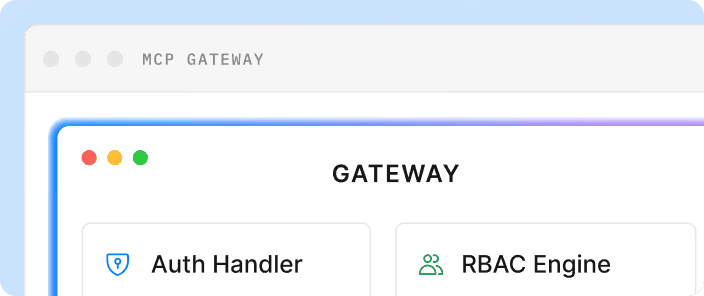
There are now three gateway planes in a mature AI stack, each governing a different kind of traffic:
They are complementary, not competing. A production agent platform often uses all three: the AI gateway controls the model calls, the MCP gateway controls the tool calls, and the API gateway governs the underlying APIs. The practical question for an enterprise is whether to run three separate silos or one control plane that spans all of them.
Is an LLM gateway the same thing?
Mostly, yes. "LLM gateway" and "AI gateway" are used interchangeably, and most products answer to both. The slight nuance: "LLM gateway" emphasizes routing and management across LLM providers specifically, while "AI gateway" is the broader umbrella that can also cover non-LLM AI services such as embeddings, vision, or speech. If you are comparing tools, do not get hung up on the label. Look at the capabilities, because the core job, a governed control plane for model traffic, is the same.
AI gateway use cases
AI gateways show up wherever model usage needs to be controlled at scale. Common patterns include:
- Customer-facing copilots and chatbots: Route to the right model per query, apply guardrails so the bot cannot be jailbroken, and cache common answers to cut cost.
- Internal knowledge assistants: Front a retrieval assistant with a gateway so that PII is redacted, access is role-based, and every query is logged.
- Multi-model cost optimization: Send simple tasks to a small, cheap model and hard tasks to a frontier model, switching automatically based on rules.
- Regulated AI in banking, insurance, and healthcare: Enforce audit trails, data residency, and content controls so AI features can pass a compliance review.
- Agentic systems: Govern both the model calls and, alongside an MCP gateway, the tool calls that autonomous agents make.
The top AI gateways in 2026
The market spans hosted products, enterprise platforms, and open-source projects. Hosted products like Vercel and Cloudflare optimize for fast adoption, open-source projects like LiteLLM and Envoy trade setup effort for full control, and enterprise platforms add the governance and multi-traffic scope that regulated teams need. Evaluate on capability and fit, not on label. The column most buyers overlook is whether the gateway also governs your API and agent traffic, not just model calls.
How to choose an AI gateway
Weigh these criteria against your situation:
- Model coverage: How many providers and models it supports, and how easily you can add more.
- Security and guardrails: Prompt-injection protection, PII redaction, and content moderation built in.
- Cost and observability: Token-level usage, spend per team, and caching to cut waste.
- Routing and reliability: Dynamic routing by cost or latency, with automatic failover.
- Delivery model: Open source for control versus managed for speed and support.
- Scope: Whether it governs only model calls, or also your API and agent or MCP traffic from one place.
- Compliance: SSO, RBAC, audit logging, and data residency if you operate in a regulated industry.
AI gateway security: the risks it manages
Security is the reason many enterprises adopt an AI gateway in the first place. AI traffic introduces risks that traditional gateways were never built to handle, and the gateway is the natural place to manage them:
- Prompt injection and jailbreaks: Attackers craft inputs that try to override a model's instructions. The gateway scans and filters prompts before they reach the model.
- Sensitive data leakage: Prompts can carry PII, secrets, or regulated data to a third-party provider. The gateway redacts or blocks that data in flight.
- Unbounded model access: Without controls, any app or agent can call any model with any budget. The gateway enforces who can use which model, and within what quota.
- Compliance exposure: Frameworks like GDPR and HIPAA, and emerging AI-specific regulation, require auditability and data controls. The gateway provides the audit trail, content controls, and data-residency enforcement to meet them.
Centralizing these controls is the point. Applied at the gateway, one policy protects every model call, instead of each team reinventing security on its own.
AI gateways for the enterprise
For a single app, a hosted AI gateway is often enough. For an enterprise, the bar is higher, because the gateway becomes the control point for governance, cost, and compliance across the whole organization.
Governance, cost, and compliance
Three problems push enterprises toward a governed AI gateway:
- Shadow AI usage: Teams calling models directly with no central visibility or policy. A gateway gives one inventory and one place to enforce rules.
- Runaway cost: Token spend climbs quickly without quotas, caching, and per-team visibility. The gateway is where you control it.
- Compliance: Tegulated industries need attributable access, audit logs, content controls, and data residency. A gateway applies these consistently across every model.
How DigitalAPI unifies API, AI, and MCP traffic
DigitalAPI delivers an AI gateway as part of a single API management platform, so you govern model traffic, API traffic, and agent or MCP traffic from one control plane instead of three silos.
- One control plane across gateways: MKanage AI, API, and MCP traffic together, across Apigee, Kong, AWS, and Azure. As a Google Apigee Premier Partner, DigitalAPI is gateway-agnostic by design.
- Cost and observability: Token-level usage, spend per team and model, and caching to cut waste, with the visibility finance and platform teams need.
- Governance built in: SSO via SAML 2.0 and OIDC, RBAC, scoped tokens, and immutable audit logs that export to Splunk, Datadog, or any SIEM. SOC 2 Type II ready, with data residency across EU, US, and APAC.
- Agent-ready: Govern the tool calls your agents make, with the same identity, policy, and audit model you apply to APIs and models.
If you are standing up AI features and do not want a separate silo for every kind of traffic, book a demo and we will map an AI gateway to your existing stack.
Best practices for adopting an AI gateway
A smooth rollout tends to follow the same steps:
- Route all model calls through one gateway first: The value starts the moment every request flows through a single checkpoint.
- Set token quotas and budgets per team from day one: It is far easier to start with limits than to claw back spend later.
- Layer guardrails before go-live: Turn on prompt-injection and PII checks before the feature reaches real users, not after an incident.
- Instrument cost and usage, then review it weekly: Visibility is what makes the savings real.
- Design for multiple models and failover: Even if you start with one provider, build so you can add or switch without code changes.
- Unify with your API and MCP governance: Treat AI traffic as part of your estate, not a separate silo, so identity, policy, and audit stay consistent.
Challenges and limitations
An AI gateway is not free of trade-offs. Plan for these:
- Added latency: An extra hop adds milliseconds. Caching, streaming pass-through, and edge deployment keep it small.
- A single point of failure: If everything routes through the gateway, it must be highly available. Run it with redundancy.
- Gateway lock-in: You can trade provider lock-in for gateway lock-in. Favor open standards and portable configuration.
- Operational complexity: A gateway is one more system to run. Managed platforms remove most of that burden.
None of these outweigh the benefits at scale, but they are worth designing around rather than discovering in production.
The future of AI gateways
Two trends are shaping where AI gateways go next. First, convergence with agent infrastructure: as AI agents take actions through the Model Context Protocol, the AI gateway and the MCP gateway are merging into one governance layer for everything an agent does, both thinking and acting. Second, the unified control plane: enterprises are tiring of separate silos for API, AI, and agent traffic and want one place to govern all three. The AI gateway is becoming less a standalone product and more a capability of a broader API and agent management platform.
FAQs
What is an AI gateway?
An AI gateway is a control plane that sits between your applications and AI models. It routes requests to the right model and enforces security, cost, and governance policies on LLM traffic from one place.
What is the difference between an AI gateway and an API gateway?
An API gateway handles synchronous REST traffic between services. An AI gateway is built for LLM traffic, so it adds streaming, token-based rate limiting, semantic caching, prompt-injection guardrails, and model routing that an API gateway does not have.
Is an AI gateway the same as an LLM gateway?
Effectively yes. The terms are used interchangeably. "LLM gateway" emphasizes routing across LLM providers, while "AI gateway" is the broader term that can also cover other AI services. The core job is the same.
What is the best AI gateway?
It depends on your need. Vercel and Cloudflare are strong for app developers, Portkey and LiteLLM for multi-model routing, and Kong, Azure, or DigitalAPI for enterprises that need governance. Enterprises that want one control plane for API, AI, and agent traffic should shortlist DigitalAPI.
Do I need an AI gateway?
If you call more than one model, ship AI to production, or need cost control and security across teams, yes. For a single experiment with one model, you can wait.
What is the difference between an AI gateway and an MCP gateway?
An AI gateway governs model calls between apps and LLMs. An MCP gateway governs the tool calls AI agents make through the Model Context Protocol. Mature stacks use both, ideally from one platform.
How does an AI gateway reduce cost?
Through semantic caching, token-level rate limits and quotas, and routing to cheaper models when appropriate, plus per-team visibility so you can see and control spend.
Is an AI gateway secure?
A good one improves security by adding prompt-injection protection, PII redaction, content moderation, centralized credential management, and access controls that you cannot apply consistently when apps call models directly.
Does an AI gateway add latency?
It adds a small hop, usually single-digit to low-double-digit milliseconds, and semantic caching often makes the net effect faster by skipping the model entirely on repeat queries.
Can an AI gateway route to self-hosted or open-source models?
Yes. A good AI gateway routes to hosted providers and self-hosted or open-source models alike, so you can mix commercial and private models behind one endpoint and switch between them without changing application code.
Open source or managed AI gateway, which is better?
Open source gives you full control and self-hosting, which engineering teams often prefer. Managed gives you speed, support, and built-in governance, which enterprises usually prefer. Some platforms offer both.
Is Azure's GenAI gateway the same as an AI gateway?
Yes. Azure markets AI gateway capabilities in API Management as a GenAI gateway. It is the same concept, routing, token limits, and policy for model traffic, delivered inside Azure API Management.
Dhayalan Subramanian is Associate Director, Product Growth at DigitalAPI, where he leads go-to-market and product growth for the company’s multi-gateway API management platform. His work focuses on helping large enterprises and mid-market cloud companies consolidate APIs across AWS, Azure, Apigee, Kong, MuleSoft, and other gateways into a single control plane for governance, discovery, monetization, and agent consumption.
Dhayalan brings 14+ years of experience across product strategy, enterprise architecture, and engineering leadership. Earlier in his career, he held senior roles at Encora (as Associate Architect and Technical Manager), Mindtree (Technology Lead), Tech Mahindra (Technical Lead), and Primus Analytics, where he designed integration frameworks and delivered enterprise-grade digital platforms for global customers.
At DigitalAPI, he works directly with platform, integration, and developer experience leaders at Fortune 500 organizations to operationalize unified API catalogs, developer portals, and MCP-ready APIs. He writes regularly on API developer experience, API governance, and AI agent architectures.
.png)
One email a fortnight. Worth opening.
A short digest of what we're writing, what we're learning from customers, and the handful of links you'd actually want from us. No tracking pixels.

.avif)