


AI Agent Authentication: How to Verify and Control Agent Identity
AI agents call APIs with no human at the login screen, often on behalf of someone else, for hours at a time. This guide explains how agent identity works, compares the authentication methods that fit agents, walks through the MCP authorization flow and shortlists the tools teams use to run it.

TL;DR:
What is AI agent authentication?
AI agent authentication is how a system verifies which AI agent is calling an API or tool, and on whose behalf, before it decides what the agent may do.
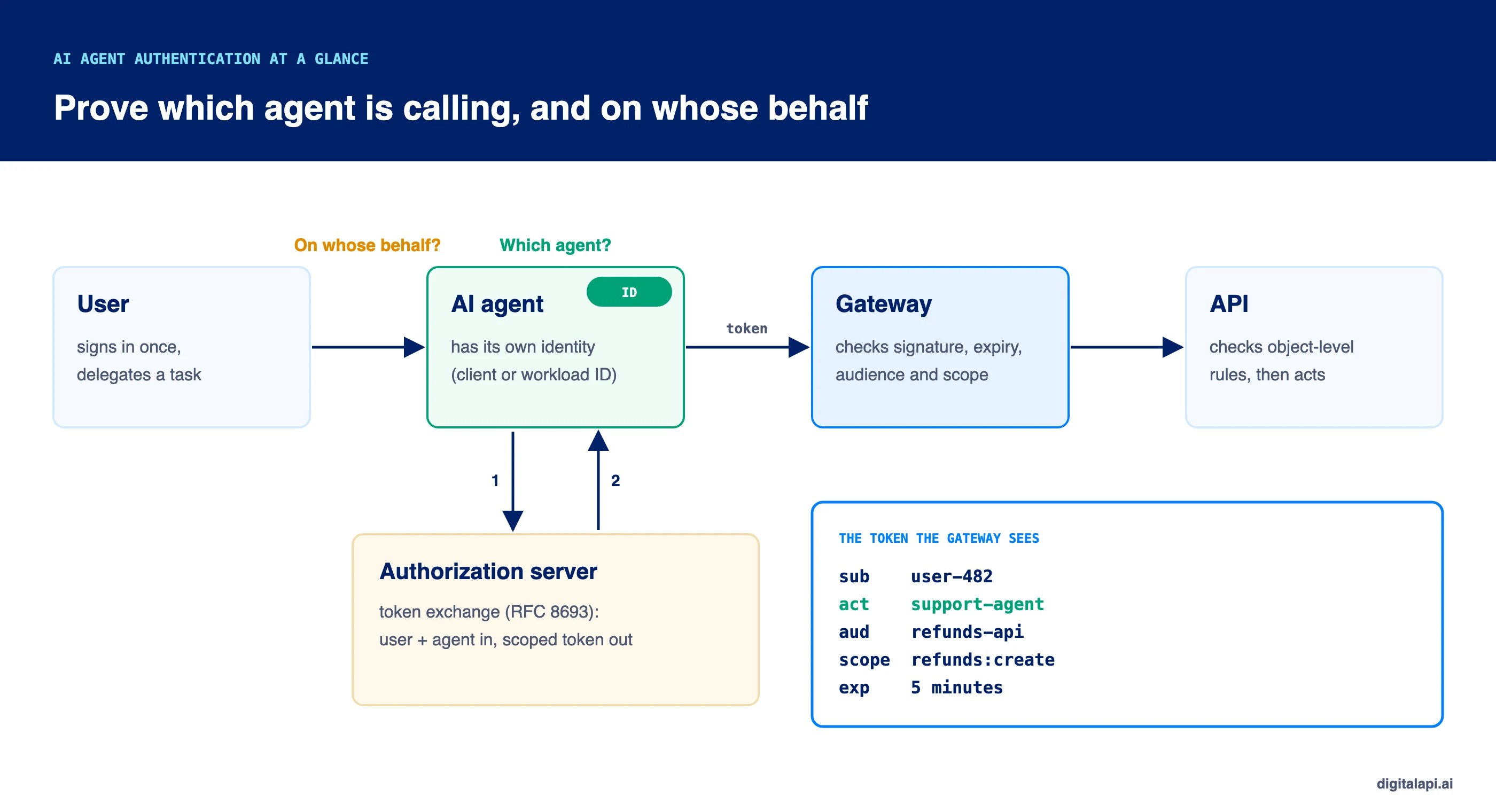
Agents should get their own identity, short-lived tokens from OAuth 2.1 flows, token exchange (RFC 8693) for delegated access, workload identity or mTLS for service-level trust, and narrow scopes on every call.
A support agent built on your company's LLM stack needs to read a customer's orders, open a refund ticket and post a note to Slack. The quickest way to ship it is to paste a service account key into its config. It works. Six weeks later the same key sits in three other agents, nobody can tell which one issued a bulk export at 2 a.m., and revoking it breaks everything.
That's the problem AI agent authentication solves. Agents aren't users who log in once and click buttons, and they aren't ordinary backend services with a fixed job. They act on behalf of people, chain tools together and run unattended. Each call needs a clear answer to two questions: which agent is this, and whose authority is it using?
This guide explains agent identity, compares the authentication methods that fit agents, walks through delegated access and the MCP authorization flow, and shortlists the tools teams use to run it.
What is AI agent authentication?
AI agent authentication is the process of verifying an AI agent's identity, and the identity of any user it acts for, before it reaches an API, tool or data source. Authentication answers "who is calling?" AI agent authorization then answers "what may it do?"
Agents reuse the building blocks of other machine clients: OAuth tokens, certificates and workload identity. What changes is how you combine them, because an agent often carries two identities at once (itself and the user) and hands off to other agents or MCP servers.
Why do AI agents break traditional authentication?
Traditional authentication assumes a human at a login screen or a service with a fixed, predictable job. Agents are neither. Three properties cause most of the trouble.
- No human at the login step. An agent running a nightly job can't tap an MFA push, so teams fall back to static API keys that are long-lived and hard to trace.
- Delegation. With its own broad service account, an agent can reach data the user can't. With the user's session, every action looks like the user's own. Neither is auditable.
- Long-running, chained tasks. An agent may run for hours and call other agents and MCP tools. Each hop needs its own token, not one broad token passed down the chain.
The scale is real. CyberArk's 2025 Identity Security Landscape report found 82 machine identities for every human in surveyed organizations, and that 42% of machine identities have privileged or sensitive access. AI agents add to that count quickly.
OWASP names the risk directly. The OWASP Top 10 for LLM Applications (2025) lists LLM06:2025 Excessive Agency, caused by excessive functionality, excessive permissions and excessive autonomy. Its mitigations include running actions in the user's context with minimal OAuth scopes and enforcing authorization in downstream systems, not in the model. The OWASP Top 10 for Agentic Applications 2026, released in December 2025, includes "Identity and Privilege Abuse" as one of its risks.
What is agent identity, and how is it different from user and non-human identity?
An agent identity is a dedicated, registered identity for one AI agent, with an owner, a purpose and its own credentials. It's a kind of non human identity, but agents need features that classic service accounts don't have: delegation from users, short lifetimes and per-task scopes.
Microsoft's Entra Agent ID documentation makes the same split: agent identities are separate from service principals because an agent "might exist for minutes" or be created thousands of times a day.
A good AI agent identity record holds a unique ID (never shared), a named human owner, the agent's purpose and allowed APIs, its credential type and rotation policy, and a lifecycle state so retired agents lose access at once.
How do AI agents authenticate? The main methods compared
AI agents authenticate with the same machine-to-machine methods as other software, chosen by who the agent acts for and where it runs. Here is how the five common methods compare.
API keys
API keys are the simplest option and the weakest one for agents. A key carries no user, no default expiry and no proof of which agent used it. Keep keys for prototypes; otherwise issue one per agent, scope it tightly and rotate it often.
OAuth 2.1 client credentials
The client credentials grant is the default for machine to machine authentication, and it fits agents that act on their own authority. The agent authenticates to the authorization server and receives a short-lived access token with specific scopes. For the full flow, see our guide to the client credentials flow.
OAuth 2.1 is still an IETF Internet-Draft, not an RFC. The latest version at the time of writing is draft-ietf-oauth-v2-1-17 (October 2026). It consolidates OAuth 2.0 with later security guidance: PKCE is required for the authorization code flow, the implicit grant and the resource owner password grant are removed, and redirect URIs need exact matching. If OAuth basics are fuzzy, start with our OAuth 2.0 explainer.
Prefer asymmetric client authentication, such as a signed JWT assertion (private_key_jwt), over a shared client secret, so there's no reusable secret to leak.
Token exchange (RFC 8693)
Token exchange lets an agent trade a token it holds for a new token aimed at a specific API, with the user and the agent both recorded. RFC 8693, OAuth 2.0 Token Exchange (January 2020, IETF Standards Track), defines it.
The request uses grant_type=urn:ietf:params:oauth:grant-type:token-exchange, a subject_token (the party being acted for, usually the user) and an optional actor_token (the party doing the acting, here the agent). RFC 8693 separates two semantics:
- Impersonation: the new token treats the agent as the user. Simple, but the audit trail loses the agent.
- Delegation: the agent keeps its own identity and acts for the user. The issued token carries an
act(actor) claim naming the agent. Nestedactclaims record earlier actors in a chain.
For agents, prefer delegation. The authorization server can also check a may_act claim in the user's token to decide whether this agent is allowed to act for this user at all.
The resulting access token might carry claims like these:
The orders API now sees that user 4711 is the subject, the support copilot is the actor, and the token is only good for reading orders.
Workload identity with SPIFFE and SPIRE
Workload identity proves which running software is calling, based on where and how it runs, so the agent never holds a static secret. SPIFFE is a set of open standards for identifying software workloads. Each workload gets a SPIFFE ID, a URI such as spiffe://acme.com/agents/support-copilot, and a short-lived identity document called an SVID, either an X.509-SVID (for TLS) or a JWT-SVID (for tokens).
SPIRE, the reference implementation, runs a server that signs identities and an agent on each node. It first attests the node (for example with a cloud instance identity document), then attests each workload by inspecting properties such as its Kubernetes namespace and service account, and only then hands out an SVID through the local Workload API. SPIRE is a CNCF graduated project (graduated August 2022). Cloud platforms offer similar built-in workload identities.
Workload identity tells you which agent deployment is calling. It doesn't say which user the agent is acting for, so pair it with token exchange for delegated calls.
Mutual TLS (mTLS)
mTLS authenticates both ends of a connection with certificates, and can bind tokens to the client that requested them. RFC 8705 defines mTLS client authentication for OAuth and certificate-bound access tokens, so a stolen token is useless without the matching private key. DPoP (RFC 9449) gives a similar proof-of-possession binding at the application layer.
mTLS proves the channel, not delegation or per-task scope, so use it under OAuth tokens, not instead of them.
How does delegated access work when an agent acts on behalf of a user?
The user grants the agent limited rights, and the agent gets a token that names both the user and the agent, for one API and a narrow scope. The agent never sees the user's password or session.
There are three common patterns:
- Authorization code flow with PKCE. The user signs in once and consents to specific scopes for the agent. The agent gets a token tied to that user. This is how MCP clients connect to remote MCP servers.
- Token exchange. A backend agent swaps the user's token for a downstream token with the
actclaim, as shown above. Good for multi-hop chains, because each hop gets a fresh, audience-restricted token. - Asynchronous approval. For high-impact actions taken while the user is away, the agent asks for approval out of band. OpenID Connect CIBA (Client-Initiated Backchannel Authentication) sends a push or message to the user's device, and the agent receives a token only after the user approves.
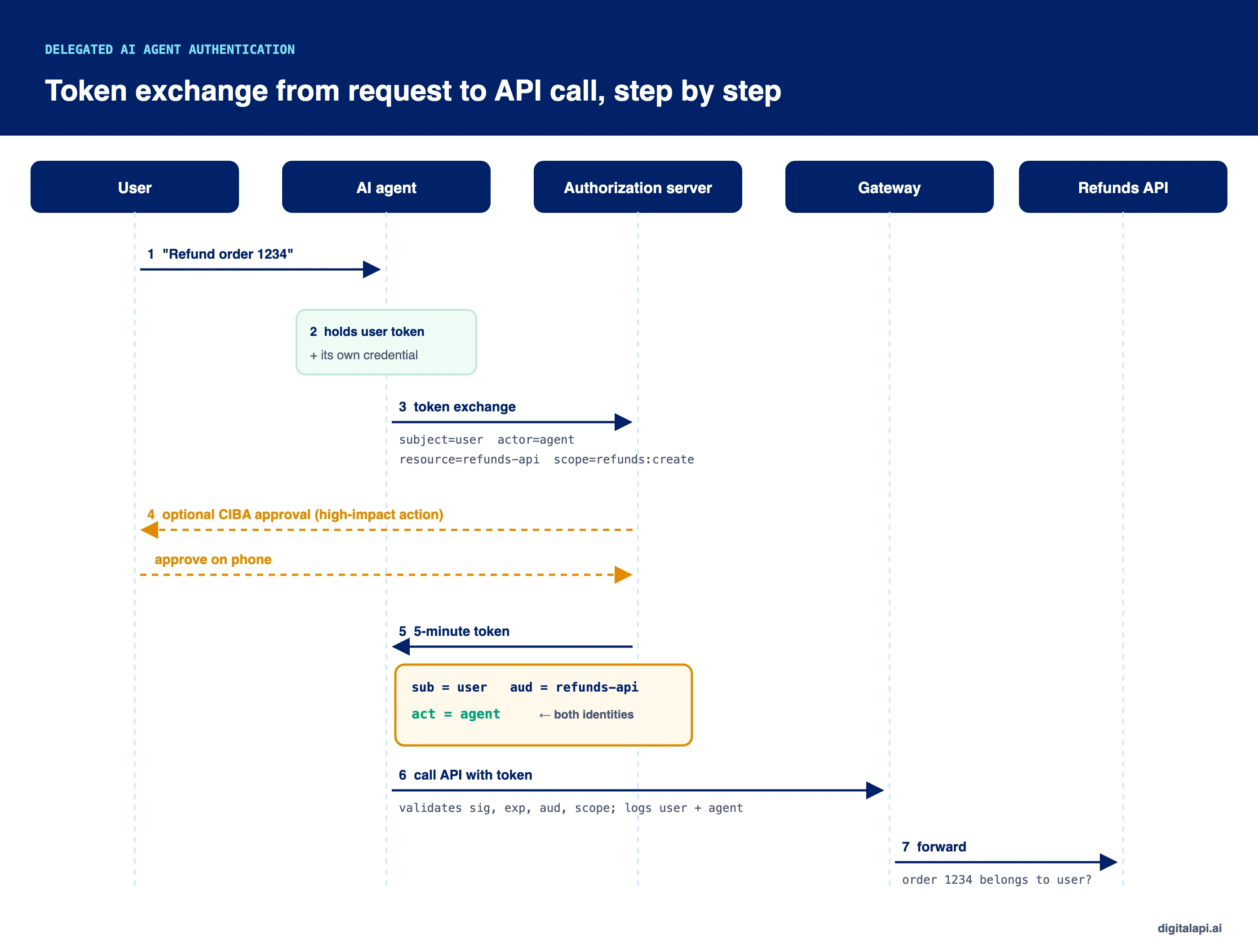
Here's the delegated flow as a short sequence, from user request to API call:
- The user asks the agent: "refund order 1234."
- The agent holds the user's token from an earlier sign-in, plus its own credential (client assertion or workload SVID).
- The agent calls the authorization server's token endpoint with a token exchange request: subject = user, actor = agent, resource = refunds API, scope =
refunds:create. - The authorization server checks policy: is this agent allowed to act for this user, for this API and scope? If the action is high impact, it triggers CIBA approval on the user's phone.
- The authorization server returns a five-minute token with
sub= user,act= agent,aud= refunds API. - The agent calls the refunds API through the gateway. The gateway validates signature, expiry, audience and scope, then logs both identities.
- The refunds API checks object-level rules (does order 1234 belong to this user?) and processes the refund.
How does MCP authorization work?
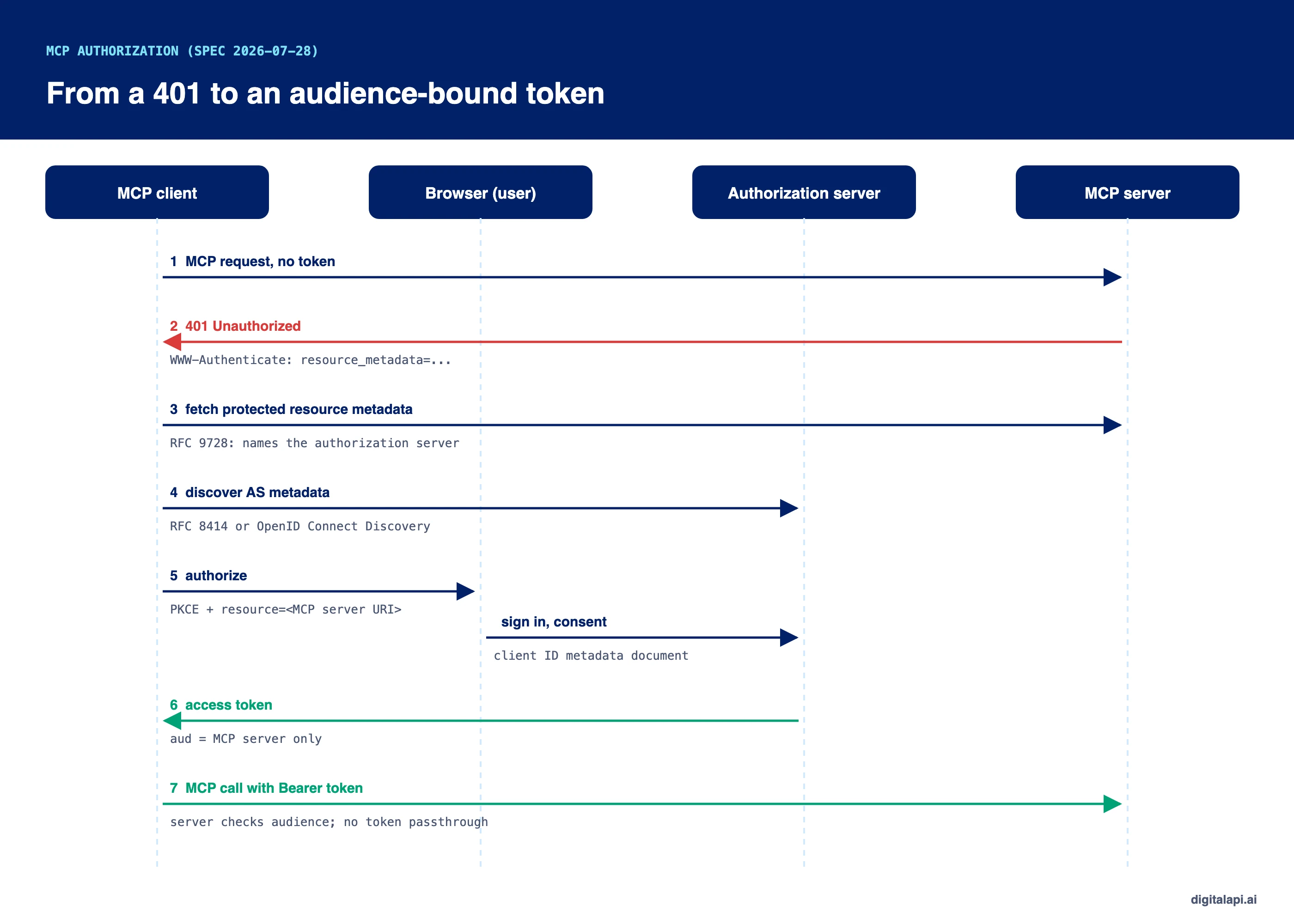
The MCP authorization spec uses OAuth 2.1: the MCP server is a resource server, the MCP client is an OAuth client, and a separate authorization server issues tokens bound to that MCP server. The details below follow the MCP authorization specification, version 2026-07-28.
Key points from the spec:
- Authorization is optional, and HTTP-only. Implementations using HTTP transport should follow the spec. stdio servers should not, and instead take credentials from the environment.
- Discovery starts with a 401. The MCP server returns
401 Unauthorizedwith aWWW-Authenticateheader that points to its Protected Resource Metadata (RFC 9728). MCP servers must implement RFC 9728. - The client finds the authorization server from that metadata, then reads its metadata through OAuth Authorization Server Metadata (RFC 8414) or OpenID Connect Discovery.
- Client registration uses Client ID Metadata Documents (recommended), pre-registration, or Dynamic Client Registration (RFC 7591), which the 2026-07-28 spec marks as deprecated and kept for backwards compatibility.
- PKCE and resource indicators. Clients must use PKCE and must send the
resourceparameter (RFC 8707) naming the MCP server's canonical URI in both the authorization and token requests. - Audience validation and no passthrough. MCP servers must check that tokens were issued for them, and "MUST NOT accept or transit any other tokens." An MCP server that calls an upstream API needs its own token for that API, not the client's.
- Scope challenges. If a token lacks scope, the server should return
403witherror="insufficient_scope"and the scopes needed, and the client can step up.
The spec also lists optional authorization extensions, including OAuth Client Credentials (for agents with no user present) and Enterprise-Managed Authorization (for organizations that control access through their own identity provider).
For setting up per-tool permissions on an MCP server, see our guide on managing AI agent permissions with MCP authorization. For endpoint hardening, see securing MCP endpoints.
What happens after authentication? AI agent authorization and least privilege
Authentication says who the agent is. AI agent authorization limits each call to what this agent, for this user, needs for this task. Most real incidents come from valid credentials with too much access, not from failed logins.
Apply these controls on top of authentication:
- Scopes per agent and per tool:
orders:read, notapi:all. Start minimal and step up when needed. - Audience-bound, short-lived tokens: one API per token, valid for minutes.
- Policy at the edge: a gateway checks identity, scope, rate and context before the call reaches the API. See authentication vs authorization.
- Object-level checks in the service: only the API knows whether order 1234 belongs to user 4711.
- Human approval for payments, deletes and bulk exports.
- Audit both identities (agent and user) on every decision.
For the wider threat model, see our guide to MCP security.
What are the best AI agent authentication tools?
The best AI agent authentication tools fall into three groups: identity providers that add agent identity and delegation, workload identity platforms that remove static secrets, and gateways that enforce identity and scope on every agent call. Most teams combine one from each group. The shortlist below is described from each vendor's own documentation as of November 2026. Pricing is tiered or quote-based for most of them, so check each vendor's pricing page.
How to choose:
- Your agents act for end users in SaaS apps: start with an identity provider that offers a token vault and async approval.
- Your agents run as backend services: remove static keys first with workload identity, then add client credentials or token exchange.
- You expose APIs to agents through MCP: you need an authorization server that follows the MCP spec and a gateway that enforces audience, scope and policy on every tool call. If your APIs aren't MCP-ready yet, MCP Studio converts existing APIs into MCP servers without code.
See how DigitalAPI authenticates and scopes every agent call at the edge → Book a Demo
AI agent authentication implementation checklist
Roll out AI agent authentication in this order: inventory, identity, credentials, delegation, authorization, then monitoring. Each step reduces risk on its own.
- Inventory agents and credentials. List each agent, its owner, the APIs it reaches and the secrets it holds. Flag shared and long-lived keys.
- Give each agent its own identity with a named owner. No shared service accounts.
- Replace static secrets with workload identity or signed client assertions.
- Issue short-lived, audience-bound tokens using the
resourceparameter. Bind them with mTLS or DPoP for sensitive APIs. - Use delegation, not impersonation, for user actions: token exchange with the
actclaim, or authorization code with PKCE. - Scope per agent and per tool, starting minimal with step-up.
- Enforce at the edge and fail closed: errors return
401or403, never allow. - Require human approval for high-impact actions, using CIBA or similar.
- Log agent and user on every call with token ID, scope and decision.
- Retire agents fully by revoking credentials and registrations.
For connecting agents to private systems end to end, see how to connect AI agents to internal APIs.
Key takeaways
- AI agent authentication must answer two questions on every call: which agent is this, and whose authority is it using?
- Give every agent its own identity with an owner and lifecycle. Shared service accounts and static keys are the most common failure.
- Use the right method for the job: client credentials for autonomous agents, token exchange (RFC 8693) for delegated access, workload identity and mTLS to remove static secrets.
- The MCP authorization spec is built on OAuth 2.1 and requires PKCE, resource indicators, audience validation and no token passthrough.
- Authentication isn't enough. Narrow scopes, short lifetimes, edge enforcement and human approval are what contain excessive agency.
Frequently asked questions
1. How do AI agents authenticate?
AI agents authenticate with machine-to-machine methods rather than passwords. An agent acting for itself typically uses the OAuth client credentials grant with a signed client assertion or workload identity. An agent acting for a user uses the authorization code flow with PKCE, or token exchange (RFC 8693), so the token names both the user and the agent. mTLS can bind those tokens to the agent.
2. What is agent identity?
Agent identity is a dedicated, registered identity for a single AI agent, with a named owner, a defined purpose, its own credentials and a lifecycle. It lets systems tell which agent made a request, separate from the user it acts for, and revoke or scope that agent without affecting others. It's a specialized kind of non-human identity.
3. Can AI agents use OAuth?
Yes. OAuth is the main standard for AI agent authentication. Agents use the client credentials grant for their own access, the authorization code flow with PKCE when a user consents, and token exchange for delegated, multi-hop calls. The MCP authorization specification is built on OAuth 2.1, which is still an IETF Internet-Draft as of November 2026.
4. What is the difference between agent identity and non-human identity?
Non-human identity covers every machine identity, including service accounts, API keys, certificates and workload identities. Agent identity is a subset designed for AI agents. Agents often act on behalf of users, change behavior per task and may exist for minutes, so agent identities add delegation, short-lived credentials, per-task scopes and named human sponsors that classic service accounts lack.
5. What is the difference between AI agent authentication and authorization?
Authentication verifies who is calling: which agent, and which user if it's acting on someone's behalf. Authorization decides what that caller may do: which APIs, tools, scopes and records. Both run on every request. A valid, authenticated agent with broad permissions is the main risk OWASP describes as excessive agency.
6. Is OAuth 2.1 a finished standard?
No. As of November 2026, OAuth 2.1 is an IETF Internet-Draft (draft-ietf-oauth-v2-1-17, October 2026), not an RFC. It consolidates OAuth 2.0 and its security best practices: PKCE is required, and the implicit and password grants are removed. Most authorization servers already support these behaviors, and the MCP authorization spec references the draft.
7. What is token exchange in OAuth?
Token exchange, defined in RFC 8693, lets a client swap one token for another aimed at a different API or audience. For AI agents, the agent sends the user's token as the subject token and its own as the actor token. The new token records the agent in an act claim, which keeps delegated actions traceable.
8. Should AI agents use API keys?
Only for prototypes or low-risk, read-only APIs. API keys are long-lived, easy to copy, carry no user context and don't show which agent used them. If you must use them, issue one key per agent, scope it tightly and rotate it often. For production agents, prefer short-lived OAuth tokens and workload identity.
9. What are the best AI agent authentication tools?
Common choices include Auth0 for AI Agents, Microsoft Entra Agent ID, Okta for AI Agents, Amazon Bedrock AgentCore Identity, WorkOS AuthKit, Scalekit, Aembit and the open-source SPIFFE/SPIRE. Pair an identity provider or workload identity platform with a gateway, such as DigitalAPI MCP Gateway, that enforces identity, scope and policy on every agent and MCP call.
10. Does MCP require authentication?
Authorization is optional in the MCP specification. When an MCP server uses HTTP transport and requires authorization, it should follow the MCP authorization spec, which uses OAuth 2.1 with PKCE, Protected Resource Metadata (RFC 9728) and resource indicators (RFC 8707). Local stdio servers should take credentials from the environment instead.
Conclusion
AI agent authentication isn't a new protocol. It's a stricter way of using the ones you have: OAuth 2.1 flows, token exchange, workload identity and mTLS, applied so every call shows which agent is acting, for whom, against which API, with which scope. The pieces are standard. What most teams lack is the discipline to give every agent its own identity and to stop passing broad, long-lived credentials around.
Start with an inventory. Every shared key you find is an agent you can't trace or revoke. Replace those keys with short-lived, audience-bound tokens, use delegation for user actions, and enforce scope at the edge before agent traffic reaches your APIs.
Authenticate and scope every agent call at the edge, using the keys and policies you already run. See DigitalAPI MCP Gateway
Prefer a walkthrough? Book a Demo
Dhayalan Subramanian is Associate Director, Product Growth at DigitalAPI, where he leads go-to-market and product growth for the company’s multi-gateway API management platform. His work focuses on helping large enterprises and mid-market cloud companies consolidate APIs across AWS, Azure, Apigee, Kong, MuleSoft, and other gateways into a single control plane for governance, discovery, monetization, and agent consumption.
Dhayalan brings 14+ years of experience across product strategy, enterprise architecture, and engineering leadership. Earlier in his career, he held senior roles at Encora (as Associate Architect and Technical Manager), Mindtree (Technology Lead), Tech Mahindra (Technical Lead), and Primus Analytics, where he designed integration frameworks and delivered enterprise-grade digital platforms for global customers.
At DigitalAPI, he works directly with platform, integration, and developer experience leaders at Fortune 500 organizations to operationalize unified API catalogs, developer portals, and MCP-ready APIs. He writes regularly on API developer experience, API governance, and AI agent architectures.
One email a fortnight. Worth opening.
A short digest of what we're writing, what we're learning from customers, and the handful of links you'd actually want from us. No tracking pixels.