



MCP Security: Top Risks and Best Practices (2026)
In this blog, we’ll discuss the key security threats, policies, and industry practices you need to implement to make your MCP deployments resilient and compliant.

As APIs evolve to serve not just humans but AI agents, the security perimeter needs to shift from static firewalls to dynamic context. That’s where the Model Context Protocol (MCP) enters, enabling AI agents to call APIs autonomously, with context-aware access. But with great power comes significant risk.
Exposing enterprise APIs to autonomous agents without rigorous security controls can lead to privilege escalation, data leakage, or malicious orchestration at scale. Securing MCP isn’t just about authentication; it’s about defining what context is valid, who can invoke it, and how to govern it in real-time.
In this blog, we’ll discuss the key security threats, policies, and industry practices you need to implement to make your MCP deployments resilient and compliant.
What is MCP (Model Context Protocol)?
The Model Context Protocol (MCP) is a machine-readable standard that allows AI agents to understand how to safely interact with enterprise APIs. Instead of hardcoding API calls, MCP provides metadata, like available endpoints, authentication flows, usage policies, and sample calls in a structured format that LLMs can interpret. Think of it as a context layer that bridges the gap between AI reasoning and API execution.
By adopting MCP, enterprises can make their APIs discoverable, testable, and executable by autonomous agents without compromising control. It’s not just about simplifying API consumption; it’s about enforcing guardrails, exposing only what’s necessary, and enabling trusted execution through context-driven governance. MCP is foundational for enterprises preparing for the AI agent era.
Why does MCP security matter for enterprises?
As enterprises adopt MCP to enable AI agents, they also expose a new layer of API access, one that’s dynamic, contextual, and autonomous. Without strong security foundations, this flexibility can easily turn into a vulnerability. Here's why MCP security is critical:
- Autonomous execution raises the stakes: Unlike traditional API consumers, AI agents can act without human oversight. If context validation fails or access is misconfigured, agents might execute unintended actions, like placing orders, triggering workflows, or exposing sensitive data.
- Context can be faked or manipulated: MCP relies on “context” to determine what an agent is allowed to do. But if that context isn’t properly validated or signed, bad actors could craft fake context to bypass access rules or escalate privileges.
- Sensitive APIs become exposed by design: MCP is designed to make APIs discoverable to agents. This means internal or sensitive endpoints, if not tightly controlled could inadvertently become part of the exposed surface area, increasing breach risks.
- LLM misuse and prompt injection risks: Since agents are LLM-driven, they can be influenced by malicious inputs. If security guardrails aren’t enforced through MCP, prompt injections or jailbreaking could lead to API misuse via seemingly valid instructions.
- Governance gaps can lead to compliance failures: MCP-driven access needs policy enforcement who can call what, under which conditions, and why. Without proper auditing and logging mechanisms, organisations risk violating internal controls or industry regulations.
- Scale amplifies impact: Once MCP is in place, any misconfigured access pattern or exposed API isn’t just one mistake it’s a system-wide risk that every AI agent across the organisation might replicate instantly, leading to massive unintended consequences.
Common security threats in MCP environments
MCP environments are designed to make APIs agent-ready, discoverable, testable, and executable. But this very openness can expose organisations to new classes of threats. Unlike traditional API access, MCP introduces risks tied to dynamic context, LLM behaviour, and autonomous orchestration. Below are the most critical threats to watch out for:
1. Prompt injection leading to malicious API calls
LLMs powering AI agents can be tricked by adversarial prompts. A recent study found that prompt injection attacks had a success rate as high as 64.8% for some state-of-the-art models, dropping only to 27.8% even with enhanced ethical prompt engineering defences. Without proper input validation, a malicious actor could manipulate the agent into executing API calls it shouldn’t, including data deletion, financial transfers, or privilege escalation.
2. Context spoofing or forged context payloads
MCP relies heavily on structured context metadata to decide what an agent is authorised to do. Attackers may craft forged contexts to gain access to endpoints or invoke actions beyond their intended scope.
3. Overexposed API metadata via MCP files
If MCP files include too many internal endpoints or lack proper access segmentation, agents (or attackers) may discover sensitive APIs that were never meant to be publicly visible or agent-accessible. In fact, 84% of security professionals reported experiencing an API security incident in the past 12 months.
4. Broken authentication or token reuse
68% of organizations experienced API security breaches in 2024, often due to broken authentication, including poor token validation and session handling. MCP-integrated systems must manage secure auth flows for agents. Weak token validation or poor session handling can result in token reuse, stolen credentials, or unauthorised API access.
5. Inadequate rate limiting on agent traffic
Agents can execute high-frequency actions rapidly. Without robust rate limiting and throttling, APIs are vulnerable to abuse, cost spikes, or even unintentional denial-of-service from overactive agents.
6. Lack of signature verification for context
Unsigned or unverifiable MCP payloads are a major risk. If an attacker tampers with the context without any digital signature check in place, agents might act on falsified instructions.
7. Absence of audit trails for agent actions
When agents execute across APIs, tracing what happened, when, and why becomes complex. Without proper logging tied to agent identity and context, breaches can go undetected and compliance fails. In fact, 70% of businesses report challenges in managing API logs, further indicating a widespread gap in auditability for API-driven systems.
OWASP MCP Top 10 (2025-2026): the framework every MCP policy should map to
OWASP published the first official MCP security framework in 2025 (beta refined through 2026). It's the canonical taxonomy referenced across the spec, vendor guidance, and the NSA's May 2026 MCP security CSI. Every internal policy should map to a Top 10 risk.
| ID | Risk | What It Is |
|---|---|---|
| MCP01 | Token Mismanagement & Secret Exposure | Hard-coded credentials, long-lived tokens, secrets stored in model memory or logs. |
| MCP02 | Prompt Injection (Including Tool Poisoning) | Hidden instructions embedded inside tool descriptions, responses, or returned resources. |
| MCP03 | Insecure Tool & Resource Definitions | Tools with unbounded inputs, missing schemas, weak validation, or vague descriptions. |
| MCP04 | Software Supply Chain & Dependency Tampering | Compromised MCP server packages, third-party dependencies, registries, or distribution channels. |
| MCP05 | Command Injection & Code Execution | Untrusted input flowing into shell commands or code evaluation paths. Roughly 43% of recent MCP-related CVEs fall into this category. |
| MCP06 | Sensitive Data Disclosure | Tool responses returning more information than required, causing PII or confidential data leakage into the model context. |
| MCP07 | Insufficient Authentication & Authorization | Static API keys, missing scope validation, weak identity propagation, or absent per-user authorization checks. |
| MCP08 | Insecure Communication & Transport | Plain HTTP traffic, missing TLS protection, insecure Server-Sent Events (SSE) channels, or weak transport security. |
| MCP09 | Shadow MCP Servers & Unverified Registries | Agents discovering and connecting to rogue MCP servers through untrusted registries or unmanaged discovery mechanisms. |
| MCP10 | Insufficient Observability & Audit | No structured audit trail for tool invocations, making incidents difficult or impossible to investigate and reconstruct. |
Infrastructure-layer governance vs application-layer governance
A pattern split has emerged across 2026 MCP deployments. The choice between them is the single biggest predictor of whether your security program scales.
| Aspect | Application-Layer (in each server) | Infrastructure-Layer (at the gateway) |
|---|---|---|
| Auth Implementation | Per server, hand-coded authentication logic | Centralized authentication integrated with enterprise identity providers |
| Policy Consistency | Policies drift across teams and implementations | Uniform policy enforcement across the entire MCP estate |
| Audit Format | Server-dependent logging and event structures | Standardized audit schema across all MCP traffic |
| PII Redaction | Each server implements its own filtering approach | One centrally managed redaction policy applied everywhere |
| Scope Enforcement | Depends on individual server implementation | OAuth 2.1 and per-tool scopes enforced before requests reach the server |
| Onboarding a New Server | Requires reviewing and validating a new codebase | Apply existing gateway policies and governance bundles |
| Outage Blast Radius | Limited to the affected server | Gateway-managed architecture with high-availability controls |
| Audit Posture | Inconsistent controls and difficult compliance certification | Single control plane with centralized governance and certification readiness |
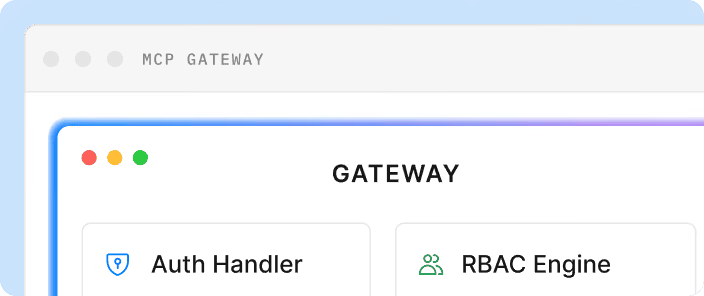
The 2026 consensus from Tetrate, Kong, Lunar.dev, Portkey, MintMCP, Microsoft, and the MCP project's own roadmap: governance belongs at the infrastructure layer. Every tool call passes through a managed gateway that enforces auth, policy, redaction, and audit consistently, so your server authors can focus on business logic instead of reinventing security.
This is the architectural decision that determines whether your MCP program can pass a SOC 2 audit on the first try.
10 MCP security best practices
MCP changes how APIs are consumed, moving from static integrations to dynamic, agent-driven interactions. That shift demands a new class of security policies focused on context validation, agent intent, and endpoint exposure. Here are the foundational policies every enterprise must implement:
- Define context boundaries explicitly: Not every piece of information should be part of the agent’s context. Enterprises must define a strict schema outlining what context fields are accepted, such as role, user ID, region, and permitted actions, and enforce rejection of any malformed or excessive payloads. This prevents overreach and ambiguity in agent permissions.
- Sign and verify all context payloads: Every MCP payload should be signed using enterprise-grade cryptographic methods before it's handed to an agent. Upon receipt, API gateways or AI gateways must validate the signature before honouring the request. This ensures the context hasn’t been tampered with mid-flight or generated by an untrusted source.
- Restrict the API surface exposed via MCP: Exposing your entire API library through MCP is risky. Enterprises should only include agent-relevant endpoints in MCP manifests, preferably scoped per use case or application. Use role-based tokens to govern what agents can “see,” ensuring that only explicitly permitted APIs are discoverable.
- Enforce role and intent-based access control: Basic RBAC isn’t enough when agents are operating autonomously. Policies should account for both the role of the agent and the declared intent in the context. For example, “retrieving a balance” vs “initiating a transfer.” These controls add semantic understanding to API access decisions.
- Throttle agent-specific traffic: AI agents can execute at a scale and speed that far exceeds human use. Without adaptive rate limits, even well-meaning agents can flood APIs with redundant calls. Policies must throttle based on context identity, endpoint sensitivity, and intent, with stricter thresholds for high-risk actions.
- Enable end-to-end audit logging: Every agent interaction must be logged with traceable metadata, including the original context, action taken, timestamp, agent identity, and response. These logs are critical for investigating breaches, enforcing accountability, and meeting compliance requirements across industries.
- Isolate test and production agent environments: Agents used in development, QA, or sandbox environments should never be allowed to call production APIs. Use separate MCP registries and credential sets for test and prod environments, ensuring that no test context accidentally leaks into live systems.
Checklist to follow for MCP security
Securing MCP isn’t just about one-off configurations; it’s about continuous, layered defence. From developer workflows to runtime validation, every stage of the agent-to-API interaction needs safeguards. Use this checklist to reinforce your MCP security posture.
- Treat context as a first-class security artifact: Validate, sanitize, and monitor every context payload the same way you would a user credential or auth token.
- Use short-lived, purpose-bound credentials: Avoid long-term API keys. Instead, generate time-bound, task-specific tokens scoped to the agent’s declared intent.
- Separate human and agent access paths: Don’t mix UI-based and agent-based access flows. Maintain dedicated endpoints and auth policies for agent interactions.
- Scan MCP files for sensitive leakage: Before publishing MCP metadata, scan it for hardcoded credentials, test endpoints, or internal system references.
- Automate policy enforcement in CI/CD: Make sure context validation rules, signature checks, and access scopes are tested and enforced during deployment.
- Regularly rotate keys and context secrets: Set up automated key rotation and invalidate stale context secrets across all environments, especially for high-risk APIs.
- Simulate agent behaviour in staging: Test how different agents interpret and act on your MCP files. This helps catch ambiguous context or dangerous defaults early.
Industry trends in MCP security and governance
As more enterprises adopt MCP to enable AI-driven automation, the security landscape around it is rapidly evolving. From AI gateways to fine-grained access policies, new patterns are emerging to balance openness with control. Here are key trends shaping the future of MCP security and governance:
1. Shift from role-based to intent-aware access control
Enterprises are moving beyond traditional RBAC models and introducing policies that evaluate the agent’s purpose, not just identity. This ensures context-specific authorisation that aligns with real-world agent behaviours.
2. AI gateways enforcing runtime context validation
New gateway layers are emerging that sit between agents and APIs, not just routing calls, but validating context in real time. These AI gateways verify signatures, enforce policy, and inject audit metadata on the fly.
3. Automated agent attestation and trust scoring
To differentiate between trusted enterprise agents and third-party or rogue agents, companies are introducing agent attestation, where agents sign requests with identity proofs and build a reputation over time.
4. Integration of MCP with zero-trust architectures
MCP security is being embedded into broader zero-trust frameworks. Rather than assuming trust within a network, enterprises are validating every agent-API interaction, even for internal systems.
5. Secure metadata generation through CI/CD pipelines
DevSecOps teams are now treating MCP context and metadata as code, automating validations, signature checks, and access rules as part of build pipelines. This reduces manual errors and keeps security policies consistent across environments.
Compliance for regulated industries: the 2026 regulatory landscape
Three regulatory drivers make 2026 the year MCP security stops being optional:
- EU AI Act high-risk system provisions take effect August 2026. Any AI agent acting on behalf of users in healthcare, finance, employment, or public services qualifies. Mandatory requirements include risk management, technical documentation, record-keeping (audit trails), transparency, and human oversight. MCP without structured audit logs cannot satisfy this.
- US states introduced 1,561 AI-related bills across 45 states in 2026. California's AI Transparency Act, Colorado's Algorithmic Discrimination Act, New York's bias auditing rules, and similar legislation produce a per-state patchwork. Most require auditable decision logs and per-user attribution.
- SOC 2, HIPAA, and ISO 27001 all require, in modern interpretations, that every tool invocation by every agent is logged with timestamps, user identity, parameters, and execution results. MCP makes this concrete; it also requires you to implement it.
Sector-specific 2026 signals:
- Healthcare: FDB's MedProof MCP launched March 31, 2026 as the first MCP server purpose-built for AI-agent-driven medication decisions. HIPAA still applies, with audit, encryption, and minimum-necessary requirements expressed through the MCP control plane.
- Financial services: Comply launched the first agentic compliance MCP server in 2026, enabling teams to build custom AI agents without developers. SOC 2 audits now treat MCP traffic as in-scope wherever it touches customer data.
- Insurance: real-time policy quoting via MCP requires data classification and DLP at the gateway to keep PII out of model contexts.
A compliance-ready MCP deployment ships with:
- Standardized audit logs in your SIEM, with retention matching the regulatory window.
- Per-user identity propagation (OAuth 2.1 OBO flow).
- Sensitive-data classification and redaction at the gateway.
- A registry of approved servers with documented purpose, owner, and risk classification.
- A documented incident-response runbook for MCP-specific events.
- A residency strategy (where data sits, where calls execute, where logs land).
If any of those rely on tribal knowledge instead of platform controls, the next audit will find it.
How does DigitalAPI secure MCP for enterprises?
At Digital API, MCP security is built into the fabric of the platform, not treated as an afterthought. Every MCP file generated through the system is signed with tamper-proof keys and scoped to its intended agent, environment, and use case. This ensures that only verified AI agents can access the right APIs with the right context.
Access to MCP manifests is tightly governed through token-based discovery, mutual TLS, and role + intent-based access control. Agent identity, purpose, and rate limits are enforced at the gateway layer, ensuring runtime validation of every call triggered via MCP.
DigitalAPI.ai also separates dev and prod environments, enabling safe experimentation without risking data exposure. All agent activity is logged with full traceability, and enterprises can plug in their compliance, audit, or security analytics tools. Combined with native CI/CD integrations and alerting, the platform offers a secure, governed MCP adoption at enterprise scale.
FAQs
1. What are the essential MCP security policies?
Seven core policies: explicit context boundaries with schema validation, cryptographic signing and verification of context payloads, a restricted API surface exposed via MCP, role and intent-based access control, agent-specific rate limits, end-to-end structured audit logs, and isolated dev/prod environments. Map each to the OWASP MCP Top 10 to identify gaps.
2. What is the OWASP MCP Top 10?
The first official security framework dedicated to the Model Context Protocol, published by OWASP in 2025 and refined through 2026. It enumerates ten risk categories (MCP01-MCP10) from token mismanagement to insufficient observability. Every modern MCP security program is structured around it.
3. Why does MCP security matter for enterprises?
MCP exposes existing APIs to autonomous agents that act on behalf of users. The same controls that protected developer-facing APIs (auth, rate limit, audit) need to be extended to agent traffic, with new controls layered on for LLM-specific risks (tool poisoning, indirect prompt injection, shadow servers). Without those layers, every MCP server becomes an attack surface for both classic API risks and AI-specific ones.
4. Should MCP security live in the application layer or the infrastructure layer?
Infrastructure layer. Putting auth, policy, redaction, and audit in each server's code drifts inconsistent across teams and is impossible to audit consistently. Routing every MCP call through a managed gateway gives you one control plane to certify and operate.
5. What does an MCP compliance audit look like?
For SOC 2, HIPAA, or ISO 27001 in 2026: structured per-call audit logs in your SIEM, per-user identity attribution via OAuth 2.1 OBO, documented onboarding and offboarding processes for MCP servers, encryption in transit and at rest, sensitive-data classification with gateway-level redaction, and a defined incident-response runbook. The EU AI Act high-risk provisions (effective August 2026) add risk management, technical documentation, and human-oversight requirements on top.
6. How do I prevent prompt injection in MCP?
Treat tool descriptions and tool responses as untrusted input. Scan descriptions on install and on every update for hidden instructions. Apply content filters and prompt-injection-detection rules to returned resource content at the gateway. Require explicit user confirmation for write actions triggered by content the model just read. Use OAuth scopes to limit what a compromised tool can actually do.
7. What is the difference between RBAC and intent-aware access control in MCP?
RBAC grants access based on the role assigned to an agent. Intent-aware access control evaluates the agent's declared purpose on each call (e.g. "summarizing for the user" vs "writing to production") and can deny calls that conflict with the stated intent even when the role allows them. The 2026 pattern combines both: RBAC for the floor, intent-aware policy for the runtime check.
8. Does the MCP spec require OAuth 2.1?
Yes for HTTP transports. The MCP specification mandates OAuth 2.1 with PKCE for any MCP server exposed over HTTP, replacing static API keys and basic OAuth 2.0. Local stdio servers inherit the host's process boundary and don't require transport-level auth.
9. What is shadow MCP and how do I prevent it?
Shadow MCP refers to MCP servers installed without governance, usually on individual workstations, that connect to production data sources without security review. The defenses are a managed registry of approved servers, allowlisting at the agent runtime or network layer, endpoint controls preventing unsanctioned processes, and an onboarding workflow requiring security sign-off for any new server.
10. How does DigitalAPI map to the OWASP MCP Top 10?
OAuth 2.1 brokering covers MCP01 and MCP07. Tool description scanning covers MCP02. Schema validation covers MCP03 and MCP05. The signed registry and version pinning cover MCP04 and MCP09. Gateway-level redaction covers MCP06. TLS termination covers MCP08. Standardized audit export covers MCP10. Every Top 10 risk has a platform-level home rather than being delegated to per-server code.
.png)
One email a fortnight. Worth opening.
A short digest of what we're writing, what we're learning from customers, and the handful of links you'd actually want from us. No tracking pixels.

.avif)