











API Access Governance: Policies, Approvals, and Audit
Most API attacks now come through authenticated access, yet few teams govern who gets that access. This guide explains API access governance: access policies written as code, approvals with separation of duties, clear ownership, access reviews, tamper-evident audit logs and the metrics that show it's working, with tested code.

TL;DR:
What is API access governance?
API access governance is the set of rules, roles and records that decide who can access which APIs, who approves it, and how you prove it later.
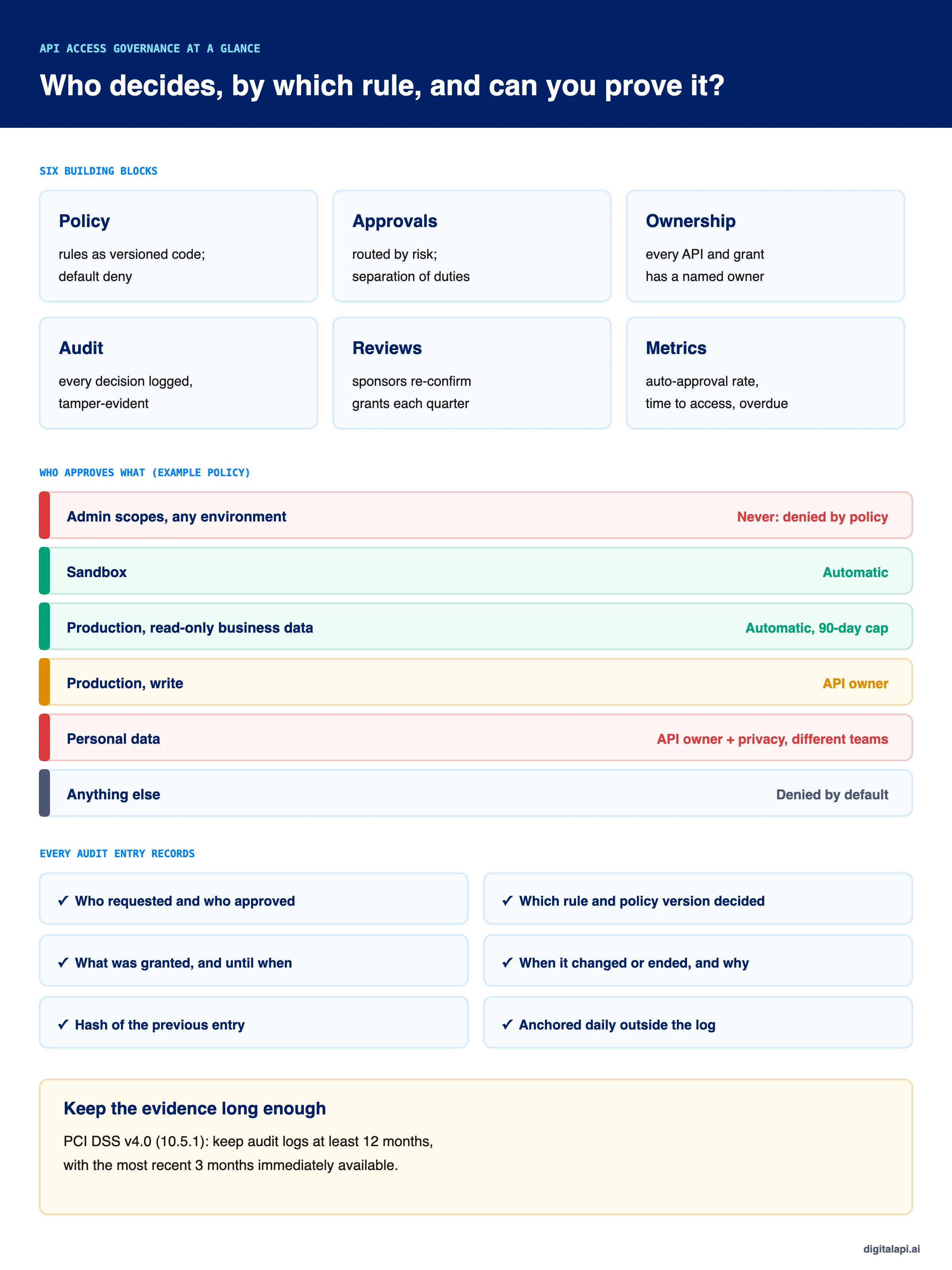
It covers access policies written as versioned code with default deny, approvals routed by risk with separation of duties, a named owner for every API and grant, periodic access reviews, and a tamper-evident audit log of every decision.
In Salt Security's State of API Security report (2025), 95% of API attacks came from authenticated sources. The attacker had valid access. Only 10% of the organisations surveyed had an API posture governance strategy.
Authentication answers "who is this?" It doesn't answer "should they have this access at all, who agreed, and is that still true?" That's the job of API access governance. This guide covers the policies, approvals, ownership, reviews and audit trail it needs, how to change policies without breaking partners, and the metrics that show it's working, with code we tested.
What is API access governance?
API access governance is the control layer above API access control: it decides who may be granted access, under which rules, with whose approval, and keeps evidence of every decision. Access control enforces decisions on each request; governance makes sure those decisions were right in the first place and stay right.
It sits next to two things it's often confused with:
- API governance in the broad sense covers design standards, versioning and publishing. Access governance is one part of it, focused on consumers rather than API design.
- API access control is the enforcement: keys, tokens, scopes and gateway checks. Governance decides what access control should enforce.
The difference matters when something goes wrong. Access control can show that a request was allowed. Only access governance can show why that access existed, who agreed to it and whether anyone checked it since.
What should API access policies cover?
API access policies should define, for every combination of environment, data sensitivity and action, whether access is automatic, needs approval from named roles, or is never allowed, with a maximum duration and a default of deny. Write them as versioned code, not prose in a wiki.
A useful access control policy for APIs answers five questions for each rule:
- When does it apply? Environment, scope risk (read, write, admin), data class (business, personal, payment) and consumer type (internal, partner, AI agent).
- What's the decision? Automatic, approval needed, or deny.
- Who must approve? Named roles, not named people, so the rule survives staff changes.
- For how long? A maximum grant duration.
- What happens if no rule matches? Deny. Gaps in the policy should fail closed.
Order matters. In our policy, the personal-data rule sits above the production-read rule, so read access to personal data still needs two approvers.
Why write API access policies as code?
Policy as code makes access rules reviewable, testable and versioned, so every decision can be traced to the exact rule that made it. A wiki page can't do that, and two people reading it often apply it differently.
- Review: policy changes go through pull requests, like any other change.
- Test: you can check rules against sample requests before they go live.
- Trace: every decision records the rule ID and policy version that made it.
- Dry-run: you can see what a new rule would do to existing grants before rollout.
Policy engines such as Open Policy Agent, which graduated in the Cloud Native Computing Foundation in February 2021, make this practical at scale. A small team can start with policy as structured data, as in our code below.
How should API access approvals work?
Route each request to the approvers its policy names, enforce separation of duties between requester and approvers, and keep the human queue small by automating low-risk decisions. Approvals are where governance meets real people, so the rules have to be simple and enforced by the system.
Separation of duties for API access comes down to four rules:
- The requester never approves their own request.
- One person can't fill two required roles, even if they hold both.
- Approvers must hold the role they sign for. A privacy approval from someone outside privacy doesn't count.
- For high-risk access, approvers come from a different team than the requester, so a team can't approve its own access to sensitive data.
Plan for urgent cases, too. A break-glass path lets an on-call engineer get time-limited access in an incident, with automatic expiry within hours and a mandatory review afterwards. It's better than people sharing credentials because the normal path is too slow.
For approvals on API changes rather than access, see governing risky API changes with role-based approvals.
Who owns API access decisions?
Every API needs a named owner who sets its access rules, and every grant needs a named sponsor who answers for it; platform, security and privacy teams set the guardrails around them. Access without an owner is access nobody will review or revoke.
The table is a RACI in practice: owners and sponsors are accountable, platform is responsible for the machinery, security and privacy are consulted on risky access, and consumers are informed of changes.
How do you run API access reviews?
Run an access review on a fixed schedule, at least quarterly: each grant's sponsor keeps, reduces or revokes it, and anything not confirmed by the deadline is revoked automatically. Reviews are how governance catches access that was right once and isn't now.
Three things make reviews worth doing:
- Send them to the sponsor, not the holder. A partner can't vouch for its own access.
- Show usage next to each grant. Unused scopes are the easiest to remove.
- Treat silence as revoke. Carrying unreviewed grants forward defeats the purpose.
Our guide on how to grant API access walks through a full review with tested code, including the auto-revoke at the deadline.
What should an API access audit log record?
An API access audit log should record every request, policy decision, approval, issuance, change and revocation, with who, when, which rule and policy version, and why, in an append-only, tamper-evident store kept for at least a year. It's your evidence for auditors, incident responders and partners.
Audit logging best practices for access come down to three properties:
- Append-only and tamper-evident. Chain each entry to the previous one's hash, and anchor the latest hash somewhere else every day, such as write-once storage. Our test shows why the anchor matters.
- Complete. Log decisions, not only outcomes: a denied request is evidence too.
- Retained long enough. PCI DSS v4.0 requirement 10.5.1 asks for at least 12 months of audit log history, with the most recent three months immediately available. ISO/IEC 27001:2022 control 8.15 asks for logs to be produced, stored, protected and analysed.
For log management practice in general, NIST's SP 800-92 remains the reference; a revised draft, published for comment in 2023, reframes it as a log management planning guide.
How do you change API access policies safely?
Dry-run every policy change against the grants that are live today, see which would be denied, need new approvals or get shorter limits, and decide how to handle each before you roll it out. Policy changes that break partners overnight teach people to work around governance.
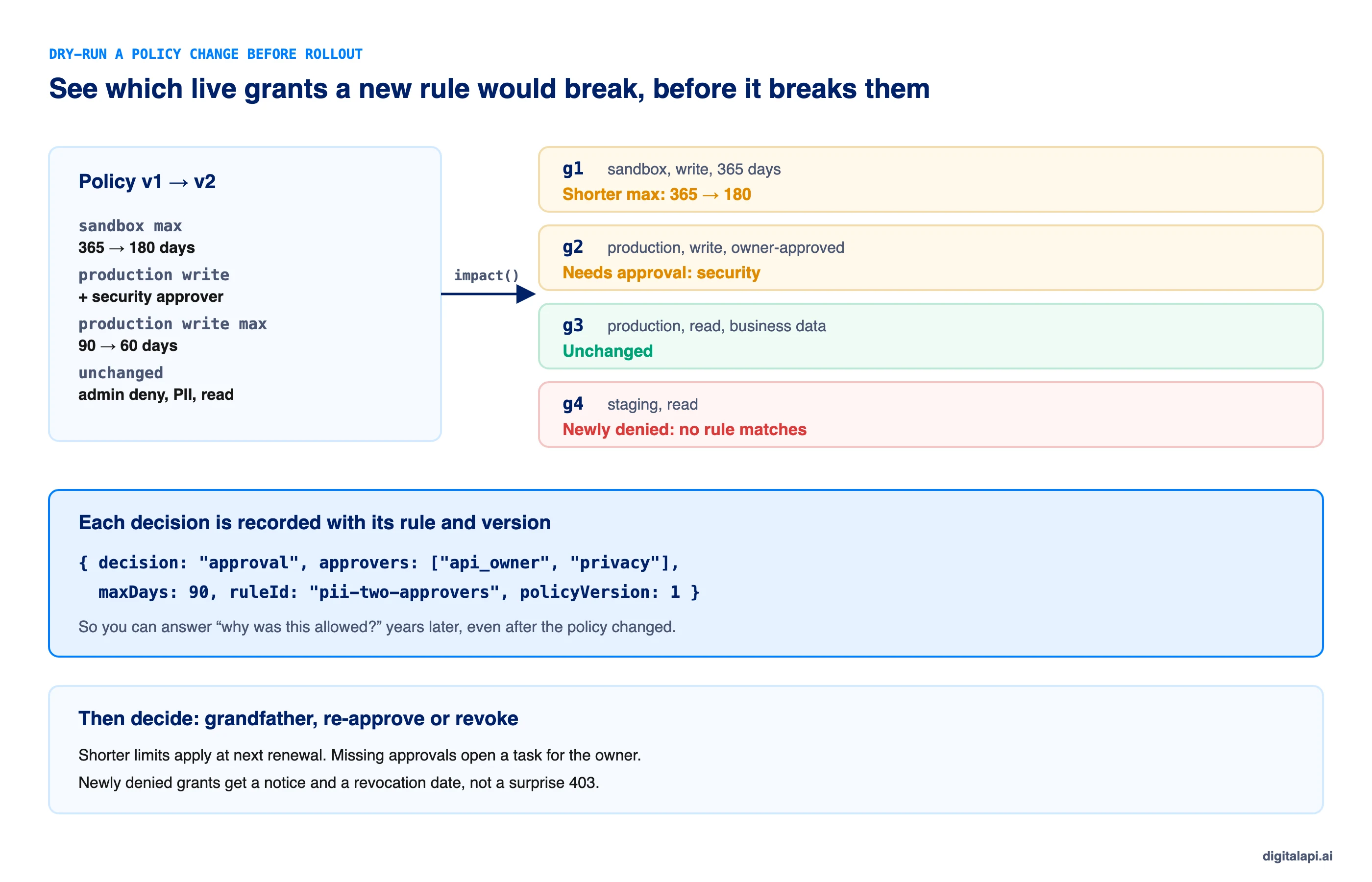
For each affected grant, choose one:
- Grandfather: keep it until its next renewal, then apply the new limit.
- Re-approve: open a task for the missing approver.
- Revoke on notice: give the consumer a date, not a surprise 403. See how to revoke API access.
What happened when we tested API access governance?
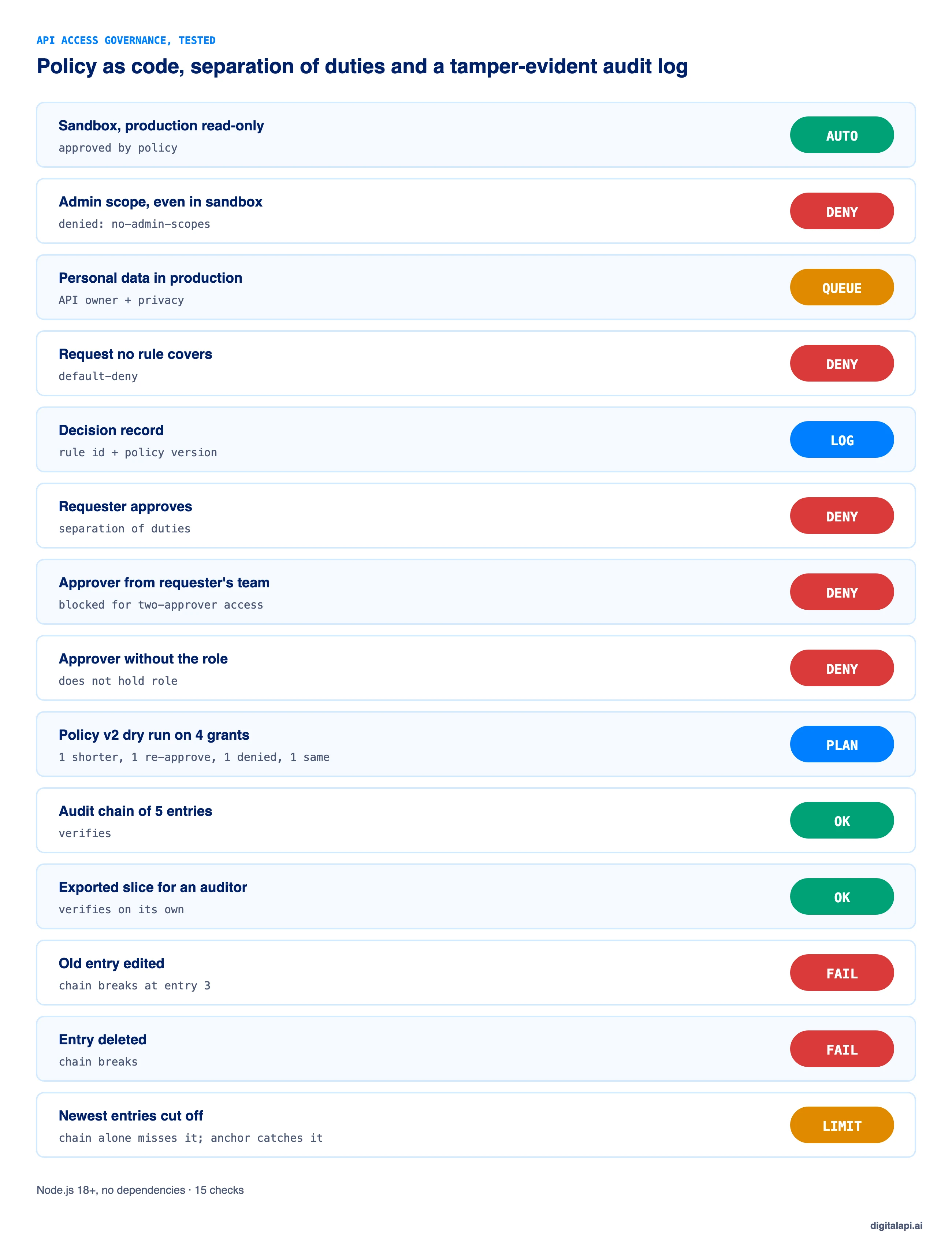
Our policy engine, separation-of-duties check and audit log passed 15 checks. The policy denied admin scopes and anything it didn't cover, routed personal data to two approvers, blocked same-team approvals, and a dry run showed exactly which live grants a policy change would hit. The tests also exposed a limit of hash chains.
The limit we found: a hash chain detects edits and deletions in the middle, but if someone cuts off the newest entries, what's left still verifies. Only comparing against a head hash stored somewhere else catches it. That's why we anchor the head daily, outside the log.
This is the code we tested:
How do you measure API access governance?
Measure API access governance with a handful of numbers that show speed and control together: how fast people get access, how much is automated, and how much access lacks an owner, expiry or review.
- Auto-approval rate: share of requests decided by policy. Higher means less queueing, if the policy is sound.
- Median time to access, for automatic and approved requests separately.
- Grants without an owner or sponsor: should be zero.
- Grants without an expiry: should be zero.
- Overdue reviews: grants past their review date.
- Exceptions and break-glass uses, and how many were reviewed afterwards.
- Attempts with revoked credentials: a signal of leaks or forgotten integrations.
- Policy coverage: share of APIs whose access rules are in the policy engine.
Inventory comes first. In Salt Security's 2025 report, only 15% of respondents were strongly confident their API inventory was accurate, and the OWASP API Security Top 10 lists improper inventory management (API9:2023) as a top risk. You can't govern access to APIs you don't know exist.
What are the best practices for API access governance?
Write access rules as versioned code with default deny, enforce separation of duties in the system, give every API and grant an owner, review on a schedule, and keep a tamper-evident audit trail. These ten practices cover most of it:
- Default deny. Anything the policy doesn't cover is refused.
- Policy as code, reviewed, tested and versioned.
- Record the rule and version with every decision.
- Route approvals by risk, and automate the low-risk ones.
- Enforce separation of duties in the workflow, not in a policy document.
- Name an owner for every API and a sponsor for every grant.
- Review grants at least quarterly, with auto-revoke for anything unconfirmed.
- Dry-run policy changes against live grants before rollout.
- Keep an append-only, hash-chained audit log, anchored daily and kept at least 12 months.
- Track governance metrics and share them with API owners. Apply least privilege throughout.
How should AI agents fit into API access governance?
Govern AI agents as a separate class of consumer with stricter defaults: their own credentials, named human owners and sponsors, narrower scopes, shorter durations, more frequent reviews and a rule that write or sensitive access always needs approval. Agents can be pointed at new tasks without anyone filing a request, so their access drifts faster than an app's.
Add a consumer-type condition to your policy so agent requests can never fall into an automatic rule meant for human-built apps. And log the agent and the human it acts for in every audit entry, so you can answer "who did this?" with more than a client ID.
How does DigitalAPI support API access governance?
Access governance works when policy, approvals and audit live in one place that every portal and gateway uses. When each gateway or team keeps its own rules, there's no single answer to "who has access, and why?"
Teams using the DigitalAPI API Developer Portal and API Marketplace route access requests through one set of policies and approvals, with an owner, sponsor and expiry on every grant. The DigitalAPI API Gateway layer applies those decisions across the gateways they already run and records every grant, change and revocation in one audit trail.
See how DigitalAPI governs API access across every gateway and team → Book a Demo
Key takeaways
- API access governance decides who should have access, who approved it and how you prove it; access control only enforces it.
- Write access policies as versioned code with default deny, and record the rule and version with every decision.
- Enforce separation of duties in the system: no self-approval, one role per person, no same-team approval for high-risk access.
- Give every API an owner and every grant a sponsor, and review grants at least quarterly with auto-revoke.
- Keep a hash-chained, anchored audit log for at least 12 months, and dry-run every policy change.
Frequently asked questions
1. What is API access governance?
API access governance is the set of policies, approval workflows, ownership, reviews and audit records that decide which consumers may access which APIs, make sure each grant is approved by the right people under a known rule, and provide evidence of every access decision from request to revocation.
2. What is the difference between API governance and API access governance?
API governance usually covers how APIs are designed, documented, versioned and published. API access governance is the part that covers who may use those APIs: access policies, approvals, ownership, access reviews and audit. A well-designed API can still be badly governed if anyone can get access to it without approval or review.
3. What is policy as code for API access?
Policy as code means writing API access rules as versioned, machine-readable code instead of a document. Each rule says when it applies, whether access is automatic, needs approval or is denied, who approves and for how long. Policies can then be reviewed, tested, dry-run against live grants and traced in every decision.
4. What is separation of duties in API access?
Separation of duties in API access means no single person can both request and approve access, one person can't fill two required approval roles, approvers must hold the role they sign for, and high-risk access is approved by someone outside the requester's team. The access system should enforce these rules automatically.
5. What should an API audit log include?
An API access audit log should include the event type, who acted and in which role, the exact time, the grant and consumer, the policy rule and version that decided, the scopes and expiry granted, and the reason. Each entry should carry the previous entry's hash so edits and deletions can be detected.
6. How long should API audit logs be kept?
Keep API access audit logs for at least 12 months, with the most recent three months immediately available, which matches PCI DSS v4.0 requirement 10.5.1. Some regulations and contracts require longer. Store them append-only, and anchor the latest hash outside the log so truncation can be detected.
7. How often should API access be reviewed?
Review API access at least quarterly, and more often for personal data, payment APIs and AI agents. Each grant's sponsor should keep, reduce or revoke it, and any grant not confirmed by the deadline should be revoked automatically. Revoke unused credentials between reviews, too.
8. Who should own API access decisions?
Each API's owner should set its access rules and approve write and sensitive access to it. Each grant should have a sponsor, usually its approver, who answers for it in reviews. Platform teams run the policy engine and audit log, while security and privacy set guardrails and approve high-risk access.
9. How do you change an API access policy without breaking partners?
Dry-run the new policy against every live grant to see which would be denied, need new approvals or get shorter limits. Then decide for each: keep it until renewal, ask the missing approver, or revoke it on notice with a date. Never apply a stricter policy to live grants without warning.
10. How do you govern AI agents' access to APIs?
Treat AI agents as their own consumer type in your access policy. Give each agent its own credentials, a human owner and sponsor, narrow scopes and short durations, require approval for any write or sensitive access, review agent grants more often, and record both the agent and the human it acts for in the audit log.
Conclusion
Most API attacks now arrive with valid credentials, so the question that matters isn't only "who is calling?" but "should they have this access, who agreed, and is that still true?" API access governance answers it with policies written as code, approvals that enforce separation of duties, owners and sponsors for every grant, regular reviews and an audit trail you can prove hasn't been altered.
Start with default deny and a short policy, record the rule behind every decision, make reviews automatic, and dry-run every change. For the steps that put access in place, read how to grant API access and API access provisioning; for the broader picture, see our guide to API governance.
How safely do you grant API access to partners and AI agents? Get your free readiness score: Check Your API Access Readiness
Prefer a walkthrough? Book a Demo
Dhayalan Subramanian is Associate Director, Product Growth at DigitalAPI, where he leads go-to-market and product growth for the company’s multi-gateway API management platform. His work focuses on helping large enterprises and mid-market cloud companies consolidate APIs across AWS, Azure, Apigee, Kong, MuleSoft, and other gateways into a single control plane for governance, discovery, monetization, and agent consumption.
Dhayalan brings 14+ years of experience across product strategy, enterprise architecture, and engineering leadership. Earlier in his career, he held senior roles at Encora (as Associate Architect and Technical Manager), Mindtree (Technology Lead), Tech Mahindra (Technical Lead), and Primus Analytics, where he designed integration frameworks and delivered enterprise-grade digital platforms for global customers.
At DigitalAPI, he works directly with platform, integration, and developer experience leaders at Fortune 500 organizations to operationalize unified API catalogs, developer portals, and MCP-ready APIs. He writes regularly on API developer experience, API governance, and AI agent architectures.
One email a fortnight. Worth opening.
A short digest of what we're writing, what we're learning from customers, and the handful of links you'd actually want from us. No tracking pixels.


