





MuleSoft vs Azure API Management (2026): Full Comparison
MuleSoft vs Azure API Management compared: architecture, features, hybrid support, AI, lock-in, pricing and migration, so you can pick the right one.

TL;DR: MuleSoft vs Azure API Management, which should you pick?
MuleSoft is an integration platform that also manages APIs. Azure API Management (APIM) is an API gateway and management service built for Azure.
Choose MuleSoft if you connect many systems, need heavy data transformation or run across several clouds and data centers. Choose Azure API Management if your APIs live on Azure and you want public, predictable pricing from about $150 a month.
The deciding factor is usually hybrid support. MuleSoft's gateway and runtimes run almost anywhere, and even its control plane can run on-premises. Azure's on-premises gateway needs the classic Premium tier, at about $3,045 a month in East US.
In July 2026, an Azure customer asked Microsoft a simple question. They wanted the easier networking of the APIM v2 tiers and an on-premises gateway for their own data centers. Microsoft couldn't offer both: the self-hosted gateway only runs on the Developer and classic Premium tiers. That gap sits at the heart of the MuleSoft vs Azure API Management decision. This guide covers every other difference too, so you can decide without reading anything else.
What is the difference between MuleSoft and Azure API Management?
MuleSoft connects systems; Azure API Management publishes and protects APIs. MuleSoft's Anypoint Platform is an integration platform (iPaaS, integration platform as a service) with API management built in. Azure API Management is an API gateway and management service that runs in Microsoft's cloud.
- MuleSoft Anypoint Platform is defined as an integration platform from Salesforce that designs, builds, runs and manages integrations, APIs and, since 2025, AI agents. Its core is the Mule runtime and DataWeave, its own language for transforming data.
- Azure API Management is defined as a Microsoft Azure service that puts a gateway in front of your APIs. It adds security, rate limits, policies, a developer portal and analytics, without changing your backend code.
Salesforce bought MuleSoft in March 2018 for an enterprise value of about $6.5 billion. Microsoft runs API Management as part of Azure.
Why isn't this an apples-to-apples comparison?
MuleSoft does more than Azure API Management alone. Microsoft's closer match to MuleSoft is Azure Integration Services (AIS): API Management plus Logic Apps (workflows), Functions (code), Service Bus (messaging), Event Grid (events) and Data Factory (data pipelines).
Microsoft says AIS serves over 65,000 customers in 60 Azure regions and manages 2 million+ APIs that handle 2 trillion+ requests a month. If you need to move and reshape data between systems, compare MuleSoft against all of AIS, not APIM by itself.
MuleSoft vs Azure API Management at a glance
How do their architectures compare?
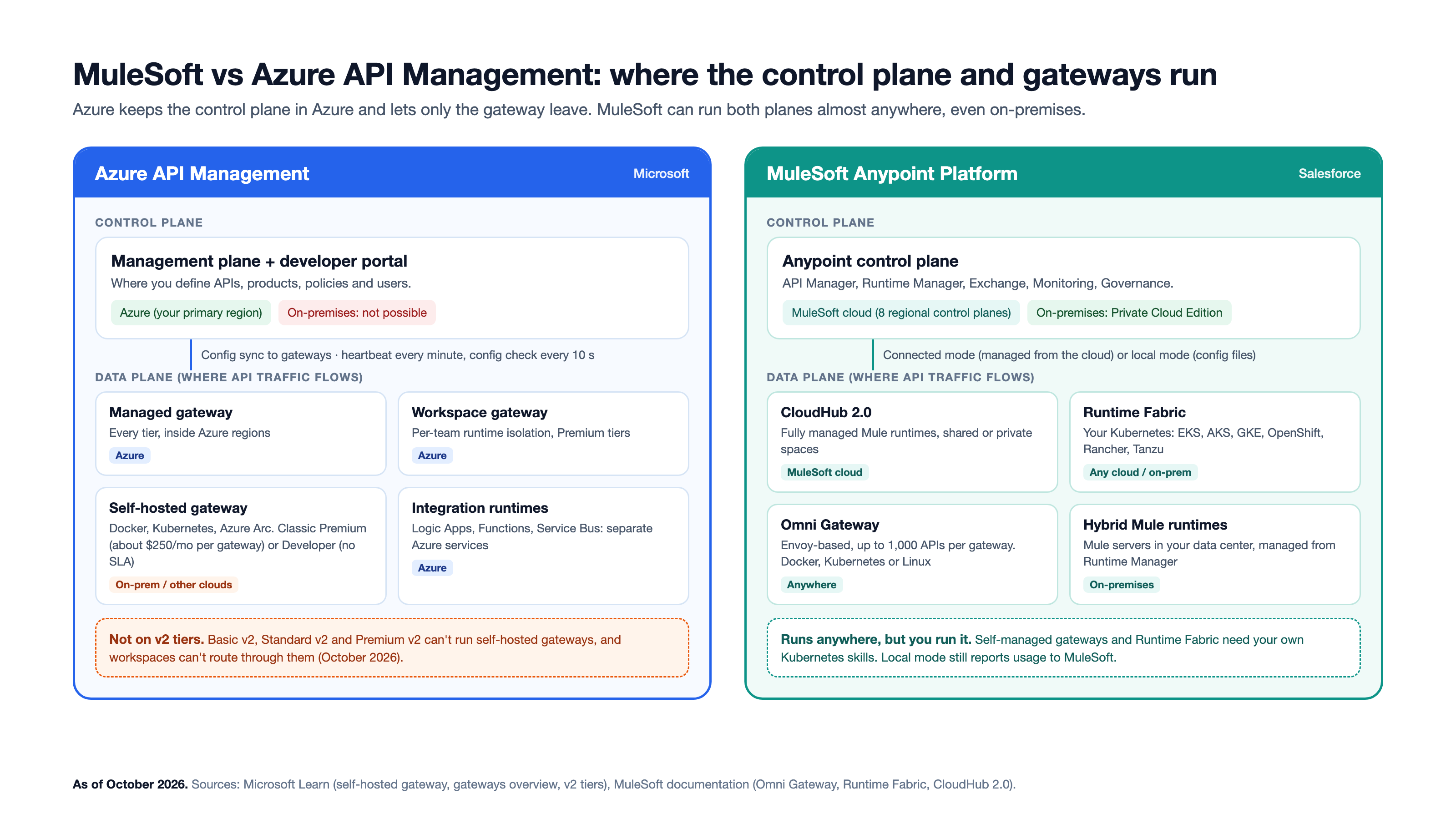
Both split into a control plane, where you configure things, and a data plane, where API traffic flows. The difference is where each part can live. MuleSoft lets you run both planes on your own infrastructure. Azure API Management keeps the control plane in Azure and only lets the gateway leave.
What are the parts of Azure API Management?
Azure API Management has three parts:
- API gateway (data plane): Receives API calls, applies policies and forwards them to backends.
- Management plane (control plane): Where you define APIs, products, policies and users, through the portal, APIs or infrastructure as code.
- Developer portal: A customizable, open-source website where developers find APIs, read docs and get keys.
Around this core, Microsoft adds:
- Workspaces, which act like folders so each team manages its own APIs under central governance. Available on Basic v2, Standard v2, Premium and Premium v2.
- Azure API Center, a separate service for design-time governance and a company-wide API inventory, including APIs from other vendors. Its Standard plan is free when linked to an APIM instance in Standard, Standard v2, Premium or Premium v2.
In multi-region setups, only the gateway copies to other regions. The management plane and developer portal stay in your primary region.
What are the parts of MuleSoft Anypoint Platform?
MuleSoft vs Azure API Management: how do the features compare?
Both products secure, limit and publish APIs well; they differ in what surrounds the gateway. MuleSoft adds integration, data transformation and portable runtimes. Azure API Management adds deep Azure ties, a public price list and a broad library of policies.
Which has better API policies?
MuleSoft and Azure cover the essentials: auth, rate limits, validation, CORS and caching. MuleSoft's Omni Gateway lists about 73 policies, including OpenID Connect enforcement, SQL and XSS injection protection, and OpenTelemetry tracing. Azure API Management ships 67 policies with fine-grained control through C# expressions. Our guide to all 67 Azure APIM policies explains each one.
The real difference is authoring. Azure policies are XML with embedded C#, which many developers find hard to read. MuleSoft policies are configured in API Manager, with less code.
Which is better at data transformation?
MuleSoft wins clearly. DataWeave reshapes JSON, XML, CSV and flat files inside one flow, and the current release is DataWeave 2.13 with Mule 4.13. In Azure, API Management can only do light changes in policies, such as JSON-to-XML. Anything heavier moves to Logic Apps or Azure Functions.
Which has the better developer experience?
MuleSoft gives you one integrated toolchain; Azure gives you familiar Azure tools.
- MuleSoft: design specs in Design Center or Code Builder, mock them, publish to Exchange, then build and deploy in the same platform.
- Azure: author policies in the portal or VS Code, and use Azure Copilot to create, explain and troubleshoot policies. Copilot can even translate policies from other API management products. APIOps adds Git-based deployment.
One catch on Azure: the VS Code extension lists only the classic tiers and Consumption, not v2, and doesn't work in workspaces.
How do monitoring and analytics compare?
- MuleSoft: Anypoint Monitoring covers apps, APIs and agents with dashboards and alerts. API Visualizer draws a live map of how your systems call each other.
- Azure: Azure Monitor metrics work on every tier. Request logs to Log Analytics work on every tier except Consumption. Microsoft is moving analytics to an Azure Monitor dashboard, and the legacy built-in analytics in classic tiers retires in March 2027.
How do they compare on security and compliance?
Both meet enterprise security needs; Azure leans on Microsoft's identity and security stack, while MuleSoft brings its own. Azure API Management integrates with Microsoft Entra ID, Defender for Cloud and Azure's WAF options. MuleSoft supports many identity providers and offers a separately licensed edge security layer.
What compliance certifications do they hold?
- MuleSoft: its Trust Center lists ISO 27001, SOC 1, SOC 2, PCI DSS, HIPAA and GDPR. MuleSoft Government Cloud holds an agency-sponsored provisional authority to operate at FedRAMP Moderate.
- Azure API Management: Microsoft lists it in scope for FedRAMP High and DoD IL2 in Azure public cloud. In Azure Government, it's in scope for FedRAMP High and DoD IL2, IL4, IL5 and IL6.
Where are the security gaps?
- Azure: Defender for APIs doesn't cover the self-hosted or Consumption gateways. Self-hosted gateways also lack credential manager and request logs to Azure Monitor.
- MuleSoft: The edge WAF layer needs a separate licence and only applies to Runtime Fabric.
Which is better for hybrid, on-premises and multi-cloud APIs?
MuleSoft is more flexible for hybrid and multi-cloud APIs. Its gateway and runtimes run on almost any Kubernetes cluster or Linux host, and its control plane can run on-premises. Azure API Management can run a gateway outside Azure, but only through the self-hosted gateway, limited to the Developer and classic Premium tiers.
What are your deployment options?
How do the off-cloud gateways compare?
What breaks in practice with Azure's hybrid setup?
- You pay Premium to go hybrid: A production self-hosted gateway needs the classic Premium tier, about $2,795 a month in East US, plus about $250 a month per gateway deployment.
- You can't mix v2 and on-premises: Teams that pick v2 for simpler networking lose the self-hosted option. The v2 tiers also lack multi-region deployment, backup and restore, and Git configuration, and there's no automated upgrade from classic to v2.
- Workspaces can't route through self-hosted gateways: You can't give one team its own workspace and run its traffic through your data center.
- Restarts need a backup: A disconnected gateway keeps running, but a stopped one can't restart unless you've enabled configuration backup to a persistent volume.
- Some features stay in the cloud: Self-hosted gateways lack TLS session resumption, credential manager, Defender for APIs and A2A support.
What breaks in practice with MuleSoft's hybrid setup?
- You run the infrastructure: Self-managed MuleSoft Omni Gateway and Runtime Fabric need your own Kubernetes skills and on-call cover.
- Nothing is fully air-gapped: Even local mode contacts MuleSoft's control plane to register and report usage. Only Private Cloud Edition moves the control plane in-house.
- Hybrid deployment needs the higher tier: In the 2024 packages, hybrid and on-premises deployment came with Integration Advanced, not Integration Starter.
How do performance, limits and SLAs compare?
Azure publishes more performance detail; MuleSoft publishes more about runtime sizing. Azure API Management lists throughput per unit for its classic tiers and a 99.95% to 99.99% SLA. MuleSoft's official SLA document promises 99.95% availability, but only for orders placed on or before 1 May 2025.
Azure API Management performance and SLA by tier
*99.99% needs units in two or more availability zones or regions. Microsoft notes its throughput figures come from tests with no policies and small payloads, and shouldn't be relied on.
MuleSoft runtime sizing and SLA
- CloudHub 2.0 replicas on current packages range from 0.05 to 4 vCores, with 1 GB to 15 GB of memory.". High availability across zones needs 2 or more replicas.
- Omni Gateway supports up to 1,000 backend APIs per gateway. MuleSoft recommends several gateways in parallel for high-traffic APIs.
- SLA: MuleSoft's cloud SLA promises 99.95% monthly availability with service credits, for production apps on 2 or more workers. It applies to orders placed on or before 1 May 2025. MuleSoft hasn't published the SLA for newer orders, so ask for it in your contract.
What limits should you know about?
Watch the v2 buffered payload limit. At 2 MiB, policies that read the request body, such as validation or transformation, can fail on larger payloads.
Which is better for AI agents and MCP?
Both moved fast in 2025 and 2026, and both now govern MCP and agent traffic. MuleSoft frames it as an agent platform, with Agent Fabric and a long list of MCP and agent policies. Azure frames it as an AI gateway, with strong LLM token controls and MCP servers built from your existing APIs.
What does each do best for AI?
- MuleSoft is stronger on agent governance: Agent Fabric registers agents and MCP servers in one place, and its MCP policies include attribute-based access control, PII detection and tool mapping.
- Azure is stronger on LLM cost control: Its token limits, semantic caching and per-consumer token metrics are mature. Our guide to Azure AI Gateway pricing and token limits covers them in depth.
Demand is real. MuleSoft's 2026 Connectivity Benchmark Report, a survey of 1,050 IT leaders, found organizations run 12 AI agents on average, and half of those agents work in silos. CloudHub 2.0 replicas range from 0.1 to 4 vCores, with 1.4It also found 39% of organizations support or plan to support MCP, and 40% A2A.
Which one locks you in more?
Both lock you in, in different ways. Azure API Management ties you to Microsoft's cloud: its control plane, identity and monitoring all live in Azure. MuleSoft ties you to its platform: DataWeave scripts, the Anypoint control plane and its consumption-based contracts.
- Azure lock-in is cloud lock-in. If your apps move to AWS or Google Cloud, APIM stays anchored in Azure. Even self-hosted gateways need an Azure control plane.
- MuleSoft lock-in is platform lock-in. You can move clouds freely, but every integration written in DataWeave stays tied to MuleSoft. Practitioners on Reddit also point to the cost of hiring scarce MuleSoft developers.
MuleSoft vs Azure API Management: how much does each cost?
Azure API Management publishes its prices; MuleSoft sells annual plans from $2,000 a month. A production Azure gateway costs about $150 to $2,800 a month on the v2 tiers in East US. MuleSoft's current Mule Credits plans start at $2,000 a month, billed yearly, and your usage draws down a shared pool of credits.
What does Azure API Management cost?
Prices below come from Azure's retail price list for East US, checked on 8 October 2026 (730 hours a month, one unit).
Extra Azure costs to budget for: additional units and regions, Azure Front Door or Application Gateway for a WAF, Defender for APIs, Log Analytics data, and Logic Apps or Functions for integration work.
What does MuleSoft cost?
MuleSoft's pricing has changed twice since 2024:
Under Mule Credits, these all draw from the same pool:
- MuleSoft flows and messages
- Managed assets (active APIs, agents, MCP servers or LLMs)
- Gateway requests
- Private spaces, network connections and load balancers
There are three ways to buy:
- Pre-Purchase
- Pre-Commit, with a minimum of $50,000 a year
- Unlimited, at a custom fixed price
MuleSoft says rates fall by up to 90% as usage grows. Credits don't roll over, and a 30-day free trial is available. Our MuleSoft pricing guide covers the flows-and-messages model in detail.
What does each cost in real scenarios?
Which is cheaper?
In the Azure API Management vs MuleSoft cost question, Azure usually wins for API management alone: it costs less and is easier to forecast. MuleSoft makes financial sense when you also use its integration engine.
One practitioner on Reddit described a December 2024 evaluation in which Azure Integration Services was almost free to start. Once the client needed more APIs under management and more scale, prices were not far apart, and the client chose MuleSoft for its clearer roadmap.
What do real users say about MuleSoft and Azure API Management?
Users rate both highly but complain about the same thing: a steep learning curve. On G2 in October 2026, MuleSoft Anypoint Platform scored 4.4 out of 5 from 893 reviews. Azure API Management scored 4.2 out of 5 from 32 reviews.
Practitioner threads add context:
- Cost drives moves to Azure: In a December 2024 r/MuleSoft thread, a developer described a client moving from MuleSoft to Azure Integration Services, mainly over cost.
- Skills matter: A commenter in the same thread said C# developers are easier to hire than MuleSoft specialists.
- The gap narrows at scale: Another commenter said AIS was cheap to start but close to MuleSoft once scale and API management were added.
Reddit comments are opinions, not data, but they match the G2 themes.
How do you migrate between MuleSoft and Azure API Management?
Migration is mostly a rebuild of policies, transformations and portals; API specs move with little effort. Both platforms import and export standard API specs. What doesn't move is the logic: MuleSoft policies and DataWeave, or Azure's XML policies.
How do you move from MuleSoft to Azure API Management?
- Inventory your assets: List APIs, policies, client apps and integrations from Exchange and API Manager.
- Convert RAML specs to OpenAPI: Azure API Management imports OpenAPI, WSDL, WADL and GraphQL, but not RAML. Note that OpenAPI 3.1 imports only partly.
- Rebuild policies in XML: Azure Copilot can translate policies from other API management products as a starting point.
- Rewrite DataWeave: Move transformations into Logic Apps, Functions or APIM policies.
- Recreate the developer portal: Move docs and onboarding into the APIM developer portal.
- Reissue credentials: Create APIM subscriptions or Entra ID app registrations for every consumer.
- Run both in parallel: Shift traffic gradually, then retire MuleSoft runtimes.
How do you move from Azure API Management to MuleSoft?
- Export OpenAPI specs from APIM and publish them to Exchange.
- Recreate policies in API Manager on Omni Gateway.
- Move logic from C# policy expressions, Logic Apps and Functions into Mule flows and DataWeave.
- Rebuild client access with client apps and your identity provider.
- Run both in parallel, then cut over.
How much effort does each part take?
MuleSoft vs Azure API Management: which should you choose?
Choose by where your systems live and how much integration you need. Azure API Management fits teams whose APIs run on Azure. MuleSoft fits teams that connect many systems across clouds and data centers.
The integration gap is real. MuleSoft's 2026 Connectivity Benchmark Report found the average organization runs 957 applications, and only 27% of them are integrated. If that describes you, the integration engine matters more than the gateway.
Choose MuleSoft if:
• You need to connect and transform data across many systems.
• Your APIs and runtimes span several clouds and data centers.
• Salesforce is central to your business, or you need the control plane on-premises.
Choose Azure API Management if:
• Your APIs and apps run mainly on Azure.
• You want public pricing, no annual minimum and a lower starting cost.
• Your integration needs fit Logic Apps and Functions.
What if you run MuleSoft and Azure API Management together?
Running both is common, and it splits your API estate in two. Each platform has its own catalog, policies, portal and analytics. Teams end up keeping two inventories and rewriting the same rules twice.
You're not alone in this. Postman's 2025 State of the API report found that 31% of organizations run more than one API gateway, and 11% run three or more. MuleSoft's own 2026 benchmark found 27% of APIs are still ungoverned.
The usual answer isn't to migrate one platform into the other. Instead, you add one layer above both. Our guide to managing multiple API gateways without migration covers the options.
Teams using DigitalAPI see their MuleSoft and Azure API Management APIs in one catalog, governed by one set of rules, without migrating either platform.
Want to see your MuleSoft and Azure APIs side by side? Get an assessment of your API landscape → Talk to our experts
FAQ
Is Azure API Management the same as MuleSoft?
No. Azure API Management is an API gateway and management service that runs in Microsoft Azure. MuleSoft Anypoint Platform is an integration platform that also manages APIs and AI agents. MuleSoft moves and transforms data between systems; Azure API Management secures and publishes APIs that already exist.
Can Azure API Management replace MuleSoft?
Azure API Management can replace MuleSoft's API gateway and portal, but not its integration engine. To replace MuleSoft's integrations, you also need Azure Logic Apps, Functions and Service Bus. Together, these form Azure Integration Services, Microsoft's closest equivalent to MuleSoft.
What is the Azure equivalent of MuleSoft?
The Azure equivalent of MuleSoft is Azure Integration Services. It combines Azure API Management for APIs, Logic Apps for workflows, Functions for code, Service Bus for messaging, Event Grid for events and Data Factory for data pipelines. Azure API Management alone covers only MuleSoft's API management features.
Is MuleSoft better than Azure APIM for hybrid deployments?
Yes, for most hybrid and multi-cloud setups. MuleSoft's Omni Gateway runs on Docker, Kubernetes or Linux in any cloud or data center, and Private Cloud Edition runs the control plane on-premises. Azure API Management's self-hosted gateway only works on the Developer and classic Premium tiers, and isn't available on the v2 tiers as of October 2026.
Can MuleSoft manage APIs running on Azure?
Yes. MuleSoft can manage APIs hosted on Azure through Omni Gateway, and it can run integrations on Azure Kubernetes Service (AKS) through Runtime Fabric. Many enterprises run MuleSoft for integration while their APIs and apps sit on Azure.
Azure API Management vs MuleSoft: which is cheaper?
Azure API Management is usually cheaper for API management alone. Its v2 tiers cost about $150 to $2,800 a month in East US, with no annual commitment. MuleSoft's Mule Credits plans start at $2,000 a month, billed yearly, so MuleSoft suits teams that also need its integration engine.
How much does MuleSoft cost in 2026?
As of October 2026, MuleSoft sells Mule Credits plans starting at $2,000 a month, billed annually. Credits pay for flows, messages, managed APIs and agents, gateway requests and private networking. Pre-Commit plans need at least $50,000 a year, and credits don't roll over.
Does Azure API Management support MCP and AI agents?
Yes. Azure API Management can turn a REST API into an MCP server, pass traffic through to an existing MCP server, and import A2A agent APIs. Its AI gateway adds LLM token limits, semantic caching and content safety. MCP isn't available on the Consumption tier or in workspaces.
Does MuleSoft support MCP and AI agents?
Yes. MuleSoft's Omni Gateway has supported MCP and A2A traffic since May 2025, with policies for access control, PII detection and token-based rate limits. Agent Fabric registers and governs agents and MCP servers, and since August 2026 it can cap token spend per agent.
What happened to MuleSoft Flex Gateway?
MuleSoft renamed Flex Gateway to Omni Gateway in version 1.13.0, released on 11 May 2026. The change is cosmetic: the CLI, APIs and environment variables stay the same. Omni Gateway is the same Envoy-based runtime, with added governance for AI agents and MCP traffic.
Can you use MuleSoft and Azure API Management together?
Yes. Many enterprises use MuleSoft for system integration and Azure API Management for Azure-native APIs. The trade-off is two catalogs, two policy sets and two developer portals. Teams usually add a shared catalog and governance layer above both rather than migrating one into the other.
Final word
- They solve different problems. MuleSoft integrates systems and governs agents; Azure API Management publishes and protects APIs on Azure.
- Hybrid is the real divider. MuleSoft runs anywhere, even its control plane; Azure needs the classic Premium tier to put a gateway outside Azure.
- Cost models differ sharply. Azure is public and pay-as-you-go; MuleSoft is annual credits from $2,000 a month.
- Lock-in comes either way. Azure ties you to its cloud; MuleSoft ties you to its platform.
If your APIs live on Azure, start with Azure API Management. If you connect many systems across clouds, MuleSoft earns its higher price. If you already run both, keep both and put one view on top.
Running MuleSoft and Azure API Management side by side? Get an assessment of your API landscape from DigitalAPI → Talk to our experts
Dhayalan Subramanian is Associate Director, Product Growth at DigitalAPI, where he leads go-to-market and product growth for the company’s multi-gateway API management platform. His work focuses on helping large enterprises and mid-market cloud companies consolidate APIs across AWS, Azure, Apigee, Kong, MuleSoft, and other gateways into a single control plane for governance, discovery, monetization, and agent consumption.
Dhayalan brings 14+ years of experience across product strategy, enterprise architecture, and engineering leadership. Earlier in his career, he held senior roles at Encora (as Associate Architect and Technical Manager), Mindtree (Technology Lead), Tech Mahindra (Technical Lead), and Primus Analytics, where he designed integration frameworks and delivered enterprise-grade digital platforms for global customers.
At DigitalAPI, he works directly with platform, integration, and developer experience leaders at Fortune 500 organizations to operationalize unified API catalogs, developer portals, and MCP-ready APIs. He writes regularly on API developer experience, API governance, and AI agent architectures.
One email a fortnight. Worth opening.
A short digest of what we're writing, what we're learning from customers, and the handful of links you'd actually want from us. No tracking pixels.

.avif)