



Best API7 Alternatives for API Gateway Management in 2026
API7 handles traffic routing and security at the gateway layer. This guide covers the 7 best API7 alternatives in 2026 including multi-gateway federation, self-serve developer portals, and MCP-ready API exposure for AI agents.

API7 routes and secures your API traffic. It do not give you a unified catalogue across gateways, a self-serve developer portal, nor MCP-ready API exposure for AI agents.
API7 handles the traffic layer well. What it do not handle: a partner asking for credentials, a developer duplicating an API that already exists somewhere else in your estate, nor an AI agent with no MCP surface to call. Those three problems are not gateway problems. They are the layer above the gateway..
The gateway did its job. The platform problems above it remain unsolved.
Platform engineers and API product managers evaluating API7 alternatives in 2026 are usually not dissatisfied with Apache APISIX's throughput. API7's performance on the data plane is strong. They are evaluating what sits above the gateway: unified visibility across a multi-gateway estate, self-serve developer onboarding, partner access management, subscription tiers, and MCP-ready exposure for AI agents. This guide covers the seven tools in the gateway category, what each one does well, its limitations, and which team it fits.
TL;DR
1. API7 handles traffic, routing, and security at the data plane. It stops at the gateway layer.
2. The seven alternatives in this guide: DigitalAPI, Kong, Tyk, Gravitee, Zuplo, Solo, and Apigee.
3. Kong: plugin-rich, battle-tested, broadest ecosystem.
4. Tyk: open-source gateway with developer portal and governance included.
5. Gravitee: event-native, REST and Kafka under one policy model.
6. Zuplo: edge-native, TypeScript-programmable, zero ops, native MCP.
7. Solo: gateway and service mesh unified in one Kubernetes control plane.
8. Apigee: full-lifecycle API management on Google Cloud.
Every gateway in one catalogue. Self-serve for developers and AI agents, out of the box.
See the platformWhy API Teams Are Moving Beyond API7 in 2026
API7's gateway performance is not the reason teams evaluate alternatives. Apache APISIX, the open-source core API7 builds on, delivers strong throughput benchmarks. The reason teams move beyond it is what sits above the gateway layer.
A gateway routes traffic and enforces policy. The API management problem continues above it. Which APIs exist across the estate? Who can access which API and from which portal? How does a partner get credentials without a support ticket? How does an internal team avoid building an API that already runs on a different gateway? How does an AI agent discover and call your APIs through MCP? Every one of those questions sits above the gateway layer, and none of the gateways on this list, including API7, answers them.
Teams moving beyond API7 in 2026 split into two groups. The first needs a different gateway runtime: more plugins, better Kubernetes integration, an included developer portal, managed infrastructure, nor event-native protocol support. This guide covers all of those. The second group has outgrown standalone gateway management entirely. They need a control plane that federates what they already run and adds the developer journey layer above it. DigitalAPI covers that second group.
API7 Alternatives at a Glance
(scroll to view full table)
| Tool | Gateway Runtime | Multi-Gateway Federation | Self-Serve Developer Portal | Monetisation | MCP Ready | Best For |
|---|---|---|---|---|---|---|
| DigitalAPI | Yes (Arelio) | Yes (Apigee, Kong, AWS, Azure, and more) | Yes | Yes | Yes | API teams that need documentation, self-service onboarding, and API management in one platform. |
| Kong | Yes | No | Limited | Limited | Partial | Teams needing a plugin-rich, cloud-native gateway with broad ecosystem support. |
| Tyk | Yes | No | Yes | Yes | Partial | Teams wanting an open-source gateway with built-in developer portal and governance. |
| Gravitee | Yes | No | Yes | Limited | Yes | Teams managing synchronous and asynchronous APIs with event-native architecture requirements. |
| Zuplo | Yes | No | Yes | Yes | Yes | Developer-first teams needing edge-native deployment with TypeScript programmability and zero operations. |
| Solo | Yes | No | Yes | No | Partial | Teams running multi-cluster Kubernetes environments needing service mesh alongside an API gateway. |
| Apigee | Yes | No | Yes | Yes | Partial | Enterprises on Google Cloud needing full-lifecycle API management with deep policy controls. |
1. DigitalAPI
DigitalAPI is a self-serve, gateway-agnostic API management platform that sits above the gateway layer as a unified control plane. It connects to API7, Kong, Apigee, AWS Gateway, and Azure APIM via read-only credentials and indexes every API from every gateway into a single searchable catalogue. Teams do not replace their existing gateways. DigitalAPI governs, exposes, and monetises every API across all of them from one platform.
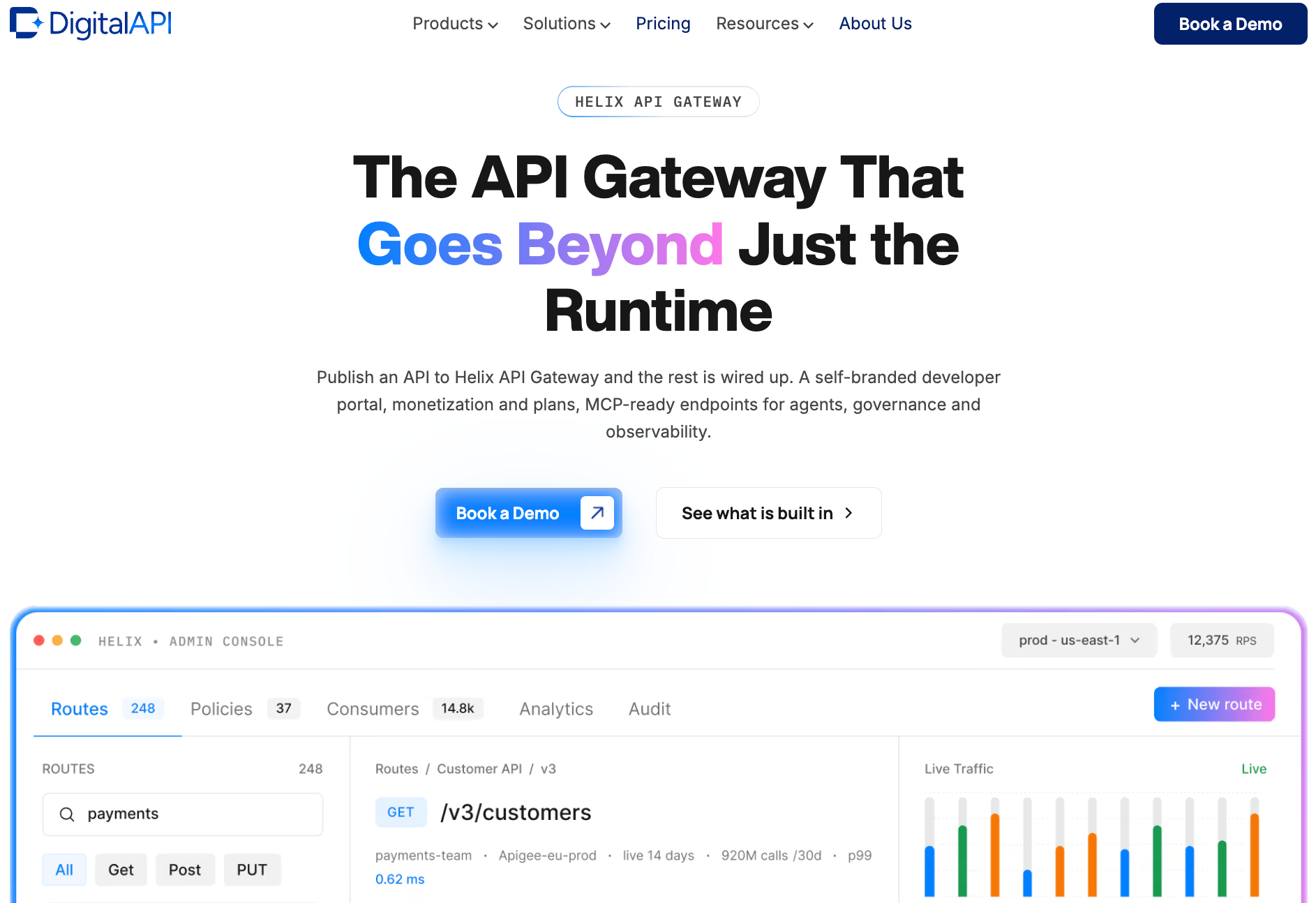
The core difference between DigitalAPI and every other tool on this list becomes visible at the multi-gateway level. API7, Kong, Tyk, Gravitee, Zuplo, Solo, and Apigee are each a single gateway runtime. Teams running more than one gateway still face the same problem after deploying any of them: fragmented catalogues, duplicated APIs, inconsistent policies, and no unified view of usage across the estate. DigitalAPI solves this at the control plane level without requiring migration.
The API discovery layer connects to every major gateway and surfaces every API into one searchable catalogue. Internal teams discover existing APIs before building duplicate ones. Architects identify overlapping services and make informed deprecation decisions. Governance policies, linting rules, and compliance checks run across the entire estate, not just within a single gateway's ecosystem.
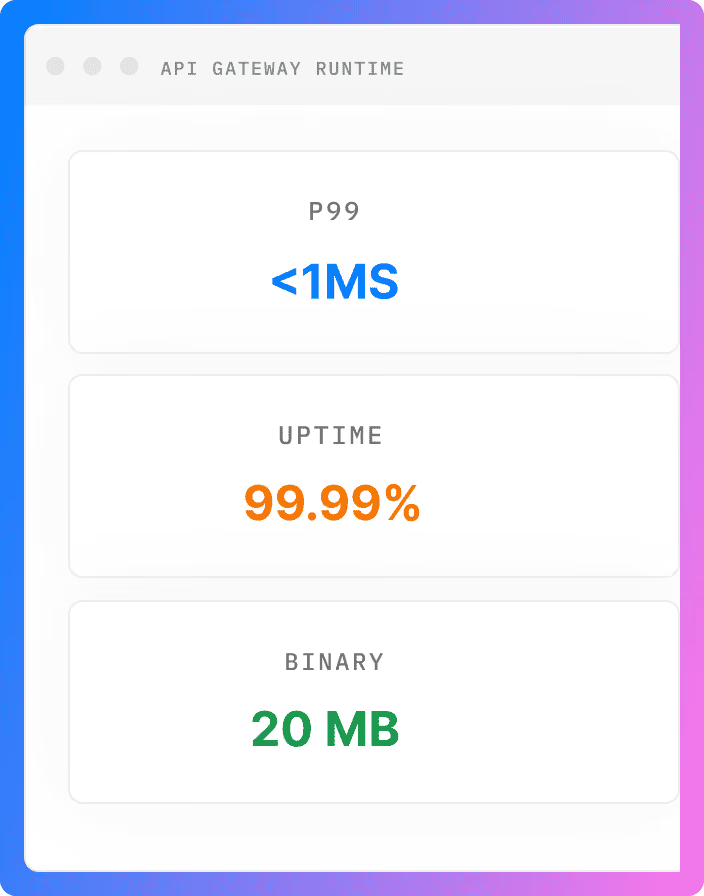
Above the governance layer, DigitalAPI adds the full developer journey. Developers sign up via SSO, receive gateway-tied API keys scoped to their environment, and test against a real sandbox, all without a support ticket. Partners onboard through a self-serve flow with separate RBAC, visibility controls, and subscription tiers. For teams preparing for AI agent consumption, the Arelio API Gateway is DigitalAPI's native lightweight runtime, built for speed with zero DevOps overhead. Every API catalogued across any connected gateway can be promoted to an MCP tool in one click with the same auth, rate limits, and audit trail that govern human traffic.
Key features:
- Multi-gateway federation: connects to API7, Kong, Apigee, AWS Gateway, Azure APIM via read-only credentials
- Unified API catalogue with AI-powered discovery, duplicate detection, and governance across the entire estate
- Self-serve developer portal with SSO sign-up, gateway-tied API key issuance, and real sandbox access
- RBAC for internal, partner, and public audience separation from one platform
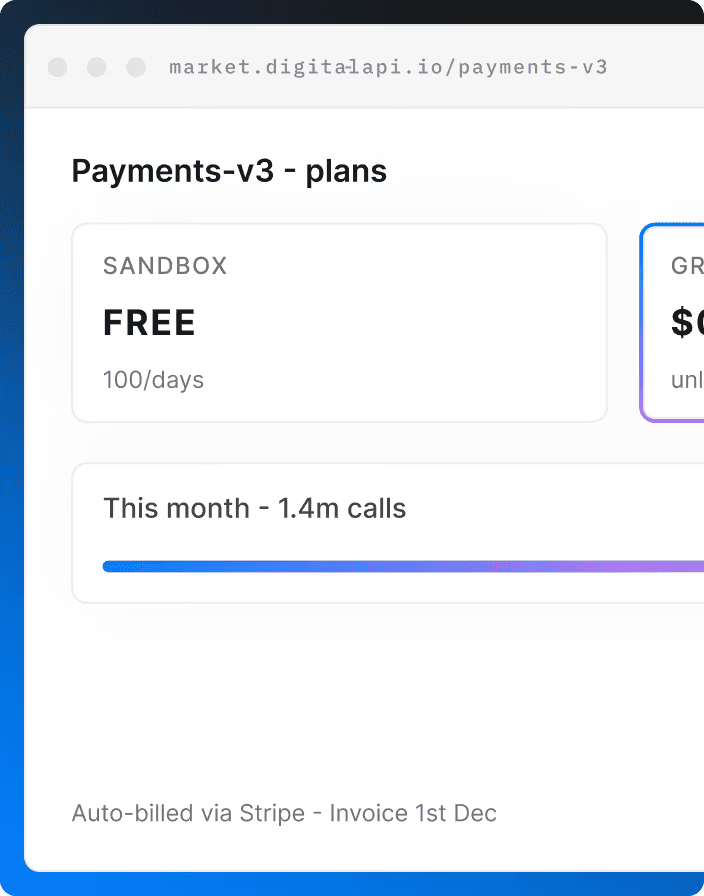
- Subscription management with tiered plans, usage metering, and Stripe/Braintree billing integration
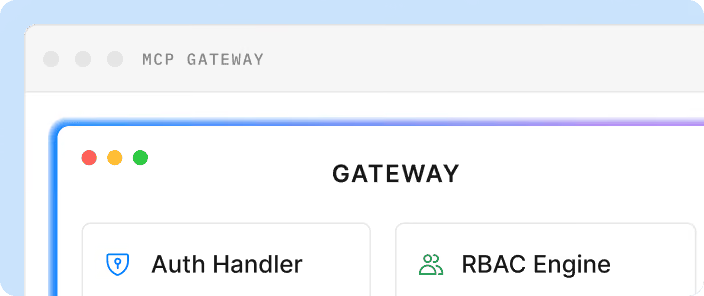
- MCP Gateway converts any catalogued API into an MCP tool in one click
- self-serve developer onboarding: external developers discover, test, generate credentials, and subscribe to a plan without contacting your team
| Pros | Cons |
|---|---|
| Only platform in this comparison that federates multiple gateways into a single control plane. | Not a standalone high-performance API gateway runtime focused on raw throughput benchmarks. |
| No gateway migration required. Existing Kong, Apigee, AWS API Gateway, Azure API Management, and other gateway configurations remain in place. | Delivers the most value when developer onboarding, documentation, governance, or multi-gateway management are requirements beyond the gateway layer. |
| Self-service developer portal with API key provisioning, subscriptions, and partner onboarding out of the box. | Requires an existing API gateway or API management platform rather than replacing one. |
| MCP-native architecture lets every connected API become AI agent-ready without additional development. | Not designed as a lightweight documentation-only solution for small single-API projects. |
| Supports internal, partner, and public developer experiences from one unified platform. | Organizations with only one small internal API may not require its full platform capabilities. |
Best for: API teams running APIs across multiple gateways, managing internal developers and external partners from one platform, and preparing APIs for AI agent consumption without migrating existing infrastructure.
Still onboarding partners manually? DigitalAPI unifies every gateway into one self-serve catalogue.
See how it works2. Kong
Kong is one of the most widely adopted API gateways in production. Built on NGINX with a Lua-based plugin architecture, it covers authentication, rate limiting, logging, observability, and traffic transformation through hundreds of community and enterprise plugins. Kong Gateway Community Edition is open-source and self-hosted. Kong Konnect adds a managed control plane, RBAC, audit logging, and a developer portal.
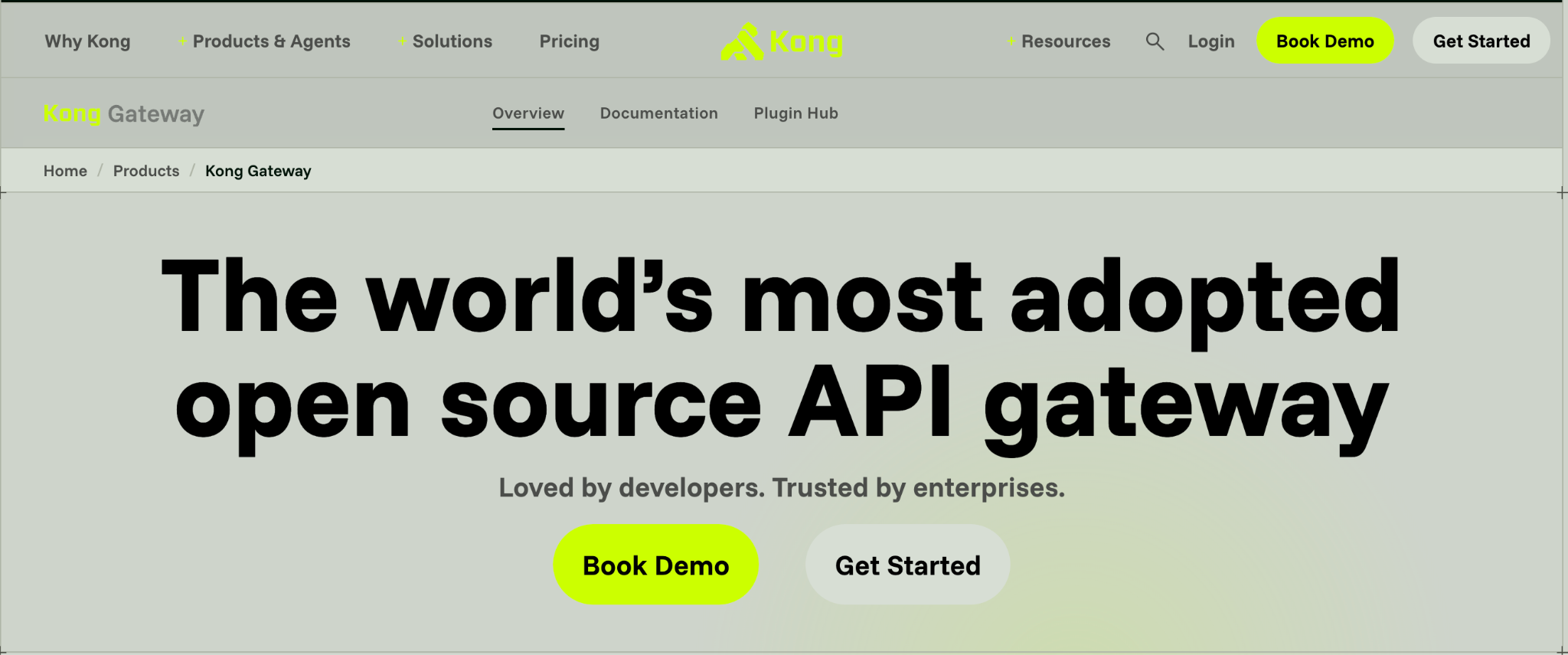
The plugin architecture is the core strength. Teams add custom logic, third-party integrations, and traffic policies without modifying the gateway core. Kong's adoption across production deployments means most observability tools, CI/CD pipelines, and infrastructure integrations already have native Kong support. Kubernetes-native deployment with the Kong Ingress Controller makes it a natural fit for teams already running containerised workloads.
Key features:
- Lua-based plugin architecture with hundreds of community and enterprise plugins
- Kubernetes-native deployment via Kong Ingress Controller
- Kong Konnect managed control plane with RBAC and audit logging
- AI Gateway and MCP support as plugins (shipped late 2025)
| Pros | Cons |
|---|---|
| Battle-tested gateway with the largest ecosystem and broad third-party integrations. | Single-gateway architecture. Teams running Kong alongside Apigee, AWS API Gateway, or Azure API Management still manage multiple control planes. |
| Extensive plugin ecosystem enables authentication, rate limiting, security, and traffic management without modifying the gateway core. | Developer portal requires significant customization to provide a modern self-service onboarding experience. |
| High-performance runtime for REST, gRPC, WebSockets, and Kubernetes-based API workloads. | Large plugin estates can increase operational complexity and maintenance overhead at scale. |
| Strong Kubernetes and cloud-native integration through the Kong Ingress Controller and Gateway API support. | No built-in API monetization or subscription workflow comparable to full API management platforms. |
Best for: Teams needing a battle-tested, plugin-rich, high-performance API gateway with the largest ecosystem and flexible deployment options across cloud, on-premises, and Kubernetes.
3. Tyk
Tyk is an open-source API gateway written in Go. It ships with a built-in developer portal, analytics dashboard, RBAC, and governance tooling as part of its core platform, not behind an enterprise paywall. Tyk Cloud adds a managed control plane and SLA-backed support. The protocol-agnostic design handles REST, GraphQL, and gRPC alongside asynchronous protocols.
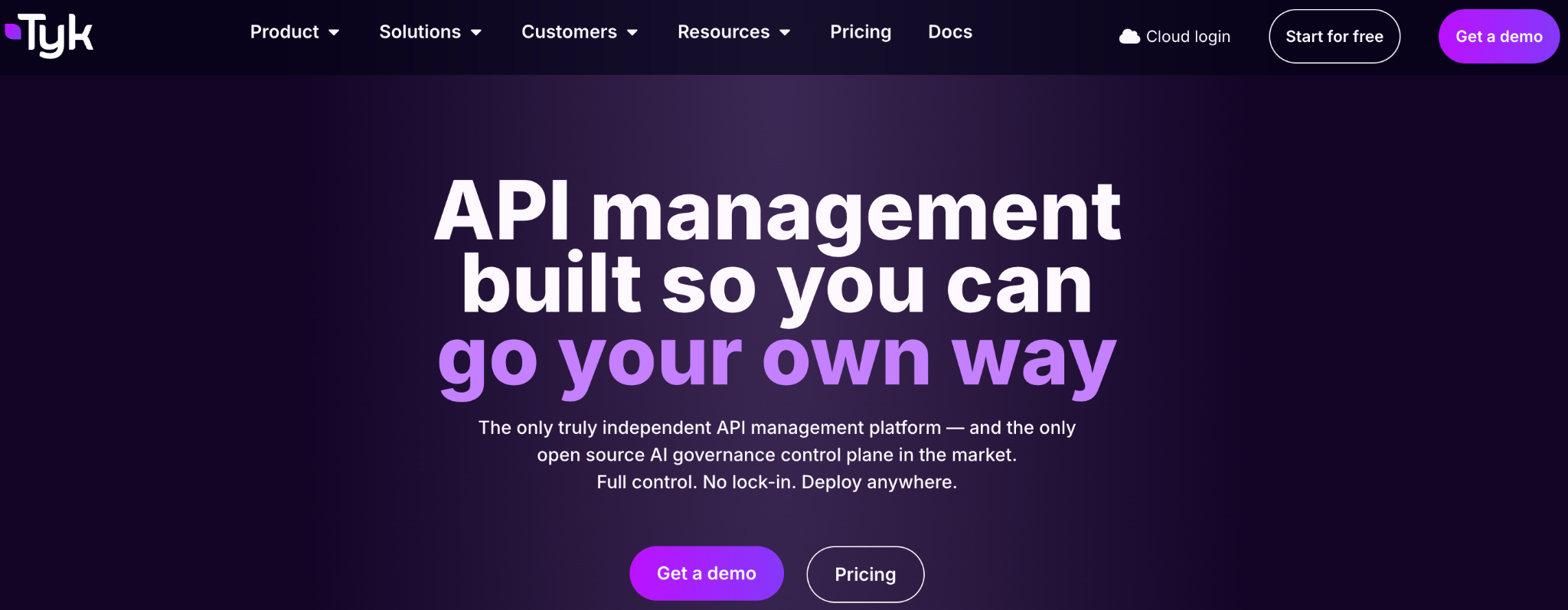
The self-contained package is the standout characteristic. Unlike Kong, where developer portal and RBAC require enterprise licensing, Tyk ships these capabilities with the community edition. The Go-based runtime delivers strong performance with low memory overhead. Key lifecycle management, quota enforcement, and policy management work out of the box. Tyk AI Studio, open-sourced in early 2026, provides a foundation for self-hosted AI governance built directly on top of the gateway.
Key features:
- Built-in developer portal, analytics, RBAC, and governance in the open-source core
- Go-based runtime with low memory overhead
- Protocol support for REST, GraphQL, gRPC, and async protocols
- Tyk AI Studio for self-hosted AI and LLM governance (open-sourced 2026)
| Pros | Cons |
|---|---|
| Developer portal, RBAC, and API management capabilities are available without an enterprise-only paywall. | Designed around a single gateway. Teams running Tyk alongside Kong, Apigee, or other gateways still manage multiple control planes. |
| Self-contained platform with gateway, portal, analytics, and governance reduces the number of tools required. | Developer portal often requires customization for large enterprise partner programmes and branded onboarding. |
| Lightweight Go-based runtime delivers strong performance with relatively low operational overhead. | Smaller ecosystem than Kong means fewer third-party integrations, plugins, and community extensions. |
| Open-source foundation with flexible deployment options across cloud, Kubernetes, and on-premises environments. | API monetization and billing workflows require additional configuration and integrations to support production-grade commercial programmes. |
Best for: Teams that want a self-hosted open-source gateway with built-in developer portal and governance tooling, and whose team has the DevOps capability to manage the infrastructure without a managed service.
4. Gravitee
Gravitee is an open-source API management platform with a gateway, developer portal, analytics, and access management included. Its defining characteristic is the event-native architecture: it handles REST, GraphQL, WebSocket, MQTT, and Kafka under one platform with a unified policy model across all protocol types. For organisations managing event-driven and traditional REST APIs through separate tools, Gravitee is the only gateway on this list that treats synchronous and asynchronous APIs with equal governance weight.
The unified protocol support is the core differentiator. Teams managing Kafka event streams, WebSocket connections, and REST APIs can consolidate onto one platform. Gravitee 4.11's MCP analytics dashboards and MCP Resource Server with enterprise-grade OAuth 2.0 support make it one of the more prepared gateways for agent traffic governance. European data sovereignty and EU-hosted deployment options address strict data residency requirements that cloud-native alternatives cannot satisfy.
Key features:
- Event-native architecture: REST, GraphQL, WebSocket, MQTT, and Kafka in one policy model
- MCP analytics dashboards and MCP Resource Server with OAuth 2.0 (Gravitee 4.11)
- EU-hosted deployment for data sovereignty requirements
- Token Exchange (RFC 8693) for secure agent delegation chains
| Pros | Cons |
|---|---|
| Only gateway on this list that treats synchronous and asynchronous APIs with equal governance priority. | Single-gateway architecture means teams running Gravitee alongside Kong or other gateways still manage separate control planes. |
| Strong MCP readiness and AI agent traffic governance capabilities. | Java-based runtime introduces higher memory usage and slower startup compared with NGINX-based gateways. |
| EU data sovereignty and compliance features make it well suited for regulated industries. | Smaller ecosystem than Kong limits the number of third-party integrations, plugins, and connectors. |
| Native support for event-driven APIs, AsyncAPI, and Kafka alongside traditional REST APIs. | Self-hosted deployments require operating and maintaining multiple platform components. |
Best for: Organisations managing event-driven and asynchronous APIs alongside REST, particularly those with European data sovereignty requirements, Kafka-heavy architectures, nor unified sync and async governance needs.
5. Zuplo
Zuplo is a fully managed, edge-native API gateway that deploys to 300-plus global edge locations with no infrastructure to provision nor maintain. Custom gateway logic is written in TypeScript with full IDE support and deployed through a GitOps workflow. A built-in developer portal with API key self-service, monetisation via Stripe, and native MCP support are included out of the box.
The zero-ops model is the standout capability. Teams go from signed contract to a globally deployed gateway with a branded developer portal in under 20 seconds via GitOps. TypeScript policies replace Lua plugins, broadening the contributor pool beyond gateway specialists. For teams frustrated by API7's Apache APISIX configuration overhead nor Lua-based plugin model, Zuplo's managed, TypeScript-first approach is a direct contrast.
Key features:
- Fully managed edge-native deployment across 300-plus global locations
- TypeScript programmable policies with full IDE support and GitOps deployment
- Built-in developer portal, API key self-service, and Stripe monetisation out of the box
- Native MCP support for AI agent consumption
| Pros | Cons |
|---|---|
| Zero infrastructure to manage—gateway, developer portal, and MCP support are all included in one managed platform. | Single managed gateway cannot federate existing Apigee, Kong, AWS, or Azure gateway estates. |
| TypeScript-first development makes customization accessible to a broader contributor base than Lua- or Go-based gateways. | Fully managed SaaS architecture reduces infrastructure-level control and customization. |
| Sub-20-second global deployments through GitOps workflows enable rapid releases. | Data residency and on-premises requirements may not align with a SaaS-only deployment model. |
| Native MCP support is available from day one for AI agent integrations. | MCP capabilities do not federate across existing multi-gateway estates. |
Best for: Developer-first teams that want a modern, edge-native, fully managed gateway with TypeScript programmability, built-in developer portal, and native MCP support, and whose team do not want to operate gateway infrastructure.
6. Solo
Solo.io is an API connectivity platform that unifies API gateway and service mesh management into a single control plane. Built on Istio and Envoy, it handles both north-south traffic (external clients calling your APIs) and east-west traffic (service-to-service communication inside Kubernetes clusters). For teams running complex multi-cluster Kubernetes environments where separating gateway and mesh tooling creates operational fragmentation, Solo removes the need for two separate control planes.
The unified gateway-plus-mesh model is Solo's defining capability. Teams that run Istio for east-west service communication and a separate gateway for north-south API traffic manage two control planes, two policy models, and two sets of observability tools. Solo consolidates these into one. For regulated industries needing consistent mTLS, zero-trust policies, and audit trails across both API and service traffic, Solo addresses the gap that pure gateway tools leave open.
Key features:
- Unified API gateway and service mesh on Istio and Envoy
- Multi-cluster Kubernetes topology management via Gloo Mesh
- Consistent mTLS and zero-trust policies across north-south and east-west traffic
- Envoy-native performance characteristics
| Pros | Cons |
|---|---|
| Unified gateway and service mesh eliminate the need for separate control planes inside Kubernetes. | Kubernetes-native architecture is poorly suited to non-containerised or VM-based infrastructure. |
| Consistent zero-trust security, mTLS, and policy enforcement across API and service traffic. | Steep learning curve due to Istio and Envoy configuration complexity. |
| Strong fit for multi-cluster, regulated Kubernetes environments requiring advanced networking. | No built-in API monetisation or self-serve developer portal. |
| Deep integration with Kubernetes Gateway API and service mesh for cloud-native platforms. | Does not federate external gateways running outside Kubernetes environments. |
Best for: Teams running multi-cluster Kubernetes environments that need gateway and service mesh unified under one control plane with consistent zero-trust policies and mTLS across both API and service traffic.
7. Apigee
Apigee is Google Cloud's full-lifecycle API management platform. It covers API design, security policy enforcement, traffic management, analytics, developer portal, and monetisation within one platform. The policy engine is one of the most mature in the market, with fine-grained controls for authentication, mediation, transformation, and quota management.
The policy engine depth is the core strength. Apigee's proxy configuration supports complex mediation scenarios including request and response transformation, payload manipulation, conditional routing, and multi-step policy chains. The analytics layer covers latency, error rates, quota consumption, and developer engagement in one dashboard. Monetisation, developer portal, and key management are production-ready and widely deployed across financial services, telco, and healthcare at enterprise scale.
Key features:
- Mature policy engine with fine-grained authentication, mediation, and transformation controls
- Comprehensive analytics covering latency, error rates, quota, and developer engagement
- Production-ready developer portal and monetisation at enterprise scale
- Deep GCP integration: BigQuery analytics, Cloud Armor security, IAM federation
| Pros | Cons |
|---|---|
| Most mature API policy engine of any gateway on this list. | Google Cloud–native architecture makes migration difficult because every proxy and policy must be recreated. |
| Production-ready developer portal and API monetisation for enterprise-scale programs. | Single-gateway architecture means teams running Apigee alongside Kong or other gateways still manage separate control planes. |
| Deep Google Cloud integration for organisations already standardised on GCP. | Platform complexity and heavier runtime can introduce additional operational overhead at high scale. |
| Mature analytics, security, and lifecycle management for enterprise API programs. | MCP server generation is tightly coupled to the Google Cloud ecosystem. |
Best for: Enterprises on Google Cloud needing full-lifecycle API management with mature policy enforcement, deep GCP integration, and production-ready monetisation and analytics at enterprise scale.
How We Chose These API7 Alternatives
This list covers only the seven tools in the gateway competitor category: DigitalAPI, Kong, Tyk, Gravitee, Zuplo, Solo, and Apigee. Load balancers, service mesh-only tools, and CDN proxies are not included. Those tools operate at different layers and are not gateway alternatives for API management use cases.
Each tool was evaluated on six criteria.
- Gateway performance and traffic management: throughput, latency, and protocol support at the data plane.
- Plugin and extensibility model: how custom logic and integrations are added without modifying the gateway core.
- Multi-gateway and multi-cloud support: does it work across heterogeneous gateway environments without requiring migration?
- Developer portal and self-serve onboarding: can developers discover and access APIs without manual intervention from the platform team?
- Monetisation and subscription management: does it support billing, plans, and partner access workflows out of the box?
- MCP and agent readiness: can AI agents discover and call APIs through the platform using standard MCP tooling?
API7 Alternatives: Use Case Fit by Industry
[fs-toc-omit]Banking and financial services
A bank running Open Banking APIs across Apigee and AWS Gateway needs consistent governance, RBAC, and audit trails across both platforms without managing two separate control planes. API7, Kong, Tyk, Gravitee, Solo, and Apigee each solve one gateway. DigitalAPI's API governance federates both into one governed catalogue, with separate access policies for internal developers, regulated partners, and public fintechs from a single platform.
[fs-toc-omit]Telco and enterprise platform teams
A telco managing APIs across Kong, Azure APIM, and a legacy Apigee instance faces the multi-gateway problem that no single gateway alternative resolves. Replacing one gateway with another moves the problem without solving it. DigitalAPI's API discovery centralises cataloguing, duplicate detection, and lifecycle management across the entire estate without requiring migration away from existing infrastructure. For a broader view of the gateway landscape, the best API gateway guide covers where each platform fits across the full stack.
[fs-toc-omit]API monetisation programmes
Teams exposing APIs to external partners need billing, subscription tiers, usage metering, and automated invoicing above the gateway layer. Kong and API7 require separate tooling for this. Tyk, Zuplo, and Apigee have built-in capabilities that work within their own gateway. DigitalAPI's API monetisation handles plans, quotas, Stripe-integrated billing, and partner onboarding across every gateway in the estate, not just the one it natively runs. For teams building out their partner access programme, the best API marketplaces guide maps the full landscape.
[fs-toc-omit]Healthcare and regulated industries
Healthcare API teams managing APIs for third-party data providers and clinical partners need sandbox environments with scoped credentials, audit trails per partner, and consistent governance across gateway deployments. DigitalAPI's API sandboxing handles time-bound sandbox access windows and scoped credentials per partner across every connected gateway, with the same audit trail that governs production traffic.
Frequently Asked Questions
1. What is the best API7 alternative for enterprise API gateway management in 2026?
DigitalAPI is the best API7 alternative for teams that need more than a gateway runtime: it covers multi-gateway federation, self-serve developer portal, partner onboarding, monetisation, and MCP support across the gateways you already run.
2. What is the difference between API7 and an API management platform?
API7 is a gateway runtime that handles traffic routing, authentication, and rate limiting at the data plane. An API management platform covers the full lifecycle above it: developer portal, multi-gateway federation, API catalogue, governance, monetisation, and analytics across every gateway in the estate.
3. Can DigitalAPI work alongside API7 without replacing it?
Yes. DigitalAPI connects to existing gateways including API7 via read-only credentials and federates them into one control plane. Your API7 configuration, policies, and routes stay in place. DigitalAPI adds unified cataloguing, governance, self-serve developer portal, and MCP-ready exposure on top without touching the gateway data plane.
4. Which API7 alternative works for teams managing APIs across multiple gateways?
Only DigitalAPI federates multiple API gateways into one unified control plane and catalogue. Every other tool on this list is a single-gateway platform. DigitalAPI auto-syncs from Apigee, Kong, AWS Gateway, and Azure APIM into one searchable catalogue with unified governance and no gateway migration required.
5. Can AI agents consume APIs managed by API7 nor its alternatives?
API7 do not natively support MCP nor agent-ready API exposure. Zuplo and Gravitee have MCP support for new deployments on their own gateway. DigitalAPI's MCP Gateway converts any catalogued API into an MCP tool in one click, with the same authentication, rate limits, and audit trail that govern human traffic, across every gateway in the estate and no new infrastructure required.
Dhayalan Subramanian is Associate Director, Product Growth at DigitalAPI, where he leads go-to-market and product growth for the company’s multi-gateway API management platform. His work focuses on helping large enterprises and mid-market cloud companies consolidate APIs across AWS, Azure, Apigee, Kong, MuleSoft, and other gateways into a single control plane for governance, discovery, monetization, and agent consumption.
Dhayalan brings 14+ years of experience across product strategy, enterprise architecture, and engineering leadership. Earlier in his career, he held senior roles at Encora (as Associate Architect and Technical Manager), Mindtree (Technology Lead), Tech Mahindra (Technical Lead), and Primus Analytics, where he designed integration frameworks and delivered enterprise-grade digital platforms for global customers.
At DigitalAPI, he works directly with platform, integration, and developer experience leaders at Fortune 500 organizations to operationalize unified API catalogs, developer portals, and MCP-ready APIs. He writes regularly on API developer experience, API governance, and AI agent architectures.
One email a fortnight. Worth opening.
A short digest of what we're writing, what we're learning from customers, and the handful of links you'd actually want from us. No tracking pixels.

.avif)