



Axway Alternatives That Help Teams Ship Self-Serve API Marketplaces Faster
Axway governs APIs well but not partner onboarding. See 7 alternatives built for self-serve marketplaces.

Axway alternatives that help teams ship self-serve API marketplaces faster: DigitalAPI, Apigee, MuleSoft, Kong, WSO2, Gravitee, Tyk.
Axway governs APIs across hybrid enterprise infrastructure. What it does not give you: a modern self-serve marketplace, a white-label developer portal, or MCP-ready API exposure for AI agents without a consultant-led implementation.
Teams evaluating Axway alternatives in 2026 are not dissatisfied with its compliance depth. They are evaluating what the marketplace layer delivers to external partners: self-serve sign-up, instant credential provisioning, and a real sandbox on day one. Axway's Amplify Engage requires agent deployment, security team involvement, and workshop sessions with Axway consultants to reach that outcome.
This guide covers the seven platforms in the marketplace category, what each one delivers, and which team it fits.
TL;DR
1. Axway governs APIs well. It does not solve self-serve partner onboarding, white-label branding, Stripe billing, or MCP readiness without a consultant-led implementation.
2. If you run APIs across multiple gateways and need a marketplace layer above them, DigitalAPI is the only platform here that federates Apigee, Kong, AWS, and Azure APIM without migration.
3. If you are on Google Cloud and need deep analytics and monetization, Apigee is the strongest fit.
4. If your API programme is inseparable from legacy system integration, MuleSoft covers both under one contract.
5. If you already run Kong as your gateway and want to extend it with a marketplace, Kong Enterprise is the natural next step.
6. If avoiding vendor lock-in matters more than polish, WSO2 gives you full lifecycle management open-source.
7. If your APIs mix REST and Kafka or WebSocket traffic, Gravitee governs both from one control plane.
8. If you want open-source with a developer portal included from day one, Tyk ships it in the community edition.
Why API Teams Are Moving Beyond Axway in 2026
Axway's governance is not the problem. For regulated industries, its compliance controls remain mature and proven. The problem is what happens after a partner arrives at your marketplace: how fast they can sign up, get credentials, and start building without involving your team.
Axway Amplify Engage requires agent deployment, security team sign-off, and consultant sessions to reach that outcome. Most teams cannot afford that friction at the partner onboarding stage.
The teams moving beyond Axway are not replacing their governance layer. They are adding a modern marketplace above it. DigitalAPI runs on top of the Axway, Kong, AWS, and Apigee infrastructure you already have, and gives partners a self-serve portal, sandbox, and credentials from day one.
Axway Alternatives at a Glance
(scroll to view full table)
How We Chose These Axway Alternatives
This list covers only platforms in the marketplace competitor category. Pure CI/CD pipeline tools, integration-only platforms, and raw API testing tools are not included. Those tools do not serve the API marketplace use case of discovery, monetization, partner onboarding, and developer self-service.
Each platform was evaluated on six criteria:
- API discovery and catalog: Can developers and partners find and browse APIs from a single place without knowing which gateway they sit on?
- Self-serve developer onboarding: Can a developer or partner sign up, get credentials, and start building without manual intervention from the platform team?
- Monetization and subscription management: Does it support billing plans, usage metering, and automated invoicing as built-in capabilities?
- Multi-gateway support: Does it work across heterogeneous gateway environments without requiring migration to a single vendor?
- White-label and branding: Can the marketplace be fully branded as the organisation's own with no third-party vendor identity visible to partners?
- MCP and agent readiness: Can AI agents discover and call APIs through the platform using standard MCP tooling at the gateway level?
1. DigitalAPI
DigitalAPI is a self-serve, gateway-agnostic API management platform with a built-in API marketplace, white-label developer portal, Stripe-integrated monetization, and native MCP support. Unlike Axway, which requires significant implementation effort to reach a modern marketplace experience, DigitalAPI delivers a production-ready branded marketplace on top of the gateways you already run, typically in two to six weeks from contract to live.
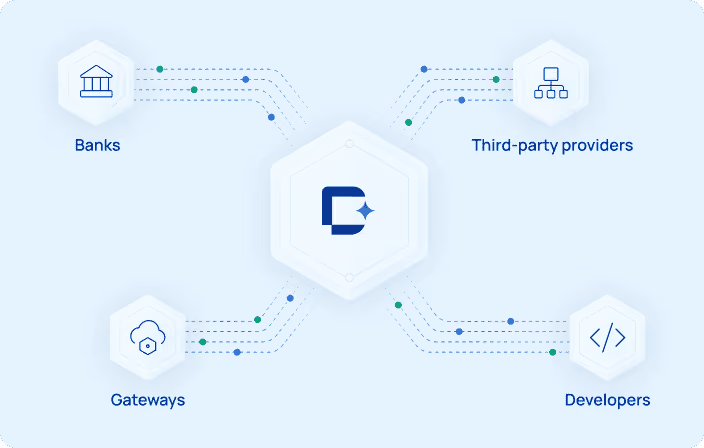
The gateway-agnostic model is the core differentiator. DigitalAPI connects to Apigee, Kong, AWS Gateway, and Azure APIM via read-only credentials and surfaces every API from every gateway into one searchable, brandable marketplace catalog. Teams do not replace existing infrastructure. The marketplace runs as a layer above it, governed by the same policies and authentication that already exist in the gateway estate.
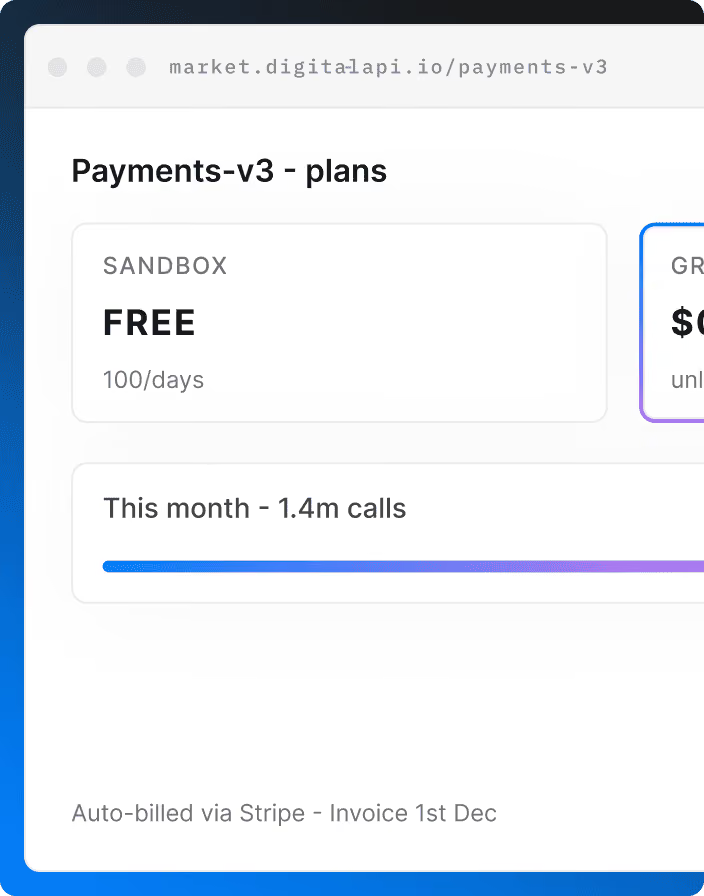
The API marketplace handles the complete commercial API journey. Developers and partners browse the catalog, subscribe to a plan, receive gateway-tied credentials, and test against a real sandbox, all without a support ticket. Subscription tiers, usage metering, overage alerts, and Stripe-integrated billing are built in. Automated invoicing replaces the manual processes that Axway's implementation typically requires to reach the same commercial outcome.
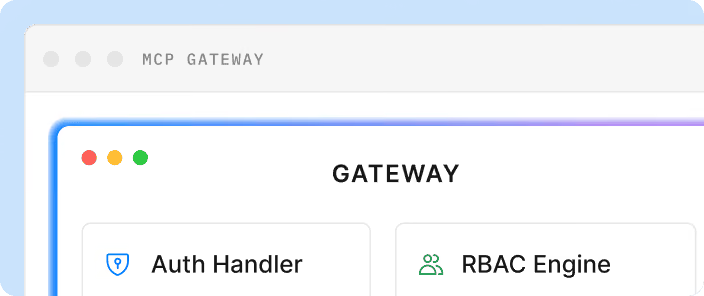
The white-label developer portal is fully branded to the organisation's domain and design system. Zurich Insurance and Fiserv run production partner ecosystems on DigitalAPI with no third-party vendor identity visible to their partners. For teams preparing for AI agent consumption, every API catalogued across any connected gateway can be promoted to an MCP tool in one click via the MCP Gateway, with the same authentication, rate limits, and audit trail that govern human traffic.
Key features:
- Multi-gateway federation: connects to Apigee, Kong, AWS Gateway, and Azure APIM via read-only credentials with no migration required
- White-label developer portal fully branded to the organisation's domain and design system
- Self-serve partner onboarding with SSO sign-up, gateway-tied credential issuance, and real sandbox access
- Stripe and Braintree-integrated billing with tiered plans, usage metering, and automated invoicing
- RBAC for internal, partner, and public audience separation from one platform
- MCP Gateway converts any catalogued API into an MCP tool in one click with the same auth and audit trail that governs human traffic
(scroll to view full table)
Fits API teams that: Run APIs across multiple gateways, build a commercial partner ecosystem, and need white-label branding, Stripe-integrated monetization, and MCP-ready exposure for AI agents from one platform.
If your team is running an API programme and partner onboarding still requires weeks of manual intervention, DigitalAPI's API monetization layer resolves both. Most teams reach a production-ready branded marketplace with their first partner onboarded in under two weeks from contract to live. Talk to us.
2. Google Apigee
Google Apigee is the deepest API management and marketplace platform in the category for teams on Google Cloud. Its analytics layer, monetization capabilities, and policy engine have set the standard for enterprise API management for over a decade. Apigee is recognized as a Leader in the IDC MarketScape: Worldwide API Management 2026 and in The Forrester Wave: API Management Software, Q3 2024.
Where Apigee earns its position: no other platform in this list matches its analytics depth or policy granularity. Developer portal, subscription management, usage-based billing, and RBAC are all production-grade and well-documented. For enterprises already invested in Google Cloud infrastructure, the native integrations with BigQuery, Cloud Logging, and Identity Platform remove significant integration overhead.
Where it falls short for marketplace use cases: Apigee's developer portal, while capable, requires configuration and is not a zero-effort self-serve experience out of the box. Onboarding new partners is a managed process. The platform was designed for a dedicated Apigee team, not for low-friction partner self-service. MCP support is on the roadmap, not in production. And for teams running non-Google gateways alongside Apigee, it provides no multi-gateway federation.
Key features:
- Deep analytics and developer engagement reporting at API, product, and programme level
- Built-in monetization with usage-based billing plans and API product bundles
- Developer portal with subscription workflows and key management
- OAuth 2.0, JWT, spike arrest, and threat protection policies
- Hybrid deployment: cloud control plane with on-prem data plane option
(scroll to view full table)
Fits API teams that: Are fully invested in Google Cloud, have a dedicated Apigee team, and need the deepest analytics, policy control, and monetization at enterprise scale.
For a capability and migration path comparison between Apigee and DigitalAPI, see the DigitalAPI vs Apigee comparison.
3. MuleSoft (Anypoint Platform)
MuleSoft Anypoint combines API management and marketplace with enterprise system integration under one platform. It's the choice for organisations that need to connect APIs to legacy systems, SaaS applications, ERP platforms, and databases through a unified integration bus, while also exposing those APIs through a managed developer portal.
The integration-first architecture is MuleSoft's core differentiator in this list. No other platform here handles SOAP, JMS, MQ Series, and modern REST API management from the same control plane. For enterprises with significant legacy infrastructure that need to expose legacy services as modern API products in a marketplace, MuleSoft covers both sides of that problem.
The trade-off: MuleSoft's marketplace layer is functional but not optimised for fast partner self-service. Onboarding a new external developer requires configuration, not just a sign-up flow. The platform cost and the MuleSoft-certified expertise requirement make it a poor fit for API teams whose primary need is a modern commercial marketplace rather than deep integration orchestration.
Key features:
- Unified API lifecycle from design to deprecation under one platform
- API Exchange as the internal developer portal and marketplace catalog
- Integration-first architecture with native connectors to hundreds of systems
- Policy enforcement with security, throttling, and transformation rules
- Hybrid deployment: cloud, on-prem, and hybrid options
(scroll to view full table)
Fits API teams that: Need deep system integration (legacy, SaaS, ERP, databases) combined with API marketplace capabilities under one contract and one operational team.
For a detailed comparison of MuleSoft and DigitalAPI across marketplace and lifecycle management, see the DigitalAPI vs MuleSoft comparison.
4. Kong
Kong is the most widely adopted open-source API gateway, and its enterprise tier adds the marketplace and developer portal capabilities that put it in this list. Kong Konnect provides a managed cloud control plane with a developer portal, RBAC, and API product management for teams that need marketplace infrastructure on top of Kong's proven gateway runtime.
Kong's marketplace positioning is honest: it's a gateway with marketplace capabilities added at the enterprise tier, not a marketplace platform with a gateway underneath. The distinction matters. Teams choosing Kong for marketplace functionality typically already run Kong as their gateway and are extending it upward, not starting from a marketplace requirement.
Plugin-based extensibility gives Kong teams flexibility but also means that marketplace capabilities, monetization workflows, and developer portal features require plugin configuration and management overhead. MCP support is available through Kong's AI Gateway plugins but is not natively integrated at the platform level.
Key features:
- Developer portal with API discovery, subscription management, and key generation at Enterprise tier
- Plugin-based marketplace extensions covering authentication, rate limiting, and transformation
- Kong Konnect as managed cloud control plane for hybrid environments
- Multi-protocol support: REST, gRPC, GraphQL, WebSocket
- AI Gateway plugins for LLM and agent traffic management
(scroll to view full table)
Fits API teams that: Already run Kong as their primary gateway and want to extend it with marketplace, developer portal, and API product management capabilities through the Enterprise tier.
For a head-to-head comparison of Kong and DigitalAPI across marketplace capabilities, see the DigitalAPI vs Kong comparison.
5. WSO2
WSO2 API Manager is an open-source, full-lifecycle API management platform that includes a gateway, developer portal, subscription management, and marketplace capabilities in one self-hosted package. It supports REST, SOAP, GraphQL, and async API formats. For enterprises that need the governance depth of Axway without proprietary vendor lock-in and at a lower licensing cost, WSO2 is the most direct open-source alternative.
The open-source model is the core advantage. Every capability, including the gateway, developer portal, subscription management, and API analytics, is available without proprietary licensing. The developer portal supports API publishing, subscription workflows, and key management out of the box. WSO2 Choreo, its serverless PaaS layer, extends the platform for teams wanting managed hosting without full self-hosted infrastructure overhead.
Where WSO2 falls short as a marketplace platform: multi-gateway ingestion from non-WSO2 sources is limited. Teams running Kong, Apigee, or AWS Gateway alongside WSO2 cannot federate them into a single catalog without custom integration work. The UI, while functional, lags behind cloud-native platforms in self-serve developer experience polish.
Key features:
- Open-source full-lifecycle API management: gateway, developer portal, analytics, and subscription management in one package
- Supports REST, SOAP, GraphQL, and async API formats
- WSO2 Choreo PaaS layer for managed hosting without full self-hosted overhead
- Mature OAuth 2.0, JWT, RBAC, and threat protection security capabilities
- API publishing, subscription workflows, and key management out of the box
(scroll to view full table)
Fits API teams that: Need open-source full-lifecycle API management with a built-in developer portal, have internal platform engineering capability to self-host, and want to avoid proprietary vendor lock-in.
6. Gravitee
Gravitee is an open-source, event-native API management platform built to govern both synchronous REST and asynchronous event-driven APIs from the same control plane. It covers REST, GraphQL, WebSocket, Kafka, and async APIs, making it the strongest choice in this list for organisations building event-driven architectures alongside traditional HTTP API products.
What puts Gravitee in the marketplace category: it ships with a developer portal, subscription workflows, and API product management in the community edition. For teams with genuinely mixed sync and async API estates, the unified governance model from one platform covers a use case that Kong, Tyk, and WSO2 handle less cleanly.
The limitation for marketplace use cases: monetization capabilities are limited in the community edition, multi-gateway federation is not available, and MCP support is partial. Teams using Gravitee as their primary marketplace platform are typically running it as both their gateway and their marketplace, not as a layer above an existing heterogeneous estate.
Key features:
- Policy-driven governance for REST, GraphQL, WebSocket, Kafka, and async APIs from one control plane
- Developer portal with subscription workflows and key management in the community edition
- Message transformation and protocol mediation between sync and async consumers
- Analytics and traffic monitoring across both sync and async traffic
- Flexible deployment: on-prem, cloud, and containerised environments
(scroll to view full table)
Fits API teams that: Are building event-driven or hybrid API programmes and need one governance and marketplace layer across REST and async event traffic from a single platform.
7. Tyk
Tyk is an open-source API gateway that ships with more lifecycle tooling in the community edition than most alternatives in this list. The community edition includes a developer portal with API discovery and key generation, basic analytics, and rate limiting, giving teams a working marketplace foundation before they need to consider enterprise pricing.
What makes Tyk relevant to the marketplace category: the developer portal is a genuine self-serve onboarding layer, not a placeholder. External developers can discover APIs, request access, generate credentials, and review documentation without manual intervention from the platform team. For API teams that want open-source marketplace infrastructure with a clear upgrade path, Tyk delivers more out of the box than Kong at the same tier.
Where Tyk falls short: no native monetization or billing layer, no multi-gateway federation, and advanced analytics and hybrid control plane capabilities require the enterprise edition. Teams running Tyk as a standalone marketplace platform are using it as both gateway and portal, not as a layer above an existing estate.
Key features:
- Developer portal with API discovery and key generation in the open-source edition
- Lightweight high-performance gateway runtime with low operational overhead
- Granular policy management: quotas, rate limits, and authentication included from day one
- Hybrid control plane for managing distributed gateway deployments
- Kubernetes-native deployment with Helm chart support
(scroll to view full table)
Fits API teams that: Want open-source marketplace infrastructure with a working developer portal from day one and a clear path to enterprise features including hybrid control plane as the API programme scales.
Axway Alternatives: Use Case Fit by Industry
[fs-toc-omit]Banking and financial services
A bank running Open Banking APIs across Apigee and AWS needs a branded marketplace that separates internal developer access, regulated partner onboarding, and public fintech consumption with different RBAC tiers and subscription controls. Axway's implementation complexity slows this commercial programme. WSO2 provides open-source governance but requires self-hosted maintenance. DigitalAPI's banking API management delivers a production-ready branded marketplace on top of existing gateways in two to six weeks, with separate access policies, subscription tiers, and audit trails per audience from a single platform.
[fs-toc-omit]Insurance and partner ecosystems
Insurance platforms managing APIs for brokers and third-party data providers need a marketplace with sandbox environments that let partners test against realistic data before going live. API Sandboxing in DigitalAPI provides time-bound sandbox access with scoped credentials per partner, within the same white-label marketplace portal that serves internal teams and public consumers. For insurance teams building partner ecosystems, the DigitalAPI insurance solution covers the full commercial API programme from discovery to monetization.
[fs-toc-omit]Enterprise API monetization programmes
Teams turning internal APIs into revenue-generating products need billing, subscription tiers, usage metering, and automated invoicing built into the marketplace. Axway requires custom implementation for mature monetization workflows. Kong and Tyk do not provide native billing at all. DigitalAPI's API monetization handles plans, quotas, Stripe-integrated billing, overage alerts, and partner onboarding across every gateway in the estate. For teams exploring the broader API marketplace landscape, the best API marketplaces guide covers where each platform fits across the full commercial API stack.
[fs-toc-omit]Multi-gateway enterprise estates
A telco managing APIs across Kong, Azure APIM, and a legacy Apigee instance faces a multi-gateway problem that no standalone marketplace alternative in this list resolves except DigitalAPI. Replacing one gateway with another moves the problem. DigitalAPI's API discovery centralises catalog visibility, duplicate detection, and lifecycle management across the entire estate without requiring migration. For a broader view of the gateway landscape, the best API gateway breakdown covers where each runtime fits.
FAQs
[fs-toc-omit]1. What is the best Axway alternative for enterprise API marketplace management in 2026?
DigitalAPI helps teams replace Axway's marketplace layer with self-serve onboarding, white-label portal, and MCP readiness.
[fs-toc-omit]2. What is the difference between Axway Amplify and an API marketplace platform?
Axway Amplify governs APIs. A best-fit API marketplace helps teams commercialise them with self-serve billing and partner onboarding.
[fs-toc-omit]3. Can DigitalAPI work alongside Axway without replacing it?
Yes. DigitalAPI helps teams add a marketplace layer above Axway via read-only credentials. No gateway changes needed.
[fs-toc-omit]4. Which Axway alternative helps teams with APIs across multiple gateways?
DigitalAPI is the top alternative that helps federate Apigee, Kong, AWS, and Azure APIM into one catalog without migration.
[fs-toc-omit]5. Can AI agents consume APIs through Axway alternatives natively?
DigitalAPI's MCP Gateway helps AI agents call any catalogued API with scoped credentials and a full audit trail in one click.
The Bottom Line
Axway's governance depth is real and earned. For regulated enterprises managing APIs across hybrid on-premise and cloud environments, those compliance controls solve problems that modern cloud-native platforms often cannot.
What Axway did not build: a commercial marketplace experience that external developers and partners can navigate at the speed they now expect. Self-serve sign-up, instant credential provisioning, white-label branding, and Stripe-integrated billing without a consultant-led implementation project are the gaps this list addresses.
DigitalAPI's API management platform covers the marketplace layer above every gateway you already run, including Axway. The governance stays. The partner onboarding friction goes. Talk to us and we'll show you how it maps to your existing estate.
Dhayalan Subramanian is Associate Director, Product Growth at DigitalAPI, where he leads go-to-market and product growth for the company’s multi-gateway API management platform. His work focuses on helping large enterprises and mid-market cloud companies consolidate APIs across AWS, Azure, Apigee, Kong, MuleSoft, and other gateways into a single control plane for governance, discovery, monetization, and agent consumption.
Dhayalan brings 14+ years of experience across product strategy, enterprise architecture, and engineering leadership. Earlier in his career, he held senior roles at Encora (as Associate Architect and Technical Manager), Mindtree (Technology Lead), Tech Mahindra (Technical Lead), and Primus Analytics, where he designed integration frameworks and delivered enterprise-grade digital platforms for global customers.
At DigitalAPI, he works directly with platform, integration, and developer experience leaders at Fortune 500 organizations to operationalize unified API catalogs, developer portals, and MCP-ready APIs. He writes regularly on API developer experience, API governance, and AI agent architectures.
One email a fortnight. Worth opening.
A short digest of what we're writing, what we're learning from customers, and the handful of links you'd actually want from us. No tracking pixels.

.avif)