



MuleSoft Pricing Model: Costs, Plans and What You Are Really Paying (2026 Guide)
MuleSoft has shifted from infrastructure-based pricing to consumption tracking across integration, API management, and automation. Each area is measured independently, which increases financial exposure as traffic, integrations, or AI usage grows.

MuleSoft median contract is $55,150/year. Mid-market Year 1 TCO reaches $350K–$600K+ before a single integration goes live.
API teams that search for MuleSoft pricing in 2026 run into the same wall: no public rate card, no list prices, and a model that has evolved across multiple layers since 2024. What used to be a single vCore-based contract is now a four-pillar consumption structure that measures integration depth, API traffic volume, automation usage, and AI agent activity independently.
This process of unbundling is the core cost challenge for enterprise buyers. Each pillar scales on its own axis. Traffic spikes in one area do not cancel headroom in another. A team that grows its integration footprint, adds a consumer-facing API, and starts using AI agents can see costs rise on three separate invoices simultaneously without exceeding any single contracted limit.
This guide is written for API product managers and platform engineers who need to model MuleSoft cost before a sales conversation, understand what drives renewals up, and evaluate where a flat-rate gateway helps absorb the consumption exposure MuleSoft introduces at scale.
TL;DR
MuleSoft pricing is fully negotiated no public list prices exist. The median buyer pays $55,150 per year based on 74 verified contracts (CostBench, April 2026). First-year total cost of ownership for mid-market enterprises runs 2x to 3x the base subscription, reaching $350,000 to $600,000+ when implementation, DataWeave developer salaries, and professional services are included.
The new Anypoint Platform packages (Starter, Advanced, Automation) launched for new customers globally on March 1, 2024, replacing the legacy vCore model. Costs can be controlled by reserving MuleSoft for complex orchestration and routing high-volume API traffic through a flat-rate gateway.
DigitalAPI is that flat-rate gateway see how it sits alongside MuleSoft
How MuleSoft Pricing Changed in 2026
Before March 2024, MuleSoft pricing was infrastructure-based. Enterprise buyers contracted for vCores compute units that determined how many Mule runtime instances could run simultaneously. The model was predictable: provision more vCores, pay more. Costs were tied to capacity, not throughput.
In March 2024, MuleSoft replaced this for all new customers with a consumption model built around two primary metrics: Mule Flows and Mule Messages. By 2026, this shift is fully embedded across all new contracts and renewal discussions including the addition of Agentforce AI workloads that now compound message consumption in ways the original 2024 model did not anticipate.
| Pricing Era | Primary Metric | Cost Behavior |
|---|---|---|
| Pre-2024 (legacy) | vCores (compute units) | Fixed at contracted capacity |
| 2024 to 2025 (new packages) | Flows + Messages (consumption) | Scales with integration breadth and transaction volume |
| 2026 onward (current state) | Flows + Messages + Agentforce Flex Credits | Three independent consumption meters running simultaneously |
What this means in practice: under vCore pricing, an enterprise knew exactly what it would pay regardless of how many integrations ran or how much traffic passed through. Under the current model, the number of integrations deployed (flows), the volume of transactions processed (messages), and AI agent activity (Flex Credits) are all active cost drivers. Growing your API program, adding AI agents, or scaling partner traffic grows your bill across three separate meters at once.
Note: The Anypoint Platform packages introduced in March 2024 apply to all new customers. Existing MuleSoft customers must work with their account team to understand package eligibility and how renewal pricing translates from legacy vCore contracts to the current model. In 2026, most renewals are now being migrated onto the Flow and Message structure regardless of when the original contract was signed.
The 2024 change introduced a third independent billing layer Automation Credits for RPA, Composer, and IDP workloads. The 2026 state adds a fourth dimension: Agentforce Flex Credits, which are consumed separately at the Salesforce platform level when AI agents run on top of MuleSoft-connected systems. Most enterprise contracts now span four billing pillars, each with its own consumption meter, making cost forecasting significantly harder than it was under the vCore model.
MuleSoft Pricing Metrics: Flows and Messages Explained
Before committing to any contract, it is necessary to clearly understand how Mule Flows and Mule Messages are measured, since these metrics directly influence billing behavior and long-term cost exposure.
Mule Flows measure how many integrations are deployed. This process of counting breadth increases cost as systems and workflows are added to your environment.
Mule Messages track transaction volume. Higher traffic directly increases spend regardless of optimization. This model raises costs for high-throughput and consumer-facing APIs.
Tip: MuleSoft uses a Max Concurrent model for Mule Flows the highest number of flows running in any single hour during the month determines your bill, not a monthly average. Plan for peak workloads, not typical ones.
Package Capacity Reference
| Package | Mule Flows (annual) | Mule Messages (annual) | Data Throughput (annual) |
|---|---|---|---|
| Integration Starter | 50 flows | 5 million messages | 10,000 GB |
| Integration Advanced | 200 flows | 20 million messages | 40,000 GB |
| Additional Capacity | Purchasable in increments | Sold in 1M message packs | Sold in 100 GB increments |
MuleSoft Integration Starter vs Advanced: Which Plan Fits Your Use Case?
MuleSoft nudges enterprises toward Advanced by limiting Starter capabilities. Starter suits small teams but lacks the resilience required for banking, healthcare, or any workload where downtime has a direct business cost.
| Area | Integration Starter | Integration Advanced |
|---|---|---|
| Core Integration | Included | Included |
| Deployment | CloudHub only | Hybrid (Cloud + On-prem + Runtime Fabric) |
| High Availability | No | Yes (clustering included) |
| Monitoring | Basic (30-day metrics retention) | Advanced Titanium monitoring (365-day retention) |
| Distributed Log Management | Not included | Included (with search + custom dashboards) |
| Business Groups / Sub-orgs | Not included | Included |
| Messaging (Anypoint MQ) | Add-on | Included / Add-on |
| Network Security | Limited | Anypoint VPN included |
| Support | Premier Success Plan (1-hour P1) | Premier + Signature upgrade available (15-min P1) |
| Automation Credits | Fixed monthly | Negotiated |
Integration Starter: Scope and Limitations
Integration Starter supports basic connectivity but excludes production-grade capabilities like high availability and advanced monitoring. The 30-day application metrics retention limit creates a compliance gap for any regulated industry that requires longer audit trails. Teams consistently outgrow Starter once integrations support business-critical workflows.
Integration Advanced: Features Built for Production Workloads
For most enterprises, Advanced becomes the practical option. It is the tier that includes the monitoring, availability, deployment, and security capabilities required for production environments. Key inclusions are:
1. Intelligent Monitoring (Titanium):
This provides visibility into runtime behavior and failures across distributed integrations, with 365-day retention and end-to-end transaction tracing.
2. High Availability and Clustering:
This ensures integrations continue running during infrastructure or node failures, which is essential for financial services, healthcare, and e-commerce workloads.
3. Hybrid Deployment:
This allows Mule runtimes to operate across CloudHub, CloudHub 2.0, and on-premises environments through Runtime Fabric.
4. Anypoint VPN:
This enables secure private connectivity between MuleSoft and internal systems, removing the need for public endpoint exposure.
5. Signature Success Plan eligibility:
The 15-minute P1 response SLA and designated CSM are only available as an upgrade on Integration Advanced.
Note: Integration Starter looks cheaper initially, but limited observability and no HA failover force upgrades once workloads scale or failures surface in production. Factor in the tier upgrade cost from day one if your workload is business-critical.
MuleSoft API Management Pricing: What Unbundling Means for Costs
Organizations that need API management only can now start with the API Management Solution package and add an integration package later. This is the recommended entry point for teams that do not yet need full integration orchestration but want centralized API governance.
| Capability | Consumption Metric | Notes |
|---|---|---|
| Anypoint Flex Gateway | API request volume + data egress (GB) | Dual billing applies from March 2025 |
| Anypoint API Manager | Volume of APIs managed | Billed on Max Concurrent APIs governed per hour |
| Anypoint API Governance | Volume of APIs governed | Gold tier includes governance for 10 APIs; additional APIs require separate purchase |
| Anypoint API Experience Hub | Portal views / API access requests | Available as add-on; not bundled in base packages |
| Anypoint Security | Edge traffic volume | Edge security and threat protection billed separately |
Note: As of March 2025, Anypoint Flex Gateway bills on both API call volume and data egress (GB). Organizations with data-heavy integrations file transfers, large payloads, or streaming APIs should model both dimensions when estimating API Management costs. This change was not widely communicated and has caught teams off guard at renewal.
1. API Volume Pricing: When Growth Increases Your MuleSoft Bill
API traffic is charged based on volume, which increases cost as public, partner, or mobile usage grows. This model suits low-volume, internal APIs but becomes expensive for any interface exposed to consumer or partner traffic at scale.
2. API Governance: The Idle Instance Problem
API instances remain under management until explicitly deleted. Forgotten or idle API instances continue accruing governance charges indefinitely. Teams without active API lifecycle hygiene accumulate significant unplanned spend here. Enforcing strict compliance across federated teams often requires the full API Management package alongside your Integration license not just the capacity bundled with Starter or Advanced.
Automation Credits and AI Usage: Where Costs Add Up Fast
Automation and agent-driven capabilities are priced using Automation Credits, which are consumed at different rates depending on task type.
WarningBase subscription plans include 57,000 Automation Credits per year. Additional credits cost $100 per 10,000 credits. RPA bot execution consumes credits at 80 credits per minute the highest rate in the system. RPA-heavy workflows consume credits approximately 40x faster than Composer-based automation.
1. How Automation Credits Are Consumed Across Tasks
Automation Credits are consumed at different rates depending on task type, which can increase usage faster than expected without close monitoring.
| Activity | Unit of Measure | Credit Consumption |
|---|---|---|
| RPA Bot Execution | Per bot minute | 80 credits per minute |
| IDP Document Processing | Per page | Lower rate than RPA |
| Composer Task | Per API call / action | Lower rate than RPA |
| Flow: Integration (low-code) | Per execution | Part of automation credit bundle |
| Salesforce Flow Orchestration | Per process execution | Included in automation credit bundle |
2. Agentforce and Its Impact on Automation Credit Usage
AI-driven interactions often trigger multiple backend calls per request, increasing message and credit consumption under usage-based pricing models.
MuleSoft Support and Success Plans: What You Are Paying For
MuleSoft offers enterprise support with defined SLAs and escalation paths, with premium plans adding proactive guidance at higher cost.
| Feature | Premier Success Plan (Standard) | Signature Success Plan (Premium Upgrade) |
|---|---|---|
| Severity 1 Response SLA | 1 Hour (24/7) | 15 Minutes (24/7) |
| Severity 2 Response SLA | 4 Hours | 2 Hours |
| Customer Success Manager | Pooled / Shared Resource | Designated Named CSM |
| Proactive Health Checks | Self-Service Tools | Expert-Led Architectural Reviews |
| Event Management | Standard Support | Dedicated War Room for Peak Events |
1. Premier Success Plan: Support Coverage and SLAs
This plan provides 24/7 coverage for critical issues and standard response-time commitments.
2. Signature Success Plan: Dedicated and Proactive Support
This add-on includes faster response times and dedicated success management for large deployments.
Signature plan adds value but costs more; teams should assess whether faster responses justify the expense or if DevOps can manage incidents.
Hidden Costs and Add-Ons
Beyond the base integration and management packages, several additional line items frequently appear in enterprise contracts. These "hidden" costs can significantly impact your final annual spend.
| Billing item | Cost rationale |
|---|---|
| vCores (Production) | Extra compute when flows exceed limits |
| vCores (Pre-Production) | Lower-cost non-prod environments |
| DataWeave Transformations | Complex logic increases vCore usage |
| Static IPs | Firewall whitelisting needs |
| Load Balancer (DLB) | Custom domains and traffic routing |
MuleSoft Alternatives and Cost Optimization Strategies
Cost control depends on using MuleSoft for complex orchestration while avoiding message-based pricing for large-scale API traffic.
| Platform | Pricing model | Scale impact | Predictability |
|---|---|---|---|
| MuleSoft | Contract + usage | Cost rises with growth | Low |
| Apigee | Subscription + traffic | Rises with volume | Medium |
| AWS API Gateway | Pay per request | Linear growth | Medium |
| Azure API Management | Tier-based | Jumps at tiers | Medium |
| Kong (Enterprise) | License + infra | Infra grows | Medium–High |
| DigitalAPI.ai | Flat-rate | Stable at scale | High |
A Hybrid Architecture Approach to Control MuleSoft Costs
A sustainable strategy avoids replacement and focuses on clear responsibility splits, keeping MuleSoft for complex integration while routing high-volume traffic through platforms designed for predictable cost and scale growth stability.
1. Keep MuleSoft for complex integration
MuleSoft continues to make sense for low-volume, high-complexity work like SAP integration, legacy systems, and transformation-heavy workflows. These use cases benefit from MuleSoft’s orchestration strengths without driving message-based costs too high.
2. Move high-volume traffic out of MuleSoft
Public APIs, mobile apps, partners, and AI agents create unpredictable traffic, making MuleSoft per-message pricing costly; flat-rate gateways absorb spikes, control costs, and keep performance steady at scale today.
Why Choose DigitalAPI.ai?
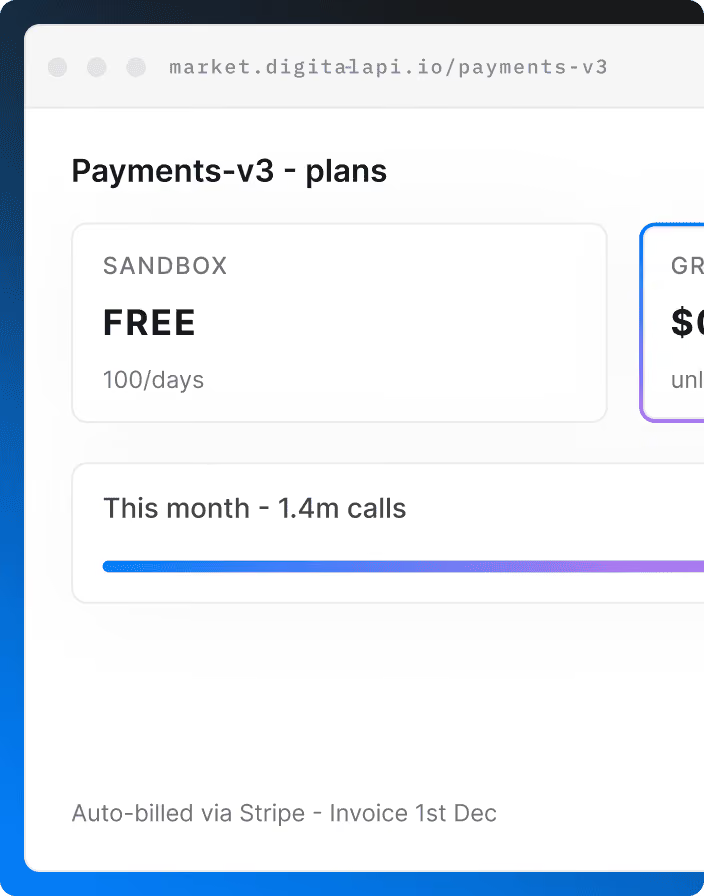
As APIs scale, predictable costs matter as much as performance. DigitalAPI avoids traffic-based price creep by separating growth from pricing, supporting mobile, partner, and AI workloads with clear, stable economics.
1. Zero-Overhead Performance
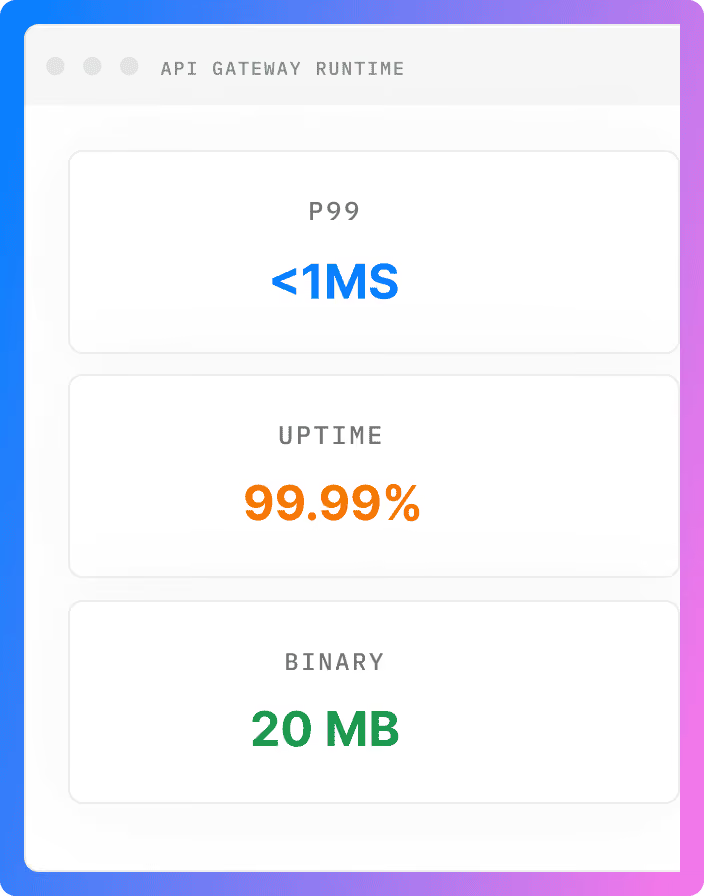
The Arelio API Gateway is a fast, scalable, and zero-overhead solution. Unlike heavy integration runtimes that add latency, Arelio ensures your high-volume APIs execute instantly.
2. Designed for AI and agent-driven workloads
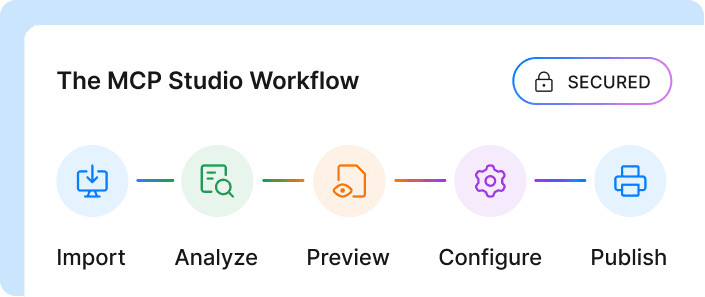
AI agents trigger many backend calls per request. DigitalAPI supports MCP, keeping interactions structured without per-call cost pressure, so teams can scale AI adoption across products without unexpected usage spikes.
3. Central control without platform lock-in
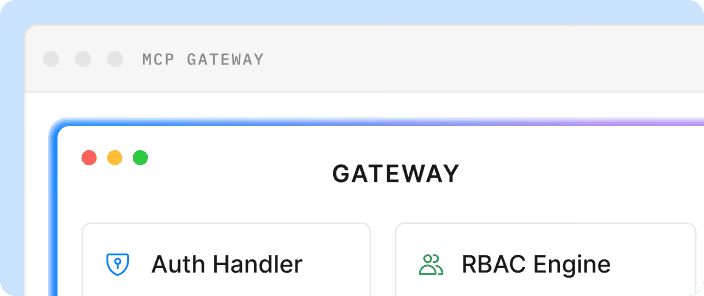
DigitalAPI provides a unified control plane across MuleSoft, Kong, and other gateways, giving teams governance and visibility while avoiding vendor lock-in and supporting long-term architecture decisions without cost or control trade-offs.
By pairing MuleSoft for integration depth and DigitalAPI for traffic scale, enterprises gain a balanced setup that supports growth without cost volatility.
.png)
Frequently Asked Questions
How much is a MuleSoft vCore?
MuleSoft pricing is negotiated, not public. Enterprise contracts often start in six figures, then rise quickly as message volume and bundled usage increase over time.
Can I just use MuleSoft for everything?
You can use MuleSoft everywhere, but it wastes money. Running processing for simple proxying or streaming delivers functionality, yet licensing and operations costs remain high.
Is DataWeave a lock-in risk?
DataWeave is proprietary to MuleSoft, so transformations are not portable. Migrating to other platforms requires rewriting logic, increasing effort, time, and dependency risks during platform changes.
How does DigitalAPI help with MuleSoft costs?
DigitalAPI sits in front of high-volume traffic, removing MuleSoft per-message fees, while MuleSoft remains focused on complex backend integrations where its orchestration capabilities deliver value.
Dhayalan Subramanian is Associate Director, Product Growth at DigitalAPI, where he leads go-to-market and product growth for the company’s multi-gateway API management platform. His work focuses on helping large enterprises and mid-market cloud companies consolidate APIs across AWS, Azure, Apigee, Kong, MuleSoft, and other gateways into a single control plane for governance, discovery, monetization, and agent consumption.
Dhayalan brings 14+ years of experience across product strategy, enterprise architecture, and engineering leadership. Earlier in his career, he held senior roles at Encora (as Associate Architect and Technical Manager), Mindtree (Technology Lead), Tech Mahindra (Technical Lead), and Primus Analytics, where he designed integration frameworks and delivered enterprise-grade digital platforms for global customers.
At DigitalAPI, he works directly with platform, integration, and developer experience leaders at Fortune 500 organizations to operationalize unified API catalogs, developer portals, and MCP-ready APIs. He writes regularly on API developer experience, API governance, and AI agent architectures.
One email a fortnight. Worth opening.
A short digest of what we're writing, what we're learning from customers, and the handful of links you'd actually want from us. No tracking pixels.

.avif)