


MCP Marketplace: How to Find, Publish, Govern and Monetize MCP Servers (2026)
An MCP marketplace is a catalog where developers and AI apps find, install and pay for MCP servers. Learn the main public options and how to publish, govern and monetize your own.


An MCP marketplace is a catalog where developers and AI applications find, install and sometimes pay for MCP servers, the programs that give AI agents tools to act in other software. Some marketplaces are public directories anyone can browse. Others are private catalogs a company runs for its own teams and partners.
The space now has an official source of truth. The MCP Registry launched in preview on 8 September 2025, backed by Anthropic, GitHub, Microsoft and PulseMCP, and public marketplaces build on top of it.
This guide explains what an MCP marketplace is, how the official registry works, the main public options in 2026, and how to publish, govern and monetize your own MCP servers.
TL;DR
To find MCP servers, start with the official MCP Registry and a few well-known public directories, and treat every listing as unvetted until you check it. To run your own MCP marketplace, publish servers with clear metadata and versions, approve what agents can use, enforce OAuth and per-tool access, and pick a pricing model your metering can support. If you already run an API marketplace, extend it to MCP rather than building a second catalog.
What is an MCP marketplace?
An MCP marketplace is defined as a searchable catalog of MCP servers that lets people and AI applications discover, evaluate, install and, in some cases, buy access to them. It sits between the teams that build MCP servers and the agents that use them.
MCP stands for Model Context Protocol, the open standard for connecting AI applications to tools and data. An MCP server exposes tools, such as "create ticket" or "look up order". Our guide to MCP tools explains how those tools work.
A good MCP marketplace answers four questions for every server:
- What does it do? A description, a list of tools and examples.
- Who made it? A verified publisher, not an anonymous fork.
- Is it safe? Security checks, required permissions and how it signs in.
- How do I use it? An install snippet or a connection URL for your AI client.
[fs-toc-omit]How does an MCP marketplace differ from a registry, a directory and a gateway?
These four terms get mixed up. They do different jobs, and most companies end up needing more than one.
| MCP registry | MCP directory | MCP marketplace | MCP gateway | |
|---|---|---|---|---|
| What it holds | Server metadata: names, versions, where to get them | Listings, often scraped or community-submitted | Listings plus install, trust signals and sometimes billing | Live connections to servers and tools |
| Who runs it | The MCP project, or a company for its own servers | Community or independent sites | Vendors, cloud providers or your own platform team | Your platform team |
| Does it run servers? | No | No | Sometimes | Routes calls to them |
| Does it govern access? | No | No | Sometimes, at sign-up | Yes, on every call |
| Best for | A source of truth other catalogs build on | Browsing what exists | Finding, installing and paying for servers | Controlling what agents can call in production |
In short, a registry records what exists, a marketplace helps people choose and get access, and a gateway enforces what agents can do at runtime. Our guides to the MCP registry and the MCP gateway cover each in depth.
How does the official MCP Registry work?
The official MCP Registry is a central metadata catalog for publicly available MCP servers, run by the MCP project and backed by Anthropic, GitHub, Microsoft and PulseMCP. It doesn't host servers. It records where to find them, so other marketplaces and private catalogs can build on one shared source.
According to the registry's own documentation, which still describes it as in preview, it works like this:
- Metadata only: Each server is described in a
server.jsonfile with its name, description, version and how to install or connect to it. - Reverse-DNS names: Server names follow a reverse-DNS pattern tied to a domain or account the publisher controls, so two servers can't claim the same name.
- Verified namespaces: Publishers prove they own their namespace through GitHub, a DNS record or an HTTP challenge before they can publish under it.
- Built to feed others: Public marketplaces and private sub-registries pull from it, then add their own curation, ratings or access rules.

This design matters for anyone running a marketplace. You don't need to scrape GitHub to find servers. You can sync from the official registry, then decide which servers your users see.
[fs-toc-omit]What is a private MCP registry?
A private MCP registry is a company's own catalog of MCP servers, visible only to its employees, partners or customers. It usually combines approved public servers with internal ones built from the company's own APIs. The official registry documentation describes private sub-registries as a supported pattern for enterprises.
What are the main public MCP marketplaces and directories in 2026?
The main public places to find MCP servers in 2026 are the official MCP Registry, a handful of large community directories and cloud marketplaces such as AWS Marketplace. They differ in how they verify servers, how big they are and whether you can install or buy from them.
| Marketplace or directory | Type | Size (self-reported) | What stands out | Best for |
|---|---|---|---|---|
| Official MCP Registry | Metadata registry | Not stated here | Verified publisher namespaces; feeds other catalogs | A trusted source of truth |
| MCP Market | Directory with a seller program | 54,595 servers (on-page counter, Nov 2026) | Large catalog and a page for selling servers | Browsing widely |
| MCP Marketplace (mcp-marketplace.io) | Directory | 55,100+ tools (on-page counter, Nov 2026) | Labels listings as security-scanned | Checking basic security signals |
| mcp.so | Community directory | Not stated here | Wide community listing | Discovering niche servers |
| Glama | Directory | Not stated here | Large browsable listing of servers | Comparing options |
| Smithery | Directory with install tooling | Not stated here | Focus on installing servers into clients | Developers setting up servers |
| PulseMCP | Directory | Not stated here | One of the backers of the official registry | Following new servers |
| AWS Marketplace | Cloud marketplace | Not stated here | Lists MCP servers next to other software; offers its own hosted MCP server for product discovery | Buying through existing cloud procurement |
Counts come from each site's own counter on 17 November 2026 and aren't independently audited. Large numbers also include duplicates, forks and abandoned projects, so a bigger catalog isn't always a better one.
If you're looking for the best MCP servers for a specific job, our list of 10 MCP tools and servers to try covers the most widely used ones, each checked against its maker's own documentation.
[fs-toc-omit]Are MCP marketplaces safe?
MCP marketplaces are as safe as the servers they list, and most public directories don't vet every listing. A listing tells you a server exists, not that it's maintained or trustworthy.
Before you install a server from any marketplace, check four things:
- Publisher: Is it from the company behind the product, or a verified namespace?
- Permissions: What can its tools change, and what scopes does it ask for?
- Sign-in: Does it use OAuth with your account, or a long-lived token in a config file?
- Activity: Has it been updated recently, and does it have a clear owner?
Our guide to MCP security covers the main threats, including tool poisoning and prompt injection.
Why do companies need their own MCP marketplace?
Companies need their own MCP marketplace because public directories can't list their internal APIs, can't enforce their access rules and can't tell them which servers their agents use. Tens of thousands of public listings don't help when the tool your agent needs is your own order API.
The pressure is growing. Gartner predicts that more than 30% of the increase in demand for APIs will come from AI and tools using large language models by 2026. Every new agent needs tools, and those tools mostly call your APIs.
Interest is also ahead of use. Postman's 2025 State of the API report found that 70% of developers are aware of MCP, but only 10% use it regularly. The same report found that 34% of teams can't find the APIs that already exist in their own company.
That last number predicts what happens with MCP servers. A pattern we see often: three teams each build an MCP server for the same order API, because none of them knew the others had. Each signs in differently, and security can't list which agents use which one.
A private MCP marketplace fixes three things:
- Discovery: Teams find an approved server before they build a new one.
- Trust: Only reviewed servers, public or internal, appear in the catalog.
- Control: Access, credentials and audit follow one set of rules.
How do you publish an MCP server to a marketplace?
To publish an MCP server, you build or generate the server, describe it in metadata, verify your namespace, version it and publish it to the registry or marketplace your users browse. The steps are the same whether the destination is the official registry or a private catalog.
- Build or generate the server: Write it with an official MCP SDK, or generate it from an existing OpenAPI spec. Generating keeps tool descriptions and schemas in sync with the API. DigitalAPI creates MCP servers from OpenAPI specs in one click; our guide to converting OpenAPI specs into an MCP server shows how it works.
- Write the metadata: Describe the server in
server.json: a reverse-DNS name, a plain-language description, the version and how to install or connect. - Verify your namespace: Prove you own the name through GitHub, DNS or an HTTP challenge. This stops others publishing under your name.
- Version it: Use clear version numbers and keep a changelog. Agents and the people who approve them need to know what changed.
- Publish: Push the metadata to the official registry for public servers, or to your private registry for internal ones.
- Document it: Add a short description of every tool, example prompts, the permissions it needs and an install snippet for common clients.
- Track adoption: Watch installs, active agents and failed calls, so you know which servers to improve or retire.
If you're building your first server, our guide on how to build an MCP server walks through the code side.
How do you govern an MCP marketplace?
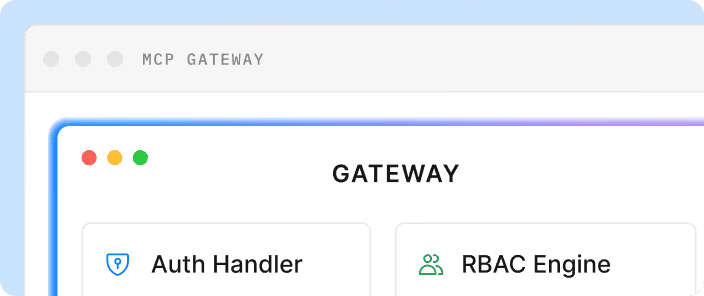
You govern an MCP marketplace by approving which servers appear, controlling which agents can use which tools, and recording every call. Listing is the easy part. Governance decides whether security lets agents into production.
The MCP authorization specification makes authorization optional. When a server is protected, it acts as an OAuth 2.1 resource server. That means a marketplace can't assume every server is protected. You have to enforce it.
| Control | Why it matters | How to enforce it |
|---|---|---|
| Approval workflow | Stops unreviewed servers reaching agents | A review step before any server is listed |
| Allow-list | Keeps agents on approved servers only | Agents connect through a catalog or gateway, not directly |
| OAuth 2.1 sign-in | Avoids shared, long-lived tokens | Require OAuth for every listed server |
| Per-agent, per-tool scopes | Limits damage if an agent misbehaves | Deny by default, then grant tools one by one |
| Audit logs | Lets you investigate mistakes | Log every call with agent, tool, inputs and result |
| Rate limits | Stops runaway agent loops | Cap calls per agent and per tool |
| Deprecation | Retires old versions safely | Announce dates and notify subscribed teams |
| Shadow server discovery | Finds servers installed outside the catalog | Review client configs and network traffic regularly |
Shadow MCP servers deserve attention. Developers can add a server to their IDE in a minute, so the catalog only governs what goes through it. Make the approved path the easiest path, or people will go around it. Our guide to MCP governance covers policies in more detail.
How do you monetize MCP servers?
You monetize MCP servers by charging for access through a subscription, a per-call or token-based price, a freemium tier, a revenue share or a cloud marketplace listing. The right model depends on how your customers' agents use the server and what you can meter.
| Model | How it works | Who meters usage | Best for |
|---|---|---|---|
| Free or open source | No charge; value comes from the product behind it | No one | Servers that drive use of a paid product |
| Freemium | Free up to a limit, then paid | Your gateway or billing system | Building adoption before charging |
| Subscription | Flat monthly or annual fee per plan | Plan limits in your platform | Predictable, steady use |
| Per-call | A price for every tool call | Your gateway | Calls with clear, similar value |
| Token-metered | A price based on data or tokens returned | Your gateway or the server | Data-heavy tools |
| Revenue share | A marketplace takes a share of each sale | The marketplace | Selling through someone else's catalog |
| Cloud marketplace listing | Customers buy through their cloud account | The cloud provider | Enterprise buyers with cloud budgets |
Most API monetization models carry over to MCP. Our guide to API monetization models covers them in depth.
[fs-toc-omit]Who meters and bills: the marketplace, the gateway or you?
Whoever sees every call can meter it. A public marketplace can bill only if calls go through it. If agents call your server directly, your gateway or the server itself must count usage and pass it to billing. Decide this before you set a price, because a model you can't meter is a model you can't charge for.
[fs-toc-omit]What are the common pricing pitfalls?
- Agent loops: An agent stuck in a loop can make thousands of calls. Set usage caps and alerts, and decide who pays for runaway usage.
- Unclear units: A "call" can mean one simple lookup or a heavy report. Price expensive tools separately.
- Free tiers without limits: Agents scale faster than people. Cap free usage per agent, not only per account.
Should you build an MCP marketplace or extend your API marketplace?
If you already run an API portal or marketplace, extend it to MCP rather than building a separate catalog. MCP servers mostly call your APIs, so they need the same products, plans, keys, approvals and audit trail.
Running two catalogs means two places to search, two sets of keys and two audit trails that never match. It also means an MCP server can drift away from the API it wraps.
| Build a separate MCP marketplace | Extend your API marketplace | |
|---|---|---|
| Catalog | A second catalog for servers | One catalog for APIs and MCP servers |
| Access and keys | New sign-up and key system | Same subscriptions, plans and approvals |
| Billing | New metering and billing setup | Same pricing models and billing pipeline |
| Audit | A separate log | One trail for API and agent traffic |
| Keeping in sync | Servers rebuilt by hand when APIs change | Servers generated from the same specs |
| Best for | Companies with no API program yet | Companies that already publish APIs |
In practice, extending means federating APIs from every gateway into one catalog, generating each MCP server from its API's OpenAPI spec, and putting both behind the same products, plans and subscriptions. Partners and agents then get access through the same approval and pay through the same plan. Our guide to what an API marketplace is explains the foundation.
[fs-toc-omit]Is an MCP marketplace right for you?
Running your own MCP marketplace is right for you if:
- Several teams are building agents that need your internal APIs
- You want partners or customers to use your APIs through AI agents
- Security has to approve and audit which tools agents can call
- You plan to charge for API or agent access
It's not right for you yet if:
- You only use a few public servers for individual developers
- You have no internal APIs that agents need
- No one owns API access and governance today
What does a good MCP marketplace look like?
A good MCP marketplace makes the right server easy to find, safe to install and simple to pay for. Use these seven checks to judge a public marketplace or plan your own.
- Search that works: Find servers by task, product and category, not only by name.
- Trust signals: Verified publishers, security checks and a visible maintenance status.
- Install snippets: One-step setup for common clients like Claude, Cursor and VS Code.
- Versioning: Clear versions, changelogs and deprecation dates.
- Access control: Approval before use, with scopes per agent and per tool.
- Metering: Usage counted per agent, per tool and per plan.
- Analytics: Installs, active agents, errors and revenue for every server.
A marketplace that scores well on the first three helps people find servers. One that scores well on all seven is ready for production agents.
How can you offer an MCP marketplace to your customers?
You offer an MCP marketplace to your customers by listing MCP servers next to the APIs they wrap, in the same portal, under the same plans, access rules and billing. Customers browse one catalog, subscribe once and connect their agents to the tools their plan allows. You don't need a second storefront for MCP.
DigitalAPI's API marketplace works this way. The marketplace you use to sell APIs to partners also lists MCP servers for their agents, so every API you publish can become an agent-ready product.
| What your customers need | How the marketplace handles it |
|---|---|
| Find the right tool | One AI-tagged catalog with natural-language search across APIs and MCP servers |
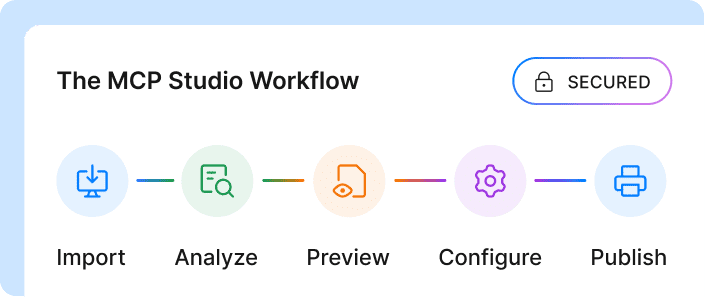
| A server for every API | MCP Studio generates a hosted MCP server from an OpenAPI spec, GitHub repo or Postman collection, grouped by business domain, with tools tagged read, write or sensitive |
| Servers from elsewhere | Your own or third-party remote MCP servers connect through encrypted tunnels and appear in the same catalog |
| A quick connection | Each server gets a live endpoint URL and a ready-to-paste client configuration |
| Safe sign-in | OAuth 2.1, API keys or mTLS, issued from the same key store as API access |
| Only what they paid for | Deny-by-default scopes per customer, per agent and per tool, with rate, quota and burst limits |
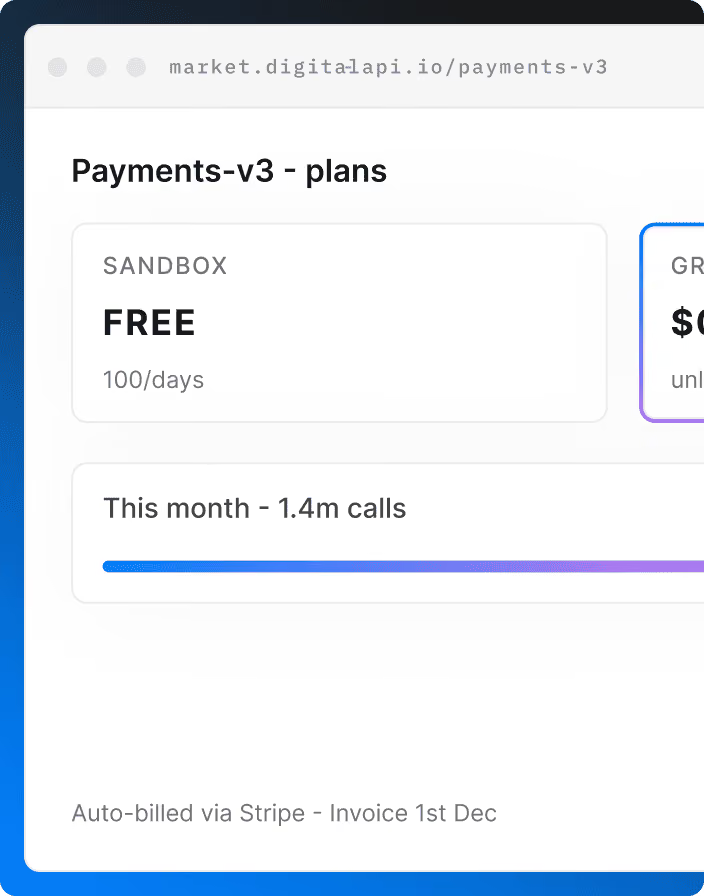
| A clear bill | Subscription plans and usage tiers, with MCP calls metered and audited alongside API traffic so finance bills from one pipeline |
For your team, that means one catalog to run instead of two. Teams using DigitalAPI launch an MCP marketplace for customers without building a second portal, and the marketplace goes live in 4 to 8 weeks. See the API marketplace for the catalog and billing side, and MCP Studio for turning APIs into MCP servers.
FAQs
[fs-toc-omit]What is an MCP marketplace?
An MCP marketplace is a catalog where developers and AI applications find, install and sometimes pay for MCP servers. It lists what each server does, who published it and how to connect to it. Some are public directories, and others are private catalogs that companies run for their own teams, partners and customers.
[fs-toc-omit]Is the MCP market legit?
Large MCP directories are real, widely used catalogs, but a listing isn't an endorsement. Most public directories collect servers from many sources and don't vet each one. Check the publisher, the permissions, the sign-in method and recent activity before you install any server.
[fs-toc-omit]Are MCP marketplaces safe?
MCP marketplaces are as safe as the servers they list. Prefer servers from the company behind the product or from verified namespaces in the official MCP Registry, use the narrowest permissions, require approval for tools that change data and make sure every call is logged.
[fs-toc-omit]Does using MCP cost money?
The Model Context Protocol itself is free and open. Many MCP servers are free to install, but you still pay for the product behind them, such as a SaaS account. Some servers charge for access through subscriptions, per-call pricing or cloud marketplace listings.
[fs-toc-omit]What's the difference between an MCP registry and an MCP marketplace?
An MCP registry records which servers exist, with metadata such as names, versions and where to get them. An MCP marketplace builds on a registry and adds discovery features, trust signals, installation and sometimes billing. The official MCP Registry is designed to feed public and private marketplaces.
[fs-toc-omit]How do I publish my MCP server?
Build or generate the server, describe it in a server.json metadata file, verify your namespace through GitHub, DNS or HTTP, version it and publish it to the official MCP Registry or a private registry. Then add documentation, example prompts and an install snippet so people can use it.
[fs-toc-omit]Can I sell an MCP server?
Yes. You can charge for an MCP server through a subscription, a per-call or token-based price, a freemium tier, a revenue share on a marketplace or a cloud marketplace listing. Choose a model you can meter, because you can only bill for the usage you can count.
[fs-toc-omit]Can I offer an MCP marketplace to my own customers?
Yes. List your MCP servers in the same portal as the APIs they wrap, and put both behind the same plans, sign-in and access rules. Customers subscribe once, connect their agents to the tools their plan allows, and pay through the same billing as API access, with every MCP call metered and logged.
[fs-toc-omit]What is a private MCP registry?
A private MCP registry is a company's own catalog of MCP servers, visible only to its employees, partners or customers. It usually combines approved public servers with servers built from internal APIs, and it applies the company's own approval, access and audit rules.
Final word
The public MCP marketplaces solve discovery. They show you what exists. They can't decide which servers your agents should trust, which internal APIs should become tools or what partners should pay.
That part is yours. Start by listing the MCP servers your teams already use, mark which ones call your own APIs, and decide who approves the next one.
Your agents and partners need one place to find, trust and pay for your tools.
See how DigitalAPI runs MCP servers and APIs in one marketplace.
Dhayalan Subramanian is Associate Director, Product Growth at DigitalAPI, where he leads go-to-market and product growth for the company’s multi-gateway API management platform. His work focuses on helping large enterprises and mid-market cloud companies consolidate APIs across AWS, Azure, Apigee, Kong, MuleSoft, and other gateways into a single control plane for governance, discovery, monetization, and agent consumption.
Dhayalan brings 14+ years of experience across product strategy, enterprise architecture, and engineering leadership. Earlier in his career, he held senior roles at Encora (as Associate Architect and Technical Manager), Mindtree (Technology Lead), Tech Mahindra (Technical Lead), and Primus Analytics, where he designed integration frameworks and delivered enterprise-grade digital platforms for global customers.
At DigitalAPI, he works directly with platform, integration, and developer experience leaders at Fortune 500 organizations to operationalize unified API catalogs, developer portals, and MCP-ready APIs. He writes regularly on API developer experience, API governance, and AI agent architectures.


One email a fortnight. Worth opening.
A short digest of what we're writing, what we're learning from customers, and the handful of links you'd actually want from us. No tracking pixels.