



API Reference Documentation: How to Write It So Customers Don't Need a Meeting
API reference documentation describes every endpoint: what it does, accepts, returns and how it fails. Learn what to include, get a template and see how to generate it from OpenAPI.

API reference documentation is the complete technical description of every endpoint in an API: what it does, what it accepts, what it returns and how it fails. It's the part of your docs developers keep open while they build, and when it's incomplete, they book a call instead.
That gap is common. In Postman's 2023 State of the API Report, 52% of respondents said lack of documentation was the biggest obstacle to consuming APIs.
This guide explains what an API reference is, what every endpoint entry should include, how to write and generate one from OpenAPI, which API documentation examples to learn from and how to tell whether your reference works.
TL;DR
A good API reference answers the questions customers would otherwise ask on a call: which endpoint to use, how to get access, what each value means, how errors are fixed and what limits apply. Generate the structure from your OpenAPI spec, then write the descriptions, examples and error fixes by hand. Measure it by time to first call and by how many meetings new customers still need.
What is API reference documentation?
API reference documentation is defined as the structured, endpoint-by-endpoint description of an API's operations, parameters, responses, errors and limits. Developers use it to look up exact details while they write code, not to learn the API from scratch.
An API reference usually covers every resource and endpoint, the HTTP method and path, the request parameters and body, example requests and responses, status codes and error messages, authentication and limits. The UK government's guidance on writing API reference documentation lists the same core: resources, endpoints and methods, parameters, examples and error codes.
[fs-toc-omit]API reference vs API documentation vs guides
API documentation is the whole set of material that helps developers use an API. The reference is one part of it. Guides and tutorials are another.
Most teams need all three. The reference is where incomplete docs hurt most, because it's where developers go when something doesn't work.
Why do customers book a meeting when the reference is weak?
Customers book a meeting when the reference describes the API's shape but not how to use it. A field list tells them a parameter exists. It doesn't tell them which value to send, when to call the endpoint or what to do when it fails.
A pattern we see often: a retail software company had a complete, generated reference for its APIs. Its customers still couldn't integrate without a call with the solutions team. The reference listed every field, but not what the values meant in the customer's business, or which of three similar endpoints to use.
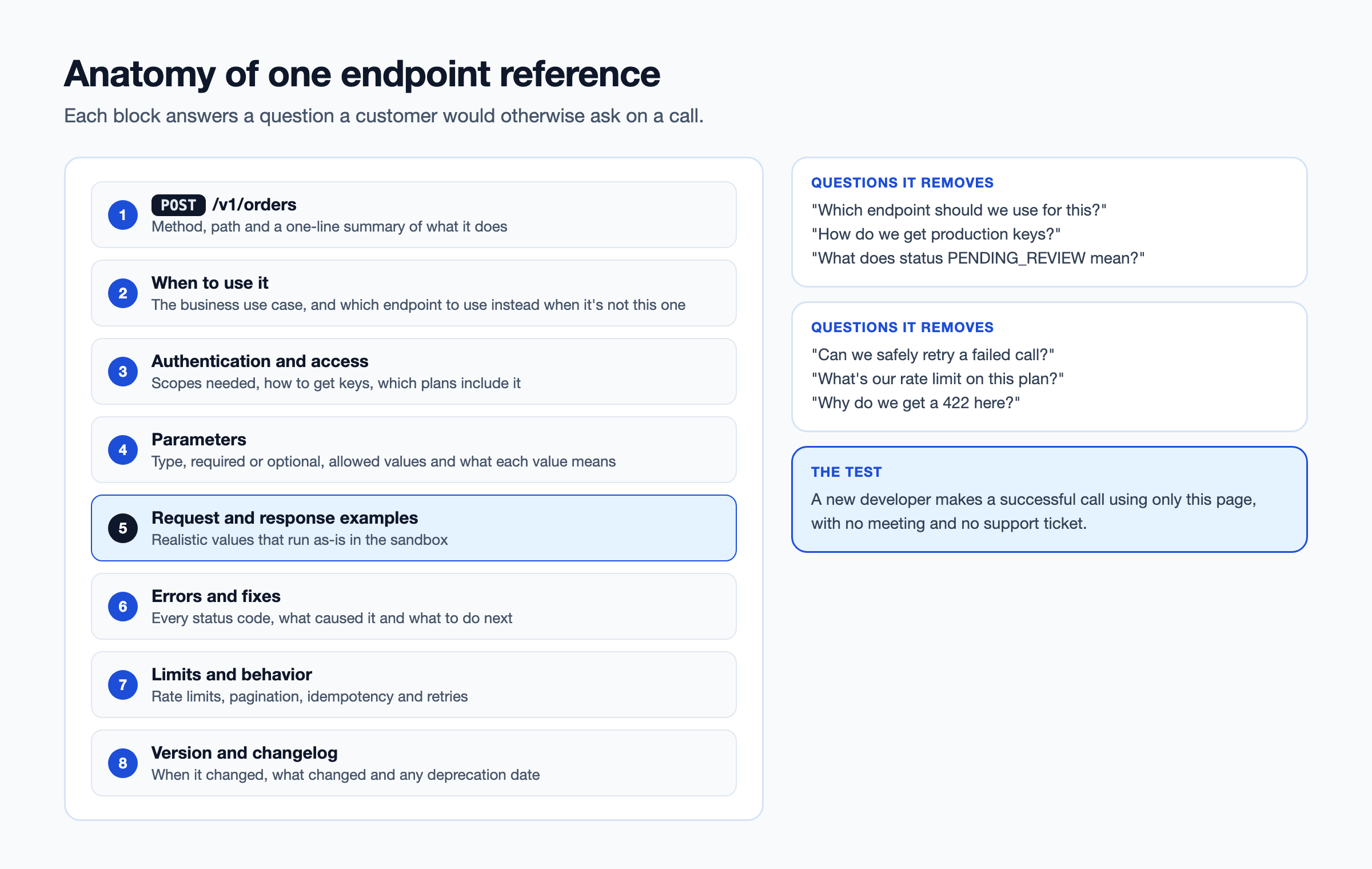
These are the eight questions that turn into meetings, and the part of the reference that should answer each one:
Inconsistency makes this worse at scale. Postman's 2025 State of the API report found 55% of teams name inconsistent documentation as their top collaboration blocker. When each team writes its reference differently, customers can't carry what they learned from one API to the next.
What should API reference documentation include?
A complete API reference includes 12 elements: an overview, authentication, endpoints, parameters, request and response examples, errors, rate limits, pagination, idempotency, versioning and status. The first six are standard. The last six are what remove the follow-up questions.
- Overview and base URLs: What the API does, the base URL for each environment and the format it uses, such as JSON over HTTPS.
- Authentication: How to authenticate, which scopes each endpoint needs and how to get credentials, with a link to the sign-up or key request flow.
- Endpoints and methods: Every operation with its method, path, one-line summary and a "when to use it" line.
- Parameters: Name, location (path, query, header or body), type, required or optional, default, allowed values and what each value means.
- Request examples: A complete, realistic request for every operation, in at least one language or as a raw HTTP call.
- Response examples: A successful response with realistic data, plus the response schema with each field described.
- Errors with fixes: Every status code and error code the endpoint can return, what causes it and what to do next.
- Rate limits: The limits per plan, the headers that show remaining calls and what happens when a client hits the limit.
- Pagination: How lists are paged, the page size limits and how to fetch the next page.
- Idempotency and retries: Which operations are safe to retry, how to send an idempotency key if you support one and which errors are worth retrying.
- Versioning and changelog: The current version, what changed and when, and deprecation dates with migration notes.
- Status and support: Where to check API status, the support route and any service levels that apply.
Our guide to common API documentation mistakes covers what goes wrong when these are missing.
How do you write API reference documentation, step by step?
Write API reference documentation by starting from a clean OpenAPI spec, then adding the use cases, examples and error fixes that a generator can't produce. These eight steps work for a single API or a large catalog.
- Start from the spec: Make the OpenAPI description the single source for paths, parameters and schemas. Don't maintain a second copy by hand.
- Lint the spec: Check naming, required descriptions, examples and error responses against a style guide before you publish anything.
- Write descriptions for the use case: "The order's current state in your fulfillment process" helps more than "Order status". Describe what a field means to the customer, not only its type.
- Add a real example to every operation: Use realistic values that work in the sandbox. Placeholder values like "string" or "123" force developers to guess.
- Document every error with its fix: For each error, say what caused it and what the developer should change. "Invalid request" alone isn't documentation.
- Add the access path: Show how to get keys, which plan includes the endpoint and whether production access needs approval.
- Test with a new developer: Ask someone who hasn't used the API to make a working call with only the reference. Note every question they ask.
- Publish and version it: Publish the reference with the API version it describes, keep a changelog and announce breaking changes before they ship.
Step seven is the one most teams skip, and it's the cheapest way to find the questions that would otherwise become meetings. Our guide to docs as code shows how to keep the reference in the same review process as the API itself.
API reference documentation template
Use this per-endpoint template for every operation in your API reference. Each row is a section of the entry. Fill in all of them, and write "Not applicable" rather than leaving one out.
A short plain-text version of one entry looks like this:
POST /v1/orders: Create an order
Use this when a customer completes checkout. Requires the orders:write scope. Returns 201 with the new order. If currency isn't supported, you'll get 422 invalid_currency: check GET /v1/currencies for valid values. Retries are safe with an Idempotency-Key header.
Copy the table into your docs tool or use it as a review checklist for generated entries.
How do you generate API reference docs from OpenAPI?
You generate API reference docs from OpenAPI by publishing the spec through a documentation tool that renders each operation as a reference page. The generator handles structure. The quality of the result depends on what's written in the spec.
The OpenAPI Specification defines a standard, language-agnostic way to describe HTTP APIs, so people and computers can understand a service without its source code. Every description, example and error response you add to the spec becomes part of the generated reference.
Here's the trade-off between generating and writing by hand:
The best approach is both: generate the structure from the spec, and write the descriptions, examples and error fixes inside the spec so they flow into every page. Our guide to API documentation generators compares the main options.
Generation only works if the spec is good. DigitalAPI scores every API's spec for documentation, style and security before it's published, so gaps like missing descriptions or examples are caught before customers see them.
[fs-toc-omit]How do you keep reference docs consistent across many teams?
Consistency breaks when each team owns its own spec, style and docs tool, especially across several API gateways. The fix is a shared style guide, automated checks on every spec and one portal that publishes every API in the same format. With DigitalAPI, specs from different gateways are checked against the same rules and published to one developer portal, so customers see one consistent reference.
What are the best API reference documentation examples?
The most cited API reference documentation examples come from Stripe, Twilio, GitHub, Plaid and Google Maps. Each is worth studying for one thing it does well, not as a template to copy whole.
What these references share is more useful than any single one: every endpoint follows the same structure, examples use realistic values and errors come with explanations. Our collection of good API documentation examples covers more of them in depth.
How do you make API reference docs readable by AI agents?
Make API reference docs readable by AI agents by writing clear operation descriptions, including examples and keeping the spec machine-readable. Agents read the same descriptions developers do, and they guess when the text is vague.
AI is already part of how documentation is made. Postman's 2025 report found about 40% of respondents use AI to generate API documentation. Agents are also becoming readers of it.
- Describe intent, not only fields: An agent chooses an endpoint from its description. "Creates an order at checkout" is easier to choose correctly than "Orders endpoint".
- Include examples for every operation: Examples show valid inputs better than schemas alone.
- Keep the spec published and current: Agents and tools can read an OpenAPI file directly. A spec that's out of date misleads them.
- Offer a plain-text entry point: Some teams publish an llms.txt file that points AI tools to the most useful pages.
- Turn operations into tools: A well-described operation can become an MCP tool for agents with little extra work.
Our guide to API docs for AI agents covers what to fix first.
How do you know if your API reference works?
Your API reference works when new customers make a successful first call without a meeting or a support ticket. Measure that directly instead of counting pages or endpoints documented.
Track these five signals:
- Time to first call: Minutes from getting credentials to the first successful request. Our guide to reducing time to first call explains how to cut it.
- First-request error rate: The share of first calls that fail. A high rate points to unclear parameters or examples.
- Support tickets per endpoint: Endpoints that generate the most tickets need better descriptions or error fixes.
- Meetings per new customer: Count the integration calls each new customer needs. It's the clearest measure of what the reference leaves out.
- Searches with no result: Terms developers search for in your docs that return nothing.
Developers also say documentation is where they go first. In Stack Overflow's 2024 Developer Survey, API and SDK documents were the documentation source of choice for 90% of developers. When your reference doesn't answer them, they go to your support team instead.
Teams using DigitalAPI track time to first call and usage per API in the same portal that publishes the reference, so they can see which docs are working.
[fs-toc-omit]Is a generated, governed API reference right for you?
It's right for you if:
- Your customers or partners integrate with several of your APIs
- Integration calls with solutions engineers are a regular part of onboarding
- Different teams write their reference docs in different ways
It's probably not necessary if:
- You have one small API with a handful of endpoints
- Only your own engineers use it, and they can read the code
For a wider look at the tools available, see our guide to the best API documentation tools, and for how the reference fits into the bigger picture, see the API developer journey.
FAQs
[fs-toc-omit]What is an API reference?
An API reference is the part of API documentation that describes every endpoint in detail: the method and path, parameters, request and response examples, errors, authentication and limits. Developers use it to look up exact details while they build, rather than to learn the API from the start.
[fs-toc-omit]What's the difference between API reference and API documentation?
API documentation is the full set of material that helps developers use an API, including overviews, getting-started guides, tutorials and the reference. The API reference is the structured, endpoint-by-endpoint part. Guides teach a task. The reference gives the exact details of each operation.
[fs-toc-omit]What should an API reference include?
An API reference should include an overview and base URLs, authentication, every endpoint with its method and path, parameters with types and allowed values, request and response examples, errors with causes and fixes, rate limits, pagination, idempotency and retry rules, versioning with a changelog, and status and support details.
[fs-toc-omit]How do I write API reference documentation?
Start from an accurate OpenAPI spec and lint it. Write descriptions that explain what each field means to the customer, add a realistic example to every operation and document every error with its fix. Add how to get access, test the reference with a developer who hasn't used the API, then publish it with a version and changelog.
[fs-toc-omit]Can API reference docs be generated automatically?
Yes. Documentation tools can generate a complete API reference from an OpenAPI description, which keeps it in sync with the API. The generated reference is only as good as the spec, so descriptions, examples and error responses still need to be written into the spec by people who know the domain.
[fs-toc-omit]What is the best API documentation example?
Stripe's API reference is the most cited example, known for placing explanations and code samples side by side. Twilio, GitHub, Plaid and Google Maps Platform are also widely referenced. The common thread is a consistent structure for every endpoint, realistic examples and errors that come with explanations.
[fs-toc-omit]What format should API reference docs use?
Most REST API references are generated from an OpenAPI description, in YAML or JSON, and published as web pages with one entry per operation. The format readers see should follow the same structure for every endpoint: summary, when to use it, authentication, parameters, examples, errors, limits and version history.
[fs-toc-omit]How often should API reference docs be updated?
Update the API reference every time the API changes, ideally in the same release. Generating the reference from the spec makes this automatic for structure. Review descriptions and examples at least once a quarter, and log every change in a changelog so customers can see what's different.
Final word
The test of an API reference isn't how many endpoints it lists. It's whether a new customer can make a working call on their own, without a meeting.
Pick the endpoint that generates the most integration calls, run it against the template above and fill in every row that's empty.
Turn your reference docs into fewer onboarding calls.
See how DigitalAPI generates reference docs your customers can use without a call.
Dhayalan Subramanian is Associate Director, Product Growth at DigitalAPI, where he leads go-to-market and product growth for the company’s multi-gateway API management platform. His work focuses on helping large enterprises and mid-market cloud companies consolidate APIs across AWS, Azure, Apigee, Kong, MuleSoft, and other gateways into a single control plane for governance, discovery, monetization, and agent consumption.
Dhayalan brings 14+ years of experience across product strategy, enterprise architecture, and engineering leadership. Earlier in his career, he held senior roles at Encora (as Associate Architect and Technical Manager), Mindtree (Technology Lead), Tech Mahindra (Technical Lead), and Primus Analytics, where he designed integration frameworks and delivered enterprise-grade digital platforms for global customers.
At DigitalAPI, he works directly with platform, integration, and developer experience leaders at Fortune 500 organizations to operationalize unified API catalogs, developer portals, and MCP-ready APIs. He writes regularly on API developer experience, API governance, and AI agent architectures.



One email a fortnight. Worth opening.
A short digest of what we're writing, what we're learning from customers, and the handful of links you'd actually want from us. No tracking pixels.