



Developer Portal vs API Marketplace: What's the Difference and Which Do You Need?
Dev Portal vs API Marketplace: Understand key differences. Choose the right platform to manage your APIs effectively or achieve broad reach and monetization.

TL;DR
1. A developer portal is the front door. An API marketplace is the storefront. The portal gets developers oriented, tested, and integrated. The marketplace is where APIs are discovered, priced, subscribed to, and monetised.
2. They solve different problems, but they are not alternatives. Most serious API programmes need both, and the leading ones run them as a single continuous experience rather than two separate tools.
3. Portals optimise for time-to-first-call. Marketplaces optimise for time-to-revenue. One compresses the integration window. The other turns integration into a commercial transaction.4. Separate tools create a seam developers feel. A marketplace in one system and a portal in another forces context switches, duplicate auth, and inconsistent docs. The fix is unified by design, not integrated after the fact.
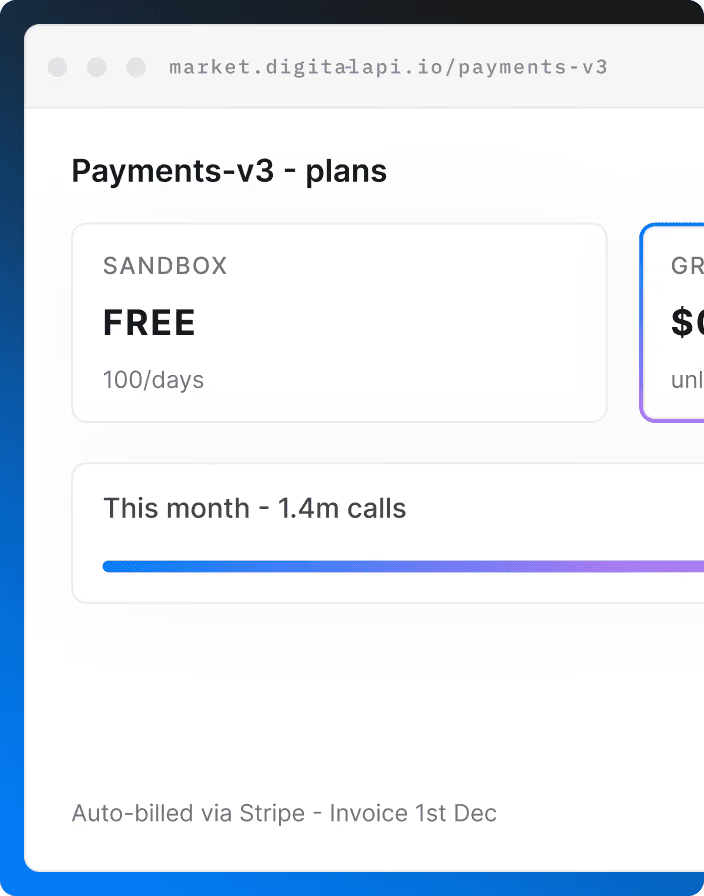
5. DigitalAPI's API developer portal combines portal and marketplace functionality in one platform - persona-based navigation, in-portal testing, usage-based billing, and subscription management - so teams avoid running two systems with two auth layers.
Get started with DigitalAPI 's API Marketplace and Developer Portal. Book a Demo!
The landscape of digital connectivity is largely shaped by Application Programming Interfaces, or APIs, serving as the conduits for data exchange and service interaction. As businesses increasingly leverage APIs to extend capabilities and unlock new value, two distinct, yet often confused, platforms emerge: the Developer Portal and the API Marketplace.
While both aim to foster API adoption and usage, their underlying philosophies, strategic objectives, and operational models diverge considerably. Navigating this distinction is crucial for any organization charting its API strategy, determining whether to cultivate a dedicated ecosystem for its offerings or to seek broader exposure and monetization through a curated public platform. Understanding their core functionalities will illuminate the path to the most suitable choice.
Understanding the Core Concepts: Developer Portal vs. API Marketplace
Before diving into which solution your organization needs, it's essential to clearly define what each platform is designed to do. While they both facilitate API discovery and consumption, their scope, purpose, and target audience are fundamentally different.
What is an API Developer Portal?
An API Developer Portal is a centralized, self-service website or platform that an organization uses to expose and manage its own APIs to internal, partner, or external developers. Think of it as your company's storefront for its digital products (APIs). Its primary goal is to foster API adoption by providing developers with all the necessary tools and information to easily discover, understand, test, and integrate with your APIs.
The focus of a developer portal is to create an exceptional developer experience (DX). It acts as a comprehensive resource hub, guiding developers from initial discovery to successful implementation. A well-designed developer portal drastically reduces onboarding time and increases the likelihood of your APIs being used effectively.
Key Features of an API Developer Portal:
- Comprehensive API Documentation: Detailed, interactive documentation (often auto-generated from OpenAPI specs) that explains what each API does, its endpoints, parameters, request/response formats, and error codes. This is crucial for developer adoption.
- API Discovery: Search functionality, categories, and filters to help developers quickly find the APIs relevant to their needs.
- API Keys and Authentication Management: A streamlined process for developers to register, obtain API keys, and manage their credentials for secure access. This might involve API access management or API key management tools.
- Interactive Sandbox Environments: A safe, isolated environment where developers can test APIs with mock data without impacting live systems. This significantly accelerates the development cycle.
- Code Samples and SDKs: Ready-to-use code snippets in various programming languages and software development kits (SDKs) to facilitate quicker integration.
- Support Resources: FAQs, forums, tutorials, blogs, and contact options to help developers troubleshoot issues and get assistance.
- Usage Analytics: Dashboards for API providers to monitor API consumption, identify popular APIs, track performance, and understand developer behavior.
- Onboarding Workflows: Guided paths for new developers to sign up, explore APIs, and make their first successful API call, often including self-serve signup and approval processes.
- Versioning Management: Clear communication and tools for managing API versions, including deprecation policies and migration guides.
A well-executed developer portal is a cornerstone of a successful API program, whether for internal enablement, partner ecosystem growth, or public API exposure. Companies like Stripe, Twilio, and Google Maps API are prime examples of organizations leveraging robust developer portals to drive their business.
What is an API Marketplace?
An API Marketplace is an online platform that acts as an intermediary, aggregating APIs from multiple providers and offering them for discovery and consumption by a broad developer audience. Unlike a developer portal, which showcases a single company's APIs, an API marketplace is a multi-vendor platform where various organizations can list, sell, and manage their APIs.
The primary goal of an API marketplace is often to facilitate API monetization and create a vibrant ecosystem where API providers can reach a wider customer base, and developers can find a diverse range of APIs to integrate into their applications, often on a pay-per-use or subscription basis.
Key Features of an API Marketplace:
- Multi-Provider API Catalog: A comprehensive directory of APIs from numerous providers, allowing developers to browse and search across a wide spectrum of services.
- Search and Discovery: Advanced search, filtering, and categorization to help developers find specific APIs among a large collection.
- Billing and Metering: Integrated systems for tracking API usage, managing subscriptions, and handling payments between consumers and providers. This is central to API monetization.
- Rating and Reviews: Features for developers to rate and review APIs, helping others assess quality and reliability.
- Subscription Management: Tools for developers to manage their API subscriptions, track usage, and monitor billing.
- Provider Dashboards: Portals for API providers to list their APIs, set pricing, view usage statistics, and manage their presence on the marketplace.
- Standardized API Consumption: Often provides a consistent experience for consuming APIs, regardless of the underlying provider, sometimes through unified SDKs or API gateways.
API marketplaces, such as RapidAPI, AWS Marketplace, or specific industry-focused marketplaces, thrive by connecting a vast pool of developers with a diverse array of API products, enabling new revenue streams and fostering innovation across industries. For organizations looking to sell their APIs, building an API marketplace for monetization becomes a crucial step.
Developer Portal vs. API Marketplace: Key Differences Unpacked
While both platforms serve as gateways to APIs, their fundamental distinctions lie in their ownership, scope, goals, and monetization approach.
1. Ownership and Scope
- Developer Portal: Owned and operated by a single organization. It exclusively showcases that organization's own APIs. The scope is limited to the APIs provided by the single entity.
- API Marketplace: Typically, an independent platform that aggregates APIs from multiple providers. Its scope is much broader, encompassing a diverse ecosystem of APIs from various companies.
2. Primary Goal and Value Proposition
- Developer Portal: The primary goal is to drive the adoption and successful integration of the owning company's APIs. It aims to improve the developer experience (DX), reduce friction, and provide comprehensive resources, thereby maximizing the value derived from the company's own API program.
- API Marketplace: The main objective is to facilitate broad API discovery and monetization. For providers, it's about reaching a wider audience and generating revenue. For consumers, it's about finding a variety of APIs to solve diverse problems, often with simplified billing and integration.
3. Target Audience
- Developer Portal: Caters to developers (internal, partner, or external) who are specifically interested in integrating with your company's unique services and data. The audience is focused on your brand and your offerings.
- API Marketplace: Serves a dual audience: API providers seeking to distribute and monetize their APIs, and developers (consumers) looking for any API that fits their project needs, regardless of the originating company.
4. Monetization Focus
- Developer Portal: While monetization can be a feature (e.g., freemium models, tiered pricing for your APIs), it's often secondary to driving adoption and usage. The focus is on your specific API pricing strategies.
- API Marketplace: Monetization is typically a core business model. The marketplace facilitates transactions, handles billing, and often takes a commission or fee from API sales, making API monetization models central to its operation. For providers, it's a direct channel to accelerate API monetization.
5. API Management and Governance
- Developer Portal: Is an integral part of an organization's overall API lifecycle management. It's where the organization enforces its own API governance, quality standards, security policies, and versioning strategies for its own APIs.
- API Marketplace: Primarily focuses on standardizing the listing and consumption experience for APIs from various providers. While it might have rules for listing, the deeper API governance and management (e.g., how the API is developed, secured, or retired) remains the responsibility of the individual API provider.
When Do You Need a Developer Portal?
You need a Developer Portal if your organization has APIs and you want to ensure they are easily discoverable, understandable, and consumable by a specific audience. This applies to various scenarios:
1. Empowering Internal Teams
If you have a microservices architecture or share APIs across internal departments, a developer portal acts as a central API catalog. It prevents duplication, promotes reuse, and significantly boosts internal development efficiency. This is crucial for large enterprises looking to reduce internal friction and accelerate product development.
2. Streamlining Partner Integrations
For businesses that rely on partners to extend their reach or integrate their services, a dedicated portal is invaluable. It provides partners with a structured environment to access your APIs, manage their accounts, and get support, leading to faster integrations and stronger partnerships.
3. Building an External API Product or Program
If your APIs are a core part of your product offering (e.g., a SaaS platform providing integrations) or if you're building an API program to foster an ecosystem around your services, a developer portal is non-negotiable. It's your direct channel to cultivate a developer community, offer premium services, and ensure API adoption.
4. Enhancing Developer Experience (DX)
A portal demonstrates your commitment to developers. By providing high-quality documentation, sandbox environments, code samples, and responsive support, you enhance their experience, making your APIs attractive and easy to work with. A positive DX directly correlates with increased API usage.
5. Maintaining Brand Control and Direct Relationship
When you use a developer portal, you maintain full control over the branding, user experience, and direct communication with your API consumers. This allows you to build a strong brand identity around your APIs and manage customer relationships directly.
For organizations in regulated industries, such as financial services with Open Banking APIs, a secure and compliant developer portal for regulated industries is essential to manage access and ensure data security.
When Do You Need an API Marketplace?
An API Marketplace serves a different set of strategic objectives, primarily centered around broad reach, new revenue streams, and simplified access to third-party services.
1. Broadening Your API's Reach and Monetization
If you are an API provider looking to expose your APIs to a vast, pre-existing developer audience that you might not otherwise reach, listing on an API marketplace is an effective strategy. This is especially true if your goal is to generate revenue from your APIs (i.e., API as a Product) and you want to leverage the marketplace's billing infrastructure.
2. Discovering and Consuming Third-Party APIs
If you are an API consumer, and your development team needs to integrate various third-party services (e.g., payment gateways, geolocation services, AI APIs, data providers) into your applications, an API marketplace offers a convenient, centralized hub. Instead of managing individual relationships and billing with dozens of providers, you can often do it all through a single marketplace.
3. Creating a New Revenue Channel by Aggregating APIs
Some businesses choose to become API marketplace operators themselves. This involves curating a collection of third-party APIs (sometimes alongside their own), adding value through simplified consumption, unified billing, or specialized tools, and taking a share of the revenue. This is common in niche industries or for platforms that aim to be a central hub for specific types of services.
4. Rapid Prototyping and Experimentation
Developers often turn to marketplaces for quick access to APIs needed for prototyping, hackathons, or exploring new technologies. The ease of discovery and quick sign-up process on marketplaces can accelerate early-stage development and experimentation.
For a comprehensive list of popular options, explore the best API marketplaces available today.
Can You Have Both? The Synergy of Developer Portals and API Marketplaces
The crucial takeaway is that a Developer Portal and an API Marketplace are not mutually exclusive. In fact, for many organizations, a hybrid approach offers the most strategic advantage.
Consider a large enterprise:
- Internal & Partner APIs: They would likely operate a robust, branded internal API developer portal to serve their internal development teams and strategic partners. This portal would offer deep integration support, custom onboarding workflows, and direct access to internal support channels. It ensures a highly controlled and optimized experience for their core API consumers.
- Public, Monetized APIs: For a select subset of their APIs that have broad appeal and significant monetization potential (e.g., a unique data API, an AI service), they might also list these APIs on one or more external API marketplaces. This allows them to tap into a wider developer audience, reach new market segments, and generate additional revenue without needing to build and market that audience themselves.
In this scenario, the organization benefits from the best of both worlds:
- Control and Branding: The developer portal maintains a consistent brand experience and direct relationship with core integrators.
- Expanded Reach: The marketplace provides visibility and access to a global pool of developers looking for diverse services.
- Optimized Monetization: Pricing and billing can be tailored for different channels.
The foundation for both approaches often lies in a strong centralized API catalog that can feed relevant APIs and their metadata to either a proprietary portal or an external marketplace.
Making the Right Choice: A Decision Framework
To determine which solution, or combination, is best for your organization, consider the following questions:
1. What is Your Primary Strategic Goal for Your APIs?
- Internal efficiency and reuse? -> Developer Portal
- Deep integration with strategic partners? -> Developer Portal
- Maximizing external adoption of your own unique services? -> Developer Portal
- Broad market reach and direct monetization of your APIs? -> API Marketplace (as a provider), potentially in addition to a Developer Portal.
- Accessing a wide variety of third-party APIs for your applications? -> API Marketplace (as a consumer).
2. Who is Your Target Audience?
- Your employees, trusted partners, or a specific community of developers interacting directly with your brand? -> Developer Portal
- A vast, diverse, and often anonymous global developer community looking for solutions to various problems? -> API Marketplace
3. What is Your Monetization Strategy for APIs?
- Are your APIs primarily enablers for your core business (e.g., driving product usage, internal cost savings)? -> Developer Portal with optional monetization features.
- Are your APIs a direct product, intended to generate significant revenue through usage or subscriptions from a broad market? -> API Marketplace (as a provider) is highly effective. Explore API pricing strategies within this context.
4. How Much Control and Branding Do You Require?
- Do you need full control over the developer experience, branding, and direct customer relationships? -> Developer Portal
- Are you comfortable with your APIs being listed alongside competitors on a third-party platform, potentially with less direct branding control, in exchange for wider exposure? -> API Marketplace
5. What Resources Do You Have for Marketing and Support?
- Do you have the marketing and support infrastructure to attract developers to your own portal? -> Developer Portal will thrive.
- Do you want to leverage a marketplace's existing user base and infrastructure for marketing, billing, and basic support? -> API Marketplace.
The answers to these questions will guide you toward the most appropriate platform for your API strategy. It’s about aligning your chosen platform with your business objectives and the specific needs of your API consumers and providers.
How DigitalAPI delivers a portal and a marketplace in one platform?
Most teams hit this decision the same way. They start with a developer portal because onboarding is the most visible pain. A year in, usage grows, pricing conversations get louder, and someone scopes a separate API marketplace project. Six months later, they are running two systems, two auth layers, two content workflows, and a seam that partners complain about in quarterly reviews. DigitalAPI exists so that the second project never has to happen.
Here is what you get as a single platform.
- Multi-gateway cataloging, unified in one catalog: Connect DigitalAPI to Kong, Apigee, AWS API Gateway, Azure API Management, MuleSoft, or APISIX. Every API surfaces in both the portal and the marketplace automatically, regardless of which gateway hosts it. Developers never need to know which gateway an API lives on. Your commercial team never needs to reconcile catalogs across systems.
- Built-in testing and sandbox before checkout: Developers try every API against real endpoints with pre-filled sample payloads and per-error response examples, then convert the sandbox into a paid subscription in the same flow. Marketplace purchase decisions happen after the developer has proven the API works, not before.
- Usage-based pricing, tiered plans, and automated billing: The marketplace side runs real commercial infrastructure, not a contact form. Usage meters, rate-limited tiers, and self-service subscription upgrades all ship out of the box. Teams that were reconciling API usage through invoices after the fact turn that into a self-service revenue channel.
- Persona-based navigation across portal and marketplace surfaces: External partners, internal teams, and enterprise customers each land on a journey that mixes portal functionality (quick-starts, try-it consoles, reference docs) with marketplace functionality (pricing, plan selection, subscription management) without ever switching tools. The seam that plagues multi-system setups disappears.
- RBAC and role-based visibility across both surfaces: Internal APIs stay internal. External partner APIs only appear for partners entitled to see them. Marketplace listings respect the same entitlements automatically, so a given partner sees one coherent view of everything they are allowed to transact on.
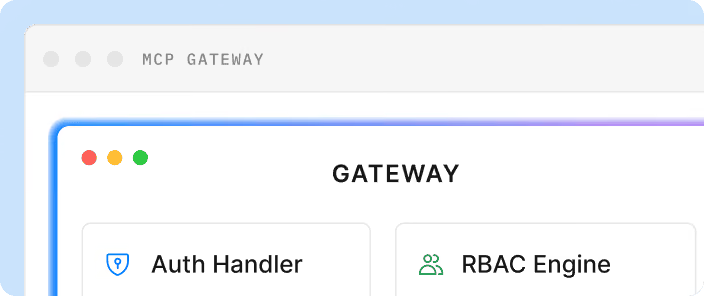
- AI-powered docs, search, and MCP-ready APIs: DigitalAPI generates overviews and error explanations from your specs, and exposes the same APIs to AI agents through a built-in MCP gateway. The marketplace side lists APIs for humans and for agents without a second integration project.
- Analytics across onboarding and monetisation: Per-API, per-partner usage, conversion from trial to paid, and error heatmaps are all in one place. You can see which APIs drive revenue, which ones stall partners, and where to invest next.
- White-label branding without engineering: Custom domain, your colors, typography, and logos. A drag-and-drop theme editor and built-in CMS let a product or partner team publish updates without an engineering ticket. New tenant portals are provisioned in minutes.
- Comprehensive SDKs: Auto-generated, downloadable code kits in Python, Java, JavaScript, Go, and .NET, distributed via NPM, Maven, and the package managers developers already use. One-click global language switching changes the programming language of every code snippet across the portal, so developers can integrate in their stack of choice.
- Governance and RBAC: Role-based access control with custom roles for internal engineers, external partners, and AI agents under one access model. IP allowlisting, scoped credentials, and immutable audit logs export to your SIEM, so every audience operates under the same compliant policies.
- Community and support: Integrated changelogs, FAQ sections, an embedded chatbot, and Salesforce-routed support ticketing keep developers informed and engaged. A built-in CMS lets a non-developer team publish guides, tutorials, and announcements without engineering.
If you are currently scoping a marketplace project on top of an existing portal, Book a 30-minute demo and we will show you how we unify them into one.
Conclusion
The distinction between a Developer Portal and an API Marketplace is more than semantic; it represents fundamentally different approaches to API strategy. A Developer Portal is a company's curated showroom, designed to provide a rich, branded experience for those integrating with its specific API offerings. Its strength lies in fostering deep engagement, streamlining integration, and building a loyal community around a single API provider's ecosystem. Conversely, an API Marketplace is a bustling bazaar, an aggregation of diverse API products from multiple vendors, optimized for broad discovery and monetization across a vast developer landscape.
The decision of which one you need ultimately hinges on your strategic intent. If your goal is to empower a focused audience to leverage your unique services efficiently, a Developer Portal is your indispensable tool. If you aim for expansive reach, new revenue streams from a broad market, or the convenient consumption of diverse third-party APIs, an API Marketplace becomes highly valuable.
Many forward-thinking organizations recognize that these are not mutually exclusive choices, often leveraging a dedicated portal for their core API program while strategically listing key APIs on marketplaces for extended reach and opportunistic revenue. By understanding these distinctions, businesses can build an API strategy that is both robust and aligned with their overarching digital ambitions.
Dhayalan Subramanian is Associate Director, Product Growth at DigitalAPI, where he leads go-to-market and product growth for the company’s multi-gateway API management platform. His work focuses on helping large enterprises and mid-market cloud companies consolidate APIs across AWS, Azure, Apigee, Kong, MuleSoft, and other gateways into a single control plane for governance, discovery, monetization, and agent consumption.
Dhayalan brings 14+ years of experience across product strategy, enterprise architecture, and engineering leadership. Earlier in his career, he held senior roles at Encora (as Associate Architect and Technical Manager), Mindtree (Technology Lead), Tech Mahindra (Technical Lead), and Primus Analytics, where he designed integration frameworks and delivered enterprise-grade digital platforms for global customers.
At DigitalAPI, he works directly with platform, integration, and developer experience leaders at Fortune 500 organizations to operationalize unified API catalogs, developer portals, and MCP-ready APIs. He writes regularly on API developer experience, API governance, and AI agent architectures.
One email a fortnight. Worth opening.
A short digest of what we're writing, what we're learning from customers, and the handful of links you'd actually want from us. No tracking pixels.

.avif)