



How to Reduce API Onboarding Time by Optimizing Your Developer Portal
Let's explore how a superior developer portal dramatically reduces API onboarding time, unlocking faster adoption and greater value.

TL;DR
1. Onboarding time is a portal problem, not an API problem: Most integration delays come from developers not knowing where to start, not from technical difficulty with the endpoints themselves.
2. The single biggest lever is persona-based navigation: Partners, internal teams, and platform integrators need different starting paths. A flat API list forces every new developer to reinvent the map.
3. In-portal testing collapses trial-and-error cycles: Pre-filled sample payloads, real response examples for every error, and a live try-it console can compress first-call time from days to under thirty minutes.
4. Living documentation removes the stale-PDF tax: When specs sync from the gateway automatically and non-developers can edit overviews, onboarding content stops decaying between releases.
5. Analytics turn onboarding into something you can actually optimise: If you cannot see where developers get stuck per API and per partner, every fix is a guess.
6. The target is 80 percent self-serve onboarding: That is the point at which your integration team stops being a bottleneck and starts focusing on partners who want to go deeper.
Get started with DigitalAPI's developer portal today to accelerate API adoption and developer productivity.
In a landscape increasingly powered by APIs, the speed at which developers can integrate and utilize your services directly impacts your innovation pace and ecosystem growth. Yet, many organizations inadvertently create significant friction, leaving valuable APIs underutilized due to complex, time-consuming onboarding processes. The challenge isn't just about building great APIs; it's about making them irresistibly easy to consume. This journey often begins and ends with your developer portal – a crucial interface that, when optimized, can transform hours of frustration into minutes of seamless integration. Let's explore how a superior developer portal dramatically reduces API onboarding time, unlocking faster adoption and greater value.
The Onboarding Bottleneck: Why APIs Aren't Being Adopted Fast Enough
Even the most robust, innovative APIs can languish if developers face high hurdles during the initial onboarding phase. This bottleneck isn't just an inconvenience; it represents lost opportunities, delayed product launches, and a significant drain on support resources. Developers, whether internal, partner, or external, expect a smooth, intuitive experience, mirroring the ease they find in consumer applications.
Common factors contributing to slow API onboarding include:
- Scattered or Outdated Documentation: When documentation is incomplete, hard to find, or doesn't reflect the current API state, developers waste time deciphering unclear instructions or encountering errors due to mismatched information.
- Complex Authentication Flows: Security is paramount, but overly convoluted authentication and authorization processes can deter developers before they even make their first API call.
- Lack of Interactive Tools: Without "try-it-out" features, code samples, or sandboxes, developers are forced to set up entire environments just to test basic functionality, slowing down experimentation.
- Poor Discovery: If developers can't easily find the APIs they need or understand their purpose, they'll either give up, duplicate efforts, or reach out to support, creating delays.
- Inconsistent API Design: A lack of standardization across APIs forces developers to learn new patterns and conventions for each service, increasing cognitive load and integration time.
- Absence of Community and Support: When developers get stuck, the absence of forums, FAQs, or readily available support channels means they spend more time troubleshooting in isolation.
Each of these pain points adds minutes, or even hours, to the onboarding process. Multiplied across multiple APIs and numerous developers, this translates into substantial operational inefficiency and missed business value. The solution lies in a strategic investment in a developer portal designed for speed and clarity.
.png)
The Developer Portal: Your API's First Impression and Integration Accelerator
Think of your developer portal as the front door to your API ecosystem. It's often the first point of contact for anyone looking to understand, integrate, or build on your APIs. A well-crafted portal isn't merely a static repository of documents; it's a dynamic, interactive environment engineered to guide developers from curiosity to successful integration with minimal friction.
Its primary goal is to empower developers to help themselves, providing all the necessary information, tools, and support in one centralized location. By doing so, a superior developer portal serves as an integration accelerator, directly addressing the common onboarding bottlenecks and turning potential frustrations into productive workflows.
The impact of an optimized developer portal extends far beyond just "making things easier":
- Increased API Adoption: An intuitive portal lowers the barrier to entry, encouraging more developers to explore and integrate your APIs.
- Reduced Support Load: Self-service capabilities mean fewer common queries for your support teams, freeing them up for more complex issues.
- Faster Time-to-Market: Developers integrate faster, which means products and features built on your APIs can reach users sooner.
- Enhanced Developer Experience (DX): A positive DX builds loyalty and fosters a thriving ecosystem around your APIs.
- Improved API Quality: Feedback mechanisms within the portal can provide valuable insights for API improvement.
- Better Governance and Control: A central portal enables consistent application of API policies, security guidelines, and version management.
Ultimately, a developer portal is not just a technical asset; it's a strategic business tool that drives value by enabling faster innovation and broader reach for your API products.
Key Pillars of a Frictionless Developer Portal: Optimizing for Speed and Clarity
To truly reduce API onboarding time, a developer portal must be built upon several foundational pillars, each designed to remove specific points of friction. These elements work in concert to create an environment where developers can quickly find, understand, and integrate your APIs.
1. Crystal-Clear Documentation: The Foundation of Understanding
Good documentation is non-negotiable. It's the first thing developers seek and often the last thing they complain about if it's lacking. To reduce onboarding time, documentation must be:
- Comprehensive: Cover every endpoint, parameter, response, error code, and use case.
- Up-to-Date: Automated documentation generation from API specifications (like OpenAPI/Swagger) ensures consistency with the actual API.
- Well-Structured: Logical flow, clear headings, table of contents, and search functionality help developers navigate large volumes of information.
- Example-Rich: Provide practical code snippets in multiple languages (Curl, Python, Node.js, Ruby, Java) for common operations.
- Human-Readable: Beyond technical specifications, offer conceptual guides, tutorials, and getting started flows that explain the "why" behind the API.
Poor documentation forces developers to experiment blindly or resort to direct support, both of which are time-consuming. Excellent documentation empowers self-sufficiency.
2. Interactive API Reference & Try-It-Out: Hands-On Learning
Reading about an API is one thing; interacting with it is another. Interactive features dramatically accelerate understanding and reduce the need for developers to set up local environments for initial testing.
- Live "Try-It-Out" Consoles: Allow developers to make real API calls directly from the portal, seeing immediate responses without writing any code.
- Sandbox Environments: Provide isolated environments where developers can test integrations without impacting production data.
- Request/Response Examples: Clearly show expected input and output for each API call, including error scenarios.
- Parameter Descriptions: Detailed explanations for each request parameter, including data types, constraints, and examples.
These tools enable rapid prototyping and validation, cutting down the initial experimentation phase from hours to minutes.
3. Seamless API Discovery & Search: Finding What You Need, Fast
As your API portfolio grows, discoverability becomes critical. Developers shouldn't have to guess or comb through endless lists to find the right API.
- Powerful Search: A robust search engine that indexes documentation, metadata, and code samples, offering intelligent suggestions and filtering.
- Categorization and Tagging: Organize APIs by domain, business capability, product line, or use case (e.g., "Payments," "Customer Management," "Notifications").
- API Catalog: A centralized, organized inventory of all available APIs with key metadata like ownership, lifecycle status, and deprecation warnings.
- Intuitive Navigation: Clear hierarchical menus and breadcrumbs to help developers understand where they are and easily move between sections.
Effective discovery reduces the time developers spend simply looking for an API, allowing them to jump straight into integration.
4. Streamlined Authentication & Authorization: Making Security Accessible
Security is complex, but its implementation shouldn't be a blocker. Your portal should simplify the process of obtaining credentials and understanding authorization models.
- Clear Authentication Guides: Step-by-step instructions for different auth methods (OAuth 2.0, API Keys, JWT, etc.).
- Self-Service Credential Management: Allow developers to generate, rotate, and manage API keys or OAuth credentials directly within the portal.
- Permission & Scope Clarity: Clearly explain what each API key or OAuth scope grants access to, helping developers request appropriate permissions.
- Testing Tools: Integrate tools for testing authentication, such as token generators or validators.
By streamlining security setup, you remove a major integration hurdle and ensure developers implement secure practices from the outset.
5. Robust SDKs & Code Samples: Accelerating Integration
SDKs and comprehensive code samples significantly reduce the amount of boilerplate code developers need to write, accelerating integration time.
- Client SDKs: Provide ready-to-use client libraries in popular programming languages (Java, Python, Node.js, .NET, Go) that abstract away HTTP calls and serialization.
- Code Samples: Beyond basic examples, offer complete, runnable code samples that demonstrate common use cases and workflows.
- Postman Collections: Share Postman collections that allow developers to import and test all your APIs quickly.
- Integration Guides: Offer detailed guides on integrating your APIs with popular third-party tools, platforms, or common architectural patterns.
These resources enable developers to get to a "hello world" state much faster, reducing frustration and proving value quickly.
6. Self-Service Management & Analytics: Developer Autonomy
Empowering developers with self-service capabilities reduces reliance on support teams and provides valuable insights.
- Application Management: Allow developers to register applications, manage credentials, and configure webhooks.
- Usage Dashboards: Provide real-time analytics on API consumption, including request volume, error rates, and latency. This helps developers troubleshoot and optimize their integrations.
- Billing & Quota Management: For monetized APIs, offer transparency into usage, costs, and options to upgrade or manage quotas.
- Webhook Management: Tools to configure and test webhooks, crucial for event-driven architectures.
By giving developers control and visibility, you foster autonomy and reduce the need for constant communication with your internal teams.
7. Community & Support: Fostering Engagement and Problem-Solving
Even with the best documentation and tools, developers will occasionally encounter unique challenges. A strong community and support system are vital.
- FAQs and Troubleshooting Guides: Address common issues and questions proactively.
- Forums or Community Boards: Allow developers to ask questions, share solutions, and interact with each other and your API team.
- Direct Support Channels: Clearly indicate how developers can reach technical support when self-service options are exhausted (e.g., ticketing system, dedicated Slack channel).
- Feedback Mechanisms: Provide ways for developers to suggest improvements, report bugs, or request new features for both the APIs and the portal itself.
A responsive community and clear support channels prevent developers from getting stuck for extended periods, preserving their motivation and reducing overall onboarding time.
8. Version Control & Lifecycle Management: Handling Change Gracefully
APIs evolve, and a good developer portal helps developers navigate these changes without breaking their existing integrations.
- Clear Versioning Strategy: Document your API versioning scheme (e.g., URL-based, header-based) and clearly list all available versions.
- Migration Guides: Provide detailed instructions and code examples for migrating from older API versions to newer ones.
- Deprecation Schedules: Clearly communicate when older API versions or endpoints will be deprecated, giving developers ample time to adapt.
- Change Logs: Maintain a visible log of all API changes, new features, and bug fixes for each version.
By offering transparency and guidance around API evolution, you reduce the risk of breaking changes and ensure developers can smoothly transition to updated versions, minimizing re-onboarding efforts.
Measuring Success: How to Quantify Reduced Onboarding Time
To understand the impact of your developer portal, it's crucial to define and track key metrics. Quantifying the reduction in onboarding time allows you to demonstrate ROI and identify areas for further improvement.
Key metrics to monitor:
- Time to First API Call (TTFC): The average time from a developer signing up (or accessing the portal) to making their first successful API call. A shorter TTFC indicates easier onboarding.
- Time to Live (TTL) / Time to Production: The average time from initial discovery to a fully integrated and deployed application using your API in a production environment.
- Developer Conversion Rate: The percentage of developers who visit your portal and successfully complete a key integration milestone (e.g., register an app, make a successful call).
- Support Ticket Volume for Onboarding Issues: A decrease in tickets related to "getting started," "authentication," or "documentation clarity" is a direct indicator of improved self-service.
- Documentation Engagement: Metrics like page views per session, time spent on documentation pages, and search query success rates. High engagement suggests developers are finding what they need.
- SDK/Code Sample Usage: Track downloads or usage of your provided SDKs and code snippets. High usage suggests they are valuable accelerators.
- Developer Satisfaction (DX Score): Conduct surveys (e.g., Net Promoter Score for developers - DNPS) to gather qualitative feedback on the onboarding experience.
By continuously tracking these metrics, you can identify bottlenecks, validate improvements, and ensure your developer portal remains an efficient onboarding engine.
Still tracking onboarding time in a spreadsheet because no system gives you the real number?
See how DigitalAPI measures time-to-first-call per partner, per API. Book a Demo!
Common Pitfalls to Avoid When Optimizing Your Developer Portal
While the benefits of a strong developer portal are clear, several common mistakes can undermine even the best intentions:
- Treating the Portal as an Afterthought: Building APIs first and then "bolting on" a documentation site. The portal should be an integral part of your API strategy from day one.
- Static, Untouched Content: Launching with great content but failing to update it as APIs evolve. Outdated documentation is worse than no documentation.
- "Internal-Only" Mindset: Designing the portal solely for internal developers, neglecting the needs of external partners or the broader developer community.
- Lack of Search and Navigation: A beautiful design won't compensate for a poor user experience if developers can't find what they need quickly.
- Ignoring Feedback: Failing to listen to developers' pain points and feature requests, leading to a portal that doesn't meet real-world needs.
- Overlooking Mobile Responsiveness: Many developers access documentation on various devices; ensure your portal is accessible and usable across all screen sizes.
- Poor Performance: A slow-loading portal or sluggish search experience will frustrate developers and drive them away.
Avoiding these pitfalls requires ongoing commitment, a developer-centric mindset, and a willingness to iterate based on real usage and feedback.
.png)
Future-Proofing Your Developer Portal: Continuous Improvement
The world of APIs is constantly evolving, and so too must your developer portal. To ensure it remains an effective tool for reducing onboarding time, consider these forward-looking strategies:
- Embrace AI-Powered Assistance: Integrate AI chatbots or virtual assistants that can answer common questions, guide developers through complex flows, or even suggest relevant APIs based on their queries.
- Personalization: Offer personalized experiences, such as tailored API recommendations, customized dashboards, or content filtered by a developer's role or projects.
- APIOps Integration: Deeply integrate the portal with your API lifecycle management tools, ensuring that documentation, versioning, and status updates are automatically synchronized with your API development pipelines.
- GraphQL and Event-Driven API Support: As API styles diversify, ensure your portal can effectively document and support GraphQL APIs, webhooks, and event streams, complete with schema introspection and subscription testing.
- Accessibility: Design your portal to be accessible to all developers, adhering to WCAG guidelines to ensure inclusivity.
- Performance Monitoring: Continuously monitor the portal's performance, load times, and uptime to ensure a consistently smooth user experience.
A developer portal is not a static project; it's a living product that requires continuous care and innovation. By investing in its evolution, you ensure it remains a powerful engine for accelerating API adoption and fostering a vibrant developer ecosystem.
How DigitalAPI cuts onboarding time by 80%?
Every principle in this guide works in theory. The hard part is standing up the portal that puts them into practice without spinning up a six-month platform project. DigitalAPI is the developer portal teams buy when they want developer onboarding in weeks instead of quarters, running on top of whatever gateways they already have.
Here is what changes for developers the day you switch.
- Persona-based navigation, out of the box: External partners, internal teams, and enterprise customers each land on a different journey to the same underlying APIs. Instead of a flat alphabetical list, a new developer sees the bundle, the quick-start, and the sandbox credentials that match their use case. This alone tends to move time-to-first-call from days to hours.
- Built-in testing with pre-filled payloads: Every endpoint in the portal ships with a live try-it console, realistic sample values, and response examples for success and every failure mode. No Postman tab, no shared credential in a Slack thread, no "works on my machine" calls. Developers form a correct mental model of the API on the first attempt, not the fifth.
- Multi-gateway, one portal: If your APIs sit behind Kong, Apigee, AWS API Gateway, Azure, MuleSoft, or APISIX (or some combination after an acquisition), DigitalAPI catalogs all of them in a single developer experience. Developers never need to know which gateway hosts a given API. That removes an entire category of onboarding questions.
- Non-developer content editing: Product managers, technical writers, and marketers can update overviews, use cases, and quick-start prose without filing an engineering ticket. Documentation stops decaying, which means onboarding content actually reflects the current state of the API.
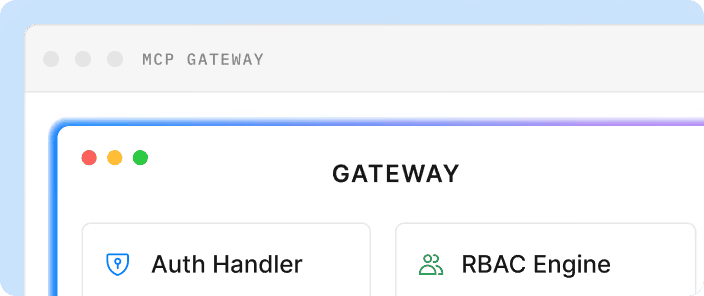
- AI-assisted docs and MCP-ready APIs: AI-generated overviews, error explanations, and search mean developers find answers inside the portal instead of pinging support. For teams exposing APIs to AI agents, DigitalAPI also ships an MCP gateway so the same APIs become consumable by agents without a second integration project.
- Per-API, per-partner analytics: You see which APIs partners actually use, where they stall, and which errors are generating the most friction. Those signals feed straight back into the docs and the quick-starts, so every cohort of new developers onboards faster than the last.
Seeing onboarding slip past six weeks on your average partner integration?
Book a 30-minute demo and we will show you exactly which steps DigitalAPI would remove from your current flow.
Conclusion
The true value of an API isn't realized until it's successfully integrated and put to use. In this context, reducing API onboarding time isn't just a technical nicety; it's a strategic imperative. A well-designed, meticulously optimized developer portal stands as your most potent weapon in this endeavor. By providing crystal-clear documentation, interactive tools, seamless discovery, robust support, and streamlined management, you empower developers to move from initial curiosity to full integration with unprecedented speed and efficiency.
The investment in a superior developer portal pays dividends in increased API adoption, reduced support costs, faster time-to-market, and a thriving developer community. It transforms potential bottlenecks into pathways for innovation, ensuring your APIs are not just built, but truly consumed and celebrated. Prioritize your developer portal, and watch your API ecosystem flourish.
FAQs
1. What is API onboarding time, and why is it important to reduce it?
API onboarding time refers to the duration it takes for a developer to go from discovering an API to successfully integrating it into their application and making their first functional call. Reducing this time is crucial because it directly impacts API adoption rates, accelerates time-to-market for applications built on your APIs, lowers support costs, and improves the overall developer experience, fostering a more vibrant ecosystem.
2. How does a developer portal contribute to reducing API onboarding time?
A developer portal significantly reduces onboarding time by centralizing all necessary resources: comprehensive and up-to-date documentation, interactive API explorers (try-it-out consoles), code samples, SDKs, clear authentication guides, and self-service credential management. It provides a guided, self-sufficient path for developers, minimizing the need for manual assistance and complex setup.
3. What are the essential features of a developer portal that optimize onboarding?
Key features include interactive API reference documentation, a powerful search function for easy discovery, clear and concise getting started guides, example code snippets in multiple languages, SDKs, sandbox environments for testing, straightforward authentication instructions, self-service application and credential management, and a robust support or community section (FAQs, forums).
4. How can I measure the effectiveness of my developer portal in reducing onboarding time?
You can measure effectiveness by tracking metrics such as Time to First API Call (TTFC), Time to Live (TTL) or Time to Production, developer conversion rates (from visit to successful integration), the volume of support tickets related to onboarding issues, and developer satisfaction scores (DX NPS). An improvement in these metrics indicates a more efficient onboarding process.
5. What are some common mistakes to avoid when building or optimizing a developer portal for faster onboarding?
Avoid treating the portal as an afterthought, allowing documentation to become outdated, neglecting robust search and navigation, failing to provide interactive "try-it-out" features, making authentication overly complicated, and ignoring developer feedback. A static, unmaintained, or unintuitive portal will quickly become a barrier instead of an enabler for API adoption.
Dhayalan Subramanian is Associate Director, Product Growth at DigitalAPI, where he leads go-to-market and product growth for the company’s multi-gateway API management platform. His work focuses on helping large enterprises and mid-market cloud companies consolidate APIs across AWS, Azure, Apigee, Kong, MuleSoft, and other gateways into a single control plane for governance, discovery, monetization, and agent consumption.
Dhayalan brings 14+ years of experience across product strategy, enterprise architecture, and engineering leadership. Earlier in his career, he held senior roles at Encora (as Associate Architect and Technical Manager), Mindtree (Technology Lead), Tech Mahindra (Technical Lead), and Primus Analytics, where he designed integration frameworks and delivered enterprise-grade digital platforms for global customers.
At DigitalAPI, he works directly with platform, integration, and developer experience leaders at Fortune 500 organizations to operationalize unified API catalogs, developer portals, and MCP-ready APIs. He writes regularly on API developer experience, API governance, and AI agent architectures.
One email a fortnight. Worth opening.
A short digest of what we're writing, what we're learning from customers, and the handful of links you'd actually want from us. No tracking pixels.

.avif)