



Web Portal API: The Complete Guide to Building a Developer-Ready API Portal
A web portal API is the browser-based interface where developers discover, test, and subscribe to your APIs - without a kickoff call. This guide covers must-have features, architecture layers, step-by-step build process, and real-world examples from banking, insurance and telecoms.

TL;DR
1. A web portal API is the browser-based interface where developers discover, read, test, and subscribe to APIs without talking to anyone.
2. It combines a searchable catalog, interactive docs, sandbox testing, credential management, and usage analytics into one destination.
3. Good portals reduce time-to-first-call from days to minutes and cut partner onboarding by 60 to 80 percent.
4. Multi-gateway support is non-negotiable for enterprises running APIs across AWS, Azure, Apigee, Kong, or MuleSoft.
5. DigitalAPI delivers a white-labeled web portal for APIs that unifies fragmented estates into one branded developer experience.
Your APIs are live. Your docs exist. And yet every partner kickoff still needs three calls, two NDAs, and a week of back-and-forth before anyone writes a line of integration code. The problem is not your APIs. It is that they do not live behind a proper web portal.
What is a web portal API
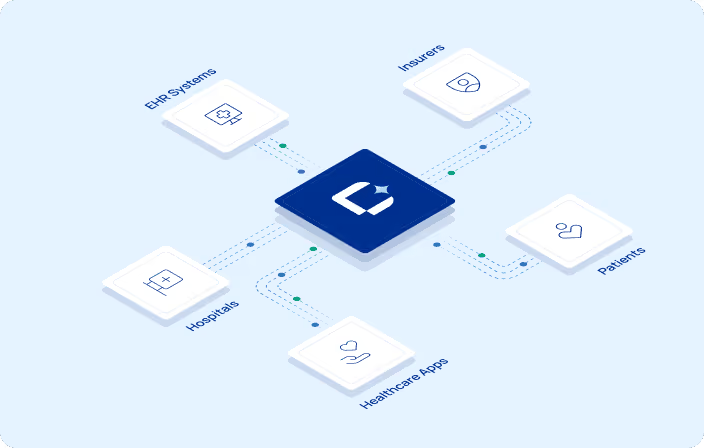
A web portal API is a browser-accessible platform that exposes your APIs to developers through a unified catalog, interactive documentation, testing sandbox, and self-service onboarding. It is the public face of your API program. The term covers both the infrastructure (the portal software) and the endpoints it surfaces (the APIs consumers actually call).
Two readings of the phrase show up in practice. The first treats "web portal API" as the APIs that power a web portal itself, which is a narrow backend question. The second, and more useful one, treats it as the web portal layer that sits above your APIs and makes them usable. This guide covers the second interpretation because that is where most enterprises are stuck.
Web portal API vs API gateway vs API marketplace
Three terms, three different jobs. Confusing them is how teams end up buying the wrong tool.
The gateway handles the call. The portal handles the developer. The marketplace handles the money. A mature API program runs all three, often through one unified platform, so the layers do not drift apart. Our breakdown of API marketplaces versus portals covers the commercial distinction in depth.
Why enterprises need a web portal for APIs
The fragmentation problem is the short answer. A global bank runs 2,000+ APIs across AWS, Azure, and a legacy on-prem stack. An insurance firm has specs in Postman, specs in SwaggerHub, and specs in a Git repo nobody remembers the URL for. Developers spend more time hunting than building. Partners spend more time waiting than integrating.
A web portal API solves four concrete business problems. It removes duplicate builds by exposing what already exists. It cuts partner onboarding because self-service replaces manual provisioning. It surfaces governance issues before they hit production. And it turns API usage into a measurable revenue stream rather than a cost center.
The payoff is not abstract. Fiserv uses its DigitalAPI-powered portal to run tiered pricing and subscription management for fintech partners, cutting integration cycles from months to weeks. Zurich Insurance routes broker onboarding through a white-labeled portal that handles branding, compliance, and key provisioning in one flow. Canara Bank bundles account, KYC, and payment APIs into open banking products a partner subscribes to in a single click.
Must-have features of a modern web portal API
A portal without these capabilities is a glorified documentation site. Developers notice within 10 minutes and route around it.
1. Unified API catalog across gateways
The catalog ingests API specs from every gateway, repo, and tool your organization runs. AWS, Azure, Kong, Apigee, MuleSoft, Postman, GitHub, SwaggerHub, and SAP events should all flow into one searchable view. Without multi-gateway ingestion, the portal becomes another silo rather than the fix for silos. You can see the full picture in our guide to high-impact portal features.
2. Interactive, auto-generated documentation
Docs that auto-sync from OpenAPI specs stay current. Docs written by hand go stale in two sprints. A modern portal renders try-it consoles, code samples in multiple languages, authentication flows, and error handling directly from the spec. If an API lacks documentation, the portal generates it with AI rather than waiting for someone to write it. DigitalAPI's documentation layer does exactly this across any ingested API.
3. Sandbox environment
Developers test before they integrate. A sandbox with mock data, proxy-enabled responses, and one-click reset lets them validate behaviour without credentials, rate limits, or production risk. This single feature shifts developer confidence more than any amount of marketing copy.
4. Self-service credential provisioning
API keys, OAuth client registration, and scoped tokens should issue in seconds. Every manual approval step is a funnel drop-off. Role-based access controls and automated rotation keep security tight without adding friction.
5. Subscription and monetization workflows
For external APIs, the portal handles pricing plans, usage-based billing, and payment gateway integration. DigitalAPI ships Stripe and Braintree plugins natively so subscription flows run inside the portal rather than across three separate systems.
6. Analytics and observability
Real-time dashboards cover call volume, latency, error rates, user behaviour, and revenue per API. Product teams use this data to price, tier, deprecate, and invest. Without analytics, every roadmap decision runs on guesswork.
7. Governance and compliance
OWASP linting, policy enforcement, versioning rules, and deprecation workflows run automatically on publish. AI-driven duplicate detection flags overlapping services before teams build the same thing twice.
8. Branding and white-label customization
The portal carries your brand, your domain, your colors, your typography. Partners should never feel they are logging into a vendor's product. They should feel they are logging into yours.
Architecture: what sits under the hood
A web portal API is not one thing. It is a stack of coordinated layers.
Each layer must stay loosely coupled. If the ingestion layer locks you to one gateway, the portal rots the moment you add a second cloud. DigitalAPI's Arelio architecture sits above whatever gateways you run, which matters when a bank acquires another bank and inherits a MuleSoft stack overnight.
How to build a web portal API in 8 steps
Heads up: this sequence works whether you build in-house or deploy a platform. Skipping a step rarely saves time.
1. Audit your current API estate: List every API, every gateway, every spec source. Most teams discover 30 to 50 percent more APIs than they thought they had.
2. Define your audience tiers: Internal developers, trusted partners, public community, or all three. Access control design flows from this answer.
3. Pick a source of truth for specs: OpenAPI 3.x is the standard. Generate specs for any API that lacks them before going further.
4. Set up gateway-agnostic ingestion: Connect every gateway and repo that holds an API. Normalize the metadata schema so search works across sources.
5. Build or buy the presentation layer: Interactive docs, try-it consoles, search, and category navigation. Auto-generation from OpenAPI saves months of hand-coding.
6. Wire in identity and credential flows: SSO for enterprise users, OAuth for external partners, scoped API keys for everyone. Automate issuance end to end.
7. Layer in governance and analytics: Linting, OWASP checks, usage dashboards, deprecation workflows. Do this before launch, not after.
8. White-label and launch progressively: Start internal. Open to trusted partners next. Go public last, once the feedback loop is proven.
Our step-by-step adoption guide covers the deeper implementation choices for each step.
How DigitalAPI's Marketplace Portal Completes Your Web Portal API
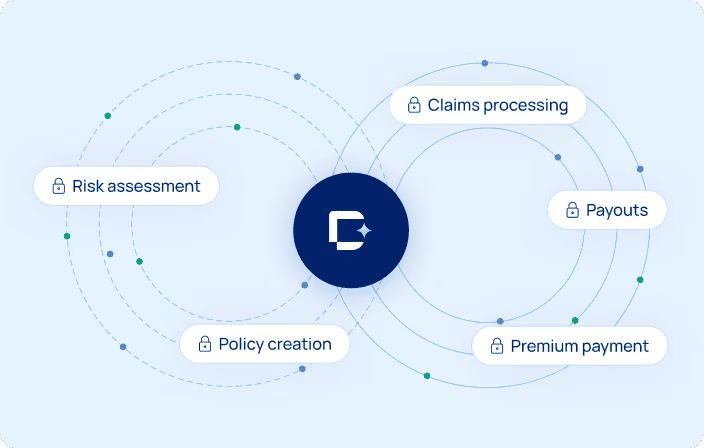
A web portal API handles discovery, documentation, and credentials. DigitalAPI's API marketplace adds the commercial layer that most portals leave out subscriptions, billing, and partner revenue running inside the same platform, not bolted on through a separate tool.
The gap is predictable. A partner finds your API, tests it in the sandbox, requests credentials and then hits a wall because there is no self-service subscription flow, no usage tier to select, and no invoice being generated automatically. That gap is where partner programs stall and manual work floods back in.
Everything the Commercial Layer Needs is Already Built In
1. Subscription plans and automated billing:
Tiered subscriptions, usage-based pricing, freemium thresholds, and enterprise licensing are all configurable through DigitalAPI's API monetization platform. Stripe and Braintree connect natively. Usage flows from the gateway to the invoice without manual reconciliation or month-end spreadsheet work.
2. Test before subscribing to access built in:
Partners validate integration behavior before selecting a plan. DigitalAPI's API sandbox gives trial users an isolated environment with realistic mock data and stable test responses. This is the feature that converts trial users into paying subscribers removing uncertainty before any commercial commitment is made.
3. Your brand. Your domain. Your marketplace:
The marketplace runs entirely under your identity. DigitalAPI's white-labelled developer portal gives you full control over domain, design, colors, and navigation. Zurich Insurance built a fully branded marketplace on this foundation that now handles millions of API transactions with no third-party vendor visible to any partner at any point.
4. Two analytics views performance and revenue:
DigitalAPI's API analytics keeps technical and business data in separate layers. Latency, error rates, and traffic patterns sit in one view. Subscription growth, churn, conversion rates, and revenue per API sit in another. Both matter. Neither replaces the other.
5. Governance before anything goes live:
Every API published through the marketplace passes DigitalAPI's API governance layer automatically. OWASP checks, policy enforcement, and quality validation run on publish nothing reaches external partners without clearing that gate first.
From First Call to Paying Partner In One Session
Fiserv used this model to cut fintech partner onboarding from months to weeks. The portal handled discovery and testing. The marketplace handled subscription tiers, usage metering, and billing all in one platform, with no handoff between tools.
Chenosis built a full monetizable API ecosystem for African telecoms on DigitalAPI from scratch. Canara Bank doubled transaction volume while cutting infrastructure costs by 50% by routing all partner integrations through a structured marketplace with automated billing and governance running end-to-end.
The web portal layer gets partners to their first API call. The marketplace layer turns that call into a subscription, an invoice, and a revenue line. DigitalAPI runs both live in 4 to 8 weeks, on top of whatever gateways you already operate.
Real-world examples
Open banking
A bank exposes account, payment, KYC, and transfer APIs through a portal tiered by partner type. Fintechs subscribe to a "Banking Starter" product bundle; larger partners subscribe to "Banking Enterprise." One catalog, one subscription key per product, compliance baked in. Canara Bank runs this exact model on DigitalAPI, serving regulated and non-regulated partners from the same interface.
Insurance broker enablement
Zurich Insurance publishes quote, claims, and policy APIs behind a branded portal where brokers self-serve onboarding. Underwriting exposure time dropped from weeks to days because governance runs automatically on publish rather than through a committee.
Telecom aggregation
Chenosis aggregates telco APIs across multiple African operators. The portal abstracts operator-level differences so a developer consumes "SMS" as one API rather than a matrix of carrier-specific endpoints. This model only works with a gateway-agnostic portal layer.
Internal platform engineering
A global bank ran AI Affinity across 2,400 internal APIs and flagged 340 duplicates. Deprecating half of those returned engineering capacity directly to product teams. The portal paid for itself in the first audit.
Common mistakes that kill adoption
Treating the portal as a documentation project: Docs are one layer. Without sandbox, credentials, and analytics, the portal is a pamphlet.
Locking to one gateway: Every enterprise eventually runs multiple gateways. A single-gateway portal is a rewrite waiting to happen.
Manual approval for API keys: Every approval is a drop-off. Automate from day one.
Stale documentation: Hand-written docs die within a sprint. Auto-generate from OpenAPI or do not bother.
No analytics: You cannot improve what you cannot measure. Ship dashboards on launch day, not Q3.
Weak branding: Partners notice when the portal looks like a vendor template. The white-labeled portal approach matters more than teams expect.
For a deeper look at what enterprise buyers actually evaluate, our enterprise portal requirements guide covers the full checklist.
The bottom line
A web portal API is the commercialization layer for your API program. It decides whether your APIs get used or ignored, whether partners ship in days or months, and whether engineering time goes into new products or hunting duplicate services. The teams treating it as a strategic surface are the ones whose API programs actually generate revenue.
If you are running APIs across multiple gateways and your portal experience is slowing partner adoption, DigitalAPI unifies the estate into one branded, AI-ready web portal with sandbox, governance, and monetization built in. Partners move from discovery to first successful call in a single session. Explore the API management platform or the API marketplace to see how the layers connect.
FAQs
1. What is the difference between a web portal API and an API gateway?
The gateway routes API traffic at runtime. The web portal is the developer-facing website where people discover, read about, and subscribe to those APIs. You need both, and they do different jobs.
2. Can one web portal API serve internal and external developers?
Yes, with tiered access. Internal users see the full catalog with no billing. External partners see a curated subset with subscription controls. Public users see the browsable marketing layer. One catalog, three views.
3. How long does it take to launch a web portal API?
Building from scratch on frameworks like Backstage typically runs 6 to 12 months to reach production quality. Deploying a managed platform like DigitalAPI runs 2 to 6 weeks for initial rollout, then iterative expansion. Our platform comparison breaks down the build-versus-buy math.
4. Does a web portal API support monetization?
The modern ones do. Look for native Stripe and Braintree integration, tiered pricing support, usage metering, and subscription workflows built into the portal rather than bolted on through third-party tools.
5. How does a web portal API handle multiple clouds and gateways?
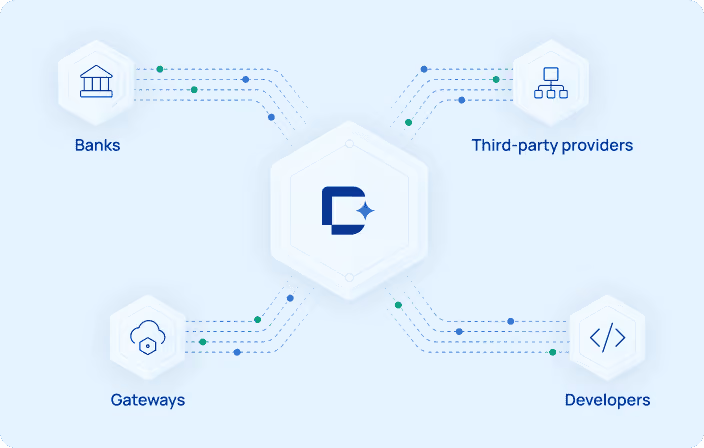
Through gateway-agnostic ingestion connectors that pull specs from each source and normalize them into a unified catalog. DigitalAPI ingests from AWS, Azure, Kong, Apigee, MuleSoft, Postman, GitHub, and SwaggerHub out of the box.
Dhayalan Subramanian is Associate Director, Product Growth at DigitalAPI, where he leads go-to-market and product growth for the company’s multi-gateway API management platform. His work focuses on helping large enterprises and mid-market cloud companies consolidate APIs across AWS, Azure, Apigee, Kong, MuleSoft, and other gateways into a single control plane for governance, discovery, monetization, and agent consumption.
Dhayalan brings 14+ years of experience across product strategy, enterprise architecture, and engineering leadership. Earlier in his career, he held senior roles at Encora (as Associate Architect and Technical Manager), Mindtree (Technology Lead), Tech Mahindra (Technical Lead), and Primus Analytics, where he designed integration frameworks and delivered enterprise-grade digital platforms for global customers.
At DigitalAPI, he works directly with platform, integration, and developer experience leaders at Fortune 500 organizations to operationalize unified API catalogs, developer portals, and MCP-ready APIs. He writes regularly on API developer experience, API governance, and AI agent architectures.
One email a fortnight. Worth opening.
A short digest of what we're writing, what we're learning from customers, and the handful of links you'd actually want from us. No tracking pixels.

.avif)