



API Documentation Generator: How to Auto-Generate Docs in 2026
Learn how API documentation generators work , from OpenAPI specs, code annotations, and live traffic. Compare tools and find the right fit for your team.

An API documentation generator creates formatted reference docs automatically from your OpenAPI spec, annotations, or live traffic.
Most documentation breaks at scale, not at the start. One team maintains their OpenAPI spec diligently. Another runs three gateways with no spec file at all. A third inherits 40 legacy APIs that have never been documented. The generator conversation almost always focuses on the single-API scenario. That's the easy case. This guide covers all three.
TL;DR
1. An API documentation generator creates formatted reference docs automatically from OpenAPI specs, code annotations, or live API traffic
2. The three types are: spec-based (most common), code-based (annotations), and traffic-based (legacy/undocumented APIs)
3. Generated docs cover reference content only: endpoints, schemas, parameters, auth. Guides and tutorials still require human writing
4. Keeping docs in sync means automating generation inside CI/CD, not running it manually after each release
5. In 2026, generated docs must serve AI agents, not just human developers: MCP-readiness and structured metadata are now baseline requirements
6. Teams managing APIs across multiple gateways need a generation layer that ingests from all sources, not just one spec file
What Is an API Documentation Generator?
An API documentation generator is a tool that automatically produces formatted API reference documentation from a structured input source. It reads your OpenAPI/Swagger spec, code annotations, or live API traffic, then renders endpoint descriptions, parameter tables, request/response schemas, and authentication details without manual writing.
The core value is consistency. When documentation is generated from the same source that defines the API, it stays accurate when the API changes. Manual docs drift. Generated docs, inside a proper pipeline, don't.
What generators produce: endpoint lists, HTTP method detail, parameter tables, request and response examples, authentication instructions, and error code references.
What they don't produce: conceptual guides, quickstart walkthroughs, tutorials, changelog narratives, or architecture overviews. Those still require human writing. A complete developer portal needs both layers.
Quick context: A documentation generator produces the reference layer. An API developer portal wraps that reference layer with self-serve access, sandbox testing, subscription management, and usage analytics. If your team is only running a generator with no portal, you're covering roughly 30% of what developers actually need to onboard independently.
How API Documentation Generators Work
API documentation generators work by parsing a structured API description, extracting endpoint metadata, and rendering it into formatted output, typically interactive HTML or a hosted developer portal. The input format determines which generation method applies.
The process follows three steps consistently:
Step 1: Input:
The generator reads a structured source: an OpenAPI/Swagger spec file (YAML or JSON), inline code annotations (JSDoc, PHPDoc, Python docstrings), or captured HTTP traffic from a running API.
Step 2: Parse and extract:
The tool pulls endpoint paths, HTTP methods, parameters, request/response schemas, authentication requirements, and error codes. Advanced generators also extract example values and enum constraints.
Step 3: Render and output:
The extracted metadata is rendered into formatted documentation: interactive HTML with Try-It consoles, static markdown, or hosted portals with search, navigation, and multi-language code samples.
The key distinction worth keeping front of mind: generators produce reference documentation, the structured, per-endpoint detail. They don't write conceptual documentation (guides, tutorials, architecture overviews). For a step-by-step approach to the full documentation process, see How to Document an API.
The Three Types of API Documentation Generators
The three types of API documentation generators are spec-based (OpenAPI/Swagger files), code-based (source code annotations), and traffic-based (live API requests). Each carries different trade-offs on accuracy, setup effort, and the situations it actually solves.
(scroll to view full table)
Spec-Based Generators
Tools in this category include Swagger UI, Redoc, Stoplight Elements, ReadMe, Redocly, and DigitalAPI. Input is an OpenAPI 3.x YAML or JSON file.
This is the dominant approach. The majority of teams today maintain an OpenAPI spec as their single source of truth, which makes spec-based generation the natural fit. The spec becomes the contract: design it, validate it, and let the generator handle the rest.
The challenge at enterprise scale is that the spec often isn't in one place. A platform engineer at a bank might have APIs deployed across Apigee, AWS API Gateway, and a legacy MuleSoft instance, each with its own spec format and storage location. A generator that works from a single spec file doesn't solve the multi-source problem.
Code-Based Generators
Tools: Swashbuckle (.NET), Springdoc (Java/Spring), pdoc (Python), Scramble (Laravel). Input: source code with annotations or decorators.
The generator runs at build time, scans your codebase for annotated endpoints, and produces an OpenAPI spec file, which then feeds into a spec-based renderer. Best for teams that don't want to maintain a separate spec file alongside their code.
The risk is annotation drift. When a developer updates an endpoint without updating the annotations, generated docs silently become wrong. CI/CD validation catches this, but only if you've set it up.
Traffic-Based Generators
Tools: Levo.ai, Treblle. Input: live HTTP traffic captured via proxy or SDK.
These observe your running API and reverse-engineer a specification from real request/response pairs. The correct scenario for this approach is a legacy API estate with no documentation, no spec file, and no annotations. Traffic-based generation gives you a starting point: a spec derived from how the API actually behaves in production, not how someone thought it was designed.
The undocumented legacy API problem: If your team manages APIs that predate your current tooling, some of those APIs may have zero documentation, no spec file, and no annotations in source. Traffic-based generation is the right first step. But the output is a skeleton, not a finished portal. DigitalAPI's API governance layer adds compliance checks and AI-powered similarity detection on top of that skeleton, flagging gaps and duplicates across the estate from day one.
How to Generate API Docs from an OpenAPI Spec: Step by Step
To generate API docs from an OpenAPI spec, feed your YAML or JSON definition file into a documentation generator, which parses it and renders interactive, formatted reference documentation. The process takes minutes once your spec is ready.
1. Create or export your OpenAPI spec file:
Write it in Swagger Editor, export from Postman, or generate it from your framework: Swashbuckle for .NET, Springdoc for Spring Boot, FastAPI for Python (automatic). Use OpenAPI 3.0+ format. Avoid Swagger 2.0 unless you're maintaining legacy integrations.
2. Validate the spec before rendering:
Run it through Spectral or the Swagger Editor's built-in validator. Catch missing descriptions, undocumented error codes, and schema inconsistencies before they appear in your published docs. A broken spec produces broken documentation, and the errors are harder to trace once they're rendered.
3. Choose your generation tool:
For basic interactive docs on a budget: Swagger UI (free, open-source). For polished branded portals: Redocly, ReadMe, or DigitalAPI. For static markdown output: Redoc CLI or Widdershins. The right tool depends on whether you need a single rendered page or a full developer portal.
4. Configure and render:
Point the tool at your spec file: local path or hosted URL. Configure authentication methods, environment URLs, and branding. The tool generates your documentation page. For most generators, this step takes under 10 minutes.
5. Add conceptual content:
Generators produce reference docs. Layer on a quickstart guide, authentication walkthrough, and error-handling guide to complete the developer experience. Reference without context forces developers to figure out the "why" themselves. That increases integration time and support tickets.
6. Automate with CI/CD:
Host the generated docs on your developer portal. Set up a pipeline to regenerate docs on every spec change. Without this step, documentation will drift within weeks as the API evolves.
If you're managing APIs across multiple gateways, DigitalAPI's API management platform ingests OpenAPI specs from Kong, Apigee, AWS, Azure, MuleSoft, Postman, GitHub, and SwaggerHub, then generates a centralized developer portal with interactive docs, versioning, and role-based access from a single pipeline. Portal launch goes from months to days.
What Makes a Good API Documentation Generator in 2026?
A good API documentation generator in 2026 produces interactive docs with a Try-It console, supports OpenAPI 3.x, integrates with CI/CD, and outputs machine-readable content that AI agents can parse. Static HTML output alone no longer meets developer expectations.
Here's what to evaluate:
1. Interactive output:
A Try-It console that lets developers test endpoints directly from the docs page. Static rendering without interactivity is a dealbreaker for adoption. Developers won't switch to Postman to test an endpoint they're evaluating. They'll move on to the next API.
2. OpenAPI 3.x support:
Including 3.1 (full JSON Schema alignment, webhooks) and ideally 3.2 (streaming support, improved tag navigation). Generators stuck on Swagger 2.0 constrain your spec expressiveness and limit AI agent compatibility.
3. Multi-language code samples:
Auto-generated snippets in cURL, Python, JavaScript, Java, and Go. Most developers skip straight to code. Prose explanations of what an endpoint does are secondary to a working example in the language they're already using.
4. CI/CD integration:
Docs regenerate on every spec change via GitHub Actions or GitLab CI. Manual re-renders are where documentation drift begins. Without automation, someone will forget. They always do.
5. AI-readiness:
Structured output that LLMs can parse and cite. As AI agents become more common consumers of your APIs, your documentation needs to be machine-readable, not just human-readable. Generators that support clean semantic markup and llms.txt serve two audiences simultaneously. Those that don't serve only one.
6. Authentication handling:
Built-in support for API key, OAuth 2.0, and Bearer token flows in the generated interactive docs. Developers hit auth issues first. Docs that show the flow clearly reduce support load immediately.
7. Versioning:
Support for multiple API versions in a single portal with clear version switching. Enterprise APIs don't retire overnight. Developers consuming v1 while you're shipping v2 need both sets of docs available and clearly labeled.
8. Customization and branding:
Custom domains, logos, color schemes, and layout control. Generic-looking docs signal "afterthought" to developers. In partner and enterprise contexts, branding is a trust signal.
How to Keep Generated Docs in Sync with Your Code
You keep generated API docs in sync with code by automating the generation step inside your CI/CD pipeline. Every merge that changes the API also regenerates the documentation. This is the docs-as-code workflow, and it's the only reliable approach at scale.
Here's the full setup:
1. Store your OpenAPI spec in the same repo as your API code:
The spec file lives alongside source code, versioned in Git. One repo, one source of truth. Separate repos for spec and code introduce the same drift problem you were trying to solve.
2. Add spec generation to your build step:
Use a framework plugin (Swashbuckle, Springdoc, FastAPI) to auto-generate the spec from code annotations on every build. The spec is an artifact of the build, not a separately maintained file.
3. Lint the spec in CI:
Run Spectral as a CI check. Fail the build if the spec has validation errors, missing descriptions, or undocumented endpoints. Treating spec quality like code quality is the mindset shift that keeps documentation trustworthy over time.
4. Trigger doc regeneration on merge:
When a PR merges to main, a GitHub Action or GitLab CI job regenerates the documentation from the updated spec.
5. Deploy docs automatically:
Push generated output to your hosting platform. No manual steps. No "someone needs to update the docs" tickets.
AI-Ready API Documentation: The MCP Layer
In 2026, documentation generation has a second audience: AI agents. If your API docs can't be consumed by an LLM accurately, your API isn't accessible to the agentic tools your developers and partners are already using.
The requirements are concrete. Structured metadata: every endpoint needs a clear, accurate description, not placeholder text. Semantic markup: clean HTML or Markdown that an LLM can parse without ambiguity. MCP server support: a mechanism that allows AI agents to discover and call your APIs programmatically, using your documentation as context.
This matters because AI agents don't browse docs the way human developers do. They parse metadata, reason over descriptions, and call endpoints autonomously. Poorly described APIs produce hallucinations. When an agent can't reason accurately about what an endpoint does, it guesses. Those guesses produce incorrect API calls, broken integrations, and hard-to-debug errors.
The spec quality standards that make generated docs useful for human developers (clear descriptions, documented error codes, example payloads) are exactly the standards that make docs accessible to AI agents. Good documentation hygiene now serves both audiences at once.
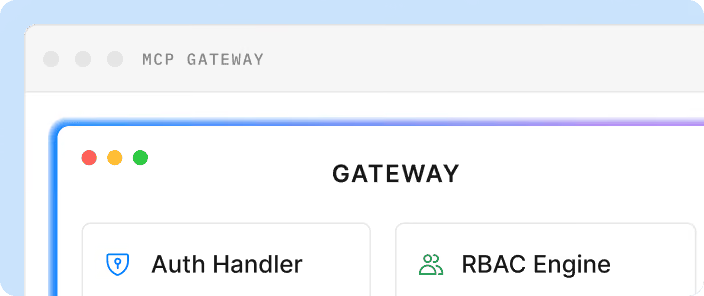
DigitalAPI's MCP Gateway converts standard APIs into MCP-ready endpoints with one click, making them accessible to AI agents through structured, spec-derived context. The documentation generated for human developers becomes the same context used by agents: no separate MCP documentation layer required.
API Documentation Generator: Tool Comparison
Choose your tool based on team size, gateway environment, and whether you need a standalone docs page or a full developer portal.
(scroll to view full table)
When to use a free open-source generator (Swagger UI, Redoc):
You have one to three APIs with a single spec file each. You need basic interactive docs with no custom branding. Your team can self-host and maintain the setup.
When to use a code-based generator (Swashbuckle, Springdoc):
Your team works code-first with no standalone spec file. Your APIs are built in a single framework. You want docs generated at build time from annotations.
When to use a traffic-based generator (Levo.ai):
You have legacy APIs with no spec or annotations. You need to reverse-engineer documentation from production traffic.
When to use a platform-based generator (DigitalAPI, ReadMe, Redocly):
You manage 10+ APIs across teams or gateways. You need versioning, access control, and custom branding. Developer onboarding speed is a metric your team tracks. Your ICP spans partners and enterprise consumers, not just internal developers.
The difference between Redocly and DigitalAPI is worth clarifying here. Redocly is a strong documentation-first platform built around a single gateway's OpenAPI spec. DigitalAPI is a control plane that sits above your existing gateways, ingesting specs from all of them and generating a unified developer portal on top. If you're running one gateway, both are viable. If you're running three, see how Redocly compares. Mintlify comparison is here.
Real-World Scenarios: API Documentation Generation in Practice
Scenario 1: A bank with four gateways and 60 undocumented APIs
A platform engineering team at a mid-size bank runs APIs across Apigee (for open banking), AWS API Gateway (for internal microservices), and a legacy MuleSoft instance (for core banking connectors). Roughly 40% of those APIs have no documentation. New developers onboard by asking colleagues, not by reading docs.
The correct generation approach: traffic-based generation to produce baseline specs for the undocumented APIs, then spec-based generation from there. But more than the generation method, the team needs a unified portal that surfaces all 60 APIs in one searchable catalog, not three separate portals with inconsistent formats.
DigitalAPI's API developer portal handles exactly this: ingesting specs from all connected gateways, generating documentation for APIs missing it, and presenting everything in one branded, searchable interface. Canara Bank uses this approach for their API estate.
Scenario 2: An insurtech company launching a partner API program
A product team at an insurance platform has built a well-documented set of APIs internally. Now they want to open those APIs to partners. The internal documentation format (Confluence pages, Swagger UI rendered locally) doesn't work for external consumption. Partners need branded docs, tiered access, sandbox testing, and the ability to generate credentials without contacting anyone.
The generation step is already complete: they have OpenAPI specs. What they need is a portal layer that takes those specs and turns them into a partner-facing experience with access control. Zurich Insurance uses this model on DigitalAPI.
Frequently Asked Questions
1. What is an API documentation generator?
A tool that auto-creates formatted API reference docs from an OpenAPI spec, code annotations, or live traffic capture.
An API documentation generator reads a structured source, typically an OpenAPI YAML or JSON file, and renders endpoint descriptions, parameter tables, request/response schemas, and authentication details without manual writing. Output is reference content only: endpoints, schemas, and auth flows. Conceptual guides and tutorials still require human writing. For a full walkthrough of the documentation process, see How to Document an API.
2. How do you auto-generate API documentation?
Feed an OpenAPI spec (YAML or JSON) into a generator like Swagger UI or DigitalAPI. It parses the spec and renders interactive docs.
Code-based generation uses framework plugins like Swashbuckle (.NET) or Springdoc (Java) to produce the spec at build time from annotations. Traffic-based generation captures live HTTP requests for legacy APIs with no spec file. For teams managing APIs across multiple gateways, DigitalAPI's API documentation solution ingests specs from all connected sources and generates a unified portal automatically.
3. What is the best free API documentation generator?
Swagger UI is the most widely adopted free option. It renders interactive docs from any OpenAPI spec with a basic Try-It console.
Redoc is a free alternative that produces clean documentation without a native Try-It console. For code-based generation, Swashbuckle (.NET) and Springdoc (Java) are free and framework-native. These tools work well for a single API with one spec file. For teams running multiple gateways or needing a branded portal with access control, a managed platform is the practical step up. See how platforms compare on the API developer portal guide.
4. Can AI generate API documentation?
Yes. AI writes endpoint descriptions, parameter explanations, and example payloads from your spec. Human review is still needed for accuracy.
AI-powered generation is now a standard feature across most major platforms rather than a differentiator. It handles boilerplate well but misses business context, edge cases, and the reasoning behind design decisions. The more specific and accurate your spec is, the more useful the AI output will be. DigitalAPI's API governance layer validates spec quality before generation runs, so AI descriptions start from a cleaner base.
5. What is the difference between an API documentation generator and a developer portal?
A generator produces reference content. A developer portal wraps it with search, access management, sandbox testing, and subscriptions.
A generator is a component of a portal, not a replacement for one. Using a generator alone is like having the product catalog without the store: developers can read the endpoints but can't test them, request access, or manage credentials without contacting your team. For the full picture of what a portal covers beyond reference docs, see what an API developer portal includes. For hands-on testing in a safe environment, the API sandboxing layer is what closes that gap.
The Bottom Line
API documentation generation is a solved problem at the single-API level. Swagger UI and a CI/CD pipeline get you most of the way there for one well-maintained spec.
The problem gets harder as the API estate grows: multiple gateways, missing specs, legacy APIs with no annotations, and a developer audience that now includes AI agents alongside human engineers. That's where a generator alone stops being enough and a managed platform starts being the rational choice.
The evaluation question in 2026 isn't "which generator produces the nicest HTML?" It's "does this tool keep docs accurate across all my sources, serve both human developers and AI agents, and reduce the documentation maintenance burden my team is currently carrying?"
If you're managing APIs across more than one gateway and documentation is already a team bottleneck, see DigitalAPI's API documentation approach and how it handles multi-source generation, AI-readiness, and portal delivery in a single platform.
Dhayalan Subramanian is Associate Director, Product Growth at DigitalAPI, where he leads go-to-market and product growth for the company’s multi-gateway API management platform. His work focuses on helping large enterprises and mid-market cloud companies consolidate APIs across AWS, Azure, Apigee, Kong, MuleSoft, and other gateways into a single control plane for governance, discovery, monetization, and agent consumption.
Dhayalan brings 14+ years of experience across product strategy, enterprise architecture, and engineering leadership. Earlier in his career, he held senior roles at Encora (as Associate Architect and Technical Manager), Mindtree (Technology Lead), Tech Mahindra (Technical Lead), and Primus Analytics, where he designed integration frameworks and delivered enterprise-grade digital platforms for global customers.
At DigitalAPI, he works directly with platform, integration, and developer experience leaders at Fortune 500 organizations to operationalize unified API catalogs, developer portals, and MCP-ready APIs. He writes regularly on API developer experience, API governance, and AI agent architectures.
One email a fortnight. Worth opening.
A short digest of what we're writing, what we're learning from customers, and the handful of links you'd actually want from us. No tracking pixels.

.avif)