




API Gateway Plugins: Unlock Your Gateway's Full Potential
API Gateway Plugins unlock your gateway's full potential. Centralize security, optimize performance, and streamline traffic management, transforming it into a powerful, agile control plane for your digital ecosystem.


TL;DR
1. API Gateway Plugins extend core gateway functions, turning it into a powerful control plane.
2. They centralize security, optimize performance, and simplify complex traffic management.
3. Key plugin types include authentication, rate limiting, transformation, monitoring, caching, and monetization.
4. Plugins are vital for consistent policy enforcement and enhanced resilience across your API ecosystem.
5. Choosing the right gateway with a rich plugin ecosystem is crucial for maximizing API infrastructure value.
Modern digital infrastructures hinge on the seamless, secure, and efficient flow of data, a task often orchestrated by the humble yet powerful API Gateway. While a gateway inherently provides crucial traffic management, its true transformative power often lies dormant, awaiting activation. This is where API Gateway Plugins step in, transcending the basic functionalities of routing and load balancing to imbue your gateway with sophisticated capabilities.
These modular extensions allow organizations to precisely tailor their API exposure, enhancing everything from stringent security protocols and granular access control to intricate traffic shaping and deep analytics. Embracing these plugins means not just managing APIs, but actively optimizing and fortifying your entire digital ecosystem, truly unlocking your gateway's full potential.
What are API Gateway Plugins?
An API gateway serves as the primary entry point for all API requests, managing basic traffic functions like routing and load balancing. Yet, its inherent capabilities can be vastly extended. This is precisely where API Gateway Plugins: Extending Gateway Capabilities become invaluable. These modular software components seamlessly integrate with your gateway, augmenting its core features without altering the gateway's fundamental code or your backend services.
They are specialized add-ons, installed to supercharge performance and expand the feature set, enabling the gateway to intercept, inspect, modify, and act upon API requests and responses at various stages, thereby transforming a standard gateway into a highly customizable control plane.
Why are API Gateway Plugins Essential?
The demand for robust, secure, and performant APIs is ever-increasing. Relying solely on basic gateway features or embedding complex logic within backend services introduces significant overhead and challenges. Plugins offer:
- Centralized Policy Enforcement: Consistently apply security, rate limiting, and data transformation policies at a single point, minimizing errors and simplifying API management policies.
- Enhanced Security: Provide advanced API security layers, including sophisticated authentication, authorization, and threat detection, protecting your backend.
- Improved Performance & Scalability: Features like caching and request throttling offload work, resulting in faster responses and better resource utilization, positively impacting API management cost.
- Accelerated Development: Externalizing common functionalities allows developers to focus on core business logic, speeding up development cycles.
- Operational Efficiency: Centralized logging, API monitoring, and analytics provide deep insights into usage and performance.
- Extending Gateway Capabilities: Fundamentally, plugins are about API Gateway Plugins: Extending Gateway Capabilities, allowing adaptation to unique business needs and integration with specialized tools.
Key Categories of API Gateway Plugins
API gateway plugins are categorized by their enhanced functionalities:
- Security & Access Control: Protect APIs with authentication, authorization, threat protection, and data privacy.
- Traffic Management: Control request flow, optimize performance, and ensure resilience via rate limiting, API throttling, and load balancing.
- Data Transformation & Protocol Mediation: Modify request/response payloads or bridge protocols for seamless integration.
- Monitoring & Analytics: Capture metrics, logs, and traces for API performance, usage, and error insights.
- Performance Optimization: Speed up responses and reduce backend load through caching and compression.
- Developer Experience & Monetization: Facilitate developer onboarding, enforce API monetization models, and integrate with billing.
- Custom Logic & Integration: Execute custom code or integrate with external systems for unique requirements.
Deep Dive into Essential Plugin Types
1. Authentication & Authorization Plugins
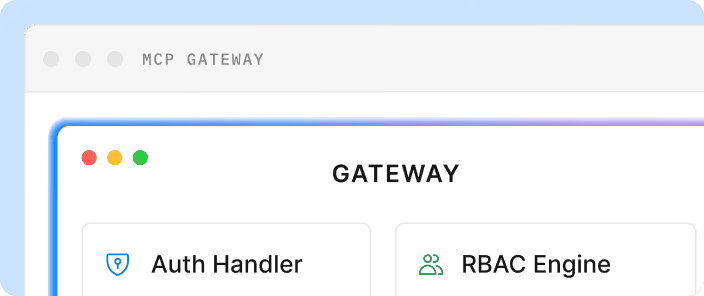
Securing APIs requires verifying client identity and permissions. API authentication and authorization plugins are critical for this. They handle JWT validation, OAuth 2.0 integration, API keys verification, Basic Authentication, Role-Based Access Control (RBAC), and IP restrictions. This centralizes security, offloads backend logic, enhances API gateway security, and simplifies policy management. For example, a plugin validates an OAuth token, extracts user roles, and grants access to specific sensitive resources.
2. Rate Limiting & Throttling Plugins
Uncontrolled traffic can overwhelm backend services. API rate limiting and throttling plugins manage inbound request volume. They restrict requests per time window, control overall traffic, allow temporary bursts, and apply per-consumer limits. These protect backends from overload and abuse, ensure fair usage, prevent API rate limit exceeded issues for critical clients, and maintain service availability. A public API, for instance, might enforce different request limits for unauthenticated users versus authenticated premium subscribers.
3. Request/Response Transformation Plugins
APIs often require payload or protocol adaptation. Transformation plugins modify requests before they reach the backend and responses before they're sent to the client. This includes header manipulation, payload transformation (e.g., XML to JSON), query parameter modification, URL rewriting, and protocol bridging. Benefits include decoupling clients from backend details, simplifying client development, enabling legacy system integration, and promoting API consistency. A mobile app might receive a simplified JSON response from a plugin, even if the backend returns a verbose XML.
4. Logging & Monitoring Plugins
Visibility into API traffic, performance, and errors is crucial. Logging and API monitoring plugins provide this observability. They handle access logging, error logging, metrics collection (latency, throughput), distributed tracing, and integration with observability platforms like Prometheus or Splunk. These features enable real-time visibility, aid troubleshooting, support auditing, and provide data for capacity planning and performance optimization, all vital for understanding overall API management cost.
5. Caching Plugins
To reduce latency and backend load, caching plugins store frequent API responses at the gateway or closer to the client. Functionalities include response caching, conditional caching using ETag/Last-Modified headers, cache invalidation mechanisms, and integration with distributed caching systems like Redis. This significantly reduces API response times, decreases load on backend services, and improves overall API scalability and user experience. A product catalog API, for example, can cache static product details for minutes, drastically boosting performance.
6. Circuit Breaker & Retry Plugins
In distributed systems, service failures are inevitable. Circuit breaker and retry plugins implement resilience patterns to prevent cascading failures. A circuit breaker monitors service health; if error rates are high, it "opens," blocking further requests to the failing service, allowing it to recover. Retry plugins automatically reattempt failed requests with backoff. These enhance system resilience, isolate faulty services, and improve service availability. For instance, if a payment service is unresponsive, a circuit breaker returns an immediate "service unavailable" message, preventing a backlog of failed transactions.
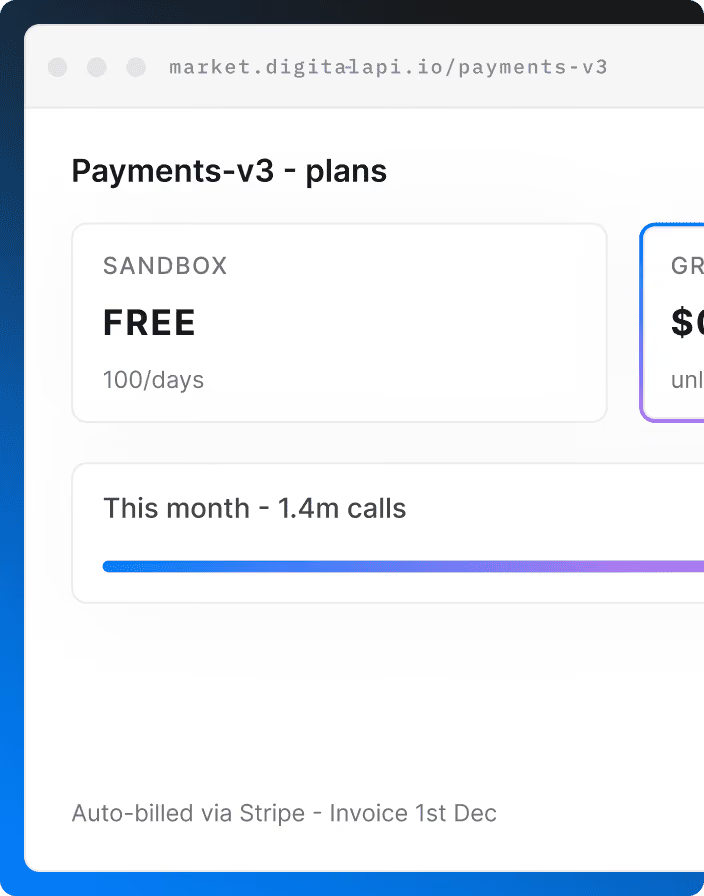
7. API Monetization Plugins
For organizations monetizing APIs, API monetization strategies require robust tracking and billing. Plugins provide usage tracking, enforce tiered pricing models, integrate with external billing systems, manage usage quotas, and offer analytics on consumption and revenue. These enable new business models, generate revenue, provide usage transparency to consumers, and automate billing, crucial for considering API as a product. A mapping API can track calls per user, charging based on a tiered model and integrating with subscription management.
How Plugins Enhance API Lifecycle Management
Plugins are integral to the entire API lifecycle management. During design and development, they abstract common functionalities, accelerating creation. In deployment, they ensure consistent policies. For maintenance, they manage API versioning and deprecation, gracefully handling traffic redirects. When an API is retired, plugins ensure smooth transitions, returning appropriate status codes. They act as enforcement mechanisms for API management policies, translating design decisions into operational reality across all stages.
Choosing the Right API Gateway and its Plugin Ecosystem
The effectiveness of API Gateway Plugins: Extending Gateway Capabilities hinges on the chosen API gateway and its plugin ecosystem. Consider open-source options like Kong versus commercial ones such as Apigee, Mulesoft, or top AWS API Gateway alternatives. Evaluate extensibility for custom plugins, community support, performance, and scalability. A API gateway comparison is essential to find a platform whose plugin capabilities align with your specific needs and ease of management.
Best Practices for Deploying and Managing Plugins
Effective plugin management is crucial for unlocking your gateway's full potential:
- Define Clear API Governance Policies: Establish clear rules on which policies are gateway-enforced.
- Modular Design: Create single-purpose, modular custom plugins for easy development and maintenance.
- Thorough Testing: Rigorously test plugins in staging for performance, edge cases, and failures.
- Version Control: Manage plugins as code within version control, integrating deployment into CI/CD.
- Centralized Configuration: Use declarative APIs or configuration-as-code for consistent plugin configuration.
- Granular Application: Apply plugins selectively to specific APIs or routes, avoiding global overhead.
- Monitor Plugin Performance: Continuously track plugin metrics to ensure efficiency.
- Regular Audits: Periodically review plugins for relevance, updates, and security.
The Future of API Gateway Plugins
The future of API gateway plugins is intertwined with microservices, serverless, and AI. Expect more intelligent, context-aware, and dynamically adaptive plugins. AI/ML will enhance threat detection and API throttling, and enable proactive anomaly detection. As API gateways and service meshes converge, plugins will facilitate seamless integration. Serverless and edge computing will see plugins become critical closer to users for minimal latency. Declarative and programmable gateways will simplify complex plugin-driven policy deployment, and standardization efforts may emerge for greater portability.
Conclusion
The API gateway transcends a simple traffic cop; it's a strategic control point. By embracing API Gateway Plugins: Extending Gateway Capabilities, organizations transform their gateways into powerful, customized engines driving security, performance, and agility. From advanced authentication to intelligent rate limiting, and innovative monetization, plugins unlock new dimensions of potential. They empower businesses to build resilient, scalable, and adaptable digital ecosystems, ensuring APIs remain competitive. Investing in a robust plugin strategy is not just an enhancement; it's a fundamental step towards maximizing your API infrastructure's value and future-proofing your digital presence.
FAQs
1. What exactly is an API Gateway Plugin?
An API Gateway Plugin is a modular software component that extends the core functionalities of an API gateway. It allows you to add specific features like security, traffic management, or data transformation to your APIs without modifying backend services or the gateway's core code. Think of it as an add-on that enhances your gateway's capabilities significantly.
2. Why should I use plugins instead of implementing features in my backend services?
Using plugins centralizes policy enforcement, leading to greater consistency and easier management. It offloads non-business logic from your backend services, allowing them to focus on core functionalities, improving their performance and reducing their complexity. This also makes your architecture more flexible and easier to evolve, supporting crucial aspects of API lifecycle management.
3. What are the most common types of API Gateway Plugins?
The most common types include authentication and authorization (e.g., JWT, OAuth, API Key validation), rate limiting and throttling, request and response transformation, logging and monitoring, caching, and circuit breakers. Many gateways also offer plugins for API monetization models and custom logic execution to meet specific business needs.
4. Are API Gateway Plugins specific to certain gateways?
Yes, most API gateway plugins are developed for a specific gateway (e.g., Kong plugins for Kong Gateway, Apigee policies for Apigee). While the types of functionalities are similar across gateways, the implementation details and APIs for developing them are usually unique to each platform. When making a decision, it’s useful to look at API gateway comparison hubs.
5. How do plugins contribute to API security?
Plugins significantly enhance API security by centralizing and enforcing critical security policies at the gateway level. They handle tasks like authenticating client identities (API authentication), authorizing access based on roles, validating incoming requests to prevent injection attacks, and enforcing IP restrictions. This robust first line of defense protects your backend services effectively.
Dhayalan Subramanian is Associate Director, Product Growth at DigitalAPI, where he leads go-to-market and product growth for the company’s multi-gateway API management platform. His work focuses on helping large enterprises and mid-market cloud companies consolidate APIs across AWS, Azure, Apigee, Kong, MuleSoft, and other gateways into a single control plane for governance, discovery, monetization, and agent consumption.
Dhayalan brings 14+ years of experience across product strategy, enterprise architecture, and engineering leadership. Earlier in his career, he held senior roles at Encora (as Associate Architect and Technical Manager), Mindtree (Technology Lead), Tech Mahindra (Technical Lead), and Primus Analytics, where he designed integration frameworks and delivered enterprise-grade digital platforms for global customers.
At DigitalAPI, he works directly with platform, integration, and developer experience leaders at Fortune 500 organizations to operationalize unified API catalogs, developer portals, and MCP-ready APIs. He writes regularly on API developer experience, API governance, and AI agent architectures.
One email a fortnight. Worth opening.
A short digest of what we're writing, what we're learning from customers, and the handful of links you'd actually want from us. No tracking pixels.

.avif)